Archive
Ephemeris: 06/30/2026 – Previewing the skies of July
This is Bob Moler with Ephemeris for International Asteroid Day, Tuesday, June 30th, the 118th anniversary of the Tunguska event in Siberia. Today the Sun will be up for 15 hours and 31 minutes, setting at 9:32, and it will rise tomorrow at 6:01. The Moon, 1 day past full, will rise at 10:31 this evening.
Let’s preview July’s skies. The Sun, having reached its northern solstice, is beginning to slide southward again, at first imperceptibly, then with greater speed. The daylight hours will decrease from 15 hours and 30 minutes tomorrow to 14 hours 41 minutes at month’s end. The daylight hours will be slightly shorter south of Interlochen, and slightly longer to the north. The altitude of the Sun at local noon, when the Sun is due south, will decrease from 68 degrees today to 63 degrees at month’s end. The Sun will be a degree lower in the Straits area. Despite the warmth, the Earth will reach its greatest distance from the Sun next Monday the 6th.
The astronomical event times given in this blog are for the Traverse City/Interlochen area of Michigan (Lat 44.7° N, Long 85.7° W; EDT, UT – 4 hours) unless stated otherwise. Times will be different for other locations.
Addendum
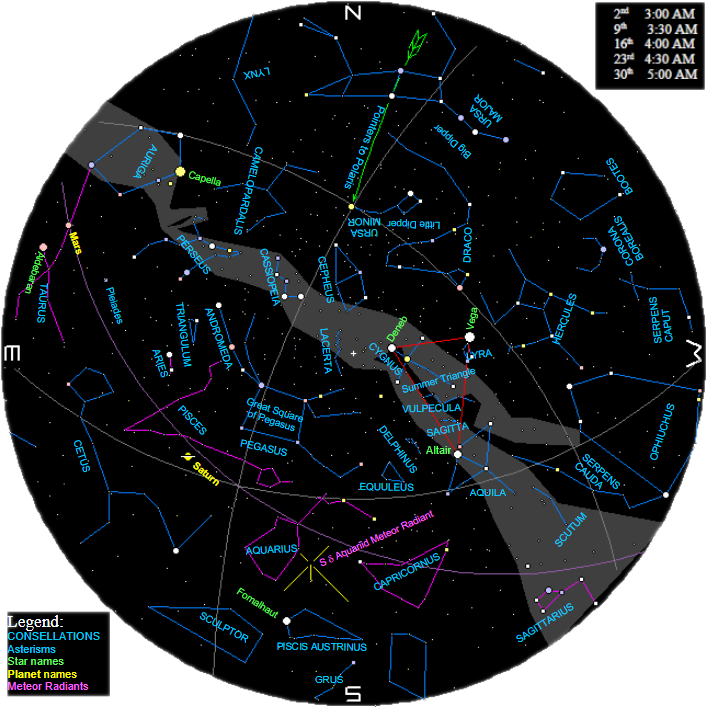
July Evening Star Chart
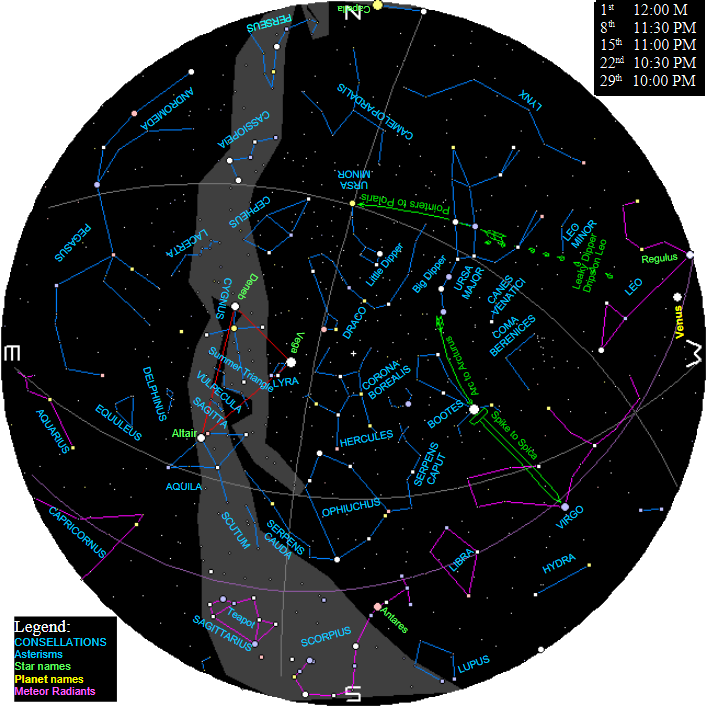
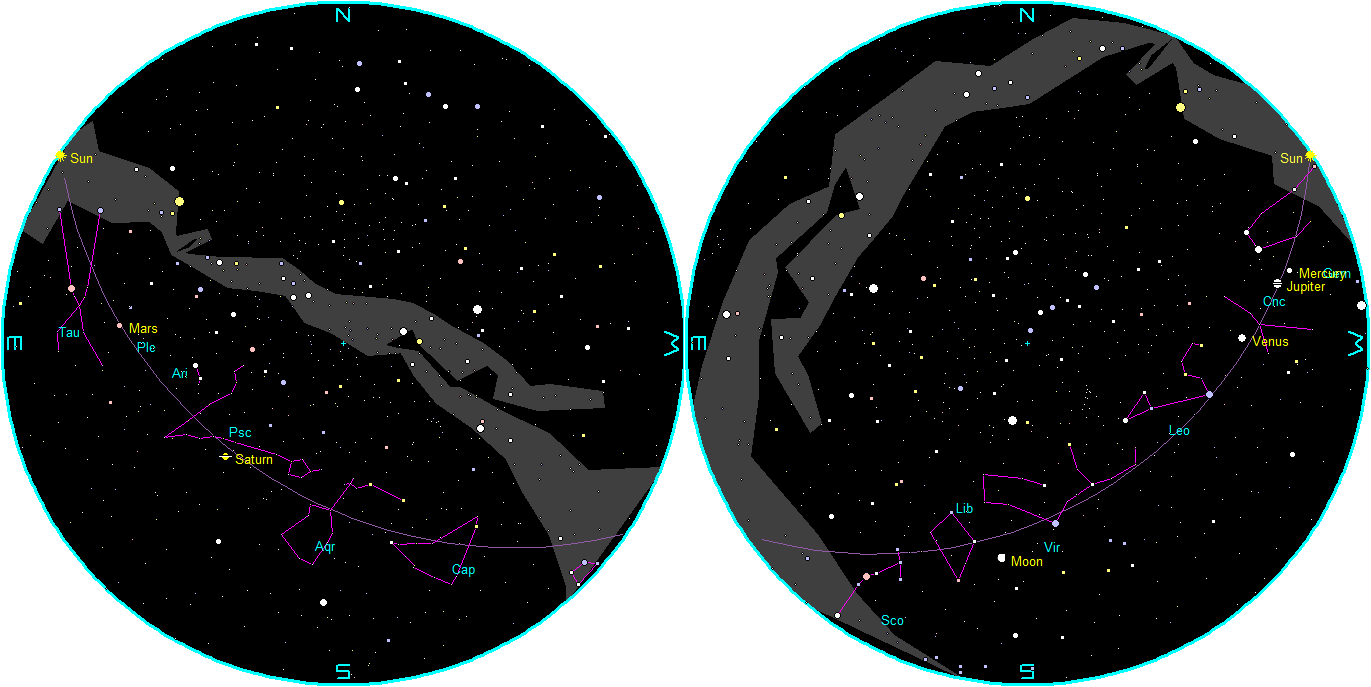
The planets and stars are plotted for the 15th at 11 PM EDT in the evening and 4 AM on the 16th for the morning chart. These are the chart times. Note that Interlochen/Traverse City is located approximately 45 minutes behind our time meridian, West 75° longitude. (An hour 45 minutes behind our daylight saving time meridian during EDT). To duplicate the star positions on a planisphere you may have to set it to 1 hour 45 minutes earlier than the current time.
Note, the chart times of 11 PM and 4 AM are for the 15th & 16th respectively. For each week before these dates, add ½ hour (28 minutes if you’re picky). For each week after the 15th, subtract ½ hour, or 28 minutes. The planet positions are updated each Wednesday on this blog.
July Morning Star Chart
Twilight Limits, Nautical and Astronomical
| EDT | |||||||
| Morning | Twilight | Evening | Twilight | Dark | Night | Moon | |
| Date | Astro. | Nautical | Nautical | Astro. | Start | End | Illum. |
| 2026-07-01 | 3h35m | 4h37m | 23h00m | 0h03m | – | – | 96% |
| 2026-07-02 | 3h36m | 4h38m | 22h59m | 0h02m | – | – | 91% |
| 2026-07-03 | 3h37m | 4h39m | 22h59m | 0h01m | – | – | 84% |
| 2026-07-04 | 3h38m | 4h40m | 22h59m | 0h00m | – | – | 76% |
| 2026-07-05 | 3h39m | 4h41m | 22h58m | 23h59m | 23h59m | 0h06m | 67% |
| 2026-07-06 | 3h41m | 4h42m | 22h57m | 23h58m | 23h58m | 0h24m | 57% |
| 2026-07-07 | 3h42m | 4h42m | 22h57m | 23h57m | 23h57m | 0h42m | 46% |
| 2026-07-08 | 3h44m | 4h44m | 22h56m | 23h56m | 23h56m | 1h02m | 35% |
| 2026-07-09 | 3h45m | 4h45m | 22h55m | 23h55m | 23h55m | 1h27m | 24% |
| 2026-07-10 | 3h47m | 4h46m | 22h55m | 23h54m | 23h54m | 1h57m | 15% |
| 2026-07-11 | 3h48m | 4h47m | 22h54m | 23h52m | 23h52m | 2h38m | 7% |
| 2026-07-12 | 3h50m | 4h48m | 22h53m | 23h51m | 23h51m | 3h33m | 2% |
| 2026-07-13 | 3h51m | 4h49m | 22h52m | 23h49m | 23h49m | 3h51m | 0% |
| 2026-07-14 | 3h53m | 4h50m | 22h51m | 23h48m | 23h48m | 3h53m | 1% |
| 2026-07-15 | 3h55m | 4h51m | 22h50m | 23h46m | 23h46m | 3h55m | 5% |
| 2026-07-16 | 3h57m | 4h53m | 22h49m | 23h45m | 23h45m | 3h57m | 11% |
| 2026-07-17 | 3h58m | 4h54m | 22h48m | 23h43m | 23h43m | 3h58m | 19% |
| 2026-07-18 | 4h00m | 4h55m | 22h47m | 23h42m | 23h42m | 4h00m | 28% |
| 2026-07-19 | 4h02m | 4h57m | 22h45m | 23h40m | 23h58m | 4h02m | 38% |
| 2026-07-20 | 4h04m | 4h58m | 22h44m | 23h38m | – | 4h04m | 48% |
| 2026-07-21 | 4h06m | 4h59m | 22h43m | 23h36m | 0h18m | 4h06m | 58% |
| 2026-07-22 | 4h08m | 5h01m | 22h42m | 23h35m | 0h39m | 4h08m | 67% |
| 2026-07-23 | 4h10m | 5h02m | 22h40m | 23h33m | 1h05m | 4h10m | 76% |
| 2026-07-24 | 4h11m | 5h04m | 22h39m | 23h31m | 1h37m | 4h11m | 83% |
| 2026-07-25 | 4h13m | 5h05m | 22h37m | 23h29m | 2h16m | 4h13m | 90% |
| 2026-07-26 | 4h15m | 5h06m | 22h36m | 23h27m | 3h04m | 4h15m | 95% |
| 2026-07-27 | 4h17m | 5h08m | 22h35m | 23h25m | 4h01m | 4h17m | 98% |
| 2026-07-28 | 4h19m | 5h09m | 22h33m | 23h23m | – | – | 100% |
| 2026-07-29 | 4h21m | 5h11m | 22h32m | 23h21m | – | – | 100% |
| 2026-07-30 | 4h23m | 5h12m | 22h30m | 23h19m | – | – | 97% |
| 2026-07-31 | 4h25m | 5h14m | 22h28m | 23h17m | – | – | 93% |
Twilight calendar was generated using Cartes du Ciel (Sky Charts).
See my blog post: Twilight Zone for the definitions of the different periods of twilight here: https://bobmoler.wordpress.com/2018/09/27/.
NASA Calendar of Planetary Events
Jul  1  We            Venus: 41.1° E
     4  Sa   3:51 AM  Moon Ascending Node
     6  Mo  10:59 AM  Aphelion: 1.0166 AU
     7  Tu   3:29 PM  Last Quarter
     9  Th  10:36 AM  Venus-Regulus: 1° N
    10  Fr   6:54 PM  Moon-Pleiades: 1.1° S
    12  Su   9:17 AM  Mars-Aldebaran: 5.3° N
    12  Su  11:18 AM  Moon North Dec.: 28° N
    12  Su   9:24 PM  Mercury Inferior Conjunction
    13  Mo   3:50 AM  Moon Perigee: 359100 km
    14  Tu   5:43 AM  New Moon
    16  Th   8:07 PM  Moon-Regulus: 0.5° N
    16  Th   8:27 PM  Moon Descending Node
    17  Fr  12:31 PM  Moon-Venus: 2.1° N
    20  Mo  11:21 PM  Moon-Spica: 2.5° N
    21  Tu   7:06 AM  First Quarter
    24  Fr   5:00 PM  Moon-Antares: 0.6° N
    25  Sa  12:45 PM  Moon Apogee: 405500 km
    25  Sa  11:56 PM  Moon South Dec.: 28.1° S
    28  Tu   6:02 AM  Delta Aquarid Shower: ZHR = 20
    29  We   8:28 AM  Jupiter Conjunction
    29  We  10:36 AM  Full Moon
    31  Fr   7:54 AM  Moon Ascending Node
All event times are given for UTC-4:00 Eastern Daylight Saving Time thereafter.
Sky Events Calendar by Fred Espenak and Sumit Dutta (NASA’s GSFC),
http://eclipse.gsfc.nasa.gov/SKYCAL/SKYCAL.html
If you go to the above site you can print out a list like the above for the entire year or calendar pages for your time zone.
Note that the site is now kept up for archival purposes. Fred Espenak retired from NASA several years ago and has his own site, AstroPixels, which contain the same information: http://astropixels.com/almanac/almanac.html. However, it uses standard time all year.
Fred passed away a year ago, on June 1, 2025. RIP.
Sun and Moon Rising and Setting Events
LU               Ephemeris of Sky Events for Interlochen/TC
July, 2026    Local time zone: EDT
+-----------------------------------------------------------------------+
| DATE |  SUN     SUN  DAYLIGHT|   TWILIGHT*    |MOON  RISE OR    ILLUM |
|      |  RISE    SET    HOURS |  END    START  |PHASE SET** TIME FRACTN|
+=======================================================================+
|Wed  1| 06:01a  09:32p  15:30 | 10:57p  04:35a |      Rise 11:01p   96%|
|Thu  2| 06:01a  09:31p  15:30 | 10:56p  04:36a |      Rise 11:26p   92%|
|Fri  3| 06:02a  09:31p  15:29 | 10:56p  04:37a |      Rise 11:47p   86%|
|Sat  4| 06:02a  09:31p  15:28 | 10:55p  04:38a |      Rise 12:05a   78%|
+------+-----------------------+----------------+-----------------------+
|Sun  5| 06:03a  09:30p  15:27 | 10:55p  04:38a |      Rise 12:23a   69%|
|Mon  6| 06:04a  09:30p  15:26 | 10:54p  04:39a |      Rise 12:42a   59%|
|Tue  7| 06:05a  09:30p  15:25 | 10:54p  04:40a |L Qtr Rise 01:02a   48%|
|Wed  8| 06:05a  09:29p  15:23 | 10:53p  04:41a |      Rise 01:26a   37%|
|Thu  9| 06:06a  09:29p  15:22 | 10:52p  04:42a |      Rise 01:57a   26%|
|Fri 10| 06:07a  09:28p  15:21 | 10:51p  04:43a |      Rise 02:38a   17%|
|Sat 11| 06:08a  09:28p  15:20 | 10:50p  04:45a |      Rise 03:33a    9%|
+------+-----------------------+----------------+-----------------------+
|Sun 12| 06:08a  09:27p  15:18 | 10:50p  04:46a |      Rise 04:43a    3%|
|Mon 13| 06:09a  09:26p  15:17 | 10:49p  04:47a |      Rise 06:04a    0%|
|Tue 14| 06:10a  09:26p  15:15 | 10:48p  04:48a |New   Set  10:04p    1%|
|Wed 15| 06:11a  09:25p  15:13 | 10:47p  04:49a |      Set  10:35p    4%|
|Thu 16| 06:12a  09:24p  15:12 | 10:45p  04:50a |      Set  10:59p    9%|
|Fri 17| 06:13a  09:24p  15:10 | 10:44p  04:52a |      Set  11:20p   17%|
|Sat 18| 06:14a  09:23p  15:08 | 10:43p  04:53a |      Set  11:39p   26%|
+------+-----------------------+----------------+-----------------------+
|Sun 19| 06:15a  09:22p  15:07 | 10:42p  04:54a |      Set  11:58p   35%|
|Mon 20| 06:16a  09:21p  15:05 | 10:41p  04:56a |      Set  12:17a   45%|
|Tue 21| 06:17a  09:20p  15:03 | 10:39p  04:57a |F Qtr Set  12:39a   55%|
|Wed 22| 06:18a  09:19p  15:01 | 10:38p  04:58a |      Set  01:04a   65%|
|Thu 23| 06:19a  09:18p  14:59 | 10:37p  05:00a |      Set  01:36a   74%|
|Fri 24| 06:20a  09:17p  14:57 | 10:35p  05:01a |      Set  02:15a   81%|
|Sat 25| 06:21a  09:16p  14:55 | 10:34p  05:03a |      Set  03:03a   88%|
+------+-----------------------+----------------+-----------------------+
|Sun 26| 06:22a  09:15p  14:52 | 10:33p  05:04a |      Set  04:00a   94%|
|Mon 27| 06:23a  09:14p  14:50 | 10:31p  05:06a |      Set  05:04a   97%|
|Tue 28| 06:24a  09:13p  14:48 | 10:30p  05:07a |      Set  06:11a  100%|
|Wed 29| 06:25a  09:12p  14:46 | 10:28p  05:08a |Full  Rise 09:30p  100%|
|Thu 30| 06:26a  09:10p  14:44 | 10:26p  05:10a |      Rise 09:52p   98%|
|Fri 31| 06:27a  09:09p  14:41 | 10:25p  05:11a |      Rise 10:12p   94%|
+-----------------------------------------------------------------------+
* Nautical Twilight
** Moonrise or moonset, whichever occurs between sunset and sunrise
Generated using my LookingUp for DOS app.
Ephemeris: 06/29/2026 – Red stars large and small
This is Ephemeris for Monday, June 29th. Today the Sun will be up for 15 hours and 32 minutes, setting at 9:32, and it will rise tomorrow at 6:00. The Moon, at full today, will rise at 9:53 this evening.
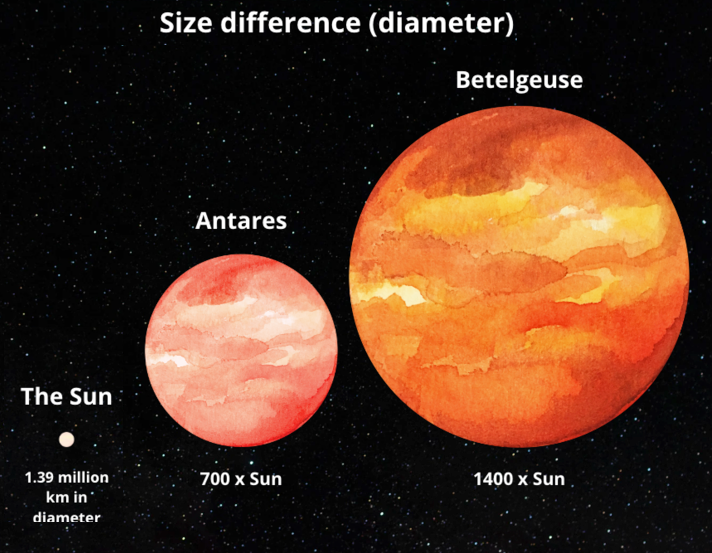
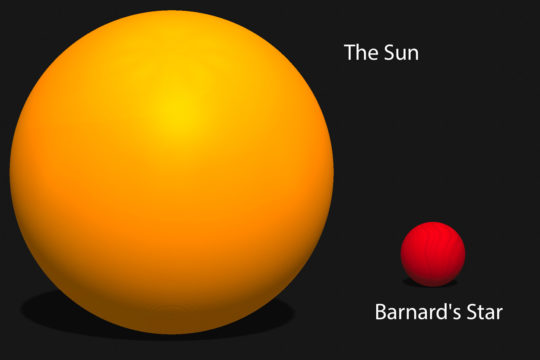
There are two kinds of red stars very bright ones and very dim ones. The bright red ones are very few. One of them in the evening sky now is Antares in the heart of Scorpius the scorpion. Another one is in the winter sky and the most famous red giant of all, Betelgeuse in the shoulder of Orion the hunter. These are giant stars have exhausted the hydrogen in their cores to produce helium and are working on helium or even heavier elements fusing them to still heavier elements at even higher temperatures to keep them alive, but since they are working on the ash of the previous reaction, they won’t last very long, and the star dies, possibly cataclysmically. The higher internal heat bloats the star to be, huge, making its outer layers are actually cooler.
The astronomical event times given in this blog are for the Traverse City/Interlochen area of Michigan (Lat 44.7° N, Long 85.7° W; EDT, UT – 4 hours) unless stated otherwise. Times will be different for other locations.
Addendum
Ephemeris: 06/26/2026 – How do we know so much about those points of lights in the sky?
This is Ephemeris for Friday, June 26th. Today the Sun will be up for 15 hours and 33 minutes, setting at 9:32, and it will rise tomorrow at 5:59. The Moon, 3 days before full, will set at 3:37 tomorrow morning.
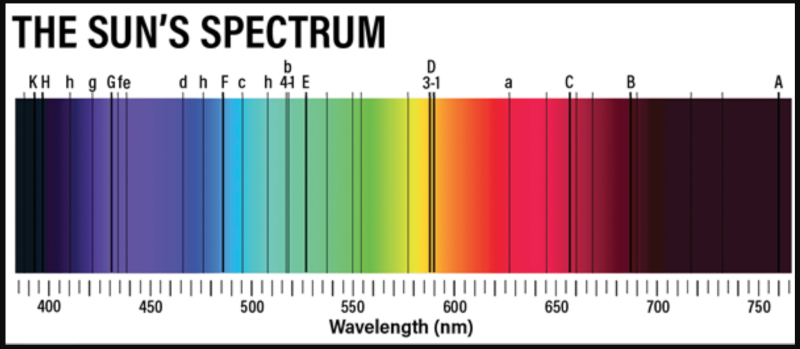
All but a handful of stars are mere points in even our largest telescopes. How do we know so much about them then? The reason is the science of spectroscopy, breaking down light into its constituent colors where color equals frequency or the energy of the light. Isaac Newton was the first to discover that by passing white light through a prism it turned into a rainbow of colors that the colors were actually combined within the white light. Passing sunlight through a vertical slit and smearing the light horizontally with the prism into its constituent colors, many dark vertical lines within that spectrum of colors appear. They turned out to be the fingerprints of the elements within the atmospheres of the stars, and that is just the beginning.
The astronomical event times given in this blog are for the Traverse City/Interlochen area of Michigan (Lat 44.7° N, Long 85.7° W; EDT, UT – 4 hours) unless stated otherwise. Times will be different for other locations.
Addendum
Ephemeris: 06/25/2026 – The color of stars
This is Ephemeris for Thursday, June 25th. Today the Sun will be up for 15 hours and 34 minutes, setting at 9:32, and it will rise tomorrow at 5:58. The Moon, halfway from first quarter to full, will set at 3:03 tomorrow morning.
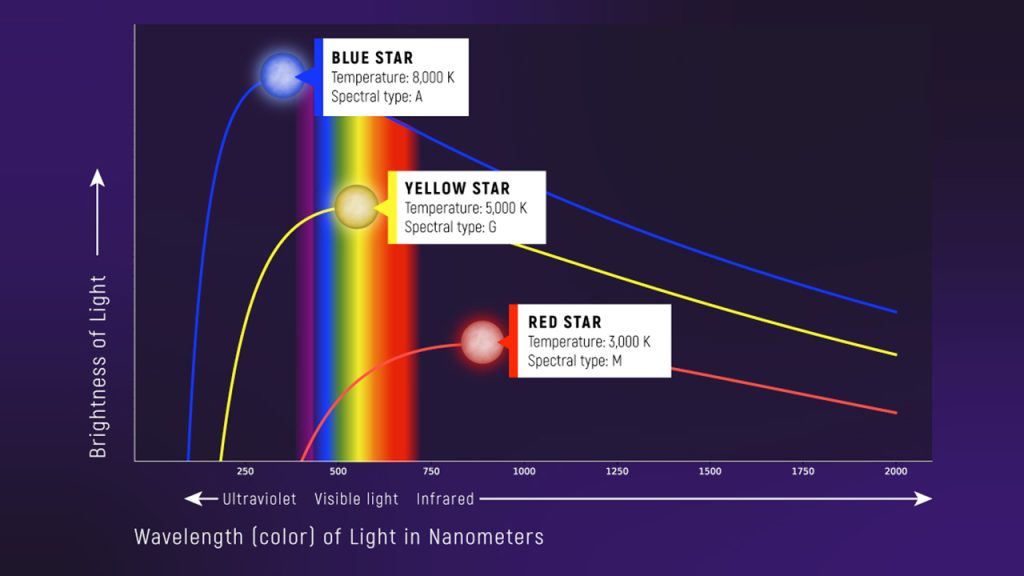
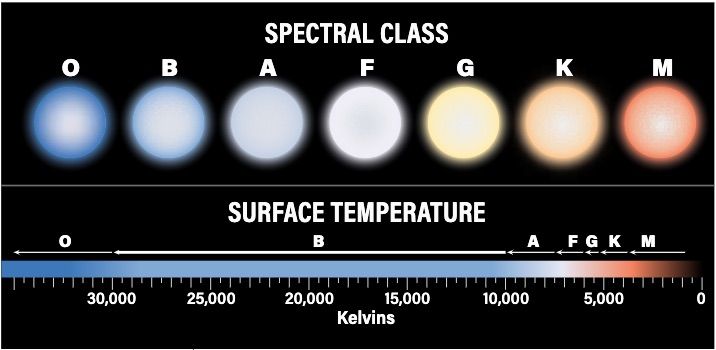
Looking out at the night sky casually, the first impression is that the stars all appear to be white. Closer inspection shows that some appear with tinges of red or orange or maybe yellow while other stars have a bluish cast to them. The color of stars is due to their surface temperature which physicists call black body radiation. A rainbow is a spectrum of colors from red through orange yellow green blue and violet. These colors represent the different wavelengths of light. The peak wavelength determines the star’s surface temperature. The Sun’s in the green in the middle of our visual field. Cooler stars have their peak in the red, while hotter stars have their peak output to the blue end of the spectrum.
The astronomical event times given in this blog are for the Traverse City/Interlochen area of Michigan (Lat 44.7° N, Long 85.7° W; EDT, UT – 4 hours) unless stated otherwise. Times will be different for other locations.
Addendum

Ephemeris: 06/24/2026 – Where are the naked-eye planets this week?
This is Ephemeris for Wednesday, June 24th. Today the Sun will be up for 15 hours and 34 minutes, setting at 9:32, and it will rise tomorrow at 5:58. The Moon, 3 days past first quarter, will set at 2:36 tomorrow morning.
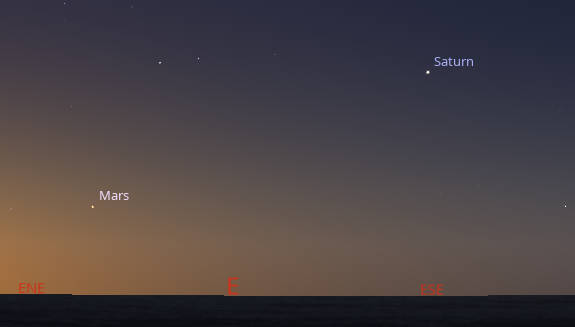
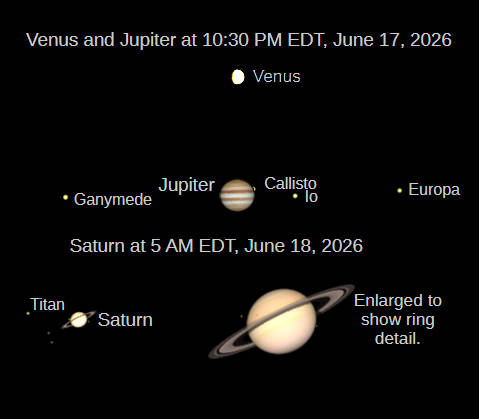
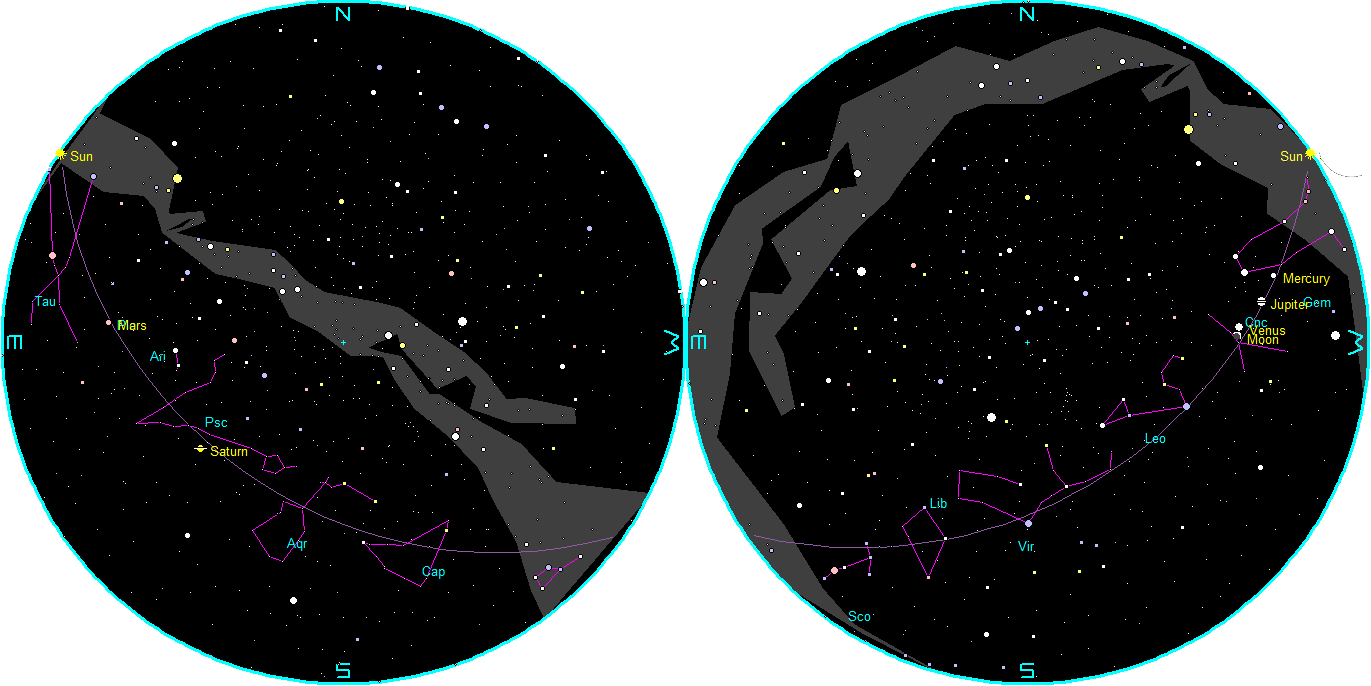
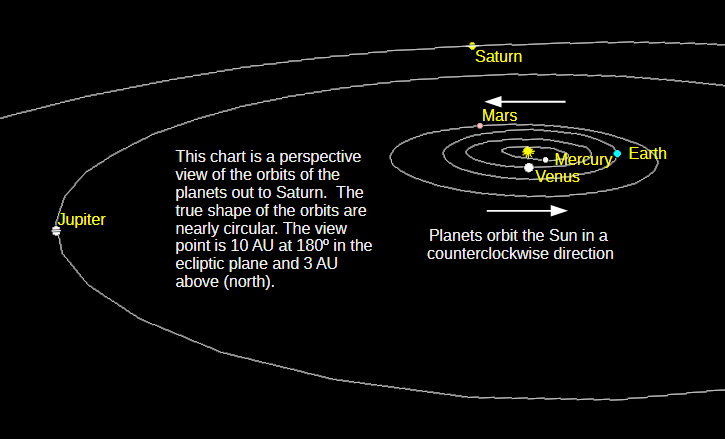
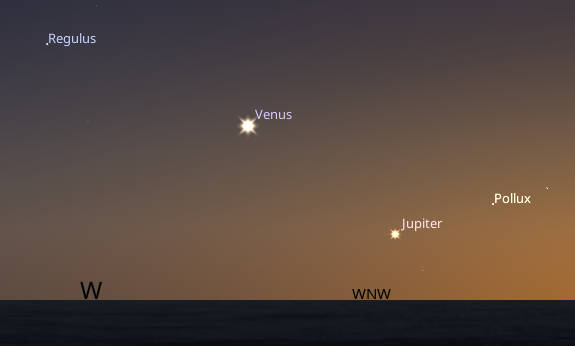
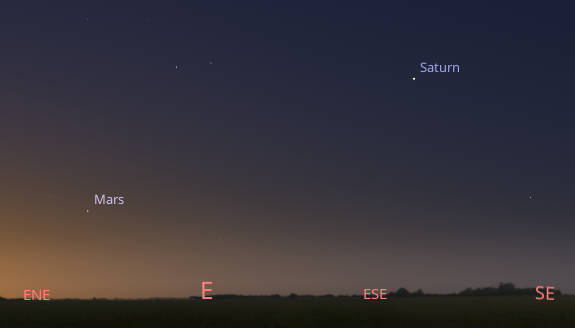
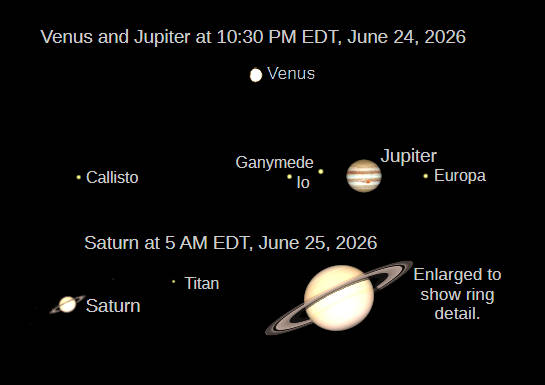
Let’s take our weekly look at the whereabouts of the naked-eye planets. By 10:30 PM tonight, nearly an hour after sunset, Venus and Jupiter are seen in the western sky, with Jupiter below and right of the brighter Venus. Mercury, though being just above the horizon at that time, is completely overcome by the twilight. A telescope will show a very tiny gibbous disc of Venus, because it is still pretty much beyond the Sun, 102 million miles (164 million kilometers) away from us. Over the next 4 months it will be moving closer to us and becoming much larger. In the morning, Saturn will rise at 1:52 AM, followed by dimmer Mars nearly 2 hours later. The Earth is now chasing down Mars, and soon the launch window will open to send spacecraft to the Red Planet.
The astronomical event times given in this blog are for the Traverse City/Interlochen area of Michigan (Lat 44.7° N, Long 85.7° W; EDT, UT – 4 hours) unless stated otherwise. Times will be different for other locations.
Addendum
Ephemeris: 06/23/2026 – How the Sun sizes up to other stars
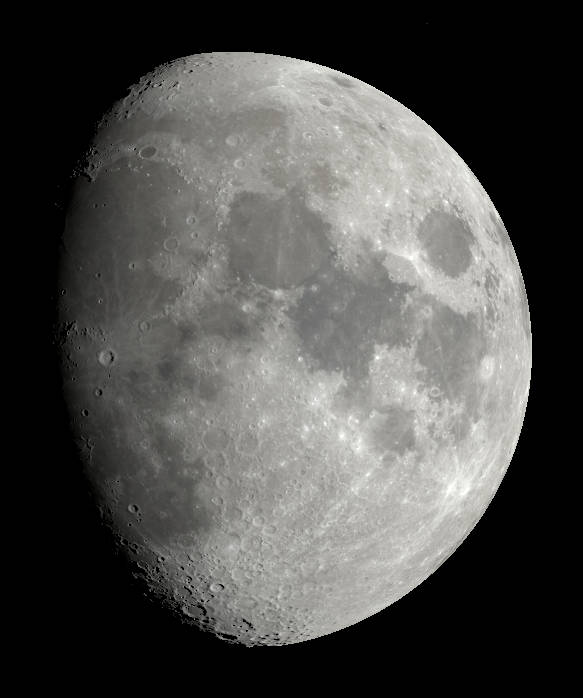
This is Ephemeris for Tuesday, June 23rd. Today the Sun will be up for 15 hours and 34 minutes, setting at 9:32, and it will rise tomorrow at 5:58. The Moon, 2 days past first quarter, will set at 2:13 tomorrow morning.
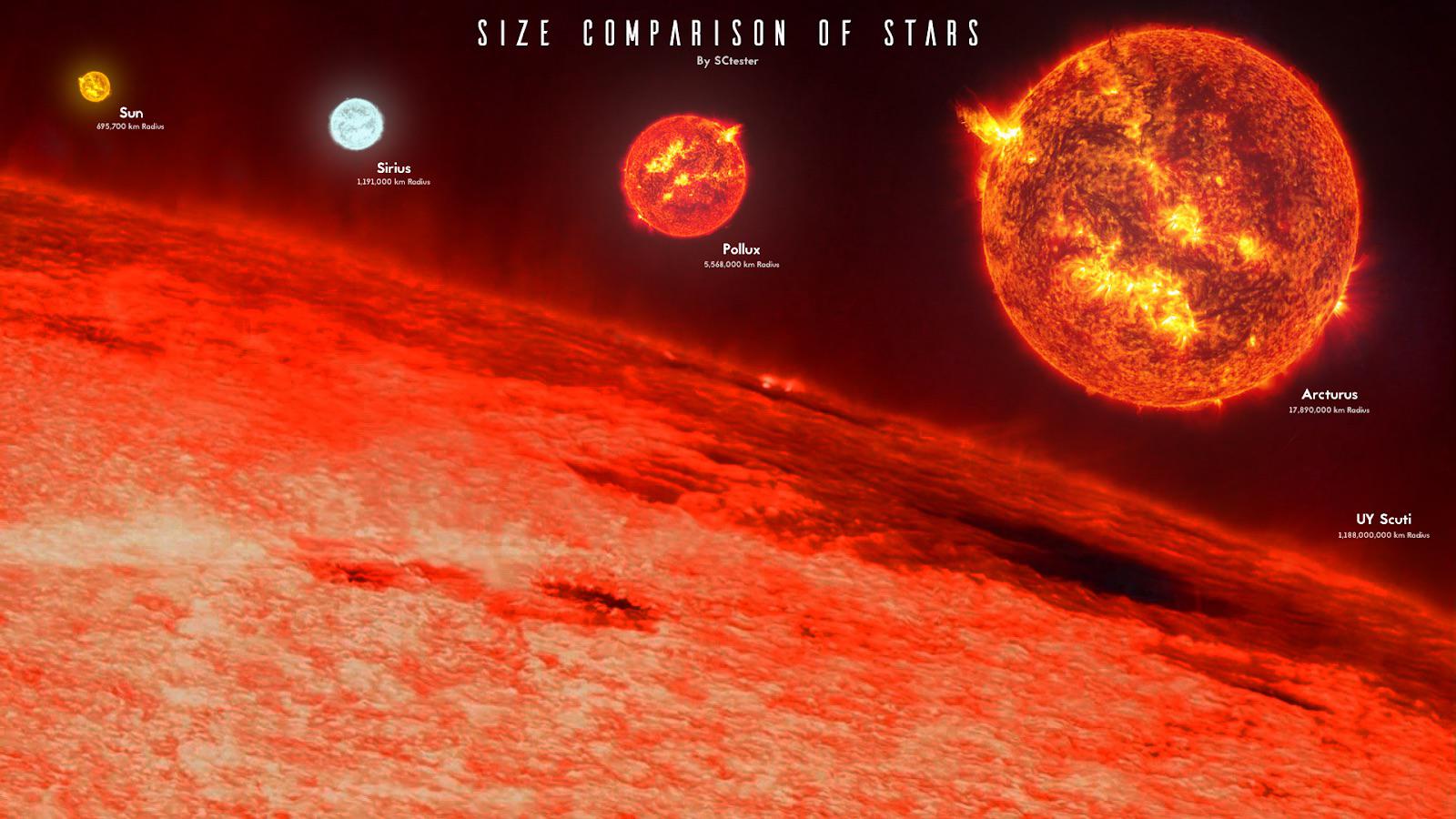
Stars big and small, where does the Sun rank? It depends on the criteria. As far as mass goes, it’s pretty much in the middle. One can’t get stars much more than 20 times the mass of the Sun stars or stars less than a 10th the mass of the sun. As far as brightness goes, there are stars 100,000 times brighter than the sun and stars hundreds of times dimmer. All the stars that you can see with the naked eye, with very few exceptions, are all brighter than the sun intrinsically. As far as size goes from the largest and smallest, the sun ranks near the bottom, in a range from 1,000% down to 15% the sun’s diameter. Don’t feel bad about the sun’s ranking. Stars like the sun in mass, which determines those other qualities, live long enough for life like us to evolve.
The astronomical event times given in this blog are for the Traverse City/Interlochen area of Michigan (Lat 44.7° N, Long 85.7° W; EDT, UT – 4 hours) unless stated otherwise. Times will be different for other locations.
Addendum
Ephemeris: 06/22/2026 – Will SpaceX and Blue Origin be ready for Artemis 3?
This is Ephemeris for Monday, June 22nd. Today the Sun will be up for 15 hours and 34 minutes, setting at 9:32, and it will rise tomorrow at 5:57. The Moon, 1 day past first quarter, will set at 1:53 tomorrow morning.
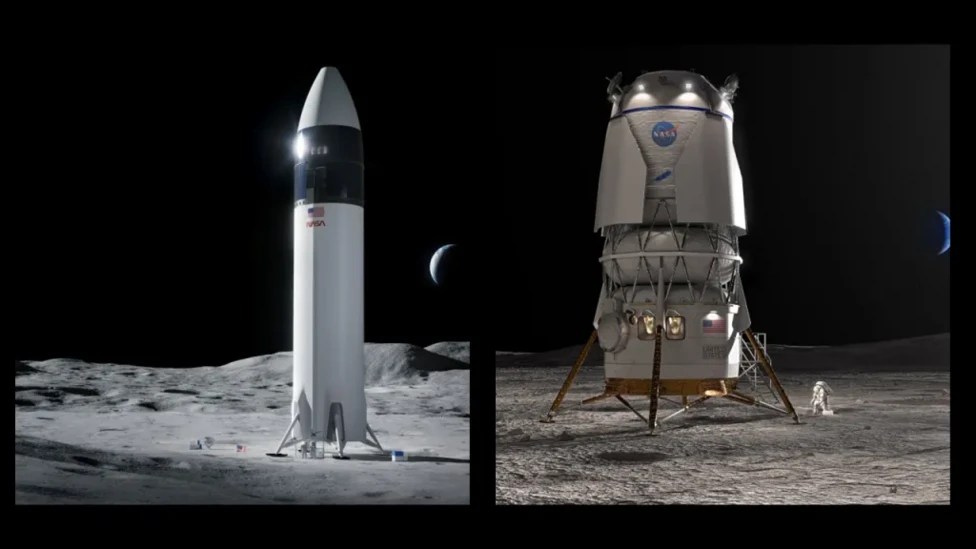
NASA and it’s partners SpaceX and Blue Origin are having problems on their way back to the Moon. On April 28th, Blue Origin’s New Glenn Rocket blew up doing a static firing of its engines, destroying the rocket and severely damaging the launch pad, the only one they had. History has shown that launch pads take a year or more to rebuild. The New Glen Rocket is to launch their moon lander. SpaceX had a partially successful flight of their Starship, but had loss of engines, and didn’t perform an in space relight of a starship engine, to prove they could deorbit it. These two companies are suppliers of the lunar landers, prototypes of which must be ready next year for the Artemis 3 mission and a real lander must be ready in 2028 to stay on schedule.
The astronomical event times given in this blog are for the Traverse City/Interlochen area of Michigan (Lat 44.7° N, Long 85.7° W; EDT, UT – 4 hours) unless stated otherwise. Times will be different for other locations.
Addendum
Ephemeris: 06/19/2026 – Summer begins Sunday as the Sun reaches the summer solstice
This is Ephemeris for Juneteenth, Friday, June 19th. Today the Sun will be up for 15 hours and 34 minutes, setting at 9:31, and it will rise tomorrow at 5:57. The Moon, 2 days before first quarter, will set at 12:58 tomorrow morning.
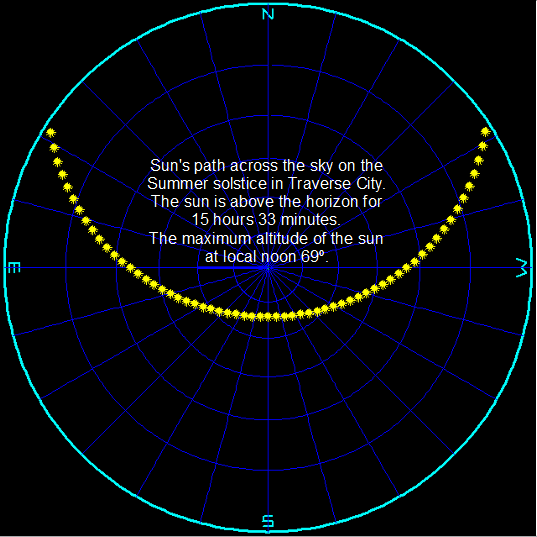
Summer will arrive at 4:25 AM Sunday morning (8:25 UT). Then the Sun will be out 15 hours 34 minutes for us in the Interlochen/Traverse City area. That’s within the same minute as today. Also, the Sun will reach up to nearly 69 degrees altitude above the southern horizon at local noon, that’s 1:44 pm. After the summer solstice we will begin to climb down from those extreme values, at first slowly, but with increasing rapidity as summer goes on. However, the Northern Hemisphere is continuing to warm up. Our warmest average temperatures tend to be near the end of July. What’s really neat is, the Earth is farther from the Sun than it was six months ago as winter started. It doesn’t make us any cooler, but makes summer longer.
The astronomical event times given in this blog are for the Traverse City/Interlochen area of Michigan (Lat 44.7° N, Long 85.7° W; EDT, UT – 4 hours) unless stated otherwise. Times will be different for other locations.
Addendum
Ephemeris: 06/18/2026 – Looking to summer with the Summer Triangle
This is Ephemeris for Thursday, June 18th. Today the Sun will be up for 15 hours and 34 minutes, setting at 9:31, and it will rise tomorrow at 5:56. The Moon, 3 days before first quarter, will set at 12:36 tomorrow morning.
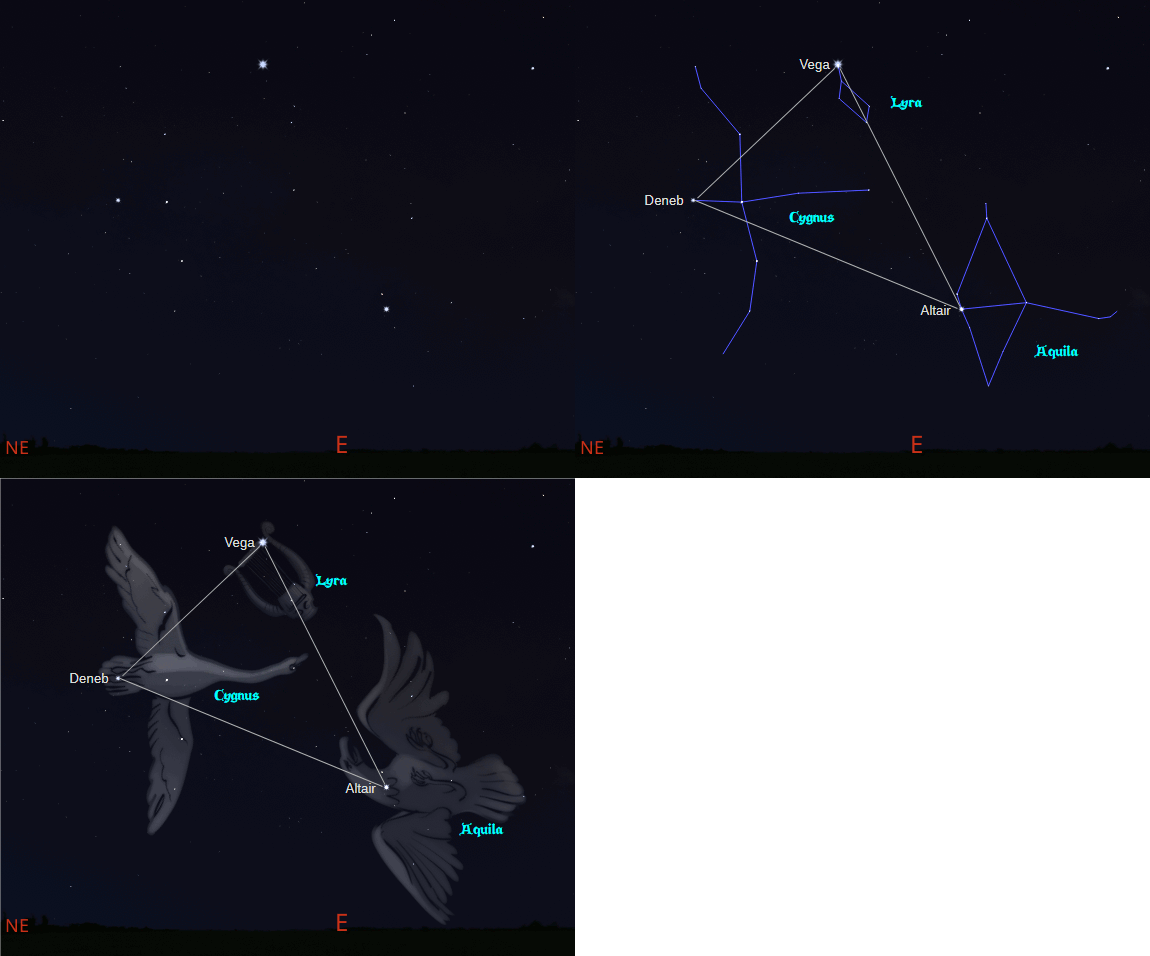
Summer skies are coming. It’s only 3 days until summer officially arrives. Looking to the eastern sky at 11 PM are three of the brightest stars in a large triangle. The top star Vega is about halfway up the sky to the zenith, and the brightest of the three. It’s in the small constellation of Lyra the harp. Lowest of the stars and just about due east is Altair in Aquila the eagle. Completing the triangle is Deneb in the northeast in the tail of Cygnus the swan or the head of the horizontal Northern Cross. These three stars make up the Summer Triangle, which isn’t an official constellation. It’s one of the many informal star patterns called asterisms. The Summer Triangle will be in our evening sky moving slowly westward until December.
The astronomical event times given in this blog are for the Traverse City/Interlochen area of Michigan (Lat 44.7° N, Long 85.7° W; EDT, UT – 4 hours) unless stated otherwise. Times will be different for other locations.
Addendum
Ephemeris: 06/17/2026 – Checking out all the naked-eye planets for this week.
This is Ephemeris for Wednesday, June 17th. Today the Sun will be up for 15 hours and 34 minutes, setting at 9:31, and it will rise tomorrow at 5:56. The Moon, 3 days past new, will set at 12:09 tomorrow morning.
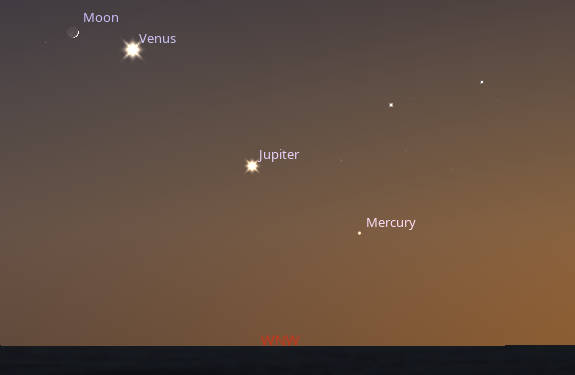
Let’s take our weekly look at the whereabouts of the naked-eye planets. By 10:15 PM tonight, nearly an hour after sunset, Venus and Jupiter, and even Mercury may be seen in the western sky, with Jupiter below and right of the brighter Venus, and Mercury below and right of Jupiter. Jupiter appears to be chasing Mercury back toward the sun. But Mercury is getting dimmer, and will soon be lost in the twilight glow. A telescope will show a very tiny disc on Venus, because it is still pretty much beyond the Sun, 106 million miles (171 mil km) away from us. Over the next 4 months it will be moving closer to us and becoming much larger. In the morning, Saturn will rise at 2:37 AM, followed by dimmer Mars an hour and a half later.
The astronomical event times given in this blog are for the Traverse City/Interlochen area of Michigan (Lat 44.7° N, Long 85.7° W; EDT, UT – 4 hours) unless stated otherwise. Times will be different for other locations.
Addendum