Archive
04/12/2019 – Ephemeris – The proposed Deep Space Gateway
Ephemeris for Friday, April 12th. Today the Sun will be up for 13 hours and 19 minutes, setting at 8:23, and it will rise tomorrow at 7:02. The Moon, at first quarter today, will set at 3:55 tomorrow morning.
With international cooperation NASA is hoping it and its partners, the European Space Agency, The Japanese JAXA, The Canadian Space Agency and the Russian Roscosmos will a build the Deep Space Gateway, a way station between the Earth and Moon to exchange crews and vehicles traveling between the two bodies. This plan is an integral part of the returning to the Moon by around 2028. The gateway will also be a way station for the eventual exploration of Mars. How President Trump’s new demand to have the United States return to the Moon by the last year of his second term, if he has one, will affect current plans and international cooperation remains to be seen.
The times given are for the Traverse City/Interlochen area of Michigan. They may be different for your location.
Addendum
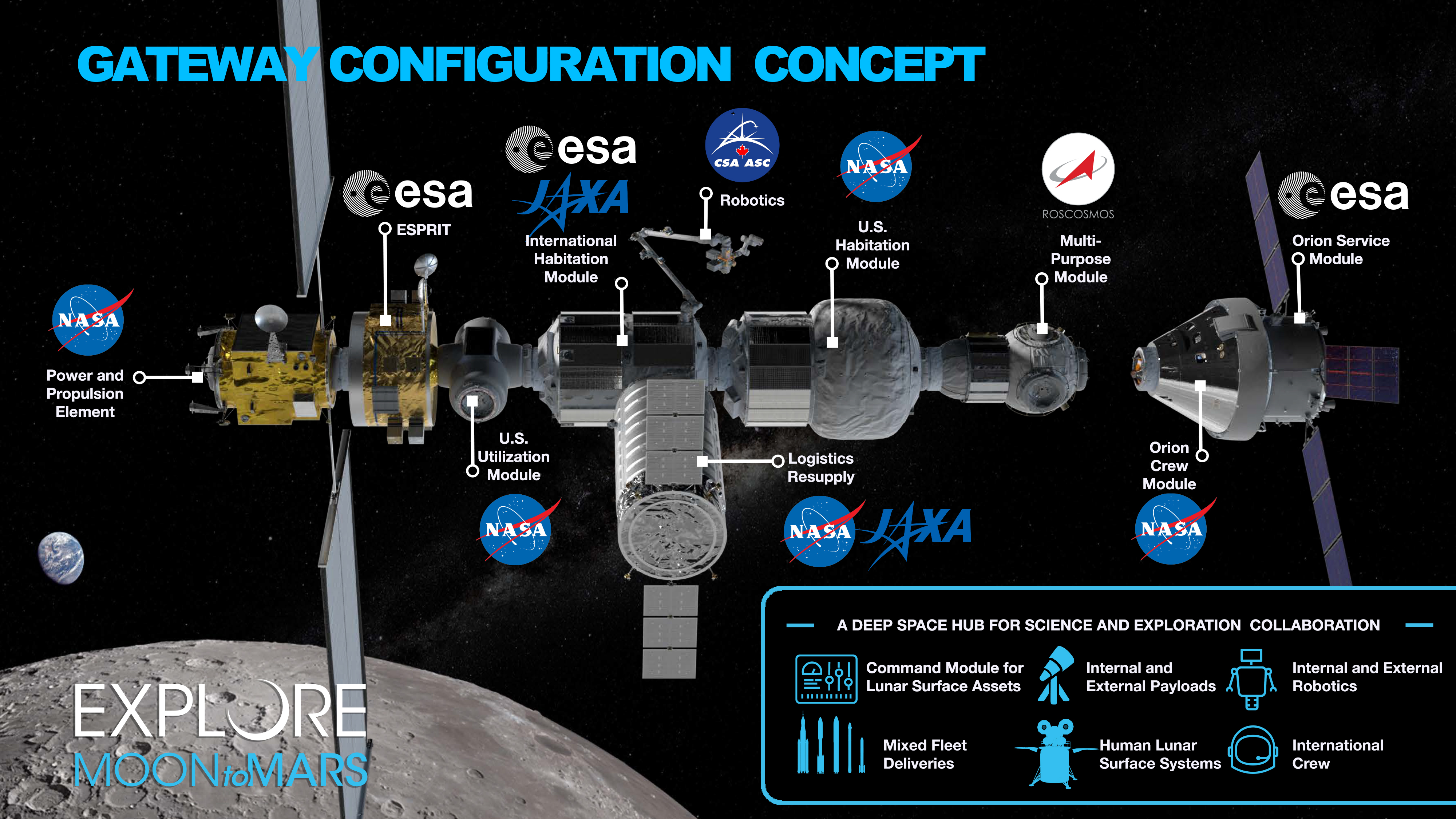
Deep Space Gateway configuration concept. This would orbit the moon is a long elliptical orbit. Click on the image to enlarge. Credit: NASA.
03/15/2019 – Ephemeris – The era of US crewed space launches begins
Ephemeris for Ides of March, Friday, March 15th. Today the Sun will be up for 11 hours and 53 minutes, setting at 7:48, and it will rise tomorrow at 7:53. The Moon, 1 day past first quarter, will set at 5:07 tomorrow morning.
Two weeks ago, the United States began to get back in the human space launch business with the launch of a test Crew Dragon space capsule on a Falcon 9 rocket, all made by SpaceX. The 6 day mission to dock with the International Space Station and then return to the Earth was an apparent success as everything appeared to go smoothly. After a successful in-flight abort test with the same capsule in a few months, another test with a crew will be flown. Boeing’s Starliner capsule is not far behind with a possible uncrewed launch in April. Both companies have abort tests to get behind them before crews can be launched. SpaceX is expected to launch a crew as early as June.
The times given are for the Traverse City/Interlochen area of Michigan. They may be different for your location.
Addendum
NASA
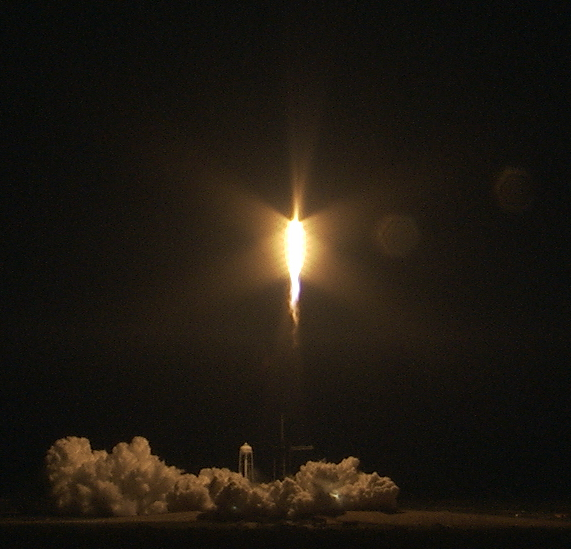
SpaceX Falcon 9 Crew Dragon Demo-1 liftoff. Credit NASA.
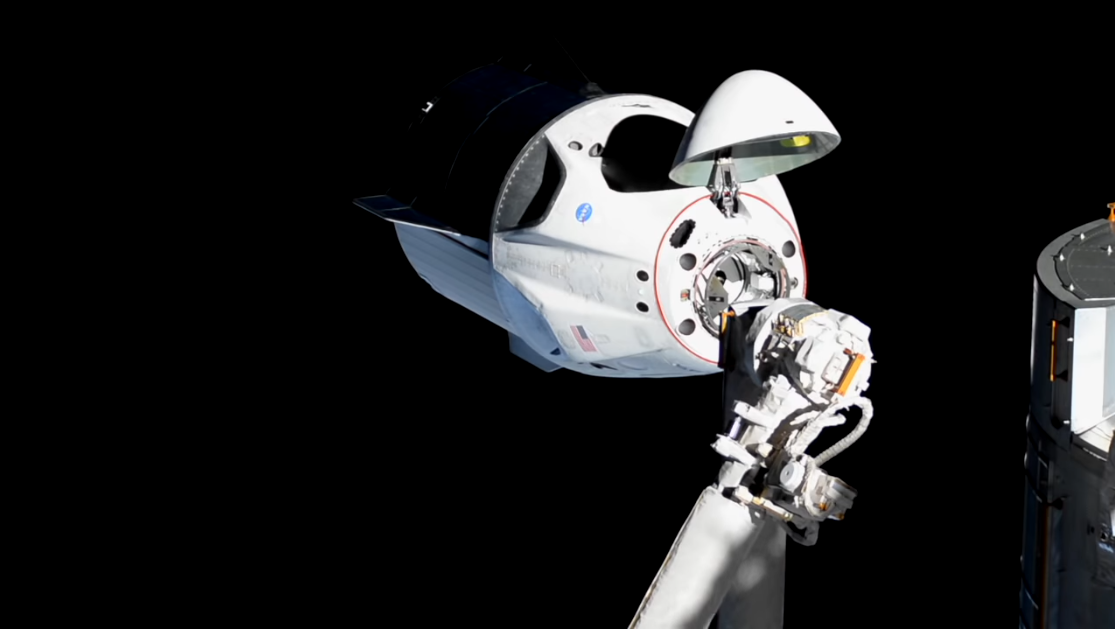
NASA-SpaceX Demo-1 Screen Cap of docking at the ISS. Credit NASA.
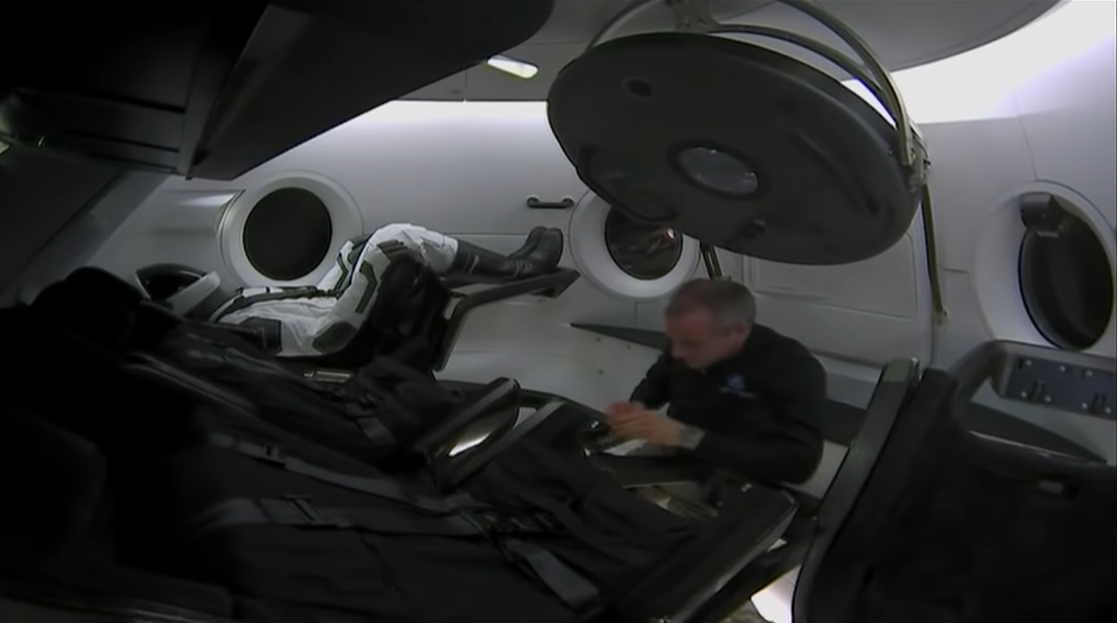
Inside the SpaceX Crew Dragon with Canadian astronaut David Saint-Jacques. Credit NASA/SpaceX.
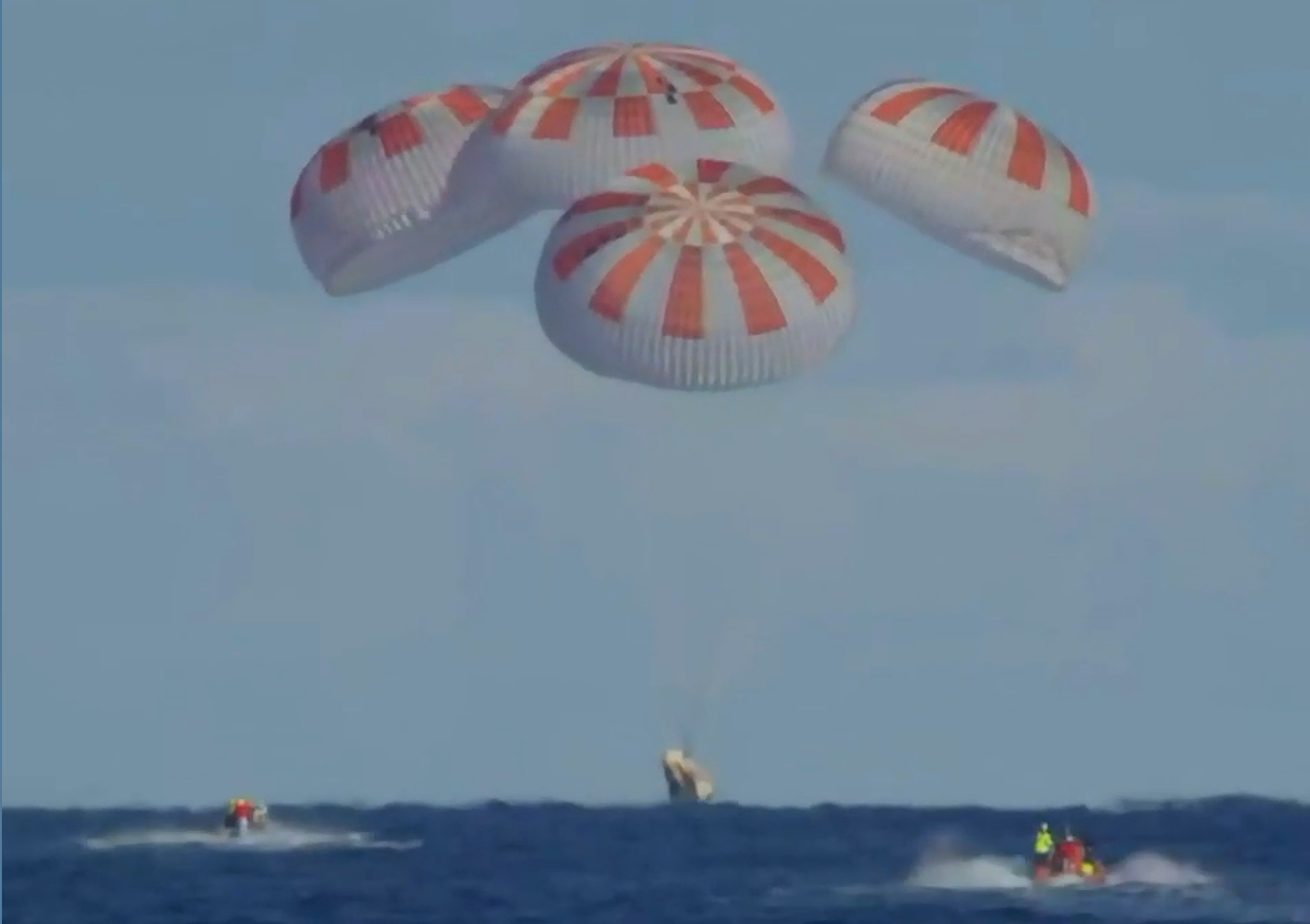
NASA-SpaceX Demo-1 Crew Dragon Capsule splashdown in the Atlantic. Credit NASA/SpaceX.
01/14/2019 – Ephemeris – New Horizons returned first images of Ultima Thule
Ephemeris for Monday, January 14th. The Sun will rise at 8:17. It’ll be up for 9 hours and 9 minutes, setting at 5:26. The Moon, at first quarter today, will set at 2:04 tomorrow morning.
On January 1st, just after midnight eastern time the New Horizons spacecraft made its closest pass of the small Kuiper Belt Object 2014 Mu69, nicknamed Ultima Thule. At just about 10:30 that morning the expected phone home came back over 4 billion miles, and 6 hours travel time from a 15 watt transmitter on the spacecraft. New Horizons was in perfect health an its data recorders were full. It will take 20 months at a thousand bits per second to relay all that information back to Earth. Though we’ll get better pictures to come, Ultima Thule is a contact binary of two nearly spherical bodies that collided very gently. It looks like a snowman of reddish-brown snow. It fits the silhouette made by it passing in front of a star back in 2017.
The times given are for the Traverse City/Interlochen area of Michigan. They may be different for your location.
Addendum
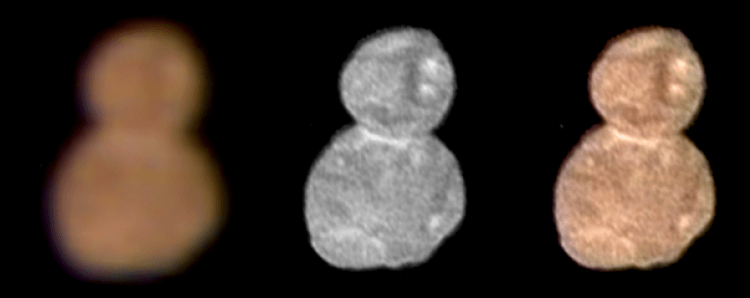
Ultima Thule on approach combing a low resolution color image with the high resolution monochromatic image shows the body in almost true color. Credit NASA/JHUAPL/SwRI
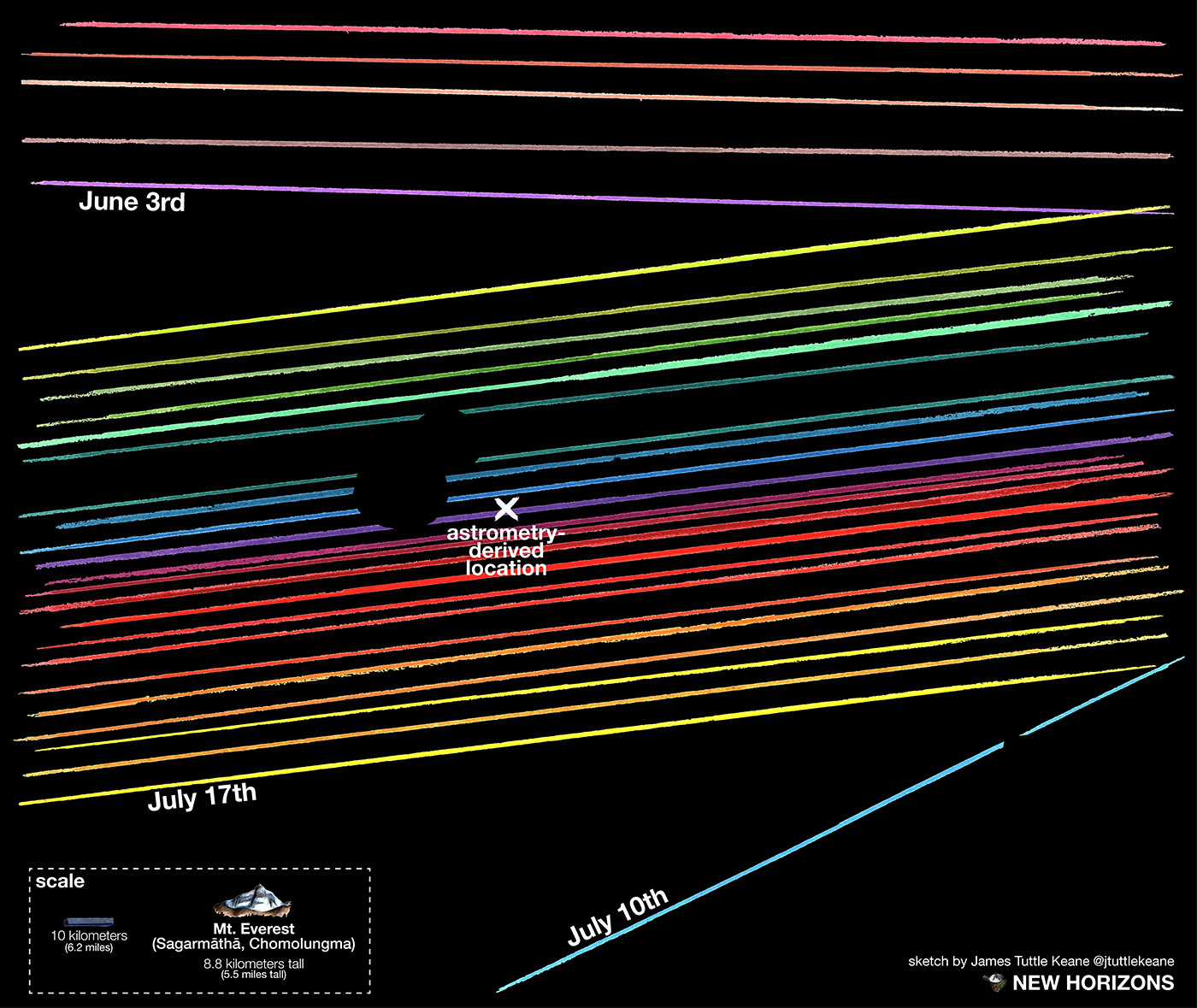
Pre-encounter occultation attempts of Ultima Thule. Continued caption from the Vatican Observatory Foundation Blog: “The colored lines mark the path of a star as seen from different telescopes on each day; the blank spaces on those lines indicate the few seconds when MU69 blocked the light from the star. Credit: NASA / JHUAPL / SwRI / James Tuttle Keane”
Note from the image: The term “astrometry” (pronounced as-trom-e-try) is the science of measuring the precise positions and motions of celestial bodies.
The New Horizons spacecraft went into solar conjunction from January 4th to the 9th. Meaning it was too close to the direction of the Sun to send of receive data due to the Sun’s radio interference. On the night of the 9th I noticed that on the DNS-Now website that the big antenna at Canberra Australia was in contact with it. So more data is flowing down!
12/31/2018 – Ephemeris – New Year 2019 – A new solar system body is being explored right now!
Ephemeris for New Years Eve, Monday, December 31st. The Sun will rise at 8:20. It’ll be up for 8 hours and 51 minutes, setting at 5:11. The Moon, 2 days past last quarter, will rise at 3:54 tomorrow morning.
Later tonight the New Horizons spacecraft, which flew by Pluto and its retinue of moons, will fly by Kuiper Belt Object (KBO) 2014 MU69, nicknamed Ultima Thule. It’s probably an odd looking contact binary body with lobes 12 ½ and 11 miles (20 & 18 km) in diameter. That’s the guess as of a week ago. It will pass this body by 1,366 miles (2200 km), traveling at over 32 thousand miles an hour (52,000 kph). The spacecraft will pass closest approach at 33 minutes after the ball drops in Times Square. Nearly 4 hours later it will phone home. We won’t receive that message here on Earth until 10:28 a.m. due to the over 6 hours of time it takes the radio signal to reach Earth. We should get the first images by tomorrow night. The New Horizons spacecraft was built and is flown by Johns Hopkins Applied Physics Laboratory (JHAPL) is collaboration with NASA and the Southwest Research Institute (SwRI).
The times given are for the Traverse City/Interlochen area of Michigan. They may be different for your location.
Addendum
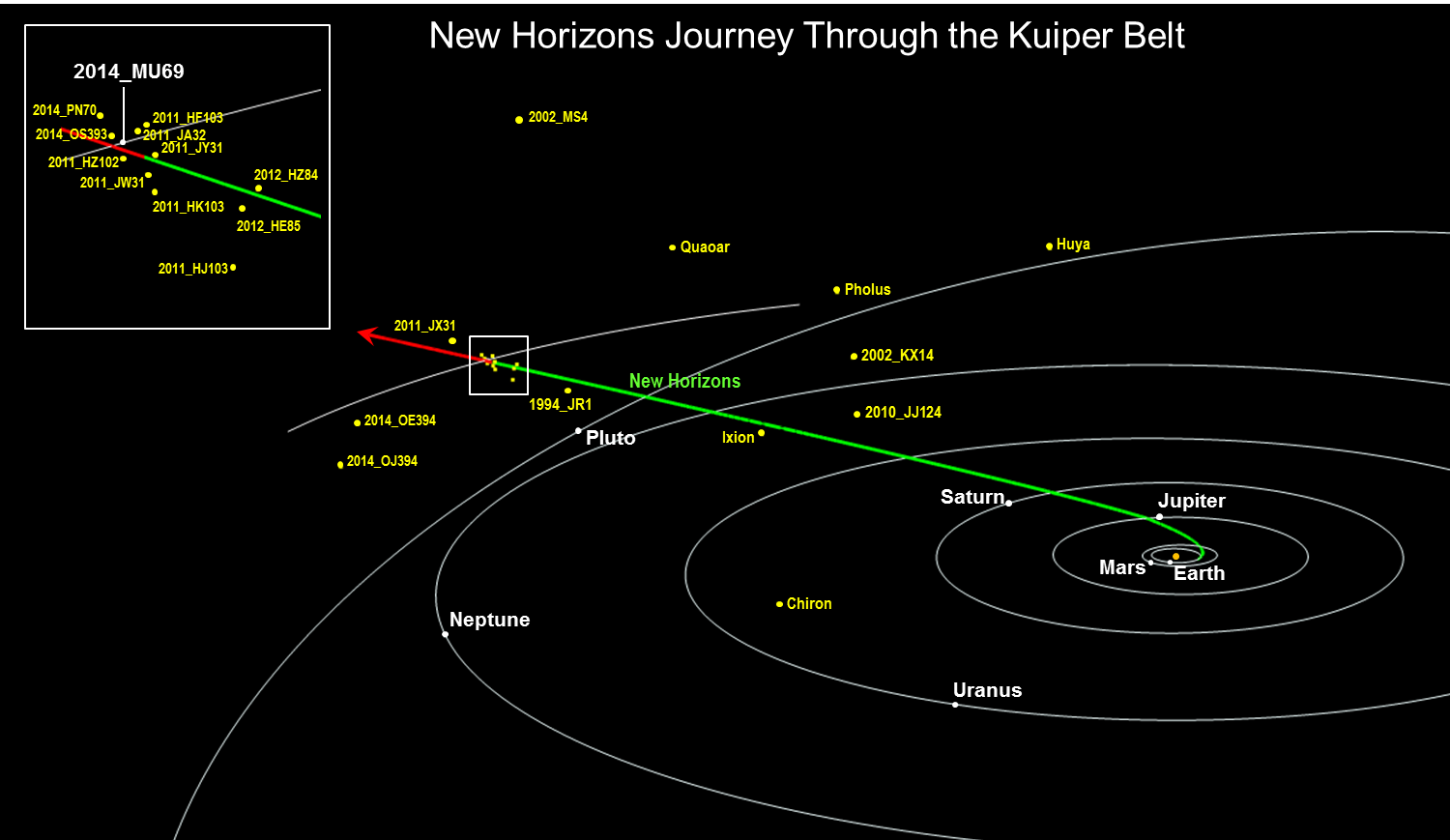
The Trajectory and position of New Horizons as it approached 2014 MU69 two months ago showing some of the KBOs recently discovered near its path. Credit JHAPL.
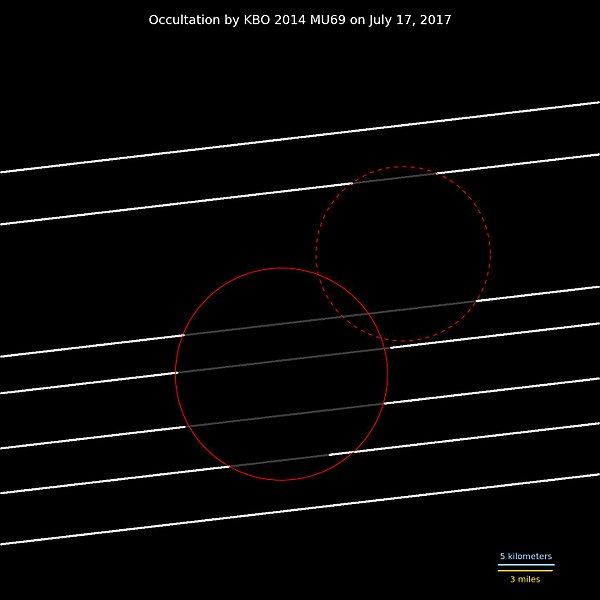
Silhouette of KBO 2014 MU69 (Ultima Thule) created by occultation timings on July 17, 2017 from southern Argentina. Credit NASA/JHUAPL/SwRI/Alex Parker.
Links to information can be found here: http://pluto.jhuapl.edu/News-Center/Where-to-Watch.php.
A cool app to follow New Horizons in real-time or to preview its passage of Ultima Thule is NASA’s Eyes: https://eyes.nasa.gov/.
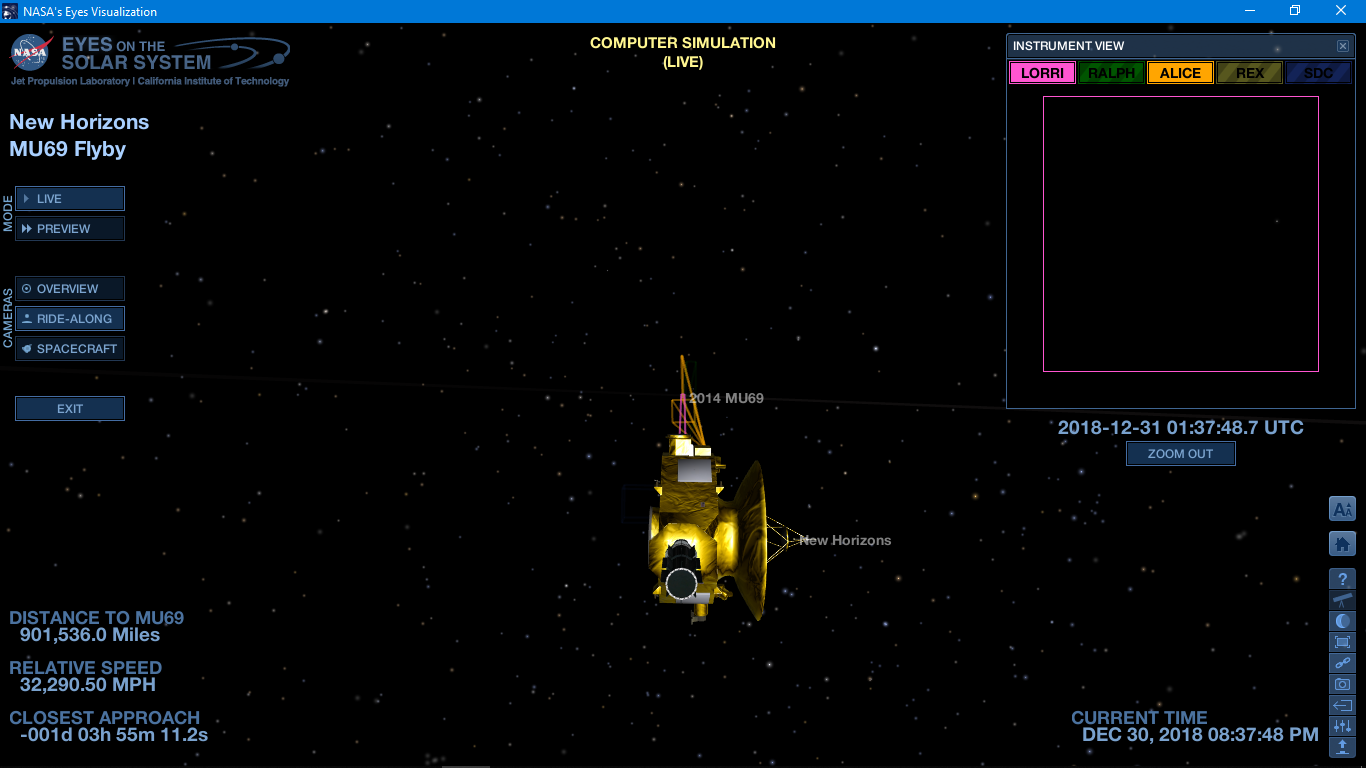
NASA’s Eyes screen Captured as a real-time simulation as I write this post. At this time two instruments are active, LORRI the long-range imager and ALICE the Ultraviolet imaging spectrometer. Click on the image to enlarge. Credit NASA/JPL
12/28/2018 – Ephemeris – Preview of space and astronomical events for 2019
Ephemeris for Friday, December 28th. The Sun will rise at 8:19. It’ll be up for 8 hours and 49 minutes, setting at 5:09. The Moon, 1 day before last quarter, will rise at 12:30 tomorrow morning.
Lets look at some astronomical and space events for 2019. Right off the bat on January 1st the New Horizons space craft will encounter the Kuiper Belt Object 2014 MU69 nick named Ultima Thule. I’ll have more on that Monday. January 20th overnight will see a total lunar eclipse lasting from 10:34 p.m. to 1:51 a.m. November 11th will see the planet Mercury cross the face of the Sun, a transit of Mercury from a couple of minutes after sunrise until 1:04 p.m. Among the space launches next year are several SpaceX Falcon Heavy launches, and the first launch of a uncrewed Dragon 2 capsule to fly up to the International Space Station. Boeing’s first Starliner uncrewed capsule test will occur in 2020.
The times given are for the Traverse City/Interlochen area of Michigan. They may be different for your location.
Addenda
New Horizons encounter of 2014 MU69 (Ultima Thule)
Due to the fact that NASA is affected by the partial shutdown we will probably not get much immediate information from them. However the New Horizons spacecraft is being run by Johns Hopkins Applied Physics Laboratory (JHAPL) and not NASA and it is a critical mission, it will not be affected. All news will flow from JHAPL, rather than NASA. NASA-TV appears to be operating, but on autopilot.
From JHAPL, Where to watch, timeline and links: http://pluto.jhuapl.edu/News-Center/Where-to-Watch.php.
The Planetary Society has lots of information and links to follow the encounter: http://www.planetary.org/blogs/emily-lakdawalla/2018/new-horizons-approaching-mu69-ultima-thule.html.
There is also a Planetary Society page of the time line of events for the spacecraft and the reception of data on the Earth : http://www.planetary.org/blogs/emily-lakdawalla/2018/what-to-expect-new-horizons-mu69-ultima-thule.html.
I’ll have much more Monday, less than 24 hours before the fly by.
Lunar Eclipse January 20-21, 2019
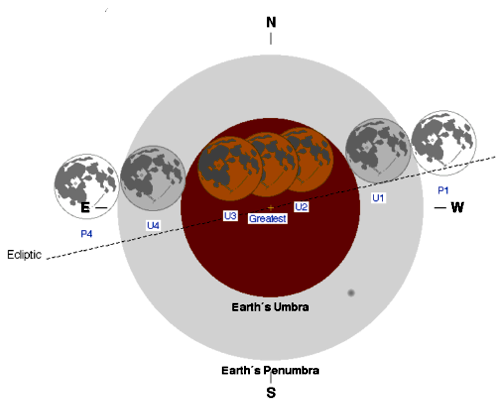
The Moon’s passage through the Earth’s shadow January 20-21, 2019. P1 and P4 events are invisible. Credit Fred Espenak, NASA/GSFC.
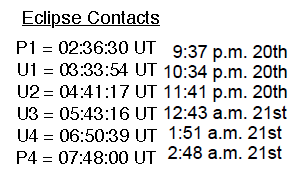
UT times are for January 21st. EST times are te nearest minute.
Transit of Mercury November 11, 2019
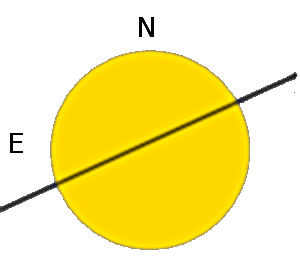
Mercury will travel from lower left to upper right across the face of the Sun. Credit Occult4.
The transit will run from about 7:34 a.m. EST
(2:34 UT) to 1:04 p.m. (8:04 UT).
11/26/2018 – Ephemeris – NASA’s InSight spacecraft lands on Mars this afternoon
Ephemeris for Monday, November 26th. The Sun will rise at 7:54. It’ll be up for 9 hours and 11 minutes, setting at 5:05. The Moon, half way from full to last quarter, will rise at 8:43 this evening.
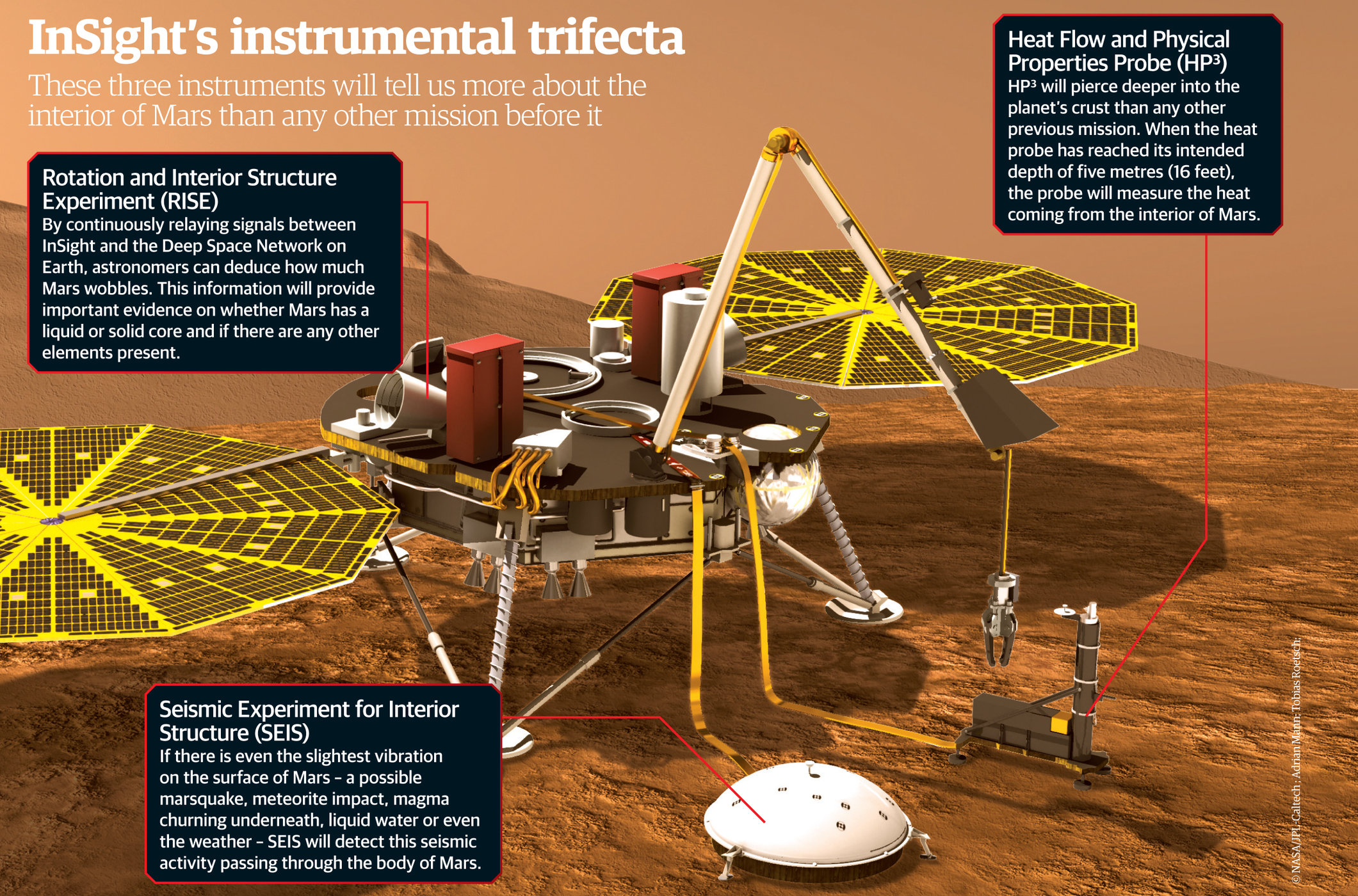
This afternoon NASA’s InSight spacecraft will land on Mars. It will drill into the martial soil to place a temperature probe to measure Mars’ heat flow to determine the interior temperature of Mars. It will also deploy a seismometer to detect marsquakes and seismic waves generated by meteorite impacts to ascertain the interior structure of the planet. The entry, decent and landing or EDL as it’s called begins at 2:47 p.m. Eastern Standard Time, with landing 6 minutes, 45 seconds later. The Jet Propulsion Laboratory calls it Seven Minutes of Terror. The spacecraft is on its own so everything has to go right. Mars is 8 light minutes away. The spacecraft will be on the ground one way or the other for over a minute by the time we get word that the spacecraft has entered the atmosphere of Mars. NASA-TV, available on the Internet, starts its coverage at 2 p.m. Eastern Standard Time.
The times given are for the Traverse City/Interlochen area of Michigan. They may be different for your location.
Addendum
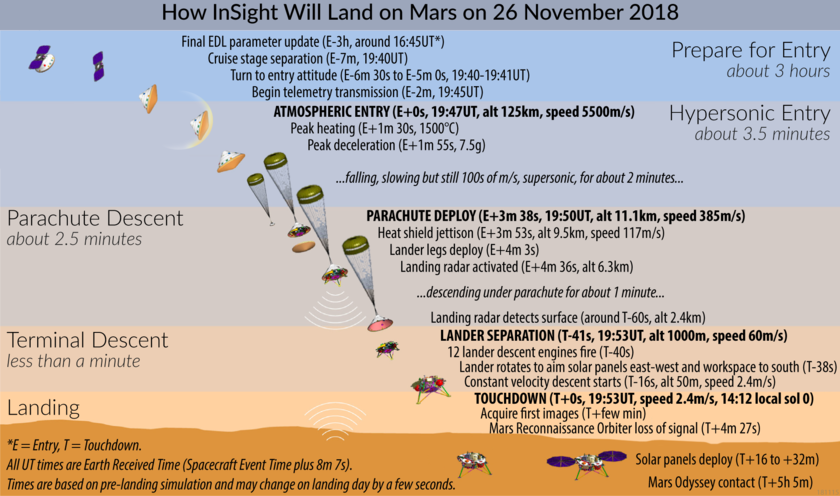
To see Emily’s post with a lot more information, click on this URL: http://www.planetary.org/blogs/emily-lakdawalla/2018/mars-insight-landing-preview.html. The post has a link to NASA’s 68 page pdf Mars InSight Landing Press Kit, which covers all aspects of entry, descent and landing, the Mars Insight components, and science instruments, and what they expect to learn about Mars’ interior.
10/15/2018 – Ephemeris – The Japanese spacecraft Hayabusa2 is exploring the asteroid Ryugu.
Ephemeris for Monday, October 15th. The Sun will rise at 7:58. It’ll be up for 11 hours even, setting at 6:58. The Moon, 1 day before first quarter, will set at 11:43 this evening.
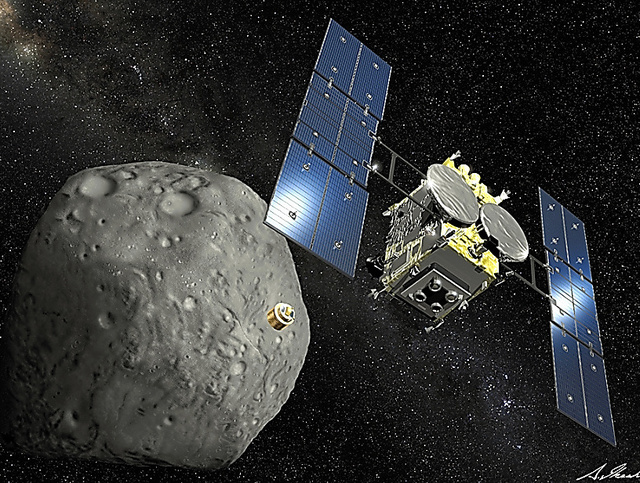
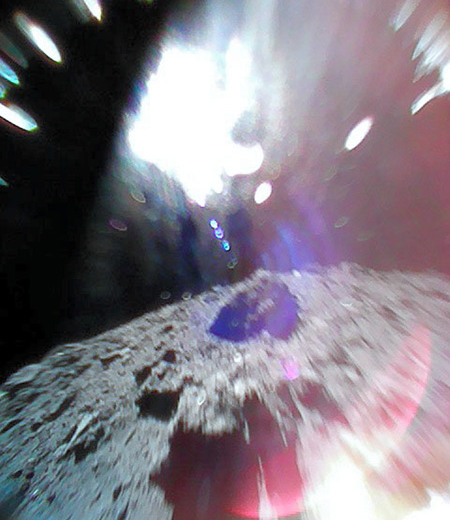
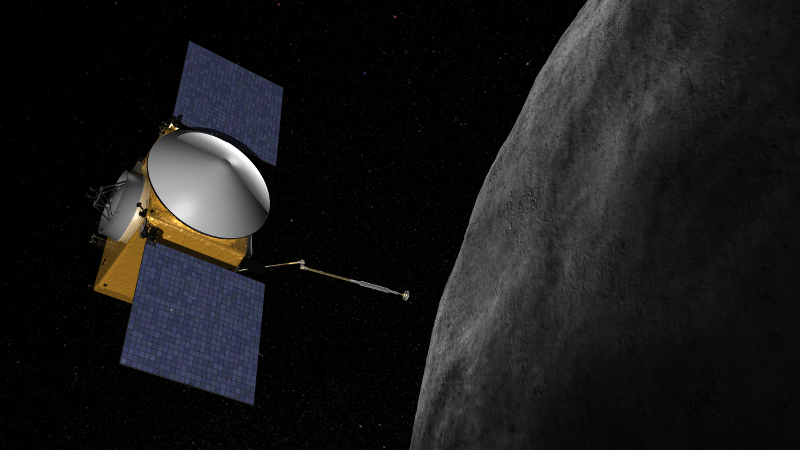
The Japanese asteroid sample return mission Hayabusa2 is in the midst of operations at the near-earth asteroid Ryugu. It dropped three rovers that hopped across its surface and later this month will take the first of three samples. Hayabusa means peregrine falcon in Japanese. It will stay at the asteroid until late next year, it then will make a year-long trip back to the Earth, landing in the Outback of Australia. NASA’s own OSIRIS-REx asteroid sample return mission is currently approaching the near-earth asteroid Bennu. It will orbit the asteroid for over a year and can make up to three attempts to take a sample of the asteroid for return to Earth. It is to land at the Utah Test and Training Range in September of 2023.
The times given are for the Traverse City/Interlochen area of Michigan. They may be different for your location.
Addendum
08/28/2018 – Ephemeris – Water on the Moon
Ephemeris for Tuesday, August 28th. The Sun will rise at 7:00. It’ll be up for 13 hours and 26 minutes, setting at 8:26. The Moon, 2 days past full, will rise at 9:47 this evening.
Ten years ago India launched its lunar orbiting Chandrayaan-1 spacecraft. On it was a NASA instrument the Moon Mineralogy Mapper to study the composition of the Moon’s crust. With it they discovered signatures of water at the Moon’s high latitudes, probably in water-bearing minerals. Water was also confirmed in craters near the Moon’s south pole by the LCROSS probe that was launched with the Lunar Reconnaissance Orbiter in 2009. It crashed near the Moon’s south pole in a crater following a centaur stage which it was observing. Though the expected visual show wasn’t visible from Earth the LCROSS satellite saw and returned its observations before it too crashed. It relayed that the Moon had ice near the south pole.
The times given are for the Traverse City/Interlochen area of Michigan. They may be different for your location.
Addendum
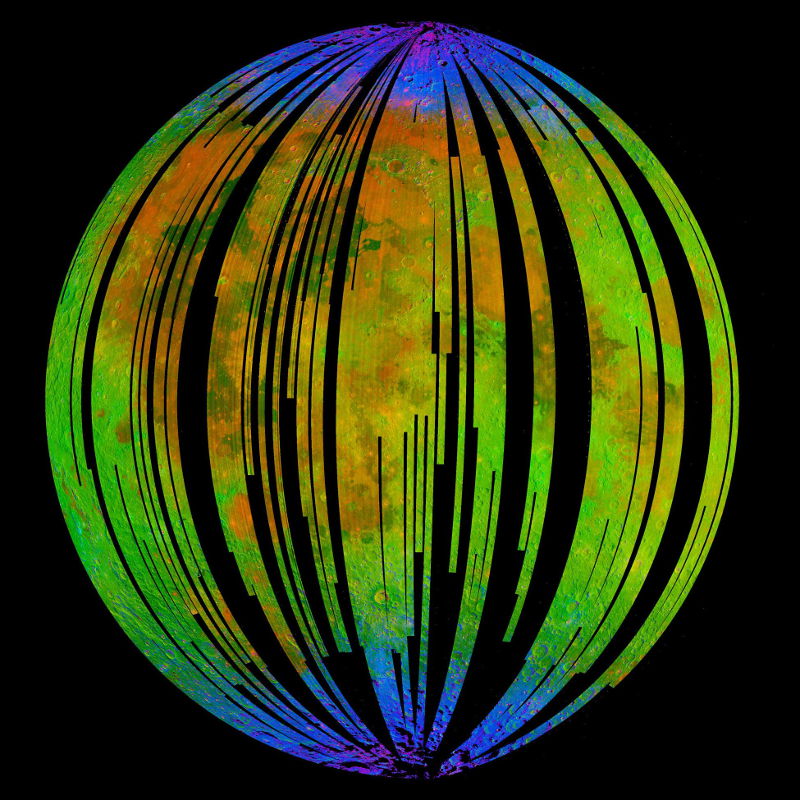
Water Detected at High Latitudes on the Moon by the Moon Mineralogy Mapper The water-bearing minerals are colored blue. Credit ISRO/NASA/JPL-Caltech/Brown Univ./USGS
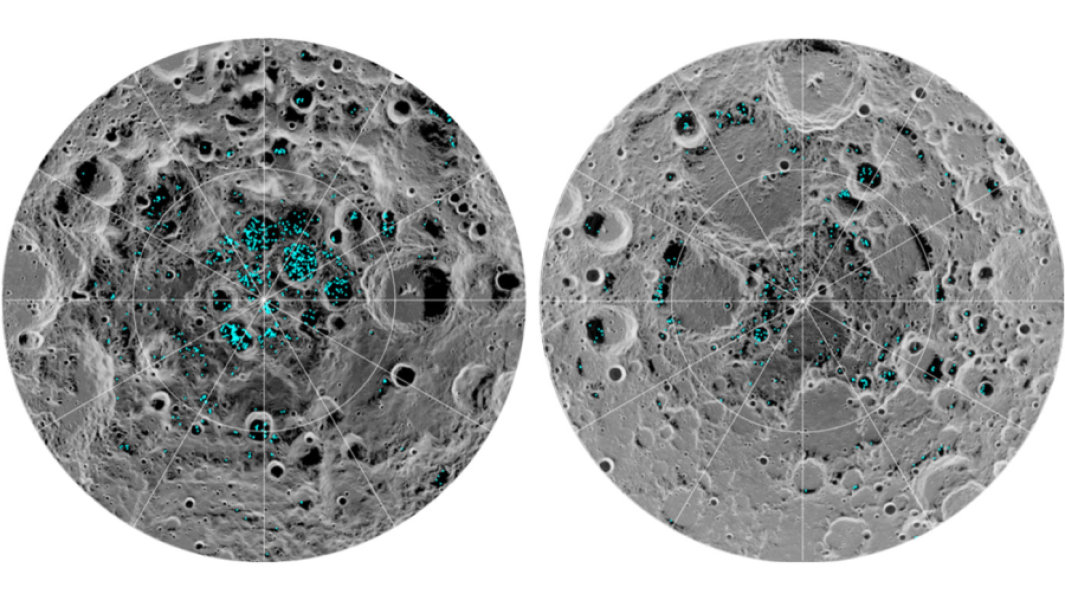
The Moon’s south pole area on the left and north pole on the right. The cyan color shows shadowed areas where ice is located. From data gathered by the Moon Mineralogy Mapper, and instruments on the Lunar Reconnaissance Orbiter, and LCROSS. Click on image to enlarge. Credit NASA.
Finding water is a big deal. It helps Moon colonists live off the land, so to speak. While the poles on Earth are foreboding places, those of the Moon could give colonists an advantage. First, that’s where the water is. The Moon has very little axial tilt so deep craters never see the sunlight, and high peaks see eternal sunlight, a great place to place solar panels for just about continuous energy production.
08/21/2018 – Ephemeris – How will the Parker Solar Probe get near to the Sun?
Ephemeris for Tuesday, August 21st. The Sun rises at 6:52. It’ll be up for 13 hours and 46 minutes, setting at 8:38. The Moon, 3 days past first quarter, will set at 3:09 tomorrow morning.
I introduced the Parker Solar Probe yesterday. It’s on its way to Venus to have some of its velocity stolen by that planet as to drop to nearly 15 million miles (24 million km) of the Sun at its first perihelion, before heading almost all the way out to the Earth’s orbit. Its next encounter with Venus will steal even more velocity from the probe to drop even closer to the Sun. It will take nearly 7 years to reach as close as 3.9 million miles (6.2 million km) from he center of the Sun of 3.8 million miles (6.1 million km) from what looks like its surface, the photosphere, the bright ball we see of the Sun. The probe has a huge heat shield that will handle the over two thousand degree heat from the Sun. Even though the corona is several million degrees in temperature, it’s not dense enough to heat the probe.
The times given are for the Traverse City/Interlochen area of Michigan. They may be different for your location.
Addendum
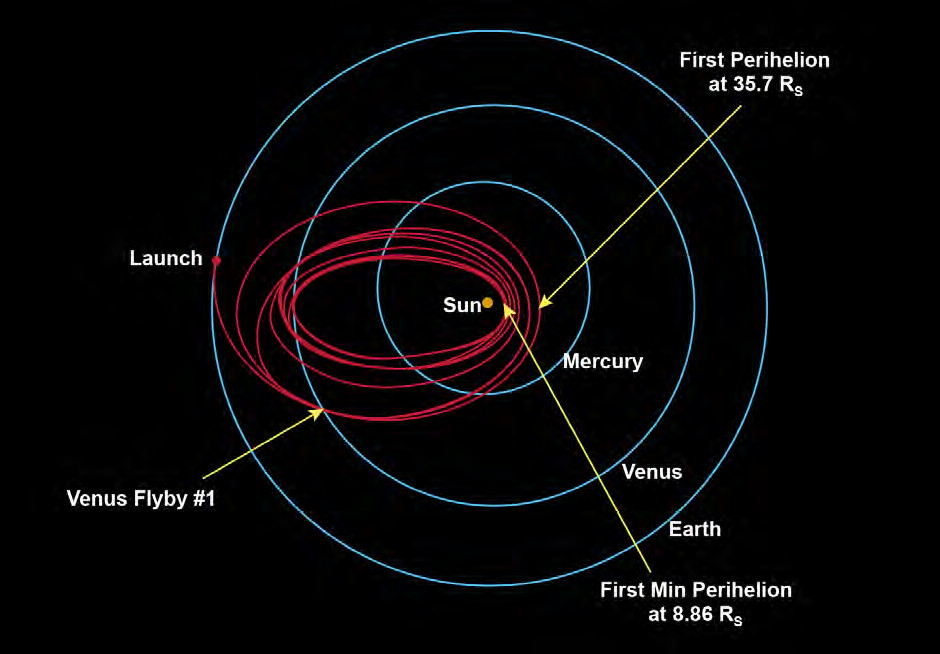
The planned orbits of the Parker Solar Probe. First flyby of Venus will occur on October 3rd 2018. The first perihelion passage a bit more than a month later on November 6th. Credit: NASA
A close look at the Sun
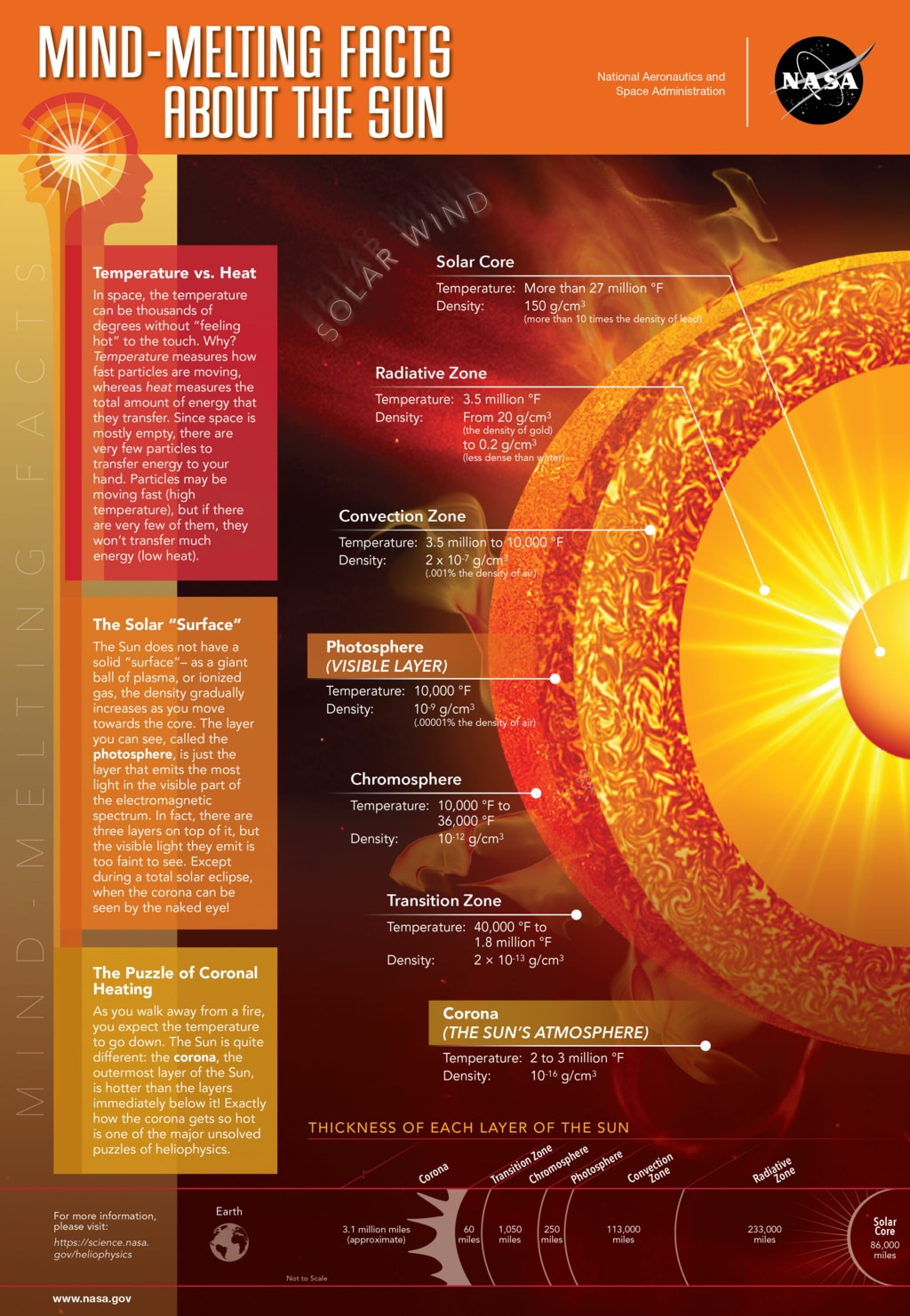
Click on image to enlarge. Credit NASA.
08/20/2018 – Ephemeris – The Parker Solar probe is on its way to skim through the Sun’s corona
Ephemeris for Monday, August 20th. The Sun rises at 6:51. It’ll be up for 13 hours and 49 minutes, setting at 8:40. The Moon, 2 days past first quarter, will set at 2:22 tomorrow morning.
Eight days ago the Parker Solar Probe was launched toward the Sun. It is the first NASA spacecraft named after a living person, Eugene Parker, a Michigander, born in Houghton in 1927, graduated from Michigan State, before moving on to Caltech. He eventually landed at the University of Chicago. In the 1950’s he put forth the theory of the supersonic solar wind of charged particles pervading the solar system. The theory was not initially accepted, but has been verified by satellites. The Parker Solar Probe will make multiple passes of Venus, giving up its velocity to fall closer to the Sun on each pass, taking almost 7 years to inch closer to the Sun at its perihelion until it gets down to about 3.8 million miles of our star.
The times given are for the Traverse City/Interlochen area of Michigan. They may be different for your location.
Addendum
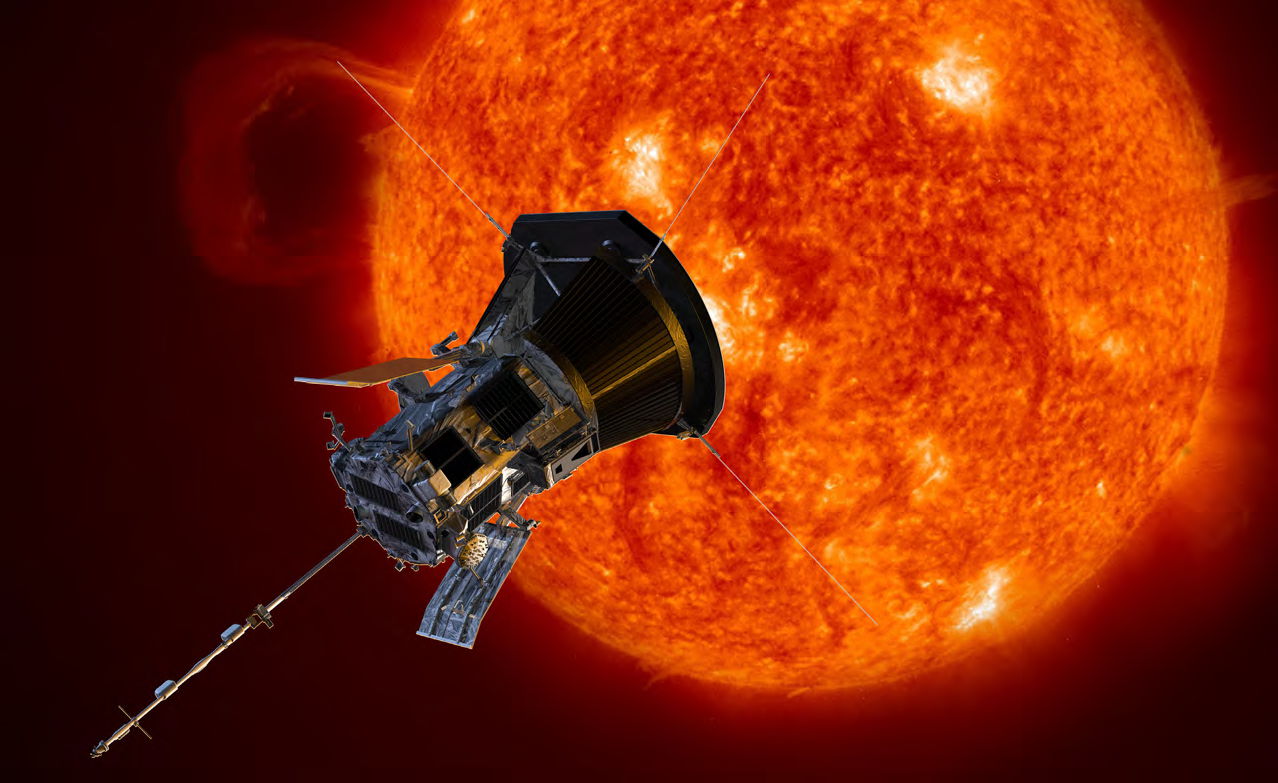
Artist’s visualization of the Parker Solar Probe near the Sun. Credit: NASA/Johns Hopkins APL/Steve Gribben.

Dr. Eugene Parker (seated in the foreground), a pioneer in heliophysics and S. Chandrasekhar distinguished service professor emeritus for the Department of Astronomy and Astrophysics at the University of Chicago, watches the launch of NASA’s Parker Solar Probe. This is the first agency mission named for a living person. Standing behind Parker is Nicky Fox, Parker Solar Probe project scientist at Johns Hopkins Applied Physics Laboratory. The liftoff took place at 3:31 a.m. EDT on Sunday, Aug. 12, 2018. The spacecraft was built by the Johns Hopkins University Applied Physics Laboratory in Laurel, Maryland. The mission will perform the closest-ever observations of a star when it travels through the Sun’s atmosphere, called the corona. The probe will rely on measurements and imaging to revolutionize our understanding of the corona and the Sun-Earth connection. Credit: NASA/Glenn Benson.
 Bob Moler's Ephemeris Blog