Archive
10/29/2015 – Ephemeris – The blue skies of Pluto
Ephemeris for Thursday, October 29th. The Sun will rise at 8:16. It’ll be up for 10 hours and 19 minutes, setting at 6:36. The Moon, 2 days past full, will rise at 8:40 this evening.
Images from the New Horizons spacecraft are streaming back slowly. It’s like trying to download a modern megapixel camera image using a thousand to two thousand bits per second telephone modem back in the ’90s. That’s why the images are dribbling out. They are released each Thursday or Friday. One of the last images was a colored image of the ring of atmosphere of Pluto backlit by the Sun, showing that the dwarf planet had a blue sky. The reason is still debated because there appear to be minute particles thought to be tholins in Pluto’s atmosphere. These would be colored brown or red. However they seen to preferentially scatter blue light like the nitrogen molecules in our atmosphere.
Times are for the Traverse City/Interlochen area of Michigan. They may be different for your location.
Addendum

Pluto seen in silhouette, backlit by the Sun in color. Released October 10, 2015 by NASA/JHUAPL/SwRI
10/26/2015 – Ephemeris – RIP Robert Farquhar interplanetary navigator extraordinaire
Ephemeris for Monday, October 26th. The Sun will rise at 8:12. It’ll be up for 10 hours and 28 minutes, setting at 6:40. The Moon, 1 day before full, will set at 8:10 tomorrow morning.
This morning Jupiter and Venus appear close together in the morning sky. They are said to be in conjunction. Also Venus is at its greatest separation from the Sun today. It will slowly begin to fall back toward the Sun. Last week Sunday Robert Farquhar died. He developed the technique of orbiting the L1 point between the Sun and the earth where the Earth nullifies the Sun’s gravity, so a spacecraft can stay there between the Earth and the Sun. He designed the trajectory for the ISEE-3 spacecraft that acted as an early warning for particles coming from the Sun. He also liberated it in 1982 and through a series of ingenious maneuvers worked it into a solar orbit that flew it through the tail of Comet Giacobini-Zinner.
Times are for the Traverse City/Interlochen area of Michigan. They may be different for your location.
Addendum
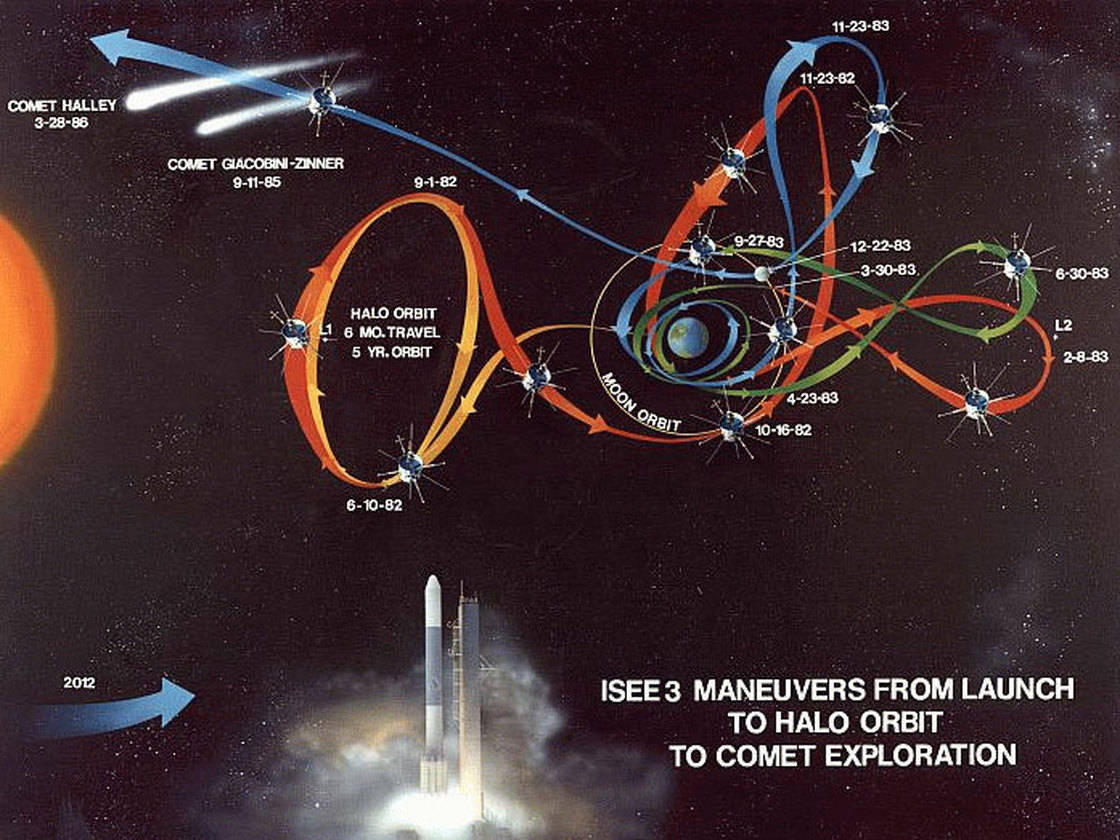
ISEE-3’s orbital path to the halo orbit at the Earth-Sun Lagrangian L1 point and out to cross the path of Comet Ziacobini-Zinner ahead of the fleet heading to Comet Halley. It was renamed ICE (International Comet Explorer). Credit: NASA/GSFC
Here’s a link to a page that recounts the quest to return the spacecraft to its L1 position by Farquhar and his band of “rouges” last year.
09/29/2015 – Ephemeris – New Horizons is now downloading some really cool pictures to Earth
Ephemeris for Tuesday, September 29th. The Sun will rise at 7:38. It’ll be up for 11 hours and 49 minutes, setting at 7:27. The Moon, 2 days past full, will rise at 8:38 this evening.
Two and a half months ago the New Horizons spacecraft flew past Pluto, spending the day incommunicado, not wasting any time sending anything back to the Earth. Starting the next day came the flood of data including some highly compressed images. Starting Labor Day weekend the high-resolution, uncompressed images started to come down at one to two thousand bits per second. At that rate a 4 megapixel monochromatic image might take 36 hours to download. Now every Thursday or Friday the New Horizons Team puts several new processed images on the NASA and Johns Hopkins Applied Physics Laboratory websites, along with explanations of what is in the images and the questions they raise.
Times are for the Traverse City/Interlochen area of Michigan. They may be different for your location.
Addendum
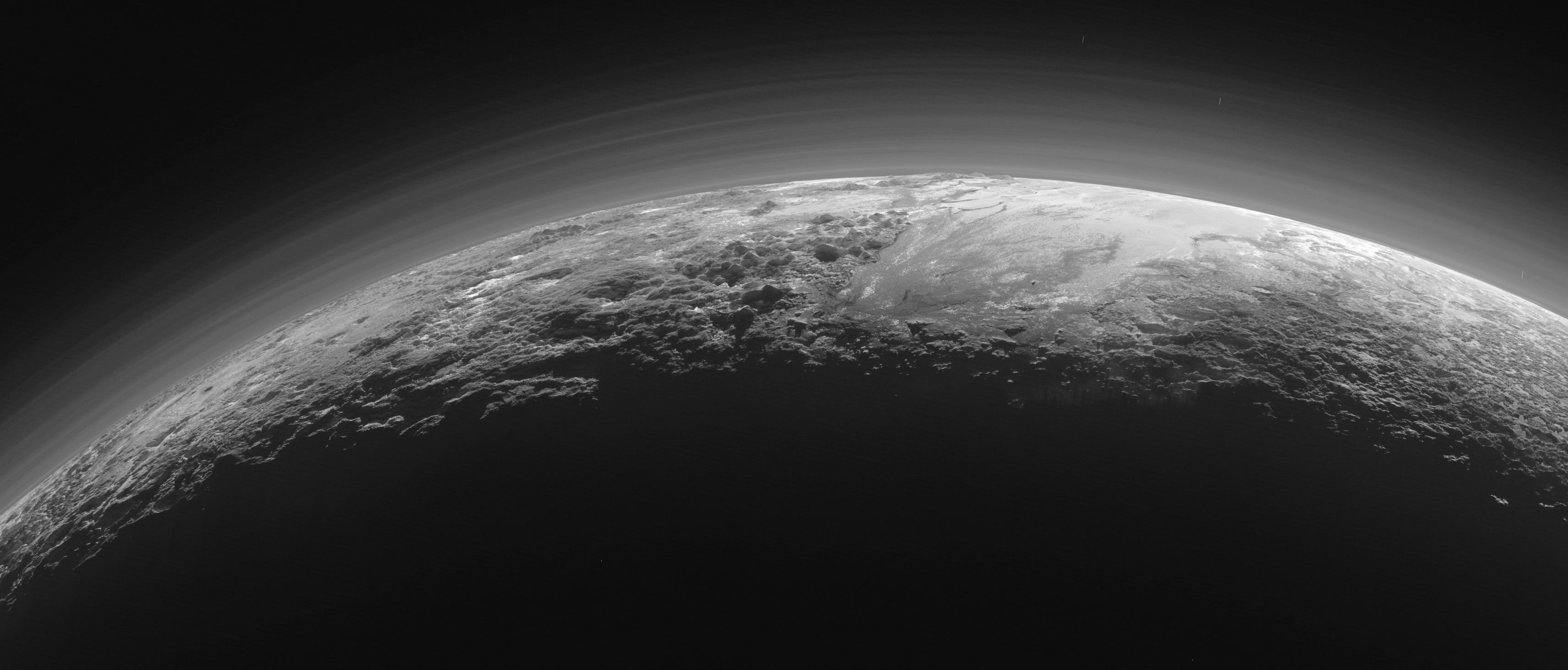
This image, taken just 15 minutes after the New Horizons spacecraft flew its closest to Pluto shows a low angle shot of the lands the spacecraft saw really close up. Check out too the many layers of the atmosphere. Credit: NASA/JHUAPL. Click on the image to enlarge.
I’ll be exploring this and the other amazing photos and other results from New Horizons this Friday at the Grand Traverse Astronomical Society meeting at 8 p.m. at Northwestern Michigan College’s Rogers Observatory south of Traverse City on Birmley Road.
07/30/2015 – Ephemeris – Pluto’s enigmatic atmosphere
Ephemeris for Thursday, July 30th. The Sun rises at 6:26. It’ll be up for 14 hours and 44 minutes, setting at 9:11. The Moon, 1 day before full, will set at 6:45 tomorrow morning.
The last image released last week from the New Horizons spacecraft was a stunning one. It was Pluto backlit, showing a glow completely around the planet, the atmosphere, showing layers. Also when New Horizons went behind the planet and again went behind Charon from the Earth’s point of view. Beams of radio waves from seven of the antennas of NASA’s Deep Space Network were sent toward Pluto and New Horizons four and a half hours earlier. The spacecraft turned its antenna toward Earth and listened. As the radio waves passed through the atmosphere of Pluto they were refracted and distorted giving clues to the state of the atmosphere. First takeaway is that Pluto’s atmosphere appears to be collapsing with its increasing distance from the Sun.
Times are for the Traverse City/Interlochen area of Michigan. They may be different for your location.
Addendum

Looking back at Pluto backlit by the Sun from 1.25 million miles. Credits: NASA/JHUAPL/SwRI.
Click here for more information on the above image.
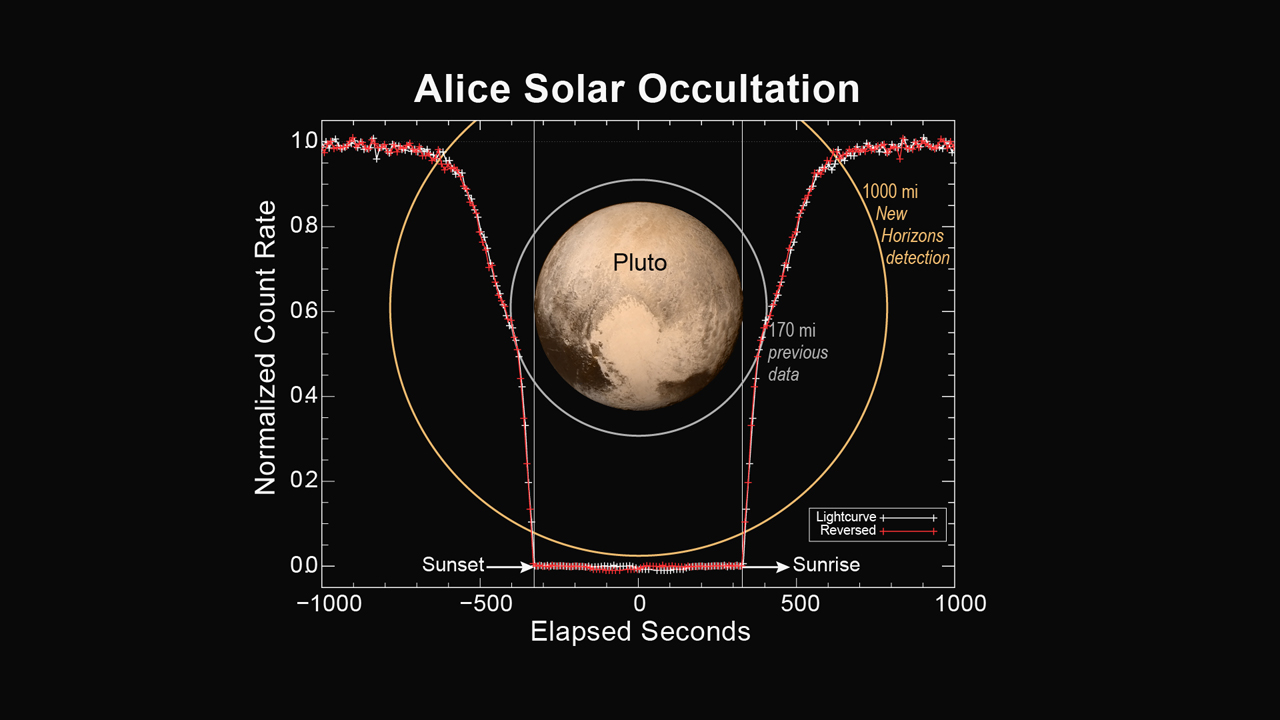
Data from the Alice ultraviolet instrument when Pluto occulted the Sun. Credits: NASA/JHUAPL/SwRI.
Click here for more information on this Alice observation.
07/28/2015 – Ephemeris – The first close up images of Pluto
Ephemeris for Tuesday, July 28th. The Sun rises at 6:24. It’ll be up for 14 hours and 49 minutes, setting at 9:13. The Moon, 3 days before full, will set at 4:32 tomorrow morning.
Two weeks ago the New Horizons spacecraft zipped through the Pluto system gathering a wealth of information including a whole host of images. Due to their large size the images will take some time to be sent back, however some highly compressed images have been returned and yield a tantalizing look at the dwarf planet Pluto and its large moon Charon. Rather than an apparently dead heavily cratered body, the first images presented a young surface with plains and mountains with nary a crater to be found. Young is relative, perhaps 100 million years old or so and implied heating where there appears no source to be found… yet. The first of many mysteries. And we have 16 months more of data and images to be returned.
Times are for the Traverse City/Interlochen area of Michigan. They may be different for your location.
Addendum
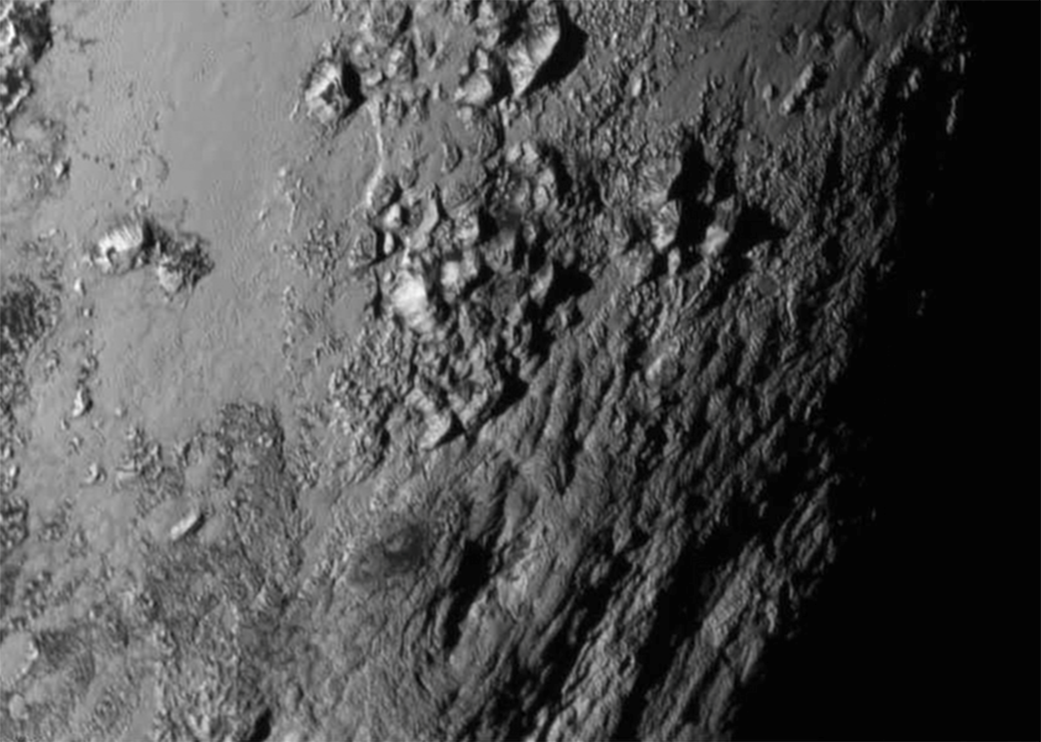
First closeup picture the New Horizon Team showed. Two mile high ice mountains, plains, and interesting terrain, but no craters. A young surface. Credit: NASA/Johns Hopkins University Applied Physics Laboratory/Southwest Research Institute. Click on image to enlarge.

Sputnik Planum (Plain) next to the ice mountains showing polygons and troughs, some with hills. This is part of Pluto’s “Heath”. Note the rectangular lossy compression artifacts in the image. An uncompressed version will be downlinked later. Credit: NASA/Johns Hopkins University Applied Physics Laboratory/Southwest Research Institute. Click on image to enlarge.
07/20/2015 – Ephemeris – July 20th anniversaries
Ephemeris for Monday, July 20th. Today the Sun will be up for 15 hours and 5 minutes, setting at 9:21. The Moon, 4 days before first quarter, will set at 11:34 this evening, and tomorrow the Sun will rise at 6:16.
July 20th is a special date for this country’s space program and a personal one. On July 20, 1969 Apollo 11 landed on the Moon, the greatest achievement in the history of space flight. Seven years later the robot lander Viking 1 landed on Mars. NASA wanted it to be July 4th, 1976, the Bicentennial, but couldn’t find a smooth landing site in time. My own connection to the date came in 1963, my first total solar eclipse. We traveled to Quebec province along side the St. Maurice River. To view 60 seconds of totality. It was the first of four successful total solar eclipse trips I’ve been on.. I’m looking forward to my 5th on August 21st 2017, two years from now which is related to my first, I’ll tell you about that in my blog.
Times are for the Traverse City/Interlochen area of Michigan. They may be different for your location.
Addendum

Neil Armstrong about to step off the LM onto the surface of the moon, July 20, 1969. Credit: NASA.

First image sent back from Viking 1 after landing on Mars, July 20, 1976. Credit: NASA/JPL. Click on image to enlarge.
Video of July 20, 1963 eclipse from the air. I got only one picture of the eclipse and it wasn’t very good. https://www.youtube.com/watch?v=OT3EW0KIjCc.
The date on the YouTube page is incorrect. It is July 20, 1963. I remember the corona being somewhat wedge-shaped, wider to one side than the other. Other than that it was a typical quiet sun corona.
In the program above I mentioned that the August 21, 2017 solar eclipse was related to my first total solar eclipse. This is the relationship: A couple of centuries BC the Chaldean astronomers of ancient Babylonia discovered that eclipses repeated in a cycle lasting 6,585 1/3 days. That’s 18 years 10 or 11 and 1/3 days depending on the number of leap years spanned. That period was called the Saros by Sir Edmund Halley or comet fame. So each eclipse would be visible 1/3 of the Earth farther west. Note that there are many Saros cycles occurring at the same time, and that eclipses of a particular Saros gradually move northward or southward. So to have an eclipse recur at the approximate same longitude one must wait 3 Saros cycles. or 54 years and one month approximately. Thus the third Saros of the July 20, 1963 total solar eclipse will be August 21, 2017. This Saros series (145) is moving southward. In 1963 it crosses the US at Alaska and Maine. Quebec was closer for us, s we went there. Good thing too. Maine was clouded and rained out. For us the clouds parted at the beginning of the eclipse. The 2015 eclipse will cross the continental US from Oregon to South Carolina.
A squished image of the July 20, 1963 eclipse path. Right click on the image and select view image to get a correct image. (works in Firefox).

A squished image of the August 21, 2017 eclipse path. Right click on the image and select view image to get a correct image. (works in Firefox).

07/07/2015 – Ephemeris – New Horizons will resume science gathering after glitch July 4th.
Ephemeris for Tuesday, July 7th. Today the Sun will be up for 15 hours and 25 minutes, setting at 9:30. The Moon, 1 day before last quarter, will rise at 12:56 tomorrow morning. Tomorrow the Sun will rise at 6:05.
On July 4th, the New Horizons spacecraft, now one week from is flyby of Pluto, suffered a glitch and went into safe mode. It, however switched to its backup computer, and is now in contact with the Earth. Sunday night it was determined that the problem was a timing flaw in a command sequence preparing for Pluto encounter. Normal spacecraft operations will resume today. Two way communication time is now nearly 9 hours, almost half a day. Earth day that is. New Horizons is approaching Pluto at 31,000 miles an hour. The spacecraft will have only a few hours to observe Pluto and its moons at their closest next Tuesday. It’s getting down to crunch time for the little spacecraft.
Times are for the Traverse City/Interlochen area of Michigan. They may be different for your location.
Addendum
I wrote Tuesday’s program Sunday night before the announcement that the problem with New Horizons was found and the spacecraft would back to normal on Tuesday. I found that out just before recording the programs, and had to do a quick fix. With New Horizons problems found, I could write the July 13th program I had planned. I write and record 5 programs at a time – Tuesday through Monday.

Artist’s rendition credit NASA.
06/18/2015 – Ephemeris – 26 days to Pluto!
Ephemeris for Thursday, June 18th. Today the Sun will be up for 15 hours and 34 minutes, setting at 9:31. The Moon, 2 days past new, will set at 10:57 this evening. Tomorrow the Sun will rise at 5:56.
I hope everyone’s been following the progress of the New Horizons spacecraft as it nears the Pluto system. It will reach and pass through the Pluto system on July 14th, only 26 days from now after a journey of 9 years. Now, Pluto is more than a dot in the probe’s cameras, which are used to look for possible hazardous rings of debris, more moons and for navigational purposes. New Horizons is aimed for a window less than a hundred miles on a side, and a few minutes in time. All its moves to study Pluto and its moons have been pre-programmed in and actually tested two years ago to make sure everything works. We will not hear from the spacecraft on encounter day, it will be too busy.
Times are for the Traverse City/Interlochen area of Michigan. They may be different for your location.
Addendum
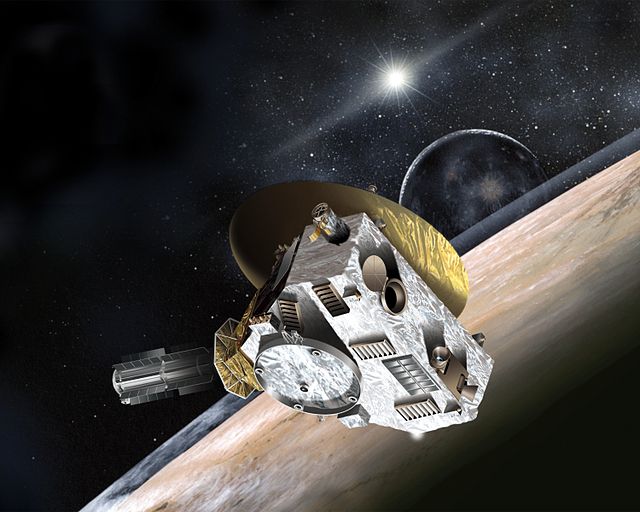
Artist conception of the New Horizons spacecraft at Pluto. Credit: NASA/Johns Hopkins University Applied Physics Laboratory/Southwest Research Institute
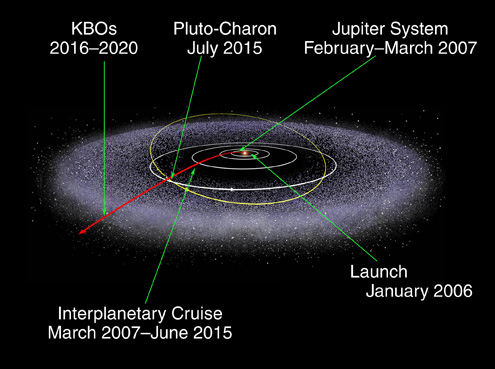
New Horizon’s trajectory through the solar system. Credit: NASA/APL.
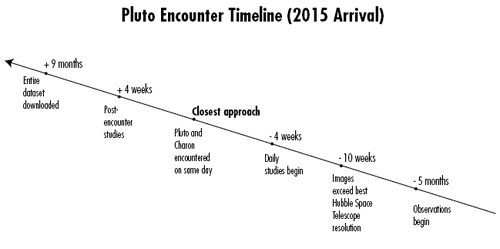
New Horizons Encounter Timeline. Credit: NASA/JHAPL.
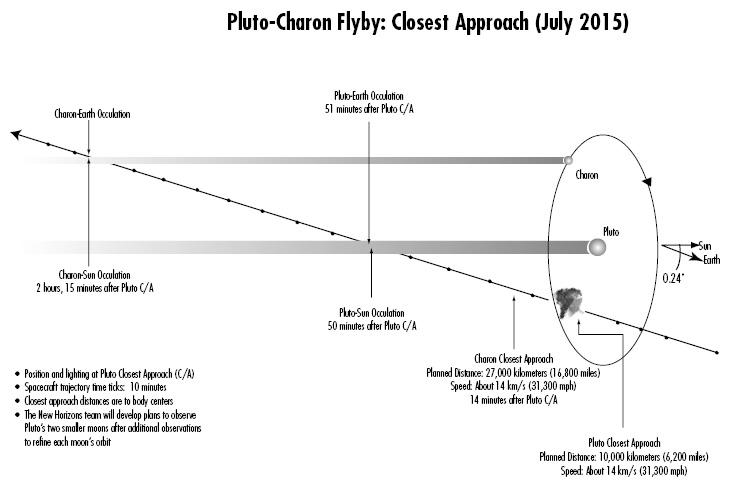
New Horizons at closest approach to Pluto. Credit: NASA/JHAPL.
05/07/2015 – Ephemeris – Mercury is at greatest eastern elongation today
Ephemeris for Thursday, May 7th. Today the Sun will be up for 14 hours and 30 minutes, setting at 8:54. The Moon, half way from full to last quarter, will rise at 12:20 tomorrow morning. Tomorrow the Sun will rise at 6:23.
The tiny planet Mercury has been in the news lately because the MESSENGER spacecraft plunged onto its surface a week ago, after having mapped and studied chemical composition of this planet for four years. Today, for Mercury watchers from the Earth, it reached its greatest angular separation from the sun in its orbit, of 21 degrees just before 1 a.m. Mercury has always been a tough planet to study, low to the horizon in twilight. It’s also a tough planet to get to with a spacecraft, being far down the Sun’s gravity well. MESSENGER took 7 years to get there, bleeding off energy by passing Earth, Venus and Mercury itself to fall into orbit of this little world that was full of surprises.
Times are for the Traverse City/Interlochen area of Michigan. They may be different for your location.
Addendum
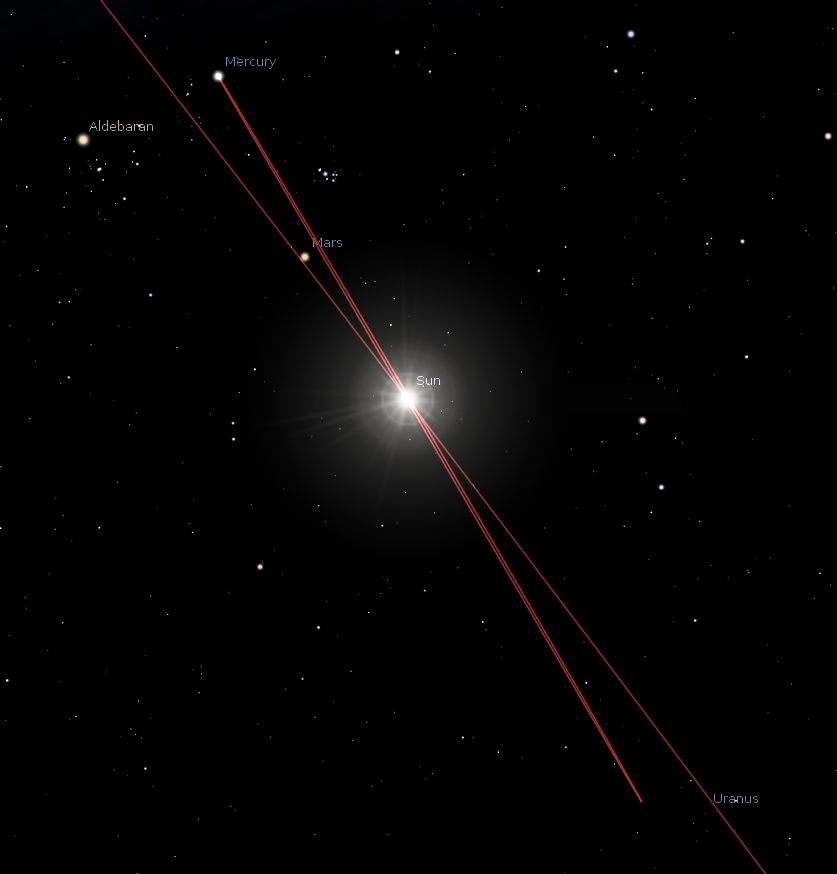
Mercury’s orbit as seen from about 45 degrees north latitude Earth at the greatest eastern elongation at sunset on May 7, 2015. Created using Stellarium.
°
The other red line is the plane of the Earth’s orbit. In the spring at sunset it is much closer to vertical than in autumn. The angle of the ecliptic to the horizon at sunset on the vernal equinox is 90° – (your latitude) + 23.5°. Here near 45° north latitude it’s 68.5°. For the sunset at the autumnal equinox the formula is 90° – (your latitude) – 23.5° or 21.5°. The ecliptic will really lay down making planets close to the direction of the Sun hard to spot. In the morning sky the ecliptic will be steep at the autumnal equinox and lay down at the vernal equinox. Thus the best time to spot Mercury, which never strays far from the sun is on late winter and spring evenings and late summer and autumn mornings. Also note that Mercury’s 7 degree inclination to the ecliptic helps it now.
Also note that we are seeing Mercury’s orbit nearly edge on. It will be edge-on in a couple of days. It so happens that a year from now, the morning of May 9th, 2016, for us in the United States, Mercury will transit, or cross in front of, the Sun. Three years ago this June we witnessed the extremely rare transit of Venus. The transit of Mercury isn’t as spectacular or rare, but it’s rare enough.
05/04/2015 – Ephemeris – Last good evening appearance of Mercury for the year*
Note: This program was recorded before the MESSENGER spacecraft crashed into Mercury.
Ephemeris for Monday, May 4th. Today the Sun will be up for 14 hours and 22 minutes, setting at 8:51. The Moon, 1 day past full, will rise at 9:29 this evening. Tomorrow the Sun will rise at 6:27.
The tiny and elusive planet Mercury will be making its final easily observable evening appearance of the year. For the next week or so. Not that Mercury is ever easy to spot. The MESSENGER spacecraft, which has been orbiting Mercury for the past four years is out of fuel and is descending to an impact any day now. It may already have. Mercury is the smallest planet only 50% larger than the diameter of our Moon. There are two planetary satellites larger than it: Jupiter’s Ganymede and Saturn’s Titan. It is a whole lot larger than Pluto, which was demoted to dwarf planet 9 years ago. Mercury is the second densest planet after the Earth. And even Venus with its greenhouse effect is hotter.
Times are for the Traverse City/Interlochen area of Michigan. They may be different for your location.
*For northern hemisphere viewers.
Addendum
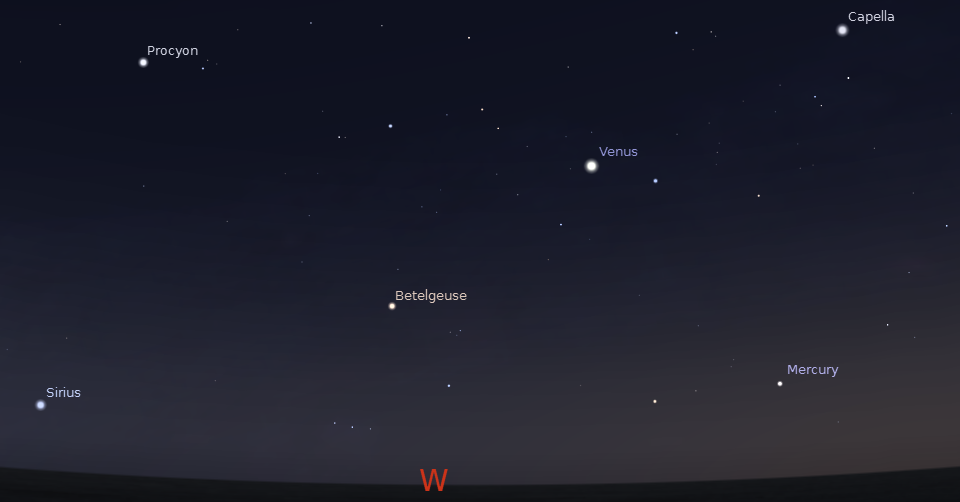
Mercury, Venus and the setting stars of winter at 10 p.m., May 4, 2015. Created using Stellarium.
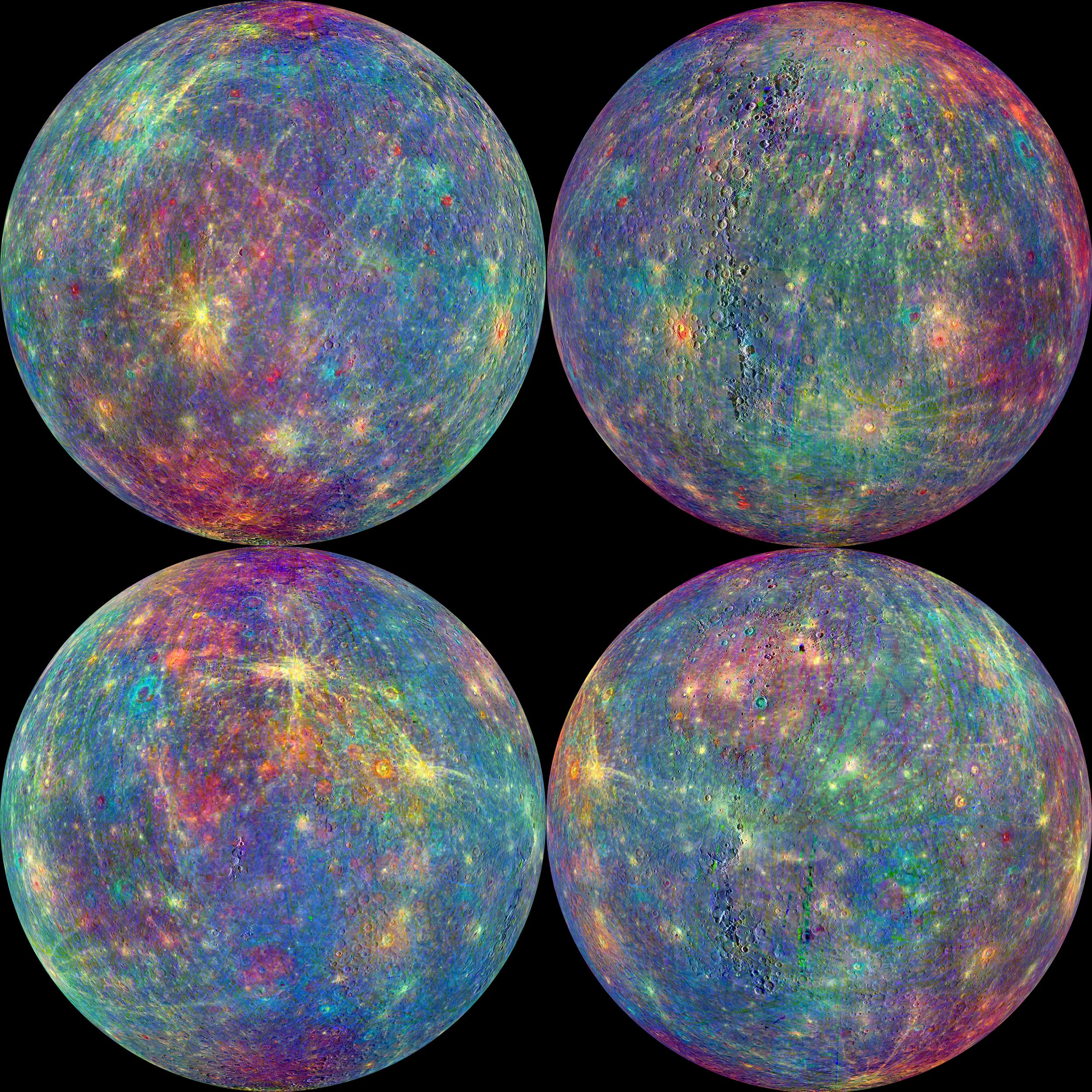
Four views of Mercury with colors based on the mineralogy seen. Credit: NASA/Johns Hopkins University Applied Physics Laboratory/Carnegie Institution of Washington. Click on image to enlarge.
 Bob Moler's Ephemeris Blog