Archive
MESSENGER’s in orbit of Mercury!
Just like clockwork! I’m looking for a year of new discoveries about this nearest planet to the sun.
They’re tweeting at http://www.twitter.com/messenger2011.
MESSENGER’s web site is at http://messenger.jhuapl.edu/.
NASA’s MESSENGER page is at http://www.nasa.gov/mission_pages/messenger/main/.
03/17/11 – Ephemeris – MESSENGER spacecraft arrives at Mercury tonight
Ephemeris for St. Patrick’s Day, Thursday, March 17th. The sun will rise at 7:51. It’ll be up for 11 hours and 59 minutes, setting at 7:50. The moon, 2 days before full, will set at 6:48 tomorrow morning.
This evening the MESSENGER Spacecraft will fire its main engine for 15 minutes to put itself in orbit of the planet Mercury. The rocket firing will be at 8:45 this evening. Due to light time delays caused by Mercury being 97 million miles away, we won’t know if the rocket fired until 8:54. While its high gain antenna won’t be pointed at earth, we should get a signal from its omni- directional antenna. We did get a signal from Cassini with its orbital insertion of Saturn in 2004, and that was nearly a billion miles away. I don’t know if NASA TV’s covering the insertion live, but Johns Hopkins Applied Physics Laboratory is having a live webcast. Google “messenger mercury live orbital insertion” It was the first hit. I’ll have the address on the blog. http://messenger.jhuapl.edu/mer_orbit.html
* Times are for the Traverse City/Interlochen area of Michigan. They may be different for your location.
What we used to know about Mercury
On Thursday evening, 8:45 p.m. March 17 EDT (12:45 a.m. March 18 UTC) the MESSENGER spacecraft will complete the second of NASA’s 2011 planetary trifecta when it will, if all goes well, fire its rocket engine to drop into orbit of the tiny planet Mercury. We’ve had six quick peeks at Mercury so far. Three by the Mariner 10 spacecraft in the 1970’s which looked at the same half of the planet due to Mercury’s unique rotational period. And three more by MESSENGER as it used Mercury to put on the breaks, so it would be going slow enough this time, so it’s rocket engine could drop it into polar orbit of the planet.
At first blush, Mercury looks like the moon. But it’s not. The moon is light, being made up, apparently, of mostly the crustal materials expelled by the earth and another Mars sized body. So it has a relatively small core. Mercury, on the other hand has a large core, and is the second densest planet at 5.43 grams per cubic centimeter. It’s only beaten out by the earth’s 5.52 g/cm3.
We’re going to learn a lot more about Mercury in the next year or so as MESSENGER maps Mercury and the complex interaction between it and the solar wind and magnetic field coming from the sun. Lets look back at the early history of our knowledge of Mercury.
It seems the that early Greeks noticed this elusive planet. They saw it in the morning sometimes, and then they saw it in the evening. At first they thought it was two separate planets that they gave the name Hermes in the evening and Apollo in the morning before they figured out that it was the same planet. The name Mercury we know the planet by today is the Roman equivalent of Hermes.
Another revelation came later. In my youth Mercury was thought to be in tidal lock with the sun, like our moon is to the earth. The rather poor markings found on the planet seen low in the sky at dusk and dawn seemed to bear that out an 88 day rotation to match its 88 day revolution of the sun. It wasn’t until 1965 that radar observations proved that the rotation was 2/3 of 88 days. Every 2 orbits of the sun Mercury rotates 3 times. It seems that the best times to spot Mercury are when it’s in the same part of its orbit, but basically every other return to that spot. Funny thing. The northern hemisphere’s best views of Mercury are for its eastern elongation on spring evenings and western elongations on autumn mornings. In effect we’re viewing Mercury at the same point in its orbit, when it is near its perihelion, when it is closest to the sun. The southern hemispheric observers get to see more favorable views of Mercury, when it’s farthest from the sun.
As we’ve found with all the planets that we’ve gotten a close look at, the generalities of our long-standing ignorance is brushed away. Each planet is its own unique place in the sun.
Taken from my March, 2011 article in the Stellar Sentinel,the newsletter of the Grand Traverse Astronomical Society.
Here is the MESSENGER web page. This mission is run for NASA by the Johns Hopkins Applied Physics Laboratory.

MESSENGER’s First Look at Mercury’s Previously Unseen Side
Credit: NASA/Johns Hopkins University Applied Physics Laboratory/Carnegie Institution of Washington
Phil Plait has a great video of the STS133 Launch
From Phil Plait’s Bad Astronomy blog comes a great Video taken from several cameras on the solid rocket boosters (SRBs). The greatest sight for me was to see from the aft cameras the shuttle orbiter and the fuel tank depart after the SRB’s were jettisoned. Here’s a screen cap from the left aft SRB camera. Check out the entire video. There’s only one or two launches left.
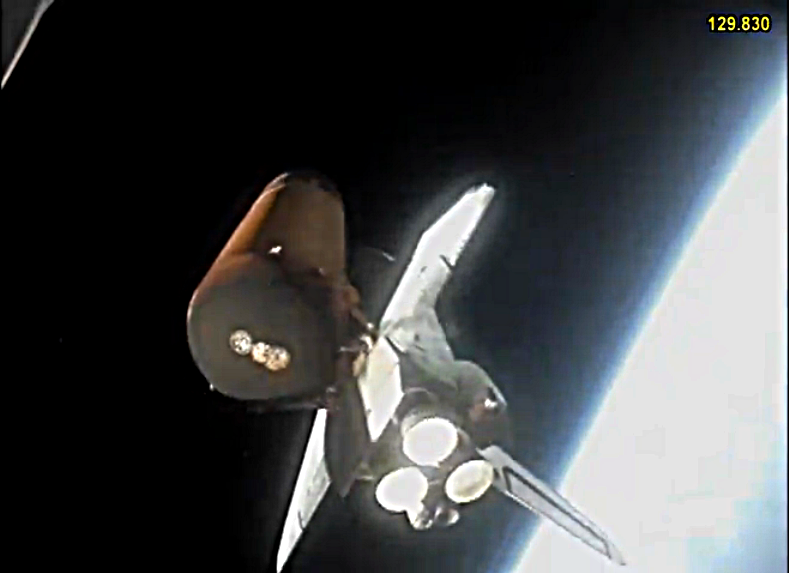
STS133 orbiter and fuel tank leaving the booster behind
Image credit NASA.
02/17/11 – Ephemeris – The whole sun is visible now
Thursday, February 17th. The sun will rise at 7:39. It’ll be up for 10 hours and 33 minutes, setting at 6:13. The moon, 1 day before full, will set at 7:24 tomorrow morning.
Four and a half years ago NASA launched a two spacecraft on a single rocket. One was sent ahead of the earth, and the other to trail behind the earth in its orbit. They are called Stereo, and give us a stereo view of the sun. Earlier this month they reached points 90 degrees ahead and behind the earth. They now cover the complete sun, front and back. For the next 9 years we should get coverage of the far side of the sun, so we’ll see what’s brewing in the way of sunspots and other solar phenomena before they rotate around to the side that faces the earth. The sun rotates slowly, and as a fluid body. At the equator the sun rotates in 25 days, at the poles it drops to 36 days. This differential rotation causes the sun’s magnetic field to tangle and break.
* Times are for the Traverse City/Interlochen area of Michigan. They may be different for your location.
Smile! – Comet Tempel 1 gets its retakes
Wow! I was tipped off by Emily Lackdawalla‘s Planetary Society Blog. She found the image of the Deep Impact site. I pulled the image from the JPL site, enlarged it, tweaked the brightness levels, and sharpened it a bit.
I got the impact site wrong, since it hadn’t been pointed out yet. I thought it was that bright spot, definitely not visible in the 2005 images. In perusing the press conference images several hours later I saw the real impact. A low crater that blends with the color and terrain around it. It goes to show how fast the dust liberated by the comet’s out gassing covers the surface of the comet. I’d bet it we ever pass the comet next time around the fresh impact would be covered too.
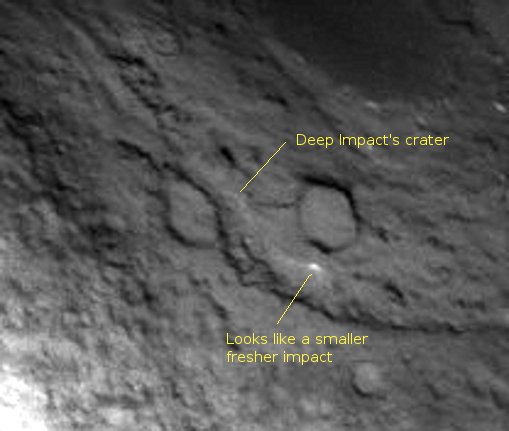
Impact crater on Comet Tempel 1. Credit: NASA/JPL-Caltech/Cornell. Image enhanced and annotated by Bob Moler
02/15/11 – Ephemeris – Kepler discoveres lots of planets
Tuesday, February 15th. The sun will rise at 7:43. It’ll be up for 10 hours and 27 minutes, setting at 6:10. The moon, 3 days before full, will set at 6:20 tomorrow morning.
Two weeks ago NASA announced the discovery of a possible 12 hundred and 35 planets around other stars discovered by the Kepler spacecraft mission, which has been staring at a single patch of the Milky Way for nearly two years. It found 5 earth-like planets in the habitable zones of their stars. It’s finding planets by their passage in front of their stars, something astronomers call transits. A very useful technique but only a few percent of star systems are so perfectly oriented to our line of sight to produce these transits. Most of these finds have to be verified by the Doppler wobble method of the planet’s effects of the motion of the star itself. Kepler even found a six planet system all orbiting within a few million miles of their star.
* Times are for the Traverse City/Interlochen area of Michigan. They may be different for your location.
02/14/11 – Ephemeris – Stardust-NExT reaches Comet Tempel 1 tonight
St Valentine’s Day, Monday, February 14th. The sun will rise at 7:44. It’ll be up for 10 hours and 24 minutes, setting at 6:09. The moon, 3 days past first quarter, will set at 5:41 tomorrow morning.
About 11:40 this evening the Stardust spacecraft will pass about 120 miles from comet Tempel 1’s nucleus. It’s happening over 200 million miles away, near Mars’ distance from the sun. The spacecraft will take 72 pictures as it speeds past the comet at over 24,000 miles an hour. By tomorrow morning many of the photographs should be available on the Internet and TV. On Tempel 1’s last approach to Mars’ orbit it was struck bu a big chunk of copper when the Deep Impact spacecraft’s impactor struck the comet’s nucleus. That was July 4th, 2005. This time the Stardust-NExT mission is interested in changes in the comet that have occurred over the orbit, and it’s looking for the crater left by Deep Impact.
* Times are for the Traverse City/Interlochen area of Michigan. They may be different for your location.
01/27/11 – Ephemeris – Mars at superior conjunction
Thursday, January 27th. The sun will rise at 8:06. It’ll be up for 9 hours and 37 minutes, setting at 5:44. The moon, 1 day past last quarter, will rise at 3:46 tomorrow morning.
Starting today the planet Mars will be too close to the direction of the sun to send commands from the earth to Opportunity rover and satellites orbiting it.. The sun is noisy in the radio spectrum. This is seen in the spring and fall when geosynchronous satellite signals are lost when the satellite passes in front of the sun. This blackout isn’t total. The Mars Odyssey orbiter will be receiving data from te rover daily and relaying it back to the earth but at a very slow bit rate. The disruption of communications will last two weeks centered on February 4th when Mars will seem pass two sun diameters south of the sun. In reality it will be 129 million miles behind the sun. and 221 million miles from the earth.
* Times are for the Traverse City/Interlochen area of Michigan. They may be different for your location.
01/18/11 – Ephemeris – Antimatter from thunderstorms
Tuesday, January 18th. The sun will rise at 8:14. It’ll be up for 9 hours and 17 minutes, setting at 5:31. The moon, 1 day before full, will set at 7:51 tomorrow morning.
The Fermi gamma ray satellite has detected gamma rays from an unusual source. The Earth. Specifically from thunder storms. That isn’t the weird part. The gamma rays produced in the storm interact with electrons in the upper atmosphere producing a positron-electron pair that tangles with the earth’s magnetic field where Fermi detects it. Positrons are anti-electrons which can be produced artificially on the earth, and are used in medical PET scans. While scientists know how lightning is produced in a general way they do not know deep down the exact mechanism that produces lightning. That goes for thunderstorms on the earth and lightning in the atmospheres of the other planets. Lightning is still a mysterious phenomenon.
* Times are for the Traverse City/Interlochen area of Michigan. They may be different for your location.
 Bob Moler's Ephemeris Blog