Archive
Ephemeris: 01/21/2025 – How to find the Great Orion Nebula
This is Ephemeris for Tuesday, January 21st. Today the Sun will be up for 9 hours and 24 minutes, setting at 5:36, and it will rise tomorrow at 8:11. The Moon, at last quarter today, will rise at 2:01 tomorrow morning.
The constellation Orion the hunter is in the southeast at 8 PM. Its rectangle of four stars lean to the left and frame his belt of three stars in a straight line in the center of the rectangle. Below the belt is what appear to the unaided eye as three more stars arranged in a shorter straight line, his sword. Binoculars aimed at the middle stars of the sword will find a glowing haze around those stars. That is the Great Orion Nebula, also known as Messier 42 or M 42. It is the birthplace of stars, illuminated by a clutch of four hot young stars. Besides stars and protostars being born in the nebula, there are also many double planets not belonging to stars discovered by the James Webb Space Telescope. The planets are only detectable in the infrared, Webb’s specialty.
The astronomical event times given are for the Traverse City/Interlochen area of Michigan (EST, UT – 5 hours). Times will be different for other locations.
Addendum
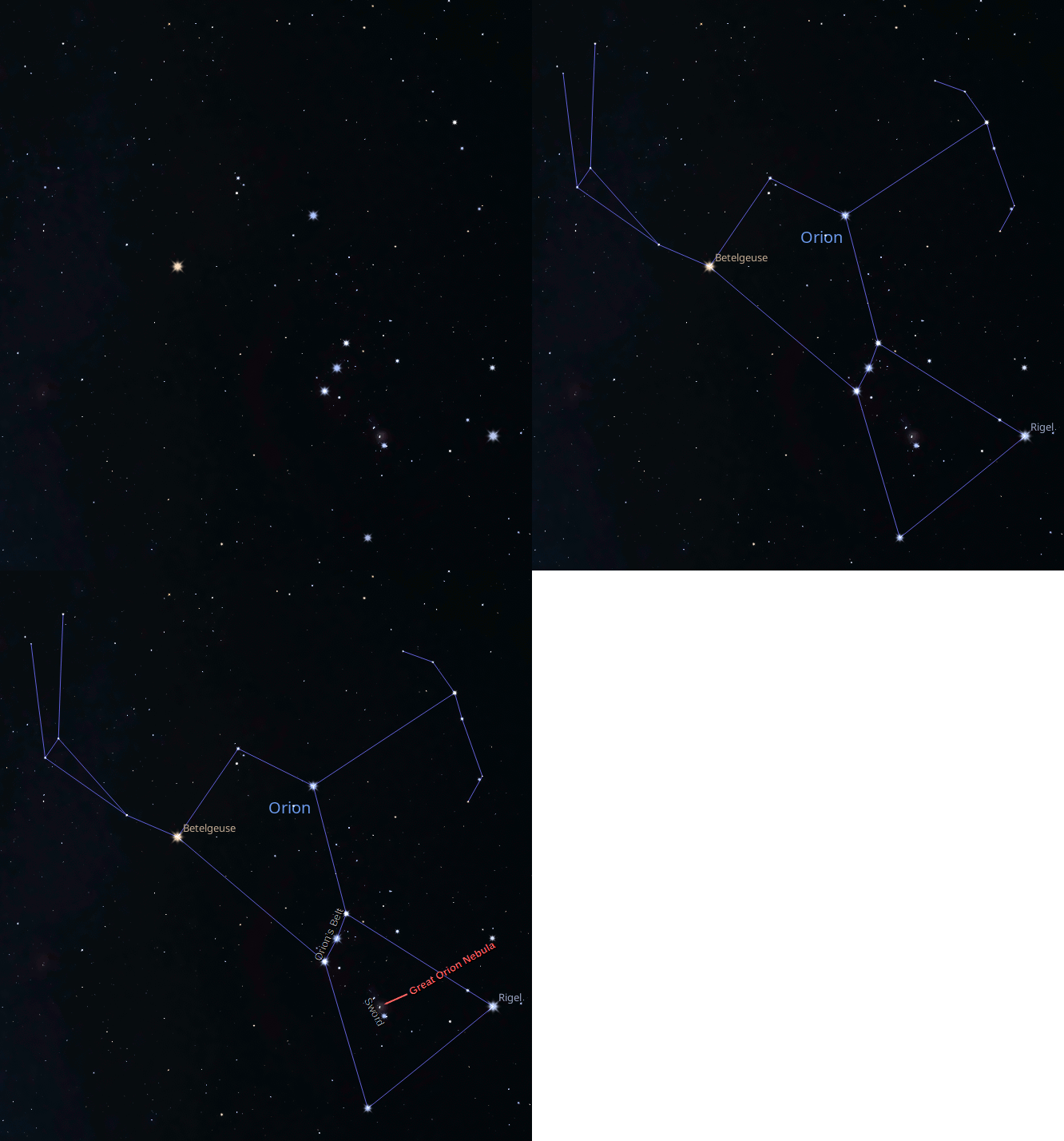
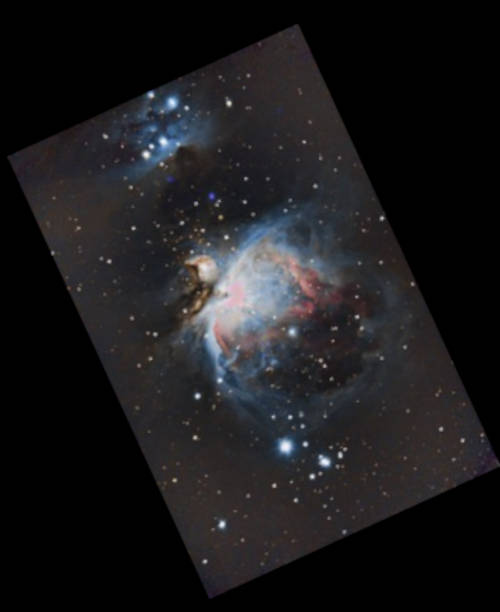
The blog’s archive has many other posts about the Great Orion Nebula and other nebulae in Orion.
Ephemeris: 01/05/2024 – The Great Orion Nebula
This is Ephemeris for Friday, January 5th. The Sun will rise at 8:20. It’ll be up for 8 hours and 56 minutes, setting at 5:16. The Moon, 2 days past last quarter, will rise at 3:18 tomorrow morning.
The constellation Orion the hunter is in the south-southeast at 9 p.m. Its upright rectangle of four stars frame his belt of three stars in a straight line and still tilt a bit to the left. Below the belt is what appear to the unaided eye as three more stars arranged vertically, his sword. Binoculars aimed at the middle stars of the sword will find a glowing haze around those stars. That is the Great Orion Nebula, also known as Messier 42 or M42. It is the birthplace of stars, and is even illuminated by a clutch of four hot young stars. Besides stars and protostars being born in the nebula, there are also many double planets not belonging to stars discovered by the James Webb Space Telescope. The planets are only detectable in the infrared, Webb’s specialty.
The astronomical event times given are for the Traverse City/Interlochen area of Michigan (EST, UT –5 hours). They may be different for your location.
Addendum
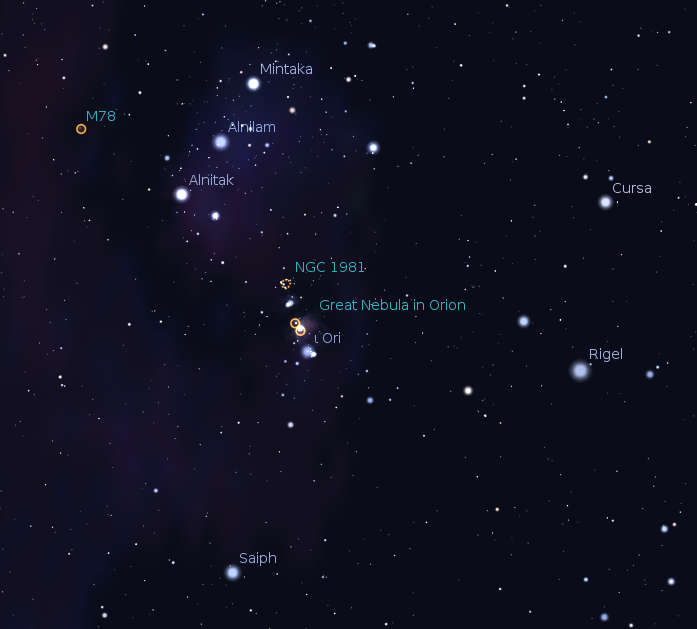
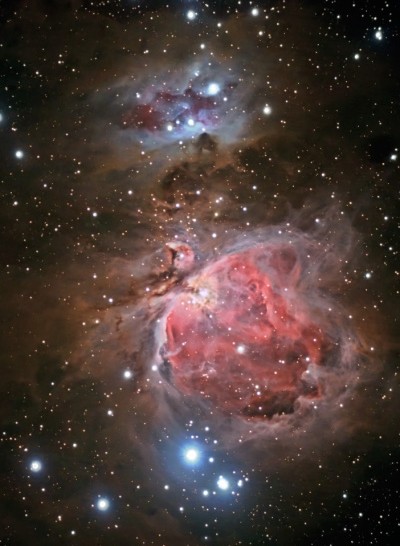
01/24/2022 – Ephemeris – The Great Orion Nebula
This is Ephemeris for Monday, January 24th. Today the Sun will be up for 9 hours and 30 minutes, setting at 5:40, and it will rise tomorrow at 8:09. The Moon, 1 day before last quarter, will rise at 1:03 tomorrow morning.
The closest star nursery to us, places where stars are being born, is the Great Orion Nebula, 1,300 light years away. A light year is about 6 trillion miles, if you want to pace it out. It’s located in the constellation Orion’s sword that hangs below his belt. In as little as a pair of binoculars, it shines by emission and reflection of the light of a tiny clutch of four stars at its heart, which astronomers have called the Trapezium. These extremely hot young massive stars are not destined to live long. Unlike the Sun’s 10 billion year lifetime, these stars lifespans will be measured in millions of years. Yet do not mourn for them, even now stars are forming within their dusty cocoons in the nebula. The Trapezium stars’ deaths will provide heavy elements for new stars and planets.
The astronomical event times given are for the Traverse City/Interlochen area of Michigan (EST, UT – 5 hours). They may be different for your location.
Addendum
The lower part of Orion, with the Great Orion Nebula. Created using Stellarium.
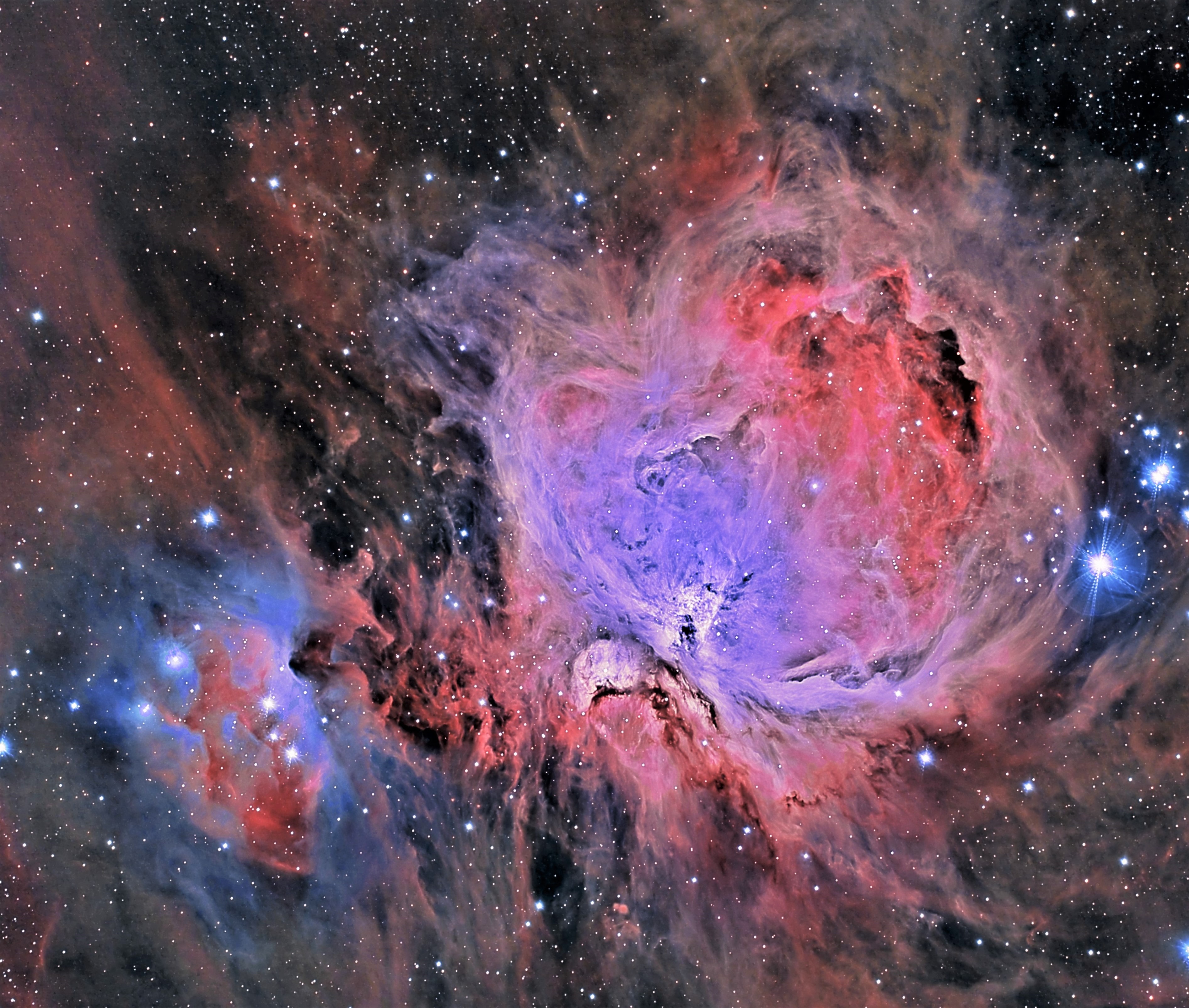
The Great Orion Nebula (M42) long exposure photograph by Scott Anttila. Includes all the sword stars.
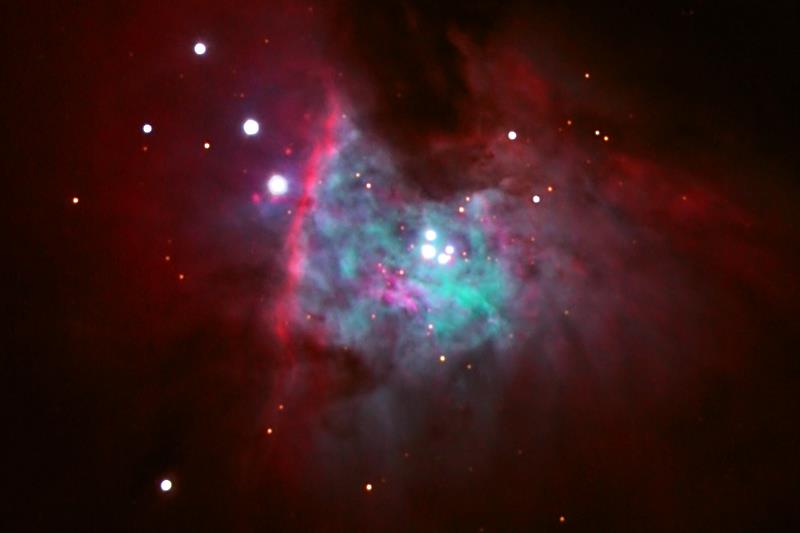
The inner and brightest part of the Great Orion Nebula. Also, visible are the four stars of the Trapezium, whose ultraviolet emissions light up the nebula. This is pretty much one’s perception of the nebula as seen in a small telescope, except it would appear colorless. In larger telescopes, one would perceive a greenish color. The red color of hydrogen is outside our night adapted visual range. The green emission is due to mainly doubly ionized oxygen and the green emission of hydrogen. Image by Scott Anttila.
10/05/2021 – Ephemeris – Can you spot the North American Nebula?
This is Bob Moler with Ephemeris for Tuesday, October 5th. Today the Sun will be up for 11 hours and 29 minutes, setting at 7:15, and it will rise tomorrow at 7:47. The Moon, 1 day before new, will rise at 7:46 tomorrow morning.
Most of what we see in the Milky Way are just masses of stars, but there are bright clouds of gas, or to name them properly: emission nebulae. These bright clouds are areas of star formation. It is the ultraviolet light from young massive stars that light up the clouds they were formed from. A bright one, easily visible in binoculars, is just about overhead at 9 p.m. Called the North American Nebula, a glow, that in photographs is shaped much like our continent, is just east of the star Deneb which is practically overhead in the evening. Deneb is the northernmost star of the Summer Triangle, and brightest star in Cygnus the swan or Northern Cross. There are many other nebulae in the Milky Way, visible in binoculars and small telescopes. Many enjoyable hours can be spent sweeping the Milky Way for nebulae and star clusters.
The astronomical event times given are for the Traverse City/Interlochen area of Michigan (EDT, UT-4 hours). They may be different for your location.
Addendum
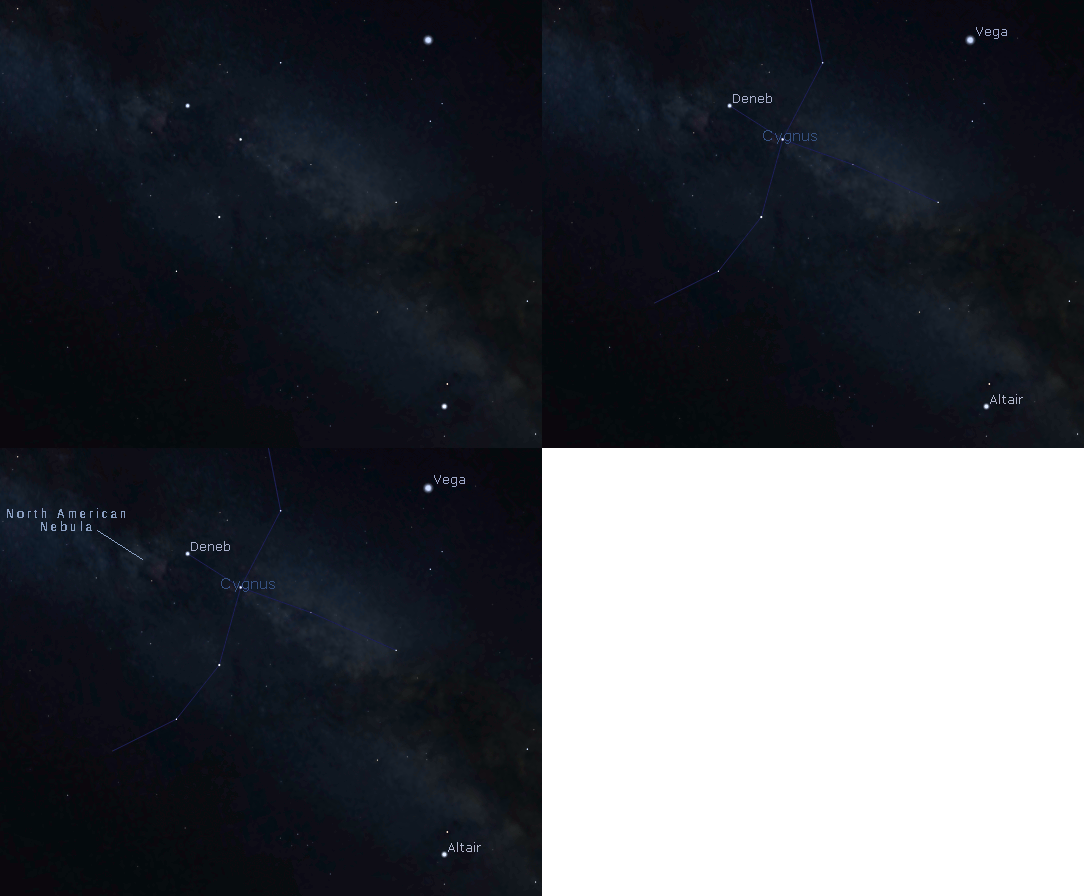
North American Nebula finder animation. I’ve dimmed down the stars a bit and increased the brightness of the Milky Way to aid in spotting the nebula. It requires dark skies to see it. I believe I can make it out with the naked eye too. Click on the image to enlarge it. Created using Stellarium and GIMP.
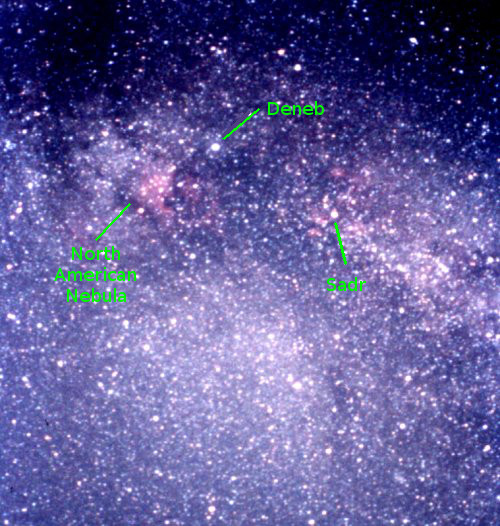
One of my old photographs of Deneb and the North American Nebula, digitized from a slide.
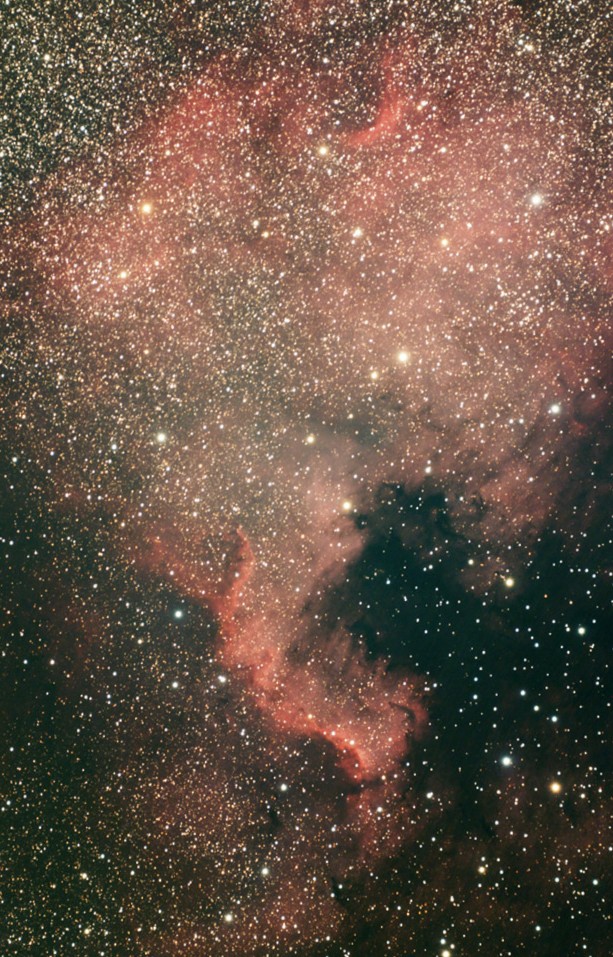
Better view of the North American Nebula taken by Scott Anttila.
02/14/2019 – Ephemeris – How about a heart shaped nebula for Valentine’s Day
Ephemeris for St Valentine’s Day, Thursday, February 14th. Today the Sun will be up for 10 hours and 24 minutes, setting at 6:09, and it will rise tomorrow at 7:43. The Moon, 2 days past first quarter, will set at 4:18 tomorrow morning.
Nebulae, or clouds of gas and dust, sometimes have shapes when seen in telescopes that remind us of familiar objects, like the Horsehead nebula, the North American Nebula, the Saturn Nebula and so on. So on Valentine’s day I’ll direct you to nebula IC 1805, the Heart Nebula. In the center of the nebula is a nest of stars, many of which are massive with strong stellar winds that blew out the original birth cloud which collided into other clouds of gas to shape it into a rough heart from our vantage point. The color for Valentine’s day is red. Red is the nebula’s true color, it’s the primary color the element hydrogen gives off when excited. In this case excited by those hot young stars in its center.
The times given are for the Traverse City/Interlochen area of Michigan. They may be different for your location.
Addendum
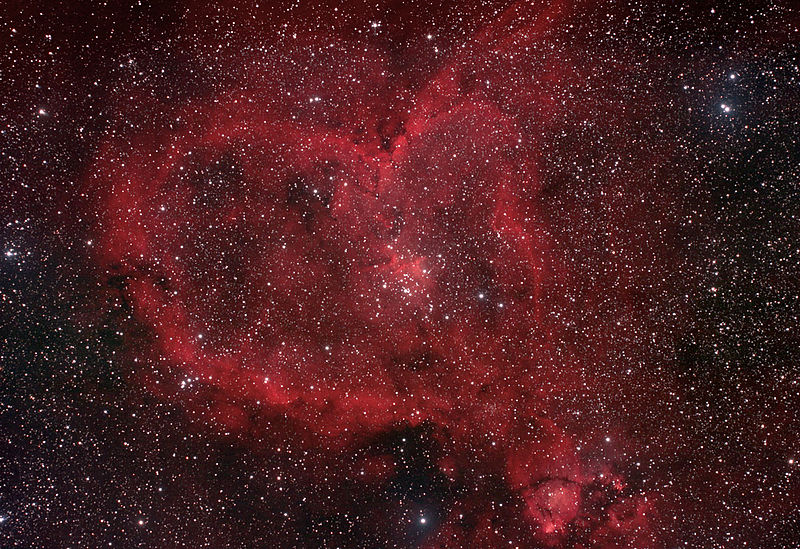
IC 1805 (Heart Nebula) Credit: s58y [CC BY 2.0 (https://creativecommons.org/licenses/by/2.0)%5D, via Wikimedia Commons
02/05/2019 – Ephemeris – The Great Orion Nebula
Ephemeris for Tuesday, February 5th. Today the Sun will be up for 9 hours and 59 minutes, setting at 5:56, and it will rise tomorrow at 7:56. The Moon, 1 day past new, will set at 6:47 this evening.
The closest star nursery to us is the Great Orion Nebula, 1,344 light years away give or take 20 light years. A light year is about 6 trillion miles, if you want to pace it out. It’s located in the constellation Orion’s sword that hangs below his belt. In as little as a pair of binoculars it shines by emission and reflection of the light of a clutch of four stars at its heart, that astronomers have called the Trapezium. These extremely hot baby stars are not destined to live long. Unlike the Sun’s 10 billion year life time these stars lifespan will be measured in millions of years. Yet do not mourn for them, Even now stars are forming in their dusty cocoons in the nebula. The Trapezium stars death will provide the material for new stars.
The times given are for the Traverse City/Interlochen area of Michigan. They may be different for your location.
Addendum
The lower part of Orion with the Great Orion Nebula. Created using Stellarium.
The Great Orion Nebula (M42) long exposure photograph by Scott Anttila. Includes all the sword stars.
The Trapezium stars in the inner part of the Great Orion Nebula. Image by Scott Anttila
01/30/2017 – Ephemeris – Can you really see a unicorn?
Ephemeris for Monday, January 30th. The Sun will rise at 8:03. It’ll be up for 9 hours and 45 minutes, setting at 5:49. The Moon, 3 days past new, will set at 8:58 this evening.
Among all the constellations in the sky of animals real and mythical, there is also a unicorn. It’s called Monoceros, and inhabits the southern sky at 9 p.m. bounded by Orion on the right, Canis Major, the great dog below and Canis Minor, the little dog to the left. Unfortunately for observers without optical aid Monoceros, though large, is devoid of any but the faintest stars. Maybe that’s why no one sees unicorns anymore. It has many faint stars because the Milky Way runs through it. To the telescope it is a feast of faint nebulae or clouds of gas and dust, the birth place of stars, including the red rose of the Rosette Nebula, and the strange and tiny Hubble’s Variable Nebula. It contains no bright stars, but a wealth of wonders below naked eye visibility.
Times are for the Traverse City/Interlochen area of Michigan. They may be different for your location.
Addendum
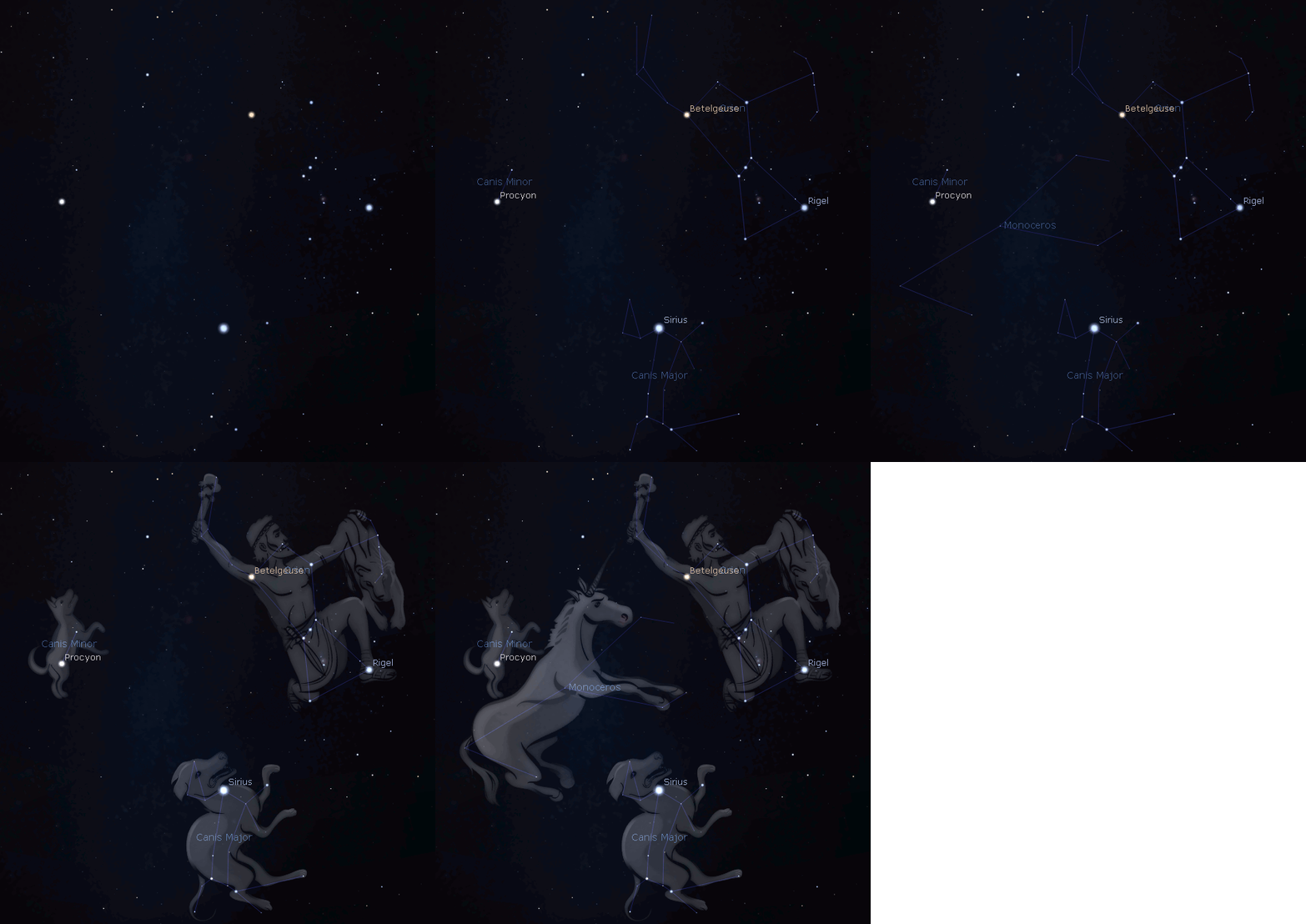
Monoceros finder chart animation. Created using Stellarium and GIMP.
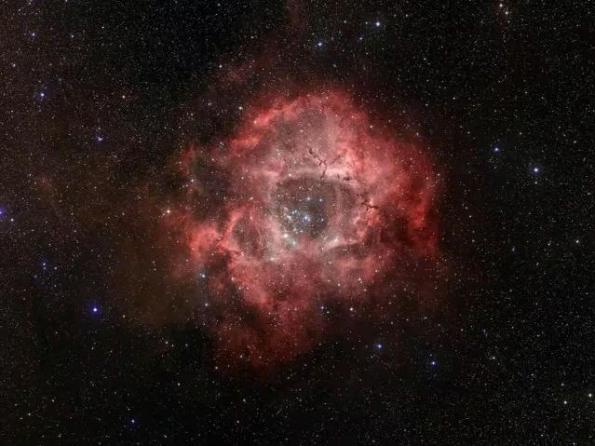
Rosette Nebula in the infrared from the Spitzer Space Telescope. Credit: NASA/JPL/Caltech.
I’ve never seen it visually through a telescope. However the inner star cluster, NGC 2244 is visible. The nebula is NGC 2239.
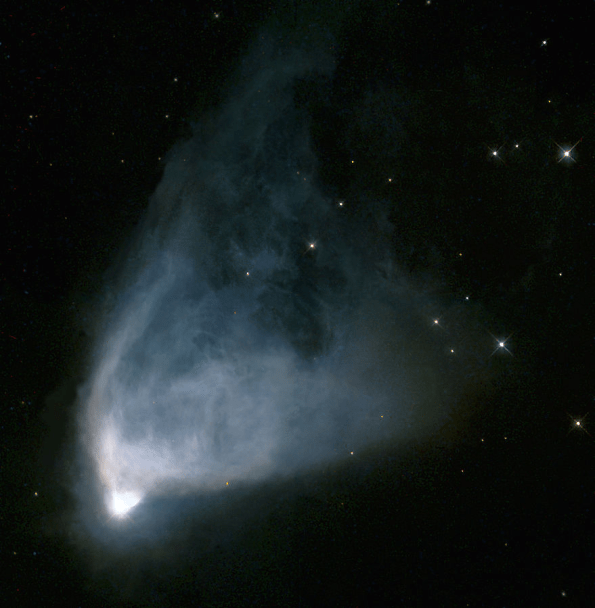
Hubble’s Variable Nebula NGC 2261 photographed appropriately enough by the Hubble Space Telescope. Credit: NASA/ESA and The Hubble Heritage Team (AURA/STScI).

Another nebula: The Cone Nebula, NGC 2264, as seen with the Hubble Space Telescope. Kind of looks like eggs in an eagle’s nest Credit ESA/Hubble.
The mentioned NGC objects can be found with a good star atlas or the free program Cartes du Ciel via the link on the right.
01/16/2017 – Ephemeris – The bright cloud in Orion, the Great Orion Nebula
Ephemeris for Martin Luther King Day, Monday, January 16th. The Sun will rise at 8:15. It’ll be up for 9 hours and 14 minutes, setting at 5:30. The Moon, 3 days before last quarter, will rise at 10:30 this evening.
The constellation Orion the hunter, which is in the south-southeast at 9 p.m., is the brightest of constellations with 2 first magnitude stars and 5 second magnitude stars in its torso. Orion’s most famous feature is the Great Orion Nebula which lies in and around the stars of his sword. It is bright, and lies about 1,344 light years away. By the way, the word nebula is Latin and means cloud or haze. The plural of nebula is nebulae. It can be seen with binoculars as a haze around what to the naked eye looks like the center of the three stars of Orion’s sword. It is the lit end of a large dark cloud where stars are being formed. It is illuminated by a clutch of four young stars in a tiny group called the Trapezium.
Times are for the Traverse City/Interlochen area of Michigan. They may be different for your location.
Addendum
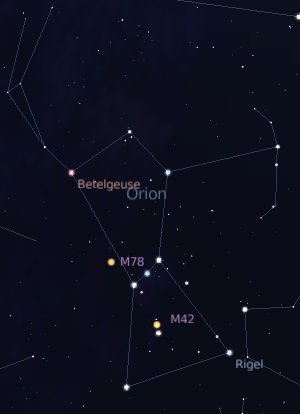
Orion with two nebulae. The Great Orion Nebula is M42. M78 is another small nebula. Created using Stellarium.
The Great Orion Nebula (M42) long exposure photograph by Scott Anttila. Includes all the sword stars.
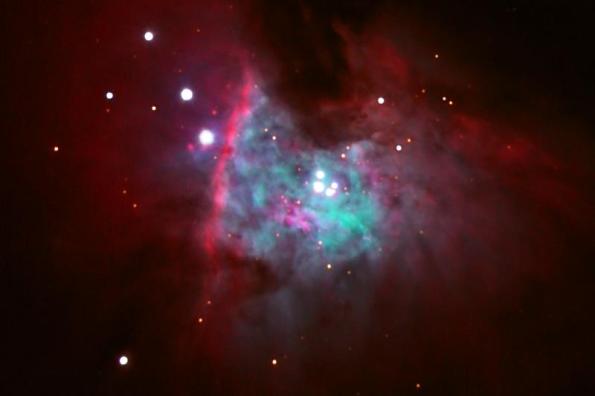
Inner part of the Great Orion Nebula with the four stars of the Trapezium. Image by Scott Anttila.
02/08/2016 – Ephemeris – The celestial unicorn
Ephemeris for Monday, February 8th. The Sun will rise at 7:53. It’ll be up for 10 hours and 6 minutes, setting at 6:00. The Moon is new today, and won’t be visible.
Among all the constellations in the sky of animals real and mythical, there is also a unicorn. It’s called Monoceros, and inhabits the southeastern sky at 9 p.m. bounded by Orion on the right, Canis Major, the great dog below and Canis Minor, the little dog to the left. Unfortunately for observers without optical aid Monoceros, though large, is devoid of bright stars. Maybe that’s why no one sees unicorns anymore. It has many faint stars because the Milky Way runs through it. To the telescope it is a feast of faint nebulae or clouds of gas and dust, the birth place of stars, including the red rose of the Rosette Nebula whose central star cluster can be seen in a telescope but the nebulosity requires a camera to capture and store its light.
Times are for the Traverse City/Interlochen area of Michigan. They may be different for your location.
Addendum
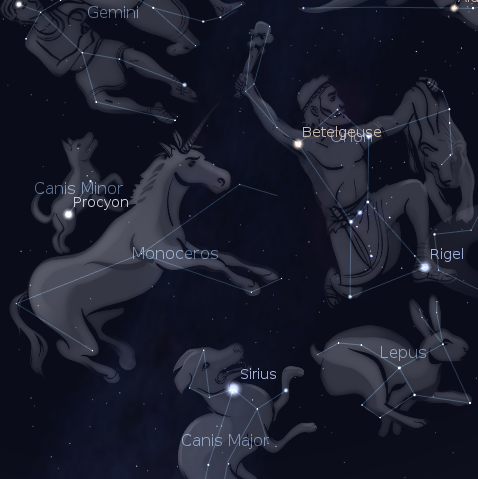
Monoceros the unicorn. Created using Stellarium.
Rosette Nebula in the infrared from the Spitzer Space Telescope. Credit: NASA/JPL/Caltech
02/04/2016 – Ephemeris – Orion is visible from everywhere
Ephemeris for Thursday, February 4th. The Sun will rise at 7:58. It’ll be up for 9 hours and 56 minutes, setting at 5:55. The Moon, half way from last quarter to new, will rise at 5:21 tomorrow morning.
The constellation of Orion the hunter is now due south at 9 p.m. It is an upright rectangle of bright stars, the shoulders and knees of this giant. In the center are three stars in a straight line, his belt, and from his belt hangs a sword. Orion is the most famous of all constellations world-wide, due to its bright stars, and straddles the celestial equator, so that it is visible at least in part from pole to pole. It contains the closest star forming region to us, the Great Orion Nebula seen easily in his sword with binoculars or small telescope. The Horse Head Nebula is found below the left belt star, but only in photographs. Another photographic feature is Barnard’s Loop, the partial shell of an ancient supernova to the left of Orion.
Times are for the Traverse City/Interlochen area of Michigan. They may be different for your location.
Addendum
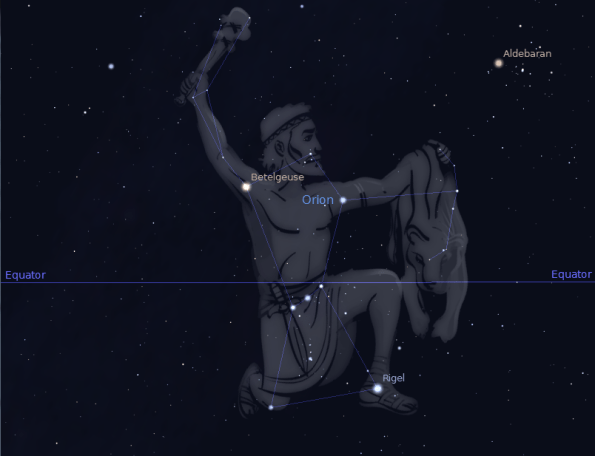
Orion from mid latitudes north of the equator. Orion would be upside down if viewed south of the equator. Created using Stellarium.
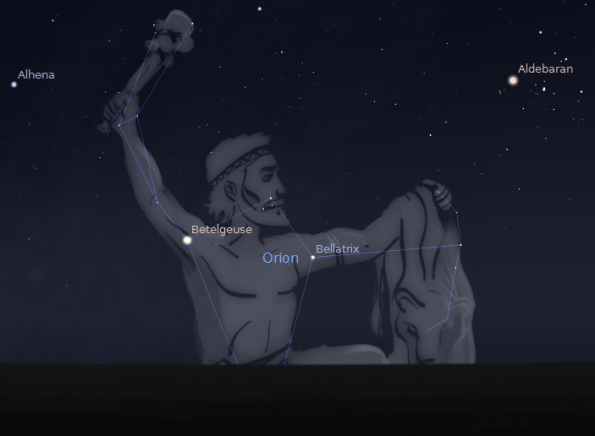
Orion from near the north pole. Created using Stellarium.
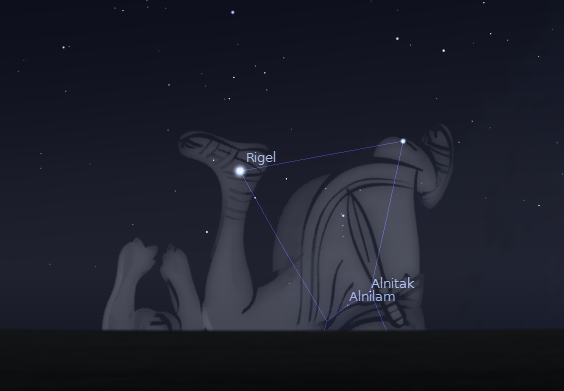
Orion from near the south pole. Created using Stellarium.
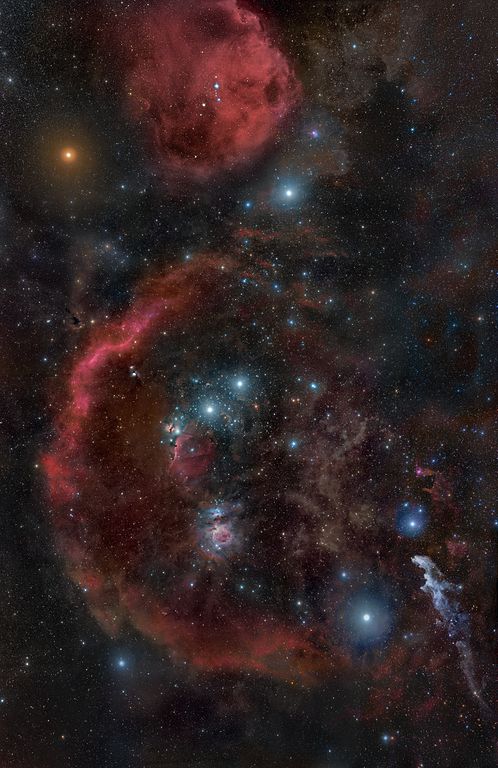
The nebulae in Orion including the Great Orion Nebula in the sword, the Horse Head Nebula below the leftmost star of Orion’s Belt named Alnitak. Barnard’s loop is the big arc on the left. Just above Alnitak is the Flame Nebula, I neglected to mention it in the program. It can be spotted in a telescope, especially if Alnitak is moved off the edge of the field of view. Credit Rogelio Bernal Andreo, via Wikipedia.
Note the nebula at the lower right. It’s the Witch’s Head Nebula, which I believe is shown brighter than it actually is. It’s being illuminated by the blue giant star Rigel to the left of it.
 Bob Moler's Ephemeris Blog