Archive
03/10/2015 – Ephemeris – The Great Orion Nebula
Ephemeris for Tuesday, March 10th. The Sun will rise at 8:04. It’ll be up for 11 hours and 37 minutes, setting at 7:42. The Moon, 3 days before last quarter, will rise at 12:43 tomorrow morning.
The constellation of Orion the hunter, now in the south at 9 p.m., contains the most beautiful star forming region in the northern sky. It is the Great Orion Nebula. A nebula is simply a cloud. Back in the early days of telescopes it was anything that appeared fuzzy. Today it’s any cloud, whether of gas or dust, light or dark. The Great Orion Nebula is made up of gas, which is ionized and shines by fluorescence by the ultraviolet light of a clutch of four stars in its heart called the Trapezium. The nebula can be glimpsed with binoculars surrounding what looks like the center star of the vertical line of three stars that appears as the sword hanging from Orion’s belt. It’s the bright end of a large dark cloud that’s behind the bright stars of Orion.
Times are for the Traverse City/Interlochen area of Michigan. They may be different for your location.
Addendum
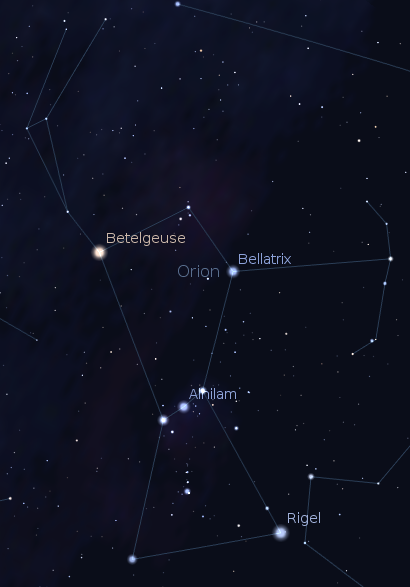
Orion upright and due south. Created using Stellarium.
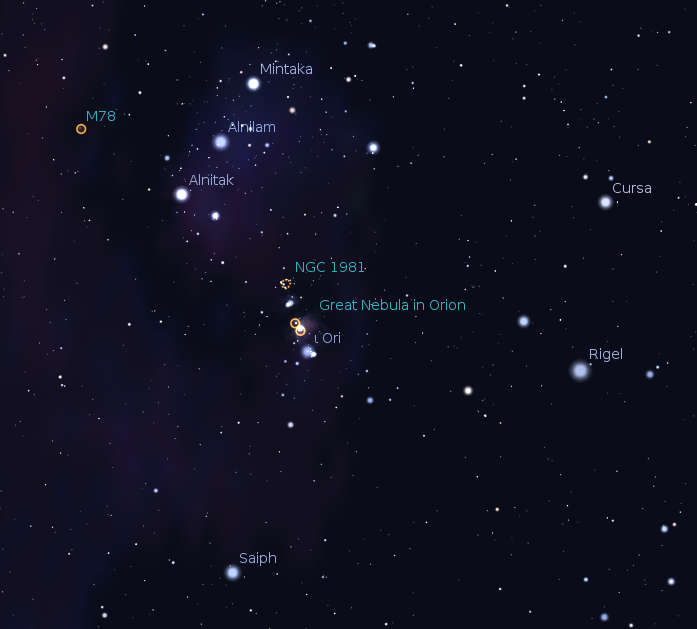
The lower part of Orion with the Great Orion Nebula. Created using Stellarium.
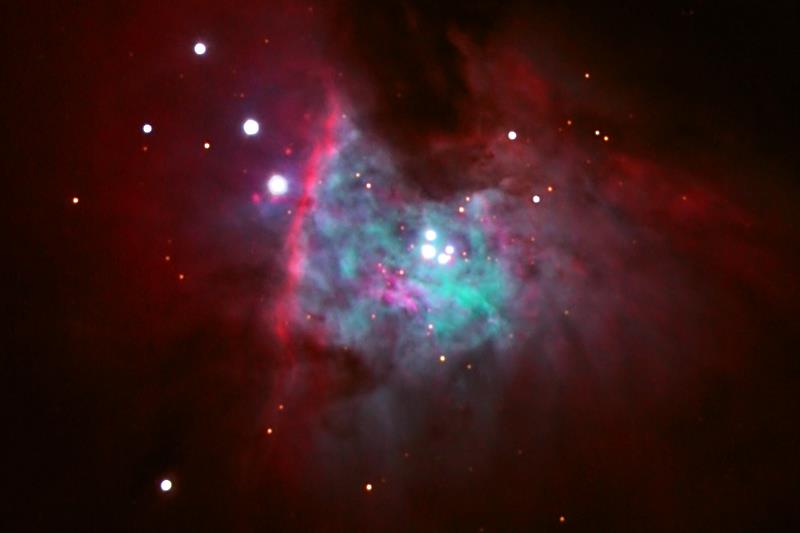
Inner part of the Great Orion Nebula with the Trapezium. Image by Scott Anttila
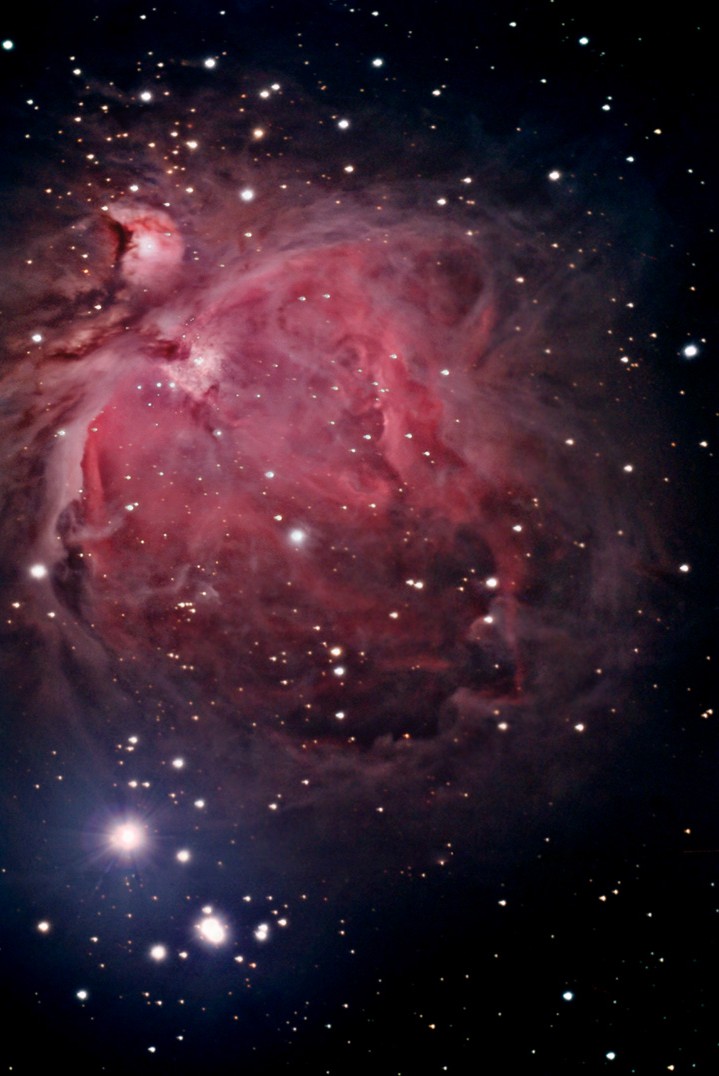
Great Orion Nebula by Scott Anttila
02/17/2015 – Ephemeris – There are no unicorns except in the heavens
Ephemeris for Fat Tuesday, Tuesday, February 17th. The sun will rise at 7:40. It’ll be up for 10 hours and 33 minutes, setting at 6:13. The moon, 1 day before new, will rise at 7:07 tomorrow morning.
Among all the constellations in the sky of animals real and mythical, there is also a unicorn. It’s called Monoceros, and inhabits the southeastern sky at 9 p.m. bounded by Orion on the right, Canis Major, the great dog below and Canis Minor, the little dog to the left. Unfortunately for observers without optical aid Monoceros, though large, is devoid of any but the faintest stars. Maybe that’s why no one sees unicorns anymore. It has many faint stars because the Milky Way runs through it. To the telescope it is a feast of faint nebulae or clouds of gas and dust, the birth place of stars, including the red rose of the Rosette Nebula, and the strange and tiny Hubble’s Variable Nebula. It contains no bright stars, but it has wonders for the telescope.
Times are for the Traverse City/Interlochen area of Michigan. They may be different for your location.
Addendum
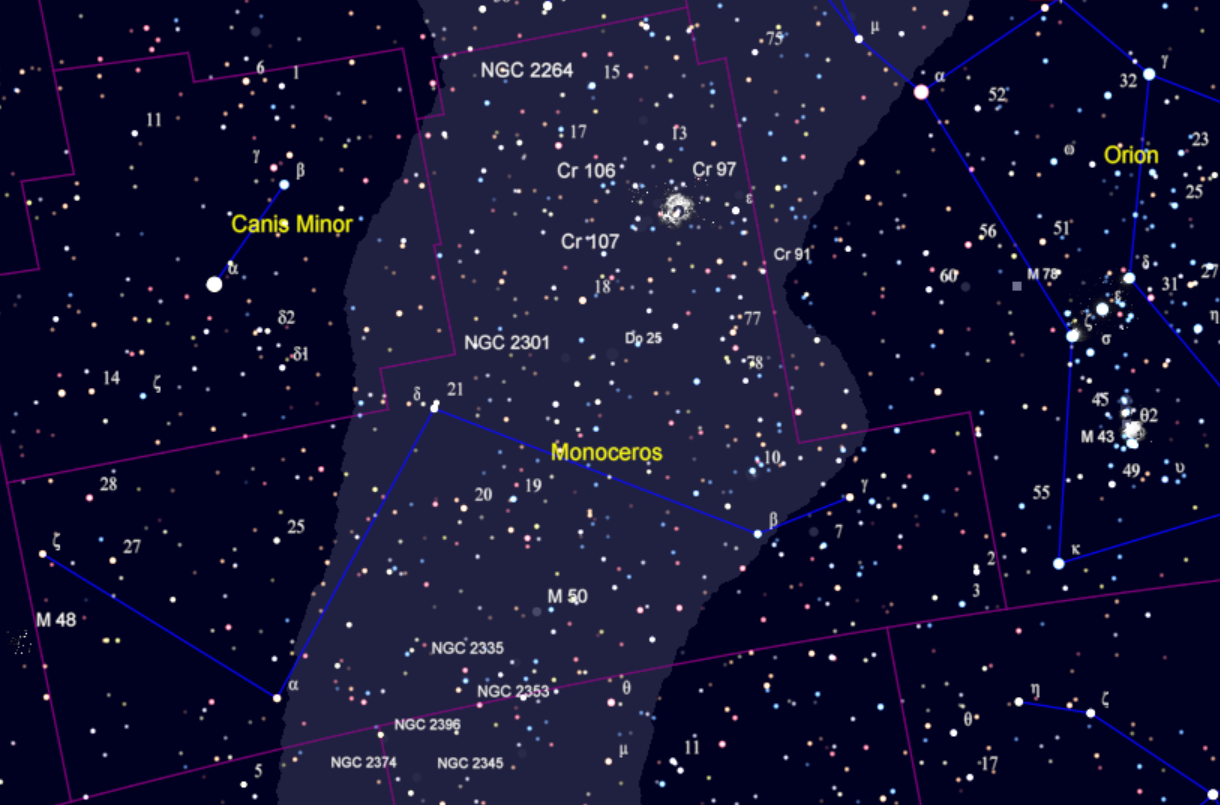
The constellation Monoceros the unicorn. Created using Cartes du Ciel (Sky Charts). Click to enlarge.
Can you see a unicorn here? Me neither.
One thing I didn’t mention in the program is the star labeled β. It is a triple star in telescopes.
Universe Today has a great post on Monoceros by Tammy Plotner, who by sad coincidence passed away a few days ago.
02/21/2014 – Ephemeris – Some nebulae in Orion
Ephemeris for Friday, February 21st. The sun will rise at 7:33. It’ll be up for 10 hours and 46 minutes, setting at 6:19. The moon, 1 day before last quarter, will rise at 1:31 tomorrow morning.
With the moon out of the sky, it’s a good time to get those binoculars or small telescope out to view at least one nebula in the constellation Orion the hunter and maybe even more. Orion is in the south with those belt stars lie in a straight line. Below the belt are three fainter stars, vertically arranged: Orion’s sword. In binoculars each of those stars are multiples. Around what looks like a center star there is a haze, which is the Great Orion Nebula, the nearest star forming region to us at around 1,400 light years away. Some of its gasses envelop the stars that make up the top star of the sword. Orion hosts the famous Horse head Nebula, which unfortunately can only be seen in photographs, It is right below the left star of the belt.
Times are for the Traverse City/Interlochen area of Michigan. They may be different for your location.
Addendum
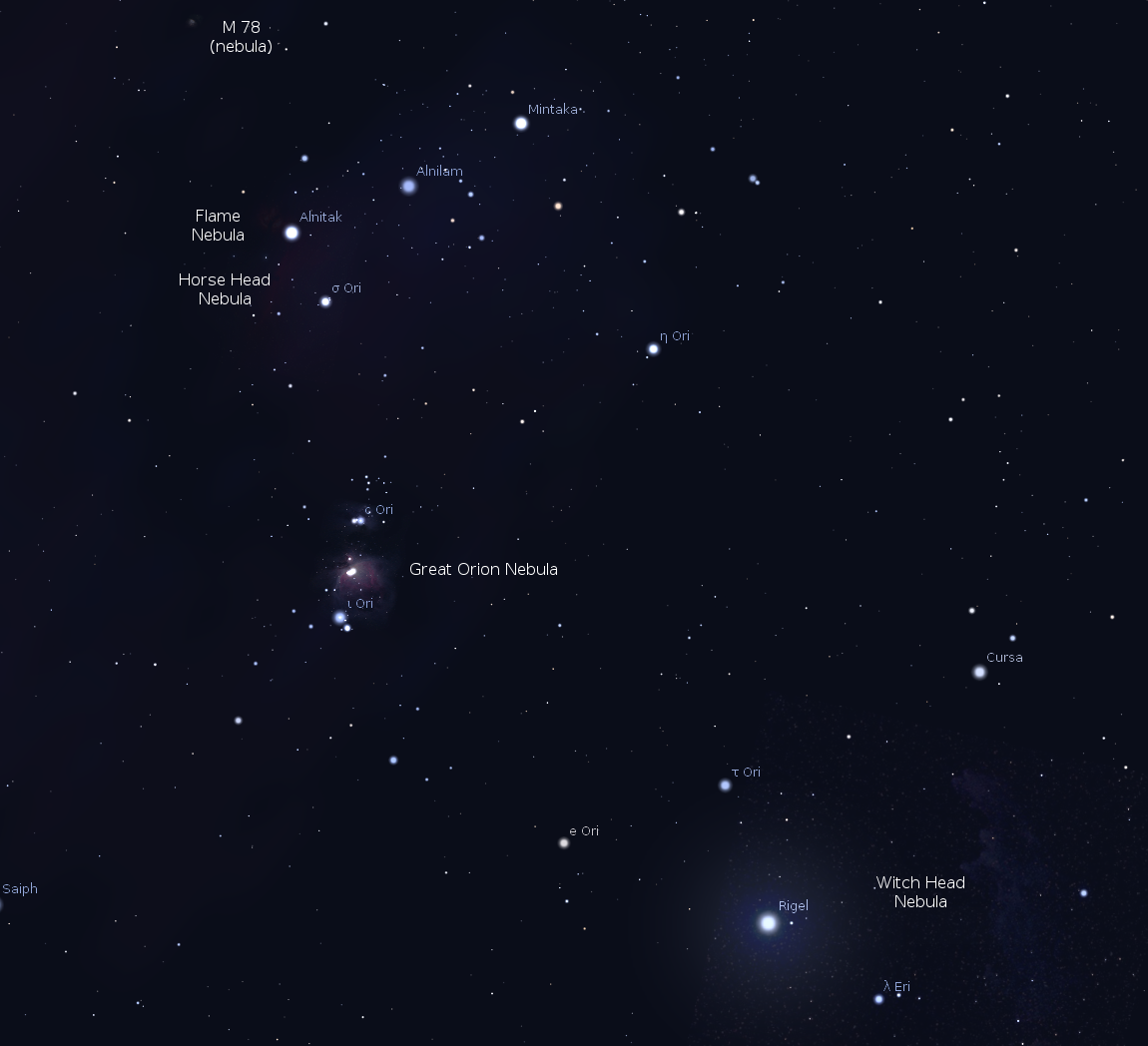
Orion’s Nebulae in the southern part of the constellation as displayed by Stellarium.
A couple of nebulae are seen here that are not in the text above. M78 is a small nebula north of the belt star Alnitak. It is visible in a telescope. The Witch Head Nebula, another large nebula, shining by the reflected light of Rigel. It’s officially in the neighboring constellation of Eridanus, and I believe strictly a photographic nebula. The witch head is best seen if the image is turned upside down.
08/08/2013 – Ephemeris – The wonders located in Scutum the shield
Ephemeris for Thursday, August 8th. The sun rises at 6:37. It’ll be up for 14 hours and 20 minutes, setting at 8:58. The moon, 2 days past new, will set at 9:28 this evening.
The teapot pattern of stars that is the constellation of Sagittarius lies at the southern end of the Milky Way this evening. It appears that the Milky Way is steam rising from the spout. The area above Sagittarius in the brightest part of the Milky Way is the dim constellation of Scutum the shield. Don’t bother looking for the stars that make up the constellation; what’s important is the star clouds of the Milky Way. Scan this area with binoculars or small telescope for star clusters and nebulae or clouds of gas. In binoculars both clusters and nebulae will appear fuzzy, but a small telescope will tell most of them apart. Even if you’ve never been able to find anything in your telescope, put on the lowest power eyepiece you have and scan back and forth for these wonders.
Times are for the Traverse City/Interlochen area of Michigan. They may be different for your location.
Addendum
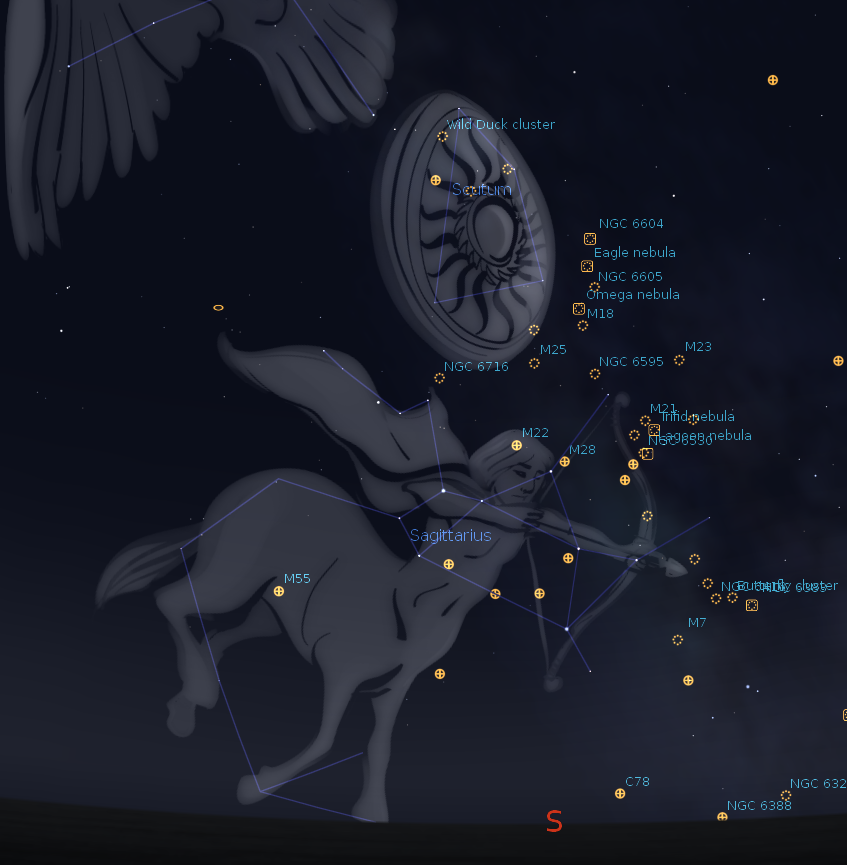
Binocular and telescope deep sky objects in Scutum and Sagittarius. Created using Stellarium.
The symbols mean:
Circle with embedded cross – Globular star cluster (Very old compact star cluster)
Open dotted circle – Open or galactic star cluster (Young loose star cluster)
Square – Nebula (Here emission nebulae. In many cases with associated open clusters)
Ellipse – Galaxy
07/08/2012 – Ephemeris – How to find the Ring Nebula (M57)
Ephemeris for Monday, July 8th. Today the sun will be up for 15 hours and 22 minutes, setting at 9:28. The moon is new today, and won’t be visible. | Tomorrow the sun will rise at 6:06.
The constellation of Lyra is high in the east when it gets dark tonight. Its bright star Vega and the thin parallelogram of stars depict the harp it represents. Between the two stars at the bottom of the parallelogram opposite Vega hides a celestial wonder that can be seen in a small telescope, though the larger the telescope the better. It is the Ring Nebula, a smoke ring blown by a dying star. The telescope’s finder cannot show the ring. Center the finder between those two stars. The nebula will appear as a small dim gray spot in the telescope. Closer inspection may reveal that the center of the nebula is darker than the edges. It is about 2,300 light years away, but that’s a very approximate distance, which could be a thousand light years off.
Times are for the Traverse City/Interlochen area of Michigan. They may be different for your location.
Addendum
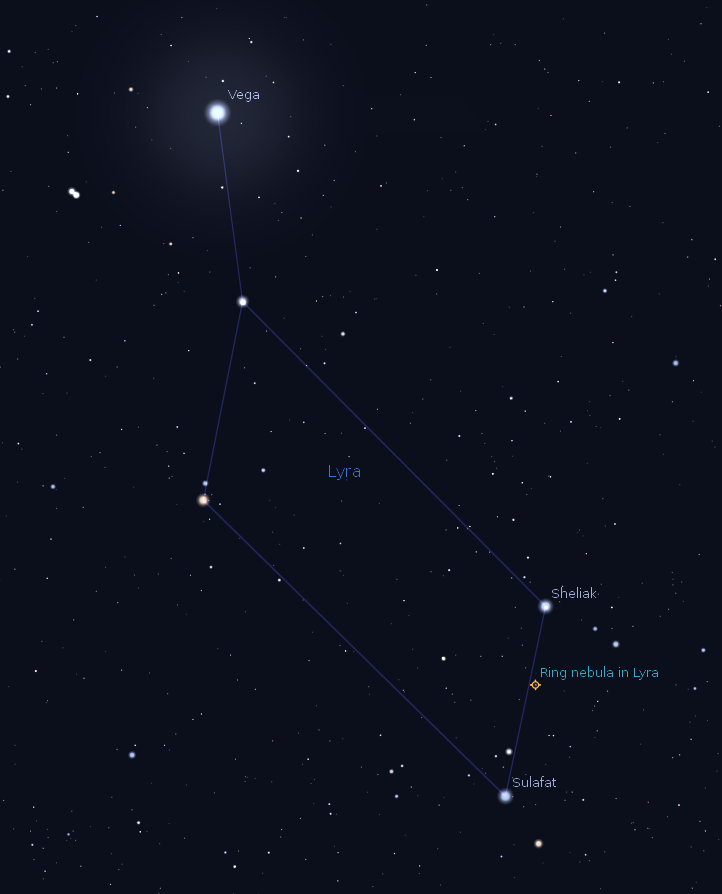
The constellation Lyra with the location of the Ring Nebula shown. Created using Stellarium.
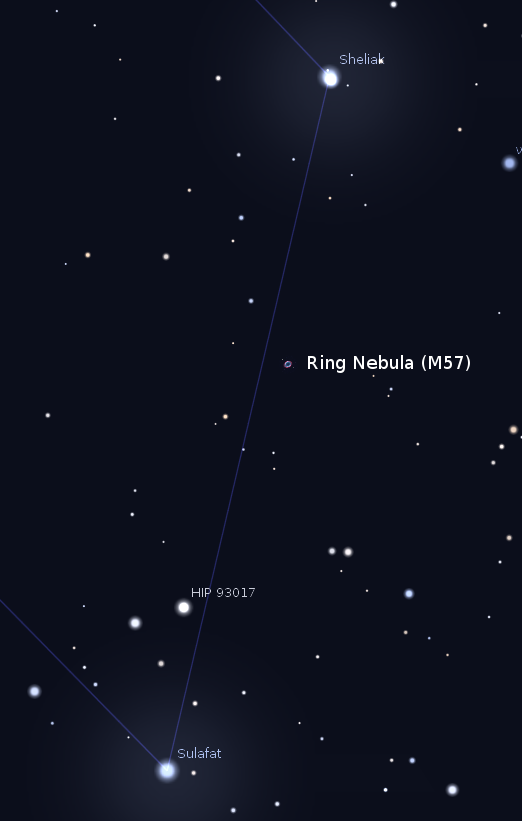
A closer look at the location of the Ring Nebula. Created using Stellarium.
 Bob Moler's Ephemeris Blog