Archive
Ephemeris: 01/20/2026 – What’s happening inside the Great Orion Nebula
This is Bob Moler with Ephemeris for Tuesday, January 20th. Today the Sun will be up for 9 hours and 21 minutes, setting at 5:35, and it will rise tomorrow at 8:12. The Moon, 2 days past new, will set at 7:42 this evening.
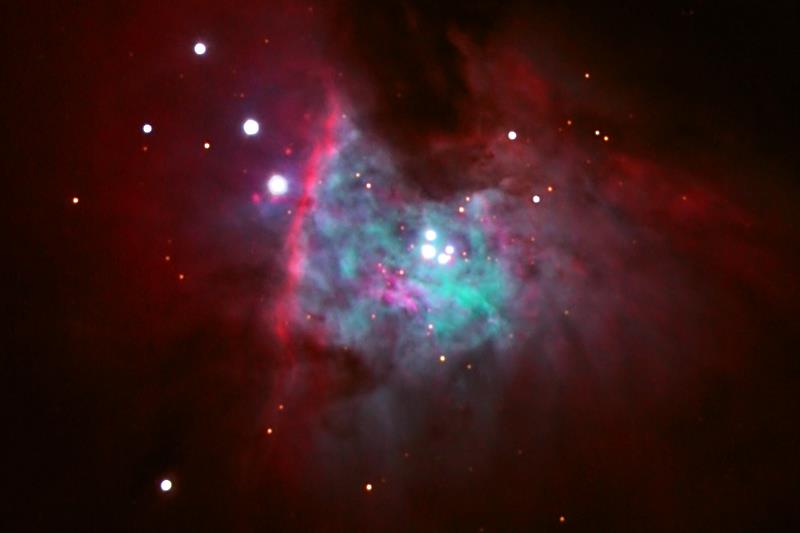
The closest star nursery to us, places where stars are being born, is the Great Orion Nebula, 1,300 light years away. A light year is about 6 trillion miles, if you want to pace it out. It’s located in the constellation Orion’s sword that hangs below his belt. It is seen in as little as a pair of binoculars, and shines by emission and reflection of the light of a tiny clutch of four stars at its heart, called the Trapezium. These extremely hot young massive stars are not destined to live long. Unlike the Sun’s 10 billion year lifetime, these stars lifespans will be measured in millions of years. Yet do not mourn for them, even now stars are forming within their dusty cocoons in the nebula. The Trapezium stars’ deaths will provide heavy elements for new stars and planets.
The astronomical event times given in this blog are for the Traverse City/Interlochen area of Michigan (Lat 44.7° N, Long 85.7° W; EST, UT – 5 hours) unless stated otherwise. Times will be different for other locations.
Addendum
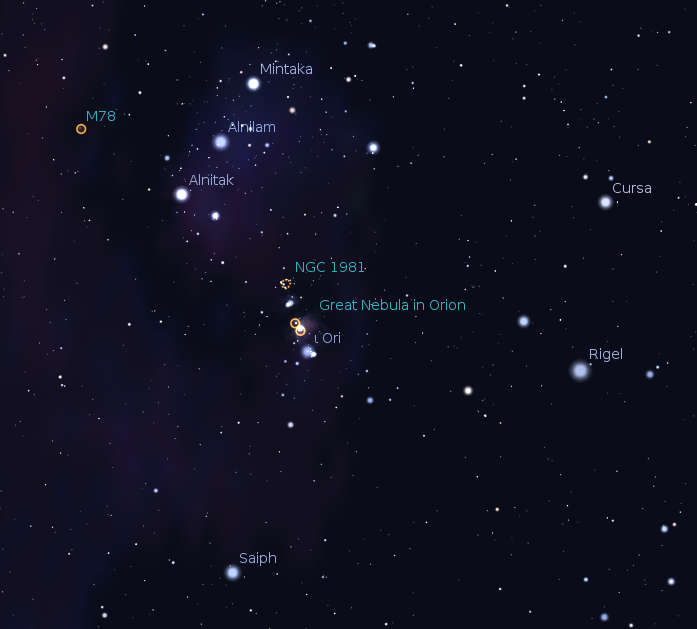
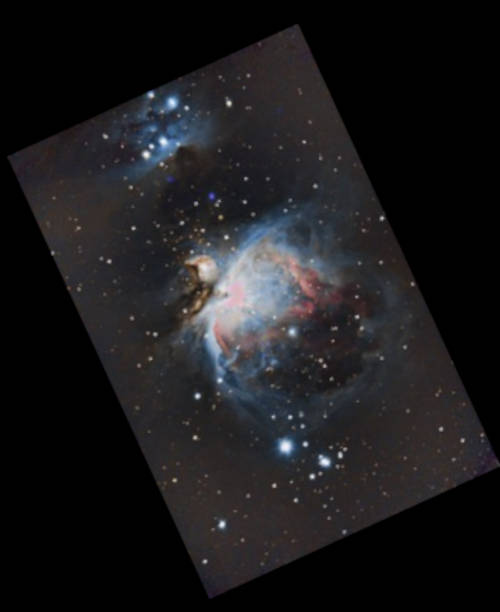
There are several videos produced by NASA, ESA and others of a fanciful trip through the Great Orion Nebula. I found them by typing: NASA trip through the Orion nebula into my Internet browser.
Ephemeris: 01/15/2026 – Orion’s great cloud
This is Ephemeris for Thursday, January 15th. Today the Sun will be up for 9 hours and 12 minutes, setting at 5:28, and it will rise tomorrow at 8:15. The Moon, 3 days before new, will rise at 7:09 tomorrow morning.
The brightest interstellar cloud visible in our skies is the Great Orion Nebula. The word nebula is from the Latin “nebulum” for cloud. The constellation of Orion is filled with nebulae, most of it are dim or dark. The Great Orion Nebula is in Orion’s sword. The sword is what looks like three stars that look dimmer than the three belt stars hanging from the belt. There are actually more than three stars here. Around the stars that appear as the center of the sword stars, to the eye, can be seen a haze in binoculars. A telescope with a wider aperture and low power can see detail in the cloud. With more magnification, a clutch of four baby stars can be spotted in the brightest part of the nebula. They light up the nebula and are called the Trapezium.
The astronomical event times given in this blog are for the Traverse City/Interlochen area of Michigan (Lat 44.7° N, Long 85.7° W; EST, UT – 5 hours) unless stated otherwise. Times will be different for other locations.
Addendum
Ephemeris: 09/15/2025 – Last month to view the southern Milky Way from Michigan
This is Bob Moler with Ephemeris for Monday, September 15th. Today the Sun will be up for 12 hours and 30 minutes, setting at 7:52, and it will rise tomorrow at 7:23. The Moon, 1 day past last quarter, will rise at 1:14 tomorrow morning.
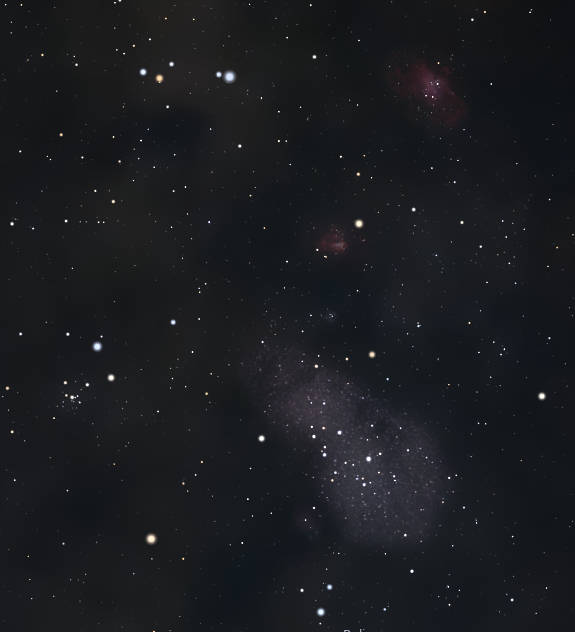
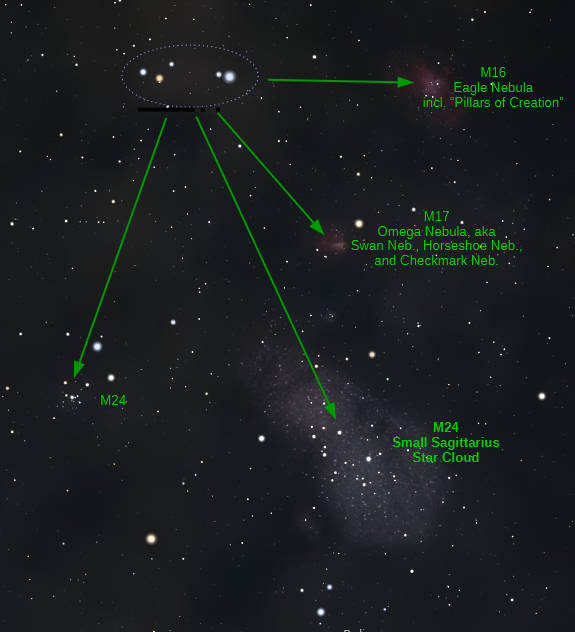
September is the second of the two months we get to see the southern part of the Milky Way in the evening sky. At 10 PM the asterism of the Teapot of the constellation Sagittarius is pouring its tea on the southwestern horizon. It is in that direction that we look to the center of the Milky Way. Unfortunately there are clouds of dust and gas between us and the center, so we cannot see it visually, though it can be seen by radio waves and other means. There are a host of objects visible in binoculars and small telescopes. One does not need a star map to be able to find them, just point a telescope at low power or binoculars in that direction and sweep around slowly. There are treasures of star clusters and nebulae to be found.
The astronomical event times given in this blog are for the Traverse City/Interlochen area of Michigan (Lat 44.7° N, Long 85.7° W; EDT, UT – 4 hours) unless stated otherwise. Times will be different for other locations.
Addendum
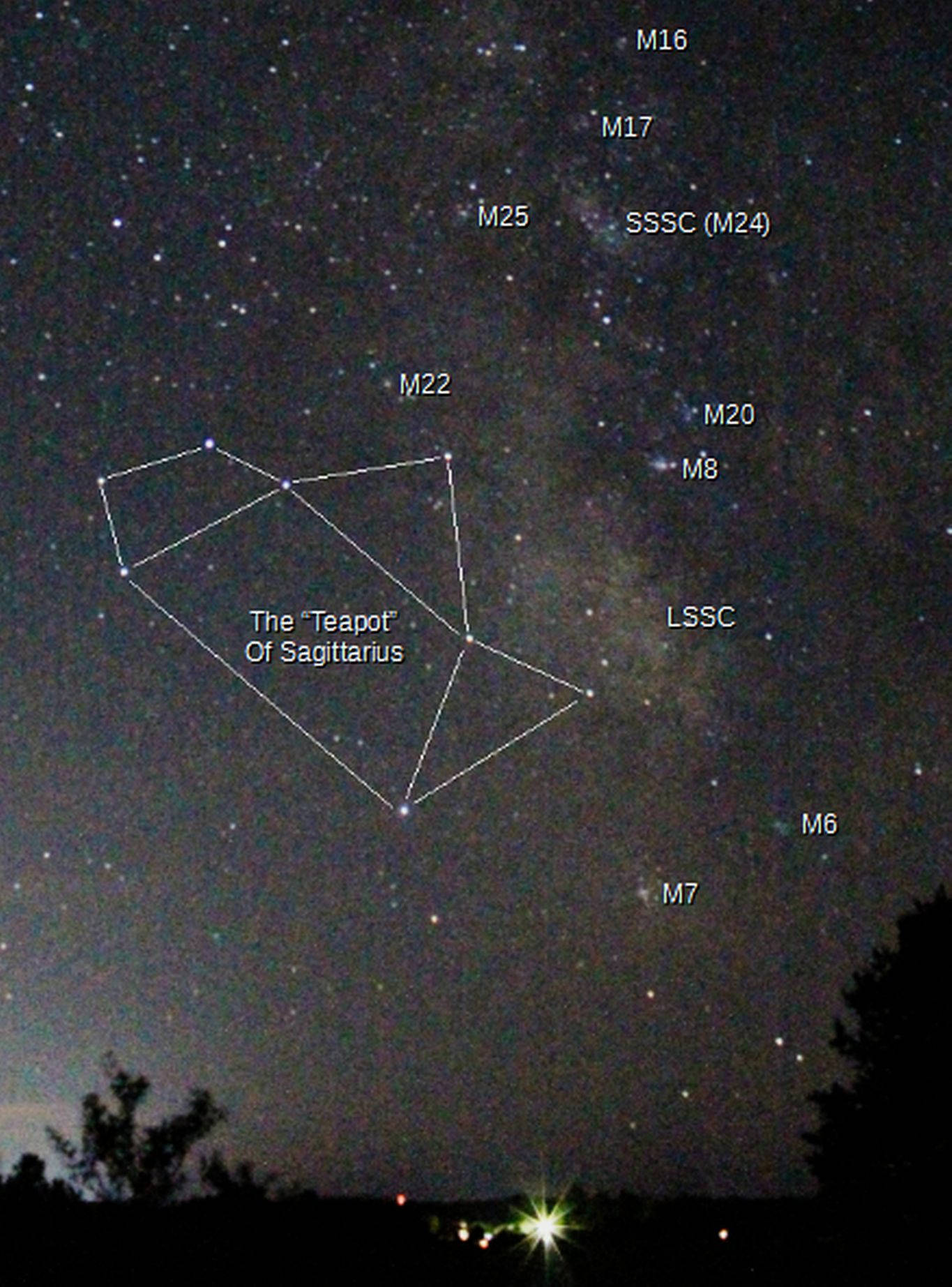
In the image above the amount of detail of the stars is approximately that of a pair of binoculars. The various nebulae and star clusters are denoted with M numbers. These are some of the brightest, what we call deep sky objects, in the catalog by Charles Messier, who is looking for comets. He numbered them as he came across them. The brightest star cluster is M7, which Claudius Ptolemy recorded in the 2nd century CE. The brightest nebula is M8, the Lagoon Nebula out of which a star cluster is being formed. In binoculars, it looks like a short horizontal gash. Next in brightness is M17, a fuzzy spot in binoculars, but appears as a glowing check mark, or swimming swan in a telescope. M20, the Trifid Nebula, is the next brightest nebula in which dark dust lanes divide it into three lobes. M16, the Eagle Nebula is very dim. Most of the time I miss the nebulosity, but its embedded star cluster is quite easily seen. The rest of the Messier objects are star clusters or a star cloud. Of these M22 is a globular star cluster and one of the easiest of these clusters to resolve, though it might take a telescope of 150 mm (6″) diameter to do it.
Ephemeris: 09/05/2025 – GTAS meeting tonight, a personal view of nebulae, interstellar clouds
This is Ephemeris for Friday, September 5th. Today the Sun will be up for 13 hours and 1 minute, setting at 8:11, and it will rise tomorrow at 7:11. The Moon, 2 days before full, will set at 5:36 tomorrow morning.
The Grand Traverse Astronomical Society will host its September meeting tonight at 8 PM at Northwestern Michigan College’s Joseph H Rogers Observatory. The talk for the evening will be given by Daniel Dall’Olmo, one of our members, who has had great success photographing the wonders of the universe. He will show and discuss the different types of nebulae he’s photographed. After the meeting, weather permitting, there will be viewing of the Moon and whatever we can find in the twilight. The observatory is located south of Traverse City on Birmley Rd. The meeting will also be available via Zoom, with instructions for joining the meeting on the society’s website, http://www.gtastro.org.
The astronomical event times given in this blog are for the Traverse City/Interlochen area of Michigan (Lat 44.7° N, Long 85.7° W; EDT, UT – 4 hours) unless stated otherwise. Times will be different for other locations.
Addendum
Ephemeris: 09/23/2024 – Scanning the Milky Way with binoculars
This is Ephemeris for Monday, September 23rd. Today the Sun will be up for 12 hours and 5 minutes, setting at 7:37, and it will rise tomorrow at 7:33. The Moon, 1 day before last quarter, will rise at 10:50 this evening.
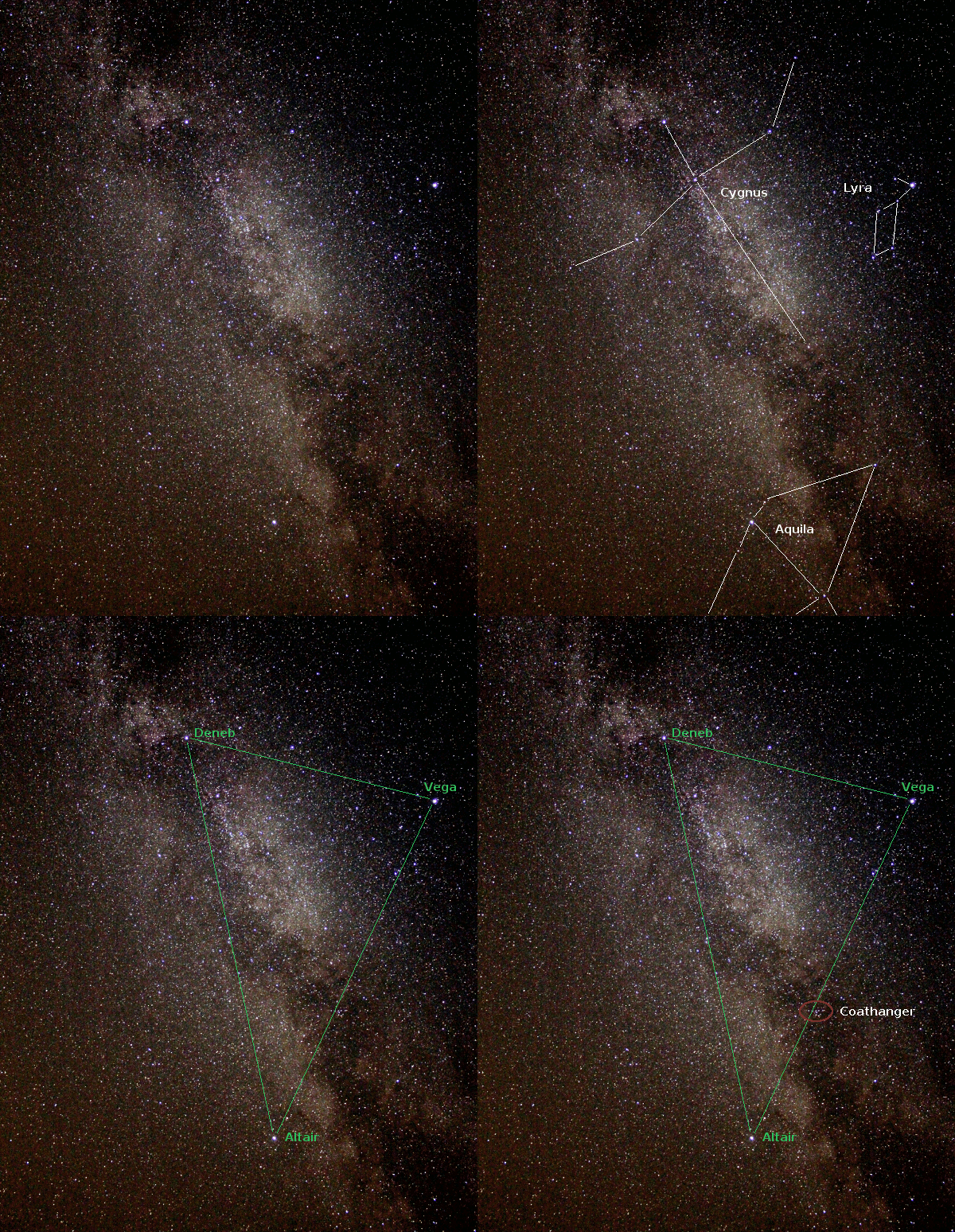
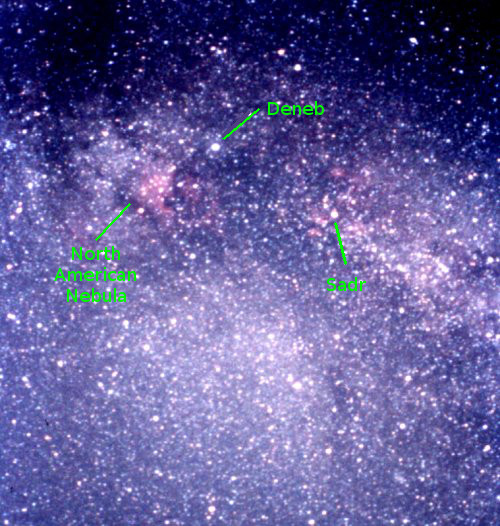
Now that the Moon has fled the early evening skies the Milky Way is showing up again, if you’re at a dark site. I’ve always said that August and September are the best times to view what I call the summer Milky Way, even now that it’s not technically summer anymore. The Teapot asterism in the constellation of Sagittarius is low in the south-southeast, pouring its tea on the horizon. It is in that direction we are looking towards the center of our Milky Way Galaxy. The Summer Triangle is high in the South with Vega and Deneb, two of its stars near the zenith. All the Milky Way is an invitation to scan it with the pair of binoculars or a very low power telescope. One doesn’t need a chart. Just wander through the Milky Way to find many star clusters, groups of stars and nebulae.
The astronomical event times given are for the Traverse City/Interlochen area of Michigan (EDT, UT – 4 hours). Times will be different for other locations.
Addendum (Some binocular wonders)
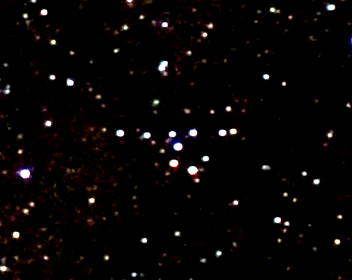
The Coathanger
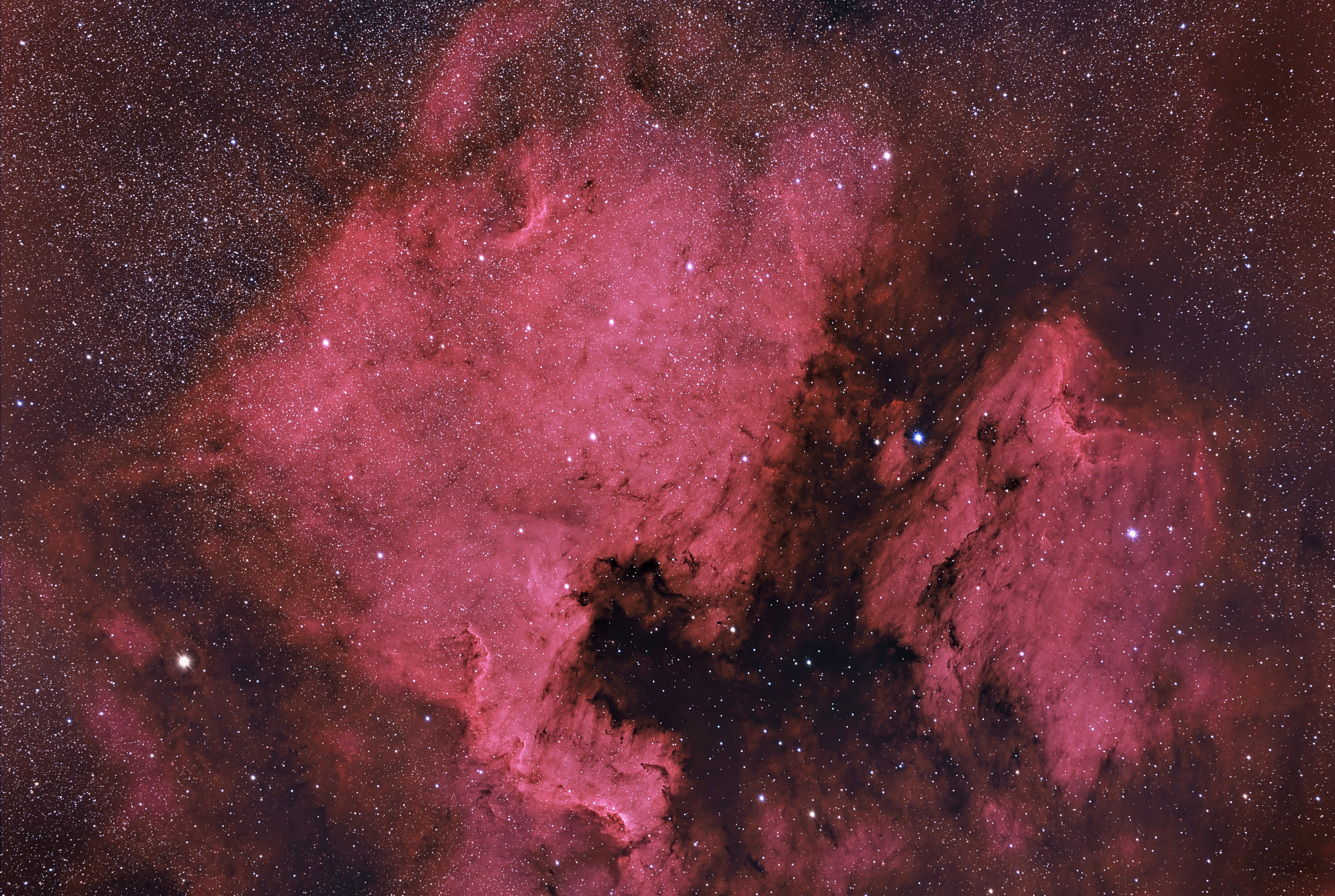
The North American Nebula
01/16/2023 – Ephemeris – Orion’s great nebula
This is Bob Moler with Ephemeris for Dr. Martin Luther King Jr. Day, Monday, January 16th. Today the Sun will be up for 9 hours and 13 minutes, setting at 5:29, and it will rise tomorrow at 8:15. The Moon, 2 days past last quarter, will rise at 3:52 tomorrow morning.
The brightest interstellar cloud visible in our skies is the Great Orion Nebula. The word nebula is related to the Latin “nebulum” for cloud. The constellation of Orion is filled with nebulae, most of it are dim or dark. The Great Orion Nebula is in Orion’s sword. The sword is what looks like three stars that look dimmer than the three belt stars hanging from the belt. And there are more than three stars here. Around the stars that appear as the center of the sword stars, to the eye, can be seen a haze in binoculars. A telescope with a wider aperture and low power can see detail in the cloud. With more magnification, a clutch of four baby stars can be spotted in the brightest part of the nebula. They light up the nebula and are called the Trapezium.
The astronomical event times given are for the Traverse City/Interlochen area of Michigan (EST, UT –5 hours). They may be different for your location.
Addendum
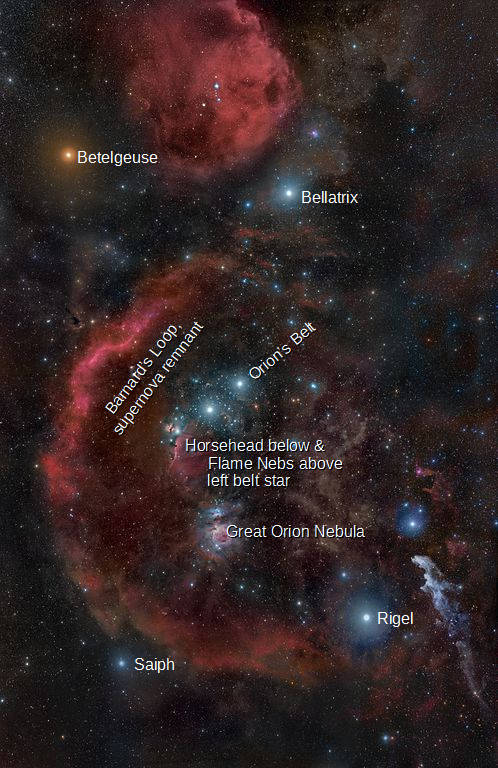
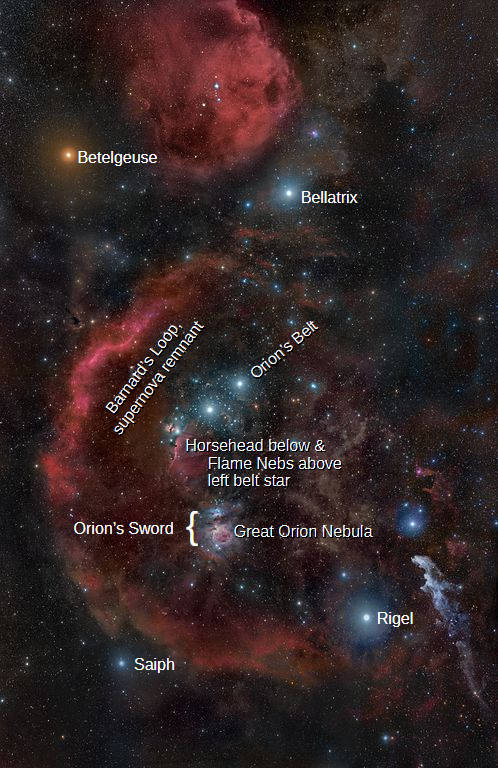
Orion is lousy with gas and dust. A regular star factory, or nursery. The red nebulae show the predominance of hydrogen in here. In actuality, the Great Orion Nebula vastly outshines all the other nebulae in Orion. The white nebulosity to the right of Rigel is the Witches Head nebula, probably the reflection of Rigel’s light off a dust cloud. Base image by Bernal Andreo, via Wikipedia. Annotations were created by myself.
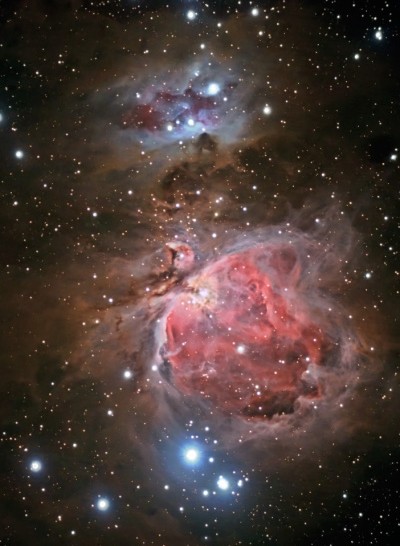
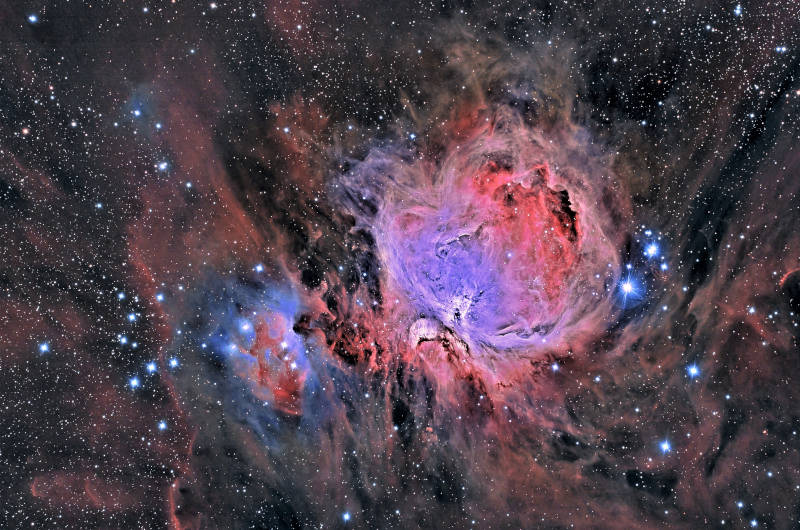
The Great Orion Nebula (M42) long exposure photograph by Scott Anttila. Includes all the sword stars.
08/16/2022 – Ephemeris – Scanning Sagittarius with binoculars
This is Bob Moler with Ephemeris for Tuesday, August 16th. Today the Sun will be up for 14 hours to the minute, setting at 8:46, and it will rise tomorrow at 6:47. The Moon, 3 days before last quarter, will rise at 11:15 this evening.
The Moon has left the evening sky, so let’s take another look at the constellation of Sagittarius. Its bright stars make a follow the dots image of a stout little teapot. In, around and above the teapot is a wealth of nebulae, which are clouds of gas and dust and clusters of stars. Stars are born in bunches from a cloud of gas. When enough stars are born, their stellar winds blow away the nebulosity leaving a star cluster. Use a pair of binoculars or a very low power telescope and just wander around and above the teapot, including and especially the spout on the right side. In binoculars, star clusters appear fuzzy like nebulae, however a small telescope with magnification of 20 times should resolve most of them.
The astronomical event times given are for the Traverse City/Interlochen area of Michigan (EDT, UT – 4 hours). They may be different for your location.
Addendum
Sagittarius in a short time exposure with added annotations. The “M” designations are objects in Charles Messier’s catalog created in the latter half of the 18th century. LSSC is the Large Sagittarius Star Cloud, SSSC is the Small Sagittarius Star Cloud. Labels are to the right of the objects they name. Credit Bob Moler.
This is the short radio program version of the August 8, 2022, Ephemeris Extra post Wandering through Sagittarius
 Bob Moler's Ephemeris Blog