Archive
Ephemeris: 08/29/2023 – Saturn’s rings disappear every 15 years
This is Ephemeris for Tuesday, August 29th. Today the Sun will be up for 13 hours and 23 minutes, setting at 8:25, and it will rise tomorrow at 7:02. The Moon, 1 day before full, will set at 6:05 tomorrow morning.
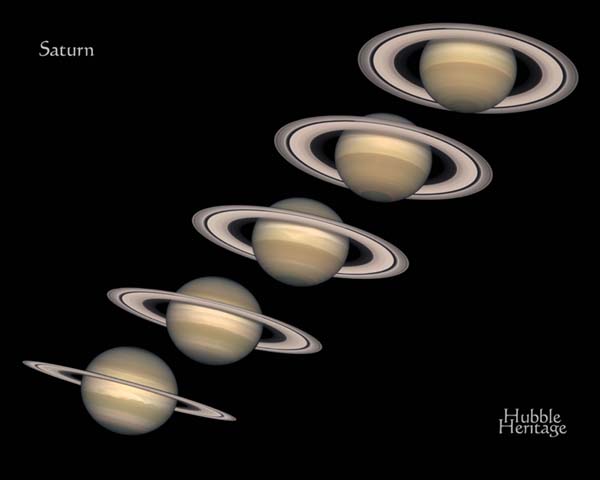
As seen in even low powered telescopes Saturn’s rings are visible. Currently, the rings are closing towards that edge on point which will they reach on March 23rd 2025 and then begin to open up again. The rings orbit Saturn’s equator, and Saturn has a nearly 27 degree inclination of its axis to its orbit, like the Earth’s 23 1/2 degrees and that means that near the equinoxes Saturn’s rings turn out to be nearly edge on to the Sun and the Earth, since we orbit much closer to the Sun than Saturn. Near the solstices on Saturn the rings are open to their widest extent. This occurs about 7 ½ years after the rings go edge on, and 7 ½ years before the next time. The next time the rings go edge on Saturn will be too close to the direction of the Sun to spot, but when they do go edge-on, they disappear. They are 150,000 miles in diameter and less than 70 feet thick.
The astronomical event times given are for the Traverse City/Interlochen area of Michigan (EDT, UT –4 hours). They may be different for your location.
Addendum
Ephemeris: 08/28/2023 – Observing Saturn’s rings
This is Ephemeris for Monday, August 28th. Today the Sun will be up for 13 hours and 26 minutes, setting at 8:26, and it will rise tomorrow at 7:01. The Moon, 2 days before full, will set at 4:38 tomorrow morning.
The most striking feature of the planet Saturn are its rings. It is not the only planet with rings. Jupiter Uranus and Neptune all have rings, plus some asteroids. And at least one Kuiper belt objects has rings, but Saturn has the grandest of all the ring systems. The broad rings are easily seen in small telescopes. They are labeled A, B and C, A being the outermost of the bright rings B is the center most and C is just barely seen inside the B ring. The diameter of these rings to the outside of the A ring is 150,000 miles, a bit more than the average distance from the Earth to our Moon, and a little less than 70 feet thick so when they go edge on to us as they do about every 15 or so years they completely disappear.
The astronomical event times given are for the Traverse City/Interlochen area of Michigan (EDT, UT –4 hours). They may be different for your location.
Addendum
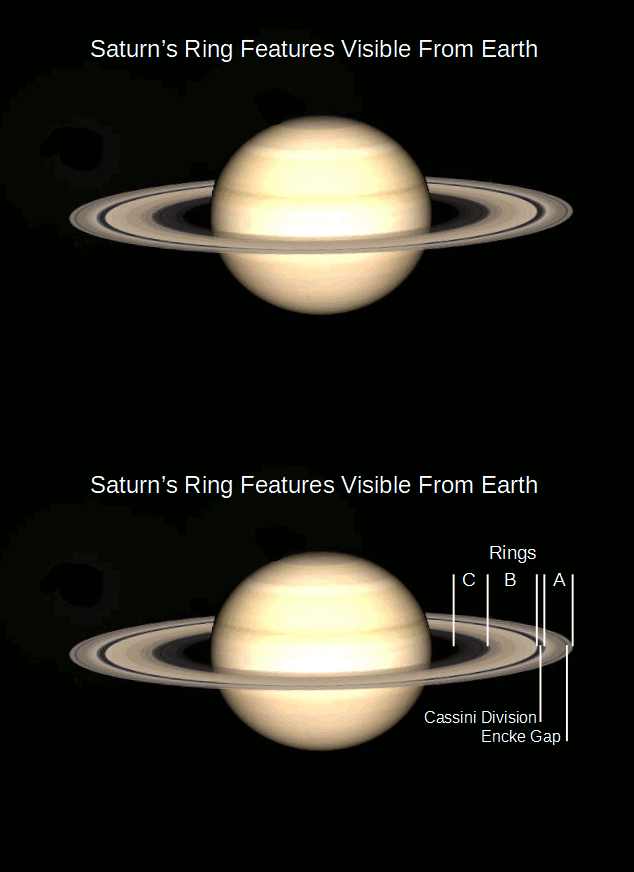
Saturn’s rings are much more complex than what can be seen in a small telescope. Observing Saturn through a small telescope, the A and B rings are evident, though the Cassini Division, of nearly 5,000 miles in width, may be elusive. The C, or Crêpe, ring is very hard to see, and is best seen as a dusky shadowlike feature against the planet. This image of Saturn was created by Stellarium, annotations were created in LibreOffice Draw, assembled and output using GIMP.
More on Saturn’s rings tomorrow.
Ephemeris: 08/25/2023 – Saturn will reach opposition on Sunday
This is Ephemeris for Friday, August 25th. Today the Sun will be up for 13 hours and 35 minutes, setting at 8:32, and it will rise tomorrow at 6:57. The Moon, 1 day past first quarter, will set at 12:57 tomorrow morning.
The planet Saturn will reach opposition on Sunday. That means it will be opposite the Sun in the sky. It will be rising as the sun sets, and it will then officially become an evening planet. Opposition is the time when Saturn is the closest it gets to the Earth, in this case it’s 816 million miles (1 billion 314 million kilometers). In telescopes, we’ll see very little in the way of shadows of the planet on the rings and the rings on the planet, because we are almost directly in line with the Sun and Saturn. We’re actually a little north of the line, so Saturn will exhibit very thin shadows, however a pretty big telescope will be needed to see them. This is the time when Saturn appears largest in telescopes, and the rings are the brightest.
The astronomical event times given are for the Traverse City/Interlochen area of Michigan (EDT, UT –4 hours). They may be different for your location.
Addendum
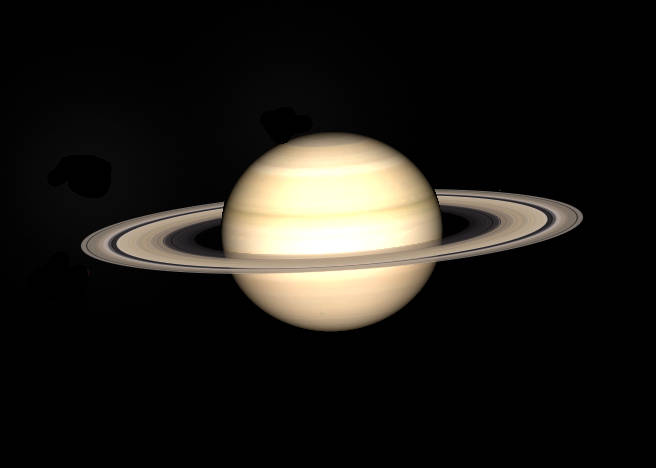
Saturn, as realized by the Stellarium planetarium app. It never appears this large in telescopes. The first time I saw Saturn in a telescope, and saw those rings, I was blown away. However, I was disappointed as to how small it was. Well, it is almost a billion miles (1.6 million kilometers) away, about twice as far as Jupiter. The extent of the rings are about as long as Jupiter’s apparent diameter, which averages about half of Saturn’s distance. Currently, the rings are getting more and more edge-on to us. The rings will be edge-on to us on March 23, 2025, nearly a year and a half from now, then begin to open up again. This is due to Saturn’s axial tilt of nearly 27 degrees, and the fact that the rings orbit the planet at its equator.
08/15/2022 – Ephemeris – Saturn moves into the evening sky
This is Ephemeris for Monday, August 15th. Today the Sun will be up for 14 hours and 3 minutes, setting at 8:48, and it will rise tomorrow at 6:46. The Moon, halfway from full to last quarter, will rise at 10:55 this evening.
Yesterday, Saturn was in opposition to the Sun. I’m not implying an argument here. Opposition is when a planet is opposite the Sun in the sky, so it rises around sunset and sets around sunrise. That means Saturn is the closest it can get to us this year. For the record, that’s 836 million miles (1,345 million kilometers). Saturn will first appear tonight in the southeast when it gets dark enough, say around 9:15 to 9:30 pm. It is in the constellation of Aquarius now. It is moving northeastward in our skies, or it would if it weren’t at opposition, and moving backward or retrograde as the Earth is, in effect, lapping Saturn in our eternal race around the Sun. Saturn’s rings appear to slowly get skinnier as the planet moves to an equinox, where its rings, which orbit its equator, will tilt edgewise to the Sun, and the Earth in 2025.
The astronomical event times given are for the Traverse City/Interlochen area of Michigan (EDT, UT – 4 hours). They may be different for your location.
Addendum
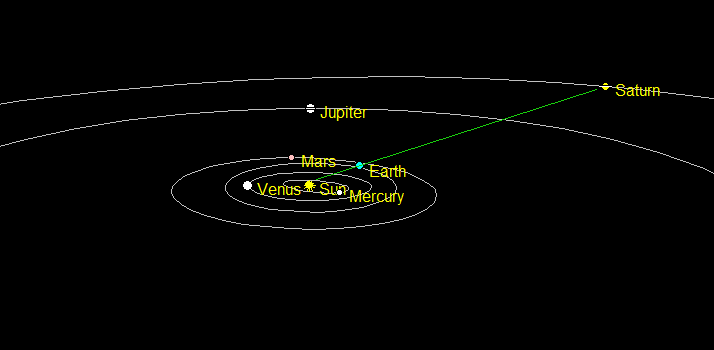
Display of the solar system out to Saturn, with added line showing Saturn’s location opposite the Sun from the Earth. This make the Earth nearly in line from the Sun to Saturn. This is the time that Saturn would be closest to the Earth. Credit: my LookingUp app. I wanted to use NASA’s Eyes, but there were too many interplanetary spacecraft near the Earth. The Earth was crowded out by spacecraft labels.
How the appearance of the rings change as Saturn orbits the Sun. Credit: NASA Hubble.
08/06/2020 – Ephemeris – Looking at Saturn through a small telescope
This is Bob Moler with Ephemeris for Thursday, August 6th. Today the Sun will be up for 14 hours and 25 minutes, setting at 9:01, and it will rise tomorrow at 6:36. The Moon, 3 days past full, will rise at 10:55 this evening.
The planet Saturn is just to the left or east of Jupiter in the southeastern evening sky. In steadily held binoculars Saturn is not star-like, but it’s not round either. It’s a small oval dot. The oval or ellipse is due to its rings of small icy bodies that orbit the planet over its equator. A telescope in needed to appreciate those rings to their fullest extent. Saturn’s largest moon Titan will be visible tonight in line with the eastern extent of the rings. Saturn, like the Earth has an axial tilt. In its case it’s 26 degrees. And the rings orbit over Saturn’s equator. So as Saturn orbits the Sun in it’s nearly 30 year orbit the aspect of the rings change over that period. The ellipse shape of the rings are getting thinner now, and in 5 years they will be seen to disappear for a bit.
The event times given are for the Traverse City/Interlochen area of Michigan. They may be different for your location.
Addendum
How the appearance of the rings change as Saturn orbits the Sun. The rings were at their widest in 2017. They are closing and will be edge-on again in 2025. When edge-on the rings literally disappear. Despite being 150,000 miles wide as we look at the planet, they are generally less than 66 feet (20 meters) in thickness. Credit: NASA Hubble.
11/14/2019 – Ephemeris – Saturn is not only Lord of the Rings, but also King of the Moons
Ephemeris for Thursday, November 14th. Today the Sun will be up for 9 hours and 37 minutes, setting at 5:15, and it will rise tomorrow at 7:39. The Moon, 2 days past full, will rise at 6:57 this evening.
This news item is a month old, but it’d kind of cool. Jupiter may be the king of the planets, but it is not the king of the Moons. In a recent announcement from the International Astronomical Union. Saturn has edged out Jupiter in the number of moons that orbit it. Twenty new moons or satellites have been recently been discovered around the ringed planet bringing its total number up to 82. Jupiter’s total number of moons stands at 79. The discovery of the 20 latest moons was done with the Subaru 8.2 meter telescope on Mauna Kea on the island of Hawai’i by a group headed by Scott Sheppard of the Carnegie Institution for Science. 17 of these new satellites orbit Saturn in similar orbits backward from most of the rest of the moons.
The times given are for the Traverse City/Interlochen area of Michigan. They may be different for your location.
Addendum
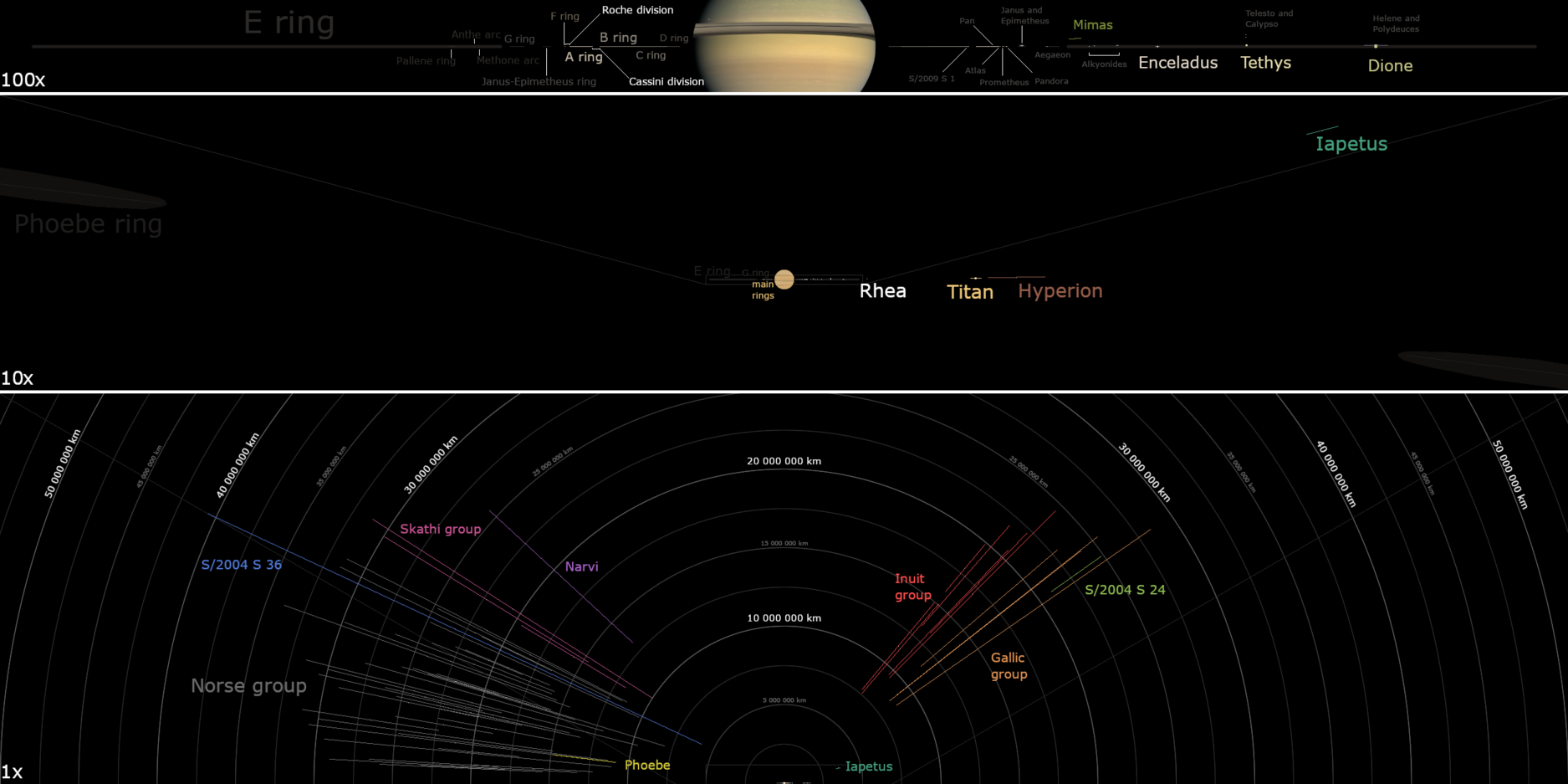
Bottom panel: The outer irregular moons of Saturn, with a scale of 1 pixel = 40,000 km. Moon groups, as well as ungrouped moons, are individually listed. They are graphed by their inclination, as well as the closest/furthest points in their orbit from Saturn (perichron and apochron) Middle panel: The middle moons of Saturn, with a scale of 1 pixel = 4,000 km. Although Saturn’s middle moons can be resolved, the inner moons and its rings are still difficult to resolve
Top panel: The inner moons of Saturn, with a scale of 1 pixel = 400 km. On the left, the rings of Saturn are labeled, and on the right, the inner moons are labeled. Click on the image to enlarge. Credit: Exoplanetaryscience.
Check it out in Bad Astronomy: https://www.syfy.com/syfywire/another-score-for-saturn-20-newly-discovered-moons-for-the-ringed-planet. The satellite diagram it contains shows Saturn not to scale with the satellite orbits. At that scale Saturn would be a small dot. These satellites are far out, really!
For more on all of Saturn’s moons: https://en.wikipedia.org/wiki/Moons_of_Saturn.
07/09/2019 – Ephemeris – Saturn is opposite the Sun in the sky today
Ephemeris for Tuesday, July 9th. Today the Sun will be up for 15 hours and 23 minutes, setting at 9:29, and it will rise tomorrow at 6:07. The Moon, at first quarter today, will set at 1:58 tomorrow morning.
Today Saturn will pass in opposition from the Sun at 12:12 p.m. It’s a time when Saturn will rise as the Sun sets, being opposite the Sun in the sky, and a time near its closest to the Earth at 841 million miles (1.354 billion km). Saturn orbits the Sun at a distance of 10 times the Earth’s distance, so Saturn’s distance from the Earth varies from 9 times to 11 times the Earth’s distance from the Sun. So it doesn’t change much in size in telescopes. This is unlike Mars which has a greater range of distances from the Earth. In telescopes the rings are the first one sees, with the planet nestled in the center. In small telescopes, it is a tiny but magnificent sight. It’s largest moon Titan is visible nearby.
The times given are for the Traverse City/Interlochen area of Michigan. They may be different for your location.
Addendum
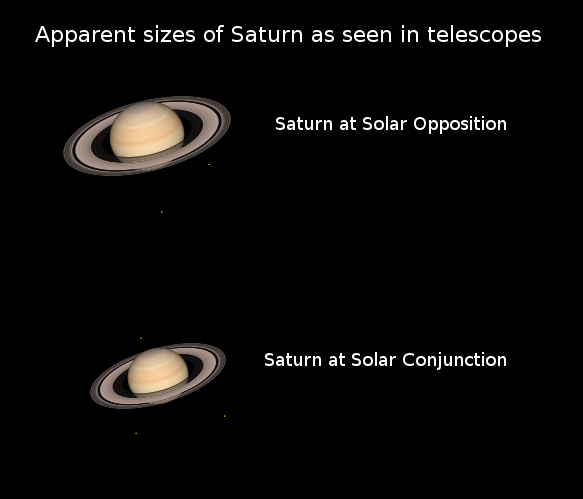
Here’s the extremes in the apparent size of Saturn from solar opposition to conjunction. Created using Cartes du Ciel.
10/02/2018 – Ephemeris – I will give a talk on Saturn at the Traverse Area District Library tomorrow night
Ephemeris for Tuesday, October 2nd. The Sun will rise at 7:42. It’ll be up for 11 hours and 39 minutes, setting at 7:21. The Moon, at last quarter today, will rise at 12:55 tomorrow morning.
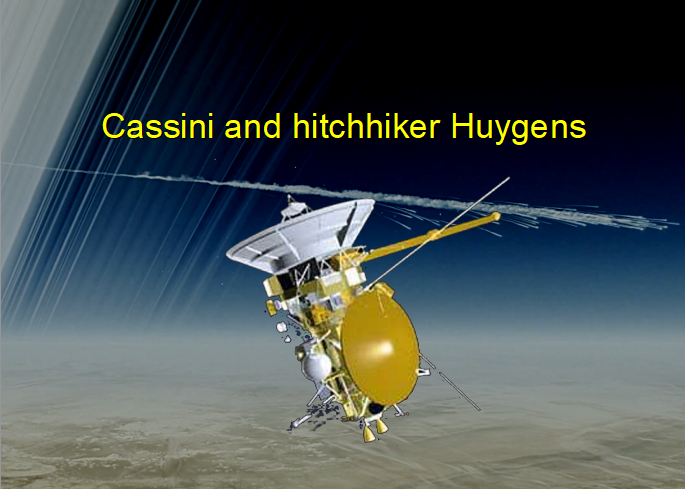
Tomorrow night October 3rd at 7 p.m. I’ll be giving a talk at the main branch of the Traverse Area District Library on Woodmere Avenue, about the amazing discoveries made about Saturn, its rings and moons by the Cassini spacecraft and its Titan lander Huygens, spanning 7 years to get there and 13 orbiting Saturn among its rings and moons. The spacecraft made a planned plunge into Saturn’s atmosphere a year ago. The illustrated talk is called Remembering Cassini. Besides the numerical data sent back were images, some of which were made into videos, such as the landing of the Huygens probe on Titan. After the talk, if it will be clear, Saturn will be visible in the telescopes of the Grand Traverse Astronomical Society, along with other wonders of the skies.
The times given are for the Traverse City/Interlochen area of Michigan. They may be different for your location.
Addendu
06/28/2018 – Ephemeris – Saturn at opposition, what it means
Ephemeris for Thursday, June 28th. Today the Sun will be up for 15 hours and 32 minutes, setting at 9:32, and it will rise tomorrow at 6:00. The Moon, at full today, will rise at 9:54 this evening.
Just before midnight last night Saturn was in opposition to the Sun. We’re not talking about an argument here. To the astronomer opposition simply means that a planet, in this case Saturn, is 180 degrees from the Sun, or opposite the Sun in the sky. It is a time when the planet rises at sunset and sets at sunrise. It is also a time when the planet is around its closest to the Earth. It’s not a big deal for Saturn, which is almost 10 times farther from the Sun than we are. However it is a big deal for a nearby planet like Mars, which at the end of July will be closer to us than at any time since 2003, at 35.8 million miles. That’s a big deal since Mars is a small planet, a bit more than half the size of the Earth.
The times given are for the Traverse City/Interlochen area of Michigan. They may be different for your location.
Addendum
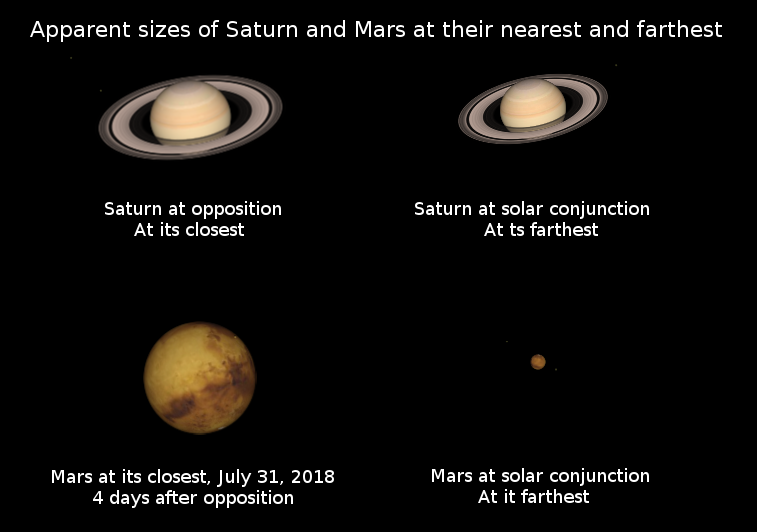
The apparent sizes of Saturn and Mars as seen from the Earth at opposition and solar conjunction. All at the same scale. Created using Cartes du Ciel (Sky Charts).
04/02/2018 -Ephemeris – Mars is appearing to pass Saturn in the morning
Ephemeris for Monday, April 2nd. The Sun will rise at 7:21. It’ll be up for 12 hours and 49 minutes, setting at 8:11. The Moon, 2 days past full, will rise at 10:40 this evening.
At 3:02 this afternoon the planet Mars will pass the planet Saturn. The event is called a conjunction, which simply means they are on nearly the same line of sight from the Earth, and nothing more. It will make a pretty sight tomorrow morning before the sky gets too bright with reddish Mars being just below Saturn, by a bit less than 3 moon widths. Conjunctions of these two planets occur at intervals of two years give or take, since it involves the orbital motions of Mars and Saturn while viewing them from a third planet also orbiting the Sun.
Currently both planets are moving eastward against the stars. Saturn will slow and stop its motion on April 18th, while Mars will continue until June 28th. They will track westward for a while. This is because the Earth will be passing these planets this summer, which is called opposition (from the Sun). Saturn will reach opposition on June 27th, Mars on July 27th. Mars closest approach will occur four days later at a distance of 35.76 million miles (57.59 million kilometers). This is Mars’ closest approach to the Earth since August 27th, 2003. Expect the return of the Mars hoax emails this summer.
The times given are for the Traverse City/Interlochen area of Michigan. They may be different for your location.
Addendum
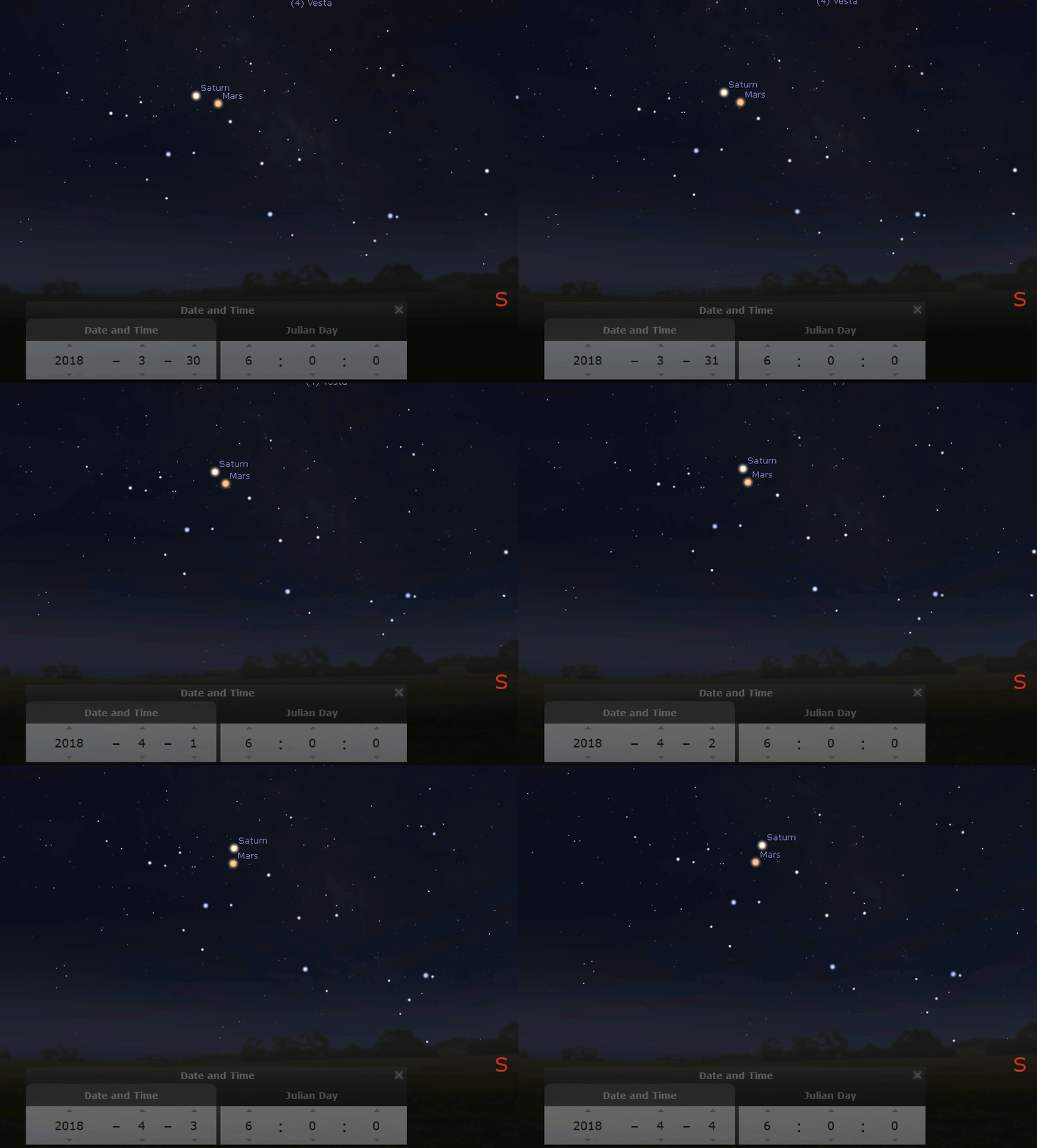
Conjunction animation of Mars passing Saturn at daily intervals at 6 a.m. for March 30 to April 4, 2018. This will occur above the Teapot asterism of the constellation of Sagittarius. Created using Stellarium and GIMP.
I covered the Mars hoax 5 years ago here on an August 27th when Mars was nowhere close to us.
 Bob Moler's Ephemeris Blog