Archive
12/22/2014 – Ephemeris – Roman solstice festivals that seem like our holiday season
Ephemeris for Monday, December 22nd. The sun will rise at 8:16. It’ll be up for 8 hours and 48 minutes, setting at 5:05. The moon, 1 day past new, will set at 6:17 this evening.
The Romans, around the time of Christ knew that the Sun would turn northward after the winter solstice. Their ancestors may not have been. They had two festivals around this time of year. Saturnalia, from the 17th to the 23rd. A time of gift giving, parties, kind of like now. The feast of Sol Invictus or the Unconquerable Sun was set on December 25th the then date to have thought to be the winter solstice. I’m not sure if the Roman calendars were off 4 days or that it was the date they detected northward movement in the Sun. Anyway that’s the date the Christians decided to celebrate Christ’s birth. The Gospel of Luke with its shepherds being out all night guarding the sheep suggests that the birth was actually in the spring.
Times are for the Traverse City/Interlochen area of Michigan. They may be different for your location.
Addendum

Saturnalia depiction.
07/07/2014 – Ephemeris – The Moon will appear near Saturn tonight
Ephemeris for Monday, July 7th. Today the sun will be up for 15 hours and 24 minutes, setting at 9:29. The Moon, 2 days past first quarter, will set at 2:43 tomorrow morning. Tomorrow the sun will rise at 6:05.
Tonight the planet Saturn will be seen above the bright gibbous Moon. At 11 p.m. Saturn will be only 3 moon widths above the moon and may be hard to spot in the Moon’s glare, so that binoculars may be needed to find it. Other than that the moon makes a nice pointer to the ringed planet. The rings of Saturn become apparent in telescopes of at least 20 power. At first the planet looks elliptical, then the planet can be seen to separate from the rings. The Moon itself is a fine but bright object for the telescope. Look near the terminator or sunrise line to see the long lunar shadows delineate the Moon’s crater detail, especially the grand Crater Copernicus near the center of the Moon.
Times are for the Traverse City/Interlochen area of Michigan. They may be different for your location.
Addendum
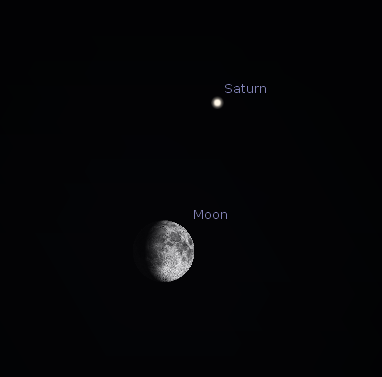
Saturn and the Moon as they would appear at 11 p.m. on July 7, 2014. Created using Stellarium.
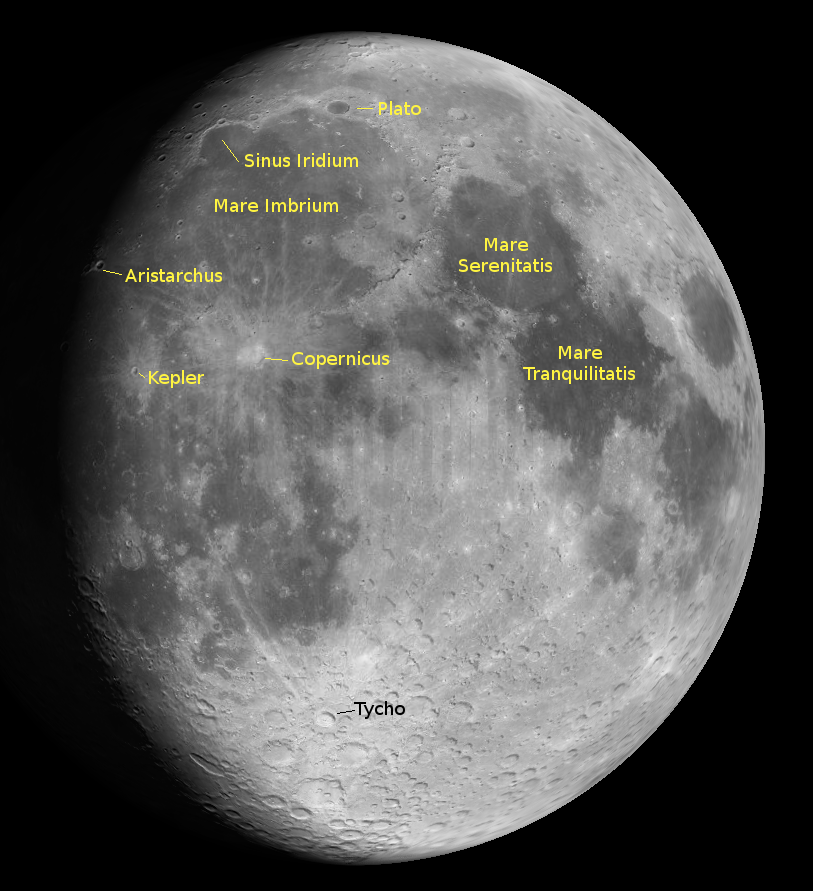
Oops, here’s the Moon for tomorrow night July 8th, 2014. The difference from tonight is the Aristarchus will not be visible, and Sinus Iridium will look cooler. Created using Virtual Moon Atlas. It’s 2 a.m. and I’m too tired to fix it.
06/13/2014 – Ephemeris – Saturn’s Rings and the Cassini Division
Ephemeris for Friday, June 13th. Today the sun will be up for 15 hours and 31 minutes, setting at 9:28. The moon, at full today, will rise at 9:54 this evening. Tomorrow the sun will rise at 5:56.
Saturn rings are the wonder of the solar system. While we know that Saturn isn’t the only planet with rings. Jupiter, Uranus, and Neptune have them plus at least one asteroid. Nowhere are they as grand as at Saturn. The rings actually outshine the planet. Now they are opening to their widest extent, and will continue to open a bit more until 2017, before closing again for 7 ½ years. Last Friday during the star party at Northwestern Michigan College’s Rogers Observatory, I was able to spot the break in the rings called Cassini’s Division. It’s caused by the orbital resonance of the moon Mimas and the ring particles at that distance from Saturn. Mimas orbits Saturn once to the ring particles at the division orbiting twice.
Times are for the Traverse City/Interlochen area of Michigan. They may be different for your location.
Addendum
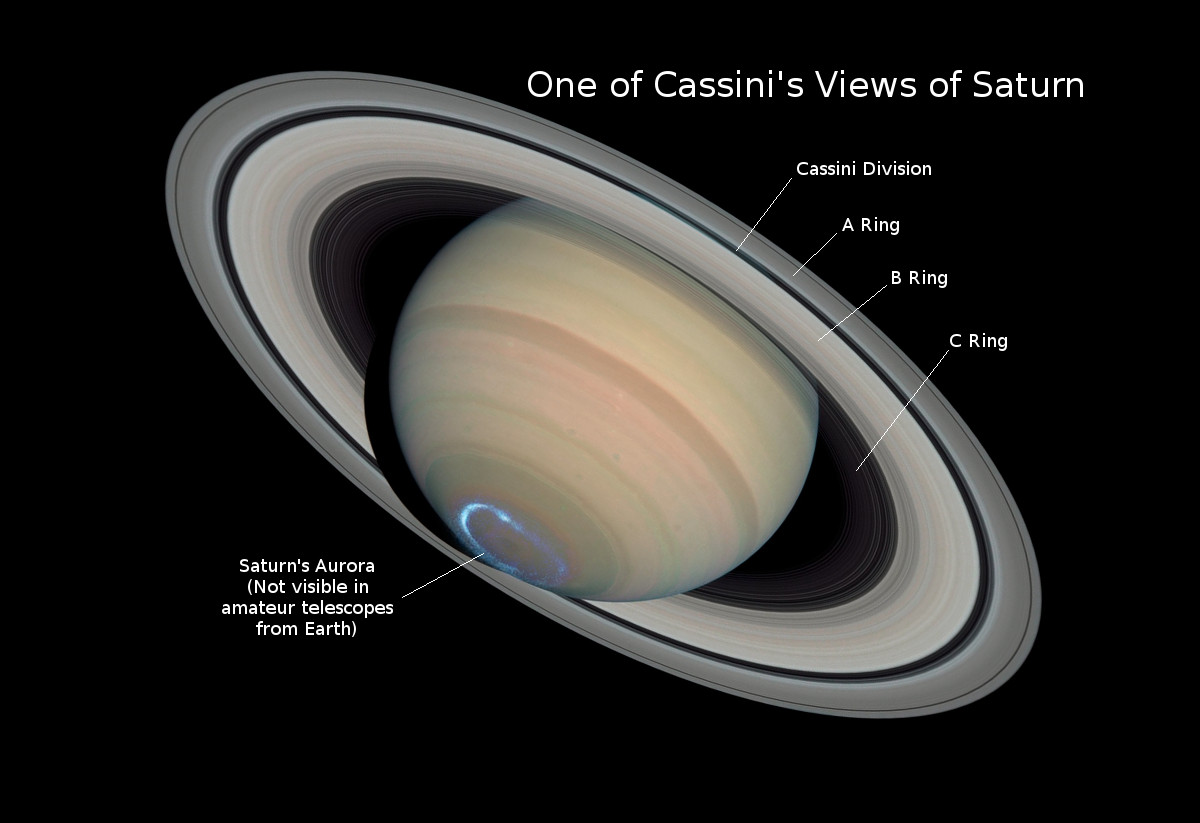
Saturn and rings from the Cassini spacecraft, plus the aurora oval in ultraviolet. Credit: NASA/JPL/Space Science Institute
06/10/2014 – Ephemeris – Our Moon and Saturn’s largest moon Titan
Ephemeris for Tuesday, June 10th. Today the sun will be up for 15 hours and 29 minutes, setting at 9:26. The moon, 3 days before full, will set at 4:51 tomorrow morning. Tomorrow the sun will rise at 5:57.
Tonight the planet Saturn will be near the bright gibbous Moon. One might need a bit of help locating it in the Moon’s glare. Saturn is to the right and slightly above the Moon. Saturn has a few moons of its own. The count’s up to 62, with another apparently forming from one of Saturn’s rings as monitored by the Cassini spacecraft now in orbit of Saturn. Cassini, which has about three years left in its mission, entered orbit of Saturn 10 years ago next month after a 7 year journey to get there. One of the most intensively studied moons is Titan, whose haze foiled the earlier Voyager spacecraft, Cassini and it’s Huygens lander have shown us earthly terrain and methane seas. Titan is easily seen in small telescopes near Saturn.
Addendum
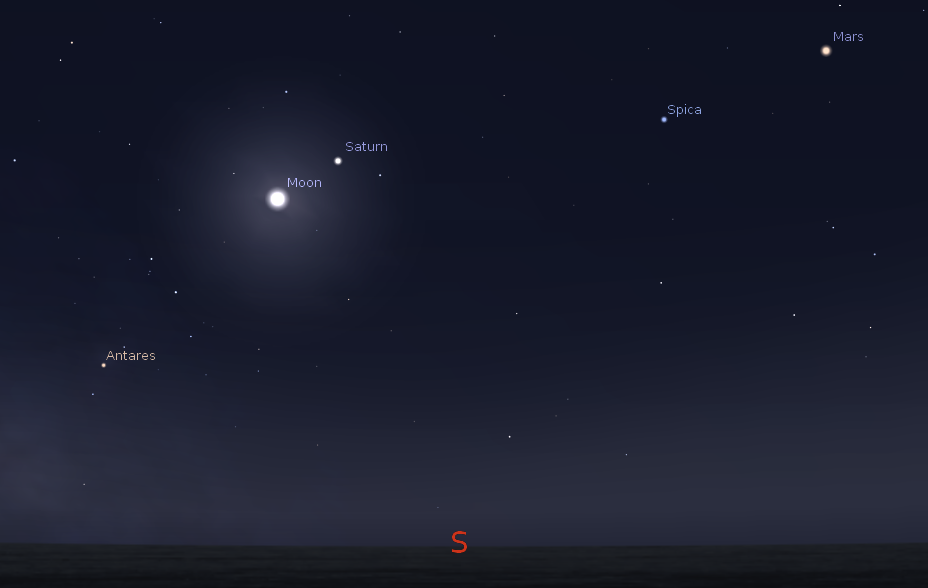
Saturn and the Moon tonight at 11 p.m., June 10, 2014. Created using Stellarium.
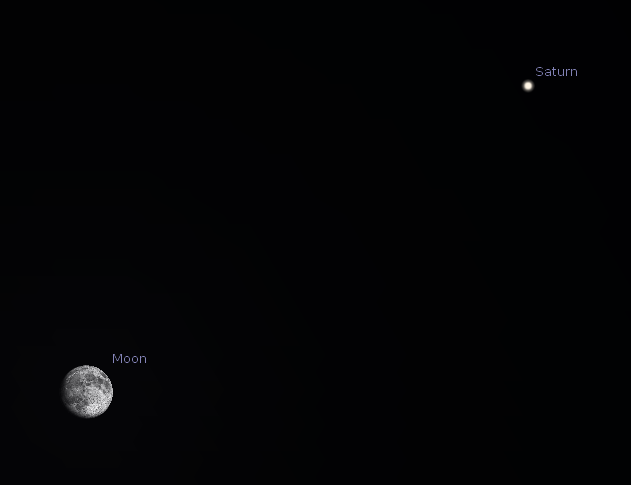
Just Saturn and the Moon showing the moon’s gibbous phase at 11 p.m. June 10, 2014. Created using Stellarium.
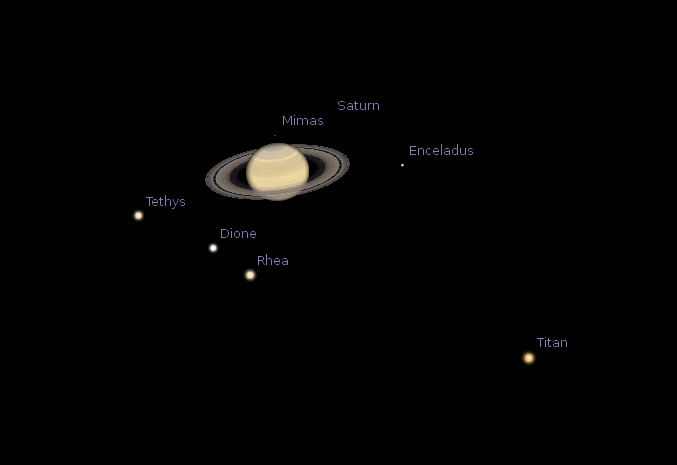
Saturn and its moons including Titan at 11 p.m. June 10, 2014. Created using Stellarium.
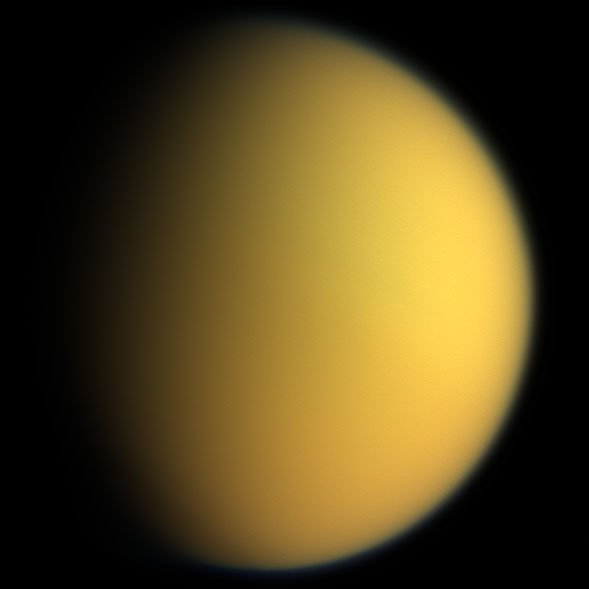
Titan, as Voyager would have seen it, but photographed by Cassini. Credit: NASA/JPL/Space Science Institute.
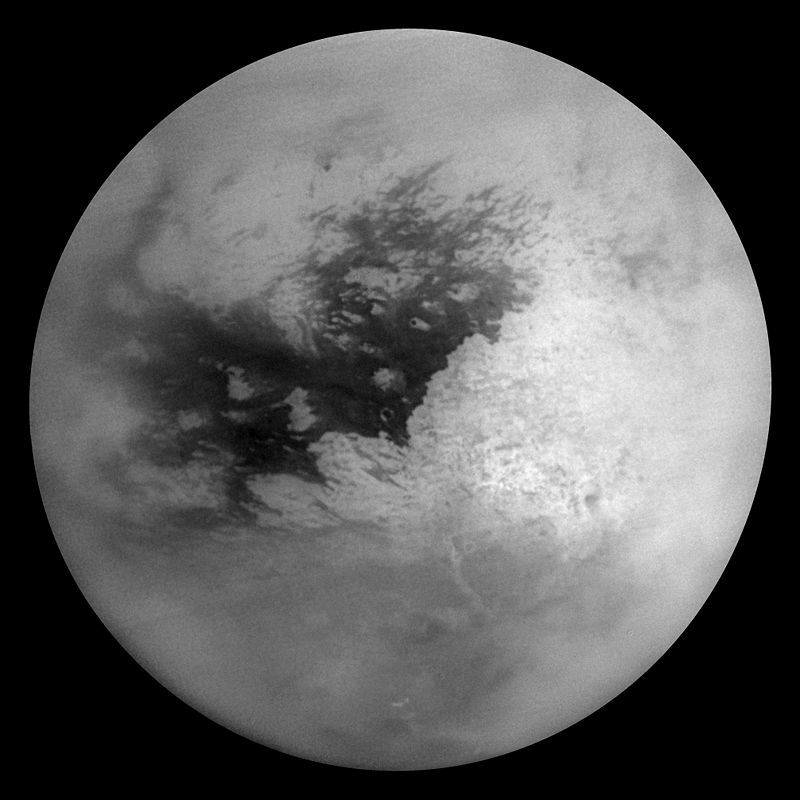
Titan as seen in the infrared by the Cassini spacecraft. Credit: NASA/JPL/Space Science Institute.
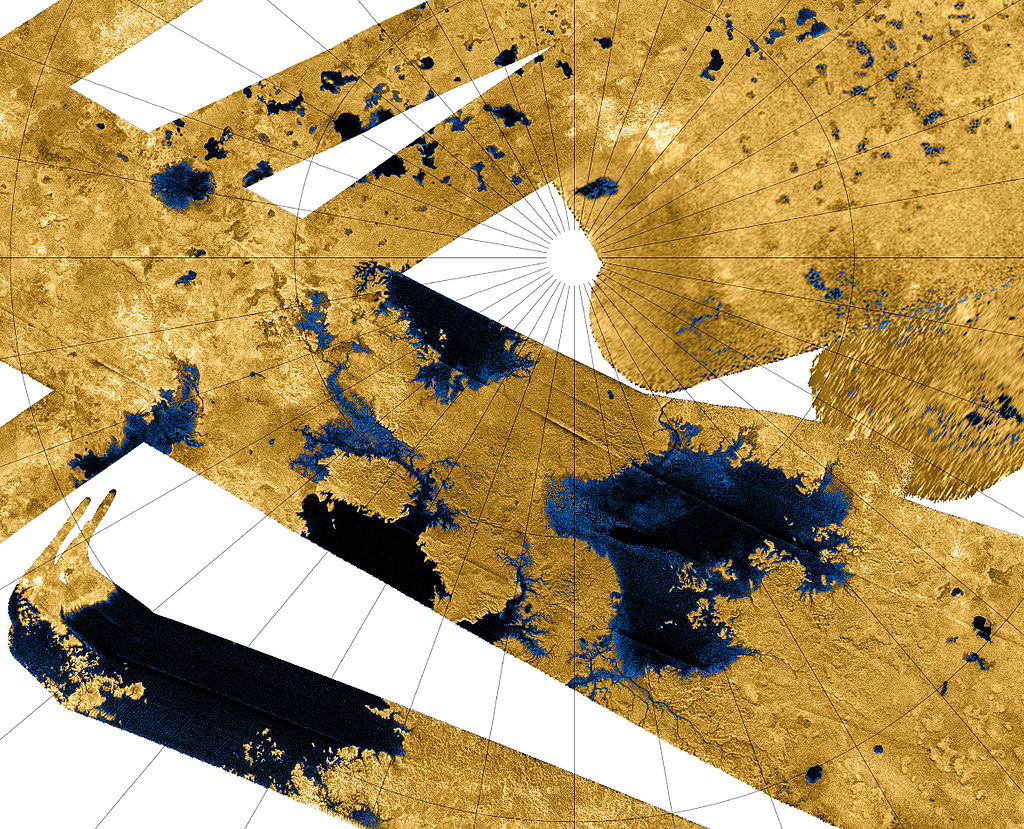
Seas and lakes at Titan’s north pole seen by radar from the Cassini spacecraft. Credit: NASA/JPL-Caltech/GSFC.

Image mosaic of Titan from the descending Huygens Lander. Credit: ESA/NASA/Univ. of Arizona.
06/03/2014 – Ephemeris – Observing Saturn’s rings over the years
Ephemeris for Tuesday, June 3rd. Today the sun will be up for 15 hours and 22 minutes, setting at 9:22. The moon, 2 days before first quarter, will set at 1:11 tomorrow morning. Tomorrow the sun will rise at 5:59.
The planet Saturn is now well placed to see with a telescope. It’s located in the southeast. The brightest star in that direction. It takes a telescope of only 20 power magnification to spot the rings. A bit more power and the planet can be detected apart from the rings. Most of the light reflected by Saturn comes from the rings. The rings are still opening up, and will be for the next 3 years. The rings orbit the planet over its equator, and Saturn has an axial tilt of some 26 degrees. Over Saturn’s nearly 30 year journey around the sun, its seasonal changes go from solstice when the rings are open wide, to equinox where the rings, only about 90 feet [30 meters] thick on average, seem to disappear.
Times are for the Traverse City/Interlochen area of Michigan. They may be different for your location.
Addendum
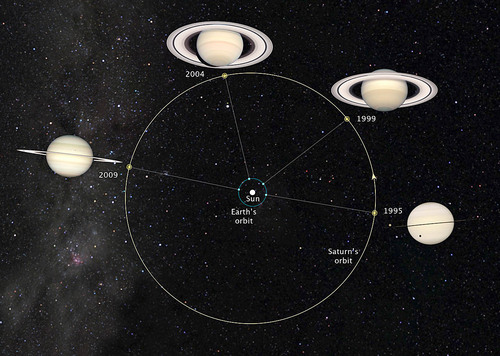
Saturn’s ring appearances over that last Saturnian half-year from the equinox in 1995 through southern hemisphere spring and summer to the equinox 2009. Illustration Credit: NASA, ESA, and Z. Levay (STScI)
05/08/2014 – Ephemeris – Saturn will reach opposition from the Sun this weekend
Ephemeris for Thursday, May 8th. The sun rises at 6:23. It’ll be up for 14 hours and 32 minutes, setting at 8:55. The moon, 2 days past first quarter, will set at 3:37 tomorrow morning.
In two days Saturn will be in opposition from the sun. That means the Earth will be nearly directly between the Sun and Saturn. Saturn will be the closest it gets to the earth all year, at 828 million miles (1,334 million km). Saturn, being about nine and a half times the earth’s distance from the sun, doesn’t vary its distance from the Earth by a great percentage, so it’s a great telescopic object at any time it’s visible. Mars, being closer and smaller is best seen near the time of opposition. One effect of opposition is the minimum amount of shadows between the planet and the rings visible. The shadows will increase until Saturn is 90 degrees from the sun, or quadrature, on August 10th. Then they will diminish again until it’s in conjunction with the sun.
Times are for the Traverse City/Interlochen area of Michigan. They may be different for your location.
Addendum
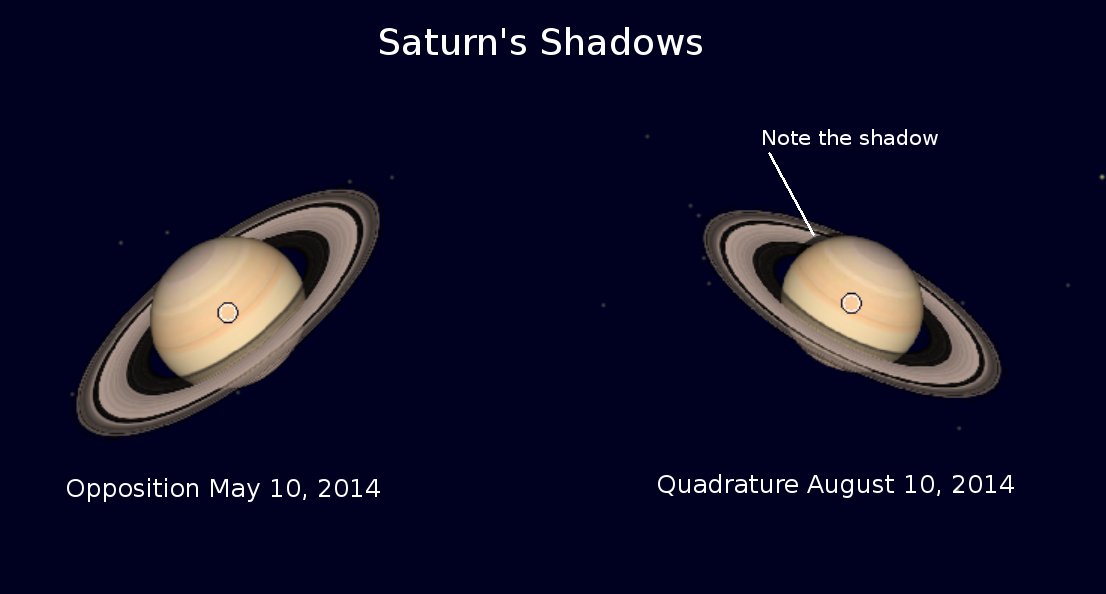
Saturn at opposition and quadrature showing the maximum shadow at quadrature. Created using Cartes du Ciel (Sky Charts).
Note that the different tilt of Saturn in these two views is due to the fact that Saturn is in the east at opposition and in the southwest at quadrature, helped out by the fact that we’re viewing it from 45 º north latitude. The different sizes of Saturn is due to Saturn’s greater distance of 919 million miles (1,481 million km) on August 10th. The little circle artifact in the center of the planet is due to telling the program that I’m tracking Saturn, so I wouldn’t have to re-find the planet when I shifted 3 months.
08/02/2013 – Ephemeris – Star Party tonight!
Ephemeris for Friday, August 2nd. The sun rises at 6:30. It’ll be up for 14 hours and 35 minutes, setting at 9:06. The moon, half way from last quarter to new, will rise at 3:38 tomorrow morning.
Tonight the Grand Traverse Astronomical Society and the NMC Astronomy Club will host a star party at Northwestern Michigan College’s Rogers Observatory starting at 9 p.m. featuring, if it’s clear, the planets Venus and Saturn. Some of the wonders of the summer sky can be seen as it gets darker. There are sparkling binary stars and star clusters including the Great Globular Star Cluster in Hercules, the Wild Duck Cluster, the Ring Nebula, the expanding gasses of a dying star. There are also other wonders of the Milky Way to be seen. There will be a program if the skies are too cloudy to observe. The observatory is located south of Traverse City, on Birmley Road between Garfield and Keystone roads.
Times are for the Traverse City/Interlochen area of Michigan. They may be different for your location.
07/19/2013 – Ephemeris – Smile you’re on Candid Cassini Camera
Ephemeris for Friday, July 19th. Today the sun will be up for 15 hours and 6 minutes, setting at 9:21. The moon, 3 days before full, will set at 3:55 tomorrow morning. Tomorrow the sun will rise at 6:16.
Between 5:27 and 5:42 p.m. today go outside and look to the southeast and smile. An hour and a half later when the light arrives the Cassini spacecraft, hiding from the sun behind Saturn will take a series of photographs that will include the Earth in the background. All of us, the Earth included will fit into one pixel in Cassini’s camera. This is a reprise of the famous back-lit photograph of Saturn taken earlier in its mission. Closer to home members of the Grand Traverse Astronomical Society will be part of Kingsley Heritage Days Saturday and Sunday to view the sun if it’s clear. Also the society will host a star party at the NMC’s Rogers Observatory starting at 9 p.m. tomorrow night.
Times are for the Traverse City/Interlochen area of Michigan. They may be different for your location.
Addendum
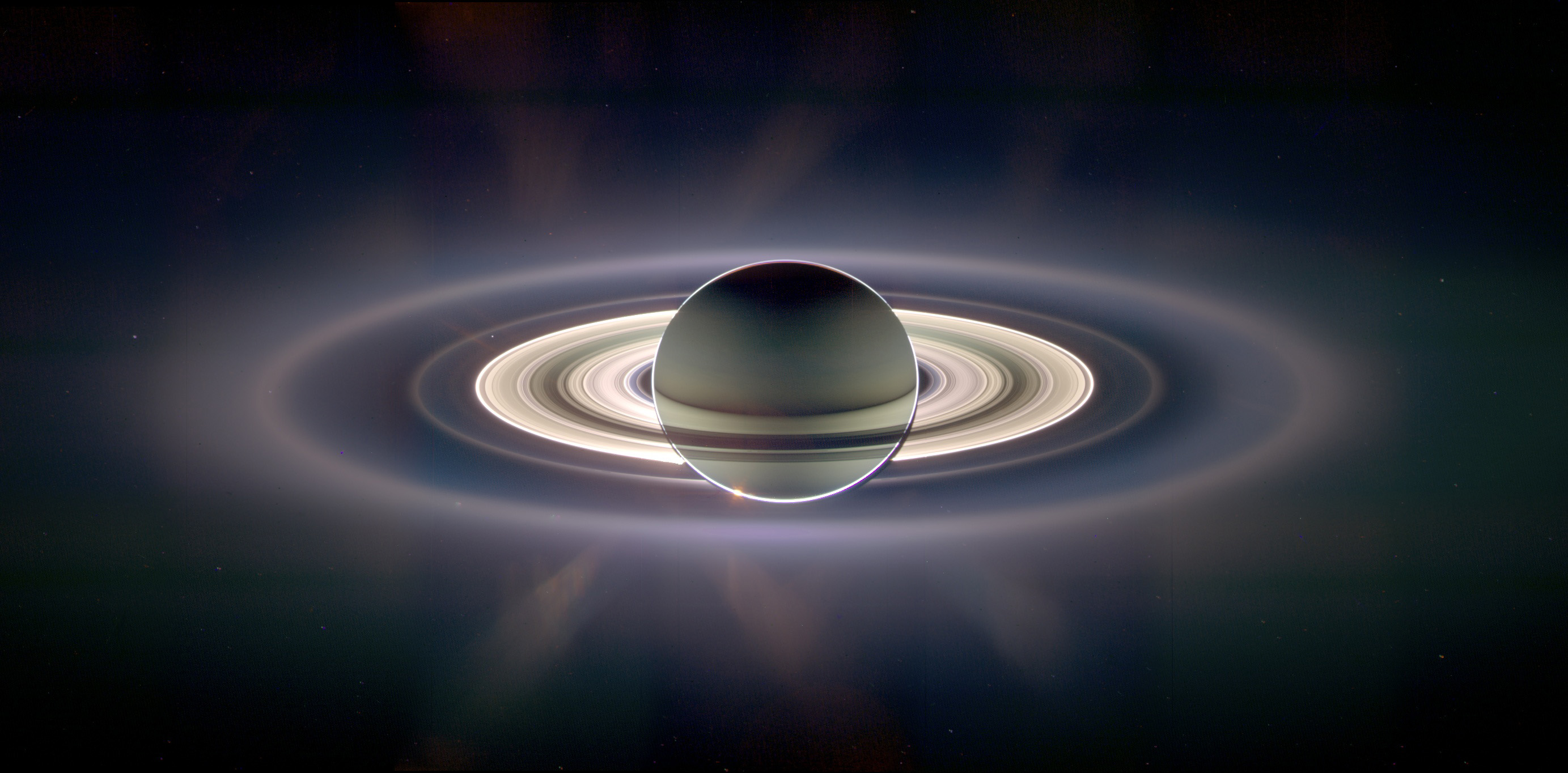
Saturn night side mosaic taken early in the mission. Note the pale blue dot at the 9:30 position outside the main rings and just inside the next fuzzy ring out. That’s Earth. Credit: NASA. Click on the image to enlarge.
04/29/2013 – Ephemeris – Saturn at opposition from the sun
Ephemeris for Monday, April 29th. The sun rises at 6:35. It’ll be up for 14 hours and 9 minutes, setting at 8:45. The moon, 3 days before last quarter, will rise at 1:11 tomorrow morning.
This past weekend Saturn was in opposition to the sun. That simply means the earth was more or less directly between the sun and Saturn. That means Saturn’s at its closest to us at 821 million miles. The Cassini spacecraft that’s still orbiting Saturn, when it sends pictures and data back to earth still takes about an hour and a quarter for the signals to get here. Shadows of the rings on the planet and planet on the rings are minimal. Saturn and the earth have some coincidental properties as seen from the sun. Saturn is 9.5 times the earth’s distance from the sun. And Saturn is about 9.5 times the diameter as the earth, so from the sun both the earth and Saturn would appear to be the same apparent size. Cool huh?
Times are for the Traverse City/Interlochen area of Michigan. They may be different for your location.
Addendum
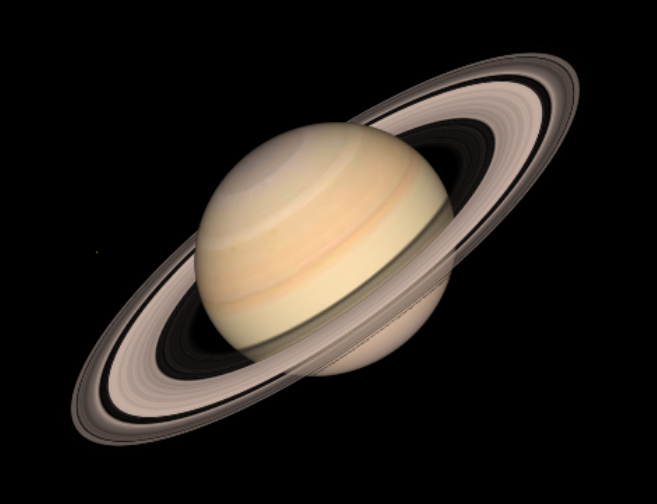
Saturn rising in the evening in May, 2013 as rendered by Cartes du Ciel (Sky Charts)
03/06/2013 – Ephemeris – Where’s the two bright planets this week?
Ephemeris for Wednesday, March 6th. The sun will rise at 7:10. It’ll be up for 11 hours and 26 minutes, setting at 6:37. The moon, 2 days past last quarter, will rise at 4:17 tomorrow morning.
It’s time to check out the two remaining bright planets for this week. Jupiter is located in the constellation of Taurus and is in the high southwest during the evening. It will set at 1:43 a.m. Jupiter is a wonderful sight in telescopes with its cloud bands and its moons which change positions each night. the other bright planet Saturn will rise at 11:10 p.m. in the east southeast. It’s located in eastern Virgo. Saturn will pass due south at 4:21 a.m. Saturn is the most beautiful of planets when seen in a telescope with its fabulous rings, now opened wide. One’s first impression is how small it is. It is the second largest planet, but it’s almost 900 million miles away. Saturn’s giant moon Titan can always be seen near Saturn.
Times are for the Traverse City/Interlochen area of Michigan. They may be different for your location.
Addendum
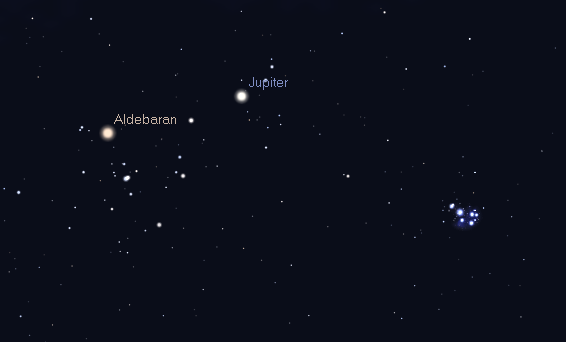
Jupiter is between the Hyades (Letter V of stars) and the Pleiades on the right at 9 p.m. March 6, 2013. Created using Stellarium.
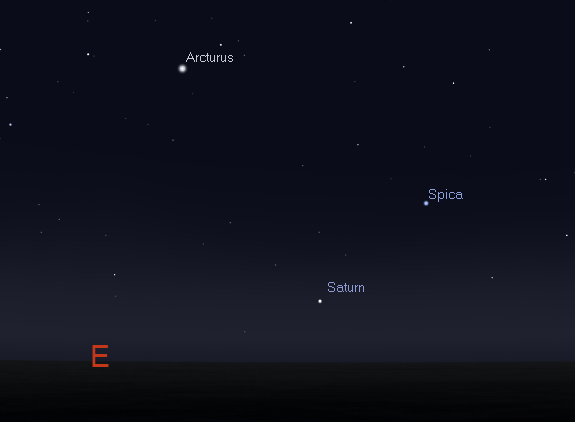
Saturn rising at midnight March 7, 2013. Created using Stellarium.
 Bob Moler's Ephemeris Blog