Archive
02/13/2014 – Ephemeris – Dwarf planet Ceres is the next stop for the Dawn spacecraft.
Ephemeris for Thursday, February 13th. The sun will rise at 7:45. It’ll be up for 10 hours and 22 minutes, setting at 6:08. The Moon, 1 day before full, will set at 7:10 tomorrow morning.
The Dawn spacecraft is in the asteroid belt. After spending a year orbiting the asteroid Vesta two years ago, it has set its sights on Ceres, the largest asteroid, which was promoted by the same reasoning that Pluto was demoted, as a dwarf planet. Recently it was announced that Ceres is out-gassing water molecules. Dawn, with its ion engine is slowly approaching Ceres and will enter orbit of the body in April next year, a few months before the new Horizons spacecraft will fly by the dwarf planet Pluto on Bastille Day 2015. Dawn will stay in orbit of Ceres for a year at least. It will take at least several months to download all the images and data from the Pluto encounter from New Horizons, so we will have a very eventful 2015.
Times are for the Traverse City/Interlochen area of Michigan. They may be different for your location.
Addendum
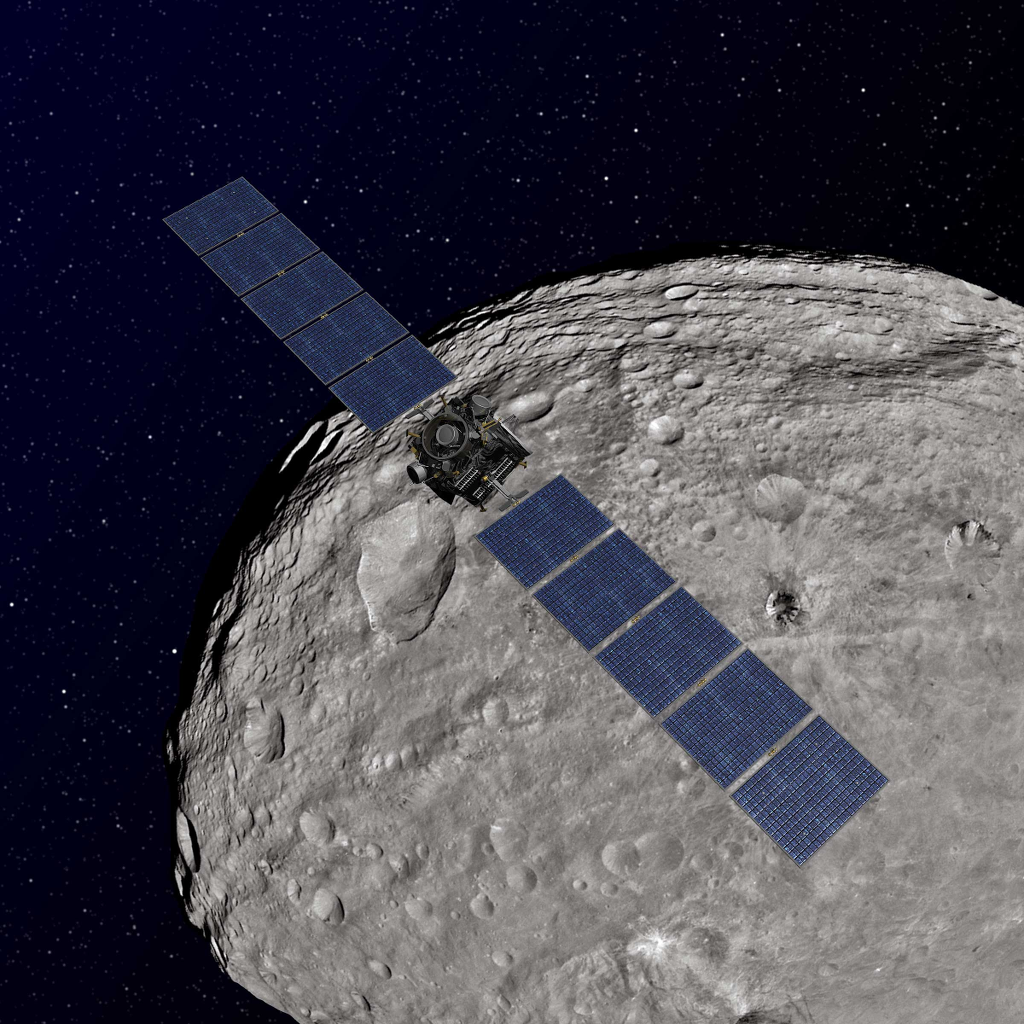
Artist’s rendition of the Dawn spacecraft at Vesta. Credit: NASA/JPL.
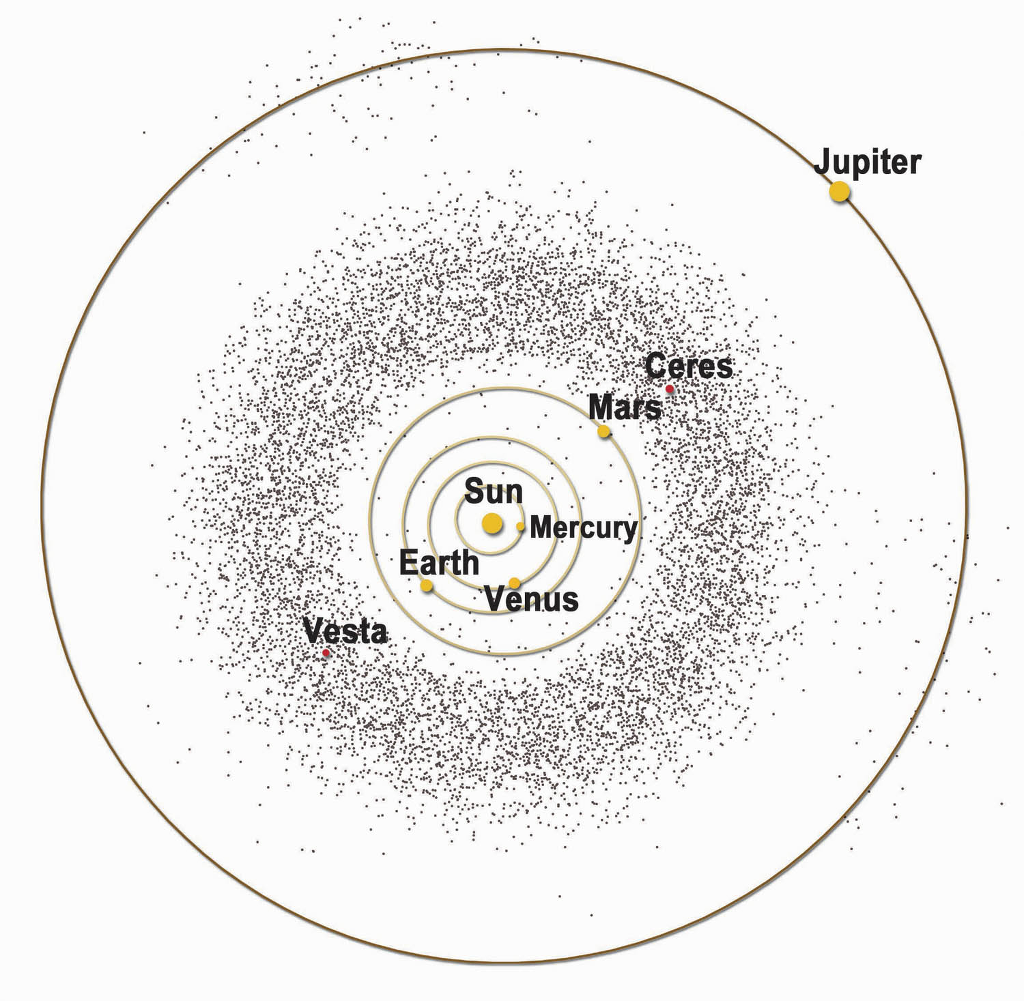
The asteroid belt n the inner solar system. Credit: NASA/JPL.
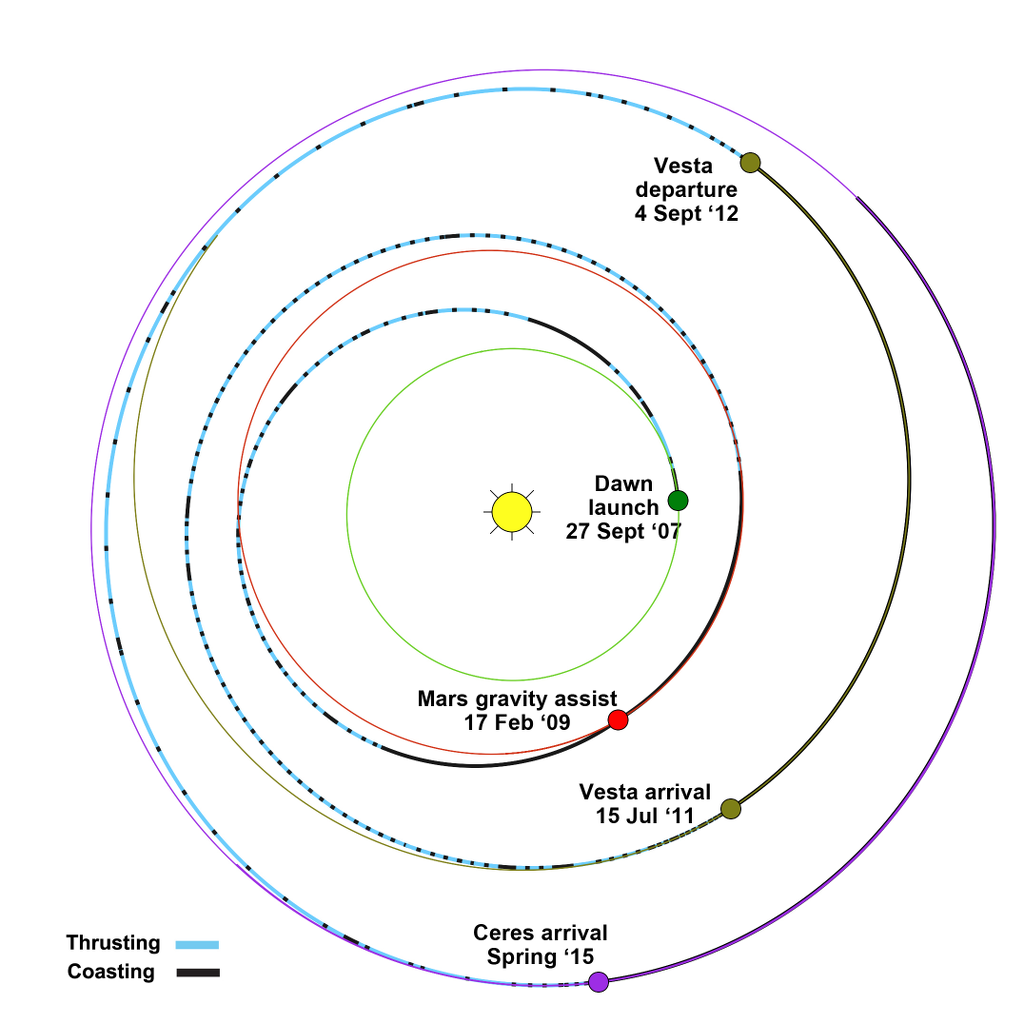
Dawn orbital track past Mars, stopping at Vesta and continuing to Ceres. Credit: NASA/JPL.
The Dawn spacecraft uses ion propulsion, which though 10 times more efficient than chemical fuels, has the thrust comparable to that of the weight of a piece of a piece of paper. Consequently the spacecraft spends most of its time thrusting. Since it’s antenna is bolted on the spacecraft, it cannot thrust and communicate with the earth at the same time, so it has to stop thrusting and turn toward the earth to report back at scheduled intervals before resuming thrusting again.
01/20/2014 – Ephemeris – Wake up Rosetta!
Ephemeris for Dr. Martin Luther King Day, Monday, January 20th. The sun will rise at 8:12. It’ll be up for 9 hours and 22 minutes, setting at 5:34. The moon, 4 days before last quarter, will rise at 10:22 this evening.
Wake up Rosetta! That’s the message The that the European Space Agency or ESA wants sent to the Rosetta spacecraft to wake it up after 33 months of hibernation when it was too far from the sun for its solar panels to provide adequate power. The wake up call is ESA’s way of gaining the public’s attention for the events later this year when the spacecraft will rendezvous with a comet. Actually the probe will have to wake itself up. It set three alarm clocks, er… timers to wake it up today, find the sun and charge its batteries and phone home. The comet is 67P/Churyumov-Gerasimenko. After orbiting the comet’s nucleus the main spacecraft will release a probe called Philae to land, or actually grapple it. [the two and a half mile [4 km] diameter nucleus, which is known to be of an odd non-round shape.]
Times are for the Traverse City/Interlochen area of Michigan. They may be different for your location.
Addendum
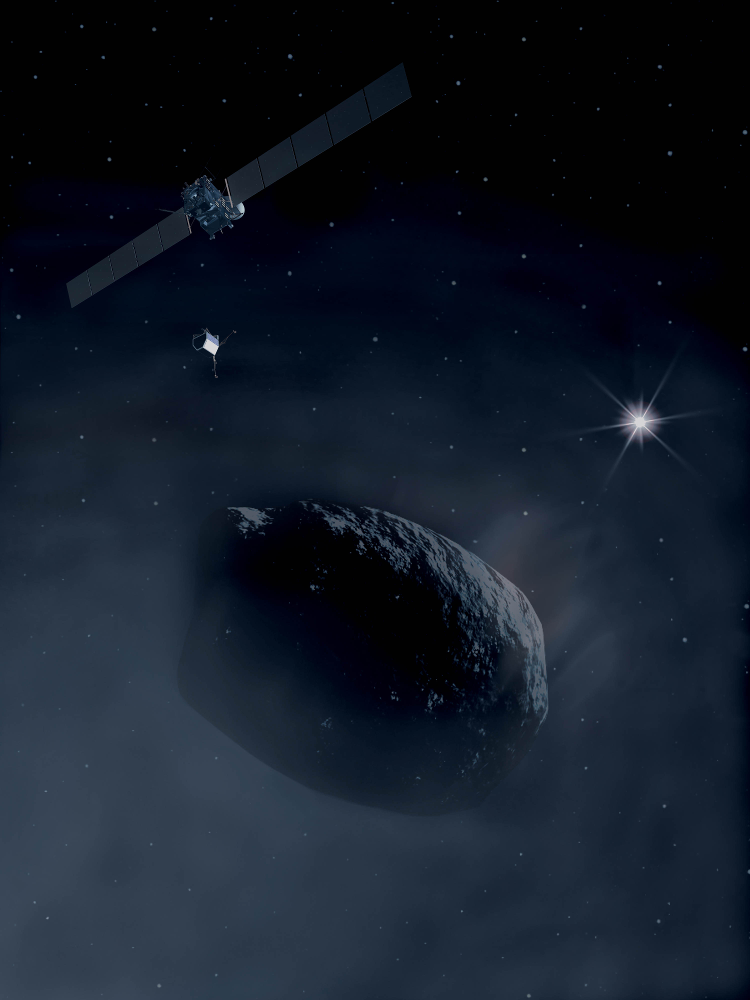
Artist’s rendering of Rosetta orbiting comet 67P/Churyumov–Gerasimenko and sending the Philae lander to the comet’s surface. Credit: ESA
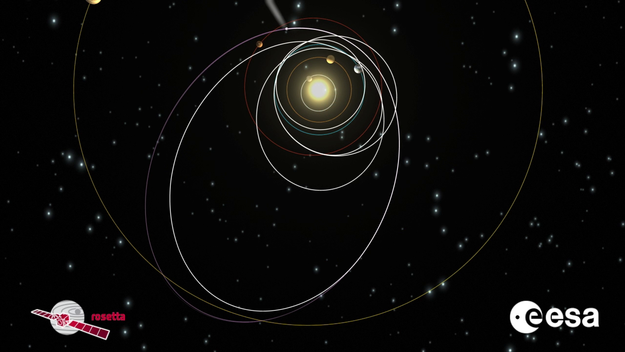
12 years of orbital maneuvers of Rosetta to match orbits with the comet. Credit ESA.
09/10/2013 – Ephemeris – The Moon reveals the Apollo 11 landing site
Ephemeris for Tuesday, September 10th. The sun will rise at 7:15. It’ll be up for 12 hours and 46 minutes, setting at 8:02. The moon, 2 days before first quarter, will set at 10:49 this evening.
Tonight the moon will reveal the entire Sea of Tranquility or Mare Tranquilitatis on the moon’s equator near the terminator or sunrise line that makes the moon look like a crescent. The sun is rising right now (morning of the 10th) on the Apollo 11 landing site dubbed Tranquility Base by Neil Armstrong right after landing on July 21st 1969. When showing the moon we are often asked, partly in jest we hope, if they could see the flag left by Armstrong and Aldrin. The answer is no. From the earth, we can barely see anything less than two miles in diameter. It took the Lunar Reconnaissance Orbiter to dip down real low, less than 15 miles altitude, to capture an image of the landing site and what the astronauts left behind. Incidentally the flag was knocked down by the blast of the ascent engine on their lunar module when they took off from the moon.
Times are for the Traverse City/Interlochen area of Michigan. They may be different for your location.
Addendum
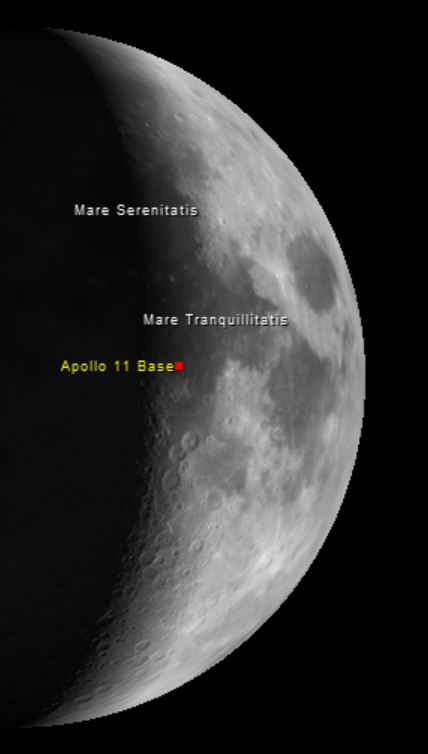
The Moon tonight, 9 p.m. September 10, 2013, with the Apollo 11 landing site marked. Created with Virtual Moon Atlas.
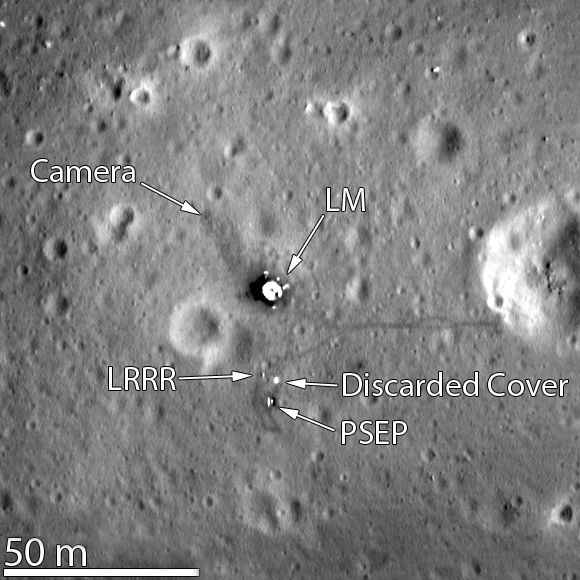
Apollo 11 Base from the Lunar Reconnaissance Orbiter. Credit: NASA.
LM is the descent stage of the Lunar Module that served as a launch platform for the ascent stage.
LRRR is the bank of retro reflectors that are still used to reflect earth based lasers to get an extremely accurate range to the Moon.
PSEP is a solar powered instrument package to monitor moonquakes and other information back to Earth after the astronauts had left the Moon.
The flag is not visible about a third of the way between the LM and the camera.
The dark lines are the tracks of the astronauts as they went about their exploration and equipment set up.
Our Past and Future in Space – A Personal View
This is a piece I wrote for the Grand Traverse Astronomical Society’s Stellar Sentinel in the January
I’ve witnessed the space program since before Sputnik. I watched the United States Vanguard program from its inception to attempt the launch the first satellite. It turns out that the Russians and the US Army beat Vanguard for the first successful US satellite. The three and a quarter pound satellite Vanguard 1 launched in 1958, with the first solar cell power is the only satellite from the early days still in orbit. Though silent it is still being tracked.
Back to Sputnik. It was a real surprise one October evening, while watching TV a news flash came over the TV announcing that the USSR (Russians for you younger folk) had launched a satellite. They showed a dot crossing the screen and the beep beep beep it emitted as if to say: “We’re in orbit and you’re not!” It turned out that it’s not nice to mess with America’s pride. We beefed up our science teaching, and math. I was old enough to miss most of the new math. Now helping my youngest granddaughter with her 4th grade math homework I’m learning a newer math, and as an old computer programmer I’m seeing how they now break problems into manageable bits, just like I do now, but wasn’t taught to me in school.
Back to the past. The 1960s were a heady time for space buffs. The manned Mercury, Gemini programs leading to the magnificent Apollo lunar landings. Along the way we sent spacecraft beyond the moon to Venus and then to Mars. After the Apollo 11 landing the will to proceed with the last three Apollo landing died in Congress, and the general public had the “been there done that” attitude, while scientists and we astronomers amateur and otherwise though it was just getting interesting. The first and last geologist who went to the moon did so on the last flight.
The next big NASA project was the Space Shuttle, which was supposed to save money and make access to space routine. Unfortunately it was built on a starvation budget which ultimately drew out its development time and weakened the spacecraft due to the shortcuts that were taken to keep it almost within budget. It was built to hopefully make trips to a space station that it didn’t begin to construct until the latter third of its lifetime. After the fiery demise of the second shuttle with its seven person crew it was finally determined that the shuttle was indeed too fragile to fly, and the program was abandoned after the International Space Station (ISS) was completed.
Without the space shuttle we have to bum rides to the ISS from the Russians whose 1960’s technology Soyuz space capsules are still perfectly capable vehicles. The Soyuz capsules also serve as life boats for the ISS. Maybe in a few years one of the commercial space companies will have a manned spacecraft ready to go. The three contenders that have received NASA grants are SpaceX, Boeing, and Sierra Nevada. NASA’s working on the Orion Capsule, to take astronauts past the moon, to the asteroids and to Mars.
Whatever we send to these destinations the Orion capsule will not be the living quarters. It’s for launch and reentry. The rest of the spacecraft will most likely be much larger with a rotating component to provide artificial gravity. The actual manned mission would be preceded by cargo missions to establish a habitat and a martian launch vehicle. It’s possible that the martian moon Phobos would be a staging area for a possible martian landing. This seems to be the thinking of the Russians who have sent, or tried to send spacecraft to Phobos, including the failed Phobos Grunt (Soil) mission of a year ago. The Russians found out that you can’t do this stuff on the cheap. That and that fact that Russia has had miserable luck with Mars.
The current guesstimate on the time of a manned landing on Mars is the 2030s. Back in the late 90’s after the successful Mars Pathfinder mission, I answered a Planetary Society member questionnaire as to my opinion as to when a manned landing on Mars would happen. I guessed 2030. It may be optimistic by a decade or two. The first man or woman to set foot on Mars is probably in grade school right now.
A good dress rehearsal for landing on Phobos or Mars would be a trip to a near earth asteroid. These will be a shorter trip than to Mars. As it happens one docks with an asteroid rather than lands on it. Other than that, we must learn a lot more about asteroids if we are able to defend the earth from them. So asteroid missions are not only good practice, but vital in learning how to defend ourselves from one on an intercept course.
The current China’s Chang’e 2 mission started as a photo mission to the moon, It was then sent to the earth-sun Lagrangian 2 or L2 location, One million miles directly opposite the sun from the earth. From there it was sent to fly by the asteroid Toutatis, which it did in December 2012. Maybe the Chinese have something. Maybe L2 might be a place to hold in reserve asteroid defense rockets. They’re outside the gravity well of the earth, so can be pre-positioned to launch to intercept an asteroid.
To practice living off the land on Mars, a lunar mission to the poles of the moon may be necessary. The moon’s low angular tilt means that lunar craters at the poles contain water ice and other frozen volatile compounds. South polar permanently shadowed craters are known to contain water ice. Also with permanent sunlight at the crater rims, solar power can be readily available. Problem is the lunar poles are part of the lunar highlands, some very rugged terrain. It makes landing there way more than exciting.
Mars has water, lots of it, either at the polar caps, and/or located as permafrost below the surface and possible methane good for rocket fuel. If water in sufficient quantities is found, then hydrogen and oxygen can be made for breathable oxygen and again rocket fuel. A manned martian population will have to be much more self-sufficient than a lunar one. Care packages to Mars can only be sent at 26 month intervals, while the moon is only 3 days away by rocket.
One of the big questions with space exploration is manned versus robotic missions. Actually I’m in favor of both. First must come the robotic missions to survey the lay of the land, the atmosphere and determine the feasibility of even sending astronauts. That’s what we’re doing to Mars. We will have to determine what life Mars has or had before we send people who will bring their own biological contamination. Even the Curiosity rover may have brought organic contamination to Mars. It may have been sterile but it came from a planet loaded with the stuff.
Robots can go to places humans can never go: Deep inside the radiation fields of Jupiter, onto the surface of Saturn’s moon Titan. Suicide plunges into the atmosphere’s of the gas giant planets. Other than that they don’t need the care and feeding of humans, and are much cheaper than a human mission, humans are much more adaptable, able to thing on the spot. Of course the humans that operate the robots are pretty good at improvising with their charges too.
Currently NASA is doing all its current and future missions with one half of one percent of the federal budget. Recent events in the Congress of the United Stated don’t give me much hope that that will improve. Congress is still starving NASA. They want all these great things, like the Space Launch System, but won’t finance it well enough to do it right. I fear the cutting of corners and eliminating science programs to finance their big rocket that currently has no manifest.
The climate scientists are quite positive that the climate is warming and 90% sure that humans are causing it. The last and next chairmen of the House Science, Space and Technology Committee are climate change deniers. What’s the chance of anything positive coming out of that committee?
09/17/2012 – Ephemeris – Cygnus and the search for exo-planets
Ephemeris for Monday, September 17th. The sun will rise at 7:24. It’ll be up for 12 hours and 24 minutes, setting at 7:48. The moon, 2 days past new, will set at 8:21 this evening.
Nearly overhead at 10 p..m. is the constellation Cygnus the swan. The bright star Deneb is at the tail of this flying swan with its wings outstretched, flying south through the Milky Way. Cygnus is located at a point in the Milky Way in the direction the sun’s orbiting the center of the Milky Way. That is the approximate direction the Kepler spacecraft is staring. Launched in 2009 the Kepler spacecraft has been slowly drifting away from the earth in a trailing orbit of the sun. It is monitoring over 100,000 stars continuously looking for transits of planets across their stars. So far some 2300 suspects have been found. They have to be confirmed by ground based telescopes before being officially cataloged. So far close in planets to their stars have been discovered.
Addendum
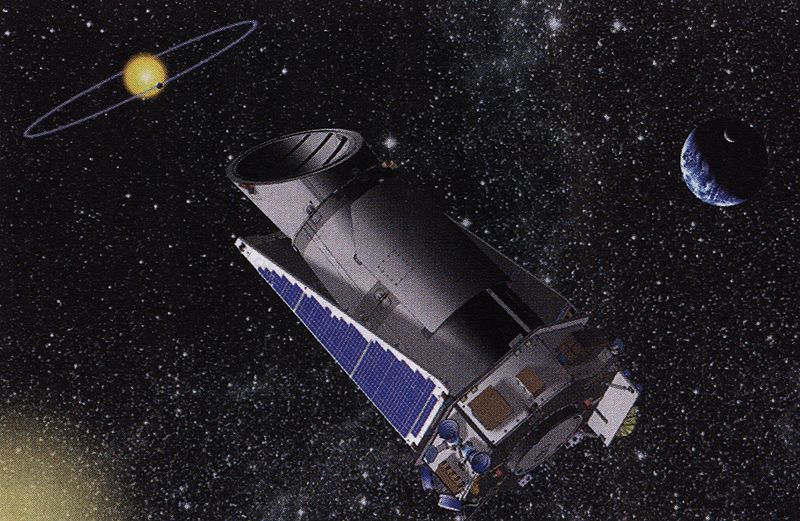
Kepler Spacecraft. Credit NASA.
Click image to enlarge.
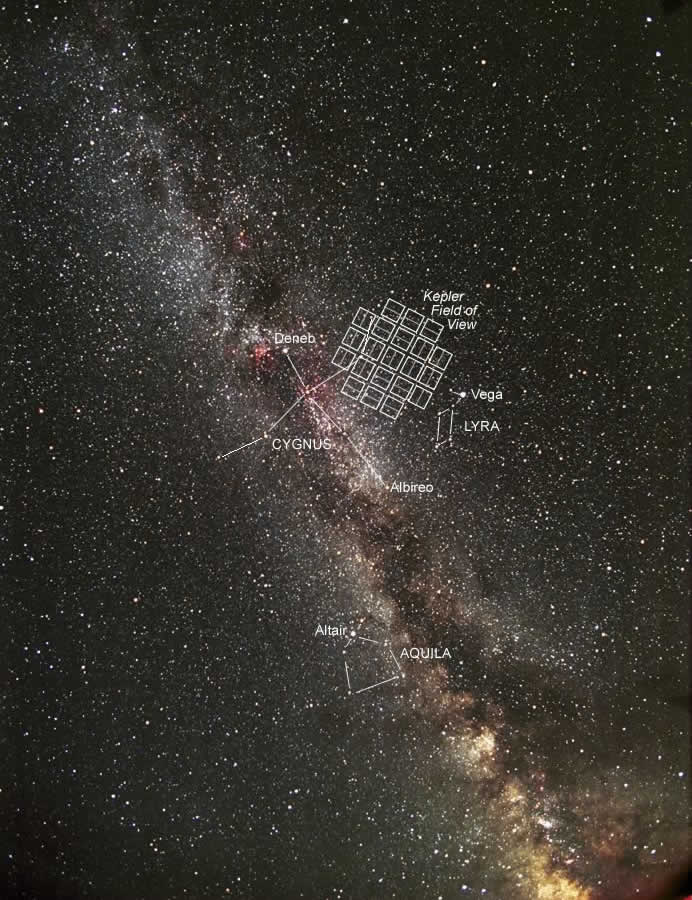
Kepler field of view. Credit C. Roberts, NASA.
Click image to enlarge.
Link to Kepler’s home page: http://kepler.nasa.gov/
08/27/2012 – Ephemeris – RIP: Neil Armstrong
Ephemeris for Monday, August 27th. The sun will rise at 6:59. It’ll be up for 13 hours and 27 minutes, setting at 8:27. The moon, 3 days past first quarter, will set at 3:44 tomorrow morning.
Over the weekend we learned that Neil Armstrong, the first human to step on the moon, passed away at age 82. I am old enough to remember all of the space age from Sputnik to Curiosity’s landing on Mars. The Apollo 11 landing and subsequent lunar EVA or moon walk were riveting to me and all the world. Neil was an engineer and understood the flying machines he flew implicitly, whether it was the X15, Gemini, Apollo Command Module or the Lunar Module. He stayed an engineer and became a college professor after he returned to earth, not cashing in on his fame. He is a hero in a time that has no true heroes. He will be remembered as long as humanity strives to reach the stars.
Times are for the Traverse City/Interlochen area of Michigan. They may be different for your location.
08/23/2012 – Ephemeris – A belated salute to Curiosity
Ephemeris for Thursday, August 23rd. The sun rises at 6:55. It’ll be up for 13 hours and 38 minutes, setting at 8:34. The moon, 1 day before first quarter, will set at 11:41 this evening.
It’s been two and a half weeks since the Curiosity Rover landed on Mars. I finished the prior two weeks programs less than an hour before Curiosity landed and before heading off for vacation, so this is my first opportunity to talk about the landing. The so-called “Seven Minutes of Terror” went without a hitch. Either receiving transmissions directly from the spacecraft or through the Odyssey Mars orbiter, tones from the spacecraft ticked off the landing milestones right on time. As I’m recording this Curiosity hasn’t moved, however it’s already zapped a rock with its laser, its delivered a panorama of its surroundings, and is still sending frames of the descent movie it took when the heat shield was dropped, until it touched down.
Times are for the Traverse City/Interlochen area of Michigan. They may be different for your location.
Addendum
Here’s a mix from the Seven Minutes of Terror video created before landing cut with actual Jet Propulsion Laboratory (JPL) Mission Control footage as Curiosity actually landed.
Here’s another video of the landing cut with scenes of gatherings around the country including Times Square, and video from the landing imager and Curiosity descending on the parachute from the Mars Reconnaissance Orbiter.
Here is a hi-res descent and landing from the MARDI landing imager. Hat tip to the Bad Astronomer. Play at full screen for best effect.
Curiosity has Landed!
Congratulations to JPL and NASA!
08/03/2012 – Ephemeris – Weekend events here and on Mars.
Ephemeris for Friday, August 3rd. The sun rises at 6:31. It’ll be up for 14 hours and 32 minutes, setting at 9:04. The moon, 2 days past full, will rise at 9:34 this evening.
The Northwestern Michigan College’s Rogers observatory will be open this evening starting at 9 p.m. For views of the heavens including the planet Saturn and the moon. There’s some bright deep sky objects also visible. Mars though up is a very tiny planet and is quite distant. What can’t be seen in a telescope will be visible shortly. Monday at 1:31 a.m. The Curiosity Mars Science Laboratory will land in Gale Crater. If the landing is successful the new rover will be bringing a new arsenal of scientific instruments to probe the martian past. From our vantage point on the earth Mars looks like a tiny yellowish orange disk. We will be back to two operational rovers joining the three operational satellites now orbiting Mars.
Times are for the Traverse City/Interlochen area of Michigan. They may be different for your location.
Addendum
Here’s a movie from the Jet Propulsion Laboratory (JPL) of Curiosity’s entry descent and landing called Seven Minutes of Terror: http://youtu.be/ISmWAyQxqqs
07/03/2012 – Ephemeris – How Curiosity will land on Mars
Ephemeris for Tuesday, July 3rd. Today the sun will be up for 15 hours and 28 minutes, setting at 9:30. The moon, at full today, will rise at 9:21 this evening. Tomorrow the sun will rise at 6:03.
At 1:31 on the morning of August 6th our time the Curiosity Rover will land on Mars. The entry, descent and landing of the rover will take just 7 minutes from first encountering the martian atmosphere. The planning to land this nearly one ton lander on Mars was enormous. There’s a heat shield to initially slow the spacecraft, then there is a parachute to slow it more. It will be on the parachute for a maximum of 90 seconds. Then 8 rockets will slow the rover more. These are on the descent stage with the rover tucked underneath. At the proper altitude the descent stage will lower the rover to the ground by cable, then fly off to crash some distance away. This isn’t the half of it. Check out the planetary dot org blog section for more details.
Times are for the Traverse City/Interlochen area of Michigan. They may be different for your location.
Addendum
How Curiosity Will Land – Part 1
How Curiosity Will Land – Part 2
Youtube video: “Challenges of Getting to Mars: Curiosity’s Seven Minutes of Terror”
 Bob Moler's Ephemeris Blog