Archive
01/26/2017 – Ephemeris – Is it a dachshund or a hot dog?
Ephemeris for Thursday, January 26th. The Sun will rise at 8:07. It’ll be up for 9 hours and 36 minutes, setting at 5:43. The Moon, 1 day before new, will rise at 7:40 tomorrow morning.
The constellation Orion has two hunting dogs. We’ve seen Canis Major the greater dog at Orion’s feet with Sirius in its heart. The lesser dog, Canis Minor is level with Betelgeuse in Orion’s shoulder and off to the left. Just two stars mark it. Is it a dachshund or is it a hot dog? You decide. It’s brighter star’s name is Procyon which means “Before the dog”, an odd title. It means that though east of Sirius, it rises before Sirius, due to its more northerly position in the sky. In many ways Procyon is nearly a twin of Sirius. It shines with the same white color, although a bit cooler, and has a white dwarf companion like Sirius. It’s a bit farther away than Sirius’ 8 light years. Procyon is 11 and a half light years away. Procyon, Betelgeuse and Sirius make the winter triangle.
Times are for the Traverse City/Interlochen area of Michigan. They may be different for your location.
Addendum
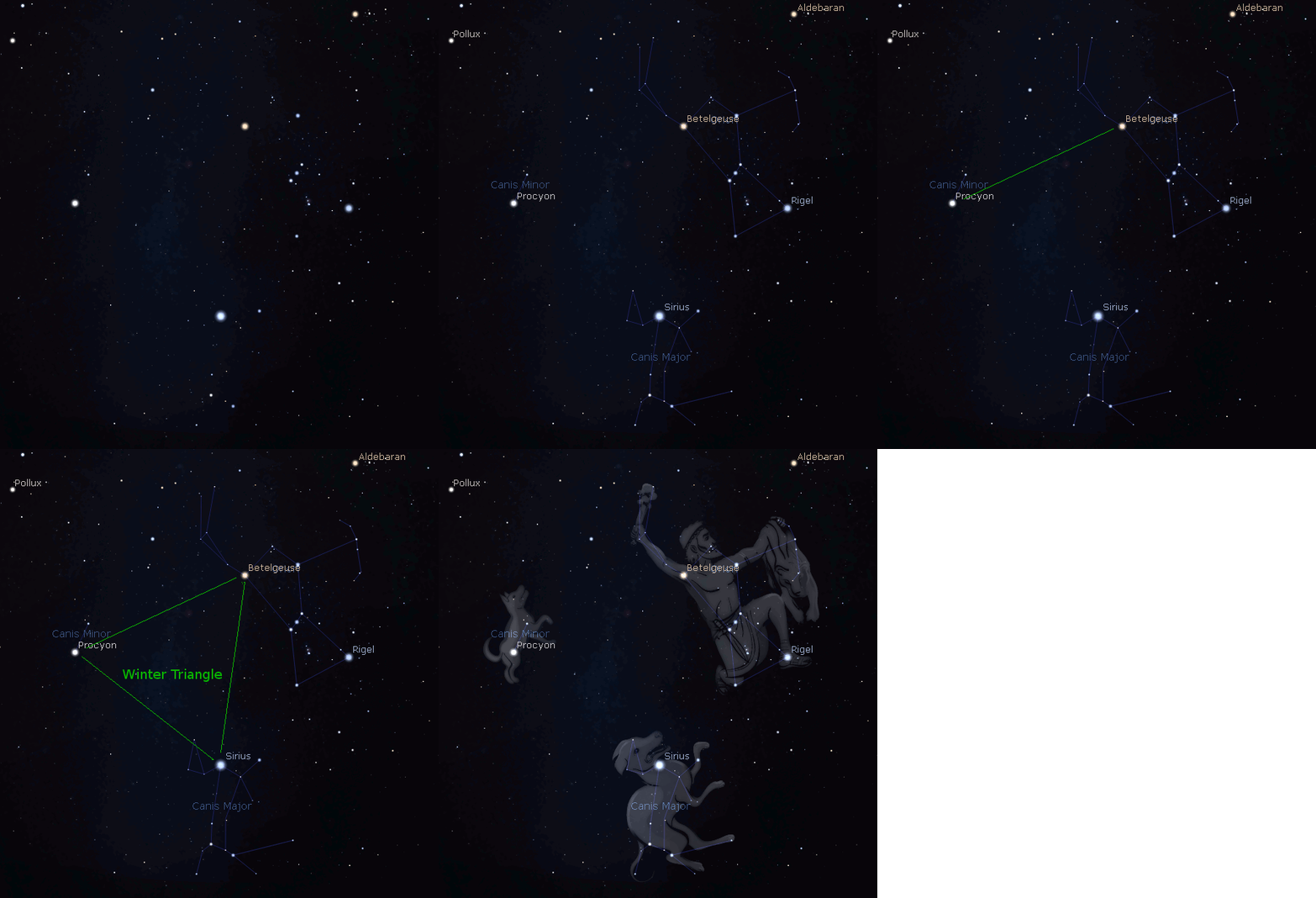
Procyon and Orion’s hunting dogs animation also showing the Winter Triangle asterism*. Created using Stellarium and GIMP.
* Asterism – an informal constellation like the Big Dipper, the Northern Cross, or the Summer Triangle. Not one of the 88 official constellations.
12/27/2016 – Ephemeris – The stars of Orion
Ephemeris for Tuesday, December 27th. The Sun will rise at 8:19. It’ll be up for 8 hours and 49 minutes, setting at 5:09. The Moon, 2 days before new, will rise at 7:26 tomorrow morning.
The large and bright constellation of Orion the hunter is in the southeast at 9 p.m., with the bright star Sirius below it near the horizon. The equally spaced line of three stars of Orion’s belt are nearly vertical and point down to Sirius, also known as the Dog Star in Canis Major, Orion’s greater dog. The whole of its constellation stars aren’t up at 9 p.m., but they will all clear the horizon by 10 p.m. Those three belt stars are in the center of an elongated rectangle of stars At the top left of Orion’s shoulder stars is the red giant star Betelgeuse. The right shoulder star is Bellatrix. Both Bellatrix and Sirius along with the names of other stars and constellations should be familiar to fans of the Harry Potter novels and movies, as members of the house of Black. The knee stars at the bottom of the rectangle are, from left to right Saiph and the brilliant blue giant star Rigel. Between his belt and knees are stars of his sword.
Times are for the Traverse City/Interlochen area of Michigan. They may be different for your location.
Addendum
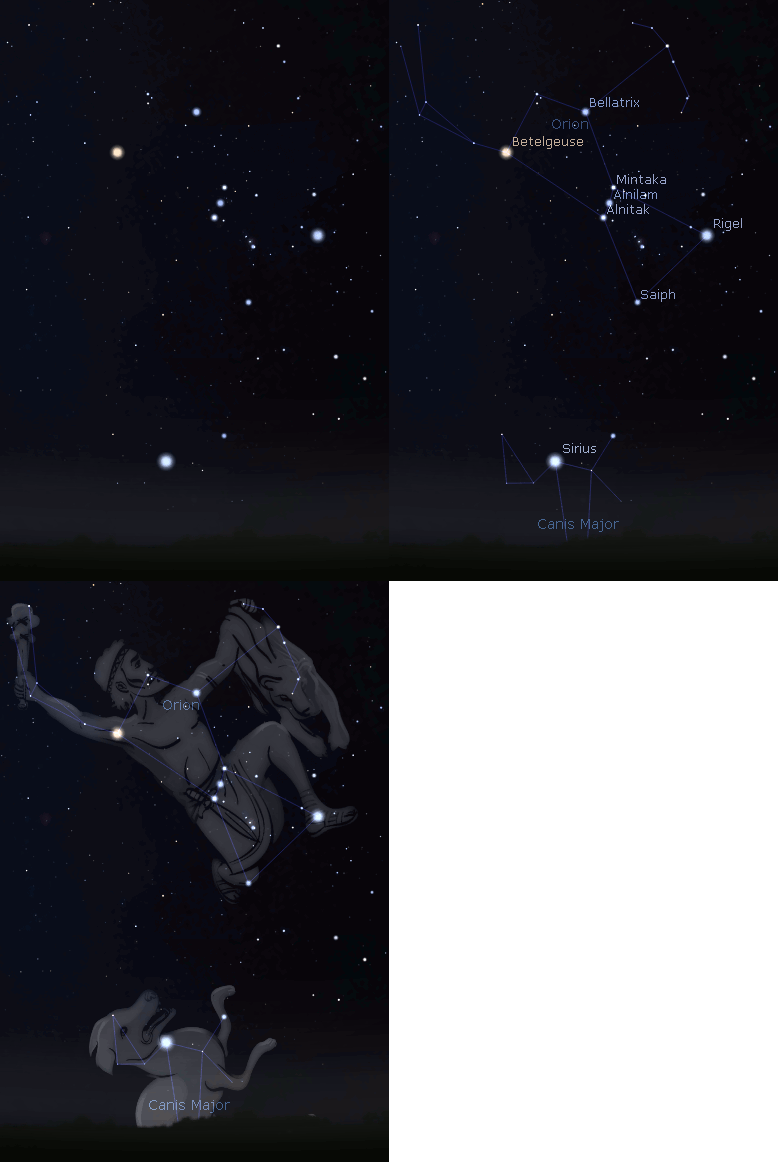
Orion, star names, and constellation art animation position for 9 p.m. December 27. Created using Stellarium and GIMP. Artist: Johan Meuris.
In the image above I’ve added the belt star names, though they are generally covered in a program of their own.
11/28/2016 – Ephemeris – The Hyades the star cluster in the face of Taurus the bull
Ephemeris for Monday, November 28th. The Sun will rise at 7:57. It’ll be up for 9 hours and 7 minutes, setting at 5:04. The Moon, 1 day before new, will rise at 7:45 tomorrow morning.
Rising in the east now is the bright star Aldebaran an orange star that’s at one end of the sideways letter V of stars that is the head of Taurus the bull. Above it is the jewel-like Pleiades or Seven Sisters star cluster. There’s more to Taurus, like it’s freakishly long horns and front part of its body. But you can say you’ve seem Taurus, if you can spot his face. That V of stars is actually a star cluster called the Hyades, and in Greek Myth were the half-sisters of the Pleiades, also fathered by the god Atlas. Both the Hyades and Pleiades are being pursued by Orion, which as Robert Frost put it is throwing a leg over the eastern horizon at 8 to 9 pm. He isn’t the only one following the Pleiades, the name Aldebaran means “The Follower”.
Times are for the Traverse City/Interlochen area of Michigan. They may be different for your location.
Addendum
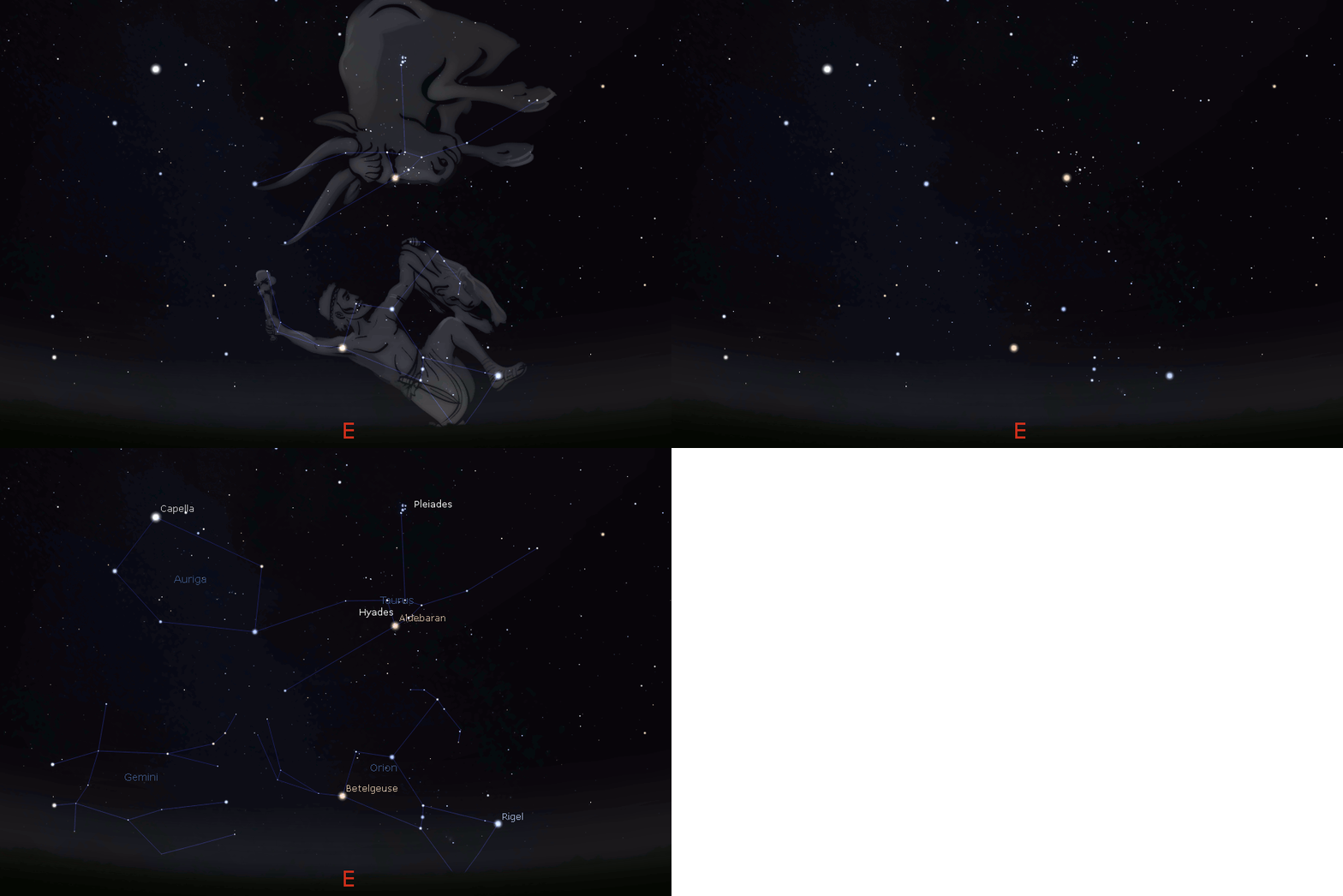
An animation showing the Hyades, Taurus, Orion and the Pleiades. Created using Stellarium and GIMP. Click on image to enlarge.
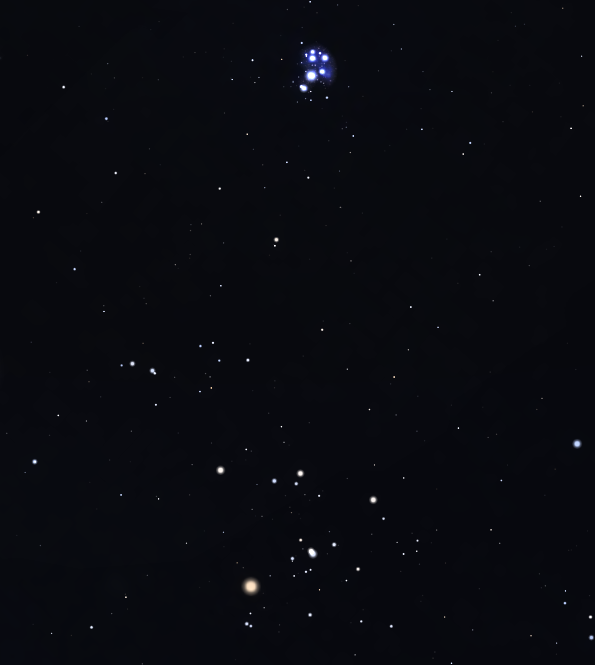
Closeup of the Hyades and the Pleiades. Created using Stellarium.
10/31/2016 – Ephemeris – What’s a Halloween sky without the Ghoul Star
Ephemeris for Halloween, Monday, October 31st. The Sun will rise at 8:20. It’ll be up for 10 hours and 12 minutes, setting at 6:32. The Moon, 1 day past new, will set at 7:28 this evening.
Not all the ghosts and goblins out tonight will be children. One is out every night, because it’s a star. Its name is Algol, from the Arabic for Ghoul Star or Demon Star. The Chinese had a name for it that meant ‘piled up corpses’. It’s the second brightest star in the constellation Perseus the hero, rising in the northeast this evening. The star is located where artists have drawn the severed head of Medusa, whom he had slain. Medusa was so ugly that she turned all who gazed upon her to stone. Algol is her still glittering eye. Astronomers finally found out what was wrong with Algol. It does a slow 6 hour wink every 2 days 21 hours because it is two very close stars that eclipse each other in that period. It did so this morning at 5:53 a.m.
Times are for the Traverse City/Interlochen area of Michigan. They may be different for your location.
Addendum
To run an app to calculate times for the minima of Algol click here: http://www.skyandtelescope.com/observing/celestial-objects-to-watch/the-minima-of-algol/ courtesy of Sky and Telescope Magazine.
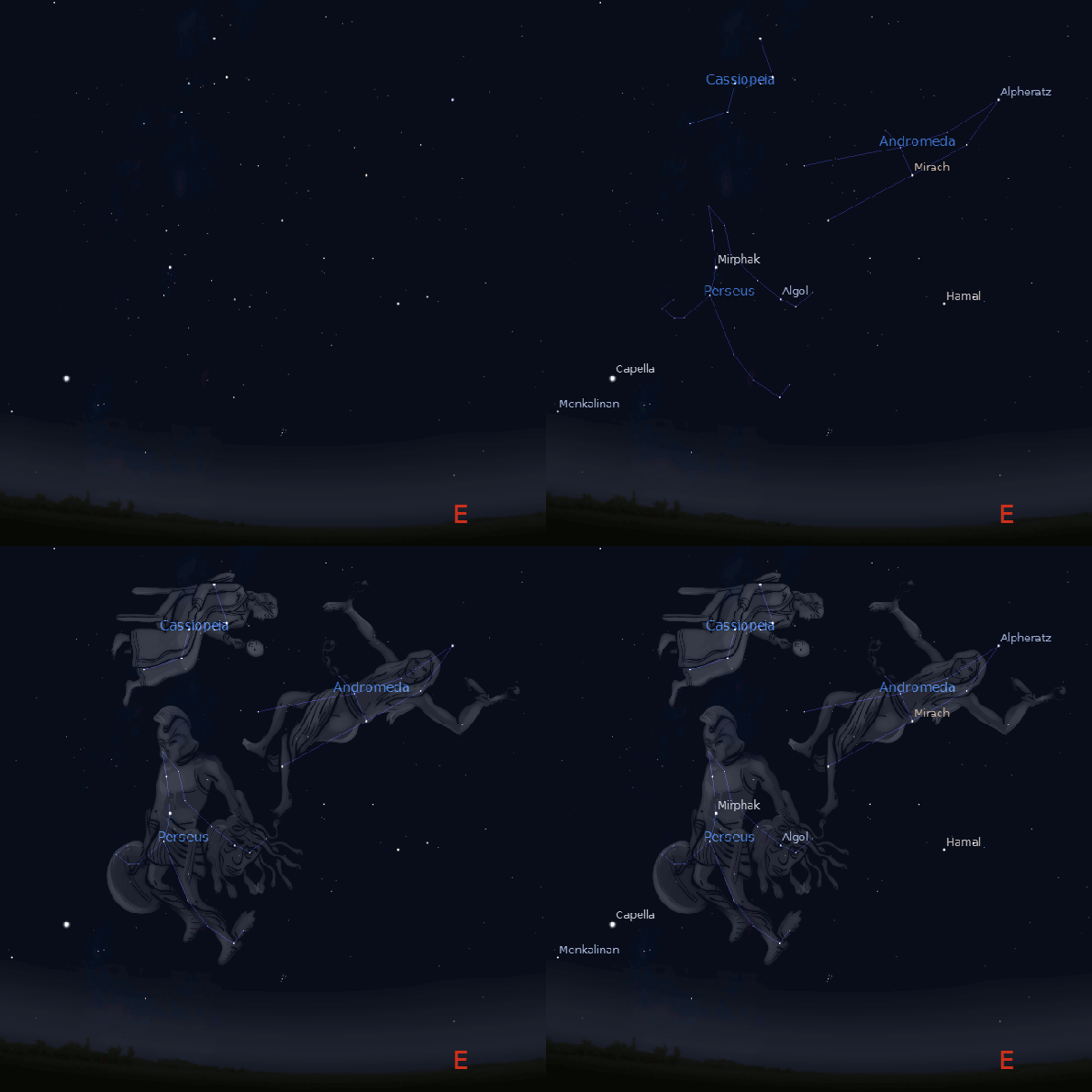
Perseus with Cassiopeia and Andromeda in the northeast at 8:30 p.m. on Halloween. Created using Stellarium and GIMP.
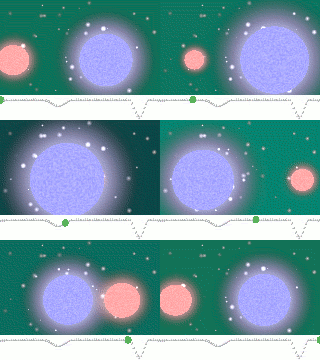
Animation of an eclipsing binary star like Algol. Credit: Wikimedia Commons h/t Earth and Sky
01/04/2016 – Ephemeris – Some named stars in Orion and how to remember them
Ephemeris for Monday, January 4th. The Sun will rise at 8:20. It’ll be up for 8 hours and 55 minutes, setting at 5:15. The Moon, 2 days past last quarter, will rise at 3:49 tomorrow morning
Now that the Moon has fled let’s turn to the dark skies of winter and the magnificent constellation of Orion the hunter. At 9 p.m. he’s not yet completely upright in the southeast at 9 p.m. His seven bright stars make him easy to spot, starting with his belt of three stars in a straight line angling down to the left. It is inside a rectangle framing his shoulders and knees, leaning now to the left. The bright reddish star at the upper left corner is Betelgeuse, which according to a certain movie one shouldn’t say three-time in a row. The other shoulder star is a name familiar to Harry Potter fans, Bellatrix, though there’s nothing Lestrange about it. The lower right star is the bright blue-white Rigel. All in all a very impressive constellation.
Times are for the Traverse City/Interlochen area of Michigan. They may be different for your location.
Addendum
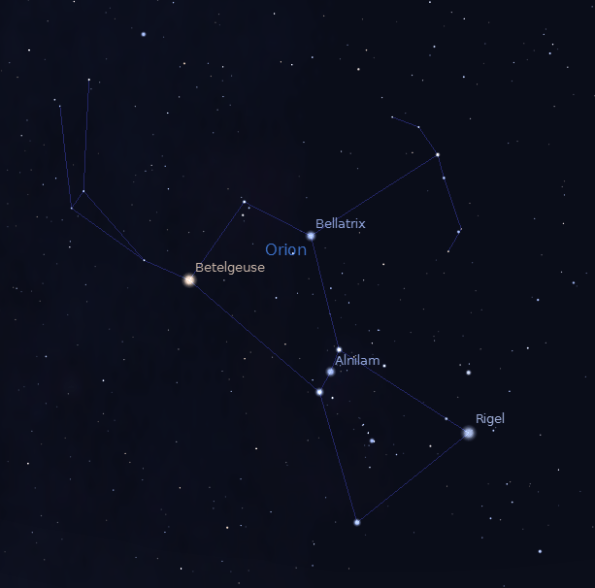
Some of Orion’s star names. Orion at 9 p.m. January 4, 2016. Created using Stellarium.
 Bob Moler's Ephemeris Blog