Archive
07/03/2017 – Ephemeris – The Earth is farthest from the Sun today
Ephemeris for Monday, July 3rd. Today the Sun will be up for 15 hours and 28 minutes, setting at 9:30, and it will rise tomorrow at 6:03. The Moon, 3 days past first quarter, will set at 3:13 tomorrow morning.
At 8:59 tonight the Earth will pass a point in its orbit of the sun called aphelion, the farthest point from the sun of 94.5 million miles (152 million km). The whole Earth gets something like 6% less heat from the Sun than early January when the Sun is closest. So why is it summer now? The difference in distance from the sun pales as a cause of the seasons next to the tilt of the earth’s axis. Six months ago, because the sun was up for a shorter period each day, and didn’t rise very high in the sky, the sun gave us in northern Michigan something like 70% less heat than it does now. The real effect of aphelion coming in summer is that it makes summer the longest season at 94 days. This is because the farther the Earth is from the Sun, the slower it travels. Hey, it’s summer – take the hint and slow down and enjoy the season.
The times given are for the Traverse City/Interlochen area of Michigan. They may be different for your location.
07/21/2016 – Ephemeris – This sunspot cycle is past peak
Ephemeris for Thursday, July 21st. Today the Sun will be up for 15 hours and 2 minutes, setting at 9:20, and it will rise tomorrow at 6:18. The Moon, 2 days past full, will rise at 10:20 this evening.
The Sun is on the down side in this sunspot cycle. Sunspots increase and decrease on the Sun in a roughly 11 year cycle. This sunspot cycle wasn’t a very high peak in numbers of sunspots. The peak of sunspot numbers occurred in both 2012 and 2014, an odd double peak. The peak in activity for this cycle is among the lowest since systematic observations have been recorded over the last 200 or so years. This year so far has seen 16 Sun spotless days according to SpaceWeather.com. There was none last year and only one in 2014. Coming up to this sunspot peak saw an extended period of years with mostly spotless days. The Sun is actually brighter when it has lots sunspots, than when it is not. Odd but true. In not so distant past sunspots have been missing for years.
Times are for the Traverse City/Interlochen area of Michigan. They may be different for your location.
Addendum
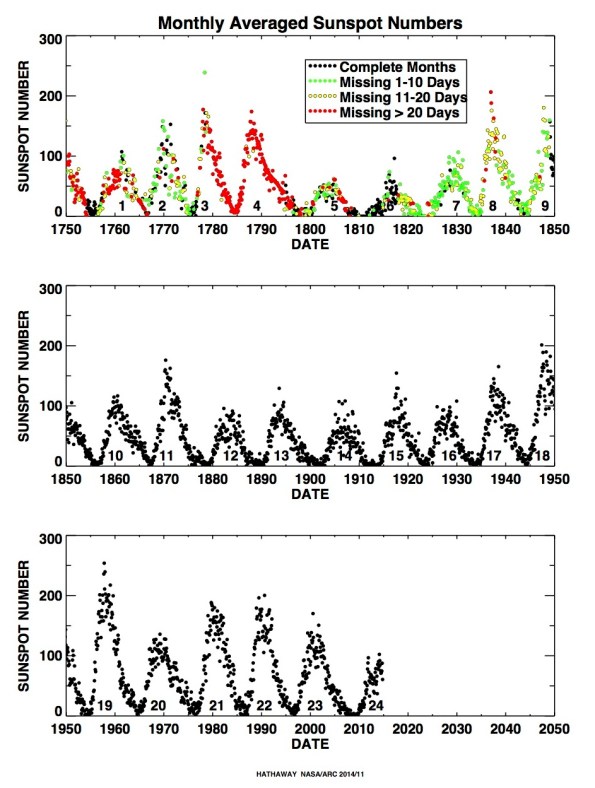
All the recorded sunspot cycles back to the 18th century. Credit: Dr. David Hathaway, NASA /ARC.
05/13/2016 – Ephemeris – GTAS Astronomy Day tomorrow
Ephemeris for Friday, May 13th. Today the Sun will be up for 14 hours and 46 minutes, setting at 9:02. The Moon, at first quarter today, will set at 2:59 tomorrow morning. Tomorrow the Sun will rise at 6:15.
The Grand Traverse Astronomical Society will host a public viewing night for Astronomy Day tomorrow night, that’s Saturday the 14th, starting at 9 p.m. It will be at Northwestern Michigan College’s Joseph Rogers Observatory. If its clear the slightly gibbous moon will be featured along with Jupiter, Mars and the ringed planet Saturn and other wonders of the spring sky. The observatory is located south of Traverse City, on Birmley Road between Garfield and Keystone roads. For the society these, twice monthly star parties at the observatory and sidewalk astronomy outings by members, to the Sleeping Bear Dunes National Lakeshore and other locations are what they do.
Times are for the Traverse City/Interlochen area of Michigan. They may be different for your location.
Other thoughts
I was checking out the Solar and Heliospheric Observatory (SOHO) LASCO C3 animation and Venus is making an entrance from the right as it heads for superior conjunction on June 6. June 6? Hmm. Wasn’t that last transit or Venus on June 5th 2012. We and Venus should be near the line of nodes again, where the planes of our respective orbits cross. I cranked up Stellarium, and sure enough the Sun will occult Venus that day… Not that we could see it.
Some views of the festivities at the Sleeping Bear Dunes National Lakeshore Dune Climb for the transit of Mercury earlier today
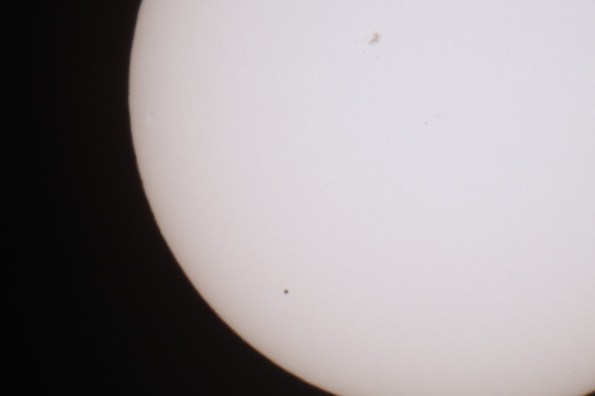
Mercury and some sunspots at 8:30 a.m. through my telescope. Thought I’d take a shot before we had visitors. C8 Cassigrainian focus, ISO 100, 1/100 second.
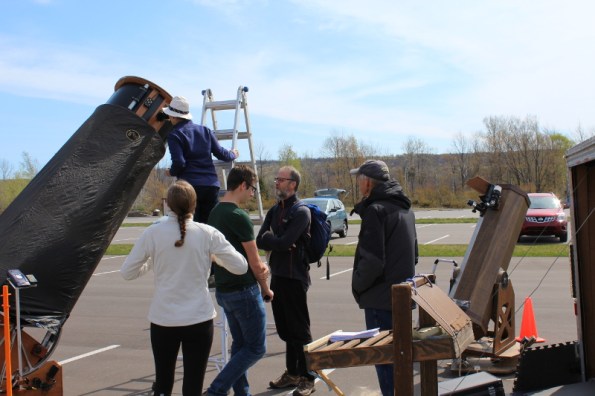
Checking the transit via the “Dobinator” through the Grand Traverse Astronomical Society’s (GTAS) 25 inch Dobsonian stopped down with an 8″ solar filter.
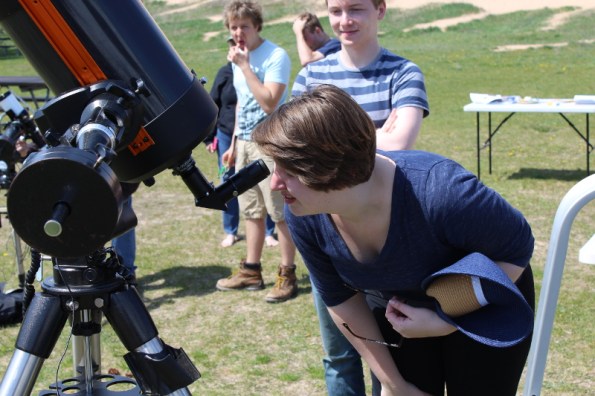
Viewing the transit through my Celestron C8.
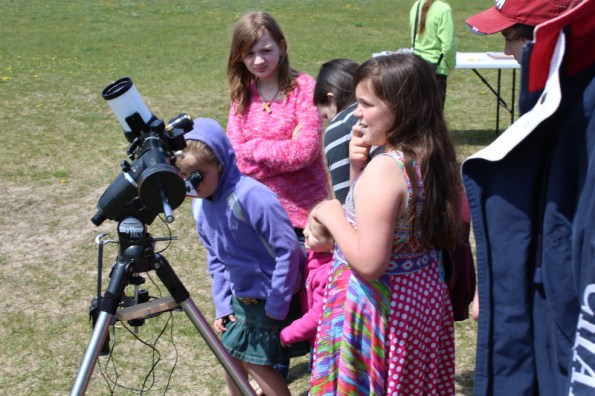
Kids viewing the transit through the society’s Lunt hydrogen alpha solar telescope.
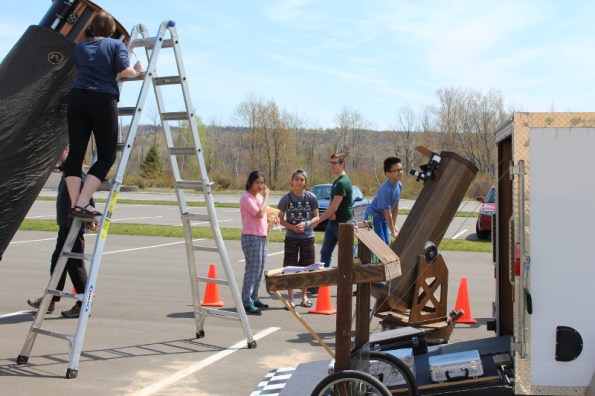
Youngster viewing the transit through Emmett Holmes’ 13″ homemade Dobsonian telescope and Poncet tracking mount.
Credit: Bob Moler
05/09/2016 – Ephemeris – The transit of Mercury is today!
Ephemeris for Monday, May 9th. The Sun rises at 6:21. It’ll be up for 14 hours and 36 minutes, setting at 8:58. The Moon, 3 days past new, will set at 12:12 tomorrow morning.
In less than an hour from now the planet Mercury will begin to cross the face of the Sun. It starts at 7:12 a.m. The transit will end at 2:42 this afternoon. Mercury is a tiny planet making a tiny dot against the face of the Sun, and smaller than any sunspot. If it’s clear or when its clear come out and view part of the transit. The Northwestern Michigan College’s Rogers Observatory will be open for that period. Also telescopes with be stationed at the Dune Climb at the Sleeping Bear Dunes National Lakeshore by yours truly to view the transit. The event is not visible to the naked eye and dangerous to even attempt. If you miss this transit, there will be another in 2019, 3 ½ years from now. After that, a Mercury transit visible from here will have to wait until 2049.
Times are for the Traverse City/Interlochen area of Michigan. They may be different for your location.
Addendum
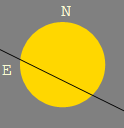
The track of Mercury across the face of the Sun. Mercury will travel from upper left to lower right. Mercury will not be visible until it impinges upon the disk of the Sun. Credit IOTA’s program Occult4.
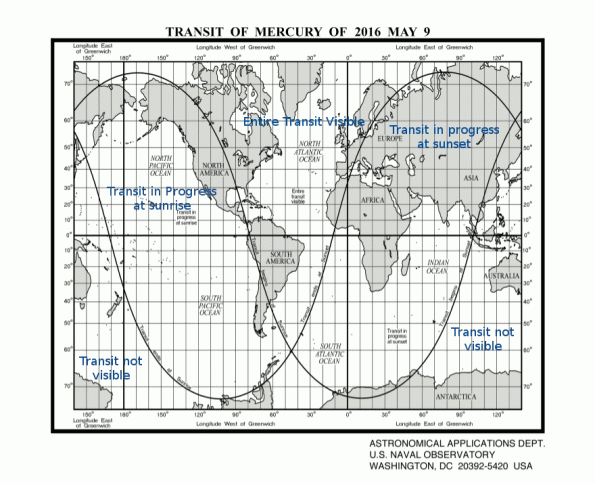
Transit visibility map with added captions to make it more readable. Credit United States Naval Observatory, The Astronomical Almanac Online.
For more information see my prior day’s posts.
12/04/2014 – Ephemeris – What’s happening on the Sun this solar cycle
Ephemeris for Thursday, December 4th. The sun will rise at 8:02. It’ll be up for 9 hours even, setting at 5:02. The moon, 2 days before full, will set at 6:52 tomorrow morning.
It looks like maybe we’ve hit the peak of sunspots in this 11 year solar cycle. Actually this cycle had two peaks, the latter part of 2012 when the world ended. You do remember the world ending two years ago on December 21st. How soon we forget. The second peak in this solar cycle occurred in the first three months of this year. The sunspot cycle 24 so far appears to be the weakest since cycle 12 in the 1880s. The time of the peak can only be determined in hindsight. Of course this weak sunspot cycle produced the largest sunspot group, or active region, as they are now called, in 24 years, so I expect more surprises from this solar cycle. I expect to see more aurorae or northern lights as the sunspot numbers decline.
Times are for the Traverse City/Interlochen area of Michigan. They may be different for your location.
Addendum
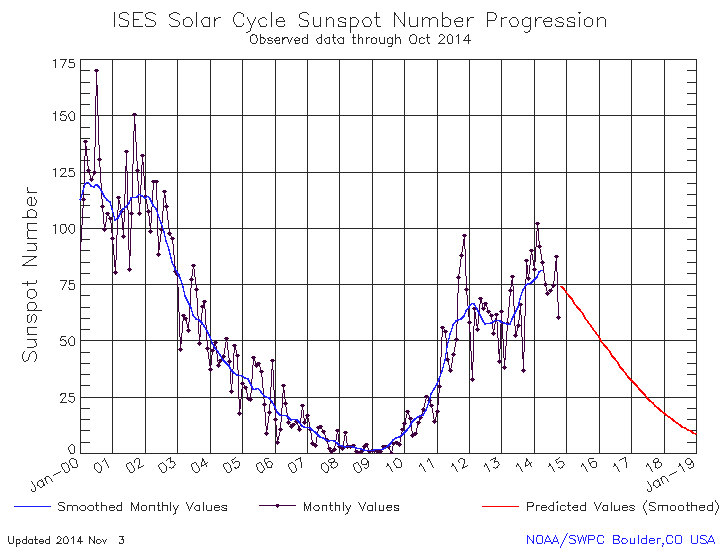
Sunspot cycle from 2000 until October 2014. Credit: NOAA/SWPC.
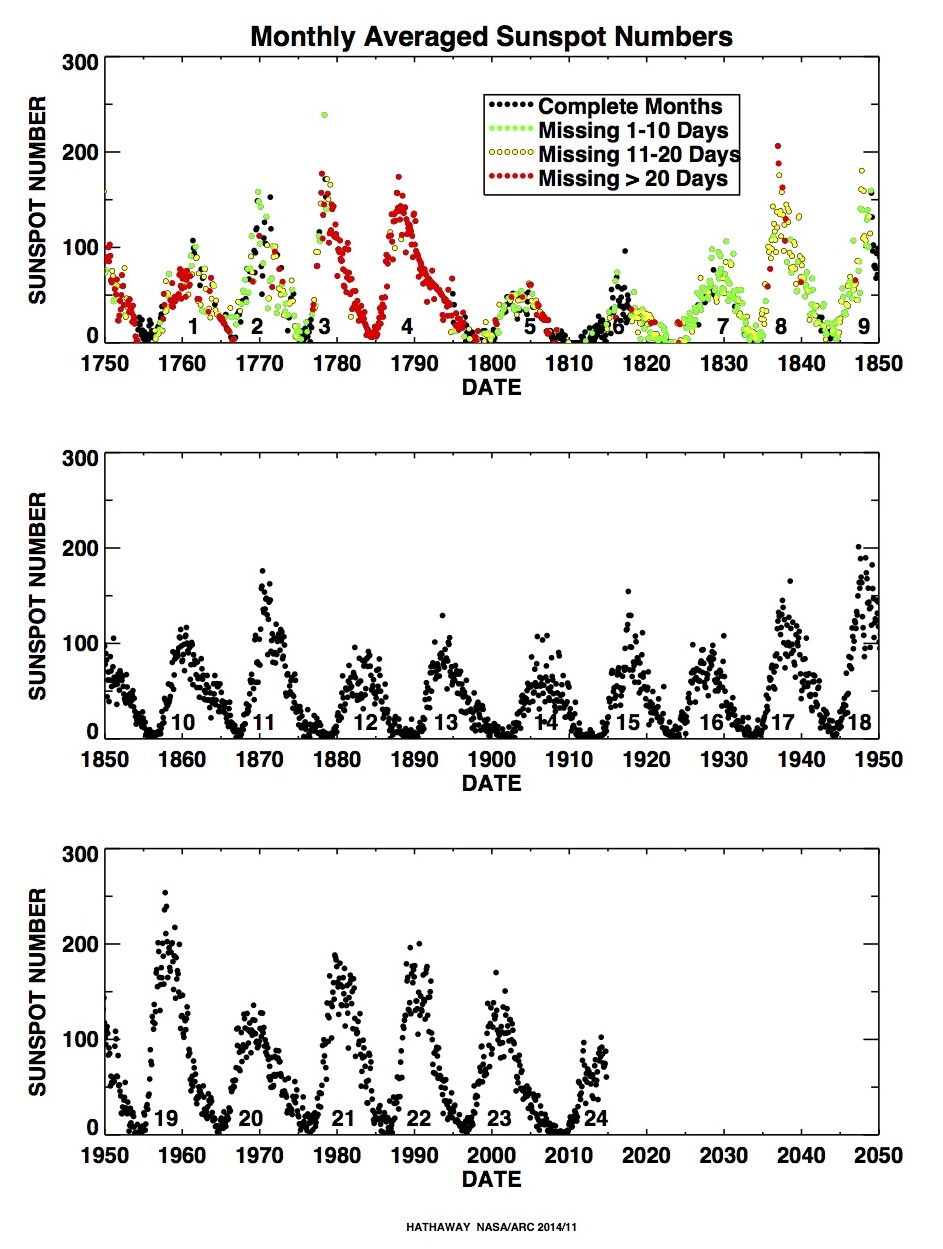
All the recorded sunspot cycles back to the 18th century. Credit: Dr. David Hathaway, NASA /ARC.
Here’s a link to NASA’s Sunspot Cycle page with a lot more information.
10/24/2014 -Ephemeris – Venus will pass superior conjunction with the Sun tomorrow
Ephemeris for Friday, October 24th. The sun will rise at 8:09. It’ll be up for 10 hours and 33 minutes, setting at 6:43. The moon, 1 day past new, will set at 7:20 this evening.
Tomorrow’s event will not be visible. Venus will pass behind the Sun, though not directly behind it. Venus can be viewed from the SOHO spacecraft go to http://spaceweather.com/, at the bottom click the link for Solar and Heliospheric Observatory, Click on the Sun Now, then LASCO C2. The event is called a superior conjunction, meaning the Venus is beyond the Sun. It will be moving from west of the Sun to the east, from the morning side of the Sun to the evening side. Venus has been in the morning sky since January 11th. So it is a morning planet for about 9 months and moves to the evening sky for another 9 months. In a month or so, Venus will appear low in the southwestern sky shortly after sunset. It will be our super bright evening star next spring.
Times are for the Traverse City/Interlochen area of Michigan. They may be different for your location.
Addendum
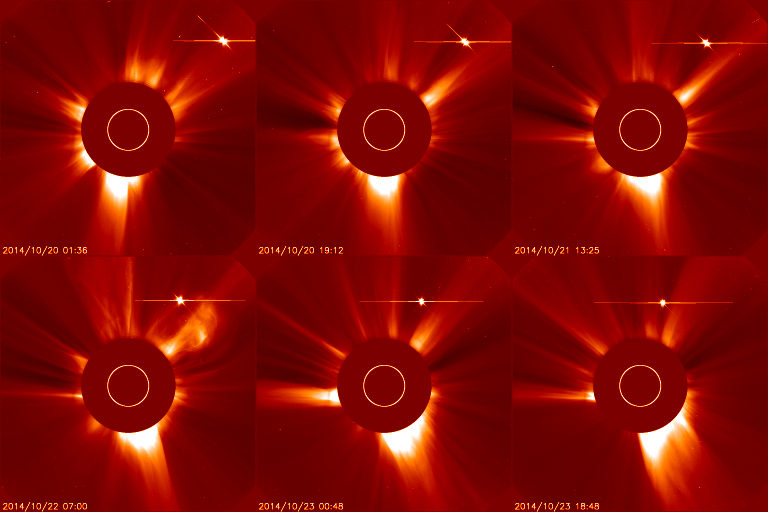
Venus approaching superior conjunction 10/20/2014 to 10/23/2014. Credit NASA – SOHO LASCO C2.
10/23/2014 – Ephemeris – Partial solar eclipse tonight for most of the US
Ephemeris for Thursday, October 23rd. The sun will rise at 8:08. It’ll be up for 10 hours and 36 minutes, setting at 6:44. The moon is new today, and won’t be visible.
This evening there will be a partial solar eclipse, in which we will see only the first part before the sun sets. The eclipse will be visible for all but the extreme eastern part of the country. It will be a partial eclipse for all who can see it because the core of the Moon’s shadow will miss the Earth to the north. For the Interlochen Public Radio listening area (Northwestern Lower Michigan) the eclipse will star a couple of minutes before or after 5:32 p.m. and will end at sunset around 6:44 p.m. The low position of the sun make a lack of cloud cover necessary to be able to see it. Proper approved solar filters, or a projection method are necessary to view the eclipse. Do Not Look Directly at the Sun! The NMC Observatory south of Traverse City will be open, weather permitting starting at 5 p.m. Also the Platte River Point location at the Sleeping Bear Dunes National Lakeshore will also be available.
An added attraction for this eclipse is the appearance of the largest sunspot group to appear on the sun in years.
Times are for the Traverse City/Interlochen area of Michigan. They may be different for your location.
Addendum
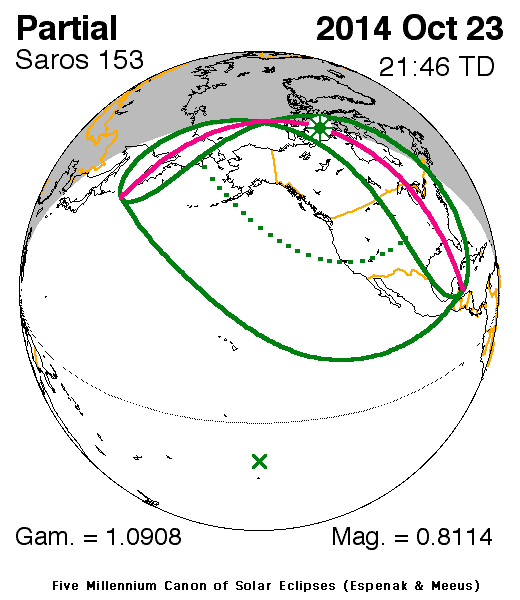
Coverage of the partial solar eclipse of October 23, 2014. Credit: NASA.

The setting partially eclipsed sun from Traverse City. Created using Stellarium.
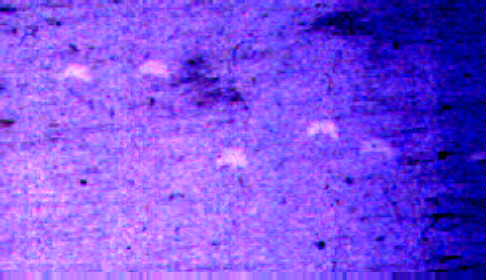
Partially eclipsed sun using a series of pinholes projected on a reasonably white surface.
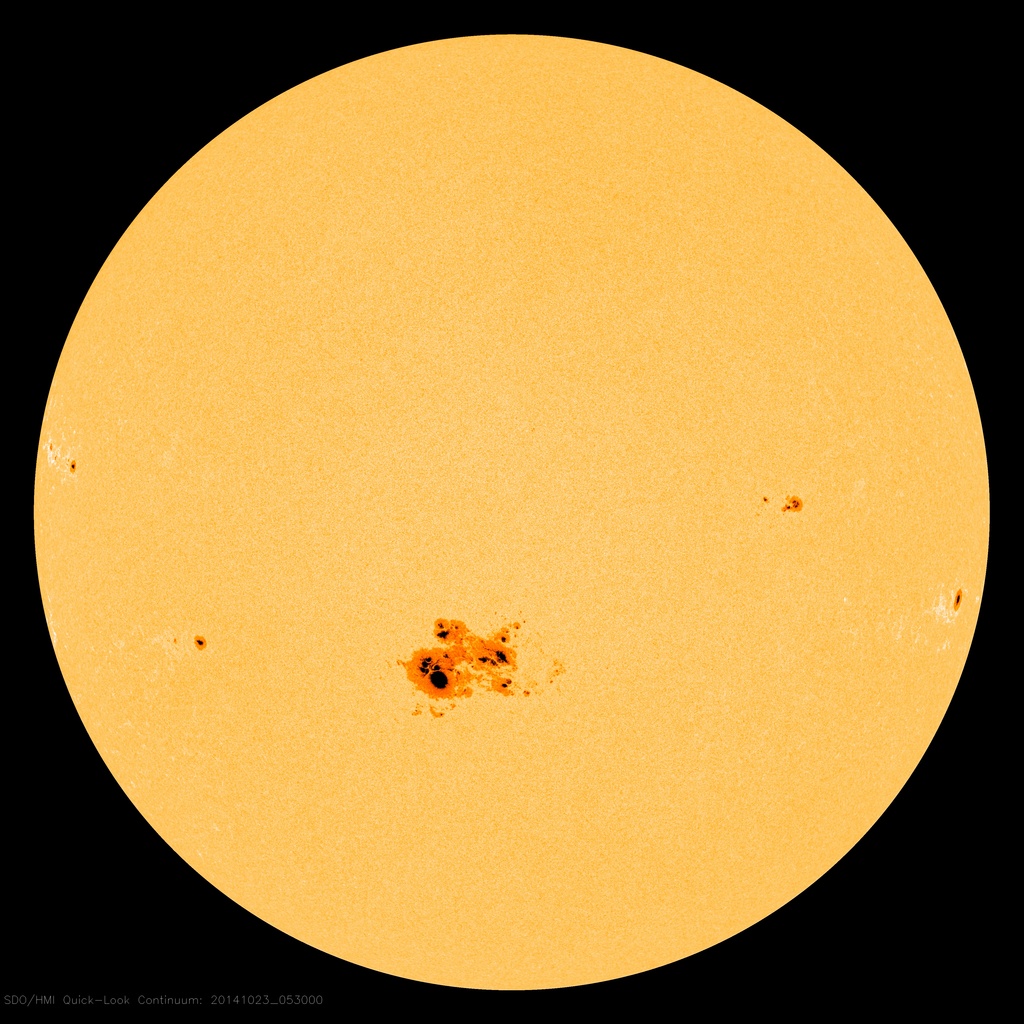
The Sun at 1:30 a.m. 10/23/2014 with large sunspot group AR 2192. Credit NASA – Solar Dynamics Observatory.
This baby gave off a X Class flare yesterday (10/22/2014). Could be more in store. Maybe we’ll see an aurora later this week.
11/26/2013 – Ephemeris – Have a helping of comet with your turkey on Thursday
Ephemeris for Tuesday, November 26th. The sun will rise at 7:53. It’ll be up for 9 hours and 12 minutes, setting at 5:05. The moon, 1 day past last quarter, will rise at 1:42 tomorrow morning.
Comet ISON is now invisible from the earth, being too close to the direction of the sun to be seen. However it is and will be in view of NASA’s fleet of solar observation spacecraft at least until the end of the month. The comet is already in view of the STEREO Ahead spacecraft, looking back toward the Earth and Mercury. Later tonight of early tomorrow it will be in the view of the Solar and Heliospheric Observatory or SOHO parked a million miles sun-ward from the earth. It will appear on the LASCO C3 imager first. Thursday it will also be visible to the Solar Dynamics Observatory or SDO. On the Internet go to spaceweather.com at the page bottom click on STEREO, then click on Latest Images, or go to bobmoler.wordpress.com.
Times are for the Traverse City/Interlochen area of Michigan. They may be different for your location.
Addendum
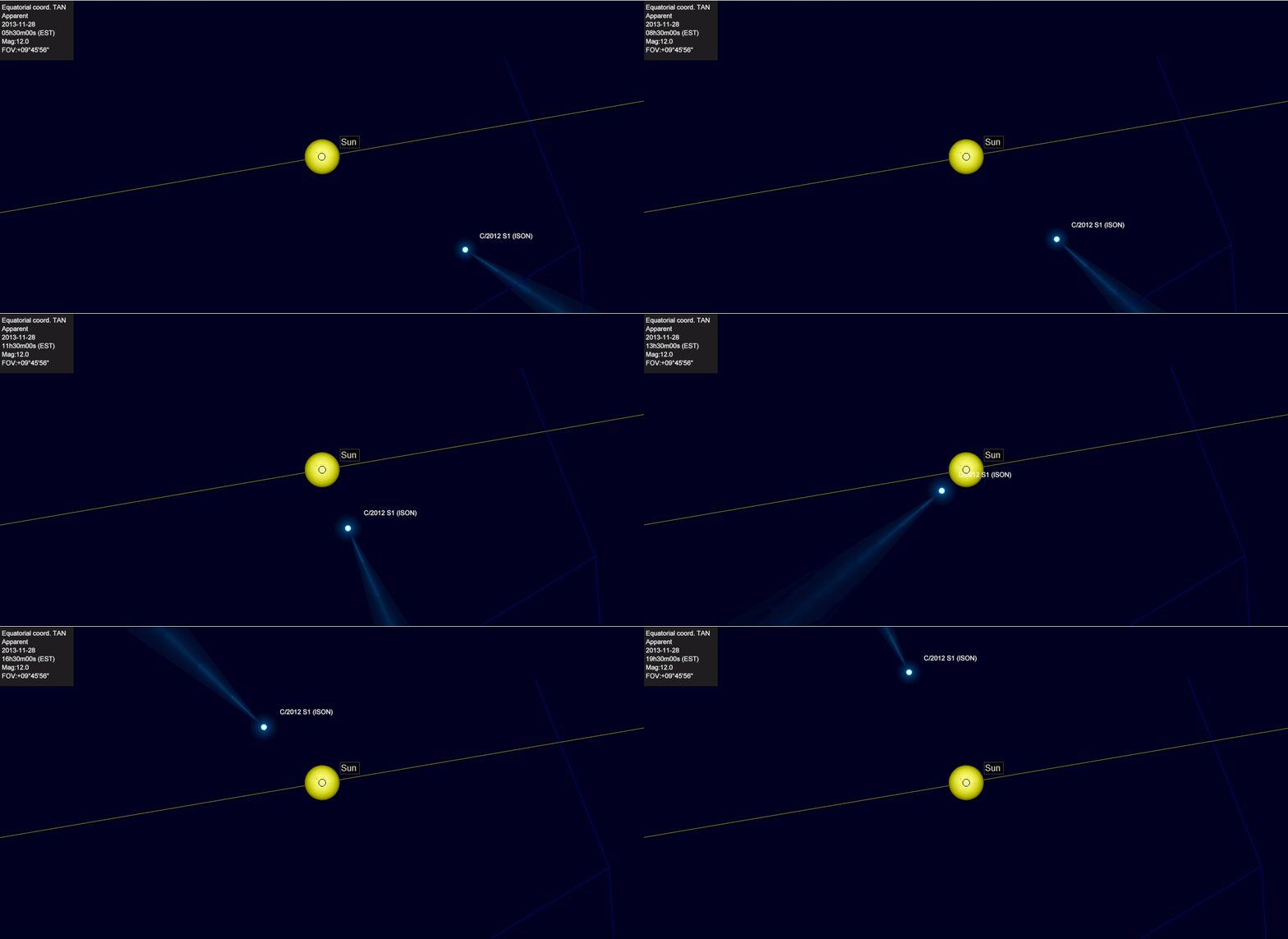
Animation of Comet ISON rounding the sun on Thanksgiving Day, November 28, 2013. Created using Cartes du Ciel (Sky Charts).
Click on the image to enlarge and animate.
07/05/2013 – Ephemeris – Earth at aphelion and astronomy tonight
Ephemeris for Friday, July 5th. Today the sun will be up for 15 hours and 26 minutes, setting at 9:30. The moon, 3 days before new, will rise at 4:52 tomorrow morning. Tomorrow the sun will rise at 6:04.
The earth is as far as it will get from the sun for the year today at 94.5 million miles. Speaking of the sun, the monthly meeting of the Grand Traverse Astronomical Society at 8 p.m. at Northwestern Michigan College’s Rogers Observatory tonight will host local landscape architect Dean Conners an expert on sundials. He created the sundial in the Children’s Garden behind the District Library. who will talk about some interesting sundials. After the meeting at 9 p.m. there will be a star party at the observatory with the planets Venus and Saturn plus some of the bright wonders of the summer sky, like the Ring Nebula, The Great Hercules Globular Star Cluster if it’s clear. There’s other activities if it’s cloudy.
Times are for the Traverse City/Interlochen area of Michigan. They may be different for your location.
 Bob Moler's Ephemeris Blog