Archive
Ephemeris: 11/11/2025 – The difference between a nova and a Type 1a supernova
This is Bob Moler with Ephemeris for Veterans Day, Tuesday, November 11th. Today the Sun will be up for 9 hours and 43 minutes, setting at 5:18, and it will rise tomorrow at 7:36. The Moon, 1 day before last quarter, will rise at 11:37 this evening.
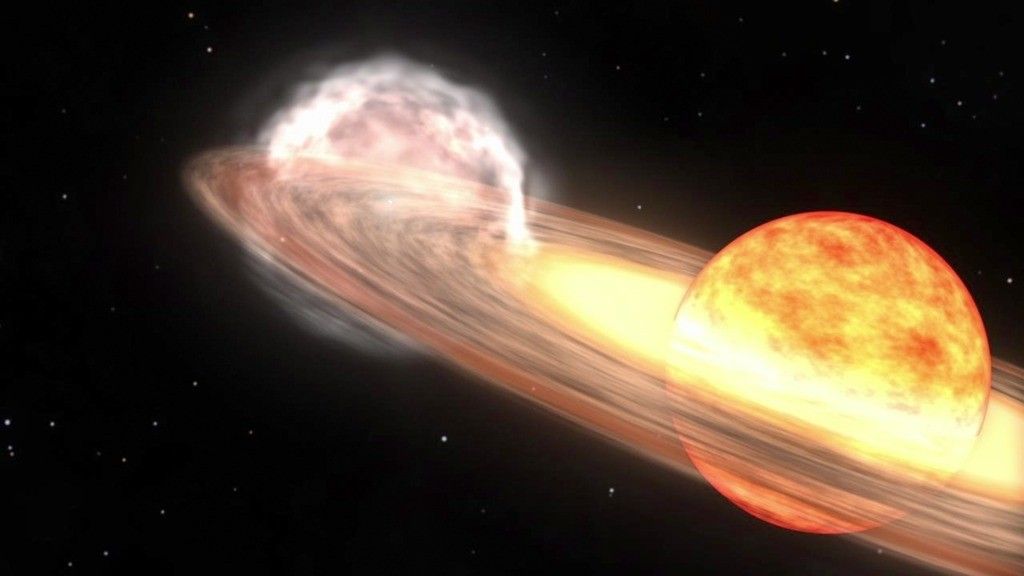
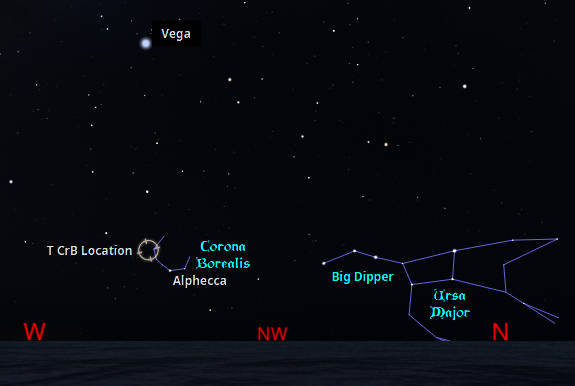
I’ve always wondered what the difference is between a nova like T Coronae Borealis, sometimes called the Blaze Star, and a Type 1a supernova. Both involve a white dwarf star and a larger star and having the mass of the larger star being drawn off onto the surface of the white dwarf until an explosion happens. If the detonation, which is a thermonuclear detonation of the hydrogen drawn off the larger star, is on the surface only, involving the outer layers of the white dwarf, the star becomes thousands of times brighter for a short period of time. The star survives. In the Type 1a supernova, the accretion of the hydrogen onto the white dwarf causes a more massive explosion involving the core of the white dwarf because its mass approaches or will surpass 1.4 times the Sun’s mass. At that point the star explodes.
The astronomical event times given in this blog are for the Traverse City/Interlochen area of Michigan (Lat 44.7° N, Long 85.7° W; EDT, UT – 4 hours) unless stated otherwise. Times will be different for other locations.
Addendum
09/15/2022 – Ephemeris – Finding Cassiopeia this time of year
This is Ephemeris for Thursday, September 15th. Today the Sun will be up for 12 hours and 31 minutes, setting at 7:53, and it will rise tomorrow at 7:22. The Moon, 2 days before last quarter, will rise at 10:30 this evening.
In the northeastern sky is a letter W shaped constellation of Cassiopeia, the queen of Greek myth. I can’t say Cassiopeia is rising in the northeast, because it never sets for us in northern Michigan. This time of year it skirts above the northern horizon during the daytime. One of Cassiopeia’s claims to historical astronomical fame is that it’s the location of Tycho’s Star, a supernova discovered in 1572 by Danish astronomer Tycho Brahe, the last of the great astronomers prior to the invention of the telescope. Tycho was able to prove that the temporary phenomenon was actually a star in the heavens, disproving the Greek notion that the heavens were changeless and perfect. The Chinese had already known that, calling them Guest Stars.
The astronomical event times given are for the Traverse City/Interlochen area of Michigan (EDT, UT – 4 hours). They may be different for your location.
Addendum
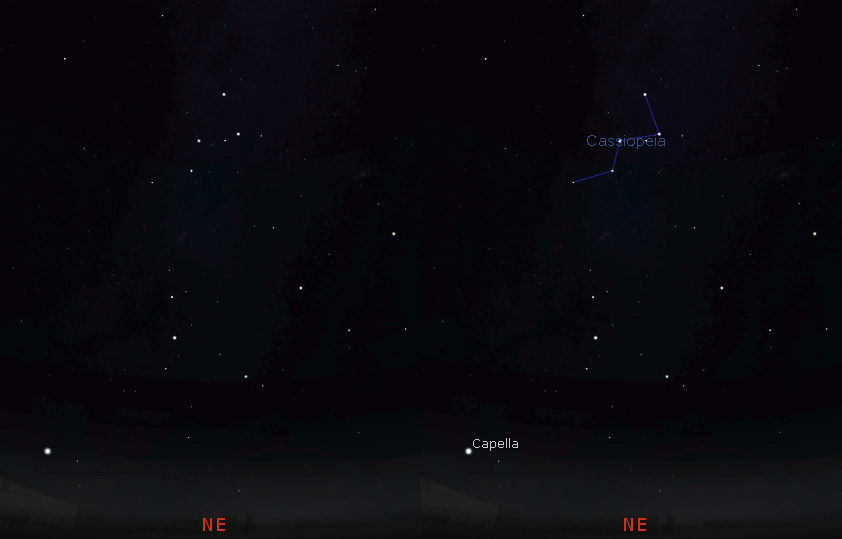
Cassiopeia finder animation for 10 pm tonight, September 15th. One cannot miss the distinctive W. Created using Stellarium.
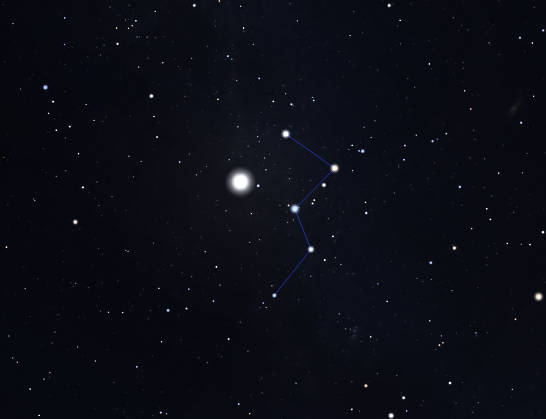
Tycho’s Supernova 1574A, as simulated in Stellarium for mid-November 1572.
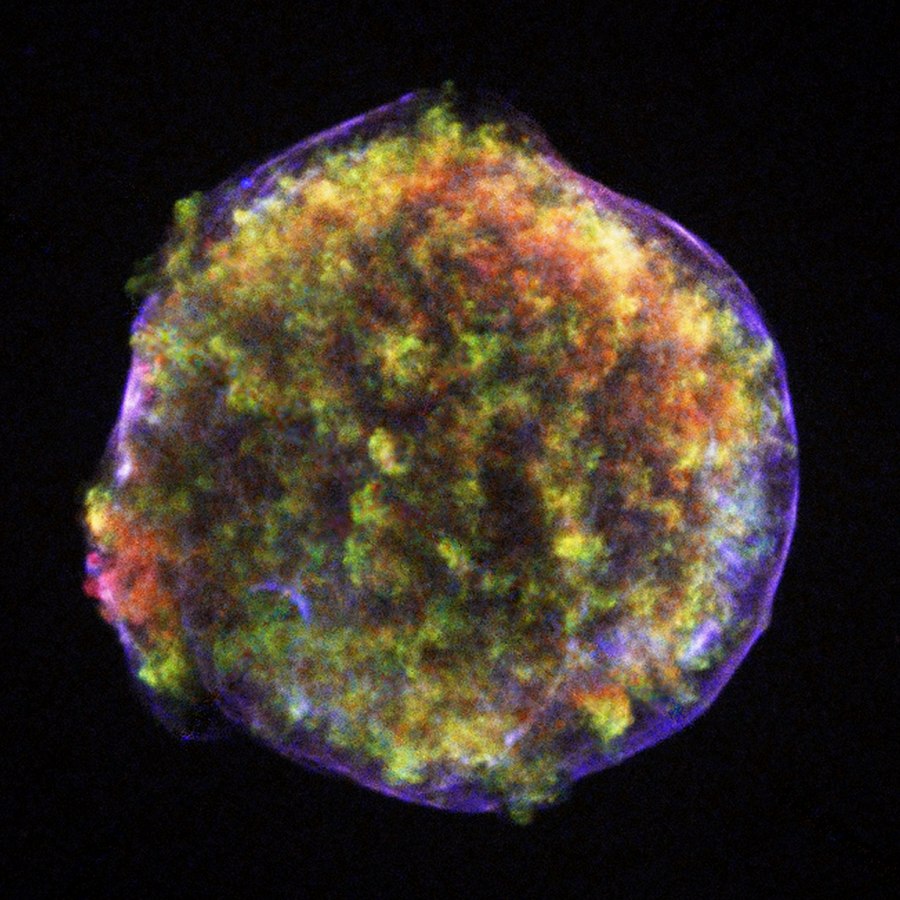
Tycho’s Supernova remnant, seen in x-rays by the orbiting Chandra X-ray Observatory. Credit: NASA / Chandra
09/16/2019 – Ephemeris – Astronomers view a supernova that completely destroyed its star
Ephemeris for Monday, September 16th. Today the Sun will be up for 12 hours and 29 minutes, setting at 7:51, and it will rise tomorrow at 7:23. The Moon, 2 days past full, will rise at 9:21 this evening.
When a star explodes in a supernova due to being very massive, it generally leaves a tiny compact remnant called a neutron star or a black hole within an expanding cloud of gas and dust. However in the early universe there was only hydrogen and helium. It turns out that stars could get much more massive, maybe several hundred times the mass of the Sun, rather than tens of times more massive that the Sun that exist now. Theoreticians suggest that when these stars explode, there was no core to collapse into a black hole or neutron star, but the whole star ignites in a thermonuclear reaction spewing its entire self, and newly created elements into the universe. Astronomers are studying a supernova suspect discovered in 2016: SN 2016iet.
The times given are for the Traverse City/Interlochen area of Michigan. They may be different for your location.
Addendum
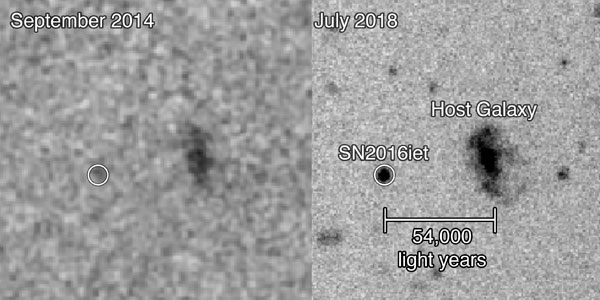
The discovery image (right) shows SN 2016iet and its most likely host galaxy. It was taken with the Low Dispersion Survey Spectrograph on the Magellan Clay 6.5-m telescope at Las Campanas Observatory on July 9, 2018. On the left is a pre-discovery image of the area wit a circle of where the supernova would appear.
The article I gleaned this information from: https://www.skyandtelescope.com/astronomy-news/supernova-that-destroyed-its-star/
It contains a link to the publication preprint.
09/05/2014 – Ephemeris – Supernovae and the Moon this weekend
Ephemeris for Friday, September 5th. The sun will rise at 7:09. It’ll be up for 13 hours and 2 minutes, setting at 8:11. The moon, half way from first quarter to full, will set at 4:07 tomorrow morning.
Tonight the Grand Traverse Astronomical Society will hold their monthly meeting at he Northwestern Michigan College’s Rogers Observatory at 8 p.m. featuring Dr. David Penney, who will talk about Supernovae, the brightest, at optical wavelengths anyway explosions in the universe. These will either completely destroy a star or leave a neutron star or black hole remnant. At 9 p.m. there will be a star party featuring the Moon, Saturn and Mars. The observatory is located on Birmley road. On Saturday the society will celebrate International Observe the Moon Night with telescopes set up on the 200 block of Front street in Traverse City. That event starts around 9 p.m., but only if it’s clear.
Times are for the Traverse City/Interlochen area of Michigan. They may be different for your location.
Addendum
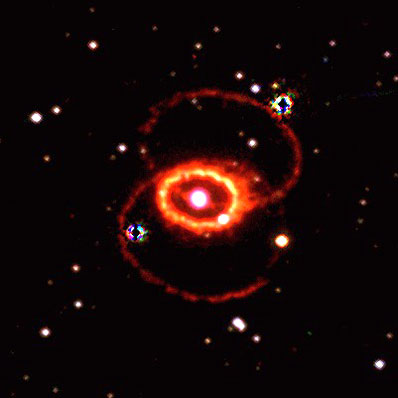
Remnant of SN1987A in the Large Magellanic Cloud, 160,000 light years away taken by the Hubble telescope’s WFPC2 camera on three occasions in 1994 and 1995. The outer rings are light echos of the explosions ionizing clouds ejected thousands of years before. Credit NASA.
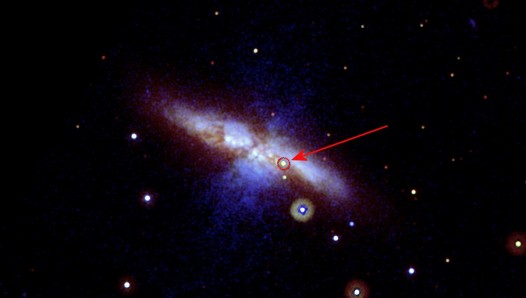
Supernova 2014J in nearby galaxy M82, 12 million light years away. Credit NASA/Swift/P. Brown, TAMU.
01/30/2014 – Ephemeris – More on the supernova in M82
Ephemeris for Thursday, January 30th. The sun will rise at 8:03. It’ll be up for 9 hours and 45 minutes, setting at 5:48. The moon is new today, and won’t be visible.
Let’s talk more about our new supernova in galaxy M82 off the bowl of the Big Dipper. Of course new and nova used in the same sentence is a bit redundant because Nova is Latin for Stella Nova or new star. It is thought that tiny massive white dwarf stars near the end of their life are involved in some way. Type 1a supernovae all seem to explode with about the same brightness so it’s thought that they accrete matter from a nearby giant star until their mass gets to about 1.44 times the sun’s mass. That that point they explode. The explosion of 1.44 solar masses is what gives them the common brightness. The 1.44 of the sun’s mass is called the Chandrasekhar limit discovered mathematically in 1930 by the Indian-American astronomer of the same name.
Times are for the Traverse City/Interlochen area of Michigan. They may be different for your location.
Addendum
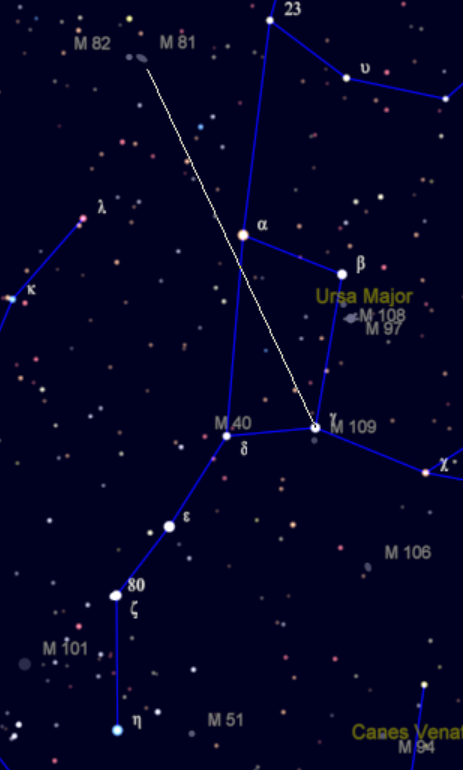
Finder Chart for M82 and M81. Actual time is 9 p.m. on January 28, 2014. Created using Cartes du Ciel (Sky Charts).
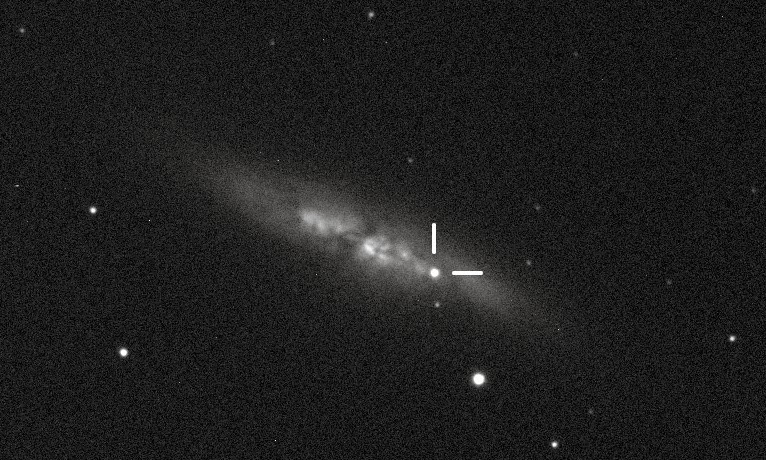
Discovery image of SN 2014J. Credit: UCL/University of London Observatory/Steve Fossey/Ben Cooke/Guy Pollack/Matthew Wilde/Thomas Wright.
Check here for the Wikipedia article on astrophysicist Subrahmanyan Chandrasekhar and the Chandrasekhar limit.
Chandra, as he was know was honored four years after his death with the naming of the Chandra X-ray Observatory, one of NASA’s Great Observatories launched in 1999 and still operating.
01/28/2014 – Ephemeris – A supernova found in a nearby galaxy
Ephemeris for Tuesday, January 28th. The sun will rise at 8:05. It’ll be up for 9 hours and 40 minutes, setting at 5:45. The moon, 2 days before new, will rise at 6:40 tomorrow morning.
There is a new supernova in our skies. It’s designation is SN 2014J and it’s pretty close as the things go, but not in our galaxy. It’s in another galaxy M82 off the front of the bowl of the Big Dipper, and 12 million light years away. It’s the closest supernova since supernova 1987A, which appeared on the last days of February 1987 in a companion galaxy to us the Large Magellanic Cloud. While the latter was visible to the naked eye, this will stay a binocular object at best. I’ll have a finder chart and more information in bobmoler.wordpress.org for those that may need it. This is a special type of supernova that’s used for distance measurement in the universe called a type 1a and this will be a good time to fine tune the calibration.
Times are for the Traverse City/Interlochen area of Michigan. They may be different for your location.
Addendum
Links to more discussion of the new supernova and type 1a supernovae in general.
Finder Charts
Finder Chart for M82 and M81. Actual time is 9 p.m. on January 28, 2014. Created using Cartes du Ciel (Sky Charts)
Pointer to M81 and M82 is a line diagonally through the bowl of the Big Dipper from the star Phad γ (gamma) Ursa Majoris through Dubhe α (alpha) Ursa Majoris. Note that the Big Dipper is not an official constellation but part of Ursa Major, the Great Bear.
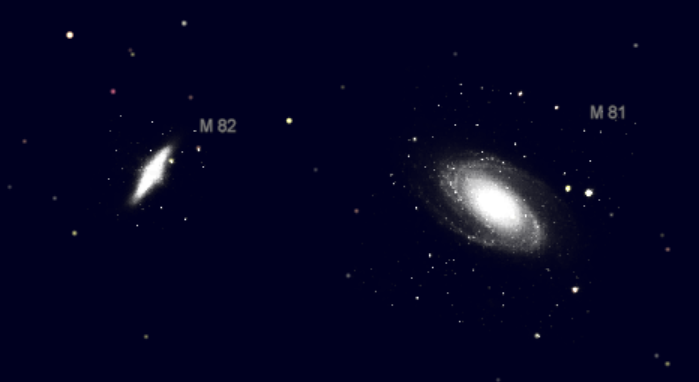
M82 and M81 as seen close up. Note the spiral arms of M81 are invisible visually. Created using Cartes du Ciel (Sky Charts).
Discovery image of SN 2014J. Credit: UCL/University of London Observatory/Steve Fossey/Ben Cooke/Guy Pollack/Matthew Wilde/Thomas Wright.
03/27/2012 – Ephemeris – Supernova near the direction of Mars
Ephemeris for Tuesday, March 27th. The sun will rise at 7:31. It’ll be up for 12 hours and 32 minutes, setting at 8:04. The moon, 3 days before first quarter, will set at 1:19 tomorrow morning.
Last week a supernova was spotted in nearby galaxy M95, which happens to be close to the direction where Mars is right now. It takes a telescope of about 6 inch diameter to spot it. If you’d like to spot it, Google “M95 supernova” for more information on its exact location. Since discovery, astronomers have found the progenitor star on an old image of the galaxy taken by the Hubble Space Telescope. The star that blew itself up appears to have been 8 times the mass of the sun as determined by its color and brightness. We don’t have to worry about the sun doing the same thing, it’s simply not massive enough. It’s nice to live orbiting around a boring star of low mass. Our sun’s wildness is seen in the sunspot cycle.
* Times are for the Traverse City/Interlochen area of Michigan. They may be different for your location.
Addendum
Finder Charts
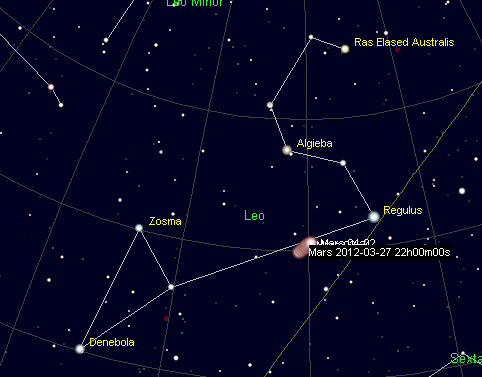
Mars' motion from March 26th to April 2nd 2012. Created using Cartes du Ciel.
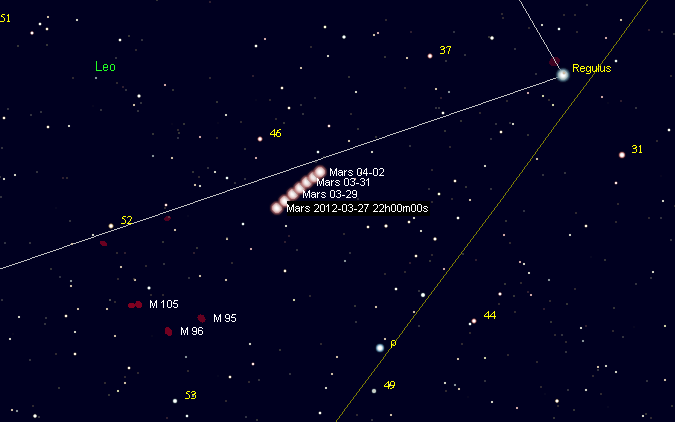
Closeup Mars and M95 for the dates March 27th to April 2nd 2012. Created using Cartes du Ciel.
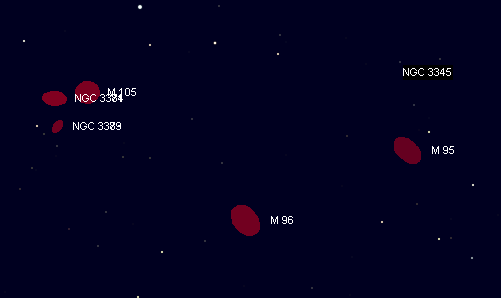
M95 and neighboring galaxies. The supernova will appear below M95. The faintest stars here are 10th magnitude. The supernova is about 12th. Created using Cartes du Ciel.
Google “M95 supernova” in Google images for what the supernova and galaxy look like.
09/13/11 – Ephemeris – Supernova in the Pinwheel Galaxy
Tuesday, September 13th. The sun will rise at 7:18. It’ll be up for 12 hours and 38 minutes, setting at 7:57. The moon, 1 day past full, will rise at 8:05 this evening.
There is currently a supernova in a galaxy near the handle of the Big Dipper. The bright moon is interfering with its visibility in telescopes. It’s in a galaxy called M101 or the Pinwheel galaxy, a difficult to spot galaxy between and above the two end stars of the handle of the Big Dipper. The galaxy is 21 million light years away, relatively close as galaxies go. It is being intensely studied because it is of a type, 1a, that is used for distance measurements of far more distance galaxies. This kind of Supernova is thought to be the destruction of a white dwarf star in a close binary relation with a more massive star and is drawing matter off the larger star. When the dwarf reaches 1.38 times the sun’s mass… Kablooey! Astronomers are trying to see if that’s true for this star.
* Times are for the Traverse City/Interlochen area of Michigan. They may be different for your location.
 Bob Moler's Ephemeris Blog