Archive
Ephemeris: 03/06/2025 – The Moon at first quarter
This is Ephemeris for Thursday, March 6th. Today the Sun will be up for 11 hours and 26 minutes, setting at 6:37, and it will rise tomorrow at 7:09. The Moon, at first quarter today, will set at 3:31 tomorrow morning.
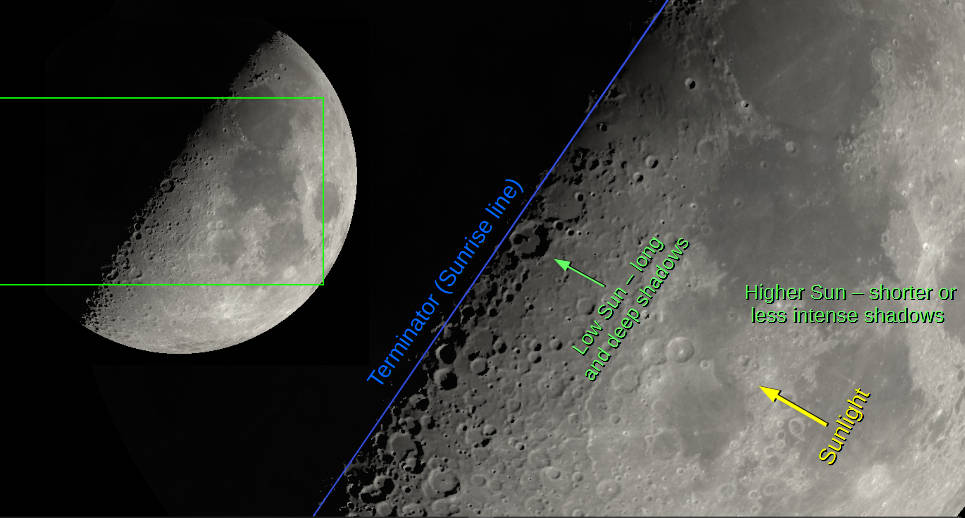
The Moon is indeed at first quarter today with the instant of being 90° from the Sun coming at 11:32 this morning. To me the first quarter moon is the best time to view because there are a lot of craters that are visible in deep shadow. The terminator, the sunrise line, on the Moon cuts the disk in half and a lot of craters can even be seen in binoculars. With a small telescope the jumble of craters provides a wonderful view of the destruction of the early bombardment of the Moon in its early days. The reason the Moon has all these craters and the Earth does not is the fact that the Earth has an active surface with volcanoes, plate tectonics, water and wind to erode and deform the surface. The Moon has really none of that.
The astronomical event times given are for the Traverse City/Interlochen area of Michigan (EST, UT – 5 hours). Times will be different for other locations.
Addendum
Ephemeris: 05/10/2024 – Earthshine
This is Ephemeris for Friday, May 10th. Today the Sun will be up for 14 hours and 39 minutes, setting at 8:59, and it will rise tomorrow at 6:18. The Moon, 3 days past new, will set at 12:37 tomorrow morning.
The Moon tonight will appear as a thin sliver, with not much visible on the thin illuminated portion. However, if as you look at the moon tonight you have the funny feeling that the whole moon is visible, you are right. It’s easily confirmed with a pair of binoculars or a small telescope. What is illuminating the dark part of the Moon is earthshine. The Earth is big and bright in the Moon’s sky, and a fat waning gibbous from its vantage point. From the Moon the Earth has the opposite phase that we see of the Moon from the Earth. The effect used to be called by the term “Old moon in the new moon’s arms”. The effect was first explained by Leonardo da Vinci some 500 years ago. The effect will disappear in a few days as the Moon gets brighter and the Earth less so in the Moon’s sky. Earthshine will appear again when the Moon appears as a waning crescent in the morning. But not many of us are up to see it at that hour.
The astronomical event times given are for the Traverse City/Interlochen area of Michigan (EDT, UT–4 hours). They may be different for your location.
Addendum
06/26/2023 – Ephemeris – After the latest sunset, a look at the Moon
This is Ephemeris for Monday, June 26th. Today the Sun will be up for 15 hours and 33 minutes, setting at 9:32, and it will rise tomorrow at 5:59. The Moon, at first quarter today, will set at 2:02 tomorrow morning.
Tonight is the night of the latest sunset. From now to December 10th the Sun will be setting earlier than the night before. It won’t be noticeable at first, but the change will increase throughout the summer. The Moon actually arrived at first quarter phase early this morning, so by tonight it will appear slightly gibbous. The term gibbous actually means hump-backed, and the Moon will appear more so as it advances toward being fully illuminated a week from now. For me personally, I find that the best time to view the Moon with a telescope is within three or four days from its quarter phase, unless I’m looking at a specific feature. That’s when shadows are front and center on the moon. The Moon being gray on gray, shadows keep the Moon from appearing flat.
The astronomical event times given are for the Traverse City/Interlochen area of Michigan (EDT, UT –4 hours). They may be different for your location.
Addendum
04/24/2023 – Ephemeris – The reason for the Moon’s phases
This is Bob Moler with Ephemeris for Monday, April 24th. Today the Sun will be up for 13 hours and 55 minutes, setting at 8:38, and it will rise tomorrow at 6:42. The Moon, 3 days before first quarter, will set at 2:02 tomorrow morning.
The Moon’s changing appearance over the month may seem to be mysterious at first glance. Maybe because one may think that the objects in the sky are somehow different from the familiar objects we see around us on the Earth. In ancient times, especially the Greeks, thought that everything in the heavens was perfect and spotless. They explained the definite markings we see as the man-in-the-moon as a reflection of the Earth by a spotless Moon. The Moon’s phases are simply light and shadow on a ball in the sunlight. Sometime, when the Moon appears in the daytime, take a small ball, like a golf ball and hold it up to the Moon, while the ball is also in sunlight, and the small ball will exhibit the same phase as the Moon.
The astronomical event times given are for the Traverse City/Interlochen area of Michigan (EST, UT –4 hours). They may be different for your location.
Addendum
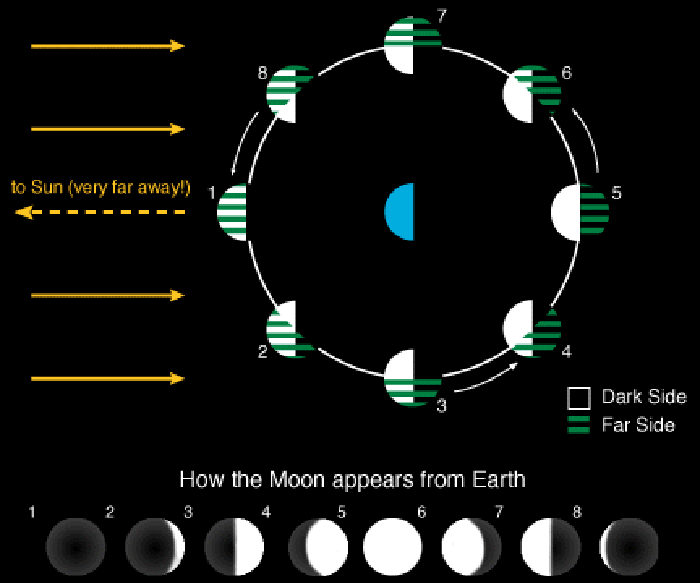
This is the best diagram of the Moon’s phases and how the it appears from the Earth. Credit http://planetfacts.org/phases-of-the-moon/ which I recommend.
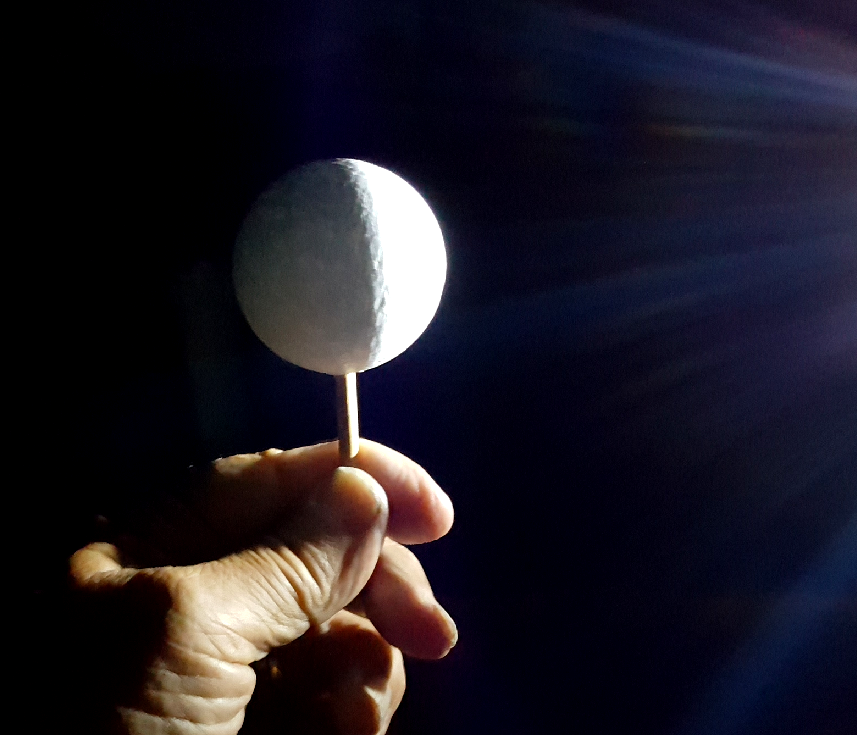
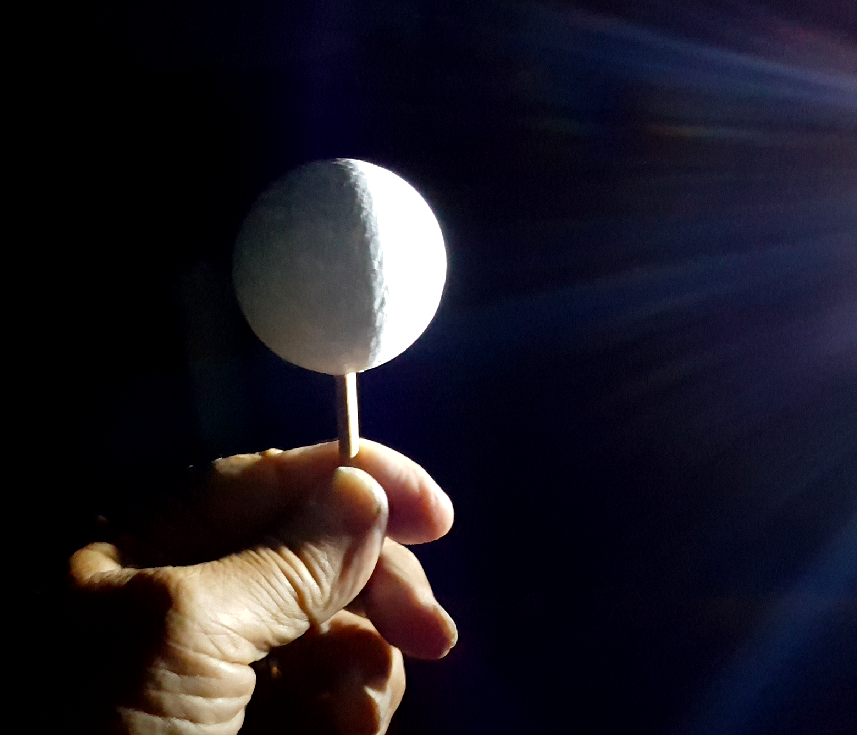
A demonstration of the Moon’s crescent phase with the styrofoam moon ball we use for Project Astro held up to a light off frame to the right. The line between the bright (day) and dark (night) side of the ball, moon or planet is called the terminator. The night side of the ball is illuminated a bit by the translucency of the ball, and the reflection off my hand. Note the roughness of the ball is visible only at the terminator, where the shadows are longest. I photographed this outside at night to minimize the ball’s nighttime illumination.
10/27/2022 – Ephemeris – Trying to spot the young Moon tonight
This is Bob Moler with Ephemeris for Thursday, October 27th. Today the Sun will be up for 10 hours and 24 minutes, setting at 6:38, and it will rise tomorrow at 8:15. The Moon, 2 days past new, will set at 7:55 this evening.
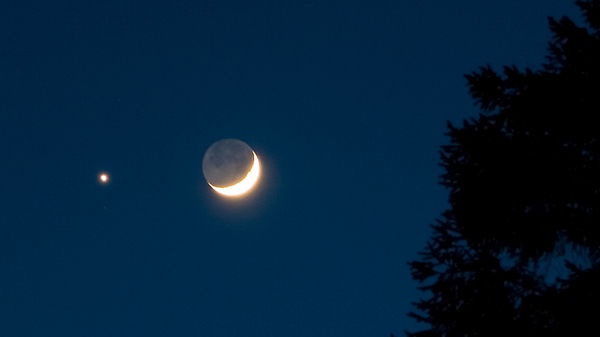
The Moon is again making its appearance in the evening sky as a thin crescent. The crescent appearance is because the moon is mostly between the Earth and the Sun. So we are seeing mostly its night side, with just a sliver of it being sunlit. But the Moon has the Earth in its sky, which is quite big and bright, much brighter than the Moon in our skies. And when the Moon’s phase is thin, the Earth, having the opposite phase, will be a nearly full gibbous orb. The Earth illuminates the Moon’s night side with earthlight. We call it earthshine, when the whole Moon appears faintly inside the crescent. It’s also known more poetically as the “Old moon in the new moon’s arms.” If you’re not sure, because the effect is faint, check it out in binoculars. The effect should last another night.
The astronomical event times given are for the Traverse City/Interlochen area of Michigan (EDT, UT – 4 hours). They may be different for your location.
Addendum
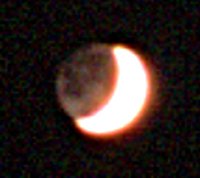
An old picture of mine overexposing the crescent Moon to bring out earthshine. The moon was a wider crescent than it will appear to be tonight.
10/03/2022 – Ephemeris – There’s something on the Moon that’s straight and not circular
This is Ephemeris for Monday, October 3rd. Today the Sun will be up for 11 hours and 36 minutes, setting at 7:19, and it will rise tomorrow at 7:44. The Moon, 1 day past first quarter, will set at 12:55 tomorrow morning.
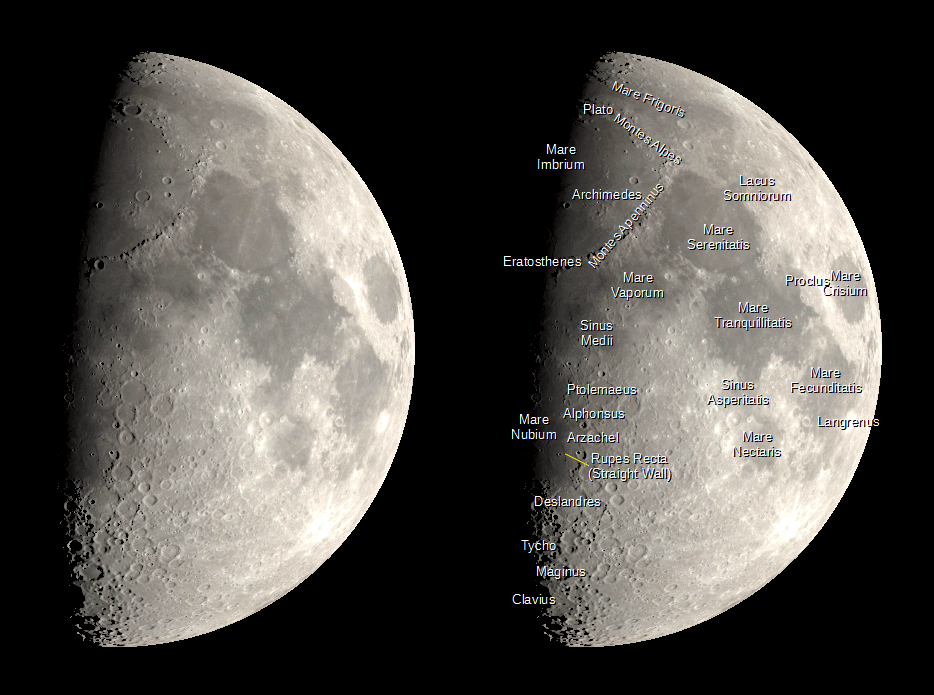
On this program, I try to talk about celestial objects one can see or find with the naked eye. Once found, I do talk about what they would look like in binoculars or small telescope. For those wanting more information, consult my blog bobmoler.wordpress.com where my scripts are posted with more information, illustrations and charts. The thing I’m talking about today is a feature on the Moon that’s visible only two nights a month. The day after first quarter, and the day after last quarter. It’s the straightest thing on the Moon, called the Straight Wall, that’s 67 miles (110 km) long and 900 feet (300 m) high. It is close to the terminator, the Moon’s sunrise line, about halfway from the center of the Moon to the south edge. It’s the thinnest dark line you can imagine.
The astronomical event times given are for the Traverse City/Interlochen area of Michigan (EDT, UT – 4 hours). They may be different for your location.
Addendum
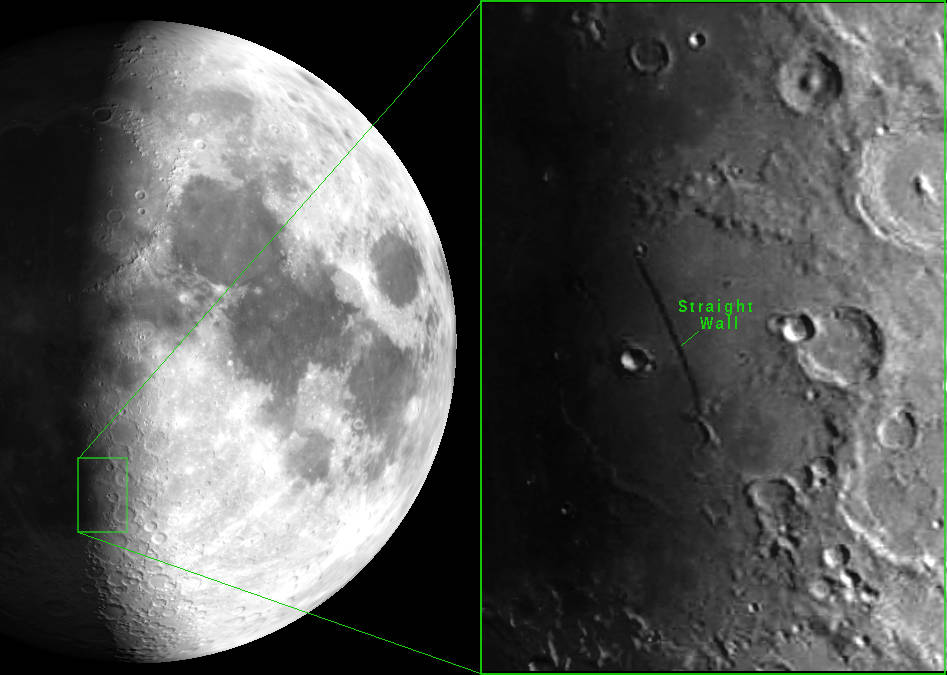
The Straight Wall or, officially in Latin, Rupes Recta, is a rectilinear fault. It isn’t really a wall, but a 7 degree slope. Once the Sun rises past seven degrees in that location of the Moon, it disappears. Near local sunset, a day after last quarter, the low sun in its sky shines more on it than the flat ground, so it shows up bright. Click on the image to enlarge it. The information and images were created from Virtual Moon Atlas, which is free software for MS Windows. I have a link to it on this page.
04/26/2021 – Ephemeris – There’s a full supermoon tonight
This is Ephemeris for Monday, April 26th. Today the Sun will be up for 14 hours and 2 minutes, setting at 8:41, and it will rise tomorrow at 6:38. The Moon, at full today, will rise at 8:19 this evening.
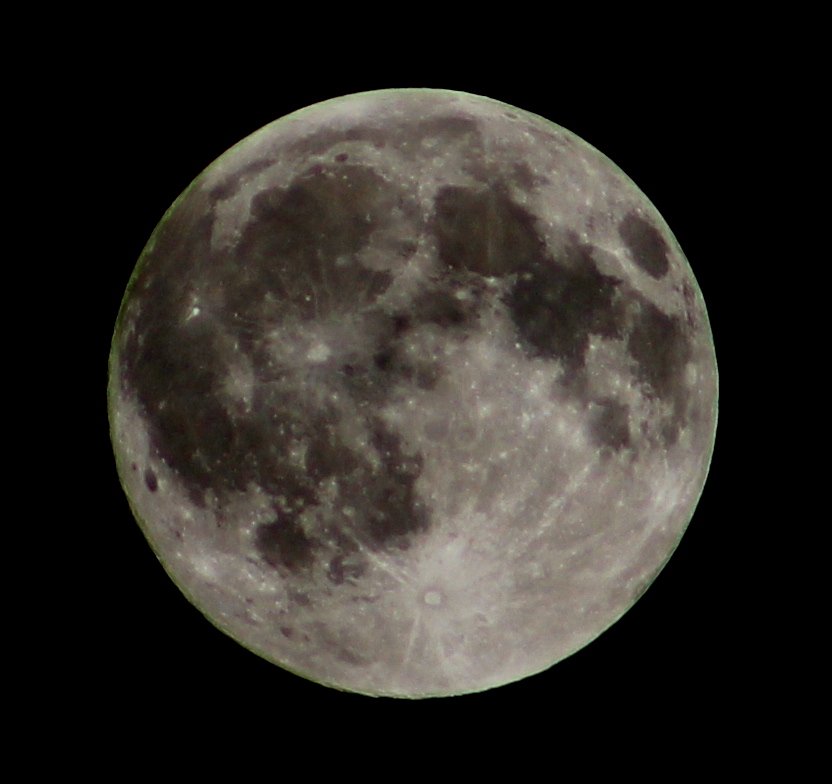
The full moon tonight is the full Pink Moon, and a supermoon. As down as I am about full moons due to the fact that they light up the sky and flood out the dimmer objects in the sky, I once in a while stop and view it. The time of the full moon is 11:31 tonight, so when it rises tonight we will be looking at the moon from very nearly the direction of the Sun, so there will be few shadows to be had. The crater Tycho is near the bottom or south end of the moon and has long rays of tiny ejecta craters. The full moon is the best time to see these rays, which are easily visible in binoculars, through which Tycho itself looks like a bright dot. In telescopes Tycho looks like a small bright crater with a dark ring around it. The full moon is super bright. It’s daytime over there.
The astronomical event times given are for the Traverse City/Interlochen area of Michigan. They may be different for your location.
Addendum
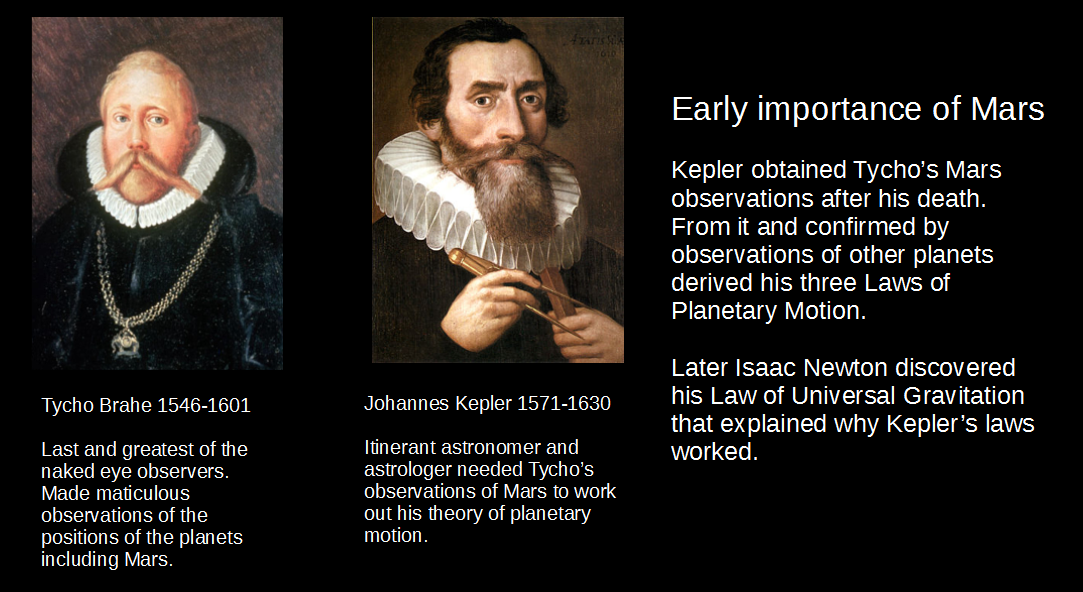
Tycho Brahe and Johannes Kepler are inexorably linked in astronomical history. Tycho was famously stingy with the results of his observations. It was only after his death that Kepler was able to have access to them. Mars was the planet that was hardest to model in both the Ptolemaic geocentric and Copernican heliocentric universes, since both assumed the planetary orbits were circular. So both resorted to epicycles in an attempt to tweak their models in an attempt to fit with observational reality.
Both Tycho and Kepler have craters named for them on the Moon. Tycho gets a splashy crater on the southern part of the Moon. Kepler, however, gets a small crater on the plains of Oceanus Procellarum west of the crater Copernicus on the left side of the Moon, as we see it
03/22/2021 – Ephemeris – The Moon and the week
This is Bob Moler with Ephemeris for Monday, March 22nd. Today the Sun will be up for 12 hours and 16 minutes, setting at 7:58, and it will rise tomorrow at 7:39. The Moon, 1 day past first quarter, will set at 5:08 tomorrow morning.
The Moon tonight is about as far north in the sky as it gets this month, and being six days before full, and this full Moon is the first full moon of spring, that means Easter is less than two weeks away. Did you notice that a week is nearly equal to a quarter of the Moon’s orbit of the Earth? If you look at a calendar that has the Moon’s phases on it the phases are 7 or 8 days apart. It’s a good thing that no one decided to adjust the length of the week to accommodate the Moon’s phases. It’d be hard to plan your weekend. Our calendar is pretty screwed up as it is with months of 28, 29, 30 and 31 days all set by politicians… Roman politicians at that. I haven’t heard much about calendar reform lately, so I guess we’re stuck with it.
The astronomical event times given are for the Traverse City/Interlochen area of Michigan. They may be different for your location.
Addendum
I wrote the above before actually checking out the historical origin of the time period we call a week. It turns out that the week is really related to a quarter of a lunation or lunar month. The Babylonians fixed the fact that seven days is a bit less than a quarter of a lunation by adding a day or two to the last week of the month, so the next month’s new moon started on the same day of the week.
Here the new moon is defined as the first appearance of the Moon in the evening sky after disappearing from the morning sky. We currently define the new moon as the Moon’s solar conjunction. Its first appearance in the evening sky would generally be the next day, or rather evening. The numbering still works out. Our new moon is day zero of the lunar month.
04/06/2020 – Ephemeris – Tomorrow’s full moon is special in two ways
This is Ephemeris for Monday, April 6th. Today the Sun will be up for 13 hours and 3 minutes, setting at 8:17, and it will rise tomorrow at 7:11. The Moon, 1 day before full, will set at 7:21 tomorrow morning.
The Moon will be full tomorrow, and also it will reach perigee, that is, its closest to the Earth of its current orbit, and for 2020. That makes it a super moon. The orbit of the Moon is affected by the Sun, Venus, and Jupiter mostly. So all perigees are not equally close. At perigee tomorrow the Moon will be 221,772 miles (356,907* km). I its most distant point from the Earth of 252,564 miles (406,462* km). We won’t notice it because it will be nearly new at that time. Tomorrow’s full moon will be special in another way, because it it the full moon that announces Easter for both Christian churches, east and west, and Passover for the Jews. I’ll talk more about that tomorrow.
The event times given are for the Traverse City/Interlochen area of Michigan. They may be different for your location.
* According to Astronomical Tables of the Sun, Moon and Planets Third Edition by Jean Meeus.
03/30/2020 – Ephemeris – Following the Moon night to night
Ephemeris for Monday, March 30th. Today the Sun will be up for 12 hours and 42 minutes, setting at 8:08, and it will rise tomorrow at 7:24. The Moon, 2 days before first quarter, will set at 2:32 tomorrow morning.
Now that clear skies are mostly back we can follow, night by night the progress of the Moon, now as its phase waxes and moves eastward at the same time each night. With the naked-eye the large darker lunar seas slowly reveal the face of the Man in the Moon, or the Chinese upside down Jade Rabbit pounding medicine with his mortar and pestle. With binoculars or telescope, more detail is revealed every night as the terminator, the sunrise line before full moon uncovers more lunar territory, with their long morning shadows. It’s the shadows that show the detail on the Moon, which is dark gray on darker gray. For the most part the surface of the Moon has been worn down by eons of meteoroid impacts and their ejecta.
The event times given are for the Traverse City/Interlochen area of Michigan. They may be different for your location.
Addendum
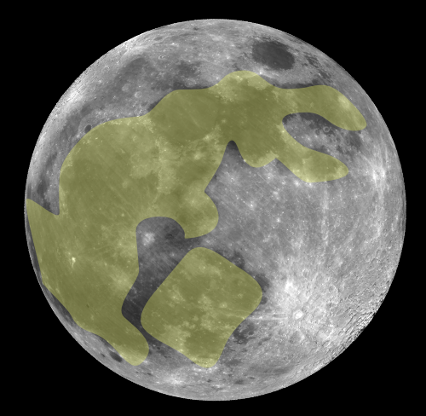
Jade Rabbit and Mortar on the Moon. Credit: Zeimusu, Creative Commons.
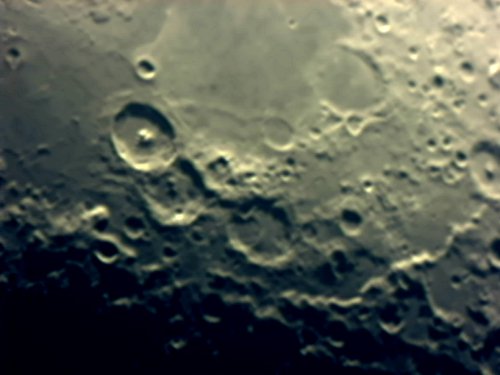
Craters near the Moon’s terminator showing how the low Sun brings out the detail. Credit Bob Moler, the author on 06/11/2011.
 Bob Moler's Ephemeris Blog