Archive
09/16/2016 – Ephemeris – The Harvest Moon is slightly eclipsed for everyone but the Americas
Ephemeris for Friday, September 16th. The Sun will rise at 7:23. It’ll be up for 12 hours and 27 minutes, setting at 7:50. The Moon, at full today, will rise at 7:59 this evening.
Tonight’s full Moon is the Harvest Moon, the nearest full Moon to the autumnal equinox. For the next few nights the Moon will rise later each night by much less than the average 50 minutes later each night effectively lengthening twilight for those gathering in crops. Also this afternoon there will be a penumbral lunar eclipse visible, well not here in Michigan… because the Moon won’t be up. Actually just about the whole world except North America and most of South America will be able to see the eclipse. A penumbral eclipse is what I call a 5 o’clock shadow eclipse. You wouldn’t know it unless someone pointed it out to you, when the Moon dips into the Earth’s outer shadow and the sunlight falling part of it is diminished by a little bit.
Times are for the Traverse City/Interlochen area of Michigan. They may be different for your location.
Addendum
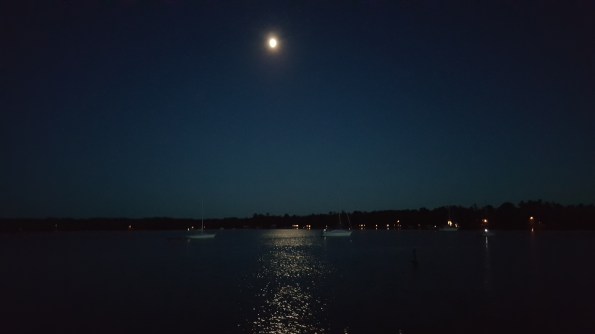
The not so full Moon of Monday night and its reflection on the waters of Suttons Bay after the schooner Inland Seas docked after an evening sail. Credit: the author.
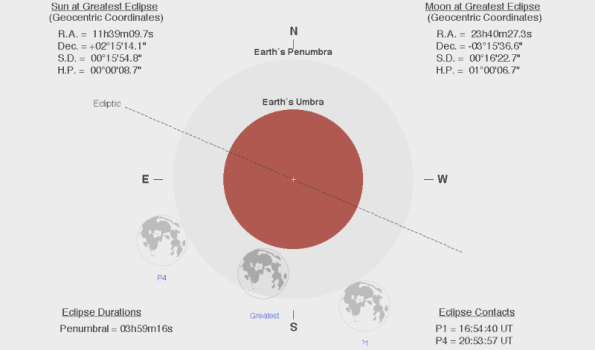
The penumbral eclipse of the Moon centered on 2:25 p.m. Eastern time, 18:54 UT, for an hour and a half before and after. Only near the middle of the eclipse will anything be visible of the effect. I find that wearing sunglasses reduces the brightness of the moon and enhances the penumbral shadow. Credit: NASA/GSFC/ Fred Espenak.
For the full-page pdf of the above click here: http://eclipse.gsfc.nasa.gov/LEplot/LEplot2001/LE2016Sep16N.pdf
08/18/2016 – Ephemeris – Viewing the full Moon tonight
Ephemeris for Thursday, August 18th. The Sun rises at 6:49. It’ll be up for 13 hours and 53 minutes, setting at 8:42. The Moon, at full today, will rise at 8:54 this evening.
The full moon, contrary to what you’d think is a poor time to observe it. The moon is essentially gray on gray. And at full moon we are looking at the moon from about the same perspective as the sun, so there are no shadows to delineate its fine features. Since the actual instant of full moon occurred at 5:27 this morning, some shadows will be creeping in on the moon’s upper right face as it is seen in the evening. Full moon is the best time to see the maria or lunar seas, the dark areas that make up the man in the moon. In binoculars can be seen the bright rays* emanating from the crater Tycho near the south end of the moon. Other craters have rays too, but none so long and distinctive. Night by night for the next two weeks the moon’s illuminated landscape will wane.
Times are for the Traverse City/Interlochen area of Michigan. They may be different for your location.
* Rays are caused by the ejecta from the impact that created the crater. They are thought to be small craters themselves which show up best at full moon because they have no shadows in them.
Addendum
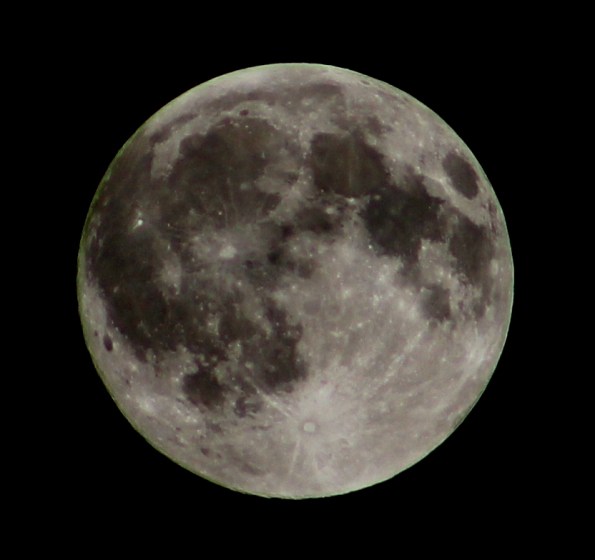
The full Moon taken last night, 7 hours before to was officially full. The contrast was greatly enhanced to bring out Tycho’s ray system. Credit Bob Moler.
06/07/2016 – Ephemeris – The Moon reappears in the evening sky
Ephemeris for Tuesday, June 7th. Today the Sun will be up for 15 hours and 28 minutes, setting at 9:26, and it will rise tomorrow at 5:57. The Moon, 3 days past new, will set at 11:41 this evening.
The Moon tonight is a thin crescent with the night side faintly illuminated by the Earth. The effect is called earthshine. The small dark sea of Crises, or Mare Crisium, near the right edge of the moon will be cut in half by the moon’s terminator, its sunrise line. Venus, which passed behind the Sun yesterday, though now an official evening planet probably won’t become easily visible till near the end of summer. The evening sky now through mid July is a time where it seems that twilight never ends. However for almost the next two weeks, we have the bright planets Jupiter, Mars and Saturn plus the Moon to help us forget the seemingly forever twilight blues. After that we’ll have just the planets. Not a bad deal.
Times are for the Traverse City/Interlochen area of Michigan. They may be different for your location.
Addendum
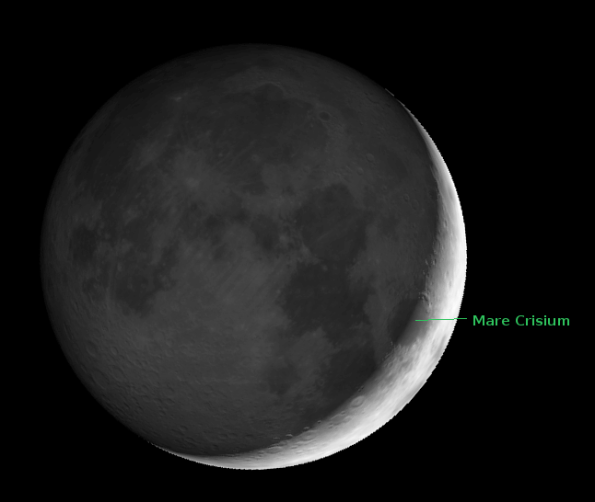
The Moon showing earthshine at 10:30 p.m. June 7, 2016. Created using Virtual Moon Atlas.
Note: The image, from Virtual Moon Atlas, has been rotated to show the approximate appearance in the sky of the Moon low in the southwest. I didn’t attempt to add the sky brightness and color.
05/19/2015 – Ephemeris – The crescent Moon reappears in the west
Ephemeris for Tuesday, May 19th. Today the Sun will be up for 14 hours and 57 minutes, setting at 9:08. The Moon, 1 day past new, will set at 10:42 this evening, and tomorrow the Sun will rise at 6:09.
The Moon is again making its appearance in the evening sky as a thin crescent. The crescent appearance is because the moon is mostly between the Earth and the Sun. , so we are looking at just a sliver of it is sunlit, and most is unlit by the sun. But the Moon has the Earth in its sky, which is quite bright, and when the moon’s phase is thin, the Earth illuminates its night side with Earth light. We call it Earthshine, when the whole Moon appears faintly inside the crescent. It’s also known more poetically as the “Old moon in the new moon’s arms.” The planets Venus and Mercury also exhibit crescent phases because they can be positioned between the Earth and the Sun, as Mercury is now and Venus will be next month.
Times are for the Traverse City/Interlochen area of Michigan. They may be different for your location.
Addendum
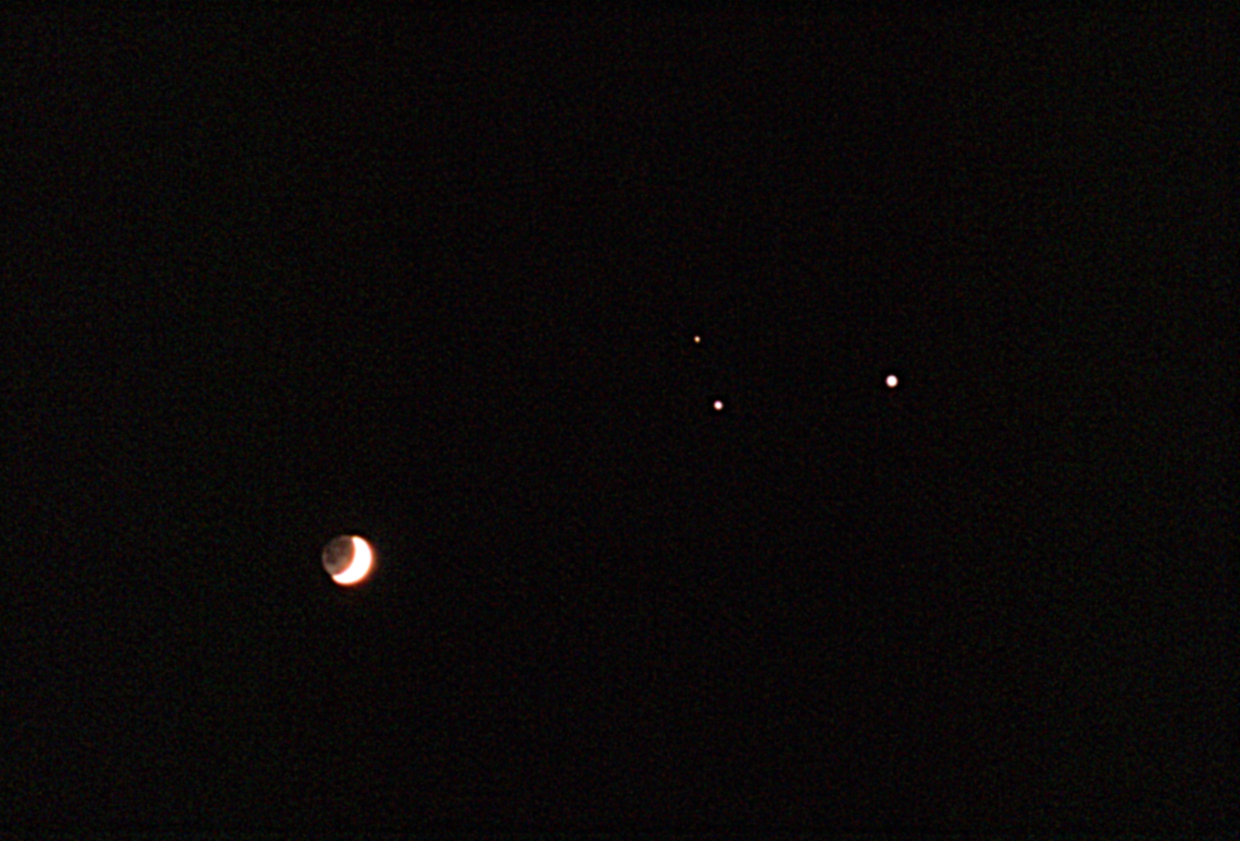
Close grouping of, from right to left, Venus, Jupiter, Venus and the overexposed crescent Moon showing Earthshine on June 15, 1991. Credit: Bob Moler.
10/10/14 – Ephemeris – Hunters Moon effect… Same as the Harvest Moon effect
Ephemeris for Friday, October 10th. The sun will rise at 7:51. It’ll be up for 11 hours and 15 minutes, setting at 7:06. The moon, 2 days past full, will rise at 8:41 this evening.
Let’s talk about the Moon one more time this week. Wednesday’s lunar eclipse came on the hunter’s moon. Like the harvest moon, the previous full moon, the bright Moon lingers in the twilit sky. We are two days past full moon and the Moon rises just before the end of twilight. 50 minutes is the average night to night advance in moon rise times. Depending on what part of the sky the moon is in, the nightly delay in rise times can be as little as 35 minutes or as long as an hour and 5 minutes. The smallest moon rise advance is when the moon is near the constellation Pisces and the longest advance time is when the moon is near Virgo. It doesn’t matter the season, it’s where the moon is in the sky. We only notice it when the moon is near full.
Times are for the Traverse City/Interlochen area of Michigan. They may be different for your location.
Addendum (4 p.m.)
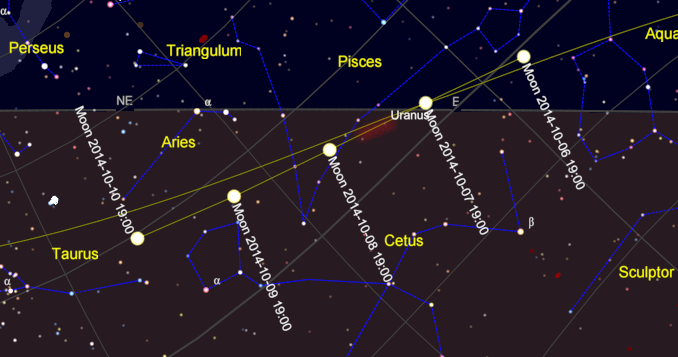
The Hunters/Harvest Moon effect for 2014. Note the shallowness of the Moon’s path. Created using Cartes du Ciel (Sky Charts).
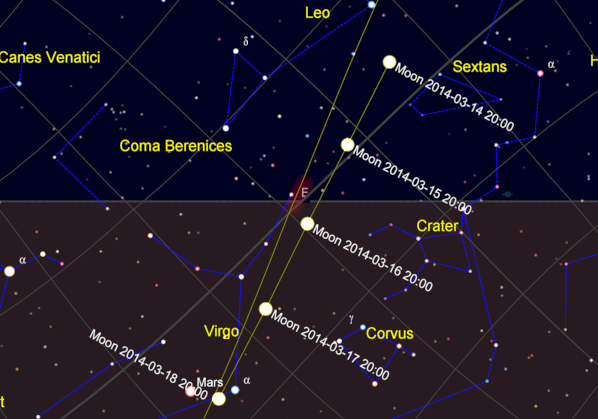
The Worm (March Full Moon) Moon effect for 2014. Note the the steepness of the Moon’s path. Created using Cartes du Ciel (Sky Charts).
Note that the brown shading on the bottom of the images is below the horizon. The yellow line is the ecliptic or plane of the Earth’s orbit. The motion of all the objects in the sky due to the Earth’s rotation is to the upper right parallel to the celestial equator line that crosses the horizon below the E or east compass point. The red smudge on the ecliptic is the display of the Earth’s shadow for the 5 days of the display. Note in the top image that early on October 8th the Moon passes through the Earth’s shadow, which gave us the lunar eclipse that morning. On the Worm Moon image the Moon misses the Earth’s shadow. However you can see that the Moon is tracking toward the ecliptic. The next month on April 15th, the Moon did indeed pass through the earth’s shadow, giving us a lunar eclipse that morning.
08/11/2014 – Ephemeris – The Moon’s terminator is now the sunset line
Ephemeris for Monday, August 11th. The sun rises at 6:40. It’ll be up for 14 hours and 13 minutes, setting at 8:54. The moon, 1 day past full, will rise at 9:15 this evening.
After the full moon the shadow action moves from the eastern or left edge of the moon to the western or right edge of the moon, or if the moon’s low in the east, to the upper right edge. For the first two weeks of the lunar cycle, from new to full we were watching the sunrise terminator slowly sweep across the face of moon. Now, after full the sunrise terminator is sweeping across the Moon’s far side, and the sunset terminator is beginning to sweep across the near side, our side of the Moon. Tonight the terminator is approaching the small Sea of Crises on the upper right of the Moon. By tomorrow night the terminator will be half way across that sea. By Wednesday it will be lights out for the Sea of Crises for two weeks.
Times are for the Traverse City/Interlochen area of Michigan. They may be different for your location.
Addendum
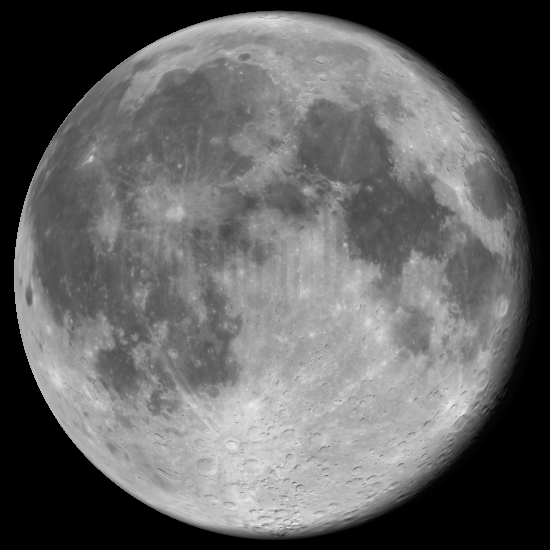
The moon at 10 p.m. tonight, August 11, 2014. Created using Virtual Moon Atlas.
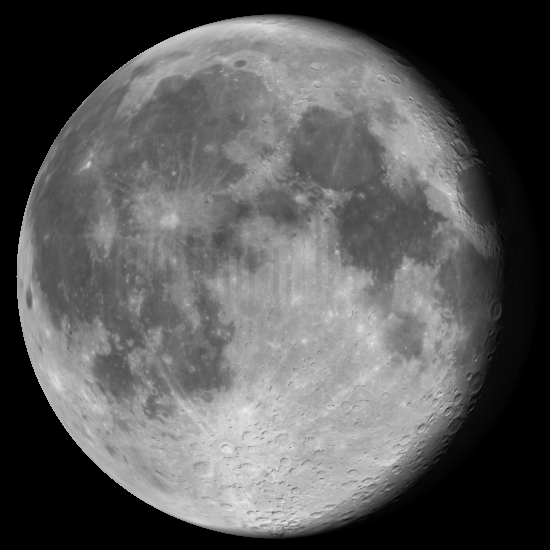
The moon at 10 p.m. tomorrow night, August 12, 2014. Created using Virtual Moon Atlas.
08/05/2014 – Ephemeris – The gibbous Moon and the Perseid meteors
Ephemeris for Tuesday, August 5th. The sun rises at 6:33. It’ll be up for 14 hours and 29 minutes, setting at 9:02. The moon, 2 days past first quarter, will set at 2:07 tomorrow morning.
As the moon moves around the Earth, its illuminated fraction gets greater since it’s now moving around to be opposite the sun in the sky which it will reach in 5 days, the full moon. Tonight the face of the moon we see is 71 percent illuminated by the sun. Anytime the moon is between 50 and 100 percent illuminated by the Sun we call a gibbous moon. The word gibbous means hump-backed, and lets face it, the Moon looks cooler when it’s a crescent. If you’re interested in the growing Perseid meteor shower and want to see it in dark skies, the hours of darkness will be restricted tonight to between moon set at 2:07 a.m. and the beginning of astronomical twilight at 4:32 a.m., though you can push it to 5 a.m. before the twilight becomes objectionable.
Times are for the Traverse City/Interlochen area of Michigan. They may be different for your location.
Addendum
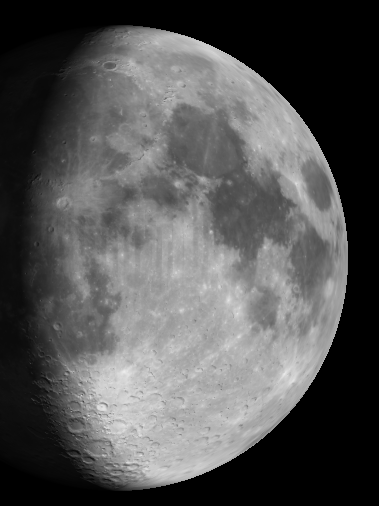
The gibbous Moon tonight (August 5, 2014). Created using Virtual Moon Atlas.
03/10/2014 – Ephemeris – Observing the Moon tonight and the crater Copernicus
Ephemeris for Monday, March 10th. The sun will rise at 8:03. It’ll be up for 11 hours and 38 minutes, setting at 7:42. The moon, 3 days past first quarter, will set at 5:04 tomorrow morning.
The moon has certainly changed appearance since I last talked about it last Thursday. It’s gone from a fat crescent to its gibbous phase. Gibbous by the way means hump-backed. Near the sunrise terminator can be seen the great crater Copernicus on the left side of the moon. This crater is 56 miles in diameter and the crater floor is two miles below the top of the crater rim. It has a three central peaks and the interior of the crater walls have slumped causing terracing. All these are easily seen with a small telescope. The crater has been dated to less than a billion years old, and it has a spray of ejecta around it that is roughly circular and can best be seen at full moon when the crater is washed out due to lack of shadows.
Times are for the Traverse City/Interlochen area of Michigan. They may be different for your location.
Addendum
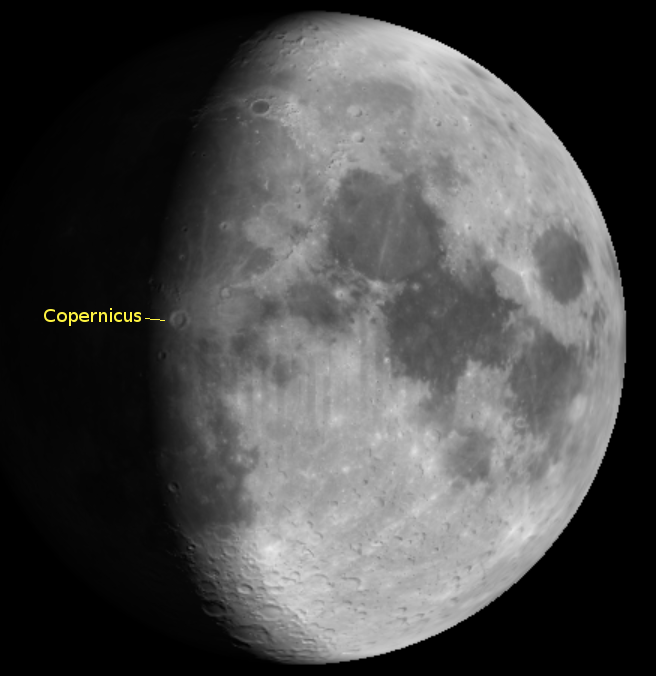
The Moon at 10 p.m. on March 10,2014 pointing out the crater Copernicus. Created using Virtual Moon Atlas.
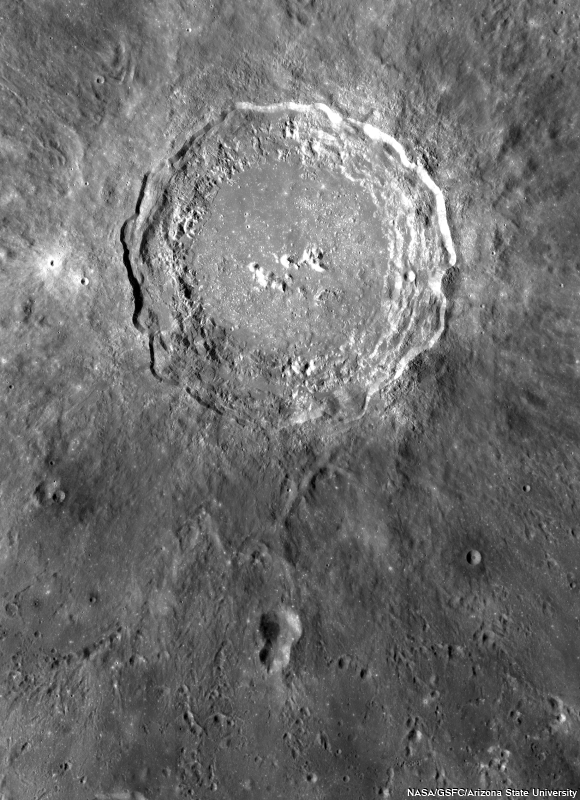
Copernicus from the Lunar Reconnaissance Orbiter. Credit: NASA/GSFC/Arizona State University
04/18/2013 – Ephemeris – The moon at first quarter
Ephemeris for Thursday, April 18th. The sun rises at 6:52. It’ll be up for 13 hours and 38 minutes, setting at 8:31. The moon, at first quarter today, will set at 3:21 tomorrow morning.
Lets take a look at the moon tonight. It’ll be about 6 hours after first quarter and we’ll see features at the terminator, the sunrise line that cuts the moon in half. In small telescopes, at the north or top end of the moon, the wide flat crater Plato is just entering sunlight. Long shadows from its crater walls will retreat across its flat floor over the evening. If you look closely you’ll notice that the floor of Plato is slightly convex to conform with the curvature of the moon itself. Nearby is the straight gash in the Alps Mountains, called the Alpine Valley. Supposedly the crater Plato formed shortly after Mare Imbrium formed throwing up the Alps and the Apennine mountains to the south. The Straight wall, can be seen on the south end of the moon.
Times are for the Traverse City/Interlochen area of Michigan. They may be different for your location.
Addendum
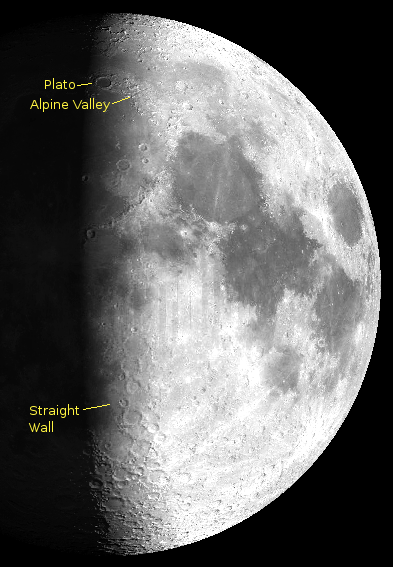
First quarter moon April 18, 2013 Created using Virtual Moon Atlas
09/28/2012 – Ephemeris – Harvest moon tomorrow
Ephemeris for Friday, September 28th. The sun will rise at 7:37. It’ll be up for 11 hours and 50 minutes, setting at 7:27. The moon, 1 day before full, will set at 7:10 tomorrow morning.
Tomorrow is the Harvest Moon, the nearest full moon to the autumnal equinox. Here the path of the moon in the sky against the stars is shallow causing the moon to rise only a little later each night. Back before electricity was available to farms this gave extra time for farmers to gather in their crops each day. This effect lasts for a bit less than a week both before and after the full moon. We astronomers aren’t big fans of the effect because the sky stays bright longer and masks the faint things they want to see. Not all astronomers are bummed by bright moonlight. There’s plenty to study when the moon is out: planets and reasonably bright stars. It’s just that the fainter objects are lost.
Times are for the Traverse City/Interlochen area of Michigan. They may be different for your location.
Addendum
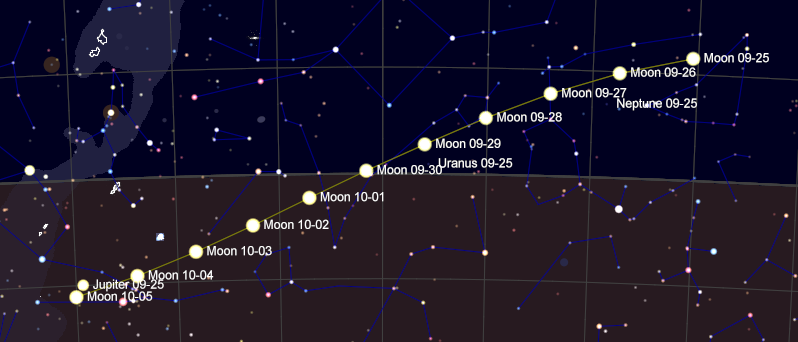
Shallow path of the moon for 11 nights centered on the Harvest Moon in 2012. Created using Cartes duCiel (Sky Charts).
Click on the image to enlarge.
 Bob Moler's Ephemeris Blog