Archive
07/02/2013 – Ephemeris – Lyra the harp in Greek mythology
Ephemeris for Tuesday, July 2nd. Today the sun will be up for 15 hours and 29 minutes, setting at 9:31. The moon, 2 days past last quarter, will rise at 2:45 tomorrow morning. Tomorrow the sun will rise at 6:02.
High in the east at 11 p.m. can be found a bright star just above a small, narrow, but very distinctive parallelogram of stars. They are the stars of the constellation Lyra the harp. The bright star is Vega the 5th brightest night-time star. To the Romans the star Vega represented a falling eagle or vulture. Apparently they never made the distinction between the two. It is a pure white star and serves as a calibration star for color and brightness. The harp, according to Greek mythology, was invented by the god Hermes. The form of the harp in the sky, is as he had invented it: by stretching strings across a tortoise-shell. Hermes gave it to his half-brother Apollo, who in turn gave it to the great musician Orpheus.
Times are for the Traverse City/Interlochen area of Michigan. They may be different for your location.
Addendum
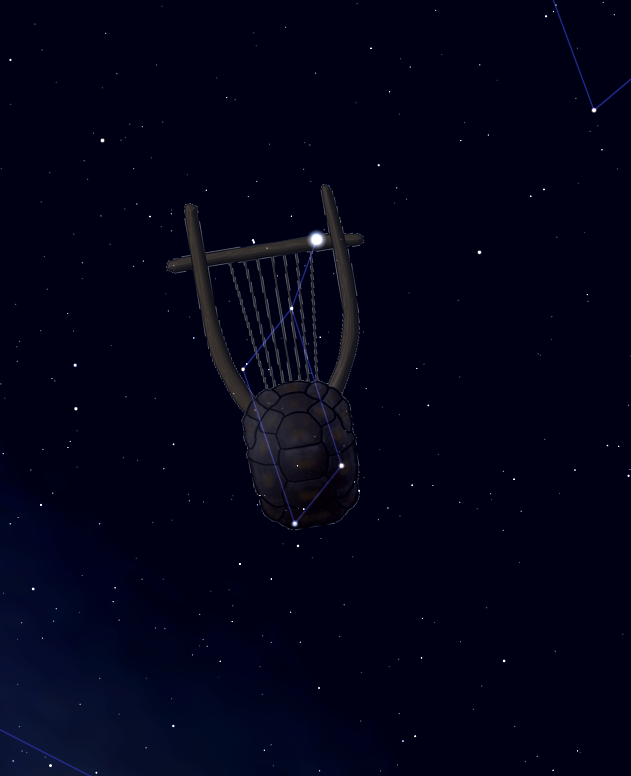
Lyra as a tortoise-shell harp. Created using Stellarium and free clip art.
Annotated Lyra:
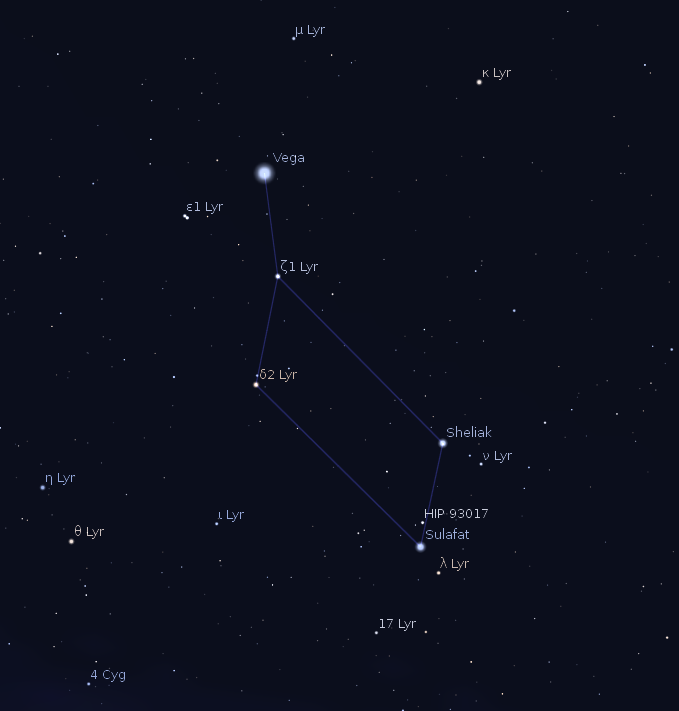
Magnified view of Lyra. Created using Stellarium.
03/21/2013 – Ephemeris – Where did Comet PanSTARRS come from?
Ephemeris for Thursday, March 21st. The sun will rise at 7:43. It’ll be up for 12 hours and 13 minutes, setting at 7:56. The moon, 2 days past first quarter, will set at 4:52 tomorrow morning.
Comet PanSTARRS is heading away from both the sun and the earth. It heading northward. Its orbit is inclined nearly 90 degrees away from the plane of the earth’s orbit. PanSTARRS will recede far past Neptune or the Kuiper Belt of objects that include the dwarf planet Pluto into the Oort cloud of cometary objects that extend out to a light year or 6 trillion miles from the sun. This cloud was named after Dutch astronomer Jan Oort. The comet may be ejected from the solar system. It’s orbit is currently calculated to be slightly hyperbolic. If that holds up, it will drift among the stars. It is thought that occasionally, in millions of years a star comes close or through the Oort cloud and scatters them.
Times are for the Traverse City/Interlochen area of Michigan. They may be different for your location.
Addendum
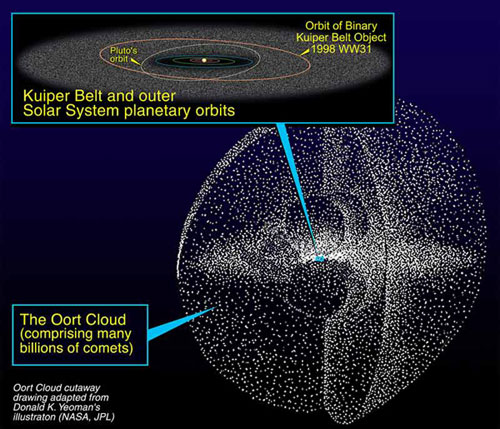
Artist’s impression of the Oort Cloud. (NASA/JPL). Hat Tip: Universe Today.
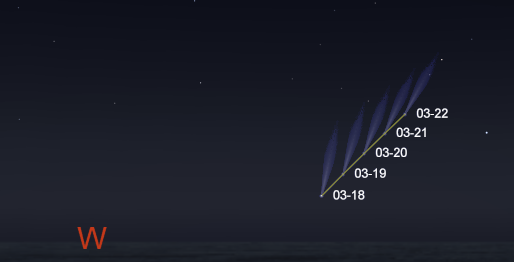
Comet PanSTARRS in the next 5 days at 9:15 p.m. Created using Stellarium and Cartes du Ciel.
02/08/2013 – Ephemeris – Mercury will appear near Mars tonight.
Ephemeris for Friday, February 8th. The sun will rise at 7:52. It’ll be up for 10 hours and 9 minutes, setting at 6:01. The moon, 2 days before new, will rise at 7:01 tomorrow morning.
This evening after sunset Mercury and Mars will appear together, less the moon width’s apart. It will take a very low horizon to the southwest and pristine skies to spot these two. They should start to be visible in binoculars starting about 6:30. Both Mars and Mercury are on the far side of the sun. Mars is heading around behind the sun. It will be in conjunction with the sun on April 17th. For several weeks around that time the sun’s radio noise will interfere with communications with the Curiosity rover and the martian satellites that relay its signals, so it will remain motionless gathering weather and other data it can do in a static mode. Mercury will continue to move away from the sun from our point of view until the 16th of this month.
Times are for the Traverse City/Interlochen area of Michigan. They may be different for your location.
Addendum
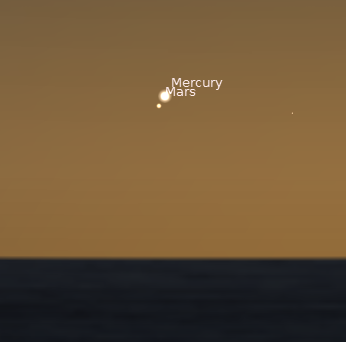
Mercury passing Mars at 6:45 p.m. on February 8, 2013. Created using Stellarium.
12/03/2012 – Ephemeris – Orion rising
Ephemeris for Monday, December 3rd. The sun will rise at 8:01. It’ll be up for 9 hours and 1 minute, setting at 5:02. The moon, 3 days before last quarter, will rise at 9:56 this evening.
Off in the southeast at 9 in the evening the great constellation of Orion will be seen now. This is the most famous of all constellations world wide. We think the Big Dipper is a big deal. It’s not even a constellation, being the hind end of the great bear Ursa Major. However it’s invisible if one travels far enough south of the equator. Orion is now a rectangle of stars tilted to the left as he rises. With three stars in a straight line in the center. They are aligned nearly vertically. Orion is a giant hunter. The rectangle depict his shoulders and knees. Among its other bright stars Orion contains two of the brightest. The upper left star is the famous red giant star Betelgeuse. The lower left star is the blue=white super giant Rigel.
Times are for the Traverse City/Interlochen area of Michigan. They may be different for your location.
Addendum
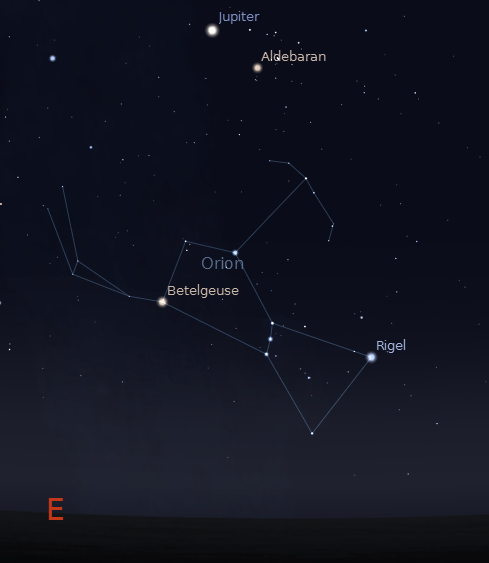
Orion rising at 9 p.m. December 3, 2012. Created using Stellarium.
10/26/2012 – Ephemeris – The planet next door
Ephemeris for Friday, October 26th. The sun will rise at 8:12. It’ll be up for 10 hours and 26 minutes, setting at 6:39. The moon, 3 days before full, will set at 6:05 tomorrow morning.Last week some astronomers announced the discovery of a planet in the star system next door. Rigel Kentaurus, better known for some reason as Alpha Centauri, only 4.3 light years away, 25 trillion miles, if your odometer goes that high, is the closest star system to the solar system. I say star system, because it contains 3 stars. Star A is much like the sun, star B, somewhat larger and dimmer is orange in color. These two orbit each other at distances the range from Saturn’s distance from the sun to Pluto’s in about 80 years. The third star is a distant red dwarf, slightly closer to us than the other two and named Proxima Centauri. The new planet discovered is in essence hugging star B. Its designation is Alpha Centauri Capital B lower case b (Bb).
Times are for the Traverse City/Interlochen area of Michigan. They may be different for your location.
Addendum
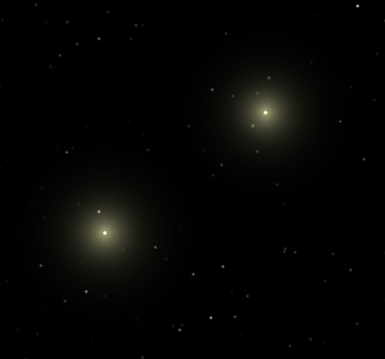
Alpha Centauri A and B. Created using Celestia.
Celestia doesn’t do Alpha Centauri justice. The A star, to the lower left, is about 1.5 times brighter than the sun. The B star is half the sun’s brightness. I wonder how far a planet could be from either star without being in an orbit that would be unstable and be ejected from the system.
10/11/2012 – Ephemeris – North American Nebula
Ephemeris for Thursday, October 11th. The sun will rise at 7:53. It’ll be up for 11 hours and 10 minutes, setting at 7:04. The moon, 3 days past last quarter, will rise at 4:30 tomorrow morning.
Most of what we see in the Milky Way are just masses of stars, but there are bright clouds of gas , or to name them properly: emission nebulae. These bright clouds are areas of star formation. It is the ultraviolet light from young massive stars that light up the clouds they were formed from. A bright one, easily visible in binoculars is just about overhead at 9 p.m. Called the North American Nebula, a glow shaped much like our continent just east of the star Deneb, the northernmost star of the Summer Triangle, and brightest star in Cygnus the swan or Northern Cross. There are many other nebulae in the Milky Way, visible in binoculars and small telescopes. Many enjoyable hours can be spent sweeping the Milky Way for nebulae and star clusters.
Times are for the Traverse City/Interlochen area of Michigan. They may be different for your location.
Addendum
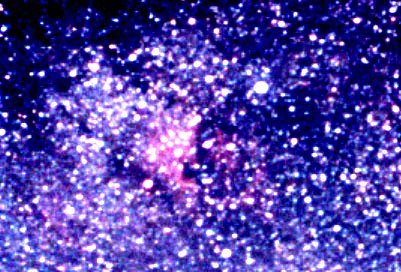
North American Nebula in Red. My old image.
The red object is the North American Nebula. Our eyes cannot perceive the color, due to hydrogen. This was a time exposure on film without telephoto. The bright star to the upper right is Deneb. The orientation is approximately correct if facing south. The photo also shows the stars that make up the glow of the Milky Way to the unaided eye.
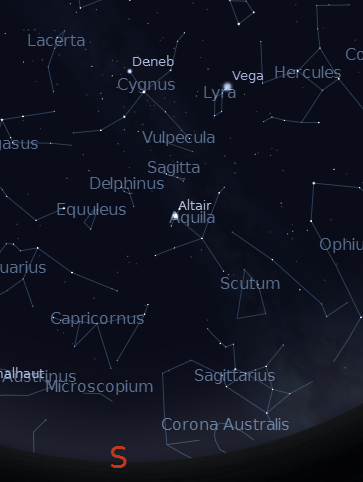
Deneb Overhead at 9 p.m. on October 11. Created using Stellarium.
The North American Nebula is about the size and position of the C in Cygnus.
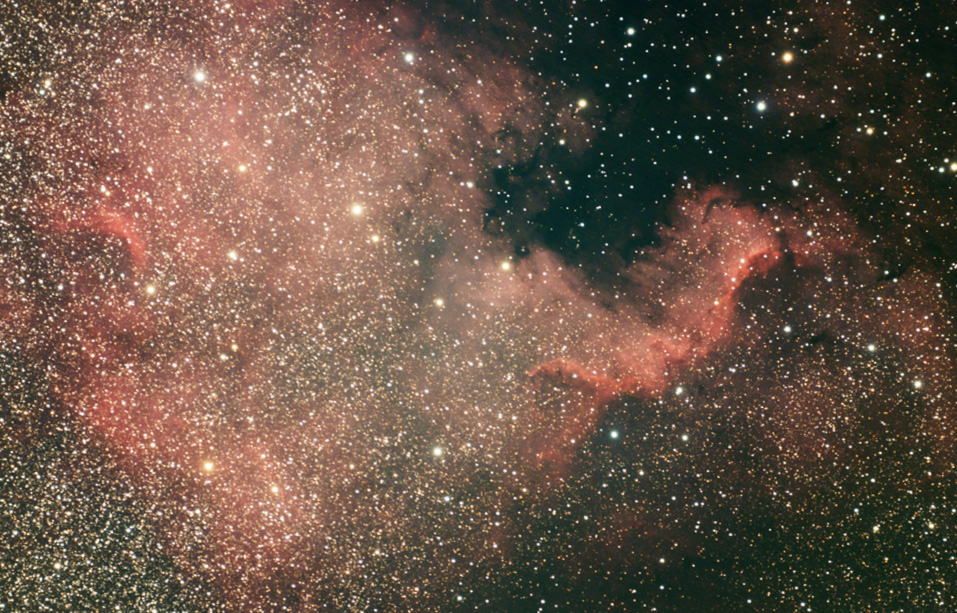
Better view of the North American Nebula taken by Scott Anttila.
This nebula is cataloged as NGC 7000.
Solar flare might give us an aurora Friday night to Saturday morning
A huge x-ray flare occurred in the huge sunspot group (AR 1520) now on the sun. We might be affected by about 2:20 a.m. EDT Saturday the 14th, give or take 7 hours. So check the skies Friday night. Go to spaceweather.com for more information.
07/02/2012 – Ephemeris – The KELT North Telescope
Ephemeris for Monday, July 2nd. Today the sun will be up for 15 hours and 28 minutes, setting at 9:30. The moon, 1 day before full, will set at 5:56 tomorrow morning. Tomorrow the sun will rise at 6:02. | Where astronomical telescopes are concerned the general rule is the bigger the better. By bigger I mean wider. The larger diameter of a telescope allows it to gather more light and resolve finer detail. These monsters have grown to be 10 meters in diameter with even larger ones in the planning stage. At the other end is the KELT North Telescope, one of a pair of telescopes stationed north and south of the equator. They use an 80 millimeter diameter telephoto lens to scan the sky in big chunks looking for exoplanets by the transit method, detecting the dimming of light of stars by an intervening planet, like our transit of Venus last month. The KELT North Telescope has found two of them so far.
Times are for the Traverse City/Interlochen area of Michigan. They may be different for your location.
There’s an auroral glow in the north at 10:41 p.m. April 23, 2012
I’m near 45 degrees north latitude. spaceweather.com issued an email earlier in the evening that there was a minor geomagnetic storm in progress, and that there will be a possibility of an aurora. Yes there is a glow in the north that needs checking over this evening for possible outbursts.
04/12/2012 – Ephemeris – The constellation Virgo the virgin
Ephemeris for Thursday, April 12th. The sun will rise at 7:02. It’ll be up for 13 hours and 21 minutes, setting at 8:24. The moon, 1 day before last quarter, will rise at 3:02 tomorrow morning.
Tonight in the sky: to the left of the constellation of Leo the lion, which lies in the south at 10 p.m. is the next constellation of the zodiac: Virgo the virgin, seen in the south southeast. Virgo is a large constellation of a reclining woman holding a stalk of wheat. The bright star in the center of the constellation, Spica, is the head of that spike of wheat; and as such ruled over the harvest in two of Virgo’s guises as the goddesses Persephone and Ceres. The planet Saturn is also in Virgo this year to the left of Spica. Virgo is also identified as Astraea the goddess of justice. The constellation of Libra, the scales, is found just east of her a couple of hours later, not yet risen at 10 p.m. Early Christians saw Virgo as the Virgin Mary.
* Times are for the Traverse City/Interlochen area of Michigan. They may be different for your location.
Addendum
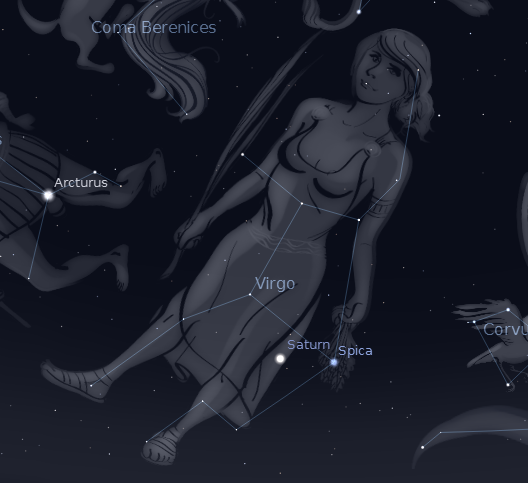
Virgo 2012. Created using Stellarium.
 Bob Moler's Ephemeris Blog