Archive
Ephemeris: 01/10/2025 – Venus’ split personality
This is Ephemeris for Friday, January 10th. Today the Sun will be up for 9 hours and 4 minutes, setting at 5:22, and it will rise tomorrow at 8:18. The Moon, 3 days before full, will set at 6:40 tomorrow morning.
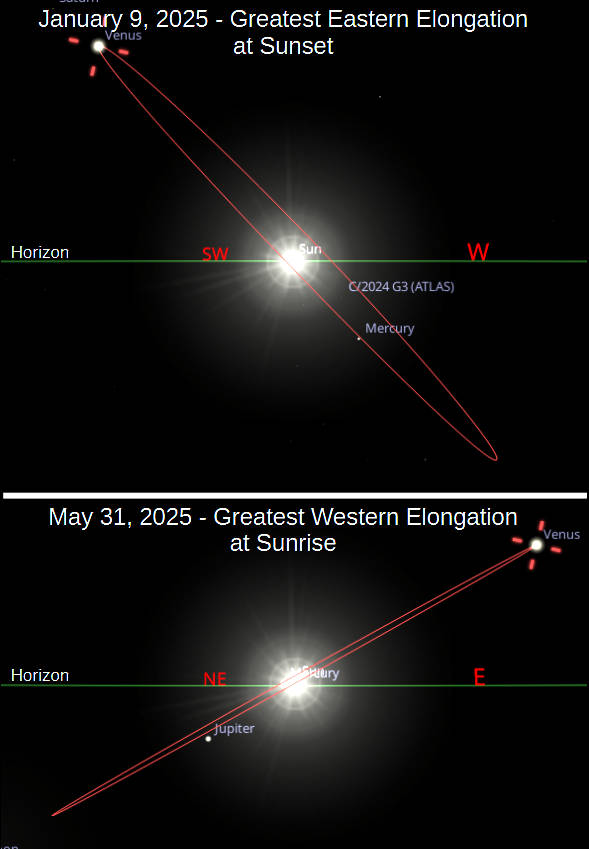
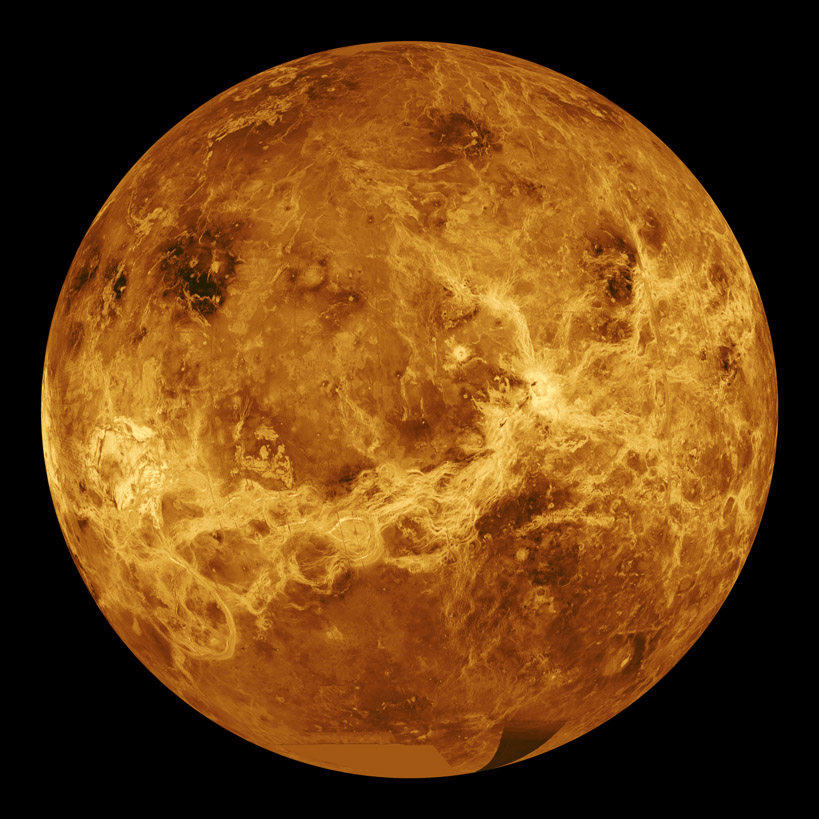
In very ancient times the Greeks thought that Venus in the evening as we see it now and Venus in the morning sky were two separate planets. The evening appearance was Aphrodite the goddess of love, and in the morning sky it was Phosphorus, the bringer of light, that being dawn. In Roman times Aphrodite became Venus and Phosphorus became Lucifer. It is interesting that Venus and Aphrodite are female while Phosphorus and Lucifer are male. Another term for Venus which I even use colloquially, is Evening Star for its current location and Morning Star in the morning sky, even though it’s a planet not a star. Venus is a beautiful planet in our sky, but a hellish planet in reality. No wonder Elon Musk would rather go to Mars than the much closer Venus.
The astronomical event times given are for the Traverse City/Interlochen area of Michigan (EST, UT – 5 hours). Times will be different for other locations.
Addendum
06/06/2023 – Ephemeris – Venus: sister planet or evil twin?
This is Ephemeris for Tuesday, June 6th. Today the Sun will be up for 15 hours and 26 minutes, setting at 9:25, and it will rise tomorrow at 5:57. The Moon, 3 days past full, will rise at 12:39 tomorrow morning.
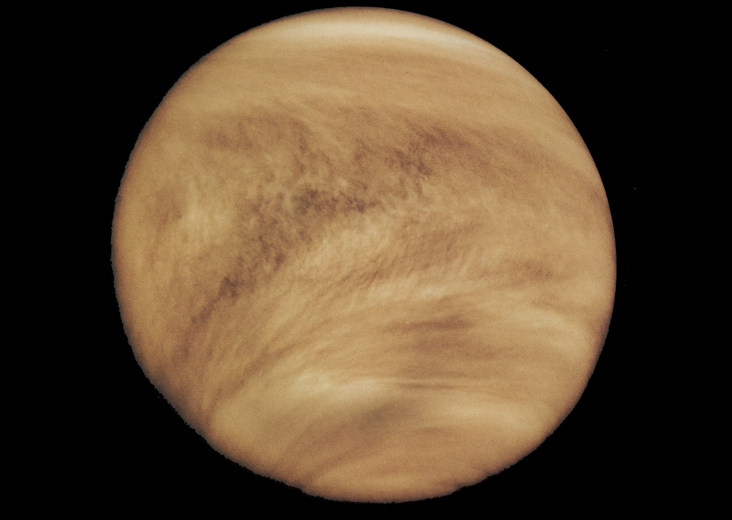
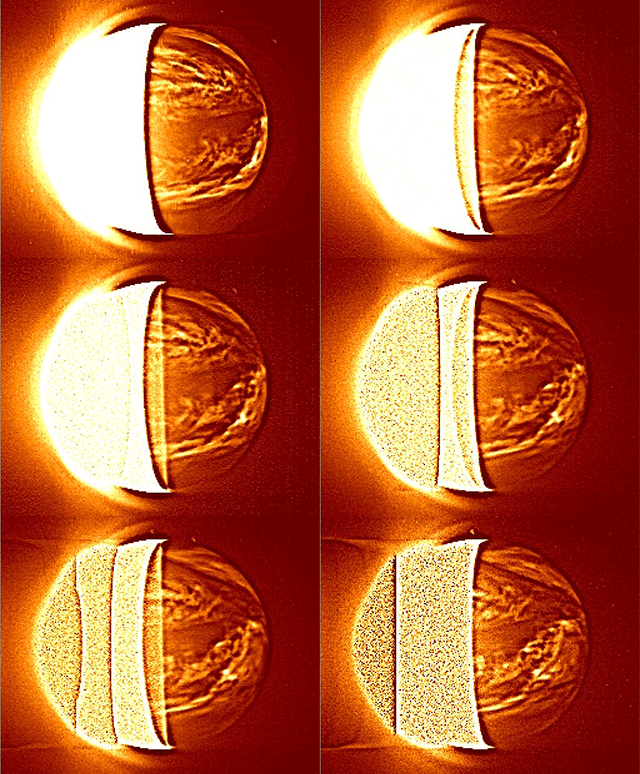
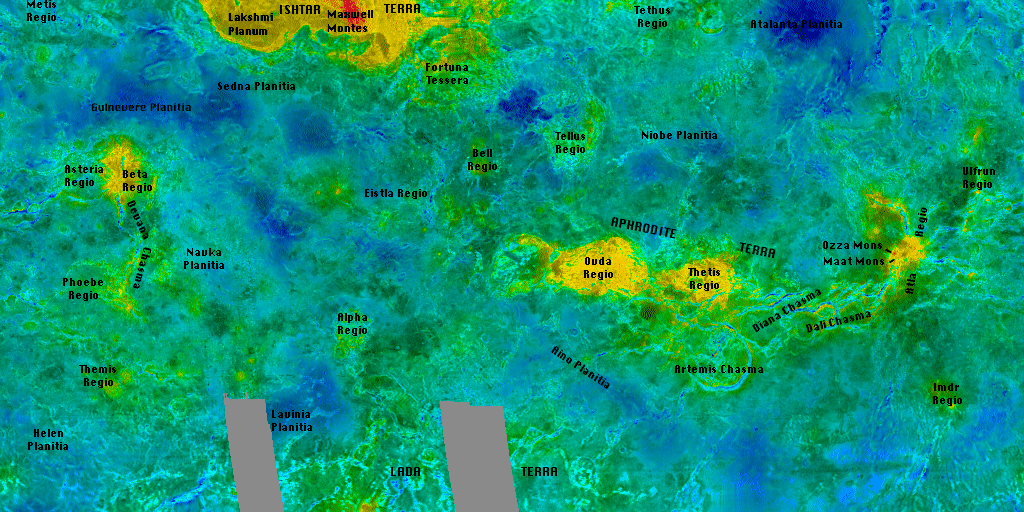
Venus has been called Earth’s sister planet, because it is nearly the same size as the Earth, only 5% smaller. It has also been called Earth’s evil twin. That was suspected as far back as 1962 when NASA’s Mariner 2 spacecraft flew past the planet and observed the planet in the infrared and microwaves. It found that though the cloud tops were relatively cool, the surface was extremely hot, averaging 867 ° Fahrenheit (464° Celsius). Venus cloud tops are featureless visually, but do show variation in the infrared and ultraviolet. Radar observations from Arecibo, and spacecraft have penetrated the clouds, showing a bleak landscape of volcanoes and lava flows. After many tries the Soviet Union successfully landed probes on it.
The astronomical event times given are for the Traverse City/Interlochen area of Michigan (EDT, UT –4 hours). They may be different for your location.
Addendum
05/26/2023 – Ephemeris – Sun & Star Party tomorrow at the Sleeping Bear Dunes National Lakeshore
This is Bob Moler with Ephemeris for Friday, May 26th. Today the Sun will be up for 15 hours and 11 minutes, setting at 9:15, and it will rise tomorrow at 6:03. The Moon, 1 day before first quarter, will set at 2:48 tomorrow morning.
Tomorrow, the Sleeping Bear Dunes National Lakeshore and the Grand Traverse Astronomical Society will host a Sun and Star Party at the Dune Climb area of the park. There will be a solar viewing period from 5 pm to about 7 pm. The society has two hydrogen alpha solar telescopes to view the Sun’s chromosphere and prominences. Plus, some members also have solar scopes and white light filtered telescopes to view sunspots on the face of the Sun. Night viewing will start at 9 pm, with the Moon and Venus featured, along with the brighter telescopic wonders of late spring. There will be a pass of the International Space Station from 10:11 to 10:18 pm. The rangers will have an alternate program if it’s cloudy.
The astronomical event times given are for the Traverse City/Interlochen area of Michigan (EDT, UT –4 hours). They may be different for your location.
Addendum
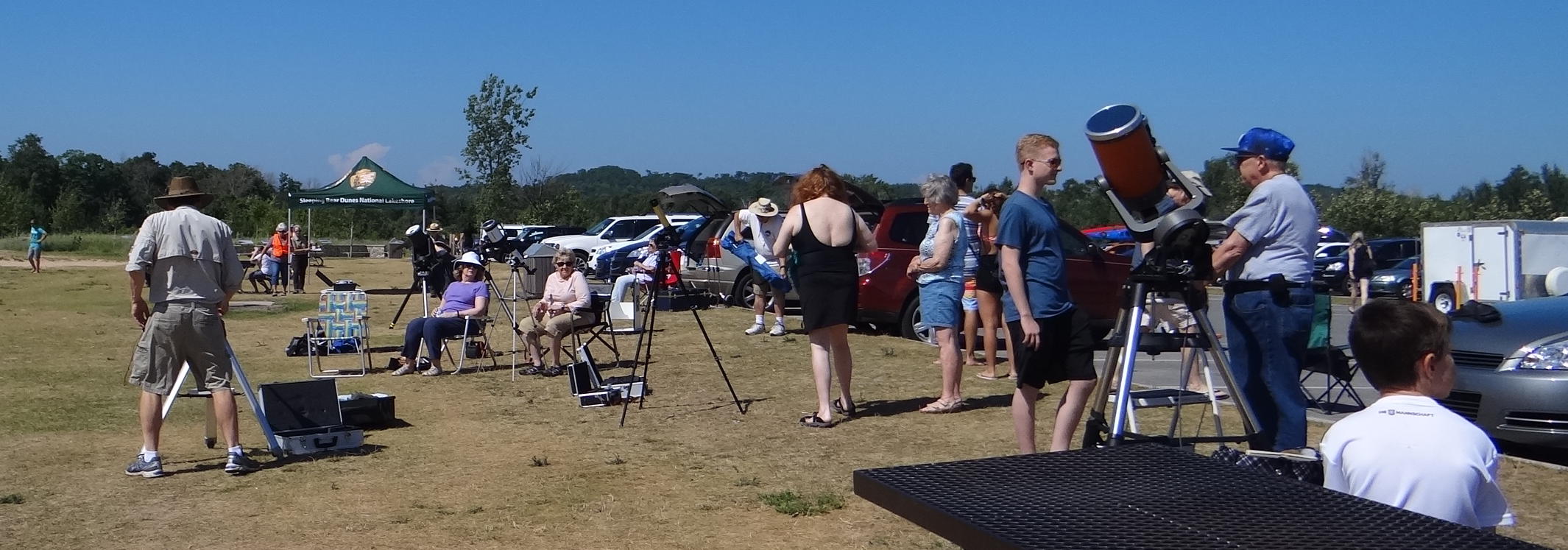
A Sun Party at the Dune Climb. Credit: Eileen Carlisle.
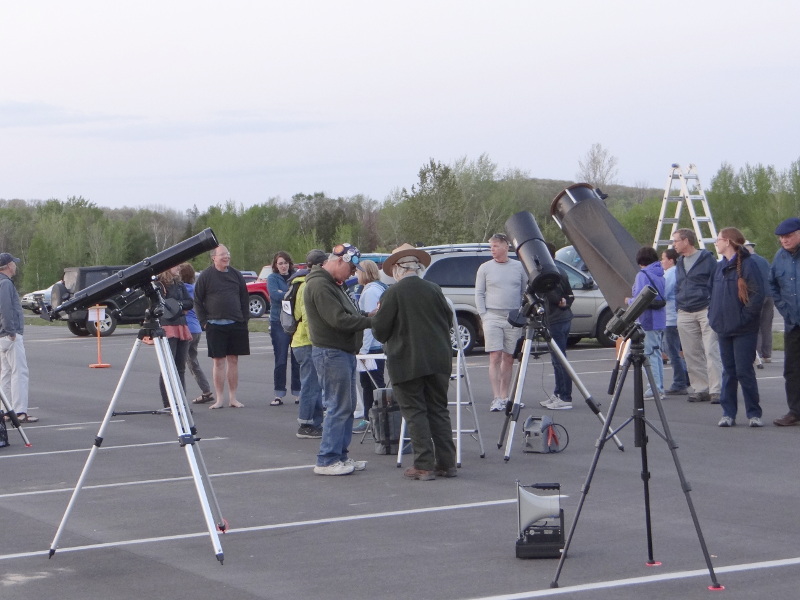
Preparing to start the May star party, several years ago at the Dune Climb. A few of the telescopes are visible, including the GTAS 25″ “Emmettron” telescope at the far right background. Credit: Eileen Carlisle.
01/14/2022 – Ephemeris – Mayan civilization and the planet Venus
This is Ephemeris for Friday, January 14th. Today the Sun will be up for 9 hours and 10 minutes, setting at 5:27, and it will rise tomorrow at 8:16. The Moon, 3 days before full, will set at 6:47 tomorrow morning.
The Mayan people of pre-Columbian Central America were diligent observers of the planet Venus. One of their few surviving records is the Dresden Codex. It counts through a long series of Venus’ 584 day cycles. The location of the Mayan cities are a lot closer to the equator than we are, so when Venus disappears as it moves between the Earth and the Sun as it did last weekend, it only disappeared for 8 days. For us, at our latitude, it can be a few days longer. So we should spot it on clear mornings next week in the southeast by 7:15 to 7:30 am. It will appear as a thin crescent in telescopes or even binoculars. Venus will stay in the morning sky until later this year, which will set it up to be a spectacular evening star next year.
The astronomical event times given are for the Traverse City/Interlochen area of Michigan (EST, UT – 5 hours). They may be different for your location.
Addendum
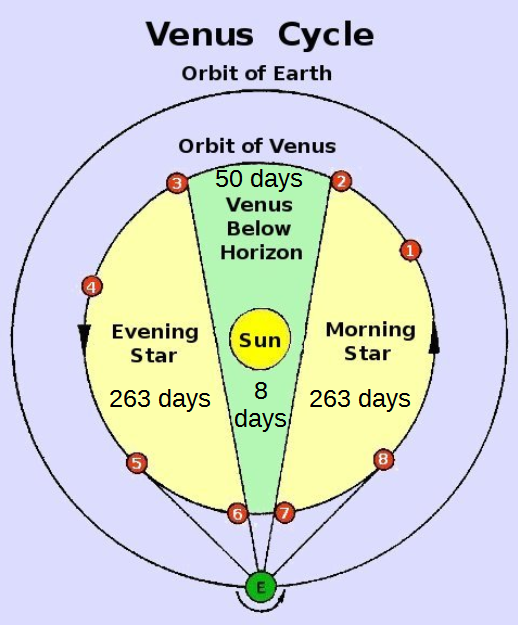
Venus Cycle derived from John P Pratt who had another purpose for the diagram and annotated to include the day number of days in each phase. For my purposes, ignore points 1 and 4. The Mayan cycle starts with 7, the first appearance of Venus during the morning. Points 8 and 5 are the points where Venus is at greatest elongation from the Sun. Credit John P Pratt.

Pages of the Dresden Codex, produced by the Maya tracking Venus’ appearances in the skies over the Yucatán, for 104 years. The Dresden Codex is one of only 4 surviving Mayan Codices.
01/10/2022 – Ephemeris – Venus starts a new cycle in the morning sky
This is Ephemeris for Monday, January 10th. Today the Sun will be up for 9 hours and 3 minutes, setting at 5:22, and it will rise tomorrow at 8:18. The Moon, 1 day past first quarter, will set at 2:36 tomorrow morning.
Two days ago, Venus passed between the Earth and the Sun in an event called an inferior conjunction. Inferior has nothing to due to quality, but denotes the fact that Venus is passing between the Earth and the Sun. The other Venus conjunction is the superior conjunction when Venus passes the Sun on the far side. We should be able to spot Venus rather suddenly in the late 7 to 8 am hour in a few days. Its appearance seems sudden and is sometimes reported as a UFO. It sometimes surprises airport control tower officials, because it may look like an airplane coming in with its landing lights on. But it never lands. In its morning appearance, Venus is sometimes called the Morning Star or Lucifer.
The astronomical event times given are for the Traverse City/Interlochen area of Michigan (EST, UT – 5 hours). They may be different for your location.
Addendum
The Mayans of pre-Columbian Central America were meticulous observers of Venus, as is seen in one of their surviving books, the Dresden Codex. A Venus Cycle lasts 584 days, from first appearance in the morning sky, its heliacal rising, through its morning appearance, disappearance behind the Sun, through its evening appearance and disappearance on front of the Sun to the next heliacal rising. Astronomers call that it’s synodic period. Five Synodic periods equal almost exactly 8 years.
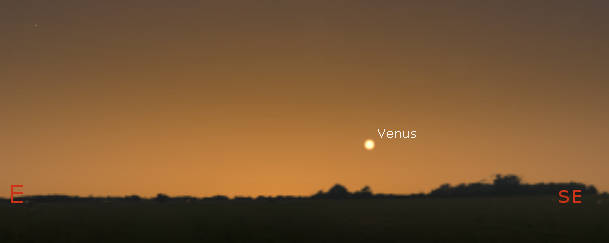
Venus, 9 days after Inferior conjunction, next Monday morning. Venus will be just under 5 degrees above an unobstructed horizon at 7:30 am in northwest lower Michigan. Created using Stellarium.
11/08/2021 – Ephemeris – The next two months will be prime time to view Venus in a telescope
This is Bob Moler with Ephemeris for Monday, November 8th. Today the Sun will be up for 9 hours and 51 minutes, setting at 5:21, and it will rise tomorrow at 7:32. The Moon, 3 days before first quarter, will set at 8:37 this evening.
Venus is beginning to look like the crescent Moon in telescopes. Right now it’s a very fat crescent. The reason is that since its greatest separation from the Sun a bit more than a week ago, Venus’ sunlit side is more and more turned away from us as it starts to move between the Earth and Sun. Venus is also rapidly approaching us now and is 54.9 million miles (88.3 million kilometers) away. A month from now it will appear larger than Jupiter, so Venus’ thinning crescent might be glimpsed in binoculars. Venus’ size will grow and crescent will get even thinner until it passes between the Earth and Sun, which will occur January 8th next year. That’s called inferior conjunction with the Sun. From our vantage point, it will pass just north of the Sun, and a week or so later will be seen in the morning sky.
The astronomical event times given are for the Traverse City/Interlochen area of Michigan (EST, UT – 5 hours). They may be different for your location.
Addendum
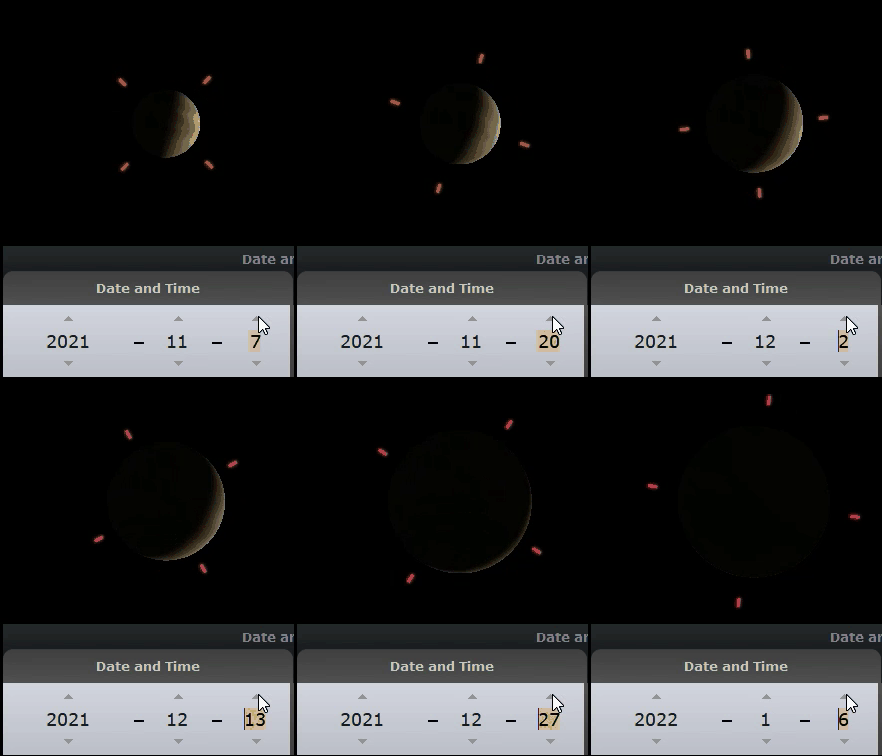
Animated GIF of Venus’ last 2 months in the evening sky, November 8, 2021, to January 8, 2022. After mid-December the crescent is too thin to show in the program, but can actually be seen. I’ve spotted Venus as close as 4 days before inferior conjunction. Created using Stellarium and Filmora.
10/29/2021 – Ephemeris – Venus is at its greatest separation east from the Sun today
This is Ephemeris for Friday, October 29th. Today the Sun will be up for 10 hours and 18 minutes, setting at 6:35, and it will rise tomorrow at 8:18. The Moon, 1 day past last quarter, will rise at 1:39 tomorrow morning.
Tonight, Venus will be at its greatest separation east of the Sun of 47 angular degrees. Having an orbit inside the Earth’s orbit, Venus never strays more than a 47-degree angle from the Sun. It has been moving away from around behind the Sun to its present position since March 26th. That’s 217 days. And now it will take only 72 days to head back to pass between the Earth and the Sun in inferior conjunction and leave the evening sky on January 9th. For this next 70 or so days, Venus will look great in telescopes. It will get larger as it approaches us and become a dazzling crescent in telescopes. Toward the latter half of December, the tiny crescent can even be made out in binoculars. It is the very best time to view Venus in a telescope.
The astronomical event times given are for the Traverse City/Interlochen area of Michigan (EDT, UT – 4 hours). They may be different for your location.
Addendum
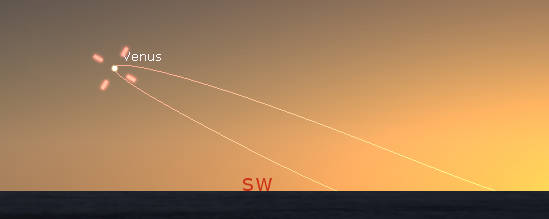
Venus at greatest elongation, seen at 7 pm tonight, October 29, 2021. Note how shallow the orbit is compared with Mercury’s orbit was on Monday’s (10/25/2021) post of Mercury’s greatest western elongation as seen in the morning. Created using Stellarium.
06/21/2021 – Ephemeris – A quick look at three of the naked-eye planets
This is Ephemeris for Monday, June 21st. Today the Sun will be up for 15 hours and 34 minutes, setting at 9:32, and it will rise tomorrow at 5:57. The Moon, 3 days before full, will set at 4:02 tomorrow morning.
I have a couple of pieces of planetary news. Venus will pass south of the star Pollux in Gemini tonight. That means in their current orientation, low on the west-northwestern horizon, that Pollux will appear above and right of the much brighter Venus. This may be visible by 10:30 pm. Venus will set tonight at 11:07. You’ll need a really low western horizon to see it. In the morning sky, Saturn is backtracking to the west slowly, and now Jupiter has stopped its eastward motion and is stationary today and will start its retrograde or westward motion. Both retrograde motions are caused by the Earth, which is in the process of passing these planets. We will pass Saturn August 2nd, and pass Jupiter August 19th. We call these events, oppositions.
The astronomical event times given are for the Traverse City/Interlochen area of Michigan (EDT, UT – 4hr). They may be different for your location.
Addendum
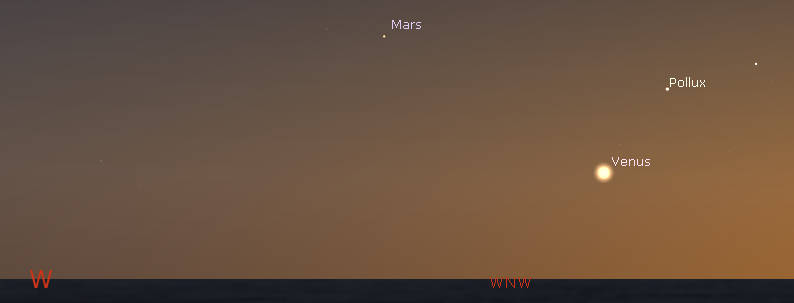
Venus, Pollux and Mars in the evening twilight tonight at 10:30 pm. Venus and Pollux in evening twilight. Venus will be about 5 degrees above the sea or lake horizon at that time. Venus and Mars will cross their apparent paths and be in conjunction on July 13th. Click on the image to enlarge. Created using Stellarium.
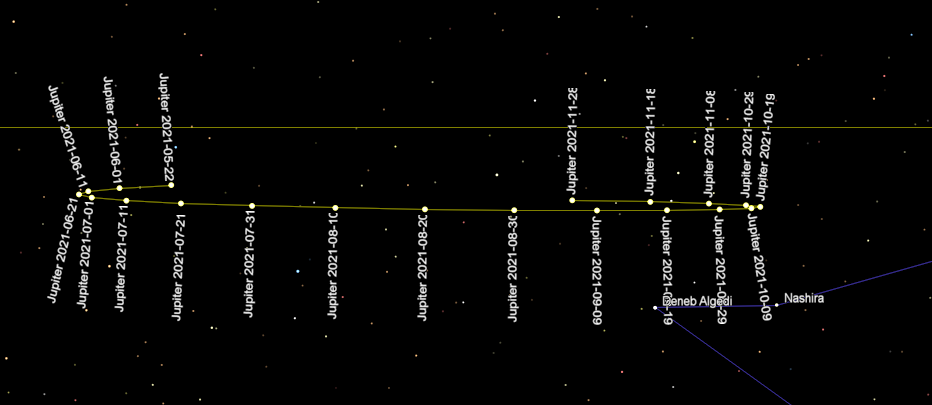
Jupiter’s retrograde path, June 21, to October 20, 2021. The constellation lines in the lower right are for the eastern end of Capricornus. We pass Jupiter, officially called opposition from the Sun, on August 20th. The solid yellow line above Jupiter’s apparent path is the Ecliptic, the Sun’s apparent path in the sky. Click on the image to enlarge. Created using Cartes du Ciel (Sky Charts).
03/26/2021 – Ephemeris – Venus passes beyond the Sun this morning
This is Ephemeris for Friday, March 26th. Today the Sun will be up for 12 hours and 29 minutes, setting at 8:03, and it will rise tomorrow at 7:32. The Moon, 2 days before full, will set at 7:24 tomorrow morning.
Early this morning the planet Venus was in conjunction with the Sun. It was a superior conjunction, meaning it was out beyond the Sun. When Venus ducks between the Earth and the Sun it’s called an inferior conjunction. Here the words superior and inferior do not have their normal meanings. Inferior means inside and superior means outside. Indeed, I find inferior conjunctions far superior to superior conjunctions. For the inferior conjunction, Venus is close to us, so it appears big, bigger than Jupiter in telescopes. It only disappears in the glare of the Sun for 8 days or so. Around superior conjunctions Venus is tiny, and it disappears in the glare of the Sun for 50 or more days. Rare inferior conjunctions will see Venus cross or transit the face of the Sun.
The astronomical event times given are for the Traverse City/Interlochen area of Michigan. They may be different for your location.
Addendum
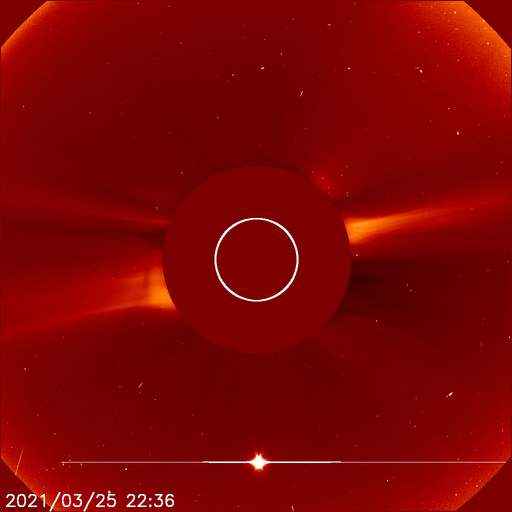
Solar and Heliospheric Observatory (SOHO) LASCO C2 coronagraph image of the Sun and Venus below and beyond the Sun. The white circle shows the size of the photosphere of the Sun.
12/11/2020 – Ephemeris Extra – Venus will hide behind the Moon for W US, Canada and N Pacific Tomorrow
Tomorrow Saturday, December 12, 2020 Venus will be occulted, or covered, by the thin crescent Moon for the area bounded in the map below. The southern boundary is a thin red line denoting that the event will take place in daylight. For safety sake observe the event from the shadow of a building open to the sky west of the Sun to not inadvertently point binoculars or telescope toward the Sun and cause permanent damage to your eyes. Venus is visible in the daytime. A program like Stellarium will help in locating Venus and determination of the time of the event for your location. Also, for Stellarium, in the configuration window’s Tool tab make sure “Topocentric coordinates” is checked.
The event will NOT be visible from Michigan.
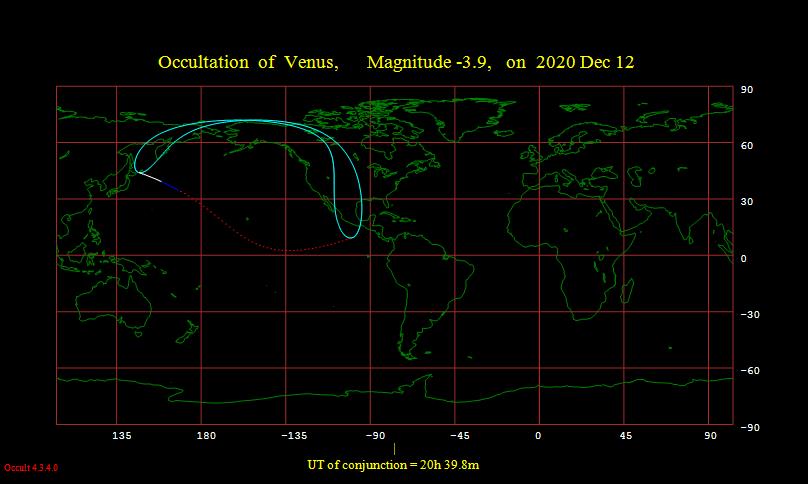
Occultation of Venus World map 12/12/2020. The occultation will be visible within the bounded area. For the area that looks like a lazy figure 8 the occultation will start (on the left) or end as Venus and the Moon rises or sets. For most areas within the bounded area the occultation is a daytime event. Credit Occult4.
 Bob Moler's Ephemeris Blog