Archive
04/27/2018 – Ephemeris – The Mayan special relationship to Venus
Ephemeris for Arbor Day, Friday, April 27th. The Sun rises at 6:38. It’ll be up for 14 hours and 4 minutes, setting at 8:42. The Moon, 2 days before full, will set at 6:20 tomorrow morning.
The Mayans of Mesoamerica a thousand years ago diligently observed Venus and discovered Venus’ unique cycles that they used to correct their calendars. The first was the Venus Cycle, the period we’d say that Venus passes between the Earth and the Sun to enter the morning sky to the next time it does it. That was 584 days. Its appearance in the morning sky would last 263 days, Then it would disappear near the Sun, actually behind it for 50 days. It would reappear in the evening sky for another 263 days before again disappearing near the Sun, this time for only 8 days. These are the 4 phases of a Venus cycle. Five of these cycles equals almost exactly 8 years, called a sequence. 13 sequences equal 104 years, a Venus Round.
The times given are for the Traverse City/Interlochen area of Michigan. They may be different for your location.
Addendum
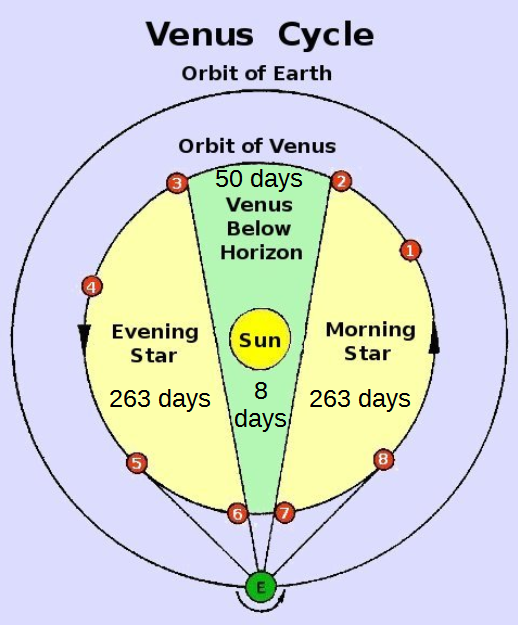
Venus Cycle derived from John P Pratt who has another purpose for the diagram and annotated by me to include the number of days in each phase. For my purposes ignore points 1 and 4. The Mayan cycle starts with 7, the first appearance of Venus during the morning. Points 8 and 5 are the points where Venus is at greatest elongation from the Sun. Credit John P Pratt.
04/26/2018 – Ephemeris – When the Greeks thought Venus was two separate planets
Ephemeris for Thursday, April 26th. The Sun rises at 6:40. It’ll be up for 14 hours and 1 minute, setting at 8:41. The Moon, 3 days before full, will set at 5:52 tomorrow morning.
For the next three programs I’m going to take a look at Venus through the eyes of the ancient, or pre-telescopic cultures. It’s a teaser for the program I’m presenting at the NMC Observatory May 4th. Venus from the mists of time to today. We call Venus’ appearance in the morning the Morning Star and its evening appearance, the Evening Star. The very ancient Greeks thought they were two separate planets. The morning planet was Phosphorus, and the evening planet was Hesperus. Somewhere around the 4th or 3rd century BC someone figured the when Hesperus was out in the evening Phosphorus was not out the next morning, and vice versa. The then single planet was named Aphrodite, by whose Roman name, Venus, we still call it by today.
The times given are for the Traverse City/Interlochen area of Michigan. They may be different for your location.
Addendum
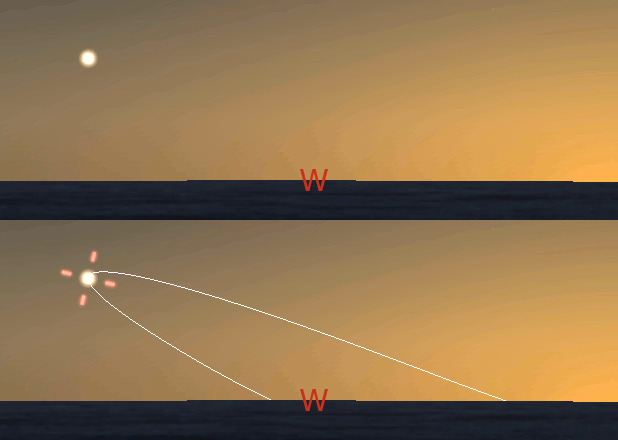
Venus (Hesperus) at its evening eastern greatest elongation on August 18, 2018 showing the part of its orbit that’s above the horizon. Created using Stellarium and GIMP.
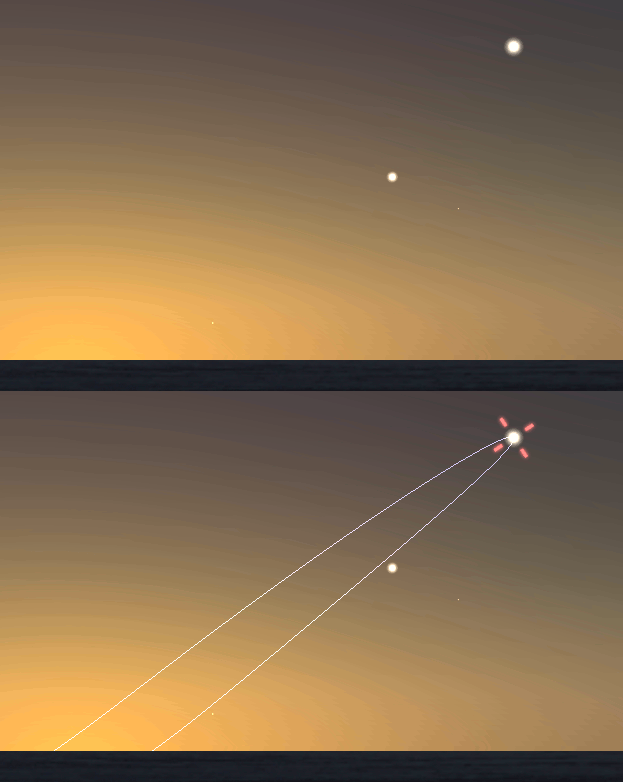
Venus (Phosphorus) at its morning western greatest elongation on January 6, 2019 showing the part of its orbit that’s above the horizon. Jupiter is the other planet visible. Created using Stellarium and GIMP.
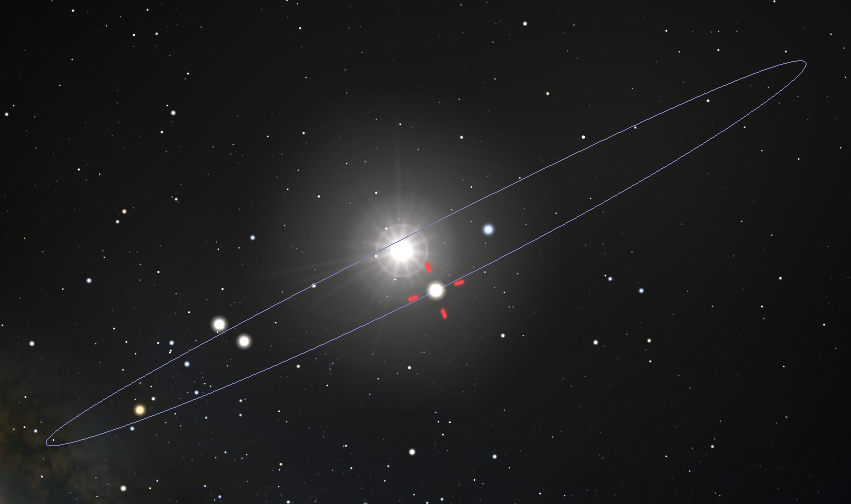
Venus at inferior conjunction on October 27, 2018 showing its entire orbit on a smaller scale than the images above from the Earth’s perspective. The far part of the orbit goes behind the Sun. The planets Mercury and Jupiter are seen left of the Sun. Created using Stellarium.
04/24/2018 – Ephemeris – Venus will be south of the Pleiades tonight
Ephemeris for Tuesday, April 24th. The Sun rises at 6:43. It’ll be up for 13 hours and 55 minutes, setting at 8:39. The Moon, 2 days past first quarter, will set at 4:51 tomorrow morning.
Tonight the brilliant planet Venus will be just south of the Pleiades, also known as the Seven Sisters star cluster. From our cockeyed position on the Earth about half way from the equator and the North Pole. The sky in the east and west, low in the sky, is tilted about the same angle, namely about 45 degrees. If you’re listening to this program from other than Northern Michigan the angle will be the same as your latitude. So instead of south being down, as one would expect when looking to the south, south is to the lower left when looking to the west. On this program Thursday, Friday and Monday I’ll be talking about Venus and what the ancients found out about the planet in the days before the telescope was invented.
The times given are for the Traverse City/Interlochen area of Michigan. They may be different for your location.
Addendum
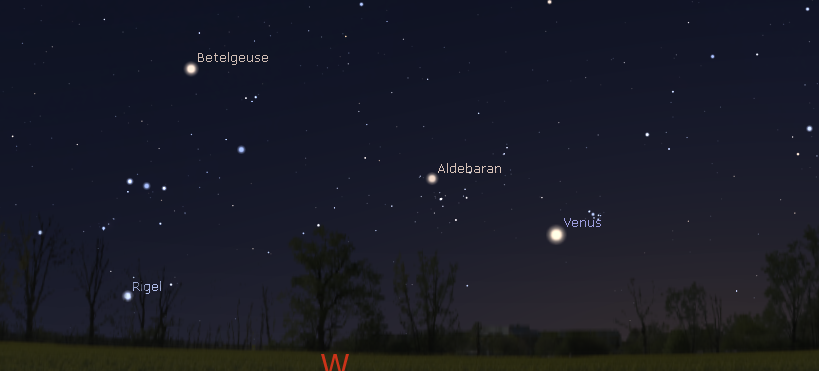
Venus, Pleiades, Aldebaran with the Hyades star cluster and Orion are seen in the west at 9:45 p.m. April 24, 2018. Venus is south of the Pleiades. Created using Stellarium.
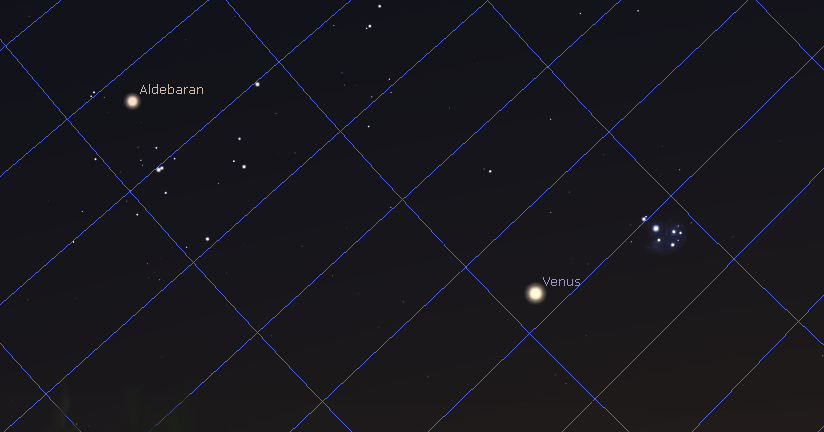
A closer look at Venus and the Pleiades with the coordinate grid added. The lines that run from upper right to lower left are lines of right ascension, analogous to longitude lines on the Earth. To the upper right is north and lower left is south. The other lines are those of declination. Like latitude lines on the Earth, they run east and west. Created using Stellarium.
04/17/2018 – Ephemeris – The Moon will appear near the planet Venus tonight
Ephemeris for Tuesday, April 17th. The Sun rises at 6:55. It’ll be up for 13 hours and 35 minutes, setting at 8:30. The Moon, 2 days past new, will set at 10:27 this evening.
This evening, while viewing Venus the Moon will be to the left and below our evening star. It will be a thin sliver of a crescent and in the twilight there will be the suggestion that there is more than the thin sliver of the Moon visible. Binoculars will confirm that the entire disk of the Moon will be visible. The effect is called earthshine. The nearly full Earth is illuminating the Moon to a much greater degree than the full Moon illuminates the Earth. The ancients had a more beautiful way to put it: “The old Moon in the new Moon’s arms.” There is the same effect in the morning of the few days prior to the new Moon. The instant of new Moon occurred at 9:57 p.m. Eastern Daylight Time Sunday night the 15th. That’s the 16th according to Universal time. What does your calendar say?*
The times given are for the Traverse City/Interlochen area of Michigan. They may be different for your location.
Addendum
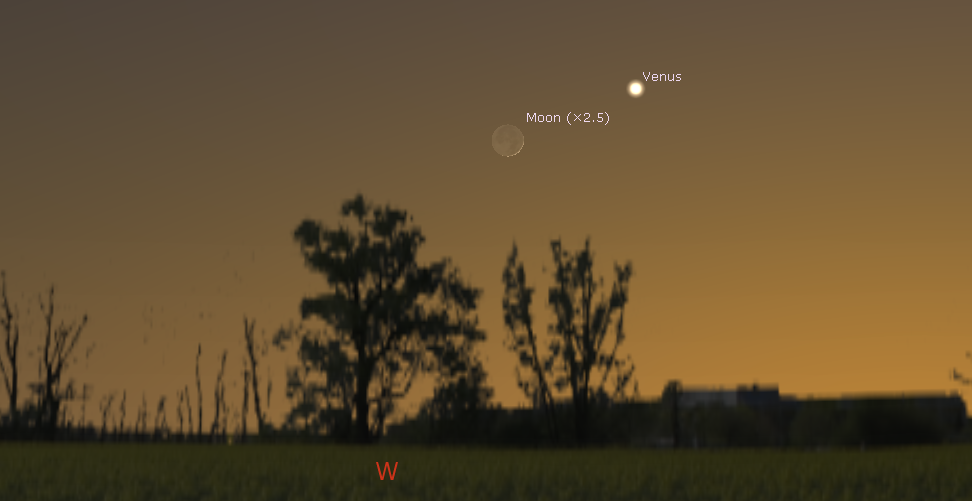
Venus and the Moon at 9 p.m. April 17, 2018. The Moon’s image has been enlarged two and a half times to show the earth shine and hint at the sliver of a crescent. Created using Stellarium.
* About the new moon this month. I have two wall calendars. One by NASA showing that the new moon occurred on April 16th based on Universal Time. Universal Time (UT) used to be known as Greenwich Mean Time (GMT). My other wall calendar is from the Old Farmers Almanac. It shows the new moon to be on the 15th. The almanac’s calendar pages are based on the location of Boston and the Eastern Time zone, standard or daylight saving. The calendar seems to be similarly based.
The Moon phase calculations for these programs are created by a DOS version of my LookingUp program, which is by now over 20 years old. I calculate them up a year at a time for the next year. These are based, of course on the Eastern Time zone.
02/01/2018 – Ephemeris – Previewing February skies
Ephemeris for Thursday, February 1st. The Sun will rise at 8:01. It’ll be up for 9 hours and 49 minutes, setting at 5:51. The Moon, 1 day past full, will rise at 7:30 this evening.
Lets look ahead at our short month of February. It’s so short that this year it has no full moons. To make up for it both January and March have two. We’re in the depths of winter but the Sun is continuing its return to northern climes. This is reflected in the increase in daylight hours, from 9 hours 49 minutes today to 11 hours 7 minutes on the 28th. These times are for the Interlochen/Traverse City area. Daylight durations are slightly shorter in the northern part of our listening area and slightly longer to the south. As the month goes on the weather should generally warm and clear up. Venus is moving away from the Sun and will become more and more visible after sunset as the month wears on. Today Venus will set 24 minutes after the Sun. This will increase to an hour after the Sun.
The times given are for the Traverse City/Interlochen area of Michigan. They may be different for your location.
Addenda
February Evening Sky Chart
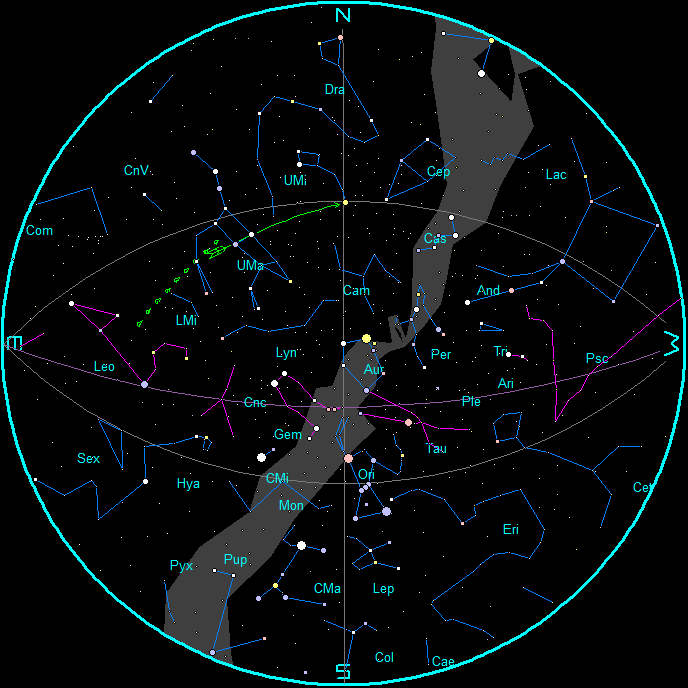
Star Chart for February 2018 (9 p.m. EST February 15, 2018). Created using my LookingUp program. Click on image to enlarge.
The planets and stars are plotted for the 15th at 9 p.m. EST in the evening and 6 a.m. for the morning chart. These are the chart times. Note that Traverse City is located approximately 45 minutes behind our time meridian. (An hour 45 minutes behind our daylight saving time meridian. during EDT and 45 minutes behind our daylight standard time meridian. during EST). To duplicate the star positions on a planisphere you may have to set it to 1 hour 45 minutes (Daylight Time) or 45 minutes (Standard Time) earlier than the current time if you are near your time meridian.
Note the chart times of 9 p.m. and 6 a.m. are for the 15th. For each week before the 15th add ½ hour. For each week after the 15th subtract ½ hour. The planet positions are updated each Wednesday on this blog. For planet positions on dates other than the 15th, check the Wednesday planet posts on this blog.
February Morning Star Chart
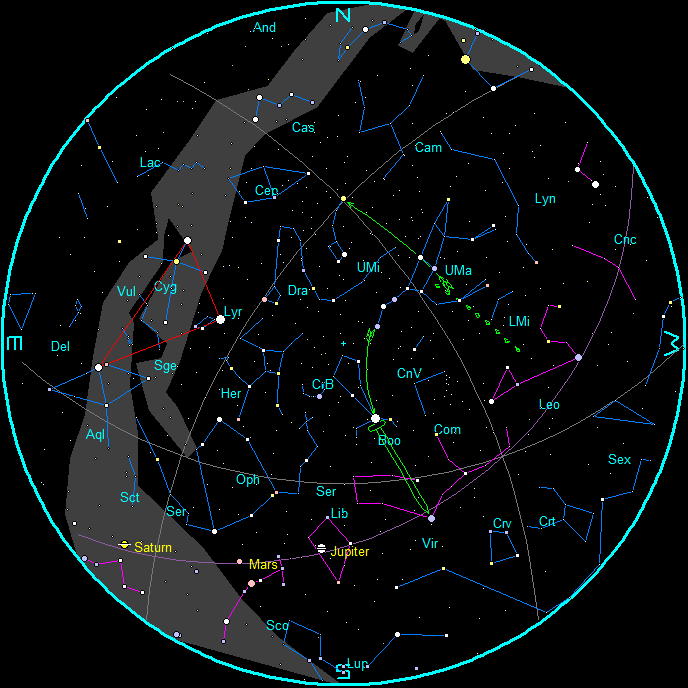
Star Chart for February 2018 mornings based on 6 a.m. February 15th. Created using my LookingUp program. Click on image to enlarge.
For a list of constellation names to go with the abbreviations click here.
Star chart annotations
- Pointer stars at the front of the bowl of the Big Dipper point to Polaris the North Star.
- Leaky Big Dipper drips on Leo.
- Follow the arc of the handle of the Big Dipper to the star Arcturus.
- The Summer Triangle is in red.
Twilight
Evening nautical twilight ends at 6:58 p.m. EST on the 1st, increasing to 7:31 p.m. EST on the 28th.
Evening astronomical twilight ends at 7:30 p.m. EST on the 1st, increasing to 8:04 p.m. EST on the 28th.
Morning astronomical twilight starts at 6:22 a.m. EST on the 1st, and decreasing to 5:45 a.m. EST on the 28th.
Morning nautical twilight starts at 6:56 a.m. EST on the 1st, and decreasing to 6:19 a.m. EST on the 28th.
NASA Calendar of Planetary Events
    Date    Time    Event
Feb 01 	Th	    Venus: 5.7° E
    01  Th  1:24 pm Moon-Regulus: 0.9° S
    07  We 10:54 am Last Quarter
    07  We  2:47 pm Moon-Jupiter: 4.7° S
    09  Fr 12:12 am Moon-Mars: 4.8° S
    11  Su  9:16 am Moon Apogee: 405700 km
    11  Su  9:46 am Moon-Saturn: 2.7° S
    11  Su 11:40 am Mars-Antares: 5.1° N
    11  Su  6:21 pm Moon South Dec.: 20° S
    14  We  4:11 pm Moon Descending Node
    15  Th  3:52 pm Partial Solar Eclipse - S. America, Antarctica
    15  Th  4:05 pm New Moon
    17  Sa  7:08 am Mercury Superior Conj.
    23  Fr  3:09 am First Quarter
    23  Fr 12:07 pm Moon-Aldebaran: 0.7° S
    25  Su  3:07 pm Moon North Dec.: 20.1° N
    27  Tu  9:48 pm Moon Perigee: 363900 km
    27  Tu 12:28 pm Moon-Beehive: 2.3° N
    28  We 12:03 am Moon Ascending Node
Mar 01  Th          Venus: 12.4° E
Sky Events Calendar by Fred Espenak and Sumit Dutta (NASA’s GSFC),
http://eclipse.gsfc.nasa.gov/SKYCAL/SKYCAL.html
If you go to the above site you can print out a list like the above for the entire year
or calendar pages for your time zone.
Sun and Moon Rising and Setting Events
     LU                  Ephemeris of Sky Events for Interlochen/TC
     February, 2018    Local time zone: EST
     +-----------------------------------------------------------------------+
     | DATE |  SUN     SUN  DAYLIGHT|   TWILIGHT*    |MOON  RISE OR    ILLUM |
     |      |  RISE    SET    HOURS |  END    START  |PHASE SET** TIME FRACTN|
     +=======================================================================+
     |Thu  1| 08:01a  05:51p  09:49 | 06:57p  06:55a |      Rise 07:30p   97%|
     |Fri  2| 08:00a  05:52p  09:52 | 06:58p  06:54a |      Rise 08:43p   92%|
     |Sat  3| 07:59a  05:54p  09:54 | 07:00p  06:53a |      Rise 09:53p   85%|
     +------+-----------------------+----------------+-----------------------+
     |Sun  4| 07:58a  05:55p  09:57 | 07:01p  06:52a |      Rise 11:01p   76%|
     |Mon  5| 07:57a  05:57p  10:00 | 07:02p  06:51a |      Rise 12:06a   66%|
     |Tue  6| 07:55a  05:58p  10:02 | 07:04p  06:50a |      Rise 01:09a   57%|
     |Wed  7| 07:54a  06:00p  10:05 | 07:05p  06:49a |L Qtr Rise 02:10a   47%|
     |Thu  8| 07:53a  06:01p  10:08 | 07:06p  06:48a |      Rise 03:09a   37%|
     |Fri  9| 07:51a  06:02p  10:11 | 07:07p  06:46a |      Rise 04:05a   28%|
     |Sat 10| 07:50a  06:04p  10:13 | 07:09p  06:45a |      Rise 04:57a   20%|
     +------+-----------------------+----------------+-----------------------+
     |Sun 11| 07:48a  06:05p  10:16 | 07:10p  06:44a |      Rise 05:45a   13%|
     |Mon 12| 07:47a  06:07p  10:19 | 07:11p  06:42a |      Rise 06:29a    8%|
     |Tue 13| 07:46a  06:08p  10:22 | 07:13p  06:41a |      Rise 07:07a    3%|
     |Wed 14| 07:44a  06:09p  10:25 | 07:14p  06:40a |      Rise 07:42a    1%|
     |Thu 15| 07:43a  06:11p  10:28 | 07:15p  06:38a |New   Set  06:07p    0%|
     |Fri 16| 07:41a  06:12p  10:31 | 07:16p  06:37a |      Set  07:09p    1%|
     |Sat 17| 07:40a  06:14p  10:34 | 07:18p  06:36a |      Set  08:13p    5%|
     +------+-----------------------+----------------+-----------------------+
     |Sun 18| 07:38a  06:15p  10:37 | 07:19p  06:34a |      Set  09:17p   10%|
     |Mon 19| 07:36a  06:16p  10:40 | 07:20p  06:33a |      Set  10:23p   17%|
     |Tue 20| 07:35a  06:18p  10:43 | 07:22p  06:31a |      Set  11:29p   25%|
     |Wed 21| 07:33a  06:19p  10:46 | 07:23p  06:30a |      Set  12:38a   35%|
     |Thu 22| 07:32a  06:21p  10:49 | 07:24p  06:28a |      Set  01:46a   46%|
     |Fri 23| 07:30a  06:22p  10:52 | 07:25p  06:27a |F Qtr Set  02:54a   57%|
     |Sat 24| 07:28a  06:23p  10:55 | 07:27p  06:25a |      Set  04:00a   69%|
     +------+-----------------------+----------------+-----------------------+
     |Sun 25| 07:27a  06:25p  10:58 | 07:28p  06:23a |      Set  04:59a   79%|
     |Mon 26| 07:25a  06:26p  11:01 | 07:29p  06:22a |      Set  05:52a   88%|
     |Tue 27| 07:23a  06:27p  11:04 | 07:31p  06:20a |      Set  06:38a   94%|
     |Wed 28| 07:22a  06:29p  11:07 | 07:32p  06:18a |      Set  07:17a   99%|
     +-----------------------------------------------------------------------+
     * Nautical Twilight
     ** Moonrise or moonset, whichever occurs between sunset and sunrise
12/22/2017 – Ephemeris – The joining of a god and goddess, a second possibility of the Star of Bethlehem
Ephemeris for Friday, December 22nd. The Sun will rise at 8:16. It’ll be up for 8 hours and 48 minutes, setting at 5:05. The Moon, half way from new to first quarter, will set at 9:21 this evening.
On Tuesday I talked about what I said was one of two possible physical explanations for the Star of Bethlehem. Here is the second. On August 13th of 3 BC Jupiter and Venus briefly merged in the pre-dawn skies against the constellation of Leo the lion. A month later Jupiter was in conjunction with Regulus the bright star in Leo, the little king star. Then 9 months later, after sunset on June 16th of 2 BC the two planets again joined as one in Leo. The king of the planets twice mating with Venus as Ishtar, the Babylonian goddess of fertility, against the constellation of the lion signifying Judah in Genesis? One might find meaning in all that, especially the Magi, who were Zoroastrian astrologer-priests from Persia.
The times given are for the Traverse City/Interlochen area of Michigan. They may be different for your location.
Addendum
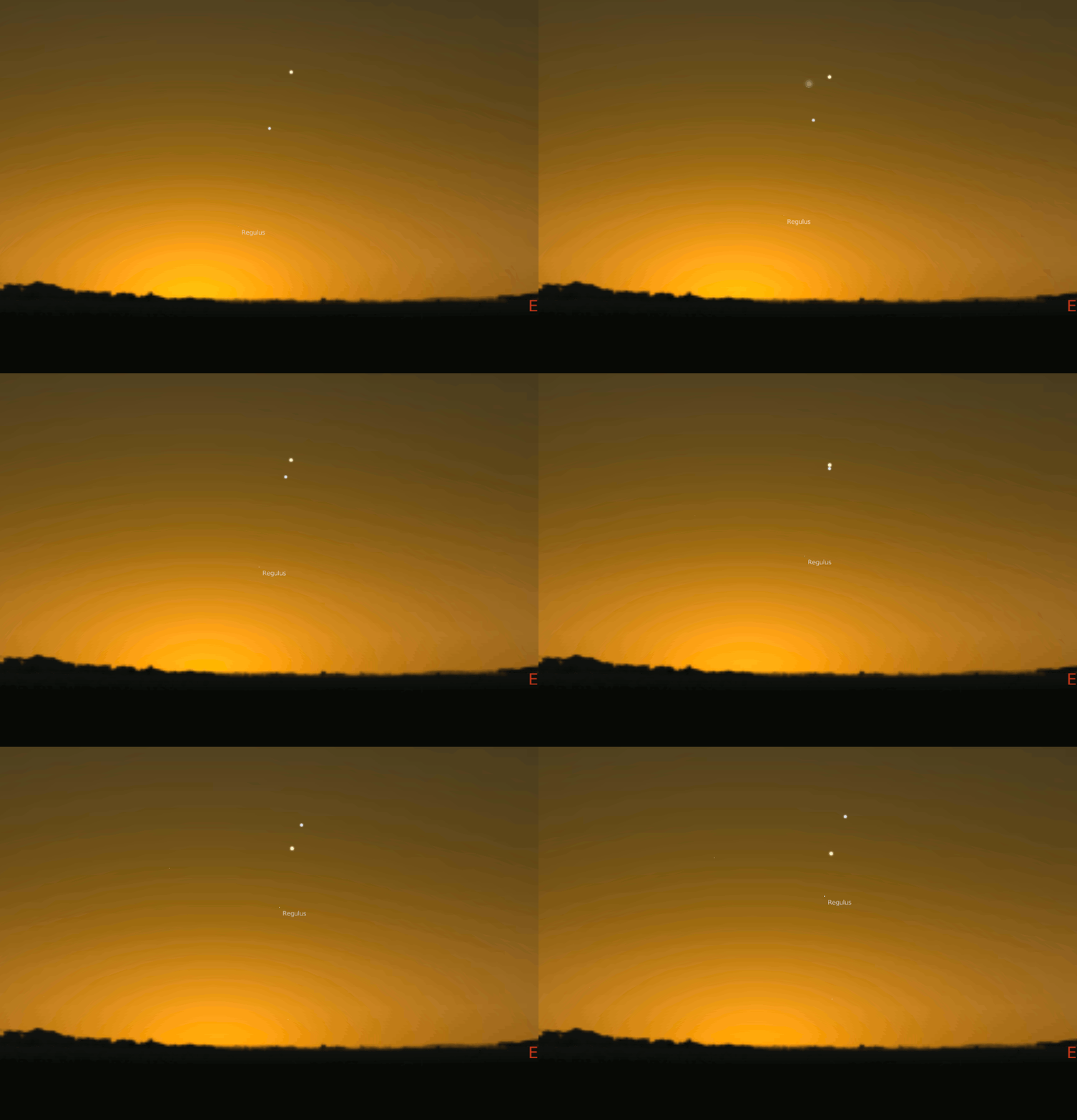
Animation of the Jupiter-Venus conjunction of August 13, 3 BC. in the morning twilight. Created using Stellarium.
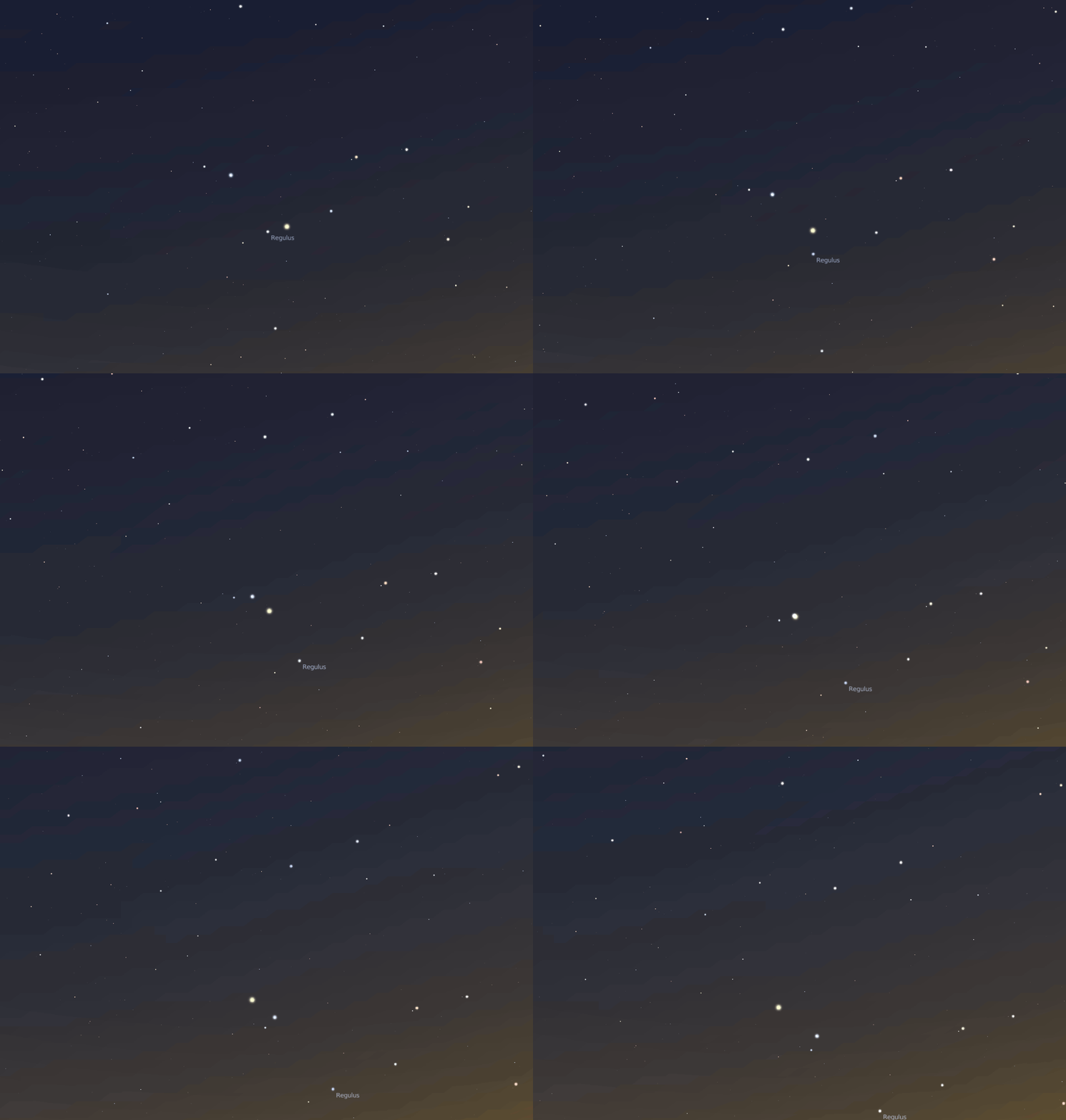
June 16, 2 BC just after sunset Jupiter and Venus again cross paths, at one point too close to be separated with the naked eye. Created using Stellarium.
07/04/2017 – Ephemeris – Happy birthday America! Tomorrow morning Venus will appear near the Pleiades
Ephemeris for Independence Day, Tuesday, July 4th. Today the Sun will be up for 15 hours and 27 minutes, setting at 9:30, and it will rise tomorrow at 6:03. The Moon, 4 days past first quarter, will set at 3:46 tomorrow morning.
This is the 241st anniversary of the signing of the Declaration of Independence. Venus is our morning star now, and back in 1776 it too was a morning planet, but a lot closer to the rising Sun, and harder to spot.
Tonight Venus will pass south of the famous Pleiades star cluster, so that tomorrow morning at about 4:30 it will be dark enough to see the Pleiades above and left of our brilliant Morning Star.
Planets to us appear as stars to the naked eye due to their distance, though they are close enough to appear as disks in small telescopes. Very few of the largest telescopes can ever see the disk of a star, other than the Sun,, and only if that star is really huge, like Betelgeuse in the winter constellation of Orion.
The times given are for the Traverse City/Interlochen area of Michigan. They may be different for your location.
Addendum
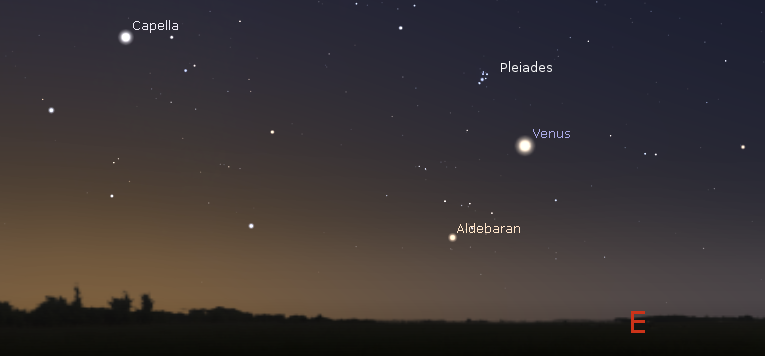
The eastern sky at 5 a.m. July 5, 2017 with the Pleiades above and left of Venus. Created using Stellarium.
We’ll be seeing the Pleiades in the evening sky in four months when summer is a memory.
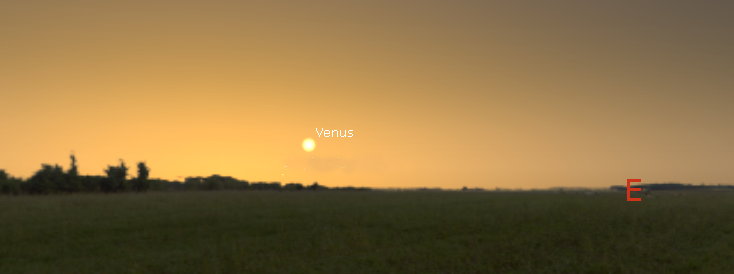
The morning sky to the east and Venus about 20 minutes before sunrise that auspicious morning July 4, 1776 from Philadelphia. Created using Stellarium.
Excuse the fact that the landscape is the same in both images.
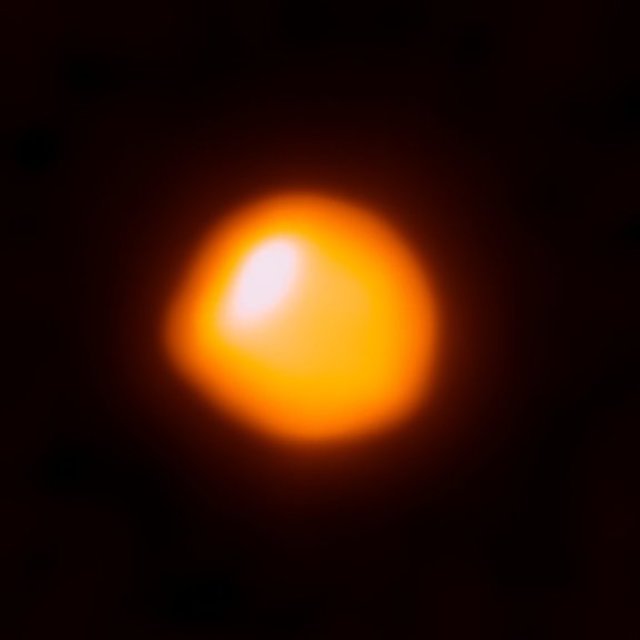
This is the disk of the star Betelgeuse in Orion. It is not an image from an optical telescope of an image created in submillimeter microwaves by the Atacama Large Millimeter/submillimeter Array (ALMA) in Chile. Credit: ALMA (ESO/NAOJ/NRAO)/E. O’Gorman/P. Kervella.
Betelgeuse, though it is 600 light years away has a radius of slightly more than the orbit of Jupiter. The bump on the left side of the image may be a plume of gas erupting from the star.
06/05/2017 – Ephemeris – Why Venus is low in the eastern sky
Ephemeris for Monday, June 5th. Today the Sun will be up for 15 hours and 25 minutes, setting at 9:23, and it will rise tomorrow at 5:58. The Moon, half way from first quarter to full, will set at 4:40 tomorrow morning.
Saturday the planet Venus was at greatest western elongation from the Sun, That is it is the farthest west it will appear from the Sun. It’s still not very high in our sky. However for those in the southern hemisphere Venus will appear very high in the east. There is a rule about this: Planets which are east of the Sun, like Mars is now are easiest seen on spring evenings. Planets which are west of the Sun, like Venus is now are easiest seen on autumn mornings. Since the southern hemisphere has the opposite seasons as the north, this is their autumn, and morning planets are easiest seen. This is especially true for Mercury, which is even closer to the Sun than Venus. Generally it’s only seen when it appears on spring evenings and autumn mornings.
The times given are for the Traverse City/Interlochen area of Michigan. They may be different for your location.
Addendum
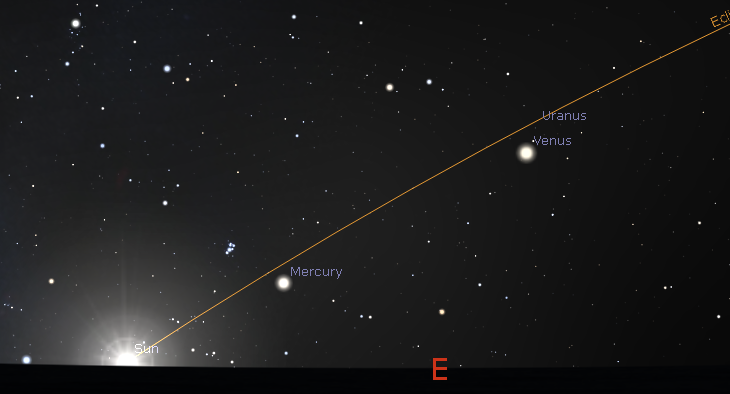
Venus’ low morning appearance is due to the fact that on spring mornings the ecliptic (red line path of the Sun in the sky and nearly that of the planets) lies low to the horizon. Created using Stellarium.
04/13/2017 – Ephemeris – Venus is in the morning sky
Ephemeris for Thursday, April 13th. The Sun will rise at 7:01. It’ll be up for 13 hours and 23 minutes, setting at 8:25. The Moon, 2 days past full, will rise at 10:52 this evening.
Venus is beginning to make its morning appearance now, rising just before 6 a.m. It’s north and west of the Sun, but it’s path away from the Sun is at a low angle to the horizon. Venus is now in its crescent phase, which is getting fatter, as it separates from the Sun. It is also getting smaller in our telescopes as it recedes from us. Venus has no natural satellites, however it currently has a small robotic one. It is Japan’s Akatsuki or Dawn spacecraft. Launched in 2010, it failed to fire its rocket engine for the entire time needed to drop it into orbit of Venus. The engineers devised a plan to chase Venus for 5 years and gently maneuver the spacecraft into orbit using only its attitude thrusters. This they accomplished in December of 2015.
The times given are for the Traverse City/Interlochen area of Michigan. They may be different for your location.
Addendum
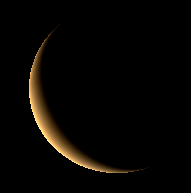
Telescopic Venus as created with Stellarium for early morning April 14, 2017. Stellarium is coloring Venus as it would be colored low in the sky.
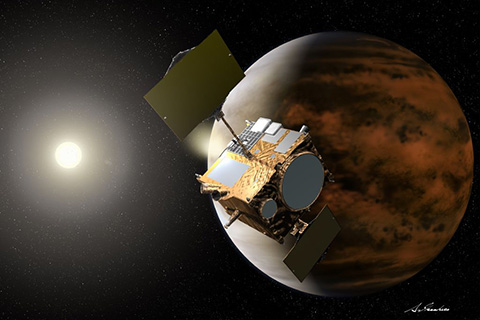
Artists drawing of Akatsuki orbiting Venus. Credit Japanese Institute of Space and Astronautical Science (ISAS)
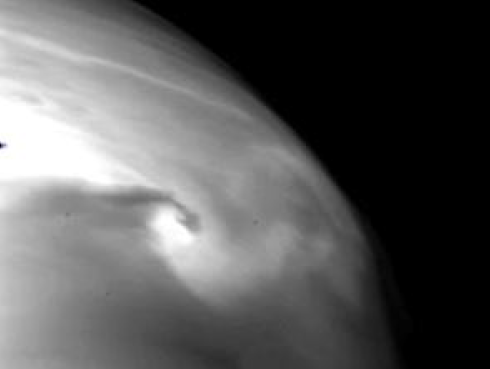
A localized vortex in the clouds of Venus captured by Akatsuki. Credit ISAS.
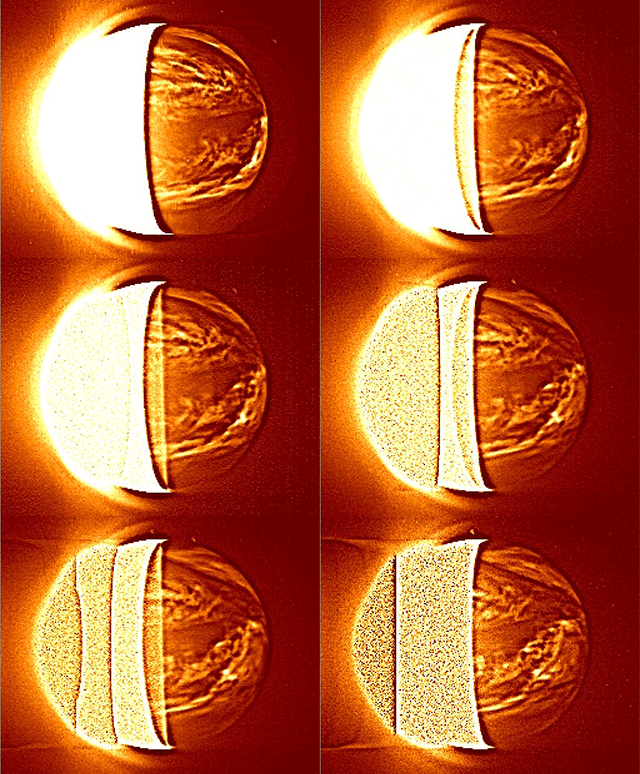
An animation of the clouds rotating on Venus’ night side by Akatsuki. Credit ISAS
02/23/2017 – Ephemeris – The Evening Star’s days are numbered
Ephemeris for Thursday, February 23rd. The Sun will rise at 7:29. It’ll be up for 10 hours and 53 minutes, setting at 6:22. The Moon, 3 days before new, will rise at 6:15 tomorrow morning.
The brilliant Evening Star, the planet Venus entered our evening sky last June. It seemed it took forever to move far enough away from the Sun to be easily seen after sunset. The summer and autumn time is a hard time to spot a planet near the Sun after sunset, because they appear more to the left of the Sun than above it. Now, in late winter Venus is high in the west after sunset. But that won’t last. It’s nearly 9 month’s reign as the Evening Star are about up. In 27 days it will be gone, out of the evening sky as it rapidly passes between the Earth and the Sun. Venus will be only 26 million miles (42 million km) from the Earth. Back is 2012 it crossed the face of the sun at conjunction, On March 25th it will be 16 Sun diameters north of our star.
Times are for the Traverse City/Interlochen area of Michigan. They may be different for your location.
Addendum
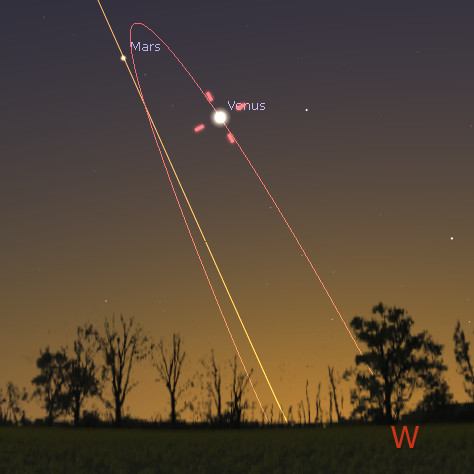
Venus and Mars showing Venus’ orbit showing how far north it will get above the ecliptic, the yellow line, which is the path of the Sun. Created using Stellarium.
 Bob Moler's Ephemeris Blog