10/22/2021 – Ephemeris 3,001st post – Mercury is now visible in the morning before sunrise
This is Bob Moler with Ephemeris for Friday, October 22nd. Today the Sun will be up for 10 hours and 38 minutes, setting at 6:46, and it will rise tomorrow at 8:09. The Moon, 2 days past full, will rise at 7:53 this evening.
The planet Mercury is now visible on clear mornings, low in the east-southeastern sky after 7 am, and twilight gets too bright around 7:50 am. Tiny Mercury is the smallest planet, only 50% larger than our Moon. It looks a lot like our Moon, close up, all gray and covered in craters. But the resemblance is only skin deep. Before the Arecibo radio telescope could bounce radar pulses from the planet in the 1960s, we thought Mercury held one side pointed at the Sun and the other side eternally away. That wasn’t the case due to its elliptical orbit. It rotates in 59 days, two-thirds of its year of 88 days. This makes its solar day, noon to noon, last two of its years. The European BepiColombo mission to orbit Mercury just made its first pass of the planet.
Addendum
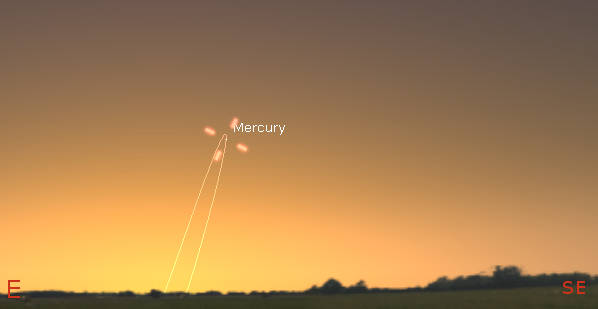
Mercury and its apparent orbit for 7:49 am tomorrow, October 23, 2021, two days before its greatest western elongation (separation from the Sun). Created using Stellarium.
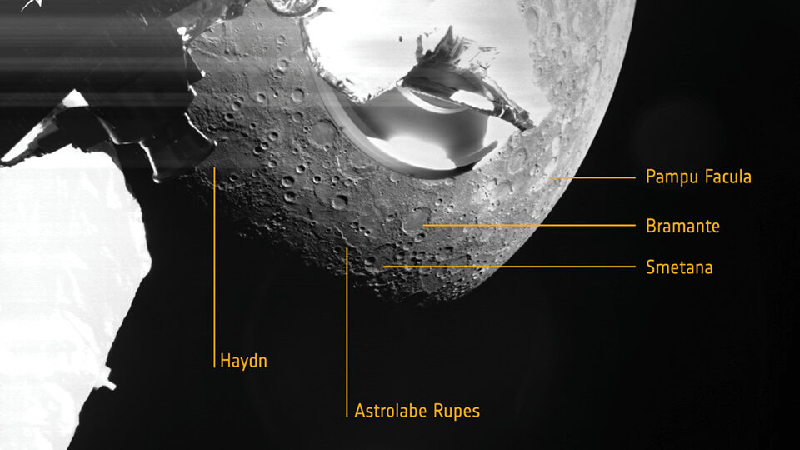
BepiColombo takes a picture of Mercury on its first of 6 flybys, October 1st, before settling into orbit of the planet on December 5, 2025. BepiColombo is actually two spacecraft connected together, and parts of the other spacecraft will get into each other’s images until they separate. Credit: ESA/JAXA.
10/21/2021 – Ephemeris – Defending the planet
This is Ephemeris for Thursday, October 21st. Today the Sun will be up for 10 hours and 41 minutes, setting at 6:47, and it will rise tomorrow at 8:07. The Moon, 1 day past full, will rise at 7:29 this evening.
This is the 4th program in 8 days here on Ephemeris about asteroids. A possible collision of an asteroid or comet has been on our collective minds since the 20-some odd pieces of Comet Shoemaker-Levy 9 hit Jupiter in July 1994. In 2016 NASA established the Planetary Defense Coordination Office to manage its ongoing planetary defense efforts. Its mission is to provide early detection of potentially hazardous objects that can come within 5 million miles of the Earth’s orbit and a size large enough to cause significant damage. Asteroid sizes would be 30 to 50 meters in diameter, that’s 90 to 150 feet in diameter or larger. It will track and issue warnings of these objects when found. It will coordinate responses to any impact threat.
The astronomical event times given are for the Traverse City/Interlochen area of Michigan (EDT, UT-4 hours). They may be different for your location.
Addendum
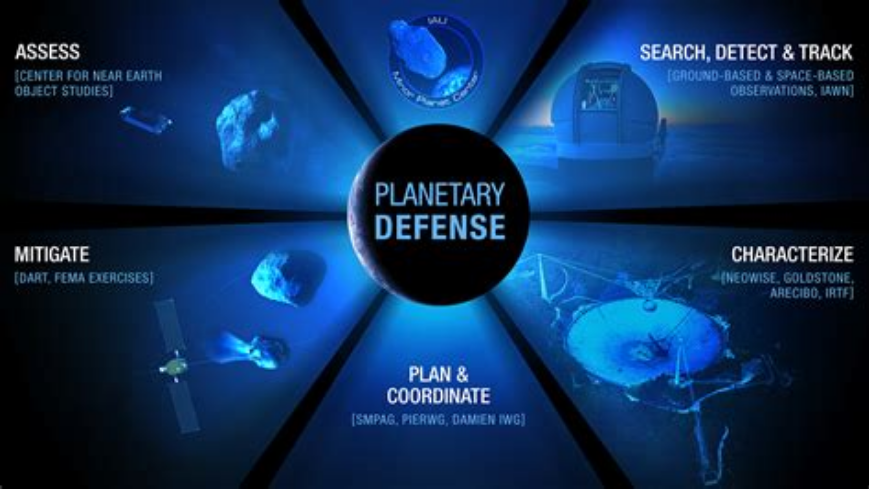
What the Planetary Defense Coordination Office does. Credit: NASA.
10/20/2021 – Ephemeris – Let’s search for the naked-eye planets for this week
This is Bob Moler with Ephemeris for Wednesday, October 20th. Today the Sun will be up for 10 hours and 44 minutes, setting at 6:49, and it will rise tomorrow at 8:06. The Moon, is full today, the Hunter’s Moon, and will rise at 7:07 this evening.
Let’s search for the naked-eye planets for this week. Venus should be visible in the southwestern evening twilight by 7:10 tonight. It will set at 8:44 pm. By 7:30 pm, Jupiter will be spotted in the south-southeastern sky. Jupiter should be easy to spot at that hour. Saturn will be dimmer, and to its right. They will be visible for a while after midnight in the southwest, with Saturn setting first at 1:04 am, and Jupiter following at 2:24. Saturn’s rings are a beautiful sight in a telescope of even modest power, but the planet will appear tiny. In the morning sky, Mercury will be visible and low in the east-southeast by 7:15 am. It will reach its greatest separation from the Sun in six days.
The astronomical event times given are for the Traverse City/Interlochen area of Michigan (EDT, UT-4 hours). They may be different for your location.
Addendum
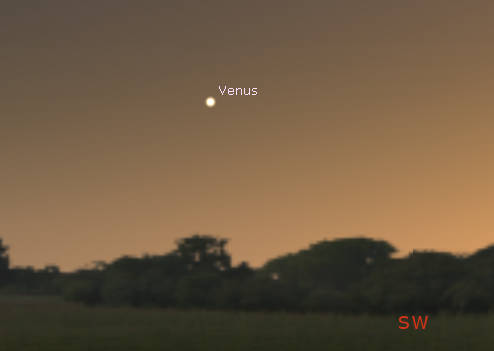
Venus seen in twilight at 7:10 pm, about 20 minutes after sunset tonight, October 20, 2021. Created using Stellarium.
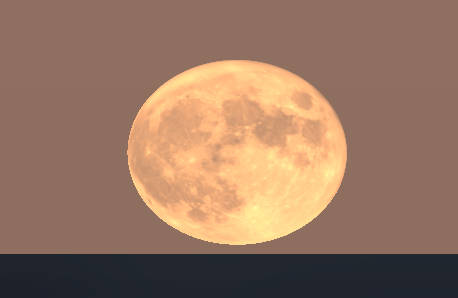
Full Hunter’s Moon rising at 7:11 this evening, October 20, 2021. Created using Stellarium.
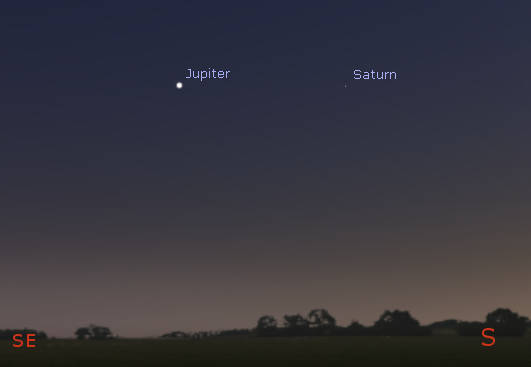
Jupiter, Saturn and the Moon at 7:30, about 40 minutes after sunset tonight, October 20, 2021. Created using Stellarium.
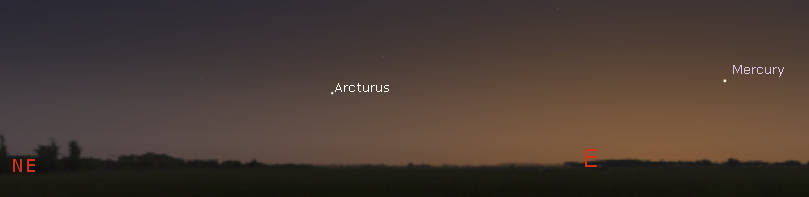
Mercury and the star Arcturus in the morning twilight at 7:15 am, about 50 minutes before sunrise tomorrow morning, October 21, 2021. Don’t confuse the two. Click on the image to enlarge it. Created using Stellarium.
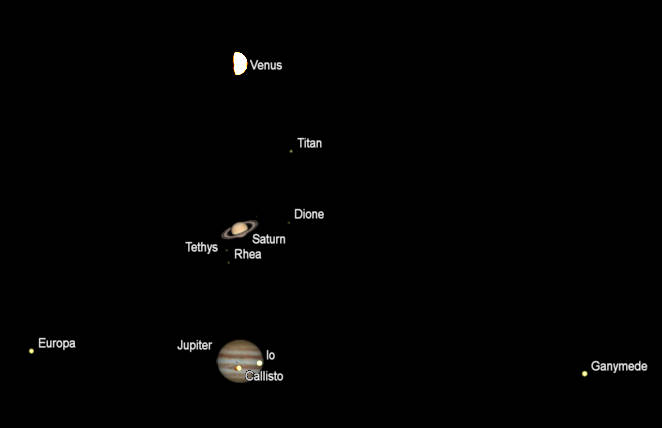
Telescopic views of the bright planets (north up) as they would be seen in a small telescope, with the same magnification, this evening at 8 pm, October 20, 2021. Apparent diameters: Venus, 22.70″, 53.7% illuminated; Saturn 17.08″, its rings 39.80″; Jupiter, 43.68″. Mercury at 7:15 am on the 21st and not plotted, 7.68″, 38.1% illuminated. The two Jovian moons transiting the face of the planet are usually not visible, though their shadows can be spotted. The ” symbol means seconds of arc (1/3600th of a degree.) Click on the image to enlarge it. Created using Cartes du Ciel (Sky Charts).
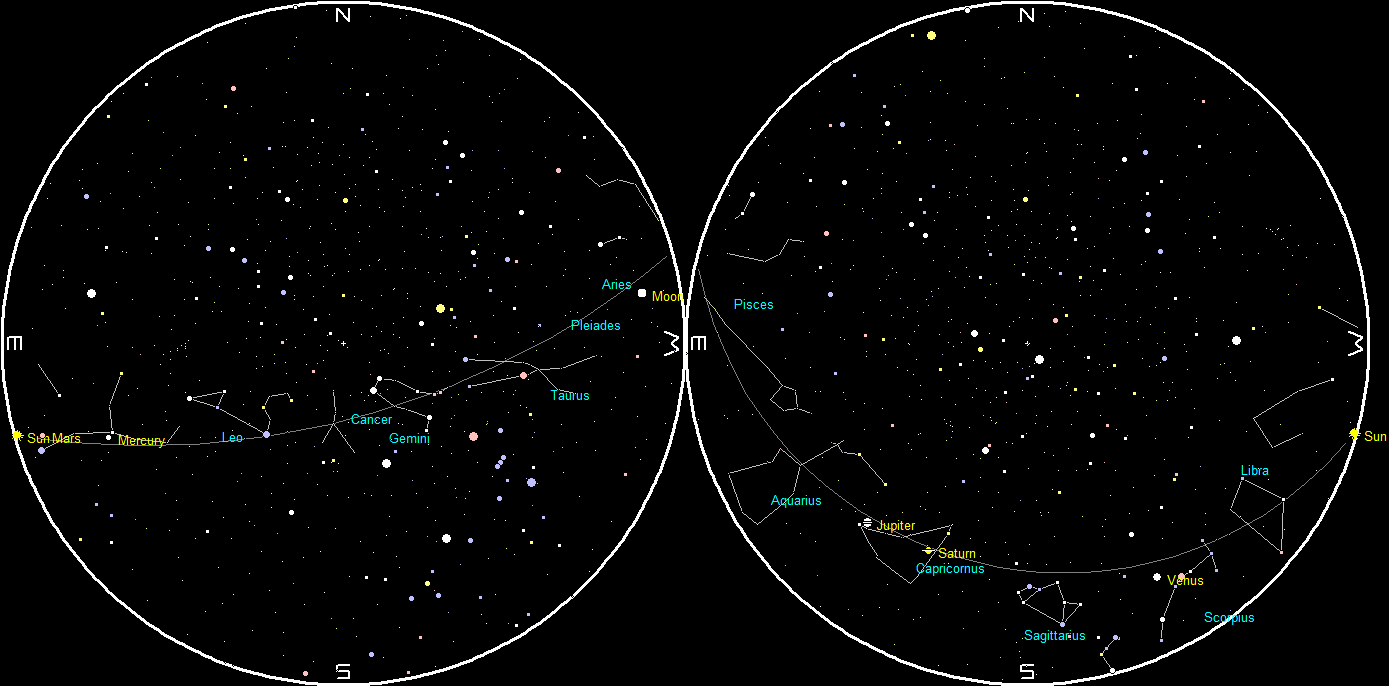
The naked-eye planets and the Moon at sunset and sunrise on a single night, starting with sunset on the right on October 20, 2021. The night ends on the left with sunrise on the 21st. Click on the image to enlarge it. Created using my LookingUp program.
10/19/2021 – Ephemeris – Introducing the DART mission
This is Bob Moler with Ephemeris for Tuesday, October 19th. Today the Sun will be up for 10 hours and 47 minutes, setting at 6:50, and it will rise tomorrow at 8:05. The Moon, 1 day before full, will set at 7:54 tomorrow morning.
Last Saturday morning, the Lucy mission to Jupiter’s Trojan Asteroids was launched. These asteroids are forever locked in Jupiter’s orbit and will never be a hazard to the Earth. Next month, NASA will hopefully launch a mission to a much closer asteroid Didymos, which is considered a potentially hazardous asteroid. The asteroid has a diameter of a bit less than a half mile (780 meters). It also has a satellite named Dimorphos, which has acquired the nickname Didymoon, 520 feet (160 meters) in diameter. The mission called DART for Double Asteroid Redirection Test will see how the impact of a spacecraft hitting the small Didymoon will affect its orbit around the larger asteroid.
The astronomical event times given are for the Traverse City/Interlochen area of Michigan (EDT, UT-4 hours). They may be different for your location.
Addendum
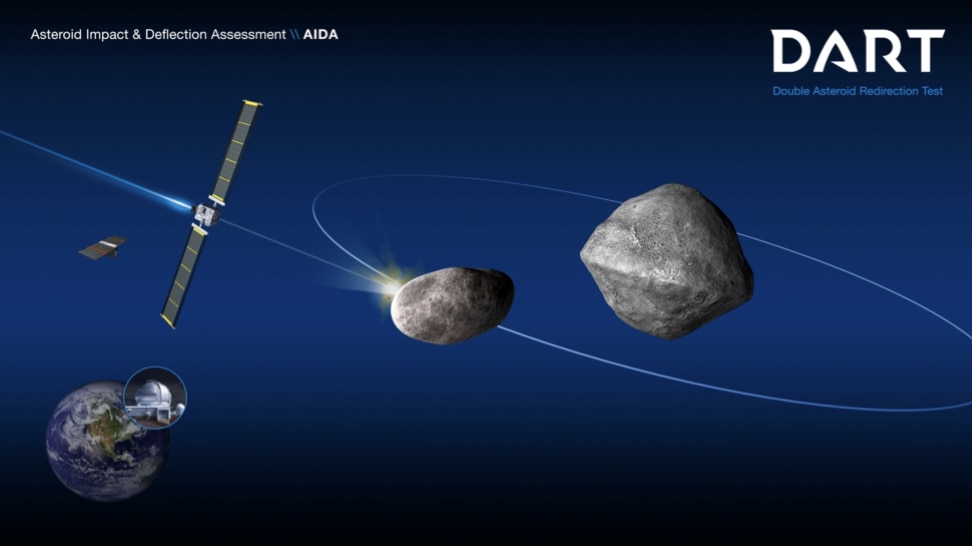
The Double Asteroid Redirection Test (DART) mission is NASA’s contribution to the international Asteroid Impact & Deflection Assessment (AIDA) program to determine the effectiveness of a spacecraft kinetic impact of an asteroid in altering its orbit. Credit: NASA.
10/18/2021 – Ephemeris – Jupiter is stationary today
This is Ephemeris for Monday, October 18th. Today the Sun will be up for 10 hours and 50 minutes, setting at 6:52, and it will rise tomorrow at 8:03. The Moon, 2 days before full, will set at 6:49 tomorrow morning.
The planet Jupiter is stationary today after moving westward for the last four months, as the Earth passed it in our race around the Sun. And it will resume its normal prograde or eastward motion against the stars and constellations of the Zodiac. During this retrograde time it had seemed to move closer to Saturn. Now that it and Saturn are appearing to resume their eastward motion, Jupiter again will appear to open up the distance between them. The ancient Greeks had a devil of a time trying to model this behavior, because they started with two false premises. One, that the Earth was stationary in the center of the universe; and two, that the Sun, Moon, and planets moved in uniform circular motion because they were perfect.
The astronomical event times given are for the Traverse City/Interlochen area of Michigan (EDT, UT-4 hours). They may be different for your location.
Addendum
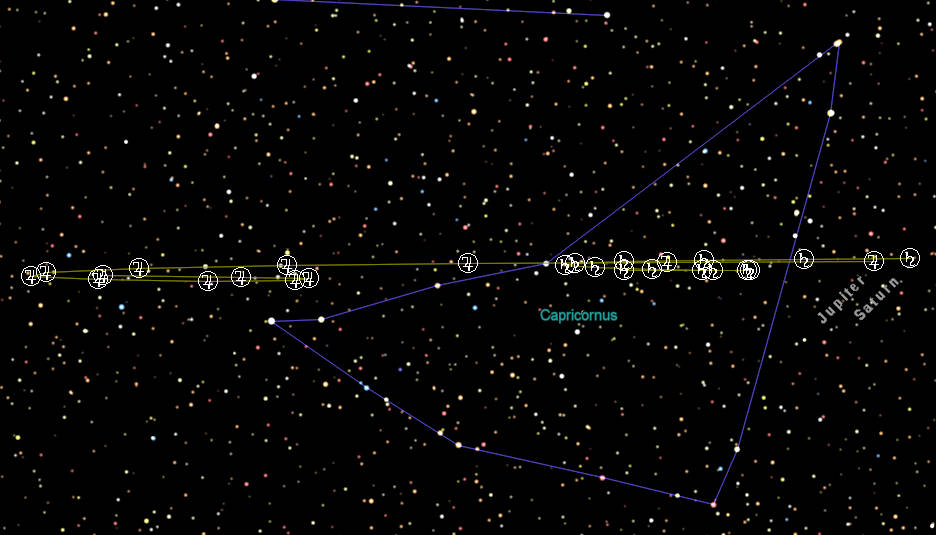
Jupiter and Saturn’s apparent motions seen against the constellation of Capricornus in 2021, including their retrograde loops. Click on the image to enlarge it. The tracks begin on the right. By the end of 2021 neither planet recovers all the eastern progress they lost in their retrograde loops. Created using Cartes du Ciel (Sky Charts).
10/15/2021 – Ephemeris – NASA mission to Trojan Asteroids
This is Bob Moler with Ephemeris for Friday, October 15th. Today the Sun will be up for 10 hours and 59 minutes, setting at 6:57, and it will rise tomorrow at 7:59. The Moon, 3 days past first quarter, will set at 3:25 tomorrow morning.
Tomorrow opens up a window to launch a satellite named Lucy to the Trojan asteroids of Jupiter. Lucy is named for a fossil of a human ancestor discovered in Africa. After launch, Lucy will make two gravitational assist passes of the Earth to get up enough velocity to reach Jupiter’s orbit and pass near Five asteroids in the leading L4 cloud of Trojans. Its orbit will take it back to the Earth, where another gravitational assist will send it to a double asteroid in the trailing Trojan group. On its way out it will pass close to a tiny main belt asteroid DonaldJohanson, named after the discoverer of the Lucy fossil. The mission will last 12 years. After that, Lucy will orbit between the Earth’s orbit and each of the Trojan swarms in turn.
Lucy is scheduled to launch on an Atlas V on Saturday, 16 October 2021 at 09:34 UT (5:34 a.m. EDT) from Cape Canaveral. If the launch can’t take place then, they have something like 22 more days in which they can get it launched.
The astronomical event times given are for the Traverse City/Interlochen area of Michigan (EDT, UT-4 hours). They may be different for your location.
Addendum
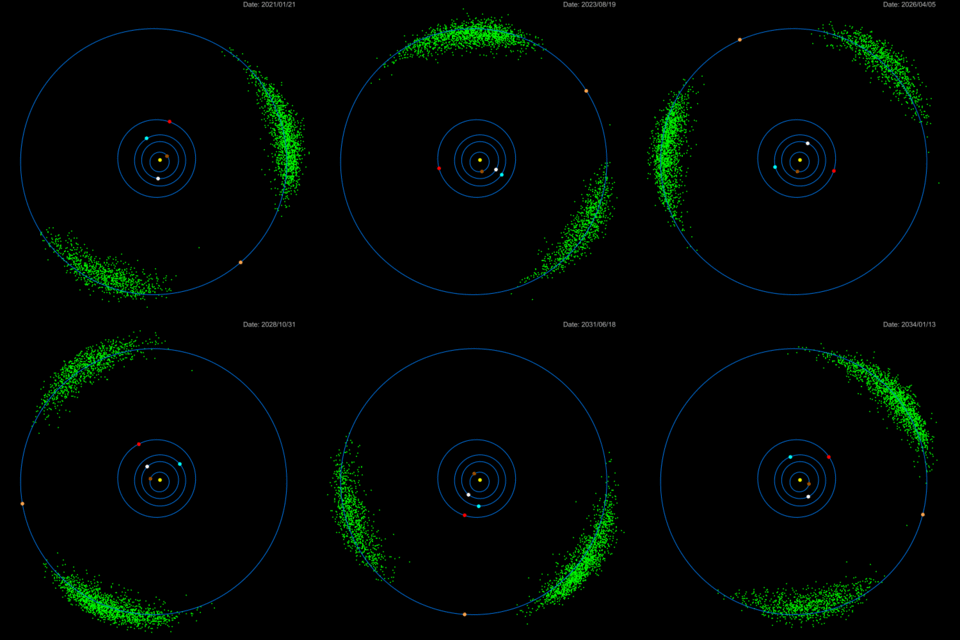
Animated GIF showing Jupiter and Trojan Asteroids during one Jovian year, which repeats. Credit: Astronomical Institute of CAS/Petr Scheirich.
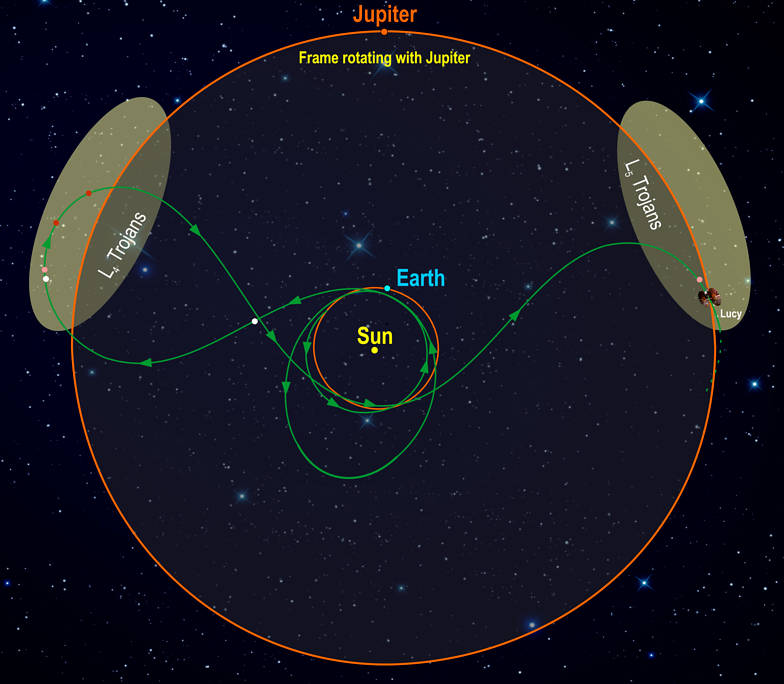
The Lucy spacecraft orbits as seen in the rotating frame of Jupiter’s orbit. Lucy’s orbits are actually ellipses. (I wish they would take the stars out, they should appear as circular trails centered on the Sun from Jupiter’s rotating frame.) Click on the image to enlarge it. Credit: Southwest Research Institute.
10/14/2021 – Ephemeris – What is a Trojan Asteroid?
This is Bob Moler with Ephemeris for Thursday, October 14th. Today the Sun will be up for 11 hours and 2 minutes, setting at 6:59, and it will rise tomorrow at 7:58. The Moon, 2 days past first quarter, will set at 2:13 tomorrow morning.
The Moon is near Jupiter tonight. On this Saturday, the 16th, the window opens up for the launch of NASA’s Lucy mission to Jupiter’s Trojan asteroids. More about the mission tomorrow, but what’s a Trojan asteroid? The Trojan asteroids are over 10,000 in number that lie in Jupiter’s orbit. One group, the Greeks, orbit around the L4 point 60 degrees ahead of Jupiter. The other, the Trojans orbit the L5 point 60 degrees behind Jupiter. Named after participants of the Trojan War, they are collectively named Trojan asteroids. Other planets, including the Earth, have Trojan asteroids. Trojan asteroids orbit the L4 and L5 gravitational equilibrium points in a planet’s orbit of the Sun, discovered by Joseph-Louis Lagrange in 1772. The first Trojan asteroid, was named Achilles after a warrior in the Trojan War, and was discovered in 1906. As new asteroids were found in these special positions, they were also given names from Homer’s Iliad.
The astronomical event times given are for the Traverse City/Interlochen area of Michigan (EDT, UT-4 hours). They may be different for your location.
Addendum
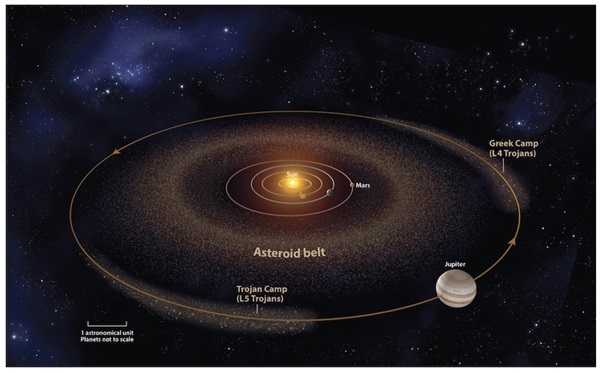
The two “camps” of Jupiter’s Trojan Asteroids. The Greek camp at L4 and the Trojan camp at L5. Credit Astronomy.com/Roen Kelly.
Other planets have Trojan Asteroids in their orbits. Earth has one, Mars has four, Uranus has two, Neptune has 28. These are not the final numbers, just what has been found so far. Apparently, Venus has a temporary one. When the term Trojan Asteroids is used without reference to a planet, they are assumed to belong to Jupiter.
10/13/2021 – Ephemeris – Let’s search for the naked-eye planets for this week
This is Ephemeris for Wednesday, October 13th. Today the Sun will be up for 11 hours and 5 minutes, setting at 7:01, and it will rise tomorrow at 7:57. The Moon, 1 day past first quarter, will set at 1:00 tomorrow morning.
Let’s search for the naked-eye planets for this week. Venus should be visible in the southwestern evening twilight by 7:20 tonight. It will set at 8:37 pm. By 7:45 pm, Jupiter will be spotted in the south-southeastern sky. The Jupiter should be easy to spot at that hour. Saturn will be dimmer, and to its right. It will be above and left of the Moon tonight. They will be visible for a while after midnight in the southwest, with Saturn setting first at 1:31 am, and Jupiter following at 2:52. Saturn’s rings are a beautiful sight in a telescope of even modest power, but the planet will appear tiny. Jupiter’s 4 brightest moons are spread out, two on each side of the planet tonight. They might all be visible in binoculars.
The astronomical event times given are for the Traverse City/Interlochen area of Michigan (EDT, UT-4 hours). They may be different for your location.
Addendum
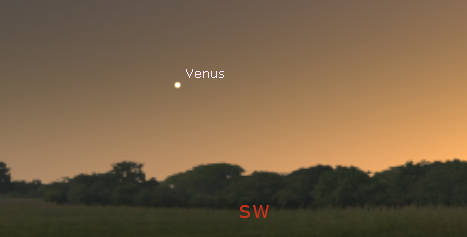
Venus seen in twilight at 7:20 pm, about 20 minutes after sunset on October 13, 2021. Created using Stellarium.
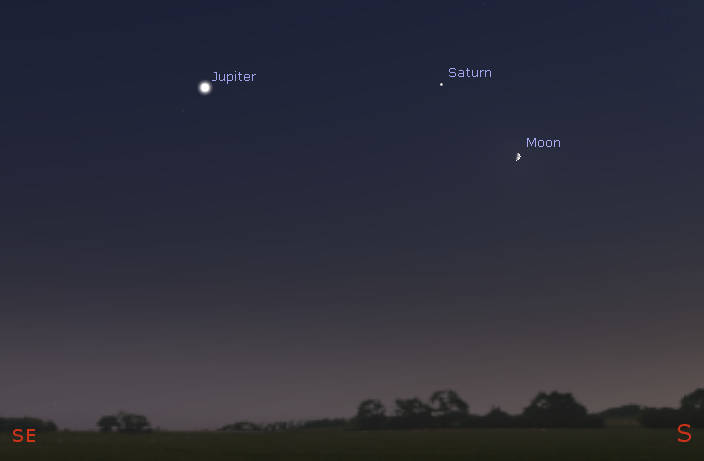
Jupiter, Saturn and the Moon at 7:45, about 45 minutes after sunset in this view to the south-southeast. Click on the image to enlarge it. Created using Stellarium.
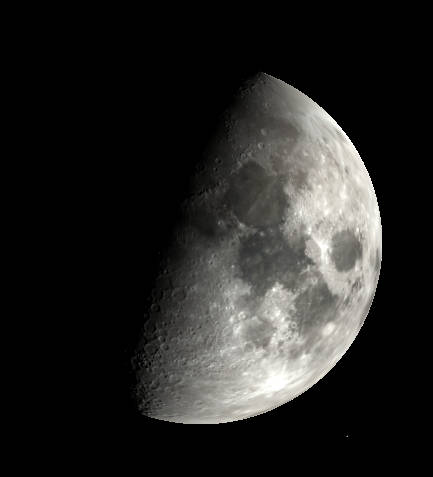
The slight gibbous Moon as it might appear tonight in binoculars or small telescope. It appears here right side up as it would appear in the sky at 9 pm. Created using Stellarium.
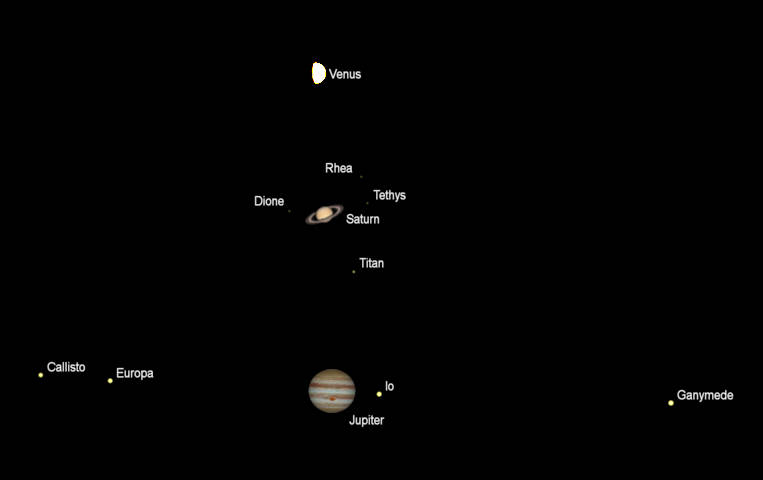
Telescopic views of the bright planets (north up) as they would be seen in a small telescope, with the same magnification, this evening at 9 pm, October 13, 2021. Apparent diameters: Venus, 21.15″, 56.8% illuminated; Saturn 17.29″, its rings 40.27″; Jupiter, 44.63″. 9 pm is also the best time to find the Great Red Spot on Jupiter’s face. Io will be in transit of the face of Jupiter until 7:53 pm. After that, Io will be increasing its distance from the planet. The ” symbol means seconds of arc (1/3600th of a degree.) Click on the image to enlarge it. Created using Cartes du Ciel (Sky Charts).
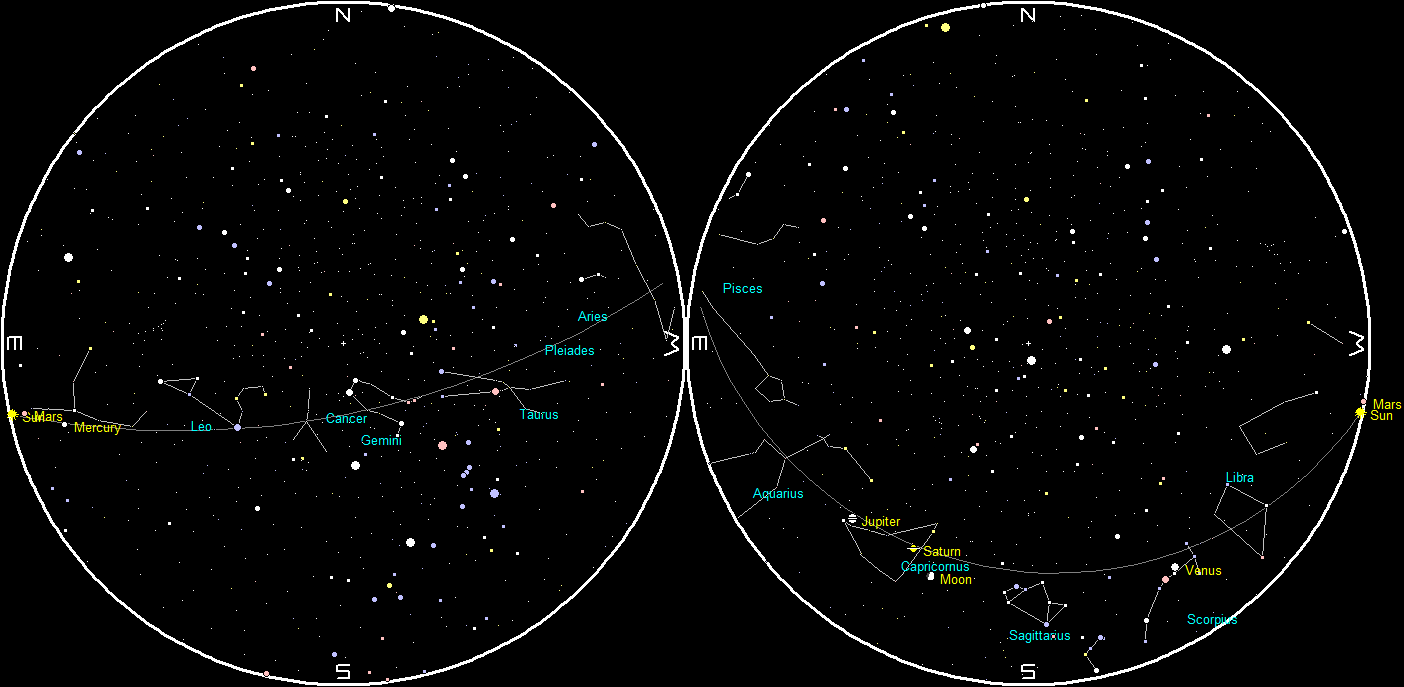
The naked-eye planets and the Moon at sunset and sunrise on a single night, starting with sunset on the right on October 13, 2021. The night ends on the left with sunrise on the 14th. It looks like Mercury will be far enough from the Sun next week to spot in the morning. Click on the image to enlarge it. Created using my LookingUp program.
10/12/2021 – Ephemeris – It’s Ada Lovelace Day!
This is Bob Moler with Ephemeris for Ada Lovelace Day, Tuesday, October 12th. Today the Sun will be up for 11 hours and 8 minutes, setting at 7:02, and it will rise tomorrow at 7:56. The Moon, at first quarter today, will set at 11:50 this evening.
Saturn has stopped its retrograde or westward motion against the stars of Capricornus and today has resumed its normal eastern motion.
Ada Lovelace, or more properly Augusta Ada King, Countess of Lovelace, was the daughter of Lord Byron and worked for Charles Babbage, and is considered the first computer programmer. She devised a way to use the same punch cards that were used on the Jacquard loom to store and run her programs, even though Babbage was unable to complete his mechanical computer the Analytic Engine in the mid 1800s. This day is set aside to celebrate the accomplishments of all the women of Science, Technology, Engineering and Math, (STEM). The computer language Ada, named after her, was created for the US Department of Defense.
The astronomical event times given are for the Traverse City/Interlochen area of Michigan (EDT, UT-4 hours). They may be different for your location.
Addendum

Ada, Countess of Lovelace (1815-1852) considered the first computer programmer, even though the machine she wrote code for was never completed. Credit: Science & Society Picture Library.

Part of Charles Babbage’s Analytical Engine on display, in 1843, left of center in this engraving of the King George III Museum in King’s College, London. Unknown engraver.
10/11/2021 – Ephemeris – It’s Indigenous Peoples Day
This is Ephemeris for Indigenous Peoples Day, Monday, October 11th. Today the Sun will be up for 11 hours and 11 minutes, setting at 7:04, and it will rise tomorrow at 7:54. The Moon, 1 day before first quarter, will set at 10:46 this evening.
Today the United States celebrates Columbus Day, a Monday near the date Christopher Columbus landed on a Caribbean island, and found people who got there at least 15 thousand years earlier. Due to superior technology, and nothing else really, the Europeans conquered the peoples of the continents they called the Americas, deeming the indigenous peoples, incorrectly, as savages. My astronomical journey started with learning the constellations and stories from the ancient Greeks. About nine years ago I began to investigate the constellations and stories of the Anishinaabe peoples, whose ancestral lands we live on, which turn out to be as rich and meaningful as those I learned in my youth from the Old World.
The astronomical event times given are for the Traverse City/Interlochen area of Michigan (EDT, UT-4 hours). They may be different for your location.
Addendum

The Anishinaabe saw North America as Turtle Island. Credit: www.rabbitandbearpaws.com.Of course, some whites still think the Earth is 6,000 years old and flat.

