Archive
Ephemeris: 10/21/2025 – Finding Andromeda
This is Ephemeris for Tuesday, October 21st. Today the Sun will be up for 10 hours and 41 minutes, setting at 6:47, and it will rise tomorrow at 8:07. The Moon is new today, and won’t be visible.
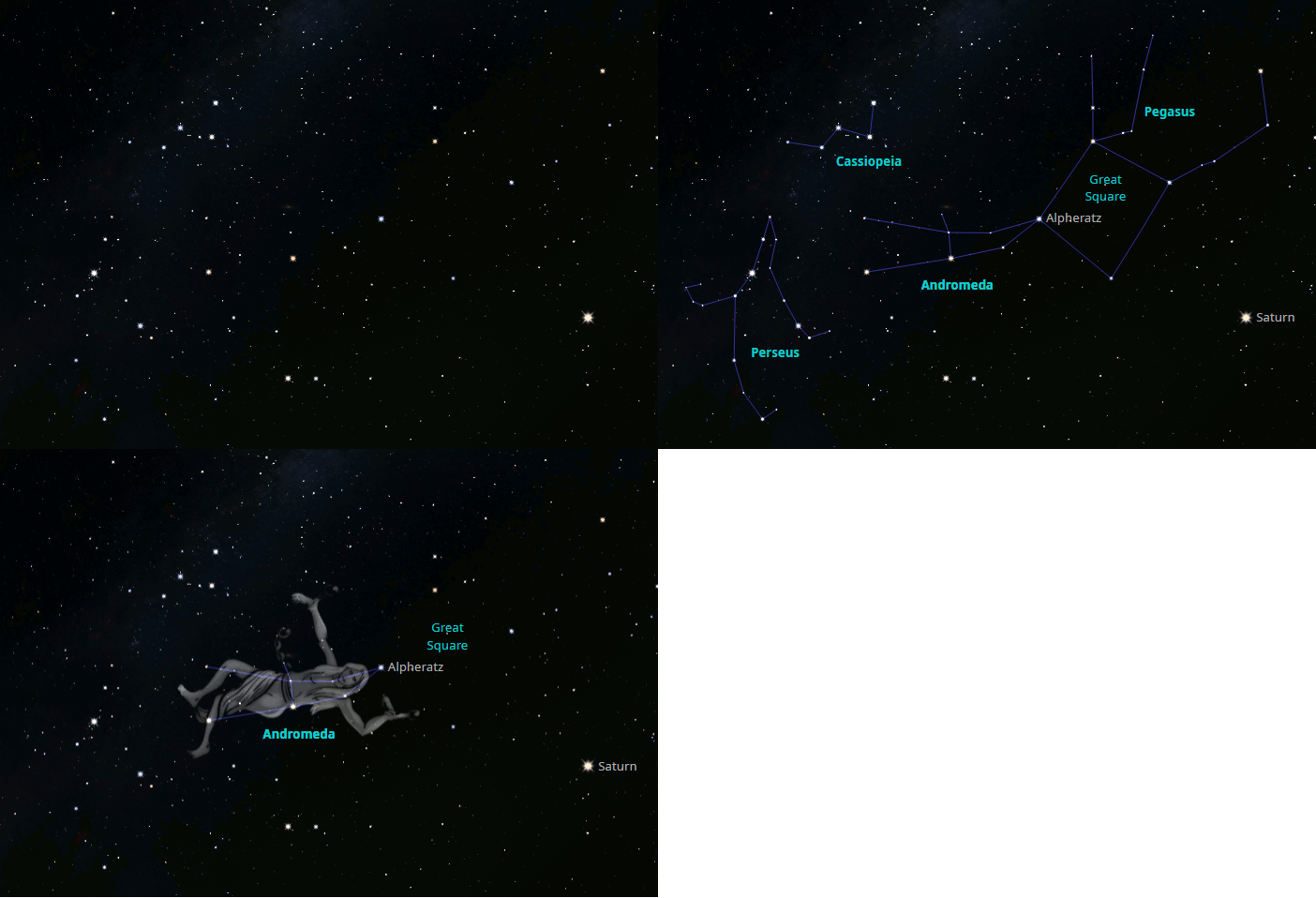
Tonight at 9:00 PM Saturn is in the southeast, with the Great Square of Pegasus above and to the left. Off the leftmost star of the Great Square, called Alpheratz, are two curved lines of stars to the left and a bit below, and slightly diverging. They might be mistaken for the hind legs of the horse, which is flying upside down. It’s another constellation, that of Andromeda the Princess, daughter of Cassiopeia, the W shaped constellation to the upper left. Andromeda was rescued by hero Perseus which is another constellation left of her, which we’ll get to later on this week. Andromeda’s claim to scientific fame is the large galaxy located there, the Great Andromeda Galaxy, probably the farthest thing one can spot with the naked eye.
The astronomical event times given in this blog are for the Traverse City/Interlochen area of Michigan (Lat 44.7° N, Long 85.7° W; EDT, UT – 4 hours) unless stated otherwise. Times will be different for other locations.
Addendum
Andromeda is part of the Great Star Story of Autumn. My take on it is linked Here.
Ephemeris: 09/30/2024 – Andromeda’s treasure, its great galaxy
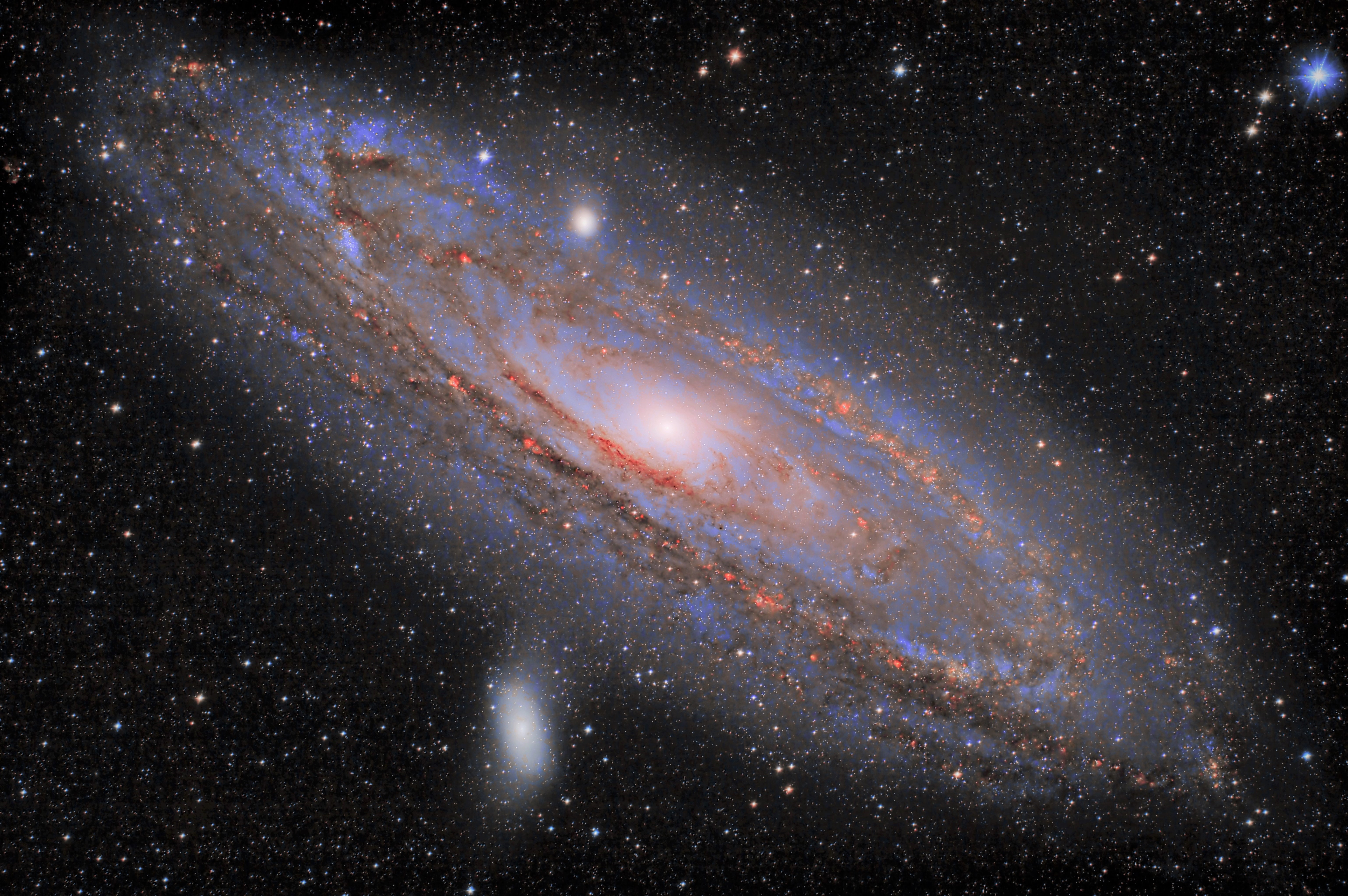
This is Bob Moler with Ephemeris for Monday, September 30th. Today the Sun will be up for 11 hours and 43 minutes, setting at 7:24, and it will rise tomorrow at 7:41. The Moon, 2 days before new, will rise at 6:27 tomorrow morning. | For at least the last thousand or so years a fuzzy spot in the constellation of Andromeda has been known. It was known as the Great Andromeda Nebula until about 100 years ago. Nebula means cloud, and it belonged to the Milky Way. At that time it was finally recognized as another Milky Way just like ours. So the word to call it was galaxy, a word that means Milky Way. It looks to be among the stars of Andromeda, but it’s far beyond the stars that we make of the constellation Andromeda. Current estimates place it at about two and a half million light years away, well beyond the stars that we see in Andromeda that range to only a few thousand light years distance. It will collide with our galaxy in about 4 billion years.
The astronomical event times given are for the Traverse City/Interlochen area of Michigan (EDT, UT – 4 hours). Times will be different for other locations.
Addendum
Ephemeris: 09/24/2024 – Pegasus is rising on autumn evenings
This is Ephemeris for Tuesday, September 24th. Today the Sun will be up for 12 hours and 2 minutes, setting at 7:35, and it will rise tomorrow at 7:34. The Moon, at last quarter today, will rise at 11:47 this evening.
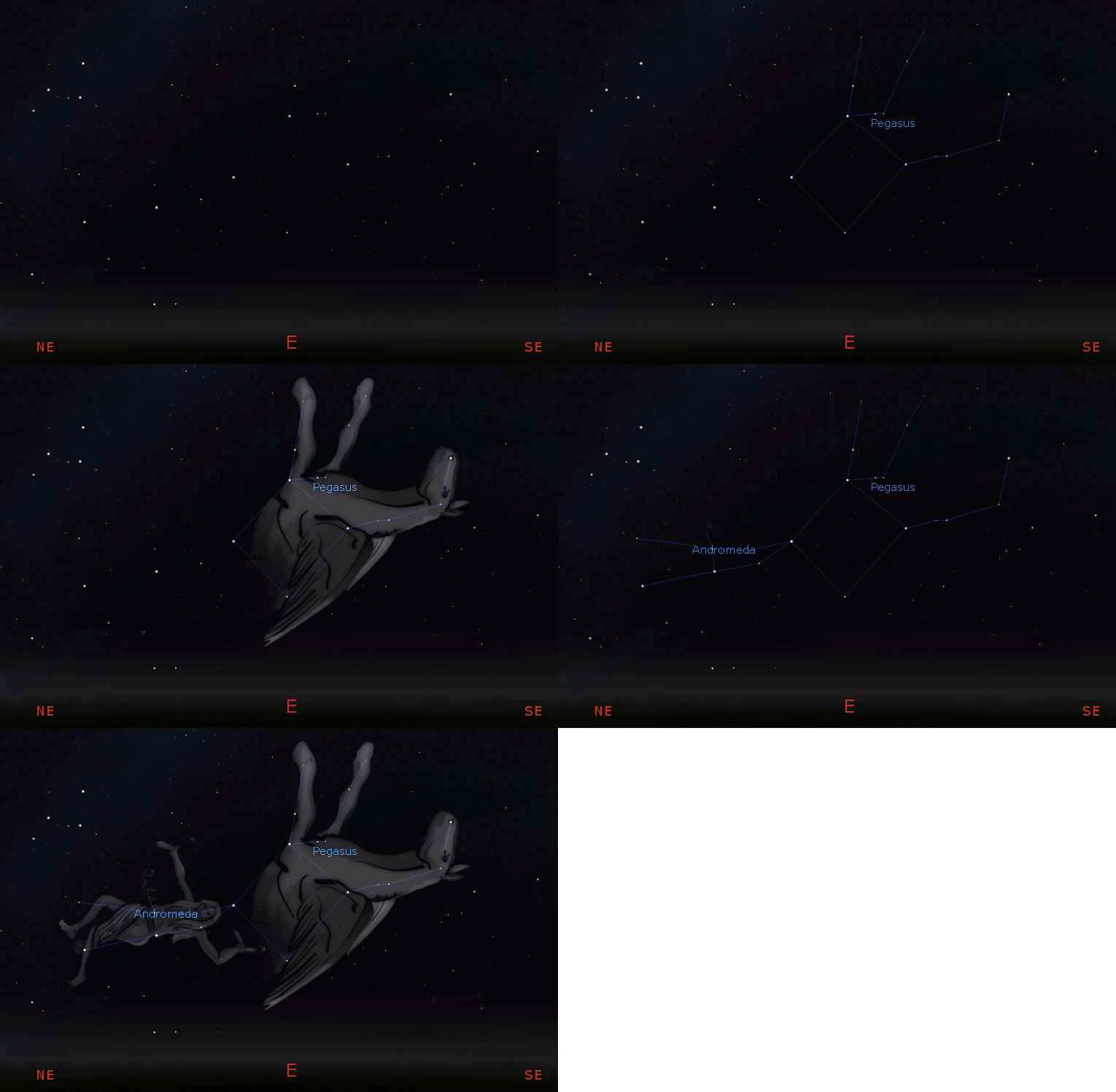
While we’ve been watching the stars and constellations of summer and the Milky Way, the constellations of autumn have been sneaking up on us from the east. About halfway up the sky in the east at 9 PM is one of the greatest constellations of autumn, Pegasus the flying horse. Her body or at least the front part of it is a large square of stars called the Great Square of Pegasus. It is an almost perfect rectangle. However, as she’s rising, it’s standing on one corner. From the upper star are her front legs, from the rightmost star her neck and head extend in the stars. And from the left star of the square are what might look like her hind legs but aren’t. Only half of her body is in the stars. It’s another constellation, Andromeda, which we’ll talk about later.
The astronomical event times given are for the Traverse City/Interlochen area of Michigan (EDT, UT – 4 hours). Times will be different for other locations.
Addendum
Ephemeris: 11/07/2023 – How to find the Great Andromeda Galaxy
This is Ephemeris for Election Day for some, Tuesday, November 7th. Today the Sun will be up for 9 hours and 55 minutes, setting at 5:23, and it will rise tomorrow at 7:30. The Moon, 2 days past last quarter, will rise at 2:22 tomorrow morning.
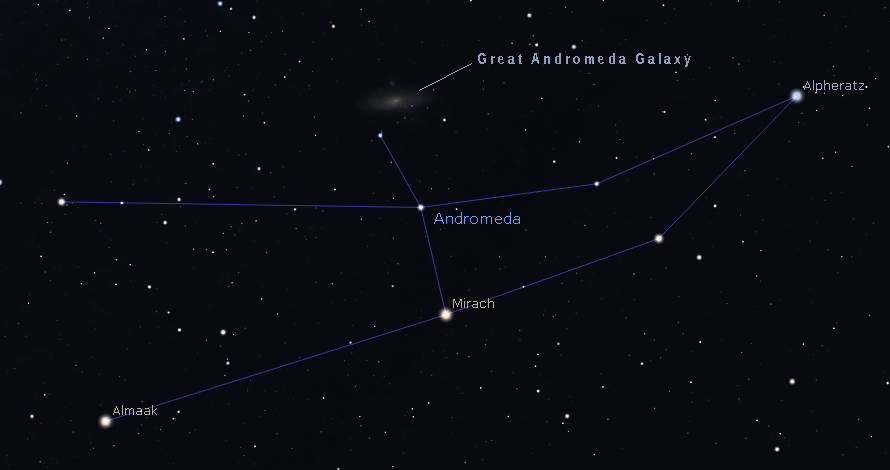
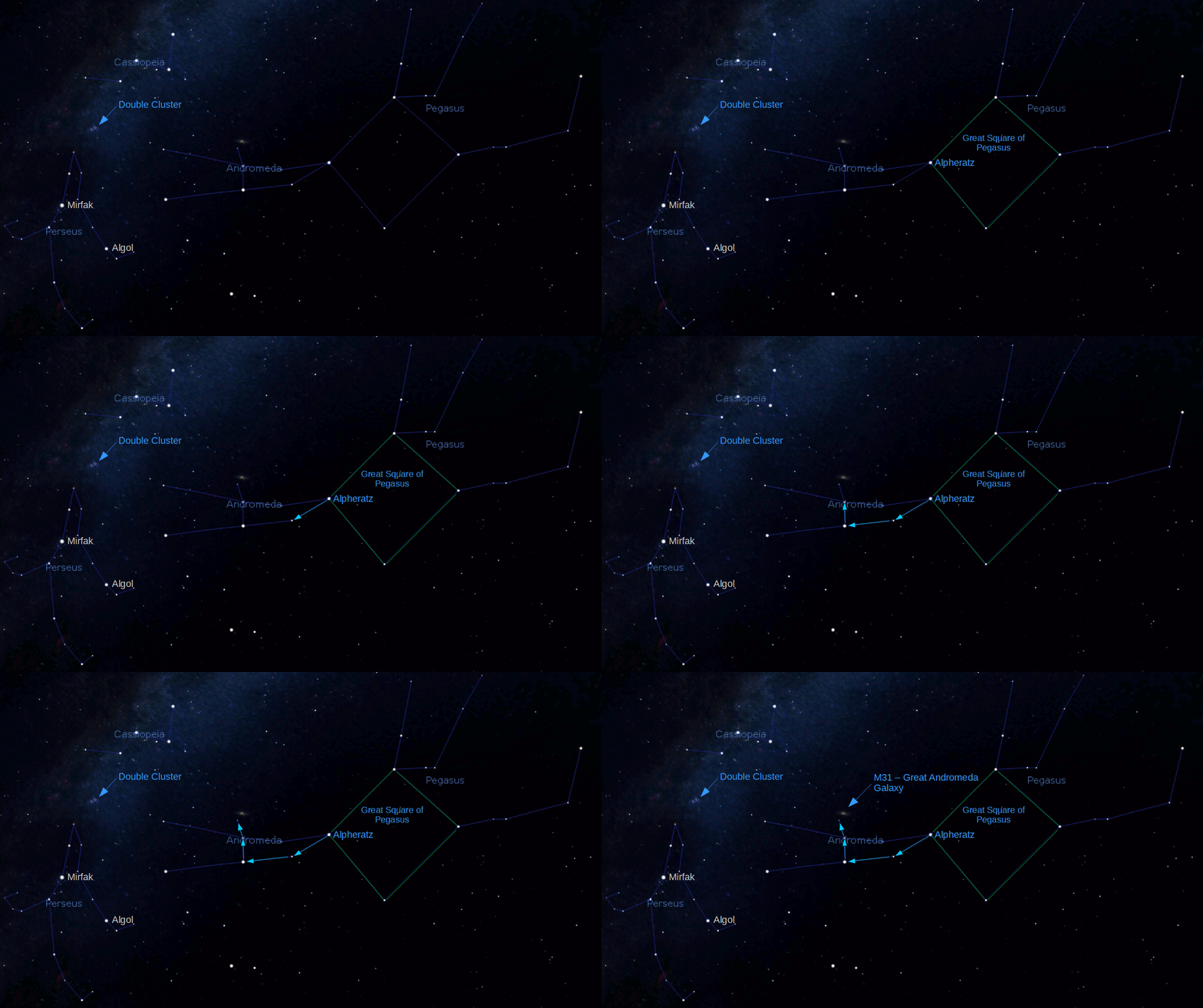
The closest large galaxy to our Milky Way galaxy is the Great Andromeda Galaxy, seen high in the eastern sky when it gets dark. It is barely visible to the naked eye. To locate it, first find a large square of stars high in the east-southeast standing on one corner, the Great Square of Pegasus. The left star of the square is the head of the constellation Andromeda. Follow two stars to the left and a bit downward, then two stars straight up. The galaxy is near that last star as a small smudge of light. Binoculars are the best way to see it as a thin spindle of light. Using a telescope, one can see, besides its nucleus, its two satellite galaxies.
The astronomical event times given are for the Traverse City/Interlochen area of Michigan (EST, UT –5 hours). They may be different for your location.
Addendum
Ephemeris: 10/16/2023 – Finding the constellation of Andromeda
This is Ephemeris for Monday, October 16th. Today the Sun will be up for 10 hours and 57 minutes, setting at 6:56, and it will rise tomorrow at 8:00. The Moon, 2 days past new, will set at 7:43 this evening.
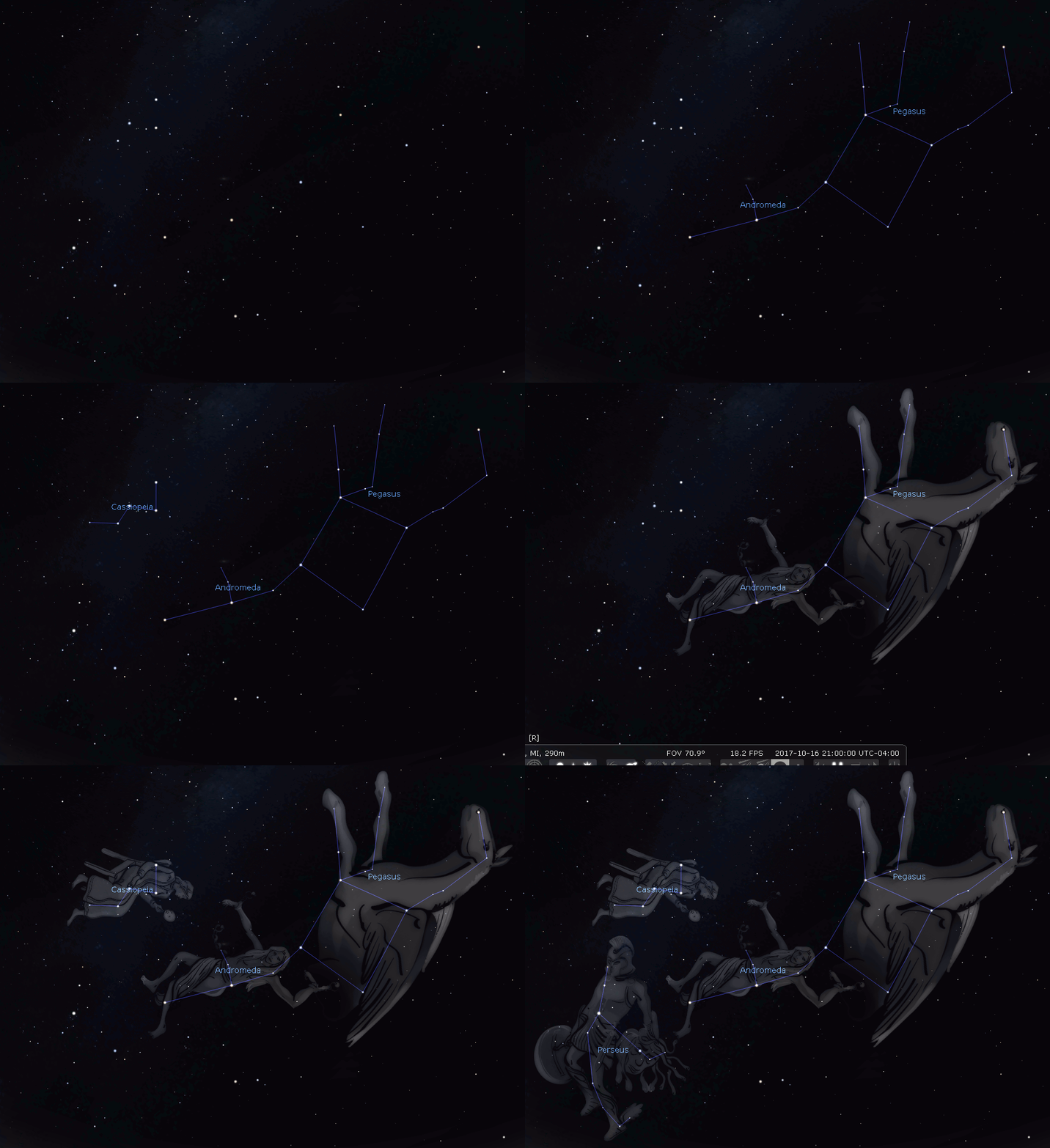
In the east at 9 this evening can be found a large square of stars, the Great Square of Pegasus the upside down flying horse. The square is standing on one corner. What looks like its hind legs stretching away from the left corner star is another constellation, Andromeda the chained princess. She is seen in the sky as two nearly horizontal but diverging curved strings of stars that curve upward. She was doomed to be devoured by a sea monster that was ravaging the coast due to her mother, Queen Cassiopeia’s boasting, which angered the god Poseidon. She was rescued by the hero Perseus, a nearby constellation, riding his steed Pegasus.
The astronomical event times given are for the Traverse City/Interlochen area of Michigan (EDT, UT –4 hours). They may be different for your location.
Addendum
Ephemeris: 09/19/23 – How to find Pegasus in the sky
This is Ephemeris for Tuesday, September 19th. Today the Sun will be up for 12 hours and 20 minutes, setting at 7:46, and it will rise tomorrow at 7:27. The Moon, 3 days before first quarter, will set at 9:39 this evening.
Looking eastward at around 9 pm, one of the great constellations of autumn. A season that will start in four days. It is Pegasus the flying horse of Greek myth. Its most visible feature is a large square of four stars, now standing on one corner. This feature, called the Great Square of Pegasus, represents the front part of the horse’s body. The horse is quite aerobatic, because it is seen flying upside down. Remembering that fact, the neck and head is a bent line of stars emanating from the right corner star of the square. Its front legs can be seen in a gallop extending to the upper right from the top star of the square. From the left star extend, not hind legs but the constellation of Andromeda, the princess rescued with the help of Pegasus.
The astronomical event times given are for the Traverse City/Interlochen area of Michigan (EDT, UT –4 hours). They may be different for your location.
10/17/022 – Ephemeris – Andromeda, damsel in distress
This is Ephemeris for Monday, October 17th. Today the Sun will be up for 10 hours and 53 minutes, setting at 6:54, and it will rise tomorrow at 8:02. The Moon, at last quarter today, will rise at 12:18 tomorrow morning
In the east at 9 this evening can be found a large square of stars, the Great Square of Pegasus the upside down flying horse. The square is standing on one corner. What looks like its hind legs stretching to the left from the left corner star is another constellation, Andromeda the chained princess. She is seen in the sky as two nearly horizontal but diverging curved strings of stars that curve upward. She was doomed due to her mother, Queen Cassiopeia’s boasting, which angered the god Poseidon. She was rescued by the hero Perseus, a nearby constellation, riding his steed Pegasus. Andromeda’s claim to scientific fame is the large galaxy seen as a faint fuzzy spot with the naked-eye just above the upper line of stars. The Great Andromeda Galaxy is two and a half million light years away.
The astronomical event times given are for the Traverse City/Interlochen area of Michigan (EDT, UT – 4 hours). They may be different for your location.
Addendum
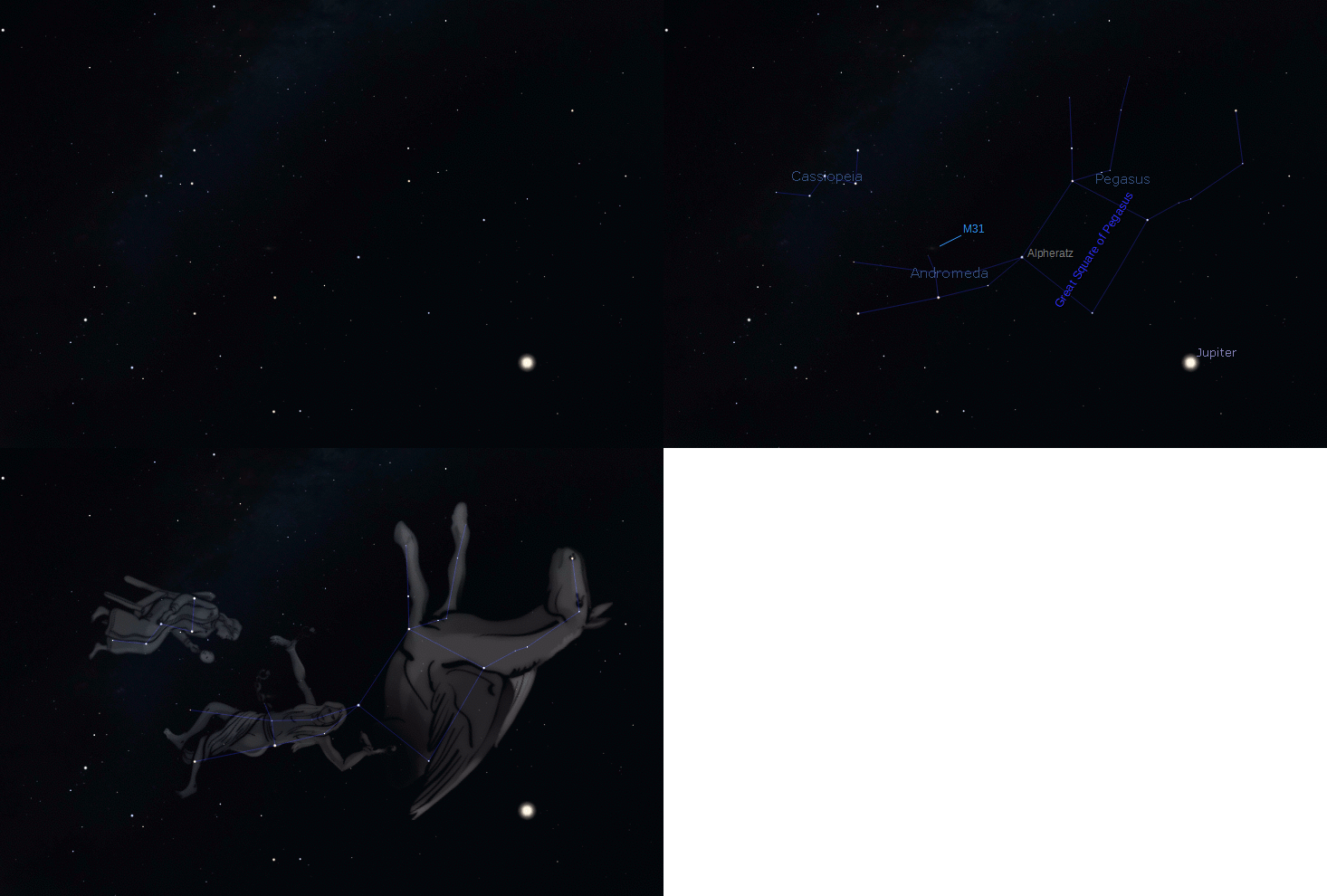
Andromeda finder animation looking east at 9 pm tonight, October 17, 2022. The left corner star of the Great Square of Pegasus is called Alpheratz, and actually belongs to Andromeda. The faint fuzzy spot labeled M31 is the Great Andromeda Galaxy, the Milky Way’s large neighbor. I’ll talk more about it tomorrow. Click on the image to enlarge it. Created using Stellarium and GIMP.
I’ve related Andromeda’s story in my post The Great Star Story of Autumn.
09/28/2021 – Ephemeris – Andromeda, a damsel in distress
This is Bob Moler with Ephemeris for Tuesday, September 28th. Today the Sun will be up for 11 hours and 50 minutes, setting at 7:28, and it will rise tomorrow at 7:38. The Moon, at last quarter today, will rise at 11:46 this evening.
In the east at 9 this evening can be found a large square of stars, the Great Square of Pegasus the flying horse. The square is standing on one corner. What looks like its hind legs stretching to the left from the left corner star is another constellation, Andromeda the chained princess. She is seen in the sky as two diverging curved strings of stars that curve upward. She was doomed due to her mother, Queen Cassiopeia’s boasting, which angered the god Poseidon. She was rescued by the hero Perseus, a nearby constellation, riding his steed Pegasus. Andromeda’s claim to astronomical fame is the large galaxy seen with the naked-eye just above the upper line of stars. The Great Andromeda Galaxy is two and a half million light years away.
The astronomical event times given are for the Traverse City/Interlochen area of Michigan (EDT, UT-4 hours). They may be different for your location.
Addendum
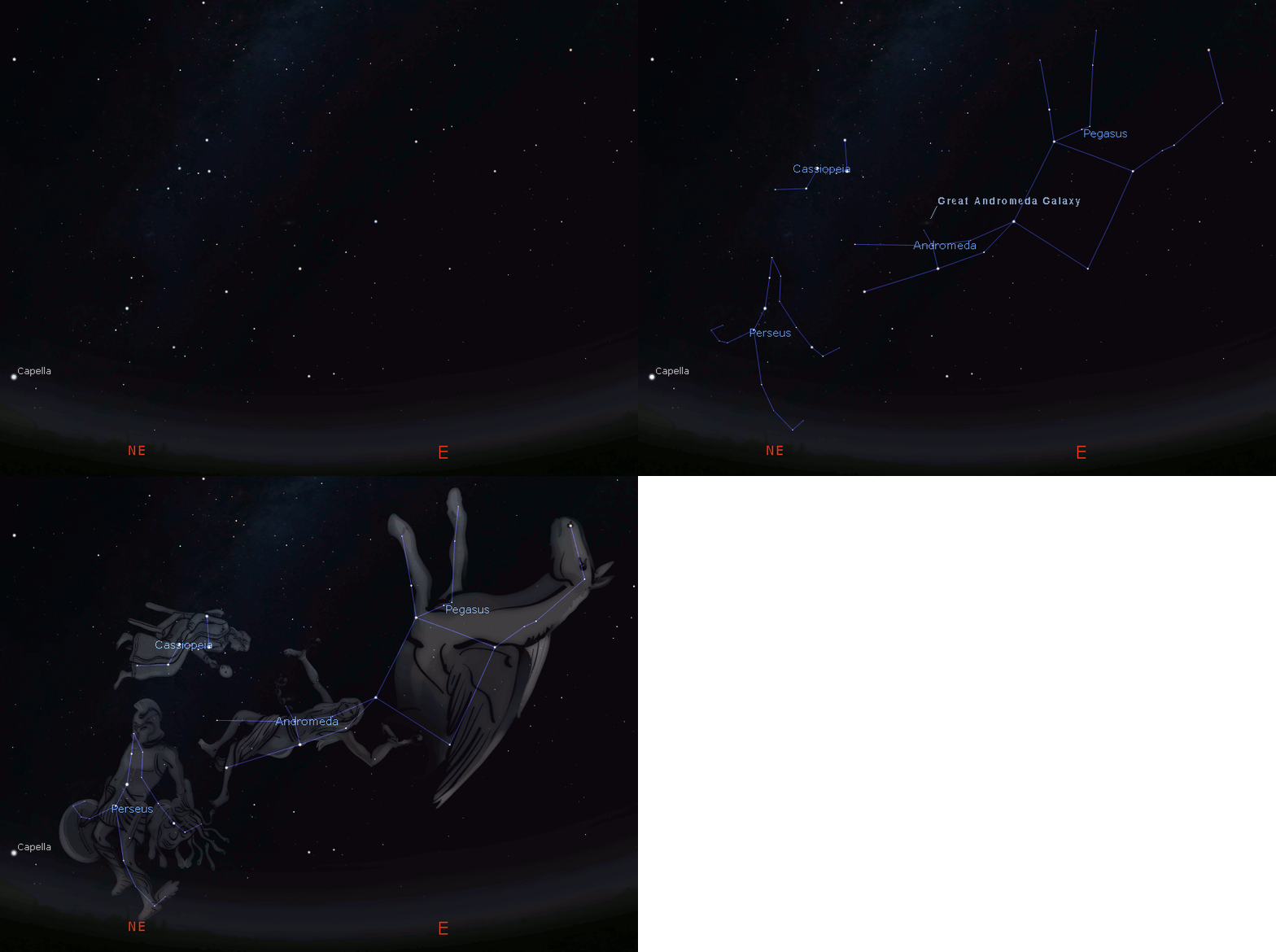
Andromeda finder animation surrounded by the other constellations in her story, except the monster, which will rise later. Click on the image to enlarge it. Created using Stellarium and GIMP.
Great Andromeda Galaxy finder chart. This image shows the galaxy almost to its fullest extent. In the finder animation above, the galaxy looks pretty much as it would to the naked eye. Click on the image to enlarge it. Created using Stellarium.
Astronomers often refer to this galaxy as M 31 for short. It was the 31st entry in Charles Messier’s catalog of objects that could be confused as being comets by comet hunters like himself. It was added in 1764. He didn’t care what these fuzzy objects were, just that they didn’t move against the background stars. Actually, M 31 is in the background. The stars are in the foreground, in our Milky Way Galaxy.
10/08/2020 – Ephemeris – A lady with a not so hidden jewel
This is Ephemeris for Thursday, October 8th. Today the Sun will be up for 11 hours and 19 minutes, setting at 7:09, and it will rise tomorrow at 7:51. The Moon, 1 day before last quarter, will rise at 11:09 this evening.
The stars of the constellations Andromeda the chained princess look like they’re supposed to be the hind legs of Pegasus the flying horse which is high in the southern sky above Mars at 9 p.m. Andromeda is high in the southeast She is seen in the sky as two diverging curved strings of stars that curve to the left and up from the upper leftmost star of the Great Square of Pegasus. Her predicament was caused by her boastful mother Cassiopeia, and the wrath of the god Poseidon. She was rescued by the hero Perseus, a nearby constellation, riding his steed Pegasus. Andromeda’s claim to astronomical fame is the large galaxy barely visible to the unaided eye just above the upper line of stars, the Great Andromeda Galaxy 2.5 million light years away.
The event times given are for the Traverse City/Interlochen area of Michigan. They may be different for your location.
Addendum
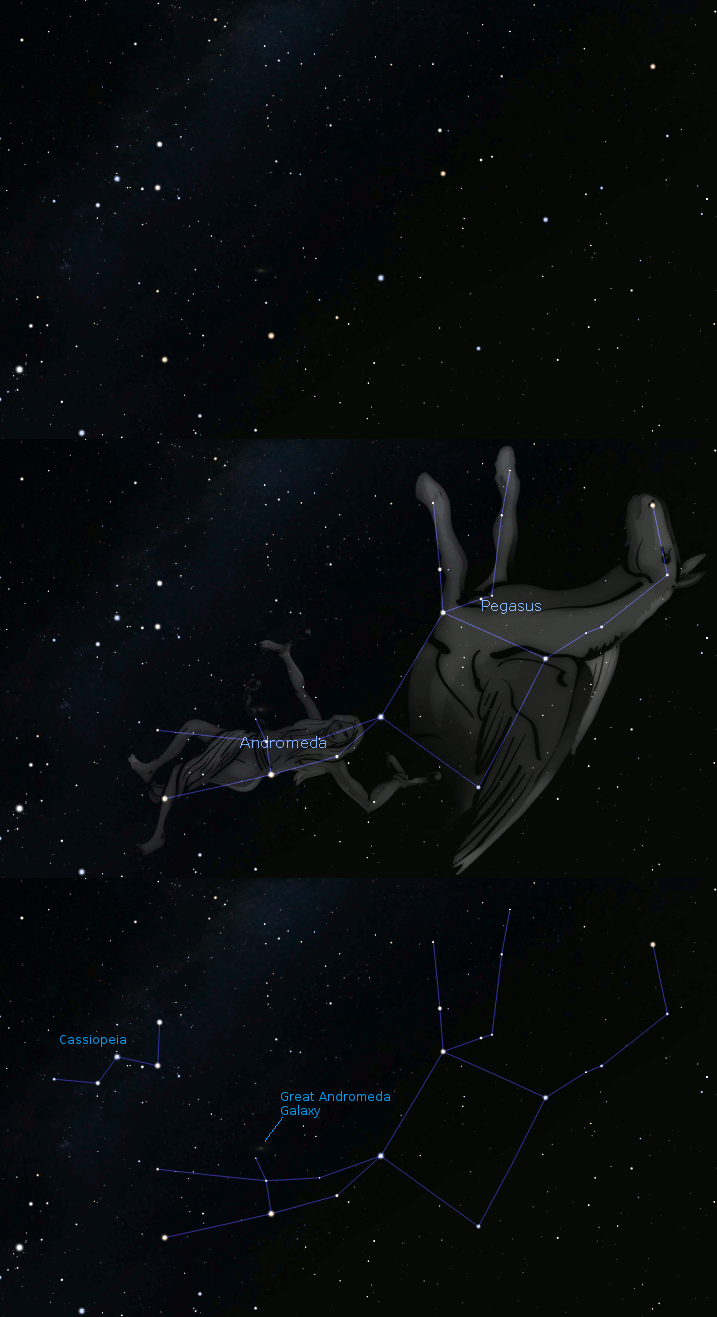
Andromeda animated finder, including the Great Andromeda Galaxy. I’ve added Cassiopeia that some folks use to find the galaxy. I start with the leftmost star of the Great Square of Pegasus that connects to Andromeda. I count off two star on the lower curve because they are brighter than the upper curve. Then count two stars up. Next to that top star is a little smudge. That is the core of the Great Andromeda Galaxy. Created using Stellarium and GIMP.
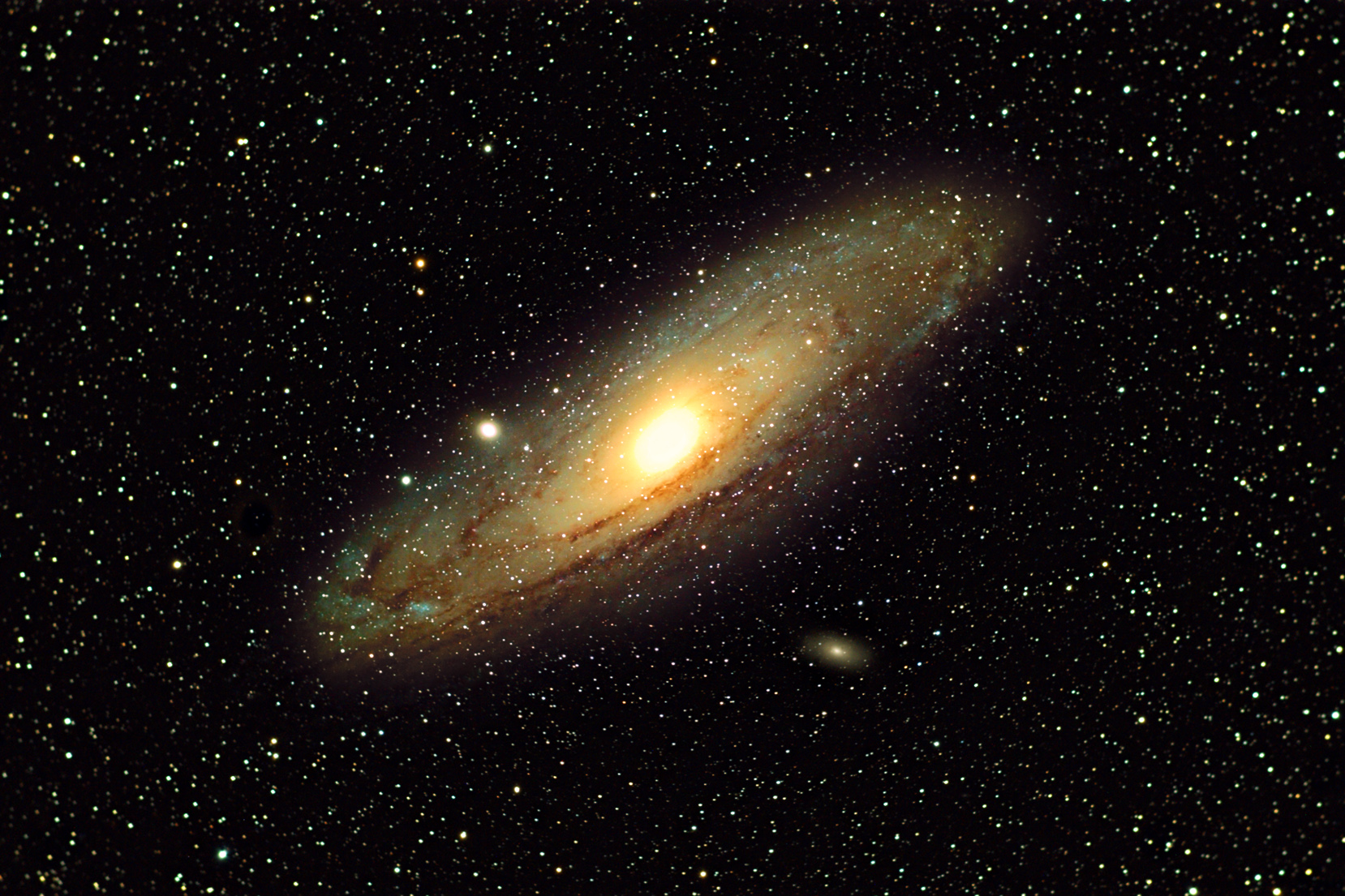
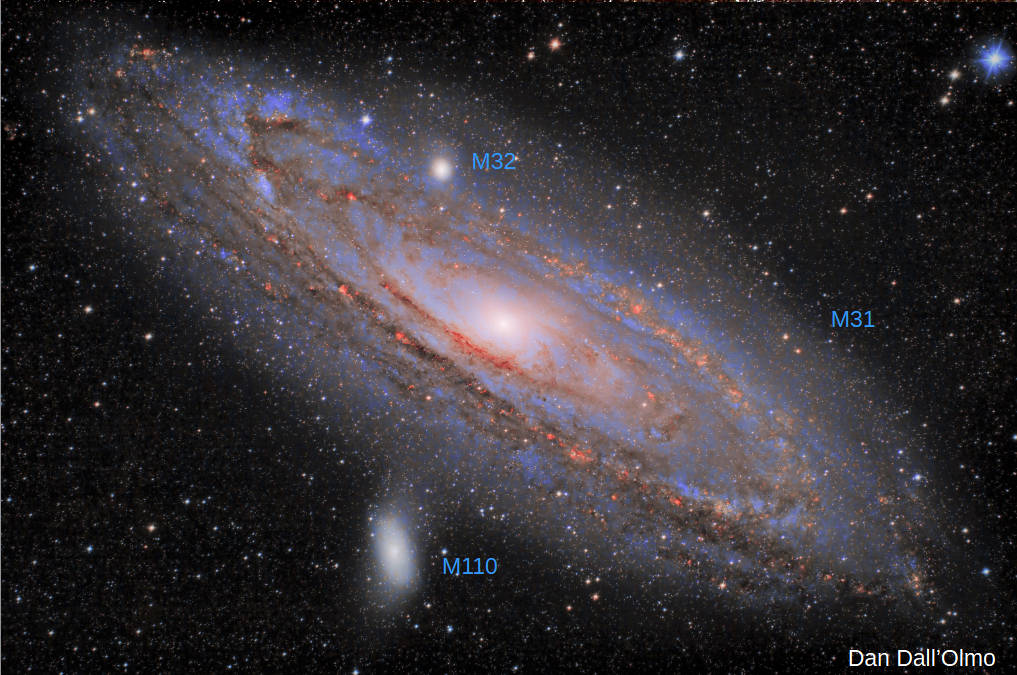
The Great Andromeda Galaxy (M31) and two of its satellite galaxies M31 (left) and M110. Image taken by Scott Anttila.
09/26/2019 – Ephemeris – Looking for Andromeda
Ephemeris for Thursday, September 26th. Today the Sun will be up for 11 hours and 58 minutes, setting at 7:33, and it will rise tomorrow at 7:35. The Moon, 2 days before new, will rise at 5:49 tomorrow morning.
In the east at 9 this evening can be found a large square of stars, the Great Square of Pegasus the flying horse. The square is standing on one corner. What look like its hind legs stretching to the left from the left corner star is another constellation, Andromeda the chained maiden. She is seen in the sky as two diverging curved strings of stars that curve upward. She was rescued by the hero Perseus, a nearby constellation, riding his steed Pegasus. Andromeda’s claim to astronomical fame is the large galaxy seen with the unaided eye just above the upper line of stars, the Great Andromeda Galaxy, about 2 and a half million light years away. To the unaided eye the galaxy appears as a small smudge of light. In binoculars the galaxy is a delicate spindle of light.
The times given are for the Traverse City/Interlochen area of Michigan. They may be different for your location.
Addendum
Pegasus & Andromeda animated finder chart for 9 p.m. in late September. Created using Stellarium and GIMP.
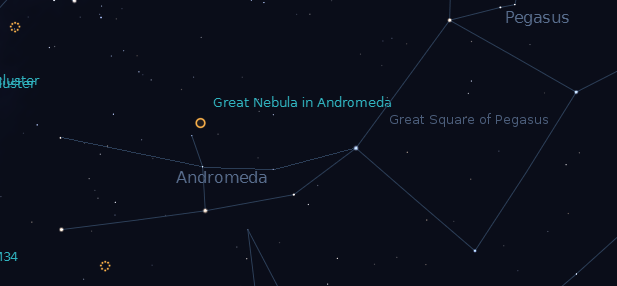
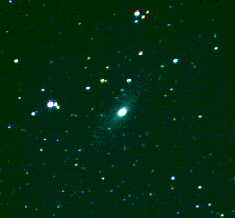
Andromeda at 9 p.m. with the Great Andromeda Galaxy. Created using Stellarium.
The Great Andromeda Galaxy (M31). Image taken by Scott Anttila.
 Bob Moler's Ephemeris Blog