Archive
Ephemeris: 02/17/2026 – There’s an annular solar eclipse today… if you’re a penguin
This is Ephemeris for Fat Tuesday, February 17th. Today the Sun will be up for 10 hours and 34 minutes, setting at 6:14, and it will rise tomorrow at 7:38. The Moon is new today, and won’t be visible.
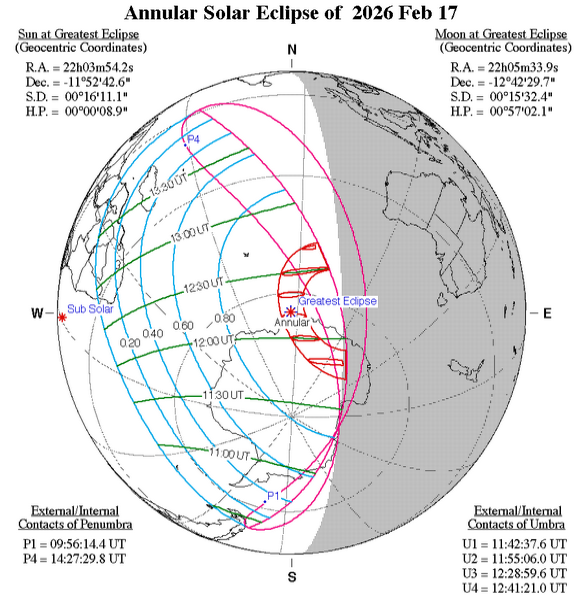
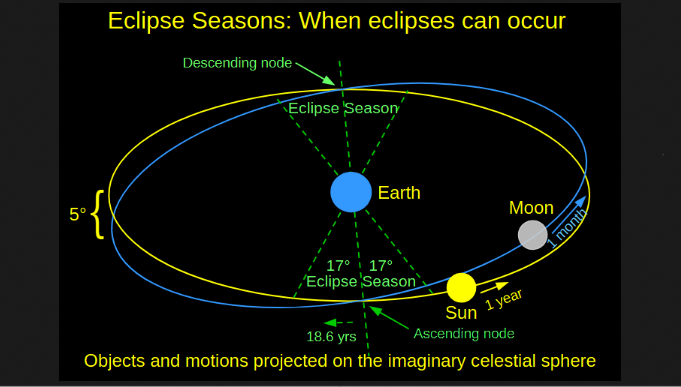
This morning there is an annular solar eclipse occurring. Don’t run outside to see it, especially if you’re here in northern Michigan. The eclipse is only visible in the Southern Ocean and Antarctica. However, this eclipse marks the beginning of an eclipse season, and we will have an eclipse that will be visible for our location in two weeks: a total lunar eclipse, which will be visible before sunrise on Tuesday morning, March 3rd. There are two periods were eclipses will occur in a year, with at least one of the sun and the moon. These periods are separated by a little less than six months, and last about 35 days. That’s about 5 1/2 days longer than a lunar month, so it is possible to squeeze in another eclipse, though not this time.
The astronomical event times given in this blog are for the Traverse City/Interlochen area of Michigan (Lat 44.7° N, Long 85.7° W; EST, UT – 5 hours) unless stated otherwise. Times will be different for other locations.
Addendum
Ephemeris: 10/12/2023 – Saturday’s (October 14, 2023) Annular Solar Eclipse
This is Bob Moler with Ephemeris for Thursday, October 12th. Today the Sun will be up for 11 hours and 9 minutes, setting at 7:03, and it will rise tomorrow at 7:55. The Moon, 2 days before new, will rise at 6:39 tomorrow morning.
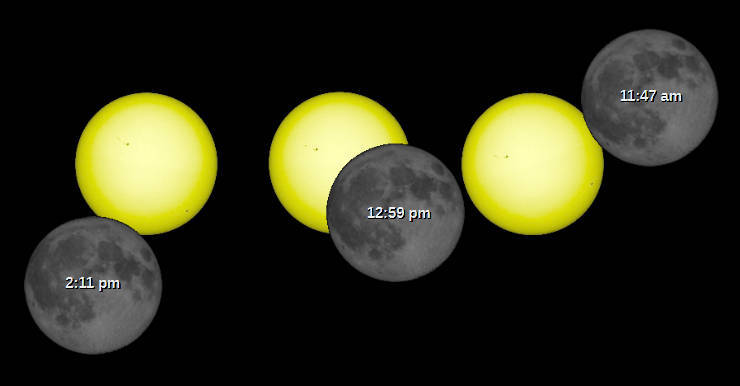
There will be a partial solar eclipse Saturday for most of the unit for the 48 Continental United States. It will be maximum on a line from Oregon through Texas. It’s called an annular eclipse. At its maximum an annular eclipse is an eclipse where the Moon is too far away to completely cover the face of the Sun so at maximum it leaves a ring of the Sun. Some call it a Ring of Fire. We’re well north of that line so we will see a partial eclipse where about 35% of the Sun will be covered by the Moon at its peak, although the Moon will encroach about 45% of the diameter of the Sun. For northern Michigan the eclipse will start at about 11:42 am, maximum eclipse is about 1 pm and the eclipse will end at 2:18 pm. I’ll talk about eclipse viewing safety tomorrow.
The astronomical event times given are for the Traverse City/Interlochen area of Michigan (EDT, UT –4 hours). They may be different for your location.
Addendum
05/05/2023 – Ephemeris – Learn about the upcoming total solar eclipse tonight
This is Ephemeris for Cinco de Mayo, Friday, May 5th. Today the Sun will be up for 14 hours and 25 minutes, setting at 8:52, and it will rise tomorrow at 6:25. The Moon, at full today, will rise at 9:13 this evening.
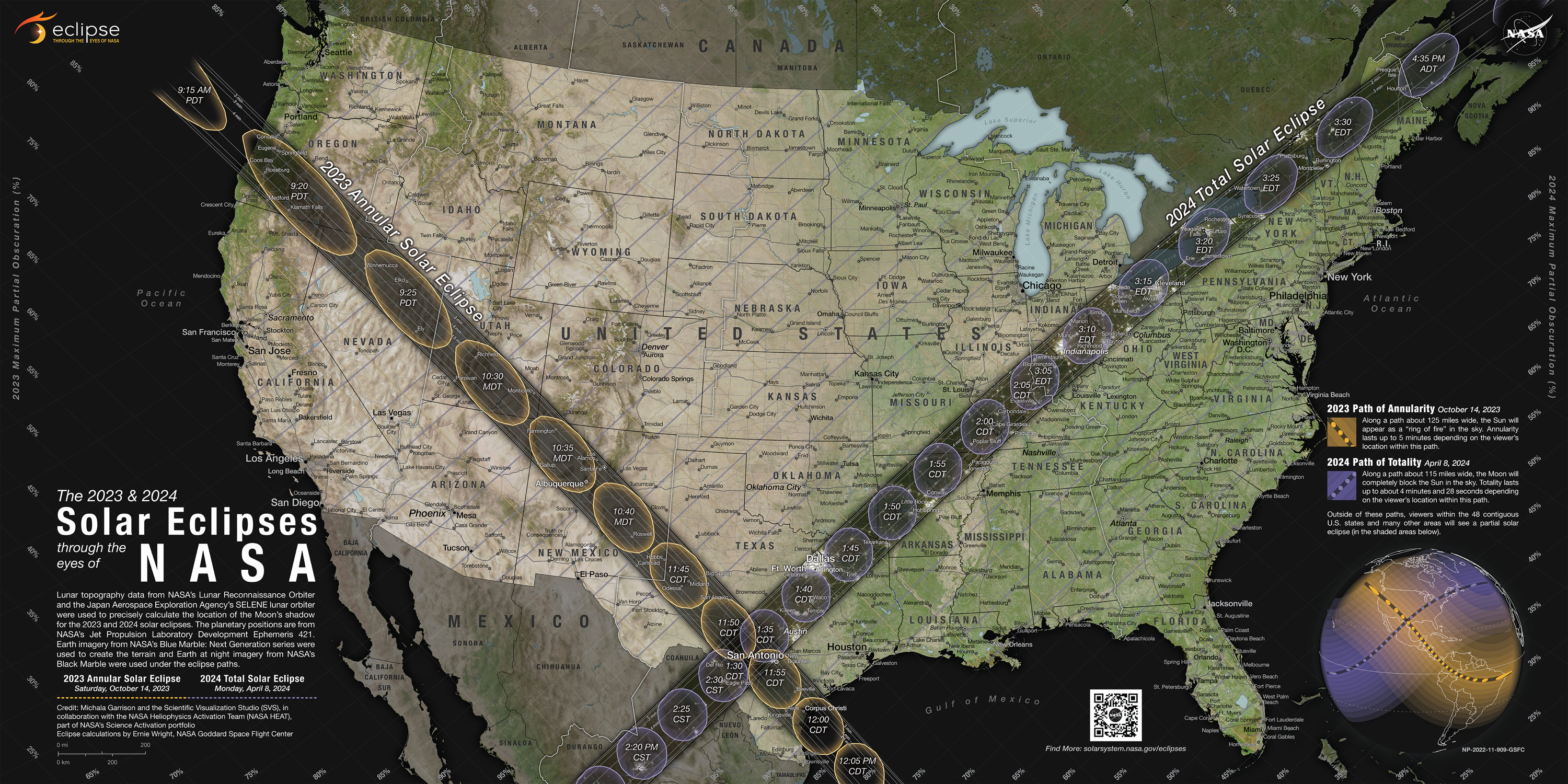
Eleven months is not too early to plan for a total solar eclipse. On April 8th next year there will be such an eclipse whose path of totality clips the southeastern corner of Michigan. Indianapolis, Toledo and Cleveland also lie in the path of totality. The path runs from Texas to Maine. Member Dan Dall’Olmo will have all the particulars at this month’s meeting of the Grand Traverse Astronomical Society, starting at 8 pm tonight at Northwestern Michigan College’s Joseph H. Rogers Observatory. For those staying home, the Sun for this eclipse will be a bit more covered by the Moon than the 2017 August solar eclipse. We’ll also have another partial solar eclipse to practice on this October 14th.
The astronomical event times given are for the Traverse City/Interlochen area of Michigan (EDT, UT –4 hours). They may be different for your location.
Addendum
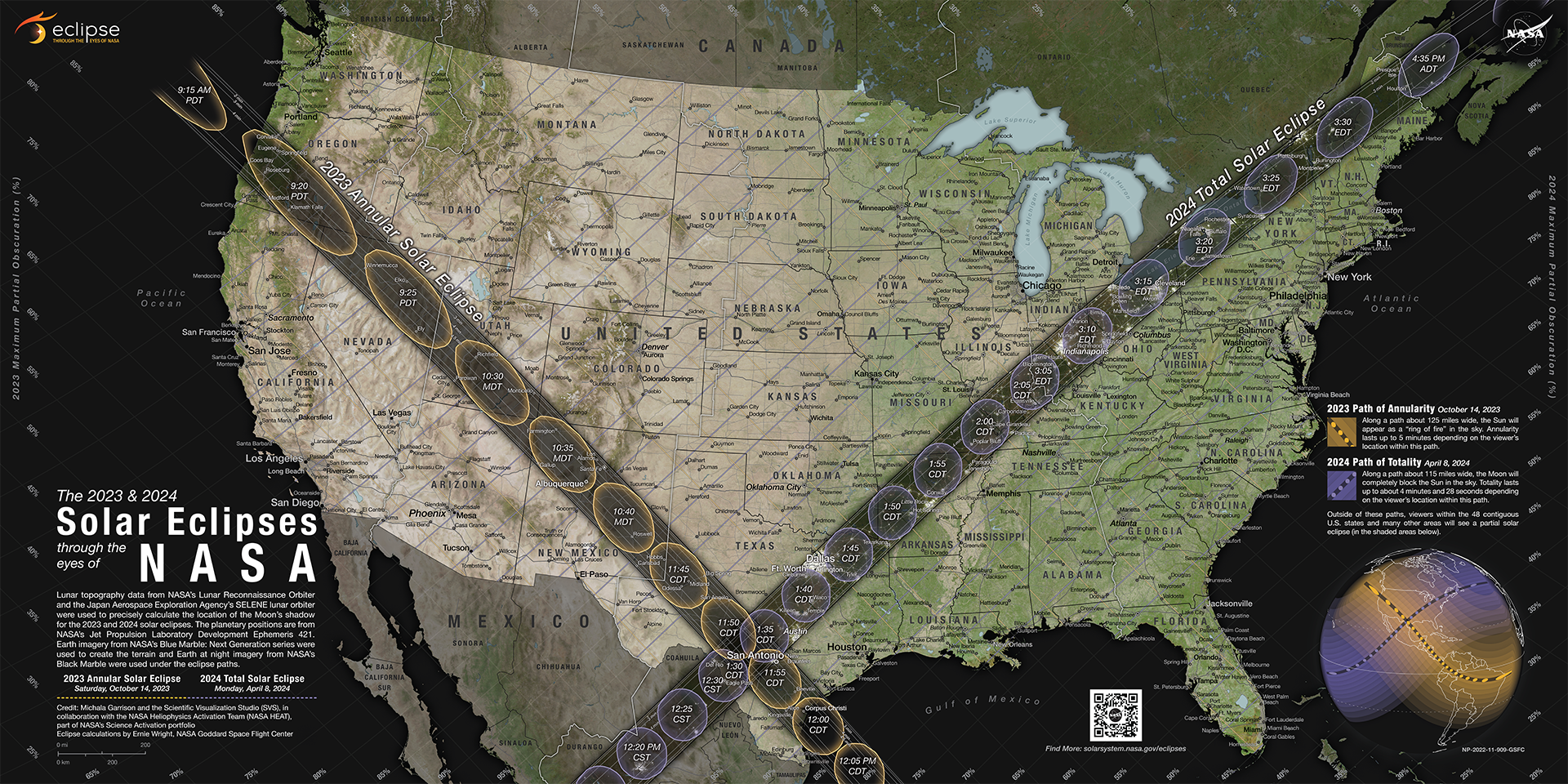
The paths of maximum eclipse of the October 14, 2023, and April 8, 2024. Click or tap on the image to enlarge it. Credit: NASA/Scientific Visualization Studio/Michala Garrison; eclipse calculations by Ernie Wright, NASA Goddard Space Flight Center.
05/16/2022 – Ephemeris – More eclipses in our future
This is Ephemeris for Monday, May 16th. Today the Sun will be up for 14 hours and 52 minutes, setting at 9:05, and it will rise tomorrow at 6:12. The Moon, at full today, will rise at 10:13 this evening.
Last night’s eclipse was the only eclipse that was visible in our area this year. However, in the next two years we will have a chance, weather permitting, to see two partial solar eclipses, the second of which will be even better than the partial solar eclipse seen here in August 2017. On October 14, 2023, there will be an annular eclipse. An annular eclipse is where the Moon is too far away to completely cover the face of the Sun. It leaves a ring of bright sun around the Moon. The technical term for a ring like that is annulus. The path of annularity will run from Oregon to Texas. For the Grand Traverse Area of Michigan, the Moon will cover less than half the face of the Sun. On April 8, 2024, the total eclipse path will run from Texas to Maine and just nip the Southeast corner of Michigan covering, for us in the Grand Traverse Area, about 85 percent of the Sun.
The astronomical event times given are for the Traverse City/Interlochen area of Michigan (EDT, UT – 4 hours). They may be different for your location.
Addendum
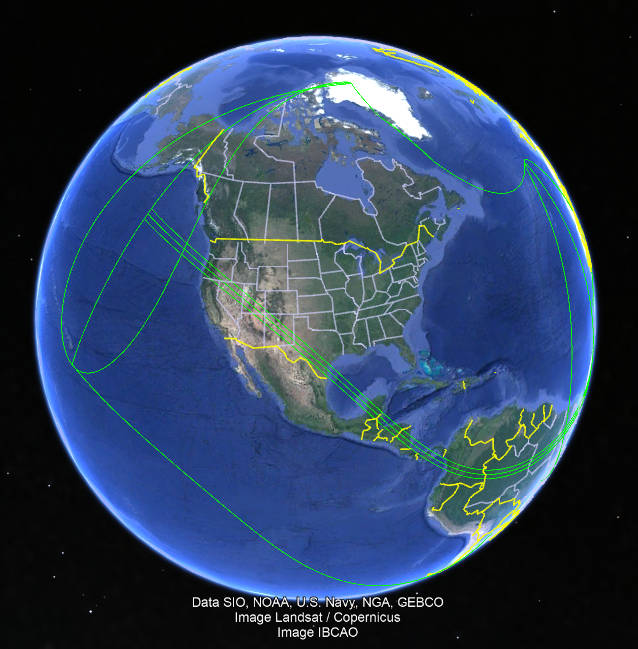
The areas where the October 14, 2023 solar eclipse can be seen are bounded by the outer green lines. The path where the annular part of the eclipse is visible is denoted by the triple green lines. Plotted on Google Earth using a file created by Occult4 software from the International Occultation Timing Association.
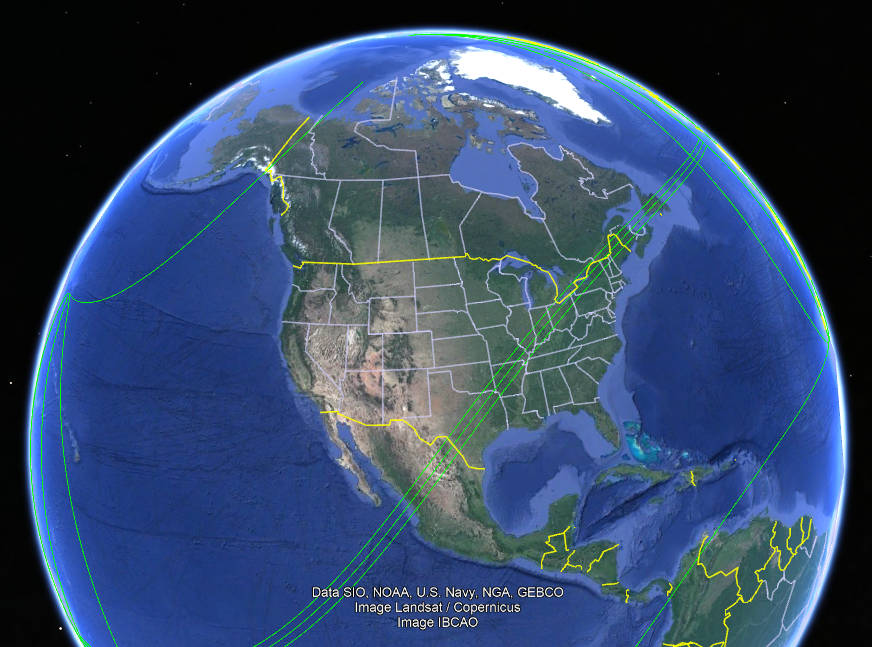
The areas across the U.S. where the April 8, 2024 solar eclipse can be seen are bounded by the outer green lines. The path where the total part of the eclipse is visible is denoted by the triple green lines. Plotted on Google Earth using a file created by Occult4 software from the International Occultation Timing Association.
06/19/2020 – Ephemeris – Summer arrives tomorrow with an eclipse of the Sun the next day
This is Ephemeris for Friday, June 19th. Today the Sun will be up for 15 hours and 34 minutes, setting at 9:31, and it will rise tomorrow at 5:57. The Moon, 2 days before new, will rise at 5:25 tomorrow morning.
Tomorrow afternoon at 5:43 pm summer will begin, as the Sun reaches its greatest northerly excursion, right over the tropic of Cancer, 23 ½ degrees north latitude on the Earth’s surface. It’s called the summer solstice for those of us north of the equator. Early Sunday morning there will be an annular eclipse of the Sun. We won’t see it in the United States, however it will be visible for parts of Africa and southern Asia. The Moon will be too far away to completely cover the face of the Sun leaving a ring or annulus at maximum eclipse, a so-called Ring of Fire. It is the second of a triad of eclipses this eclipse season. Two weeks ago there was a slight eclipse of the Moon and two weeks from now another slight eclipse of the Moon to finish the season.
The event times given are for the Traverse City/Interlochen area of Michigan. They may be different for your location.
Addenda
Annular Eclipse
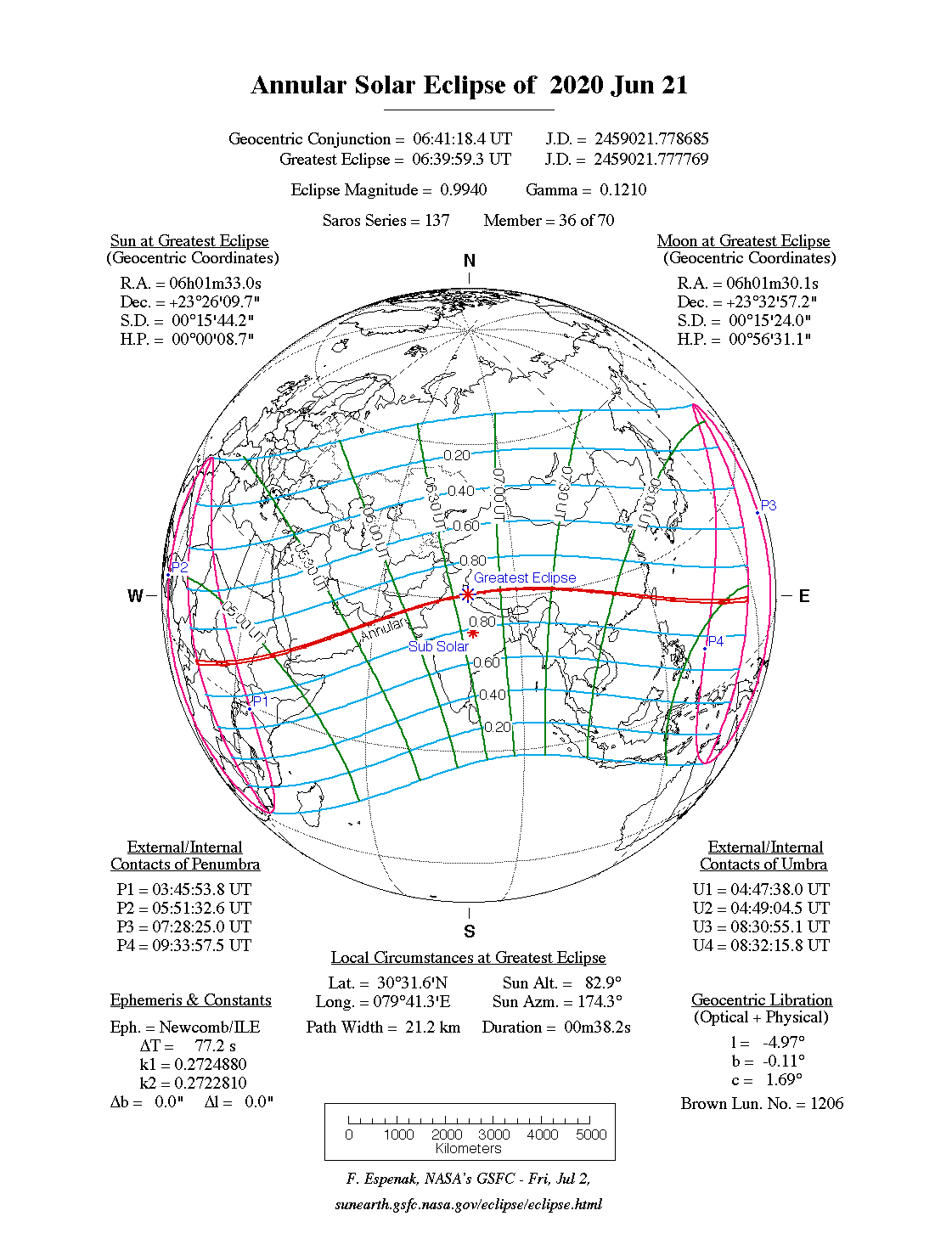
Areas of the Earth where the solar eclipse of June 21, 2020 will be visible. The central double red line delineates the path of annularity. Click on the image to see the original chart. Credit NASA GSFC, Fred Espenak.
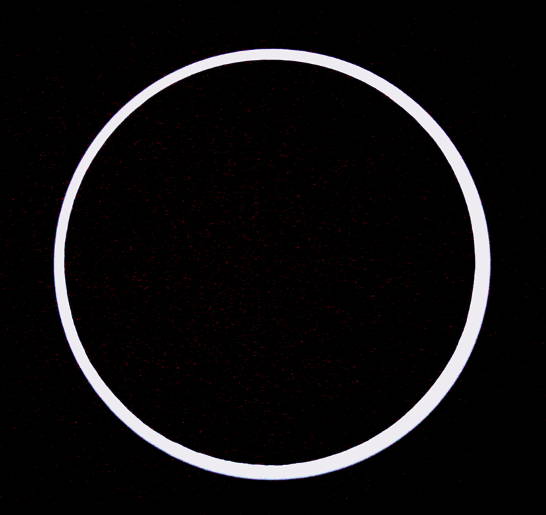
My photograph of the Annular eclipse May 10 1994 taken east of Toledo, Ohio, May 10, 1994.
Summer Solstice
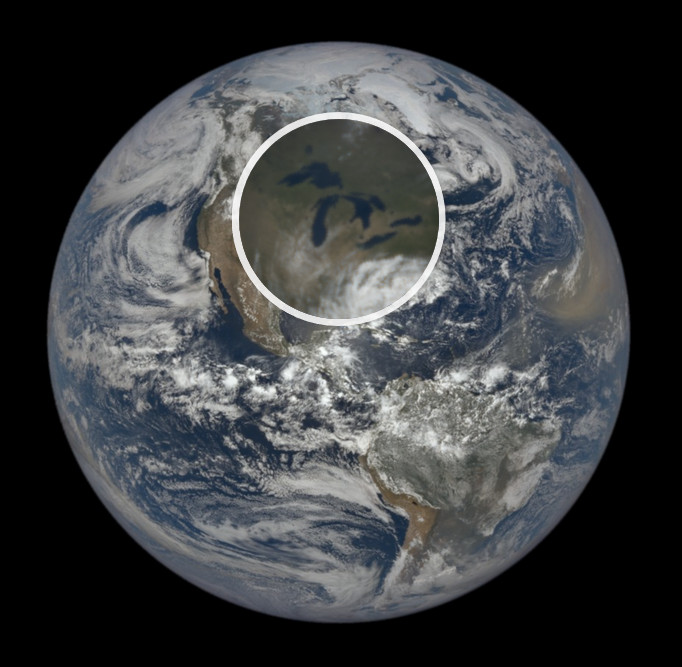
Earth and magnified local area near summer solstice. Image taken near local noon June 17, 2020. Credit NOAA DSCOVR satellite orbiting the Sun-Earth L1 point 994,970 miles (1,601,432 kilometers) sunward from the Earth. For once it’s clear enough to see the mitten of the Lower Peninsula of Michigan.
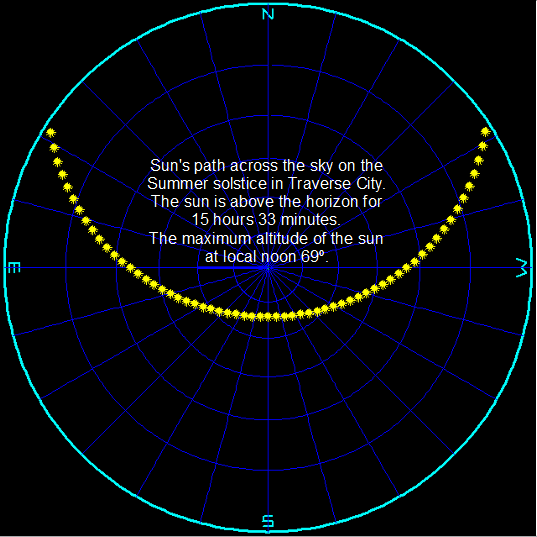
The Sun’s path through the sky on the summer solstice day from Traverse City, MI. Created using my LookingUp program..
05/09/2013 – Ephemeris – There’s an annular eclipse in the Pacific Ocean today
Ephemeris for Thursday, May 9th. The sun rises at 6:21. It’ll be up for 14 hours and 35 minutes, setting at 8:57. The moon is new today, and won’t be visible.
Solar eclipse in Pacific. Later this afternoon our time there will be an annular eclipse of the sun. However it will only be visible from parts of the Pacific Ocean including Australia. Since the shadow crosses the International Date Line and the moon’s shadow moves west to east, it start in Australia on the morning of the 10th, and end far southeast of Hawai’i on evening of the 9th. An annular eclipse is one in which the moon is farther than average from the earth and cannot cover the whole face of the moon for observers on the earth. He moon’s farthest distance from the earth this month is called apogee at 252,000 miles next Monday. The lunar eclipse paired with this is a very slight penumbral eclipse on the 25th, too slight to be noticeable.
Times are for the Traverse City/Interlochen area of Michigan. They may be different for your location.
Addendum
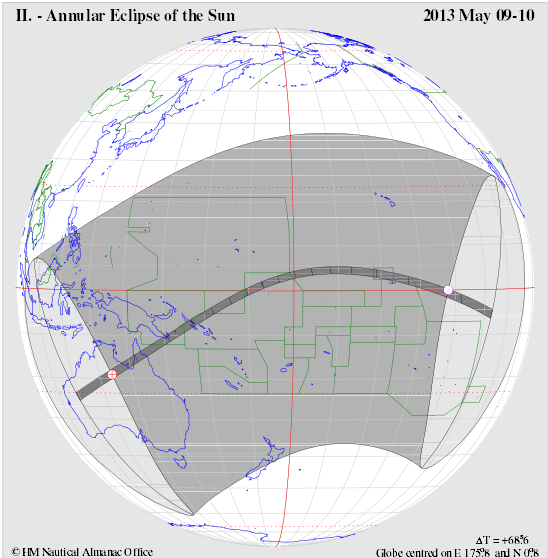
Annular eclipse path May 9-10, 2013.
From the Astronomical Almanac Online (USNO, HMNO).
The PDF version of the above image and eclipse times click here.
 Bob Moler's Ephemeris Blog