Archive
07/20/2015 – Ephemeris – July 20th anniversaries
Ephemeris for Monday, July 20th. Today the Sun will be up for 15 hours and 5 minutes, setting at 9:21. The Moon, 4 days before first quarter, will set at 11:34 this evening, and tomorrow the Sun will rise at 6:16.
July 20th is a special date for this country’s space program and a personal one. On July 20, 1969 Apollo 11 landed on the Moon, the greatest achievement in the history of space flight. Seven years later the robot lander Viking 1 landed on Mars. NASA wanted it to be July 4th, 1976, the Bicentennial, but couldn’t find a smooth landing site in time. My own connection to the date came in 1963, my first total solar eclipse. We traveled to Quebec province along side the St. Maurice River. To view 60 seconds of totality. It was the first of four successful total solar eclipse trips I’ve been on.. I’m looking forward to my 5th on August 21st 2017, two years from now which is related to my first, I’ll tell you about that in my blog.
Times are for the Traverse City/Interlochen area of Michigan. They may be different for your location.
Addendum
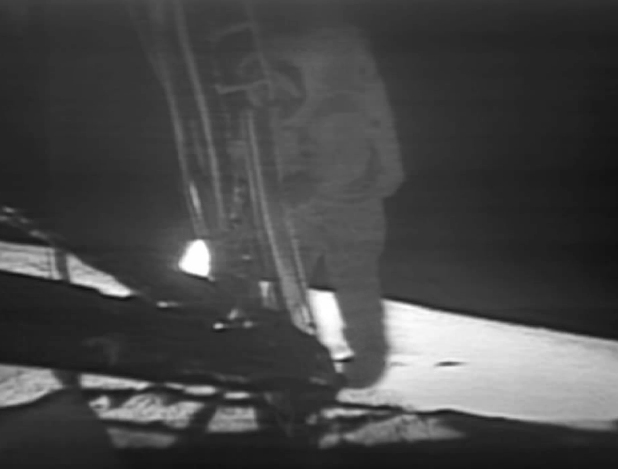
Neil Armstrong about to step off the LM onto the surface of the moon, July 20, 1969. Credit: NASA.
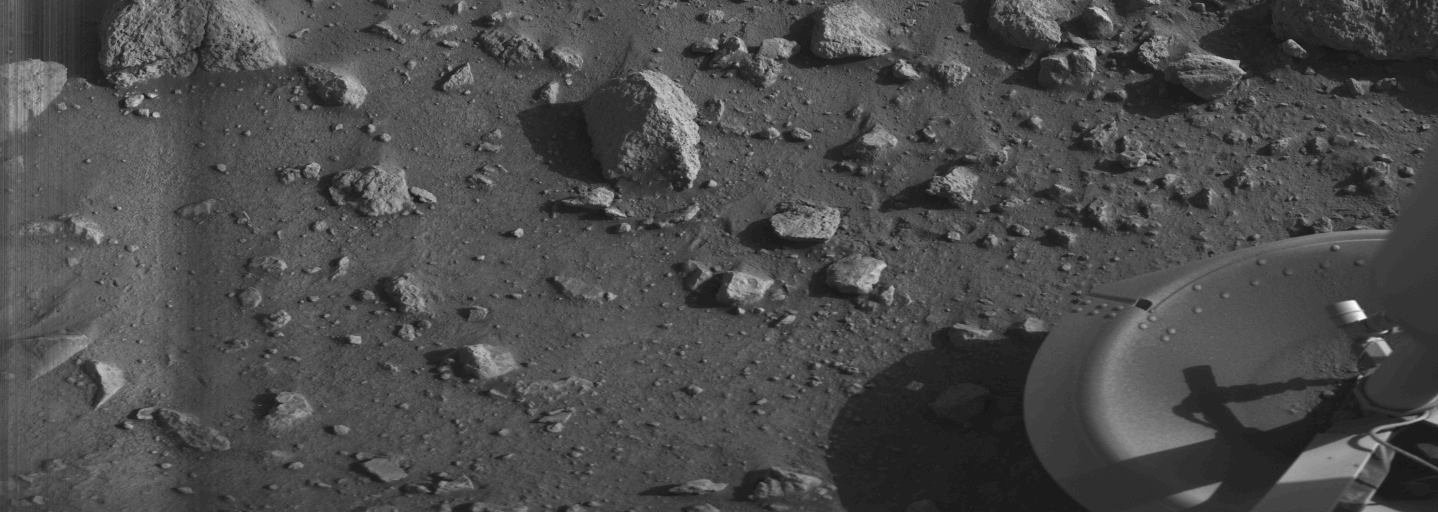
First image sent back from Viking 1 after landing on Mars, July 20, 1976. Credit: NASA/JPL. Click on image to enlarge.
Video of July 20, 1963 eclipse from the air. I got only one picture of the eclipse and it wasn’t very good. https://www.youtube.com/watch?v=OT3EW0KIjCc.
The date on the YouTube page is incorrect. It is July 20, 1963. I remember the corona being somewhat wedge-shaped, wider to one side than the other. Other than that it was a typical quiet sun corona.
In the program above I mentioned that the August 21, 2017 solar eclipse was related to my first total solar eclipse. This is the relationship: A couple of centuries BC the Chaldean astronomers of ancient Babylonia discovered that eclipses repeated in a cycle lasting 6,585 1/3 days. That’s 18 years 10 or 11 and 1/3 days depending on the number of leap years spanned. That period was called the Saros by Sir Edmund Halley or comet fame. So each eclipse would be visible 1/3 of the Earth farther west. Note that there are many Saros cycles occurring at the same time, and that eclipses of a particular Saros gradually move northward or southward. So to have an eclipse recur at the approximate same longitude one must wait 3 Saros cycles. or 54 years and one month approximately. Thus the third Saros of the July 20, 1963 total solar eclipse will be August 21, 2017. This Saros series (145) is moving southward. In 1963 it crosses the US at Alaska and Maine. Quebec was closer for us, s we went there. Good thing too. Maine was clouded and rained out. For us the clouds parted at the beginning of the eclipse. The 2015 eclipse will cross the continental US from Oregon to South Carolina.
A squished image of the July 20, 1963 eclipse path. Right click on the image and select view image to get a correct image. (works in Firefox).

A squished image of the August 21, 2017 eclipse path. Right click on the image and select view image to get a correct image. (works in Firefox).

03/06/2014 – Ephemeris – Observing the Moon tonight!
Ephemeris for Thursday, March 6th. The sun will rise at 7:11. It’ll be up for 11 hours and 25 minutes, setting at 6:36. The moon, 2 days before first quarter, will set at 12:56 tomorrow morning.
The Moon’s appearance has changed since I last talked about it on Tuesday. The Crescent is wider. The terminator, the sunrise line on the Moon that gives the Moon it’s now crescent phase has uncovered most of the Sea of Tranquility. In fact the sun will have risen at the Apollo 11 landing site by this evening. With a small telescope just beneath the center of the moon and near the terminator is one of my favorite craters Theophilus with its well-defined central peak. It’s kind of middle-aged for craters on the moon from 1 to 3 billion years old. It’s in much better shape than the crater Cyrillus of nearly the same size that it partially overlaps, which is thought to be at least a billion years older and shows it.
Times are for the Traverse City/Interlochen area of Michigan. They may be different for your location.
Addendum
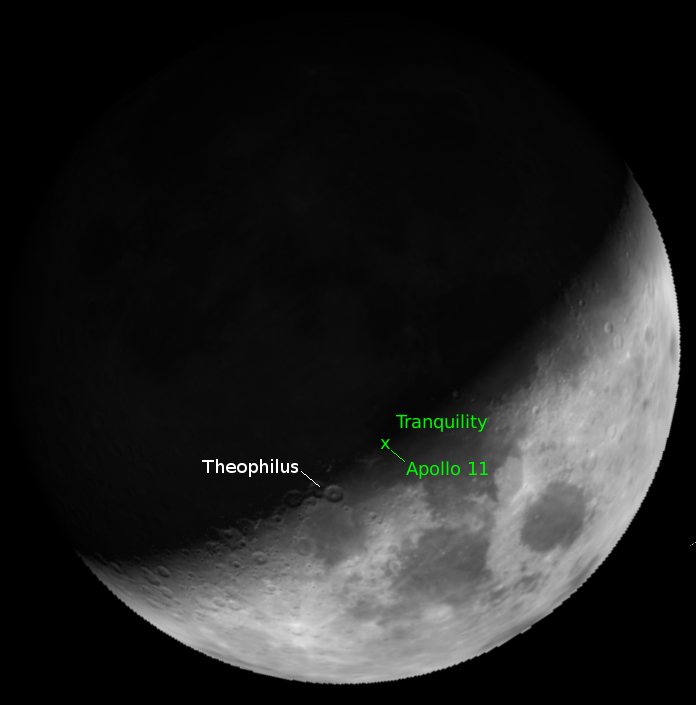
The Moon at 9 p.m. March 6, 2014 highlighting the Sea of Tranquility the Apollo 11 landing site (approximate) and the crater Theophilus. Created using Virtual Moon Atlas.
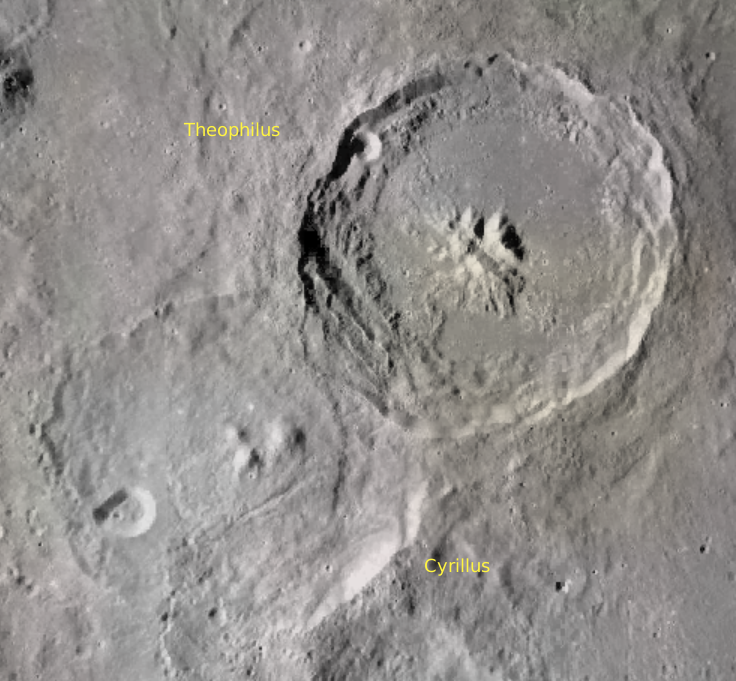
Lunar craters Theophilus and Cyrillus. Credit: NASA/LRO mapped onto Virtual Moon Atlas.
09/10/2013 – Ephemeris – The Moon reveals the Apollo 11 landing site
Ephemeris for Tuesday, September 10th. The sun will rise at 7:15. It’ll be up for 12 hours and 46 minutes, setting at 8:02. The moon, 2 days before first quarter, will set at 10:49 this evening.
Tonight the moon will reveal the entire Sea of Tranquility or Mare Tranquilitatis on the moon’s equator near the terminator or sunrise line that makes the moon look like a crescent. The sun is rising right now (morning of the 10th) on the Apollo 11 landing site dubbed Tranquility Base by Neil Armstrong right after landing on July 21st 1969. When showing the moon we are often asked, partly in jest we hope, if they could see the flag left by Armstrong and Aldrin. The answer is no. From the earth, we can barely see anything less than two miles in diameter. It took the Lunar Reconnaissance Orbiter to dip down real low, less than 15 miles altitude, to capture an image of the landing site and what the astronauts left behind. Incidentally the flag was knocked down by the blast of the ascent engine on their lunar module when they took off from the moon.
Times are for the Traverse City/Interlochen area of Michigan. They may be different for your location.
Addendum
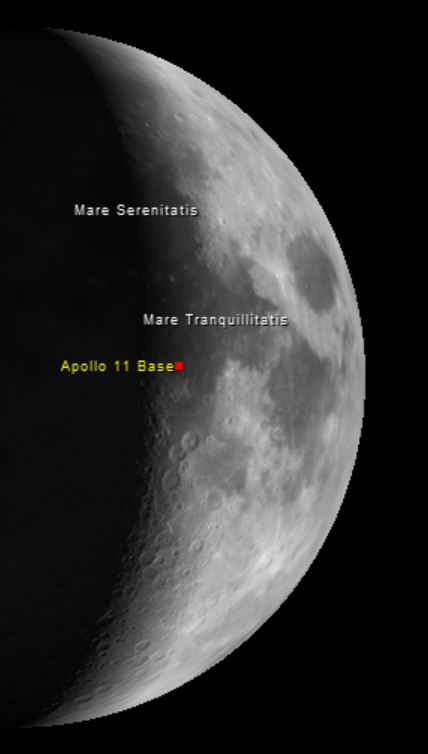
The Moon tonight, 9 p.m. September 10, 2013, with the Apollo 11 landing site marked. Created with Virtual Moon Atlas.
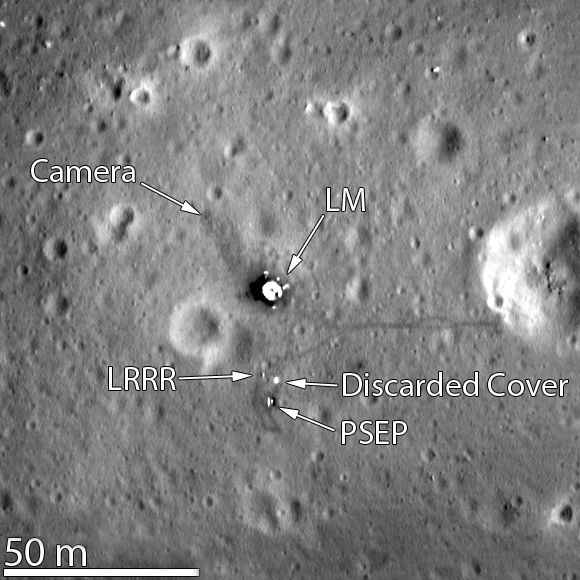
Apollo 11 Base from the Lunar Reconnaissance Orbiter. Credit: NASA.
LM is the descent stage of the Lunar Module that served as a launch platform for the ascent stage.
LRRR is the bank of retro reflectors that are still used to reflect earth based lasers to get an extremely accurate range to the Moon.
PSEP is a solar powered instrument package to monitor moonquakes and other information back to Earth after the astronauts had left the Moon.
The flag is not visible about a third of the way between the LM and the camera.
The dark lines are the tracks of the astronauts as they went about their exploration and equipment set up.

