Archive
Ephemeris: 05/14/2024 – Last Friday’s geomagnetic storm
This is Ephemeris for Tuesday, May 14th. Today the Sun will be up for 14 hours and 48 minutes, setting at 9:03, and it will rise tomorrow at 6:13. The Moon, 1 day before first quarter, will set at 3:08 tomorrow morning.
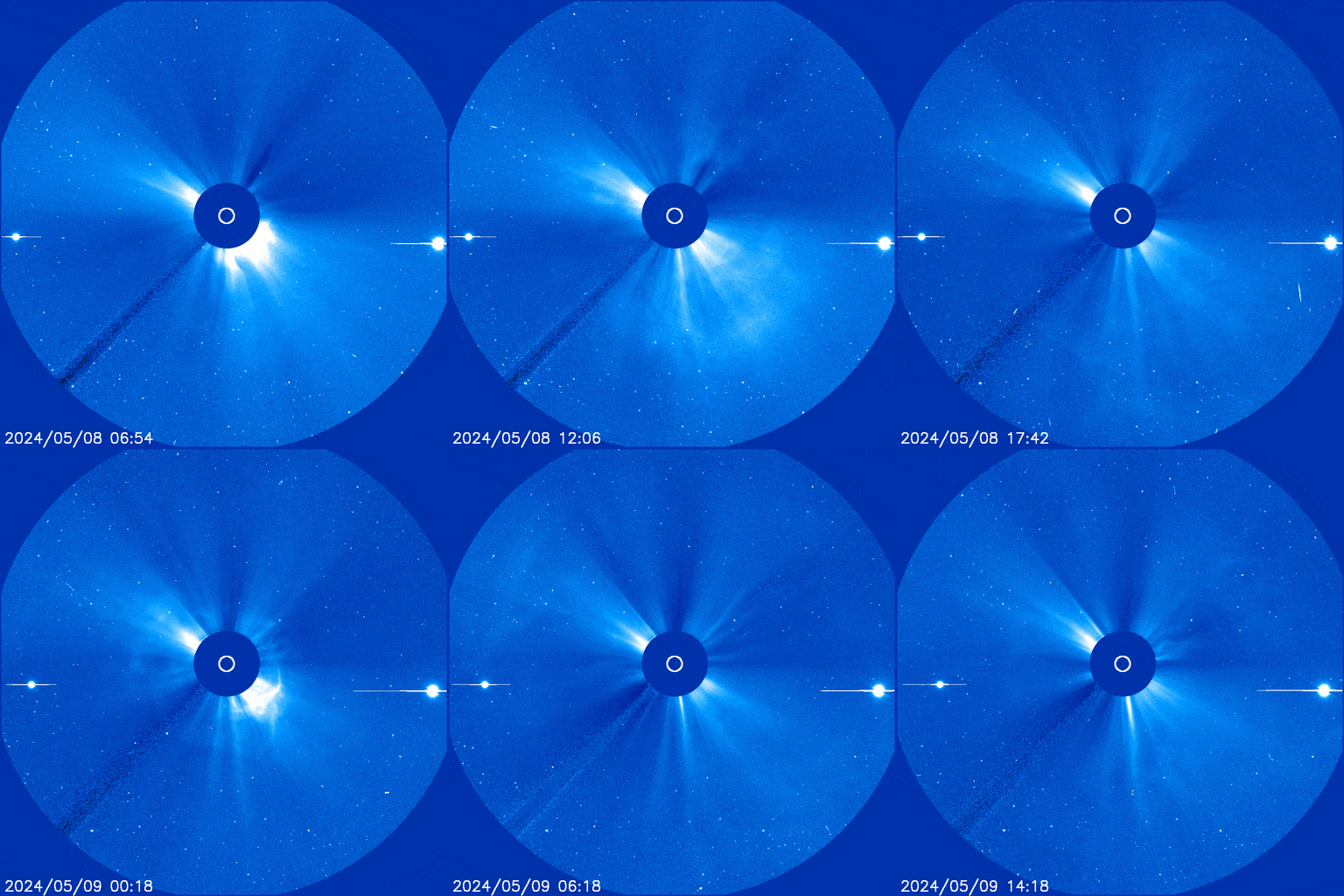
Last Friday night’s displays of the Northern Lights were seen as far as the Caribbean, making the greatest what is called a geomagnetic storm of the last 20 years, and up there with the greatest storms ever recorded. Last Wednesday there was an immense solar flare coming from a large sunspot group on the Sun. That group was large enough to be able to be seen with eclipse glasses. So you might want to keep those eclipse glasses handy, and check out the Sun every once in a while. Only the largest sunspot groups will be visible. The flare causes the ejection of the part of the Sun’s corona, what astronomers call the coronal mass ejection or CME for short. These charged particles were intercepted by the Earth’s magnetic field and caused the aurora we saw.
The astronomical event times given are for the Traverse City/Interlochen area of Michigan (EDT, UT–4 hours). They may be different for your location.
Addendum
03/17/16 – Ephemeris – Why are there no green stars?
Ephemeris for St. Patrick’s Day, Thursday, March 17th. The Sun will rise at 7:50. It’ll be up for 12 hours and 1 minute, setting at 7:52. The Moon, 2 days past first quarter, will set at 5:10 tomorrow morning.
Today we celebrate the patron saint of the Emerald Isle. And green is the color of the day. When we look to the skies we don’t see a lot of green. Well, maybe in the Hubble Space Telescope’s false color photographs like the original Pillars of Creation, where green represents hydrogen, and in the northern lights. The colors we see in stars are red or orange if they are cooler than the Sun, yellow if they are the same temperature as the Sun, and white or bluish if hotter than the Sun. In the spectrum of light we can see, green is in the middle, between yellow and blue. As a matter of fact the Sun radiates its energy most heavily in the green. So if you got rid of those other colors the Sun itself would be green.
Times are for the Traverse City/Interlochen area of Michigan. They may be different for your location.
Addendum
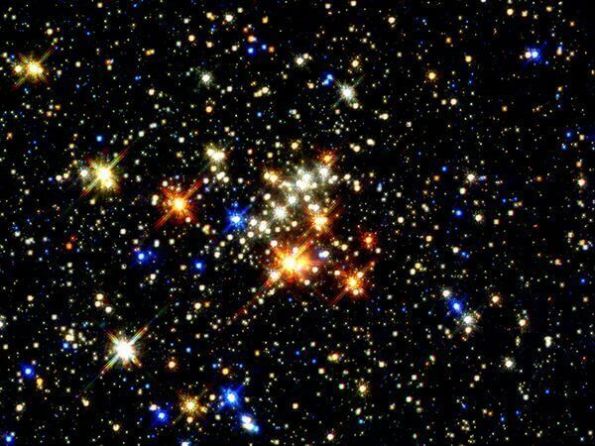
Star cluster showing star colors, probably enhanced. Source uncredited image from planetsforkids.org.
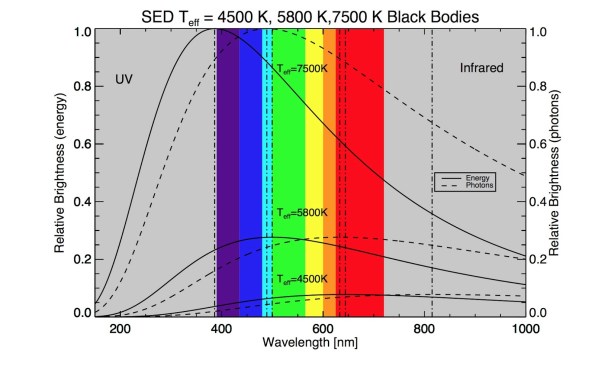
“Black body” Radiation Curves by temperatures. The Sun’s surface temperature is around 5800 Kelvin. Note the peak radiation besides increasing in amplitude slides from red to blue with increasing temperature.
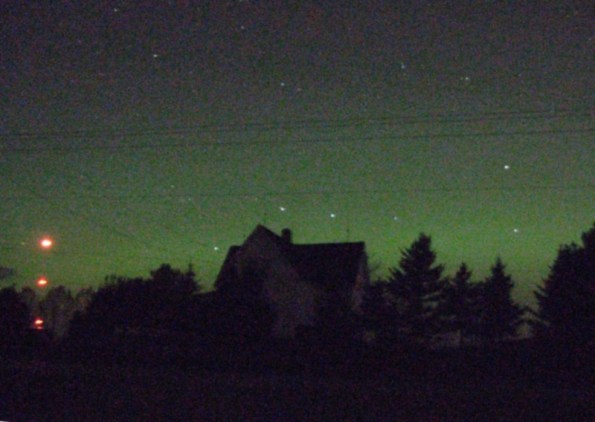
Aurora looking north at 10/24/2011 at 10:52 p.m. The first color visible in an aurora or northern lights is green. More active aurorae give off other colors. Credit: Bob Moler.
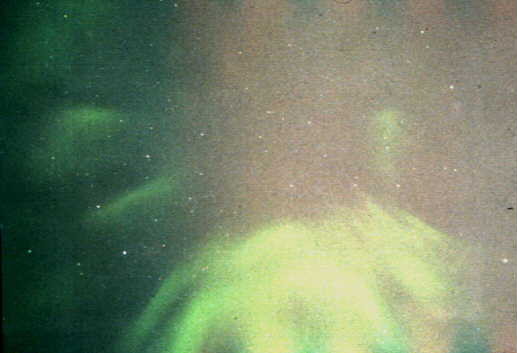
Looking overhead in an active aurora, and the variety of colors, even green. Credit: Bob Moler.
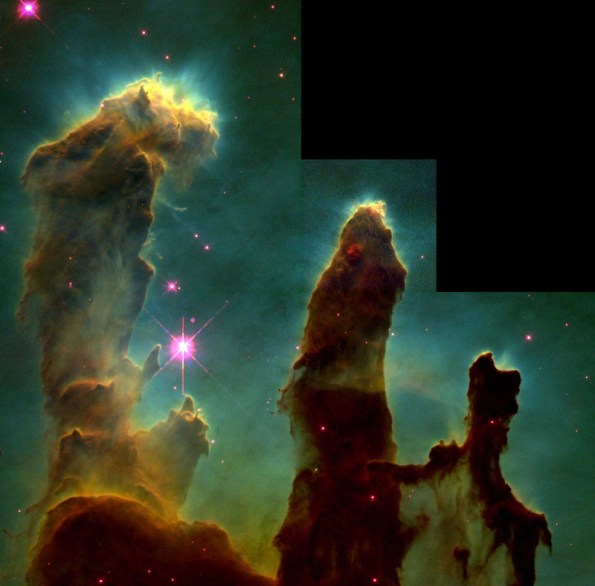
Pillars of Creation in false color by the Hubble Telescope. Sometimes the colors are given to specific elemental emissions, of shifted because the colors represent radiation that is invisible to the human eye. Credit: NASA/ESA/HST.
08/02/2012 – Ephemeris – The sun’s kicking up again this week
Thursday, August 2nd. The sun rises at 6:30. It’ll be up for 14 hours and 35 minutes, setting at 9:05. The moon, 1 day past full, will rise at 9:05 this evening.
With the sun really being active, there’s a good chance we’ll see several displays of the northern lights of aurora borealis. Those south of the equator will see the southern equivalent, the aurora australis. There’s an active group of sunspots rotating onto the earth-side face of the sun that should give us a chance to see the aurora in the next week or so. Sunspots are caused by tremendous magnetic fields generated below the bright photosphere we rather improperly call the sun’s surface. The sun has no solid surface, it’s all gas. The magnetic fields cool the gas, making it darker. The spots are maybe at a temperature 2,000 degrees cooler than the rest of the photosphere which is about 10,000 degrees Fahrenheit. In complex sunspot groups there is a potential for huge explosions.
Times are for the Traverse City/Interlochen area of Michigan. They may be different for your location.
Addendum
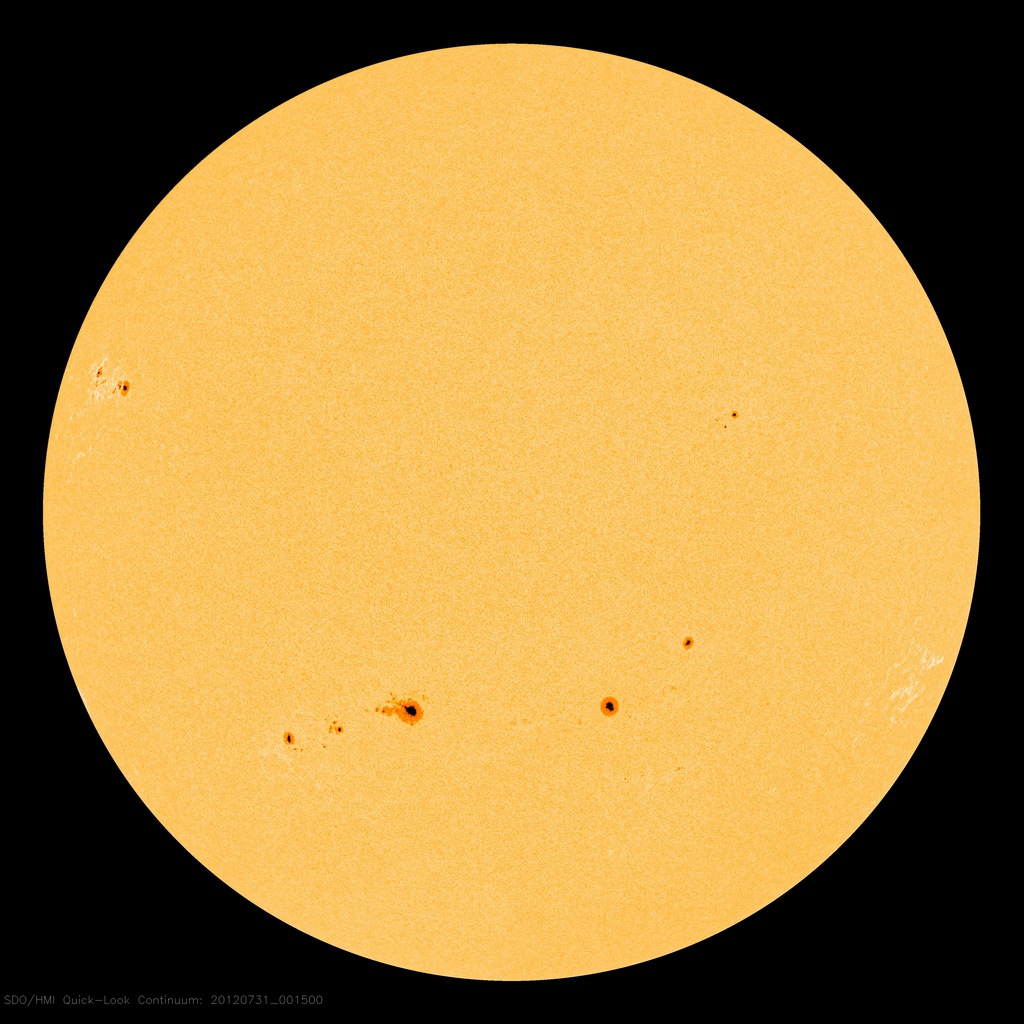
Solar Dynamics Observatory white light image of the sun from Monday. Credits NASA / SDO. Click on image to enlarge.
Possibility of an aurora (northern lights) late Friday night or early Saturday morning
http:www.spaceweather.com reports that a coronal mass ejection (CME) is heading toward the earth from the sun to arrive sometime about 2 a.m. EDT Saturday July 7th. So we may get to see an aurora. Active region 1515, the biggest sunspot group on the sun now is the culprit. It’s been kicking off lots of solar flares recently. The flare responsible was one of the ones that occurred yesterday, July 4th.
There’s an auroral glow in the north at 10:41 p.m. April 23, 2012
I’m near 45 degrees north latitude. spaceweather.com issued an email earlier in the evening that there was a minor geomagnetic storm in progress, and that there will be a possibility of an aurora. Yes there is a glow in the north that needs checking over this evening for possible outbursts.
Good possibility of seeing northern lights tonight
We’ve got a full moon tonight, so that will affect visibility somewhat. But what we really need is clear skies!
Check out http://www.spaceweather.com for more information.
Look for an aurora tonight
On Thursday the 19th a CME (Coronal Mass Ejection) erupted from the sun headed earthward. Generally these things take about 2 days give or take to get to the earth. When they do they tangle with the earth’s magnetic field and cause huge currents to flow toward the earth’s magnetic poles causing among other things the aurora or northern and southern lights.
So check the skies tonight, especially northward if you are in the northern hemisphere or southward if you’re in the southern.
The higher your latitude the better your chances of seeing it. But who knows. Check out http://spaceweather.com/.
11/28/11 – Ephemeris – There may be an aurora tonight
Monday, November 28th. The sun will rise at 7:55. It’ll be up for 9 hours and 9 minutes, setting at 5:05. The moon, 3 days past new, will set at 8:53 this evening.
Last Saturday afternoon the sun let loose with an explosion that is sending a cloud of particles toward the earth. It was called a Coronal Mass Ejection or CME for short. As usual for these things, it takes about 48 hours give or take for the cloud of particles to reach the earth. The expected arrival time for the cloud is about noon, give or take 7 hours. If the cloud is a bit late we could get a display of the northern lights or aurora borealis. The sun is getting more active now after a prolonged minimum that lasted over 2 years. The sun is ramping up for a peak in sun spot numbers possibly in 2013. Although the numbers of aurorae occur mostly after peak, so we’re just starting our auroral season, so there will be more opportunities to come.
* Times, as always are for the Traverse City/Interlochen area of Michigan.
We might get an aurora (northern lights) tonight (August 5, 2011)
Also southern lights too. There was a big coronal mass ejection (CME) yesterday. Arrival time of the stuff at earth is thought to be 10 hours UT (6 a.m. EDT) plus or minus 7 hours. Though no reports yet. See Phil Plait’s Bad Astronomy for more on it. Also check out www.spaceweather.com.
 Bob Moler's Ephemeris Blog