Archive
01/15/2013 – Ephemeris – The red giant star with a funny name Betelgeuse (Beetle Juice), plus STEM Night tonight at Greenspire School
Ephemeris for Tuesday, January 15th. The sun will rise at 8:15. It’ll be up for 9 hours and 13 minutes, setting at 5:28. The moon, 3 days before first quarter, will set at 10:31 this evening.
The bright red star in constellation Orion’s shoulder is Betelgeuse, 643 light years away give or take 146 light years. Betelgeuse is a shortened form of an Arabic phrase that means “Armpit of the central one”. Orion is seen in the south in the evening. Even at its great distance it’s the star whose surface is easiest seen, after the sun of course. That’s because it’s so big. As somewhat larger around than the orbit of Jupiter, it turns out. Recent telescopic observations of Betelgeuse have shown plumes of gas surrounding the star. A star like Betelgeuse is so bloated that it can be described as a red hot vacuum, thus its edge or limb is much darker than its center. The sun has limb darkening too, but it is much less noticeable.
Tonight:

STEM (Science, Technology, Engineering, Mathematics) Night.
We’ll have Gary Carlisle and I will be there to view the moon and Jupiter if it’s clear, Make craters hands-on. I’ll be helping to make comets. Bring your gloves because comets are COLD! We’ll be representing the Grand Traverse Astronomical Society.
Times above are for the Traverse City/Interlochen area of Michigan. They may be different for your location.
Addendum
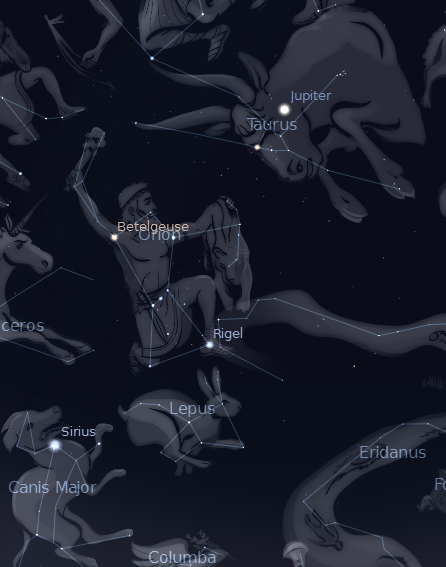
Orion facing Taurus letting Lepus escape with Jupiter in 2013. Check out Betelgeuse. Created using Stellarium.
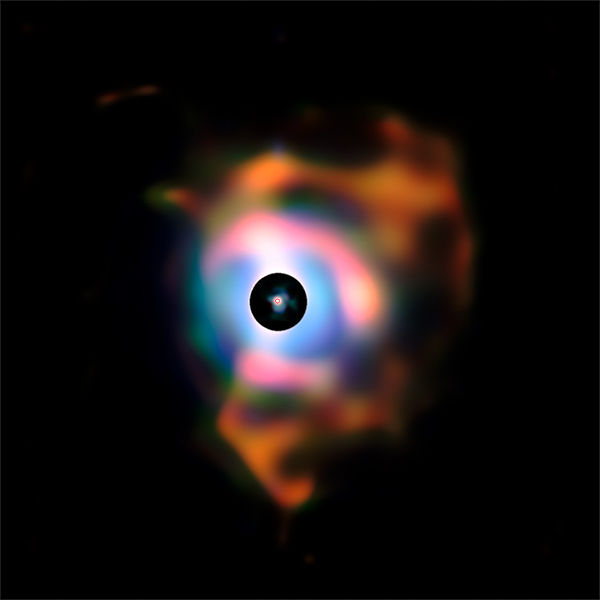
Betelgeuse and its nebula. From the European Southern Observatory’s Very Large Telescope.
12/03/2012 – Ephemeris – Orion rising
Ephemeris for Monday, December 3rd. The sun will rise at 8:01. It’ll be up for 9 hours and 1 minute, setting at 5:02. The moon, 3 days before last quarter, will rise at 9:56 this evening.
Off in the southeast at 9 in the evening the great constellation of Orion will be seen now. This is the most famous of all constellations world wide. We think the Big Dipper is a big deal. It’s not even a constellation, being the hind end of the great bear Ursa Major. However it’s invisible if one travels far enough south of the equator. Orion is now a rectangle of stars tilted to the left as he rises. With three stars in a straight line in the center. They are aligned nearly vertically. Orion is a giant hunter. The rectangle depict his shoulders and knees. Among its other bright stars Orion contains two of the brightest. The upper left star is the famous red giant star Betelgeuse. The lower left star is the blue=white super giant Rigel.
Times are for the Traverse City/Interlochen area of Michigan. They may be different for your location.
Addendum
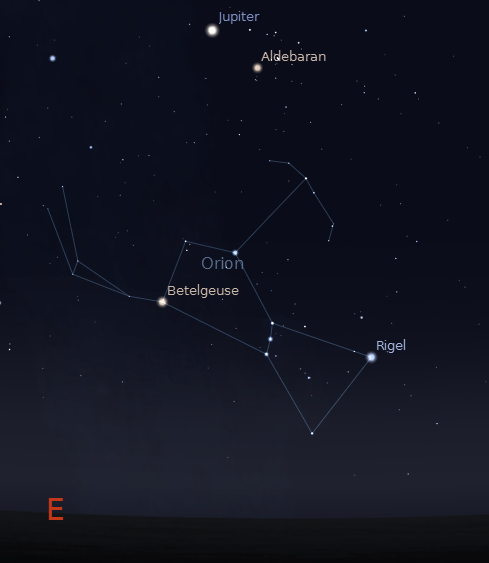
Orion rising at 9 p.m. December 3, 2012. Created using Stellarium.
02/20/2012 – Ephemeris – The Winter Circle
Ephemeris for President’s Day, Monday, February 20th. The sun will rise at 7:35. It’ll be up for 10 hours and 41 minutes, setting at 6:17. The moon, 1 day before new, will rise at 7:01 tomorrow morning. | The winter skies are blessed with more first magnitude stars than any other season. Six of these stars lie in a large circle centered on the seventh. This circle is up at 9 p.m. Starting high overhead is Capella in Auriga the charioteer. Moving down clockwise is Aldebaran in the face of Taurus the Bull. Then down to Orion’s knee we find Rigel. Down and left is the brightest star of all Sirius the Dog Star in Canis Major, lowest of these stars in the south southeast. Moving up and left is Procyon in Canis Minor, Above Procyon is Pollux in Gemini the twins. All these are centered on Betelgeuse the bright red star in Orion’s shoulder.
* Times are for the Traverse City/Interlochen area of Michigan. They may be different for your location.
Addendum
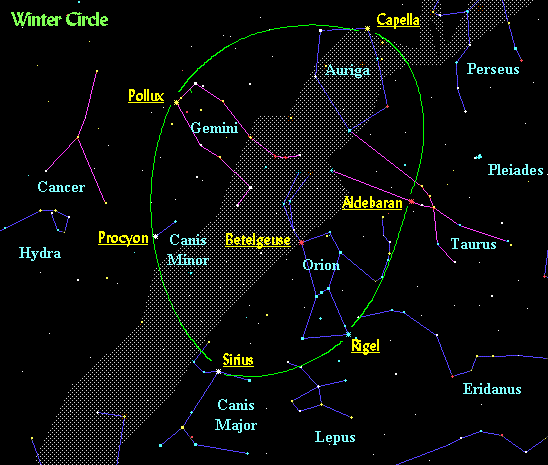
The Winter Circle of 1st magnitude stars
02/09/2012 – Ephemeris – The star Betelgeuse
Ephemeris for Thursday, February 9th. The sun will rise at 7:51. It’ll be up for 10 hours and 10 minutes, setting at 6:02. The moon, 2 days past full, will rise at 8:38 this evening.
The bright red star at the upper left corner of the constellation Orion, high in the south at 9 p.n. Is Betelgeuse. The name is a contraction of an Arabic phrase that means “Armpit of the Central One”. Betelgeuse is a huge star with a diameter four times that of the earth’s orbit of the sun. It is throwing of gas and creating a nebula around itself. It’s distance from us isn’t accurately known, since it doesn’t have a companion star. It’s about 643 light years away, give or take 148 light years. Betelgeuse is about 18 times the mass of the sun and 140 thousand times brighter. It is in the latter stages of its short life,of 10 million year so far. Within another million years or so it will probably explode in a supernova. The good news is that it’s moving away from us.
* Times are for the Traverse City/Interlochen area of Michigan. They may be different for your location.
Addendum
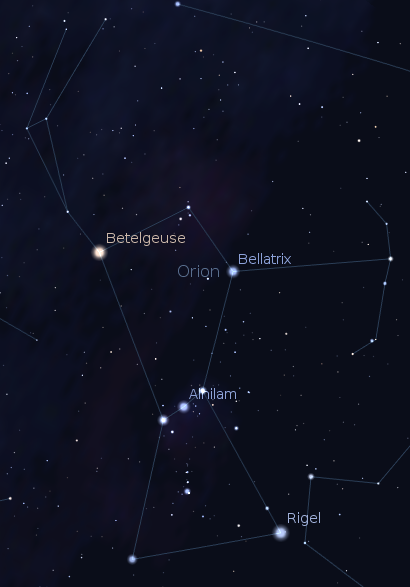
Orion upright and due south. Created using Stellarium.
Betegeuse in Orion
Betelgeuse and its nebula. From ESO's Very Large Telescope.
More information on the image above: http://www.eso.org/public/images/eso1121a/
01/12/2012 – Ephemeris – Orion’s Belt
Thursday, January 12th. The sun will rise at 8:17. It’ll be up for 9 hours and 6 minutes, setting at 5:24. The moon, 3 days past full, will rise at 9:40 this evening.
Orion’s belt of three stars is one of the most noticeable star groupings in the sky. There are no other group of three bright stars in a straight line visible anywhere else in the sky. The star’s names from left to right are Alnitak, Alnilam and Mintaka. They are actually a bit farther away than the other bright stars of Orion. Alnilam, the center star is over three times the distance of red giant Betelgeuse above them and over twice as far as blue white giant star Rigel below them. Alnilam is 375 thousand times brighter than the sun according to the SIMBAD Astronomical Database. These three stars were also known as Frigga’s Spindle by the Norsemen. Frigga also known as Freya is the goddess we get the name of the day of the week Friday.
* Times, as always are for the Traverse City/Interlochen area of Michigan.
Addendum
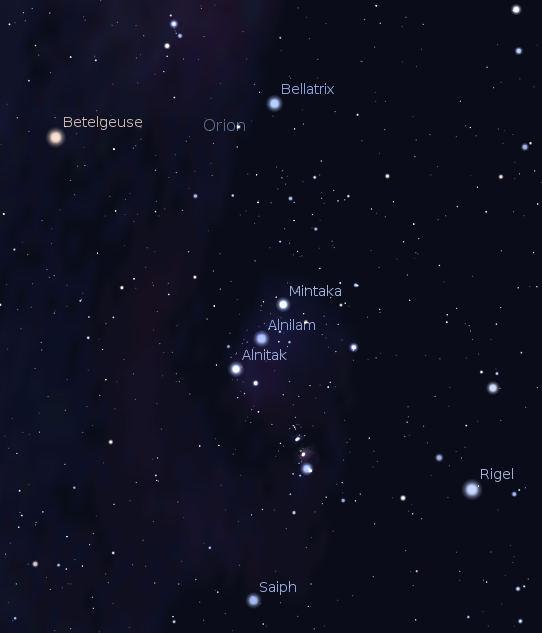
Torso of Orion centered on his belt. Created using Stellarium.
11/18/11 – Ephemeris – Pleiades, Hyades and Orion
Friday, November 18th. The sun will rise at 7:42. It’ll be up for 9 hours and 29 minutes, setting at 5:12. The moon, at last quarter today, will rise at 12:48 tomorrow morning.
The Pleiades or Seven Sisters star cluster is now quite high in the east at 9 p.m. To the Greeks they were the daughters of the god Atlas. Their half sisters, the Hyades is seen below them as the letter V shape of stars that form the face of Taurus the bull, with the bright orange star Aldebaran at one corner. Both are being chased by the giant hunter Orion, now mostly risen in the east. His three belt stars in a row are now oriented vertically. The reddish star Betelgeuse is to their upper left, while blue-white Rigel to the lower right. Rigel may suffer some by being very close to the horizon at the time, but it will come into its own as it rises higher. [Here is our preview of the glories of the winter sky. There is more to come as the night wears on.]
* Times, as always are for the Traverse City/Interlochen area of Michigan. Bracketed passage was omitted from the audio program due to time constraints.
Addendum
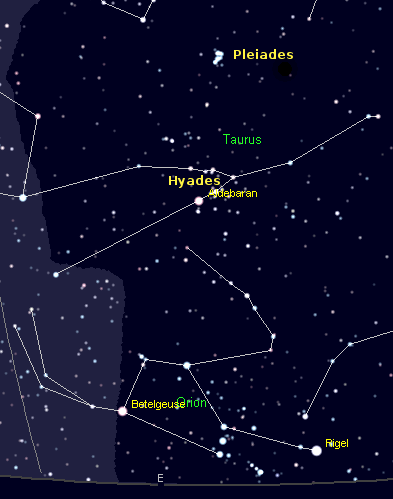
The eastern sky at 9 p.m.
 Bob Moler's Ephemeris Blog