Archive
Ephemeris: 12/28/2023 – Next year in rockets and space
This is Ephemeris for Thursday, December 28th. Today the Sun will be up for 8 hours and 49 minutes, setting at 5:09, and it will rise tomorrow at 8:19. The Moon, 2 days past full, will rise at 6:35 this evening.
Let’s take a look at 2024 in space exploration. The Artemis 2 mission of sending a crew of four around the Moon and back will take place no earlier than November, so it could be pushed back into 2025 if there are any difficulties. SpaceX early next year will attempt the third flight of their gigantic Starship rocket. Hopefully this time it will reach near orbit. Blue Origin, sort of in competition to SpaceX, but have never put anything into orbit yet, is expected to launch their New Glenn rocket, which uses 7 BE4 engines next year. Also United Launch Alliance will be expected to launch their new Vulcan Centaur rocket, perhaps as early as January next year. It uses two Blue Origin BE4 engines as its main engines plus solid rocket boosters.
The astronomical event times given are for the Traverse City/Interlochen area of Michigan (EST, UT –5 hours). They may be different for your location.
05/25/2023 – Ephemeris – NASA awards contracts for a second lunar lander
This is Ephemeris for Thursday, May 25th. Today the Sun will be up for 15 hours and 9 minutes, setting at 9:14, and it will rise tomorrow at 6:04. The Moon, 2 days before first quarter, will set at 2:26 tomorrow morning.
A week ago, NASA announced that the contract for the second Artemis moon lander would go to a group of companies headed by Blue Origin for 3.4 billion dollars. Unlike Apollo, the rocket that sens crews to the Moon will not contain a moon landing craft. It will be sent out separately before the crew. SpaceX’s Lunar Starship will be used on the first two landings, for Artemis III and IV, while the Blue Origin lander will be used for Artemis V, sometime around 2029 or later. Little detail has been released about the lander, except for an artist’s rendering. It appears to be shorter than the Boeing lander first proposed, which would require an astronaut to climb up and down a very long ladder. SpaceX’s Starship would be taller still, but will have an elevator on the side.
The astronomical event times given are for the Traverse City/Interlochen area of Michigan (EDT, UT –4 hours). They may be different for your location.
Addendum
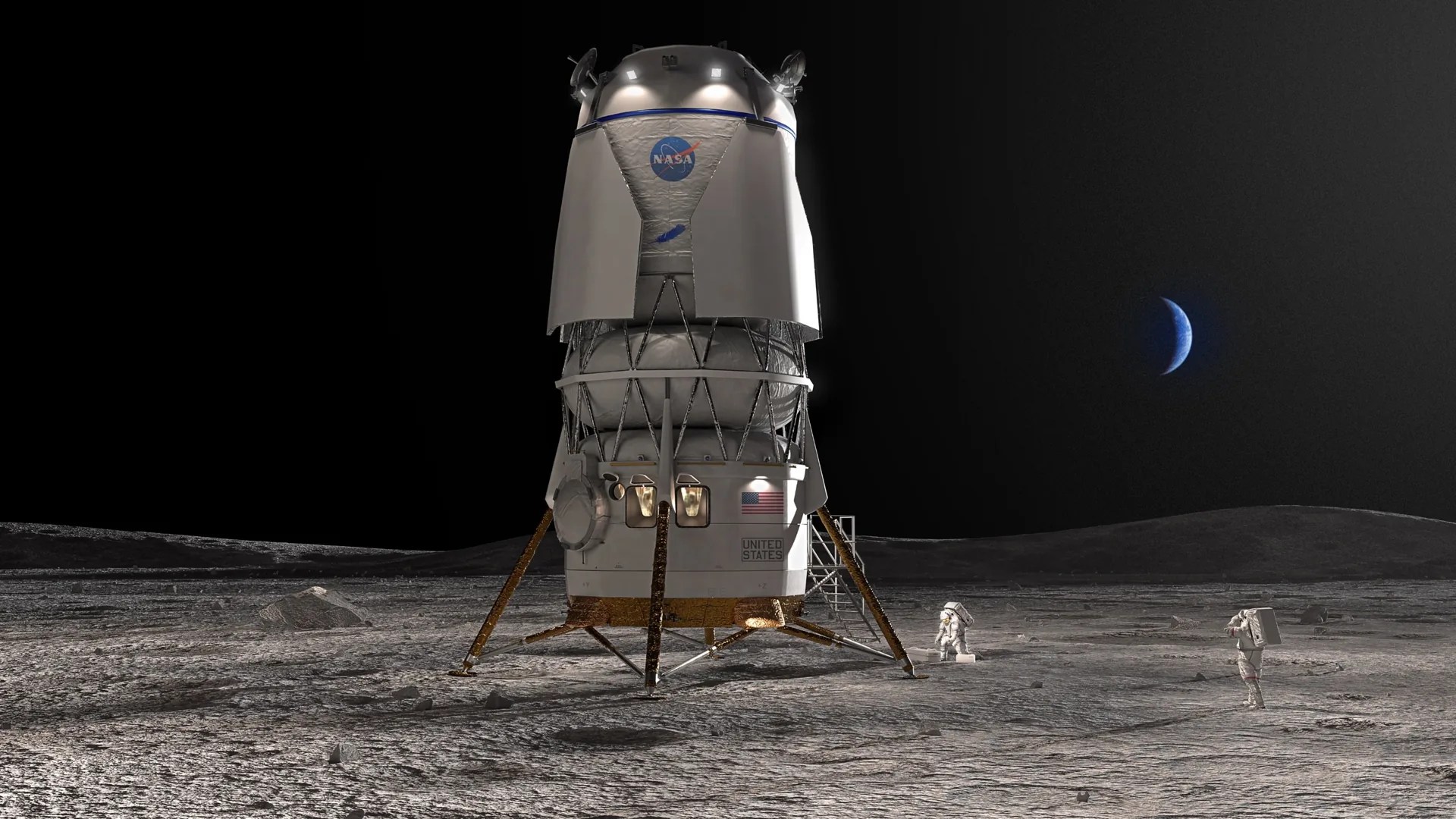
NASA picks Bezos’ Blue Origin to build second lunar lander. The crew compartment is on the bottom, allowing for a shorter ladder to the surface. The liquid oxygen (LOX) and hydrogen (LH) tanks are on top. The LH tank is on top with sun shields, with the LOX tank below. I’m guessing here, since very little information has been released. Credit: NASA.
The craft is officially known as the Human Landing System (HLS).
07/20/2021 – Ephemeris – Another giant leap for billionaires
This is Bob Moler with Ephemeris for Tuesday, July 20th. Today the Sun will be up for 15 hours and 4 minutes, setting at 9:21, and it will rise tomorrow at 6:17. The Moon, halfway from first quarter to full, will set at 3:18 tomorrow morning.
Today is the fifty-second anniversary of Neil Armstrong and Buzz Aldrin’s first steps on the Moon with Apollo 11 and the 45th anniversary of the first robotic spacecraft to soft land on Mars, Viking 1. And if all goes well, it will be the first crewed flight of Blue Origin’s New Shepard rocket with capsule up to over 100 kilometers altitude for 5 minutes of weightlessness. On board will be Jeff Bezos, CEO of Blue Origin, founder of Amazon, his brother, and 82-year-old Wally Funk, one of the Mercury 13 women, who took all the physical and mental tests that the Mercury 7 astronauts took back in the late 50s and early 60s. She’ll be the oldest person to fly into space. And with them will be Oliver Daemon, 18, the youngest person to fly in space.
The astronomical event times given are for the Traverse City/Interlochen area of Michigan (EDT, UT – 4 hr). They may be different for your location.
Addendum
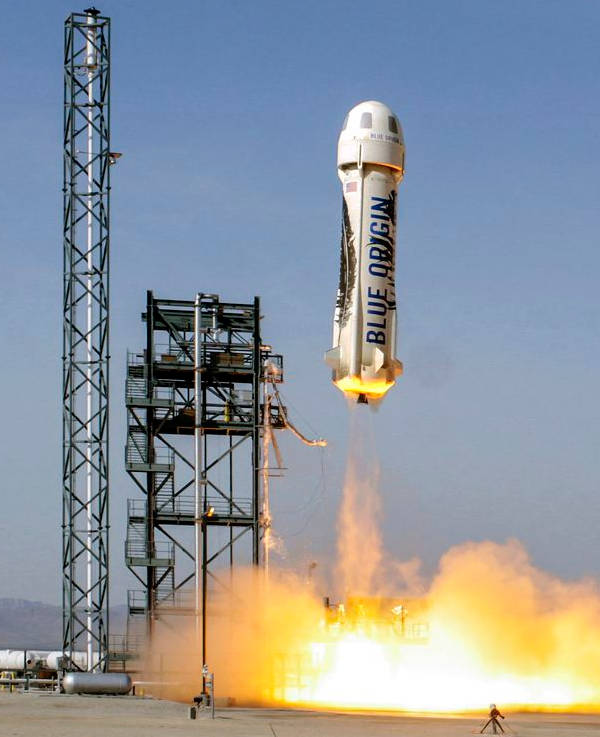
A test Launch of the Blue Origin’s New Shepard rocket and Crew Capsule. Credit: Blue Origin.
06/25/2021 – Ephemeris – The era of commercial human space flight has begun
This is Bob Moler with Ephemeris for Friday, June 25th. Today the Sun will be up for 15 hours and 34 minutes, setting at 9:32, and it will rise tomorrow at 5:58. The Moon, 1 day past full, will rise at 10:58 this evening.
It looks like this year 2021 is the year that commercial crewed spaceflight is going to take off, literally. There’s Richard Branson’s Virgin Galactic with their air dropped VSS Unity that will achieve a few minutes of weightlessness in suborbital space like the old X15 did. Competing in suborbital space is Jeff Bezos’ Blue Origin with their New Shepard rocket and capsule. Bezos and his brother are expected to ride the first crewed capsule flight later this summer. Running rings around these guys, actually, is Elon Musk’s SpaceX with three orbital Commercial Crew missions for NASA already under his belt and a completely civilian orbital mission, Inspiration 4, slated for the end of summer. So the era of commercial human space flight is finally beginning.
The astronomical event times given are for the Traverse City/Interlochen area of Michigan (EDT, UT-4). They may be different for your location.
Addendum

Virgin Galactic’s Spaceship VSS Unity ignites its hybrid rocket engine after being dropped from its carrier aircraft WhiteKnight Two on a test flight to the edge of space. Credit Sky News.
The Launch of the Blue Origin’s New Shepard rocket and Crew Capsule. Credit: Blue Origin.
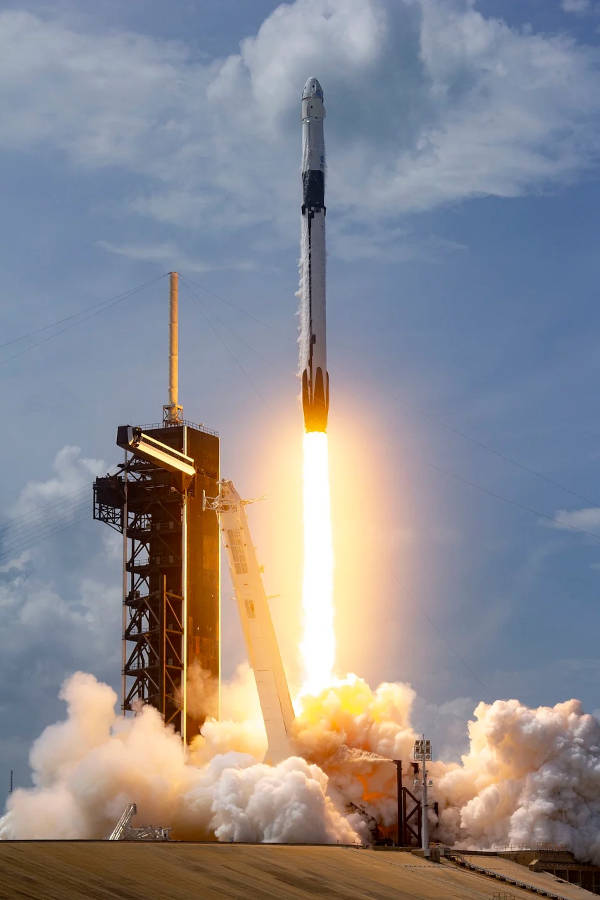
SpaceX Falcon 9 lifts off from historic Launch Complex 39A and sends Crew Dragon to orbit on its first flight with NASA astronauts. Credit: SpaceX/Twitter.
Boeing also built a human rated spacecraft, the Starliner, which will be used to ferry astronauts to the International Space Station. It will be launched on a United Launch Alliance Atlas V rocket. They are scheduled to repeat their uncrewed test flight this summer before they can send crews to the ISS.
Virgin has Virgin Orbital a company to air launch small payloads, Blue Origin is developing the New Glenn rocket a partially reusable rocket, which is expected to launch in 2022 or 2023. SpaceX is actively developing its StarShip completely reusable rocket and booster near Brownsville, Texas.
06/17/2021 – Ephemeris – Congress approves more money for NASA’s lunar lander
This is Bob Moler with Ephemeris for Thursday, June 17th. Today the Sun will be up for 15 hours and 34 minutes, setting at 9:31, and it will rise tomorrow at 5:56. The Moon, at first quarter tonight, will set at 2:18 tomorrow morning. | Tonight’s Moon will be almost exactly cut in half by the sunrise terminator, since the precise moment of first quarter will be at 11:54 this evening. Speaking of the Moon, Congress has approved NASA spending of 10 billion dollars over 5 years on the Human Lander System for the Artemis Moon program. This would allow more than one bidder to win the lander contract. SpaceX’s Lunar Starship was the only one to win a contract. NASA and Congress wanted two to win, but couldn’t afford more than SpaceX. Now comes the rub… Congress will have to appropriate the money out of the budget every year for this. The target date for the first landing is 2024, which I’m pretty sure is already out of reach.
The astronomical event times given are for the Traverse City/Interlochen area of Michigan (EDT, UT-4). They may be different for your location.
Addendum
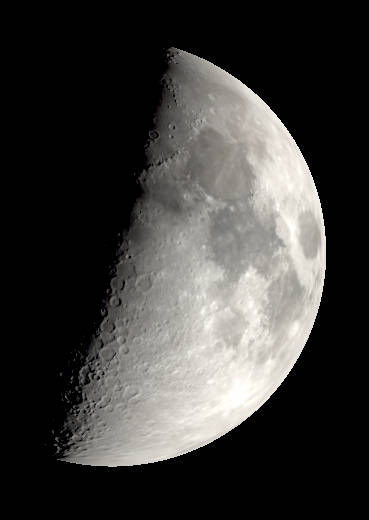
First Quarter Moon with binoculars or low power telescope as it might appear tonight at 11 pm. Created using Stellarium.
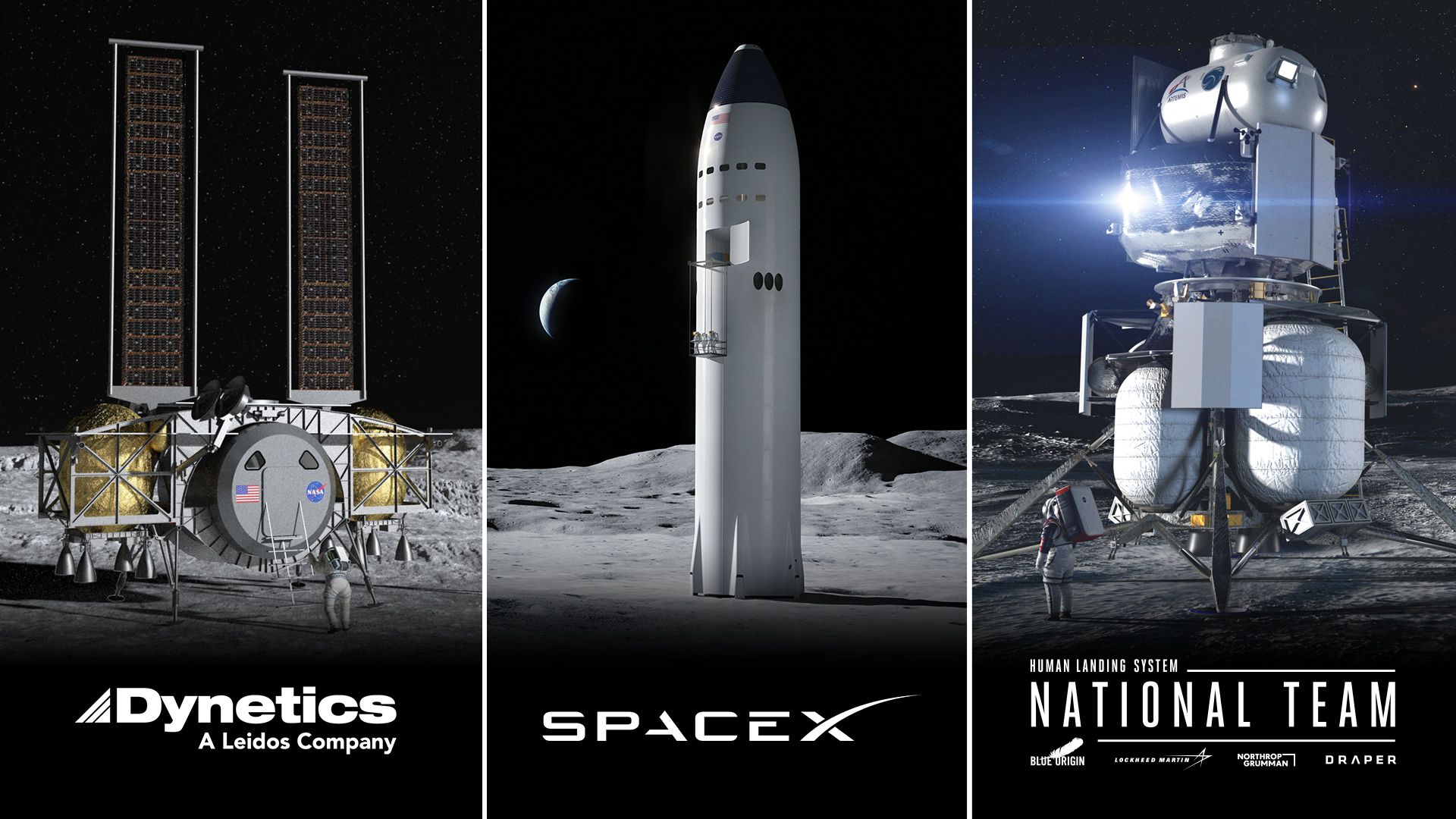
Three Lunar Lander proposals. Credit Dynetics, SpaceX, and Blue Origin. Credit NASA.
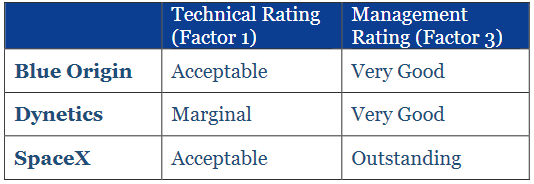
Technical and Management Adjectival Ratings from https://www.nasa.gov/sites/default/files/atoms/files/option-a-source-selection-statement-final.pdf
Also, SpaceX’s bid was the lowest by a wide margin. With the extra funds, it looks like Blue Origin will be the second successful bidder.
12/29/2015 – Ephemeris – Some space triumphs of 2015
Ephemeris for Tuesday, December 29th. The Sun will rise at 8:19. It’ll be up for 8 hours and 50 minutes, setting at 5:10. The Moon, half way from full to last quarter, will rise at 9:58 this evening.
This past year had several important events. Perhaps the biggest was the flyby of Pluto and its moons July 14th By the New Horizons spacecraft. The transmission of data and images will continue for most of 2016, but what has been revealed has been spectacular if puzzling. In other space news Blue Origin landed their New Shepard rocket vertically after sending it straight up 60 miles. In June the SpaceX Falcon 9 blew up while attempting to send its 7th resupply Dragon capsule to the International Space Station. Eight days ago The Falcon 9 returned to flight orbiting 11 satellites for Orbocomm, and flew the booster from over 100 miles up and 100 miles out over the Atlantic to land upright on its designated landing pad back at the cape.
Times are for the Traverse City/Interlochen area of Michigan. They may be different for your location.
Addendum
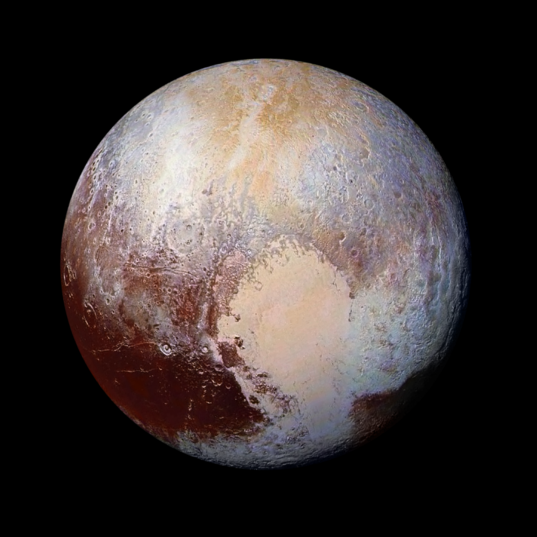
Enhanced color portrait of Pluto by the New Horizons spacecraft. Credit: NASA/JHUAPL/SwRI.

Blue Origin New Shepard rocket, with landing legs expended about to land. Credit: Blue Origin.
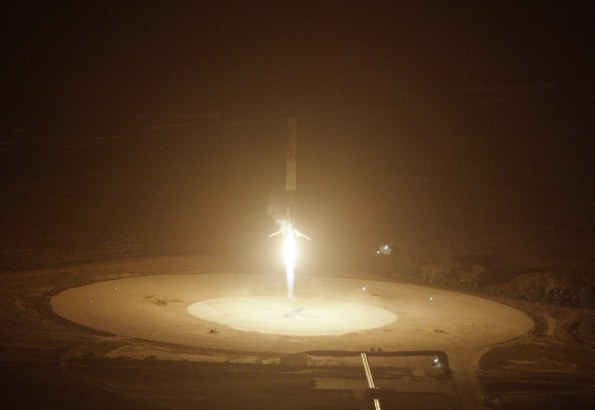
First stage of the SpaceX Falcon 9 descending on its center rocket engine to the center of the main landing pad at Cape Canaveral. Credit: SpaceX.
These weren’t the only highlights of 2015. Having only 45 seconds to devote to the story, I picked the three most important events. I consider the reuseability of rockets to be the Holy Grail of reducing the cost to access to space. The Space Shuttle was a partial, but ultimately failed solution. SpaceX had the most difficult task in refurbishment and reuse because the first stage had to endure a supersonic reentry, though it didn’t need a heat shield. We’ll have to see if the cost of recycling rocket boosters is cheaper than building one from scratch.
 Bob Moler's Ephemeris Blog