Archive
Ephemeris: 10/22/2024 – Reviewing last week’s showing of Comet Tsuchinshan-ATLAS
This is Ephemeris for Tuesday, October 22nd. Today the Sun will be up for 10 hours and 37 minutes, setting at 6:45, and it will rise tomorrow at 8:09. The Moon, 2 days before last quarter, will rise at 10:40 this evening.
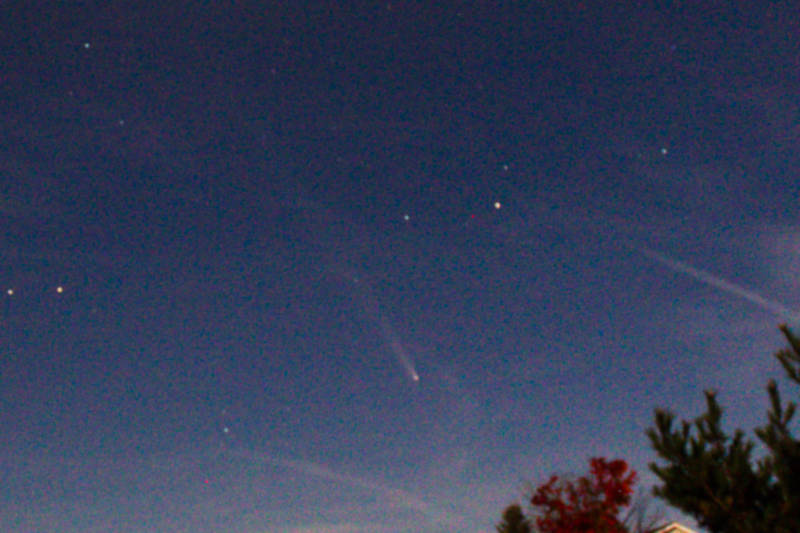
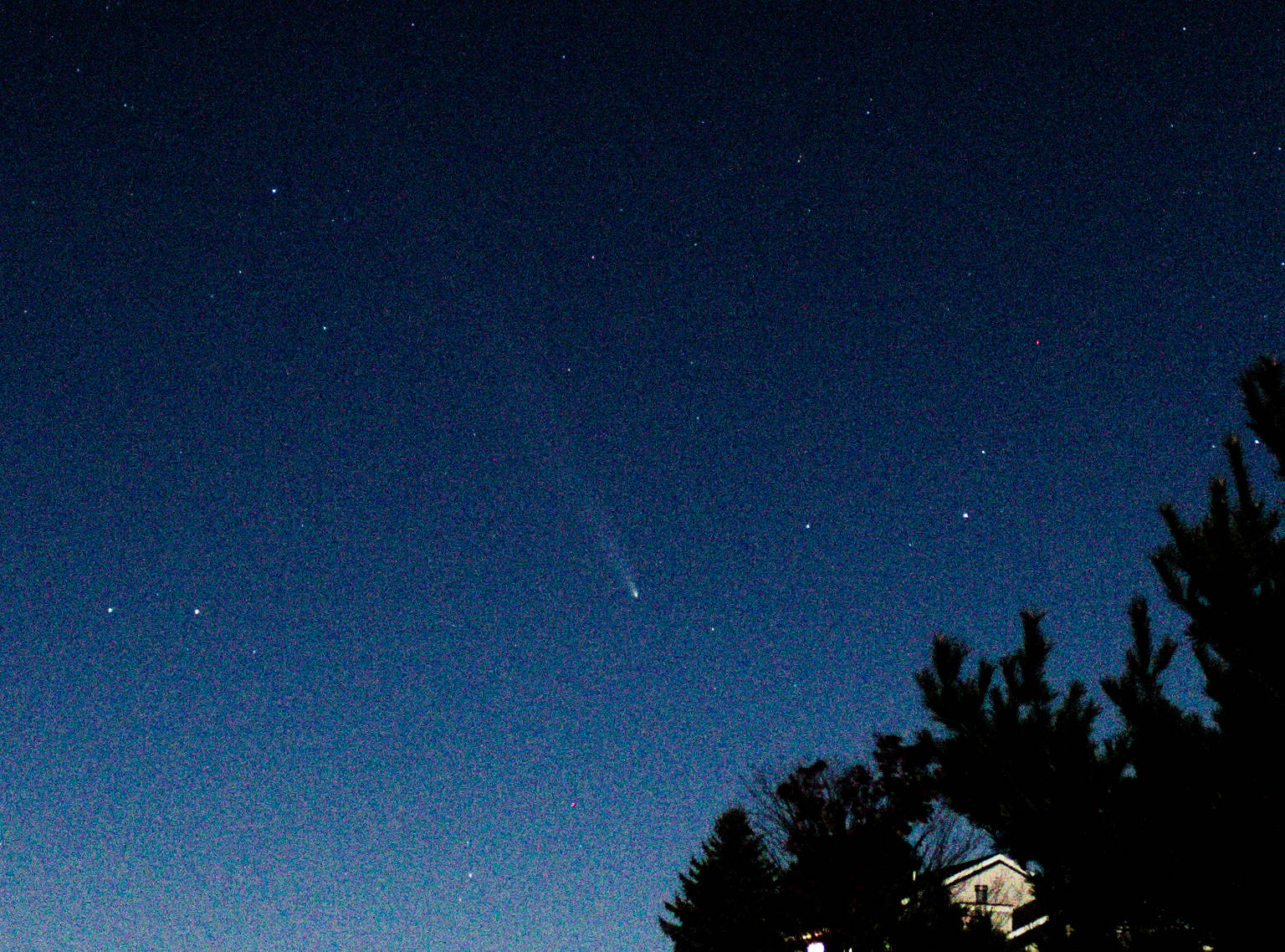
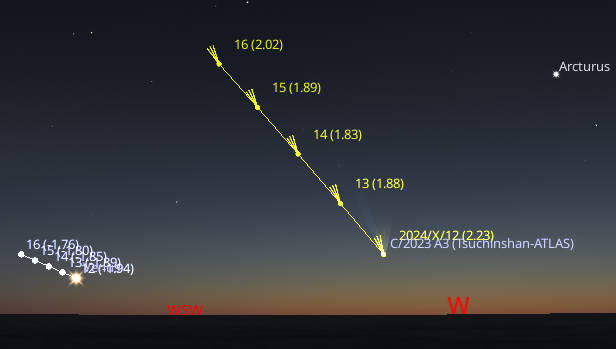
Comet Tsuchinshan-ATLAS continues to head out away from the Sun and the Earth, heading back to the Oort Cloud from whence it came. It’s best showing for us came last week. Unfortunately, it was cloudy the weekend before and the first part of the week when the comet was its brightest. However, by Wednesday evening I was able to spot the comet, but not with the naked eye. I could see it in binoculars and I photographed it. Between the twilight and bright moonlight my poor eyes were not able to spot it. Now that the Moon is leaving the evening sky, and the comet is moving up above the horizon in the west, it should be easily spotted with binoculars towards 9 pm. It has faded significantly and will continue as it speeds away from us.
The astronomical event times given are for the Traverse City/Interlochen area of Michigan (EDT, UT – 4 hours). Times will be different for other locations.
Addendum
Wednesday, October 16th
October 17th
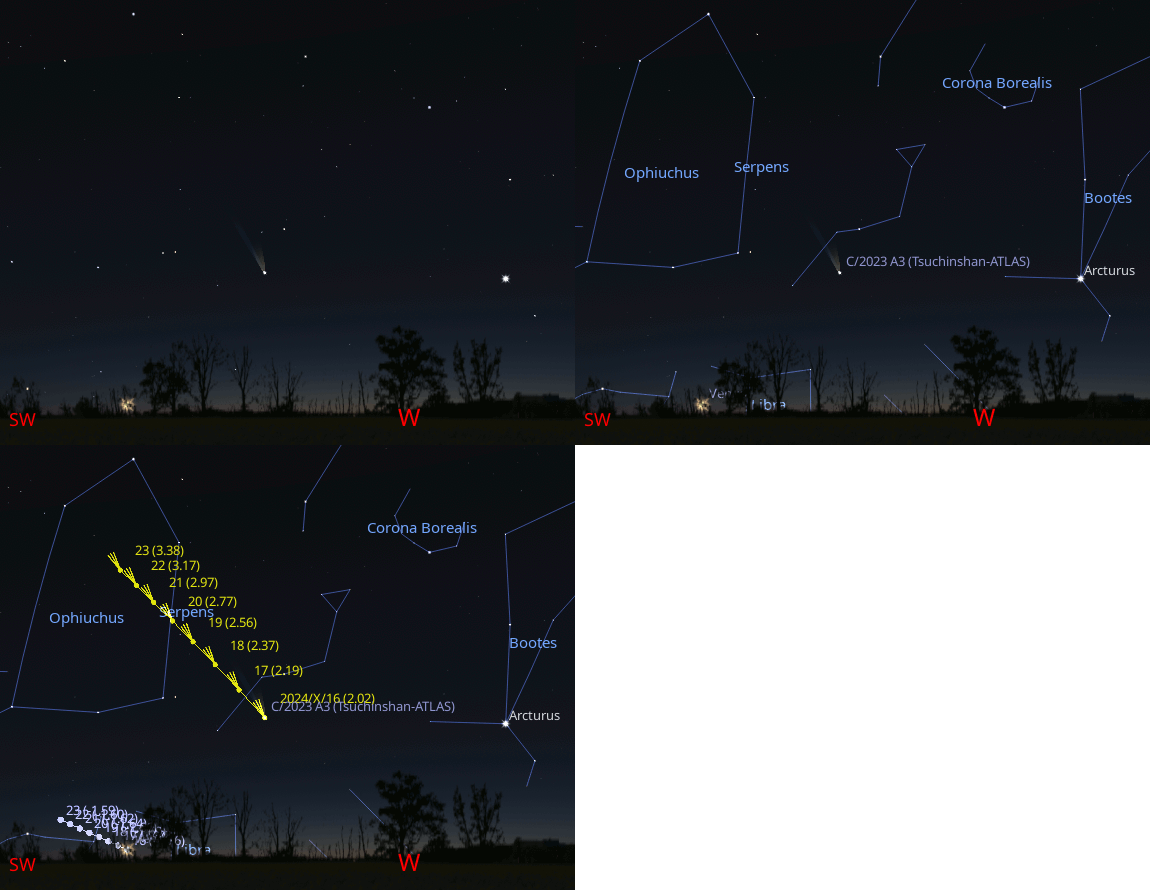
Comet track
Ephemeris: 10/15/2024 – Comet Tsuchinshan-ATLAS should be visible this week if clouds allow
This is Bob Moler with Ephemeris for Tuesday, October 15th. Today the Sun will be up for 10 hours and 58 minutes, setting at 6:57, and it will rise tomorrow at 8:00. The Moon, 2 days before full, will set at 6:47 tomorrow morning.
Comet Tsuchinshan-ATLAS has been visible in our evening skies for the last three nights and will be at least bright enough to be seen with the naked eye. And it should be so for most of the rest of the month. However, this week so far has been cloudy, and it will be cloudy until possibly Wednesday night however Thursday and Friday look like the best for viewing of the comet. Of course this is Michigan, so don’t hold me to it. The comet has been pretty much living up to expectations as far as its brightness and the length of its tail. The comet peak brightness which came early last week, when it could only be seen during the daytime, was as bright as the planet Venus. Now that it is headed away from the Sun and the Earth it will rapidly fade.
The astronomical event times given are for the Traverse City/Interlochen area of Michigan (EDT, UT – 4 hours). Times will be different for other locations.
Addendum
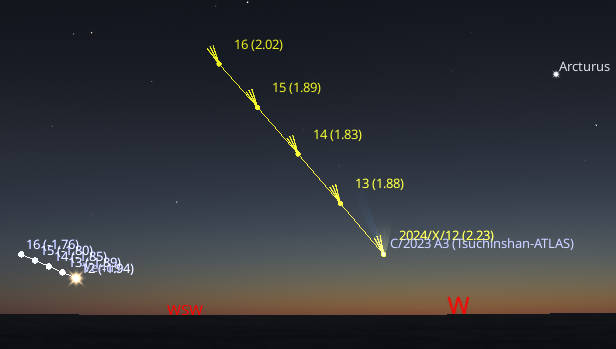
What we’ve missed
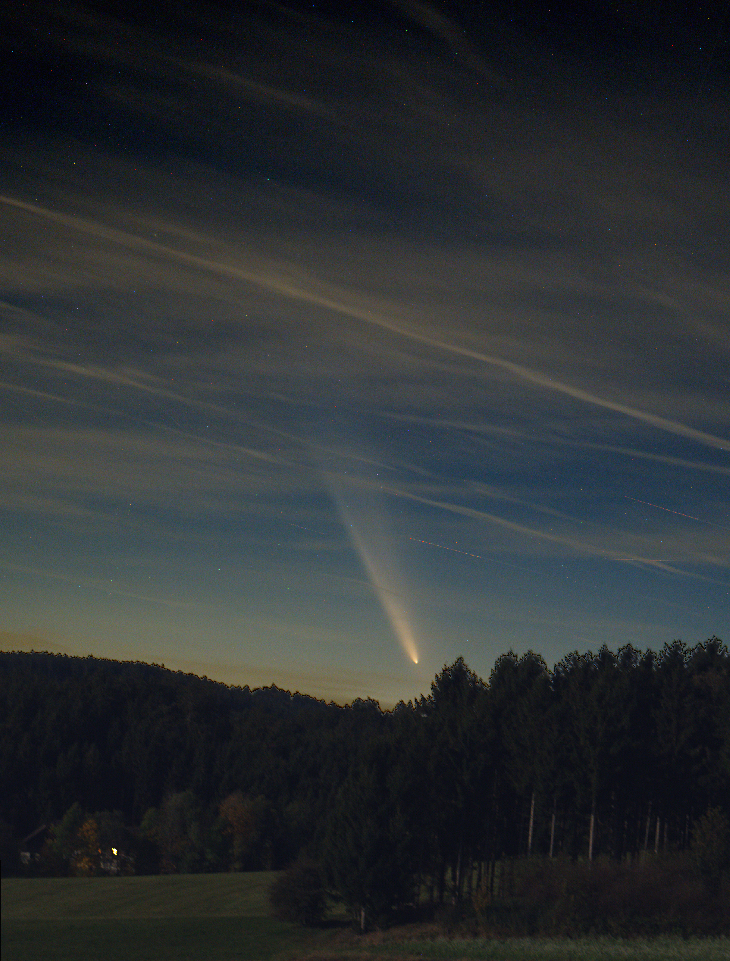
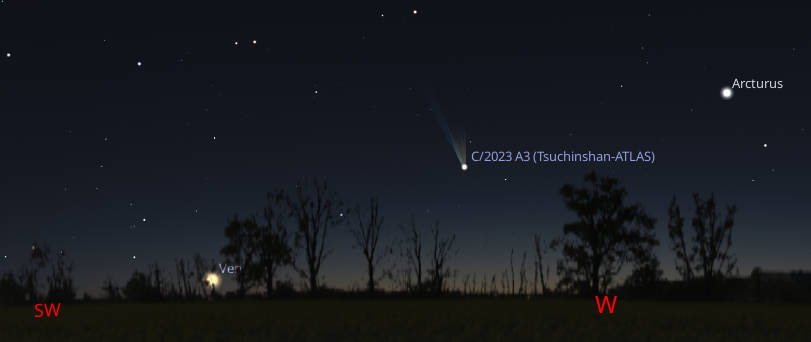
It was partly cloudy on the evening of 14th, last night. I went out a little after 8 PM to see if I could spot the comet. I could see Arcturus, however I could not spot the comet or the planet Venus. However, I believe someone in our area could have spotted the comet, if they were in the right location.
Ephemeris: 10/14/2024 – The One Who Came From a Shooting Star
This is Ephemeris for Indigenous Peoples Day, Monday, October 14th. Today the Sun will be up for 11 hours and 1 minute, setting at 6:58, and it will rise tomorrow at 7:58. The Moon, 3 days before full, will set at 5:24 tomorrow morning.
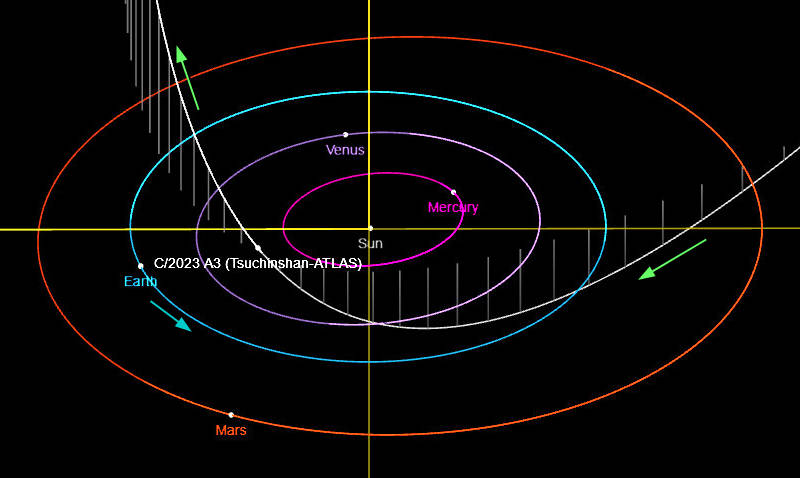
I’ll relate it to our comet. Comets are the cause of meteor showers. However, our current comet Tsuchinshan-ATLAS will never produce a meteor shower for us because its orbit doesn’t come close to the Earth’s. The closest it gets is half the distance to the Sun which it did five days ago.
The Anishinaabek have a story about how the Wolverine got its name, in their language, gwiingwa’aage, which means “The One Who Came From a Shooting Star”. An evil star spirit crashed to Earth and created a crater in what is now northern Quebec. Later it filled with water, and sometime later this ill-tempered creature crawled out of it. The University of Michigan’s teams are called the Wolverines, even though the wolverine is not native to Michigan.
The astronomical event times given are for the Traverse City/Interlochen area of Michigan (EDT, UT – 4 hours). Times will be different for other locations.
Addendum
Ephemeris: 10/09/2024 – Where are the naked-eye planets this week?
This is Ephemeris for Wednesday, October 9th. Today the Sun will be up for 11 hours and 16 minutes, setting at 7:07, and it will rise tomorrow at 7:52. The Moon, 1 day before first quarter, will set at 10:57 this evening.
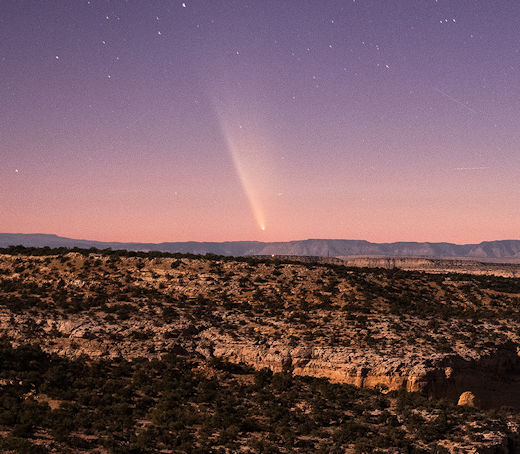
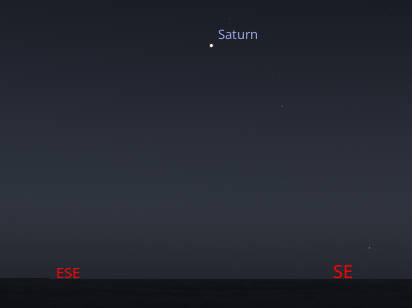
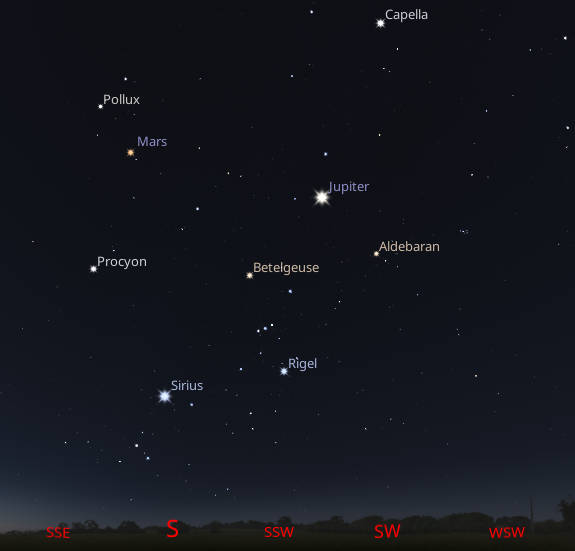
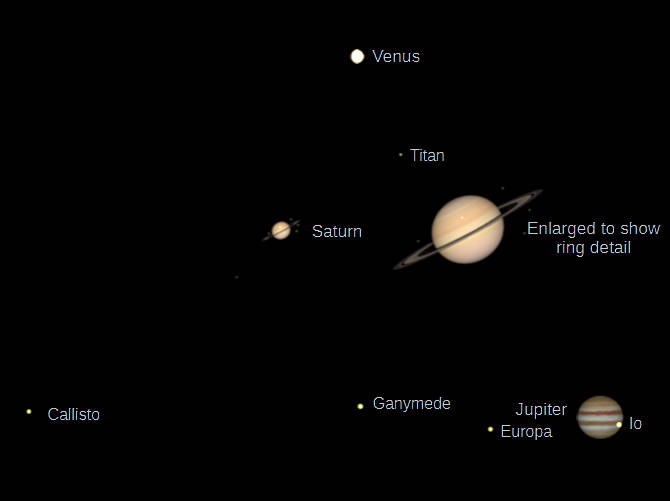
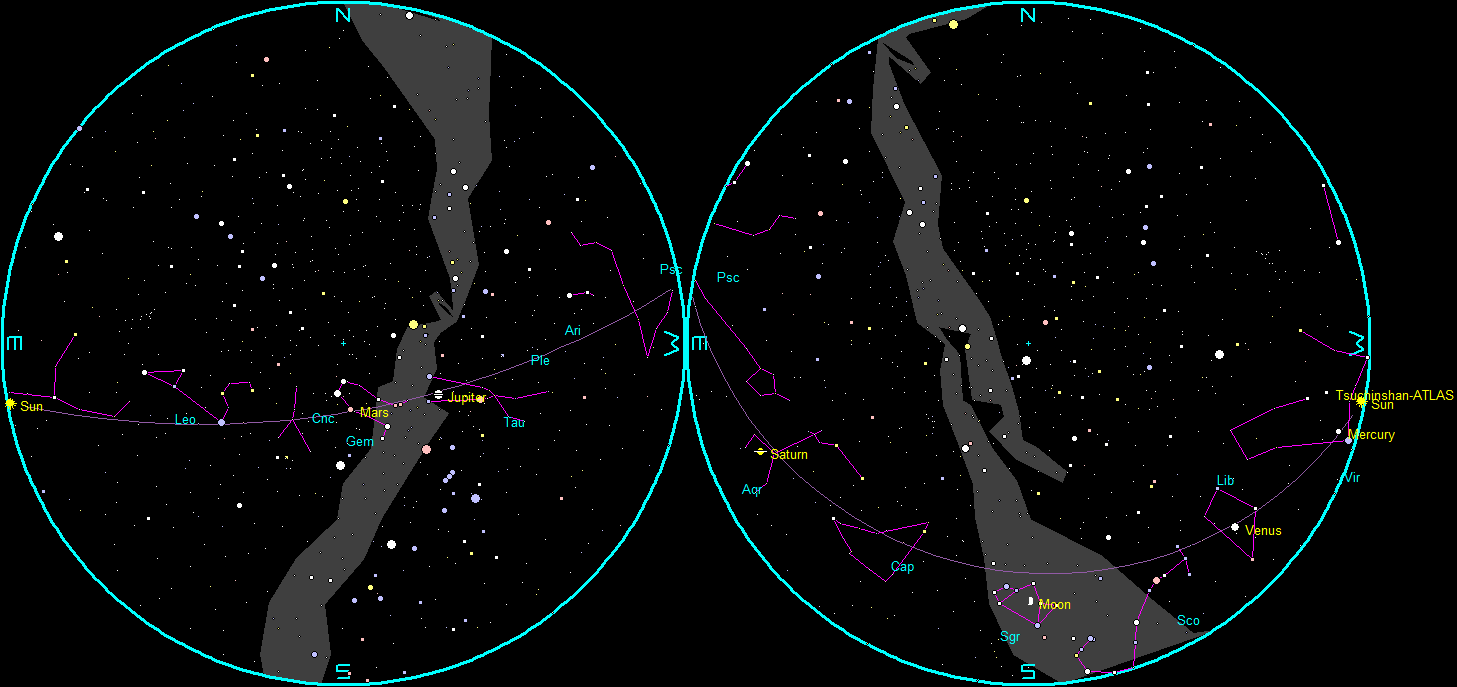
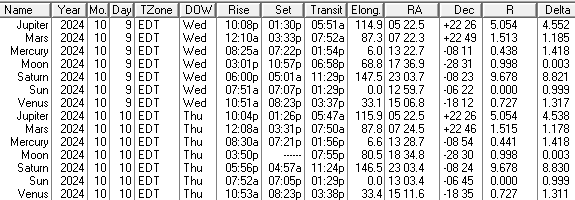
Let’s take our weekly look at the whereabouts of the naked-eye planets. Venus might be spotted in the West southwest only 7° above the horizon at 8 PM, 55 minutes after sunset. It will set at 8:23. Saturn will be in the southeast at that time. Saturn may look disappointing in telescopes this year since its rings are nearly edge on and appearing as a line through the planet like it’s stapled onto the sky. Jupiter and Mars will be up in the morning sky, with Jupiter rising about 10:08 PM in the east-northeast. By 7 AM tomorrow, Jupiter will be brighter than any of the winter stars high in the south. Mars, with its reddish hue, will be to the left of Jupiter. Comet Tsuchinshan-ATLAS will be in the western evening sky starting this weekend. It is expected to be quite bright, I’m betting with a broad tail.
The astronomical event times given are for the Traverse City/Interlochen area of Michigan (EDT, UT – 4 hours). Times will be different for other locations.
Addendum
Ephemeris: 10/08/2024 – Comet Tsuchinshan-ATLAS may be brighter than expected
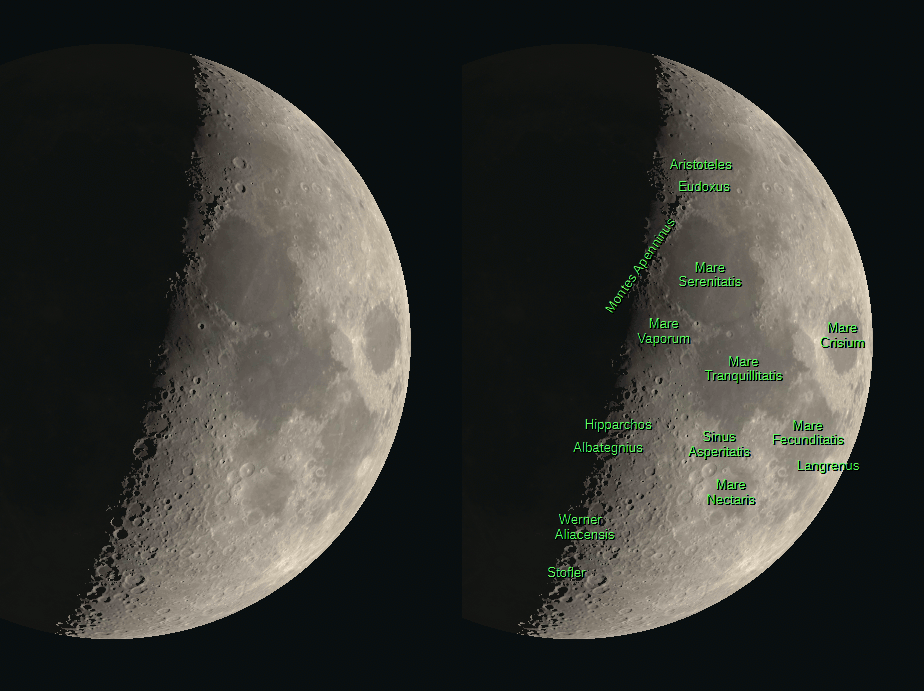
This is Ephemeris for Tuesday, October 8th. Today the Sun will be up for 11 hours and 19 minutes, setting at 7:09, and it will rise tomorrow at 7:51. The Moon, 2 days before first quarter, will set at 10:00 this evening.
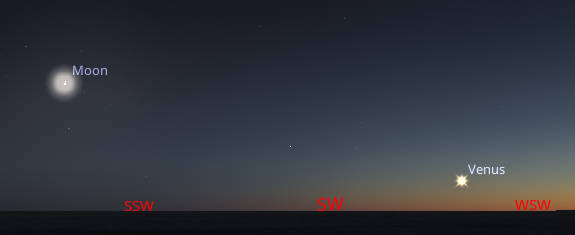
You are going to hear a lot about a bright comet visible in the evening starting this weekend. The comet with a long name Tsuchinshan-ATLAS will begin to be visible in the evening sky, and it will be very bright. It will be the brightest comet we’ve had in some time visible in the Northern Hemisphere since Comet Hale-Bopp in 1997. The reason for this comet’s great brightness is that the comet is passing between the Earth and the Sun. This comet is very dusty with an extensive dust tail. Since the comet is passing between the Earth and Sun the dust scatters sunlight in a forward direction like seeing sunbeams through holes in the clouds near sunset. This is making the comet brighter than originally predicted.
The astronomical event times given are for the Traverse City/Interlochen area of Michigan (EDT, UT – 4 hours). Times will be different for other locations.
Addendum
Ephemeris: 10/07/2024 – Comet Tsuchinshan-ATLAS will be visible starting Saturday Night
This is Ephemeris for Monday, October 7th. Today the Sun will be up for 11 hours and 22 minutes, setting at 7:11, and it will rise tomorrow at 7:50. The Moon, 3 days before first quarter, will set at 9:15 this evening.
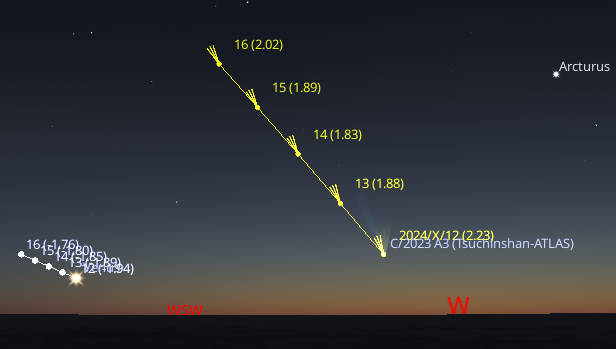
In January of last year a Chinese observatory discovered a comet which was subsequently lost. A month and a half later another observatory in South Africa rediscovered it. That’s why the comet is named, Tsuchinshan-ATLAS after the two observatories. It was soon learned that the comet had a chance of becoming visible to the unaided eye in late September and October 2024, this month. Despite having a dimming episode earlier this year the comet promises to be naked eye and possibly even spectacular. The comet is moving from the south to the north and in a direction counter to the orbiting planets around the Sun. We will begin to see it low in the West after sunset starting Saturday.
The astronomical event times given are for the Traverse City/Interlochen area of Michigan (EDT, UT – 4 hours). Times will be different for other locations.
Addendum
The comet will pass almost directly between the Earth and the Sun on the evening of the 9th. It’ll be about halfway between the Earth and the Sun at that point. It should be picked up by the Solar and Heliospheric Observatory satellite (SOHO) which is orbiting the Earth-Sun L1 Lagrange point a million miles sunward from the Earth with its C3 coronagraph*. Then the comet’s tail should be pointing almost directly at the Earth. As the comet swings out away from the Sun it will also be more rapidly moving away from Earth. This is because the comet has an orbit that is counter to that of the orbits of the Earth and the rest of the planets around the Sun and will rapidly fade as it increases its distance.
A note on the discovery designation: C/2023 A3 is C for comet; 2023, the year of discovery; A3, third object reportedly discovered in the first half of January.
The SOHO Real-time GIF Movies webpage is: https://soho.nascom.nasa.gov/data/realtime/gif/. Select LASCO/C3. It provides a time-lapse image of the Sun’s corona taken at hourly intervals for about the last 4 days.
 Bob Moler's Ephemeris Blog