Archive
02/07/2019 – Ephemeris – Siriusly, folks.
Ephemeris for Friday, February 8th. Today the Sun will be up for 10 hours and 7 minutes, setting at 6:01, and it will rise tomorrow at 7:52. The Moon, half way from new to first quarter, will set at 9:48 this evening.
At 9 in the evening the great constellation of Orion the hunter can be seen in the south. Its large rectangle of bright stars is now upright, while in the center is a row of three stars, his belt. These stars tilt downward to the left to a very bright star merrily twinkling in the south-southeast. This star is called Sirius, also known as the Dog Star because it’s in the heart of Orion’s larger hunting dog, Canis Major. It is an arc light white star as seen in binoculars or telescope. It’s a neighboring star, just twice the distance of the closest star to the sun at 8.6 light years. It’s name, Sirius, has nothing to do with a dog, but is from the Greek meaning scorching for its brightness or sparkling, due to its intense twinkling.
The times given are for the Traverse City/Interlochen area of Michigan. They may be different for your location.
Addendum
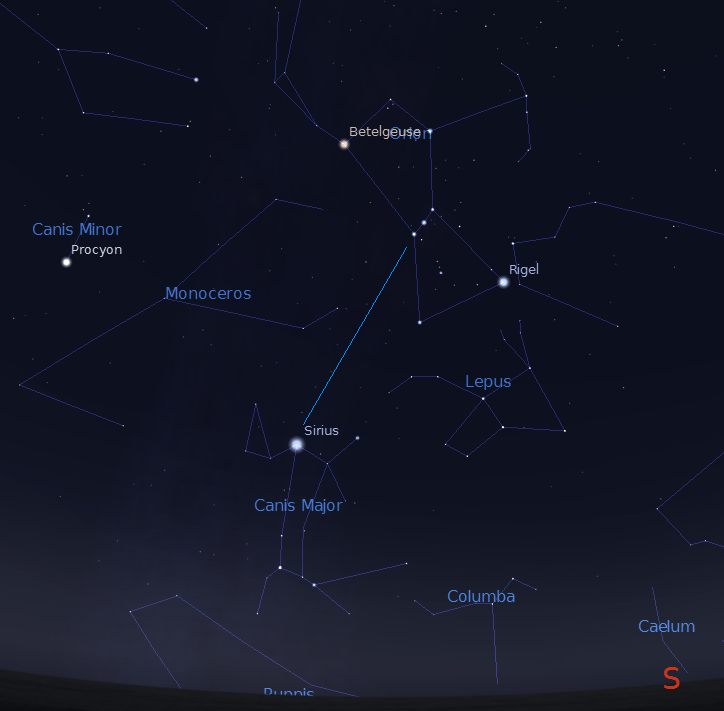
Orion’s Belt points to Sirius. Created using Stellarium.
01/28/2019 – Ephemeris – The celestial unicorn
Ephemeris for Monday, January 28th. Today the Sun will be up for 9 hours and 39 minutes, setting at 5:45, and it will rise tomorrow at 8:05. The Moon, 1 day past last quarter, will rise at 2:52 tomorrow morning.
Within a triangle bounded by stars Betelgeuse in Orion, Sirius in Canis Major and Procyon in Canis Minor, called the Winter Triangle appears a nearly starless patch of sky to the naked eye. In here is the constellation Monoceros, the unicorn. Unfortunately for observers without optical aid Monoceros, though large, is devoid of any but the faintest stars. Maybe that’s why no one sees unicorns anymore. It has many faint stars because the Milky Way runs through it. To the telescope it is a feast of faint nebulae or clouds of gas and dust, the birth place of stars, including the red rose of the Rosette Nebula, and the strange and tiny Hubble’s Variable Nebula. It also contains beautiful telescopic triple star system, Beta (β) Monocerotis.
The times given are for the Traverse City/Interlochen area of Michigan. They may be different for your location.
Addendum
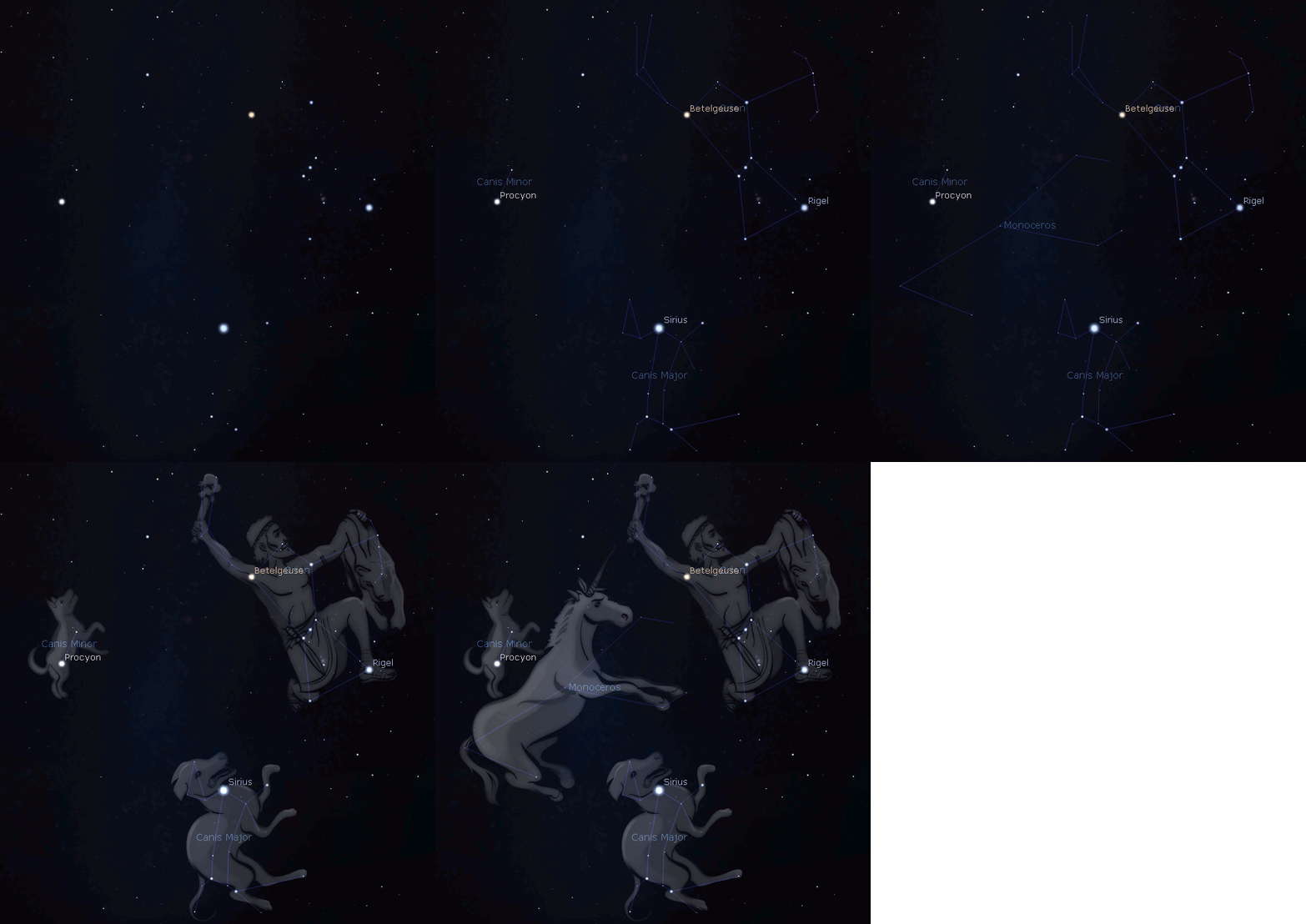
Monoceros finder chart animation. Created using Stellarium and GIMP.
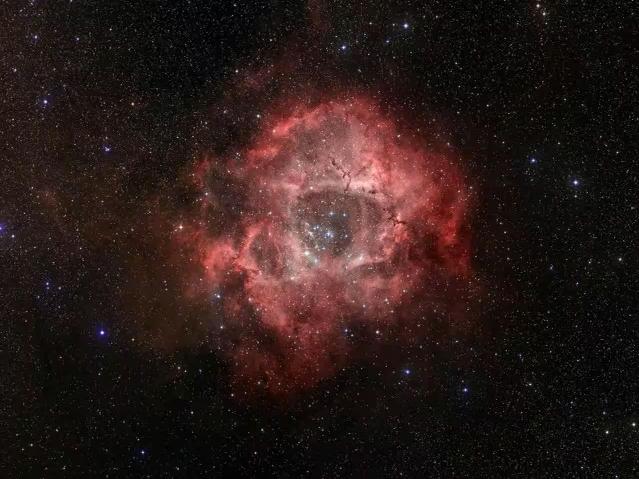
Rosette Nebula in the infrared from the Spitzer Space Telescope. Credit: NASA/JPL/Caltech
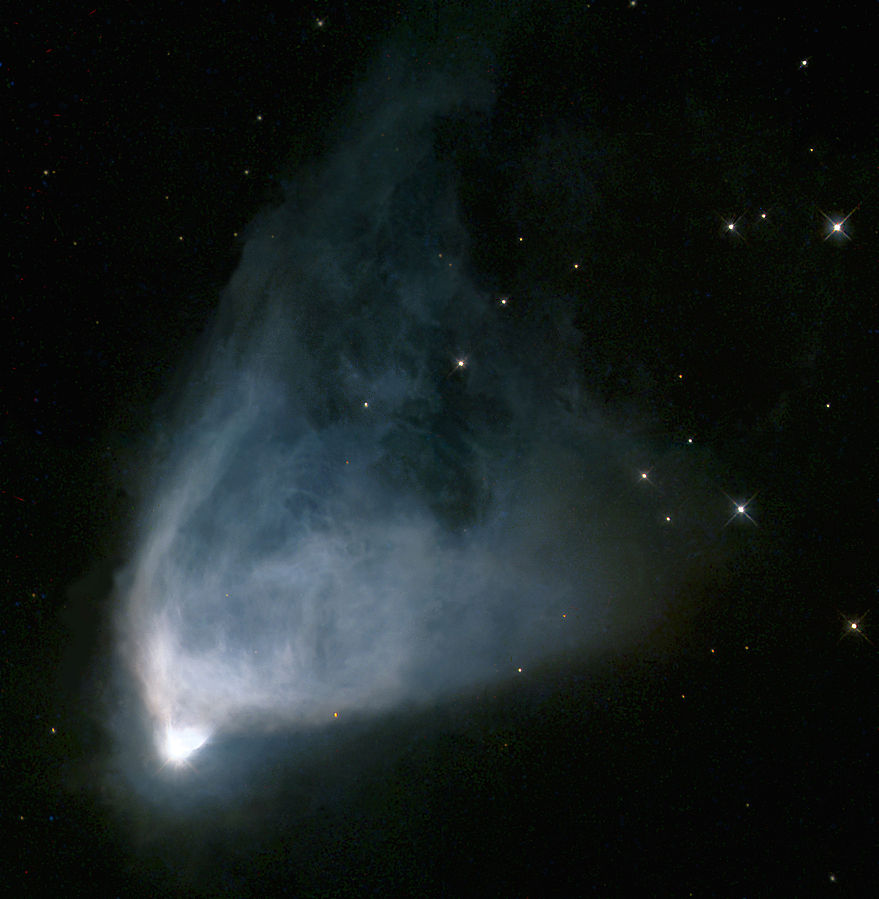
Hubble’s Variable Nebula photographed appropriately enough by the Hubble Space Telescope. Credit: NASA/ESA and The Hubble Heritage Team (AURA/STScI).
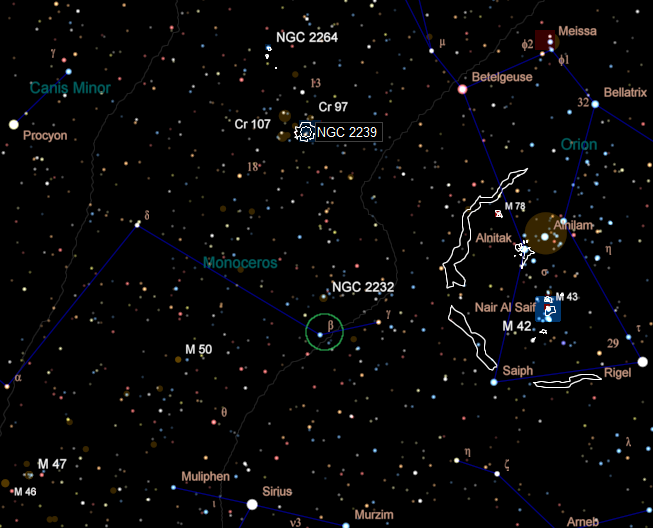
Looking at some faint objects in Monoceros. NGC 2239 is the star cluster in the center of the Rosette Nebula. The nebula itself is extremely faint. It shows in photographs, but I’ve never seen it visually. The green circle shows Beta Monocerotis, the triple star. All these stars are extremely blue-white hot. Created using Cartes du Ciel (Sky Charts).
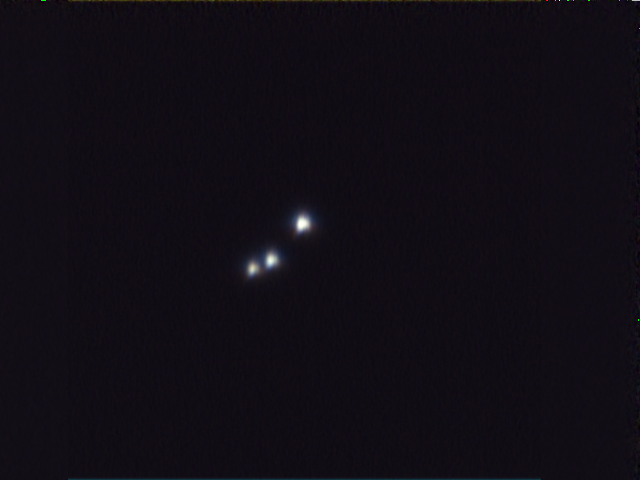
Telescopic Beta Monocerotis. William Hershel, discoverer of Uranus, said that it was “One of the most beautiful sights in the heavens.” Credit: F. Ringwald, Fresno State.
01/25/2019 – Ephemeris – Let’s find Orion’s hunting dogs
Ephemeris for Friday, January 25th. Today the Sun will be up for 9 hours and 32 minutes, setting at 5:41, and it will rise tomorrow at 8:08. The Moon, 2 days before last quarter, will rise at 11:27 this evening.
The great winter constellation or star group Orion the Hunter, is located in the south-southeastern sky at 9 p.m. His elongated rectangle of a torso is tilting toward the vertical. In the center of the rectangle are three stars in a line that make his belt. As a hunter, especially one of old, he has two hunting dogs. The larger, Canis Major can be found by following the three belt stars of Orion down and to the left. There lies the brilliant star called Sirius, also known as the Dog Star. It’s in the heart of a stick figure dog low in the southeast facing Orion that appears to be begging. Canis Minor is just two stars found by extending Orion’s shoulder stars eastward where we find bright Procyon, the little dog star.
The times given are for the Traverse City/Interlochen area of Michigan. They may be different for your location.
Addendum
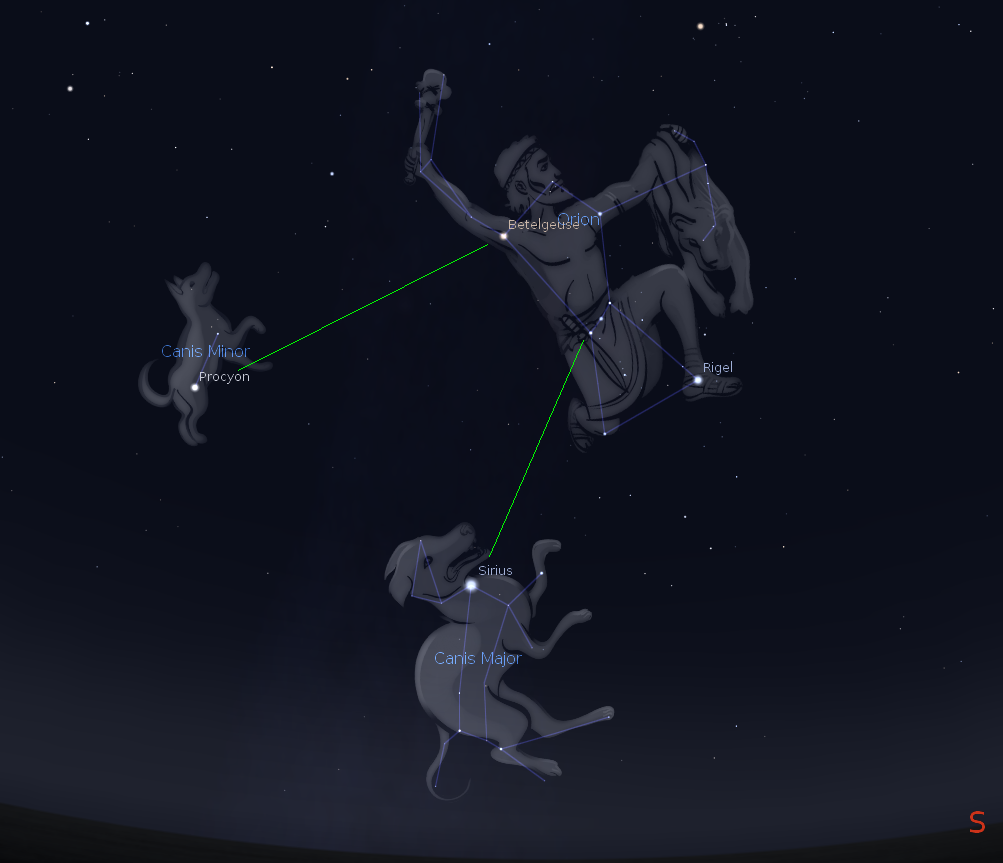
Orion and his hunting dogs with pointers as seen at 9 p.m. in late January . Created using Stellarium.
03/09/2018 – Ephemeris – The good ship Argo
Ephemeris for Friday, March 9th. The Sun will rise at 7:06. It’ll be up for 11 hours and 35 minutes, setting at 6:41. The Moon, at last quarter today, will rise at 2:50 tomorrow morning.
Located south and east of Canis Major, the great hunting dog of Orion and it brilliant star Sirius in the south is a dim constellation of Puppis, the poop deck of the old constellation Argo Navis, the constellation that depicts the ship Jason and the Argonauts used in their search for the Golden Fleece. This huge constellation has been subdivided. Only Puppis and Pyxis the ship’s compass are visible from Michigan. The other parts of the ship are Carina the keel, and Vela the sails require traveling south at least to the southern most of the United States. Three other constellations also related to this expedition are Gemini with Castor, who died on the expedition and Pollux. Hercules was also aboard as was the physician of the constellation Ophiuchus.
The times given are for the Traverse City/Interlochen area of Michigan. They may be different for your location.
Addendum
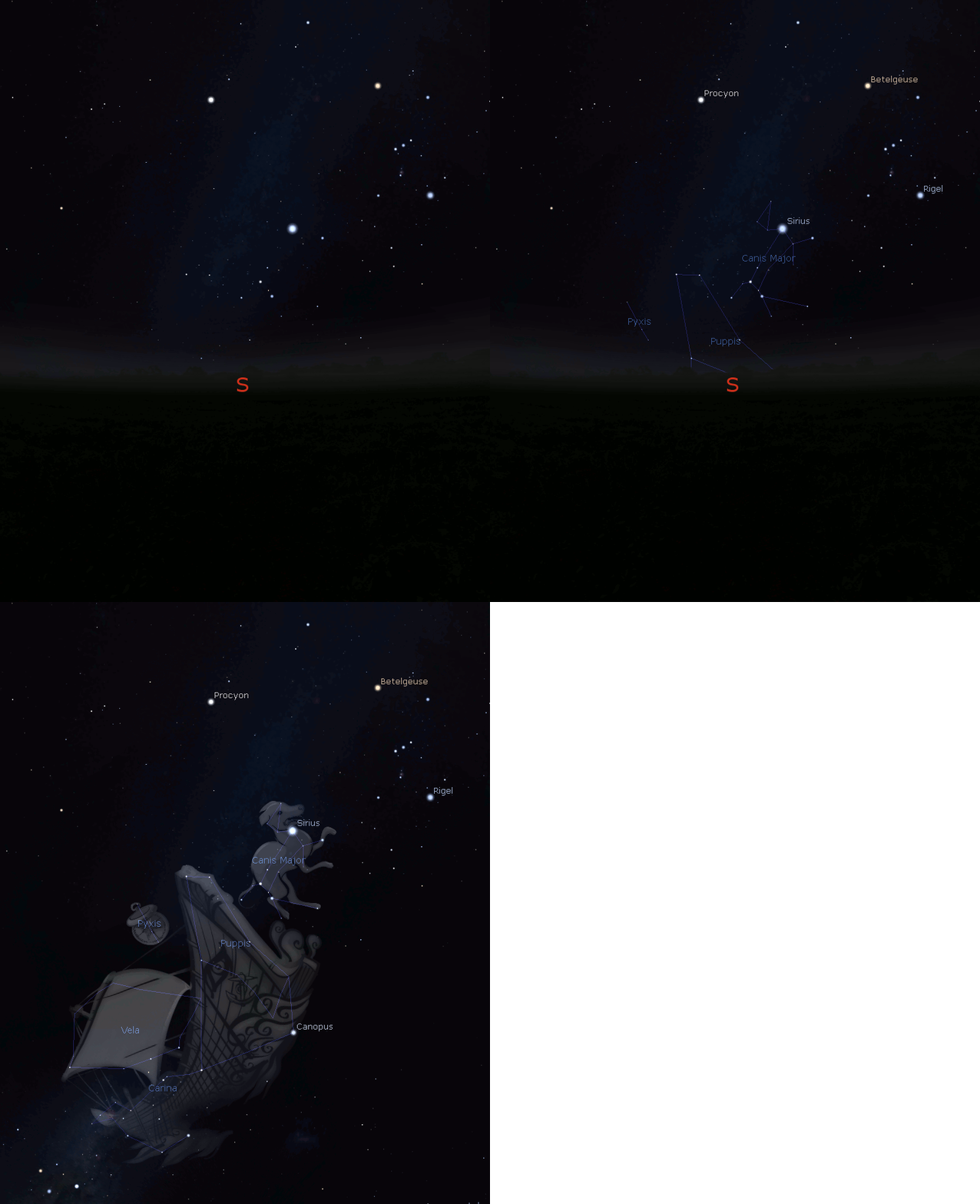
Puppis ans Pyxis; what we can see from Michigan, plus the rest of Argo Navis at 9 p.m., March 9, 2018. The Stellarium artist has the ship reversed. Puppis is the rear end, not the bow. Note that the Crux, the Southern Cross is below the ship. Click on the image to enlarge. Created using Stellarium and GIMP.
01/22/2018 – Ephemeris – The Pup
Ephemeris for Monday, January 22nd. The Sun will rise at 8:11. It’ll be up for 9 hours and 25 minutes, setting at 5:37. The Moon, 2 days before first quarter, will set at 11:24 this evening.
Sirius is the brightest night-time star and is located in the southeast at 9 p.m. below and a bit left of Orion the Hunter. We’ve visited Sirius last week. There is another star in the Sirius system that is practically invisible due to its dazzling glare. It’s Sirius B, nicknamed the Pup, alluding to Sirius’ Dog Star title. The tiny star was suspected as far back as 1834 due to Sirius’ wavy path against the more distant stars. Sirius is only 8.6 light years away. Sirius A and the Pup have 50 year orbits of each other. The star was first seen by Alvan Clark in 1862 while testing a new telescope. The Pup was the first of a new class of stars called white dwarfs. The Pup is about the size of the Earth, with the mass of our Sun, and 5 times hotter than the Sun’s surface. It’s out of fuel and slowly collapsing.
The times given are for the Traverse City/Interlochen area of Michigan. They may be different for your location.
Addendum
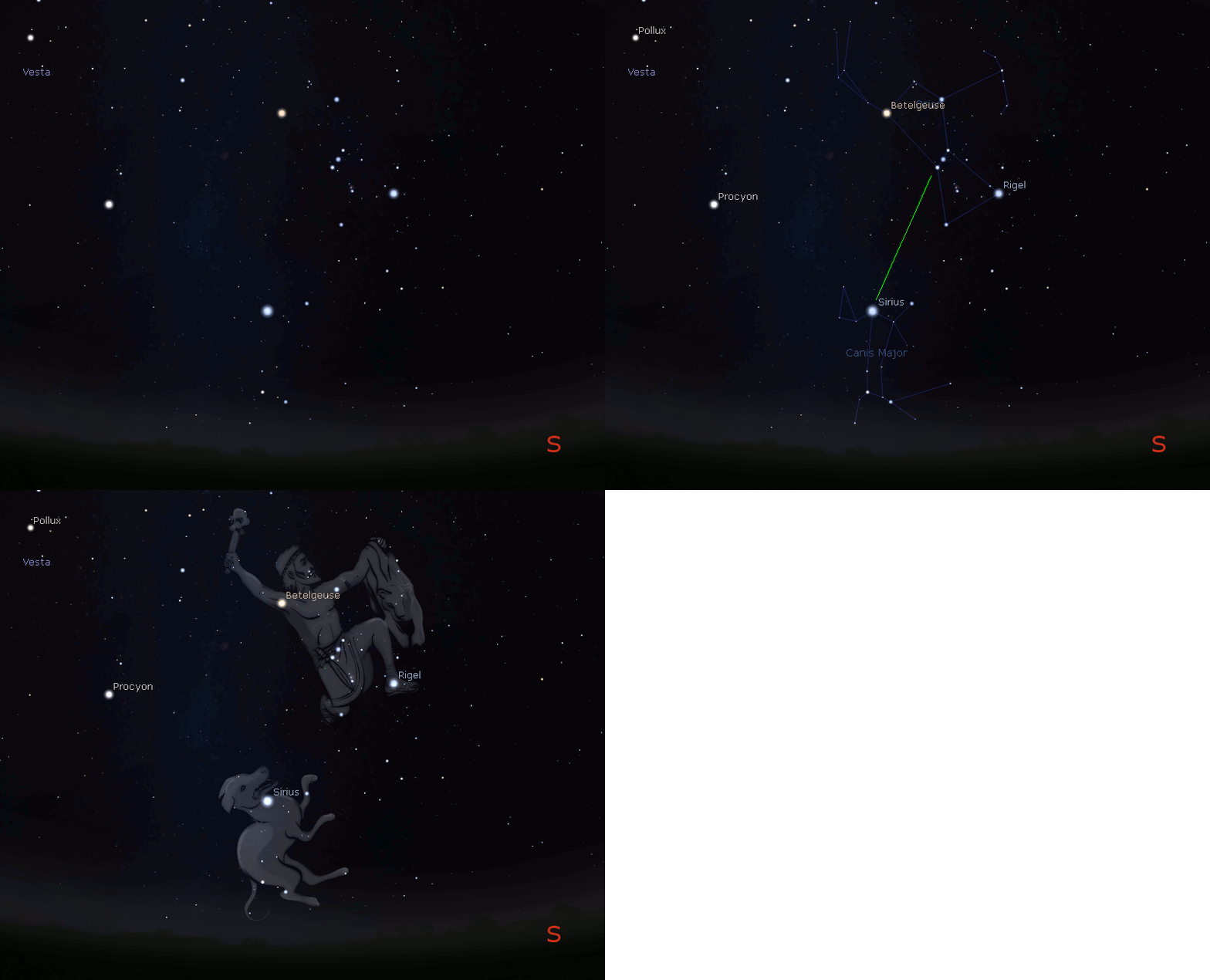
Orion and Canis Major Animation for 9 p.m. January 20, 2017. Created using Stellarium and GIMP.
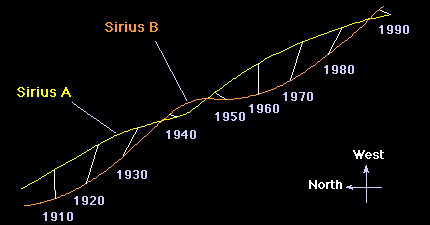
Sirius A & B’s path in the sky showing the wobble that betrayed the Pup’s presence. Credit Mike Guidry, University of Tennessee.
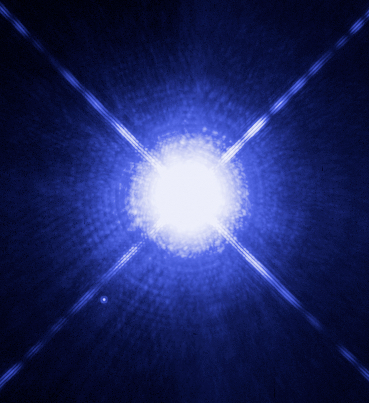
Sirius A and B (near the diffraction spike to the lower left), A Hubble Space Telescope photograph. Credit NASA, ESA.
01/19/2018 – Ephemeris – Orion’s large hunting dog
Ephemeris for Friday, January 19th. The Sun will rise at 8:14. It’ll be up for 9 hours and 19 minutes, setting at 5:33. The Moon, 3 days past new, will set at 8:15 this evening.
The brightest star-like object in the evening sky is Sirius, also known as the Dog Star. It also is the brightest night-time star in our skies period. Tonight at 9 p.m. it’s located low in the southeastern sky. The Dog Star name comes from its position at the heart of the constellation Canis Major, the great dog of Orion the hunter, which is seen almost like he’s begging, feet to the right. The three stars of Orion’s belt tilt to the southeast and point to Sirius. The name Sirius means ‘Scorcher’, a reference to its great brilliance and twinkling. To me it has a blue tinge like an arc light in a telescope. Its Egyptian name was Sothis, and its appearance in the dawn skies in late June signaled the flooding of the Nile, and the beginning of the Egyptian agricultural year.
The times given are for the Traverse City/Interlochen area of Michigan. They may be different for your location.
Addendum
Orion and Canis Major Animation for 9 p.m. tonight. Created using Stellarium and GIMP.
12/18/2017 – Ephemeris – The little dog shall lead
Ephemeris for Monday, December 18th. The Sun will rise at 8:14. It’ll be up for 8 hours and 49 minutes, setting at 5:03. The Moon is new today, and won’t be visible.
The constellation Orion has two hunting dogs. At 9 p.m. we’ll see one of them, the lesser dog, Canis Minor whose bright star Procyon is low in the East. Just two stars mark the constellation. Is it a dachshund or maybe a hot dog? The name Procyon means “Before the dog”, an odd title. It means that though east of Sirius, the bright dog star in Orion’s large dog, Canis Major, it rises before Sirius, due to its more northerly position in the sky. At 9 Sirius is just rising in the east-southeast. In many ways Procyon is nearly a twin of Sirius. It shines with the same white color, although a bit cooler, and has a white dwarf companion like Sirius. It’s a bit farther away than Sirius’ 8.6 light years. Procyon is at a distance of 11.46 light years.
The times given are for the Traverse City/Interlochen area of Michigan. They may be different for your location.
Addendum
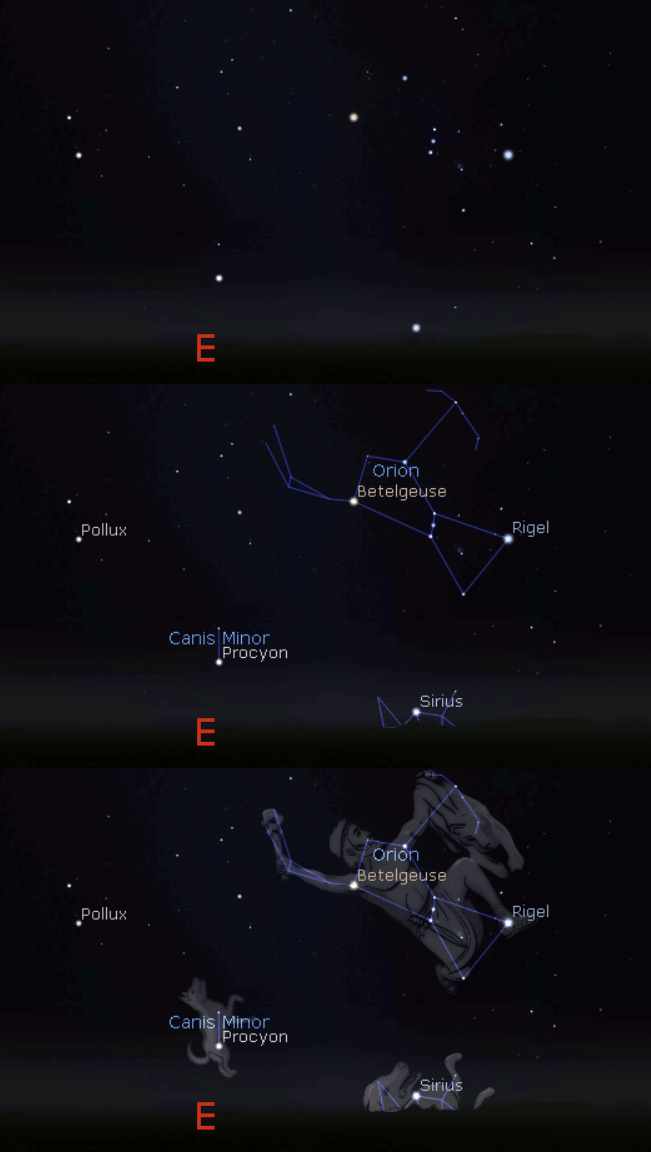
Stars and constellations in the east at 9 p.m., about 4 hours after sunset, on December 18th. This only works for locations above 30 degrees north latitude. Created using Stellarium.
02/16/2017 – Ephemeris – The Winter Circle
Ephemeris for Thursday, February 16th. The Sun will rise at 7:40. It’ll be up for 10 hours and 32 minutes, setting at 6:12. The Moon, 2 days before last quarter, will rise at 12:17 tomorrow morning.
The winter skies are blessed with more first magnitude stars than any other season. These are the twenty-one brightest stars in the sky. Six of these stars lie in a large circle centered on the seventh. This circle is up all evening now that we are in the heart of winter. Starting high overhead is Capella in Auriga the charioteer. Moving clockwise, we come to Aldebaran in the face of Taurus the Bull. Then down to Orion’s knee we find Rigel. Down and left is the brightest star of all Sirius the Dog Star in Canis Major Orion’s large hunting dog, lowest of these stars in the south. Moving up and left there is Procyon in Canis Minor, Then above it is Pollux in Gemini the twins. All are centered on Betelgeuse in Orion.
Times are for the Traverse City/Interlochen area of Michigan. They may be different for your location.
Addendum
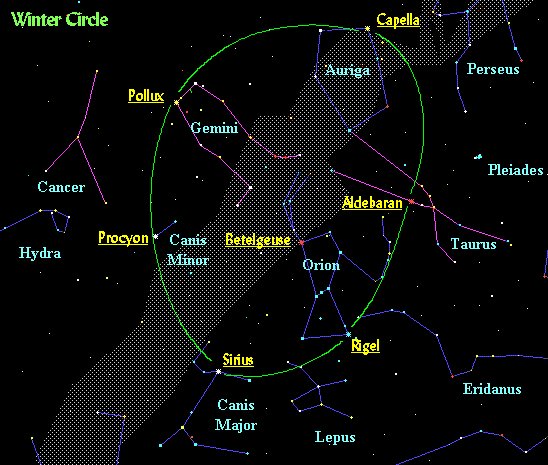
The Winter Circle of 1st magnitude stars. Created using my LookingUp program.
01/26/2017 – Ephemeris – Is it a dachshund or a hot dog?
Ephemeris for Thursday, January 26th. The Sun will rise at 8:07. It’ll be up for 9 hours and 36 minutes, setting at 5:43. The Moon, 1 day before new, will rise at 7:40 tomorrow morning.
The constellation Orion has two hunting dogs. We’ve seen Canis Major the greater dog at Orion’s feet with Sirius in its heart. The lesser dog, Canis Minor is level with Betelgeuse in Orion’s shoulder and off to the left. Just two stars mark it. Is it a dachshund or is it a hot dog? You decide. It’s brighter star’s name is Procyon which means “Before the dog”, an odd title. It means that though east of Sirius, it rises before Sirius, due to its more northerly position in the sky. In many ways Procyon is nearly a twin of Sirius. It shines with the same white color, although a bit cooler, and has a white dwarf companion like Sirius. It’s a bit farther away than Sirius’ 8 light years. Procyon is 11 and a half light years away. Procyon, Betelgeuse and Sirius make the winter triangle.
Times are for the Traverse City/Interlochen area of Michigan. They may be different for your location.
Addendum
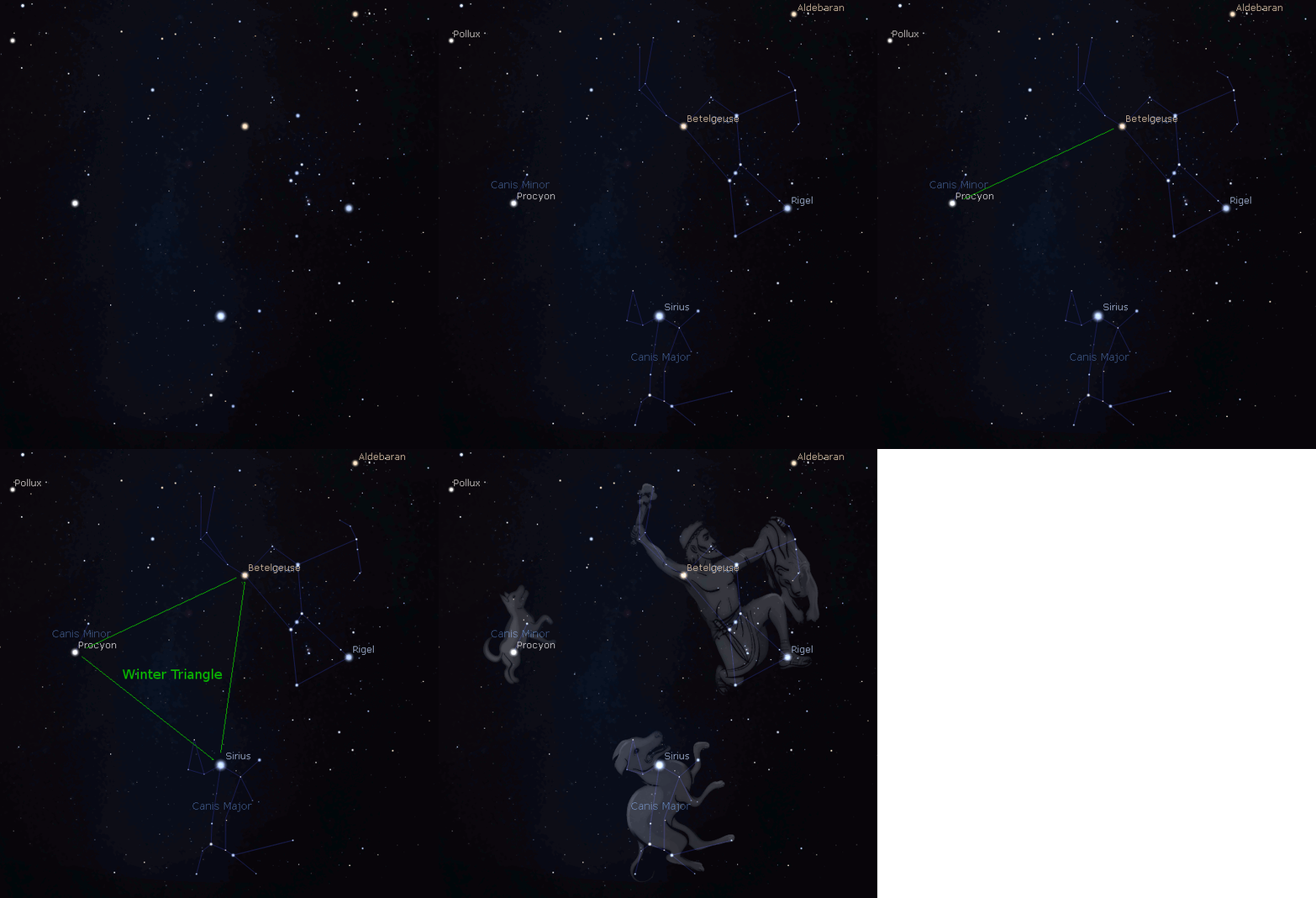
Procyon and Orion’s hunting dogs animation also showing the Winter Triangle asterism*. Created using Stellarium and GIMP.
* Asterism – an informal constellation like the Big Dipper, the Northern Cross, or the Summer Triangle. Not one of the 88 official constellations.
01/20/2017 – Ephemeris – Orion’s greater hunting dog
Ephemeris for Friday, January 20th. The Sun will rise at 8:12. It’ll be up for 9 hours and 22 minutes, setting at 5:35. The Moon, 1 day past last quarter, will rise at 2:29 tomorrow morning.
The great winter constellation or star group Orion the Hunter, is located in the south-southeastern sky at 9 p.m. His elongated rectangle of a torso is almost vertical. In the center of the rectangle are three stars in a line that make his belt. As a hunter, especially one of old, he has two hunting dogs. The larger, Canis Major can be found by following the three belt stars of Orion down and to the left. There lies the brilliant star called Sirius, also known as the Dog Star. It’s in the heart of a stick figure dog low in the southeast facing Orion that appears to be begging. I’ll have more to say about Sirius in the future, but there’s a fine star cluster, called M41, at the 5 o’clock position from Sirius easily visible in binoculars or a small telescope.
Times are for the Traverse City/Interlochen area of Michigan. They may be different for your location.
Addendum
Orion and Canis Major Animation for 9 p.m. January 20, 2017. Click on image to enlarge. Created using Stellarium and GIMP.
 Bob Moler's Ephemeris Blog