Archive
12/27/2016 – Ephemeris – The stars of Orion
Ephemeris for Tuesday, December 27th. The Sun will rise at 8:19. It’ll be up for 8 hours and 49 minutes, setting at 5:09. The Moon, 2 days before new, will rise at 7:26 tomorrow morning.
The large and bright constellation of Orion the hunter is in the southeast at 9 p.m., with the bright star Sirius below it near the horizon. The equally spaced line of three stars of Orion’s belt are nearly vertical and point down to Sirius, also known as the Dog Star in Canis Major, Orion’s greater dog. The whole of its constellation stars aren’t up at 9 p.m., but they will all clear the horizon by 10 p.m. Those three belt stars are in the center of an elongated rectangle of stars At the top left of Orion’s shoulder stars is the red giant star Betelgeuse. The right shoulder star is Bellatrix. Both Bellatrix and Sirius along with the names of other stars and constellations should be familiar to fans of the Harry Potter novels and movies, as members of the house of Black. The knee stars at the bottom of the rectangle are, from left to right Saiph and the brilliant blue giant star Rigel. Between his belt and knees are stars of his sword.
Times are for the Traverse City/Interlochen area of Michigan. They may be different for your location.
Addendum
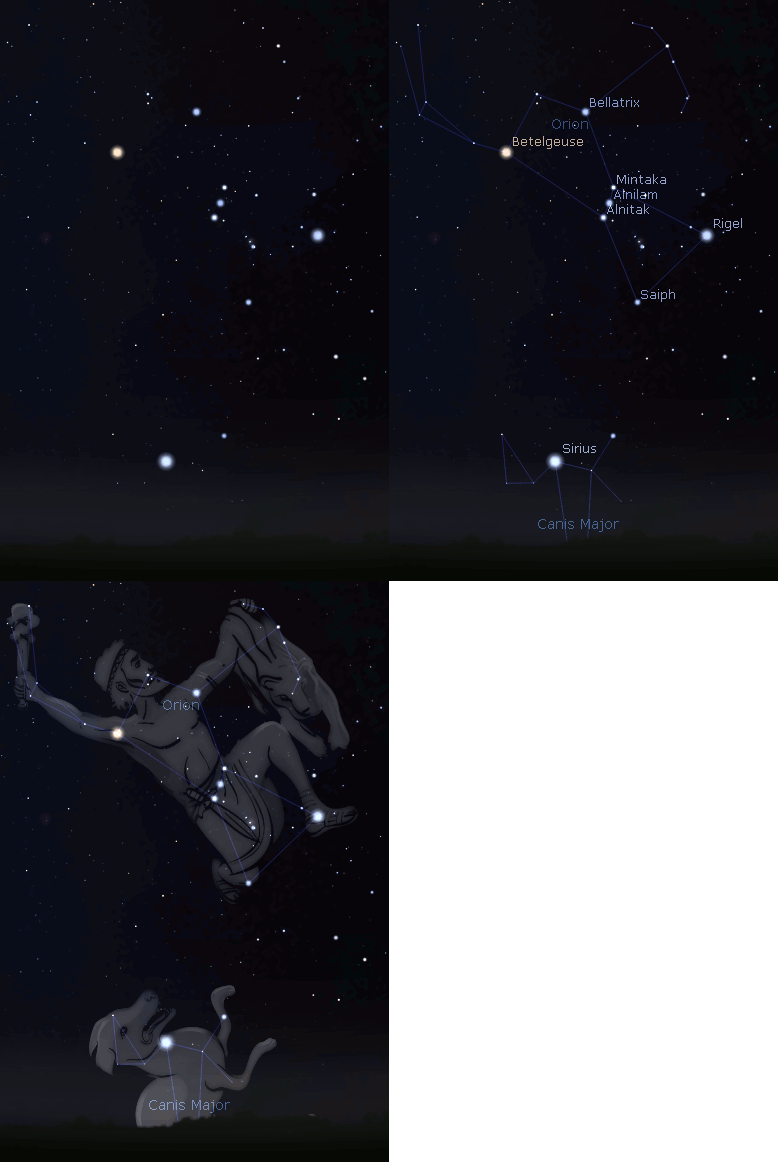
Orion, star names, and constellation art animation position for 9 p.m. December 27. Created using Stellarium and GIMP. Artist: Johan Meuris.
In the image above I’ve added the belt star names, though they are generally covered in a program of their own.
02/08/2016 – Ephemeris – The celestial unicorn
Ephemeris for Monday, February 8th. The Sun will rise at 7:53. It’ll be up for 10 hours and 6 minutes, setting at 6:00. The Moon is new today, and won’t be visible.
Among all the constellations in the sky of animals real and mythical, there is also a unicorn. It’s called Monoceros, and inhabits the southeastern sky at 9 p.m. bounded by Orion on the right, Canis Major, the great dog below and Canis Minor, the little dog to the left. Unfortunately for observers without optical aid Monoceros, though large, is devoid of bright stars. Maybe that’s why no one sees unicorns anymore. It has many faint stars because the Milky Way runs through it. To the telescope it is a feast of faint nebulae or clouds of gas and dust, the birth place of stars, including the red rose of the Rosette Nebula whose central star cluster can be seen in a telescope but the nebulosity requires a camera to capture and store its light.
Times are for the Traverse City/Interlochen area of Michigan. They may be different for your location.
Addendum
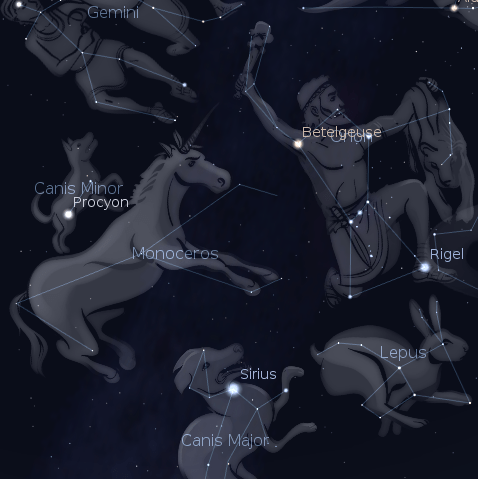
Monoceros the unicorn. Created using Stellarium.
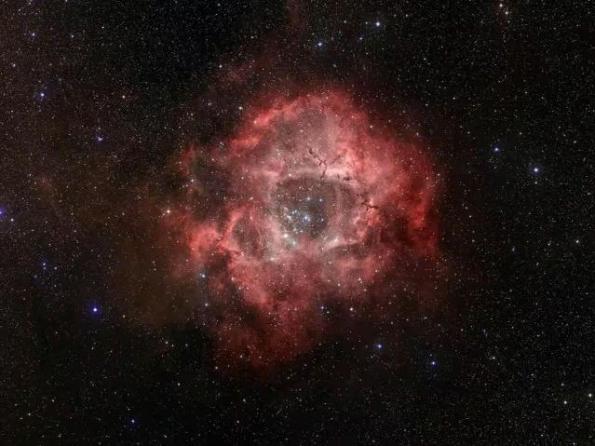
Rosette Nebula in the infrared from the Spitzer Space Telescope. Credit: NASA/JPL/Caltech
01/28/2016 – Ephemeris – This post has gone to the dogs
Ephemeris for Thursday, January 28th. The Sun will rise at 8:06. It’ll be up for 9 hours and 38 minutes, setting at 5:45. The Moon, 3 days before last quarter, will rise at 10:42 this evening.
The great winter constellation or star group Orion the Hunter, is located in the southern sky at 9:30 p.m. His elongated rectangle of a torso is vertical. In the center of the rectangle are three stars in a line that make his belt. As a hunter, especially one of old, he has two hunting dogs. The larger, Canis Major can be found by following the three belt stars of Orion down and to the left. There lies the brilliant star called Sirius, also known as the Dog Star. It’s in the heart of a stick figure dog facing Orion that appears to be begging. The smaller dog can be found by extending a line through Orion’s shoulder stars to the left. We find a bright star called Procyon. It and one other star make up the hot-dog shaped constellation of Canis Minor, the little dog.
Times are for the Traverse City/Interlochen area of Michigan. They may be different for your location.
Addendum
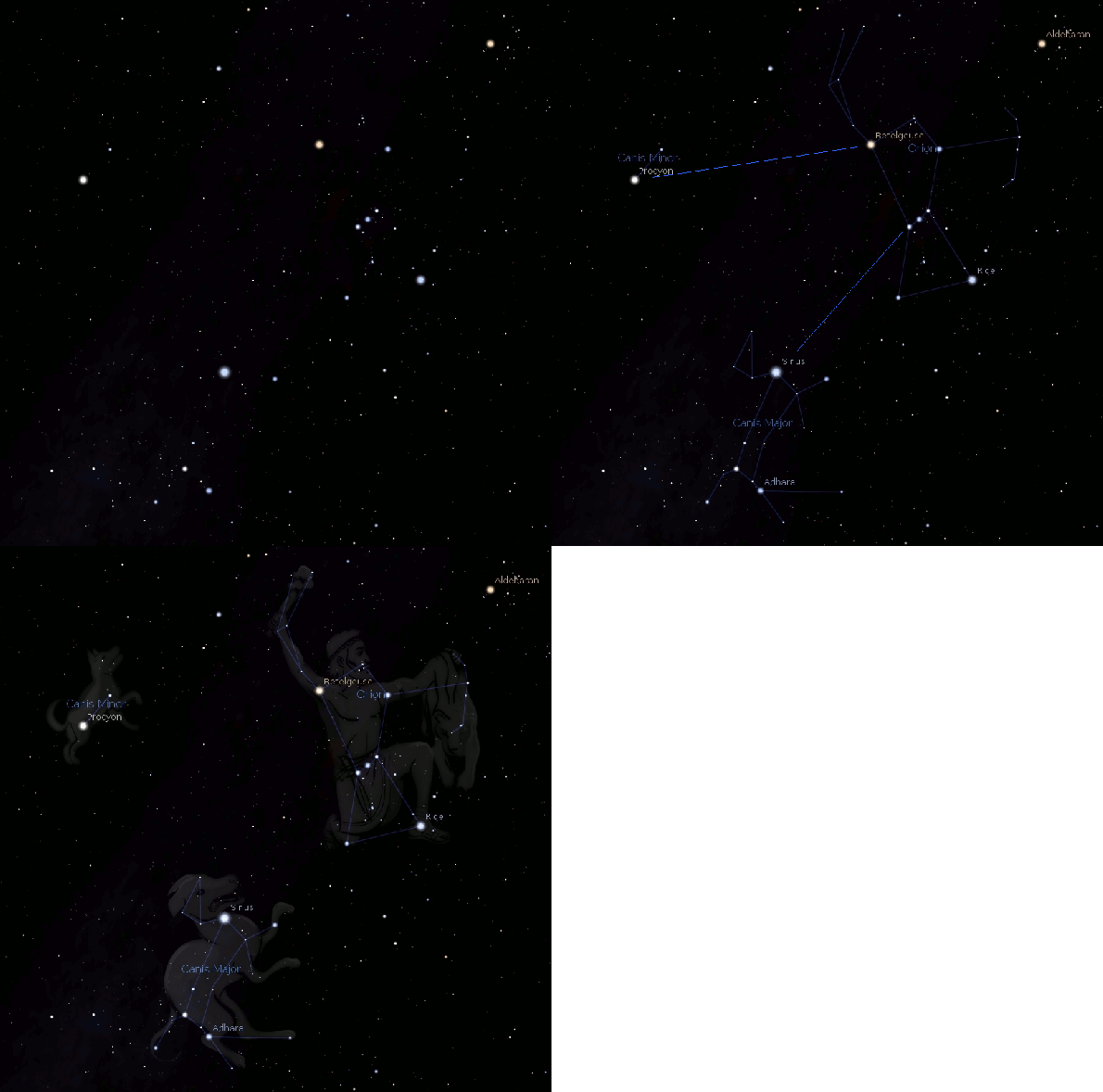
Orion and his hunting dogs revealed in animation. Created with Stellarium and GIMP.
01/25/2016 – Ephemeris – Sirius the Dog Star
Ephemeris for Monday, January 25th. The Sun will rise at 8:09. It’ll be up for 9 hours and 31 minutes, setting at 5:41. The Moon, 2 days past full, will rise at 7:43 this evening.
While we’re waiting for the bright Moon to leave the evening sky, let’s look at another bright star. This one is the brightest of all, Sirius the Dog Star. The Dog Star name comes from its position at the heart of the constellation Canis Major, the great dog of Orion the hunter. The three stars of Orion’s belt tilt to the southeast and point to Sirius. The name Sirius means ‘Dazzling One’, a reference to its great brilliance and twinkling. The Romans thought Sirius added its heat to that of the Sun in summer to bring on the scorching Dog Days of July and August. Its ancient Egyptian name was Sothis, and its first appearance in the morning twilight in late June signaled the flooding of the Nile, and the beginning of the Egyptian agricultural year.
Times are for the Traverse City/Interlochen area of Michigan. They may be different for your location.
Addendum
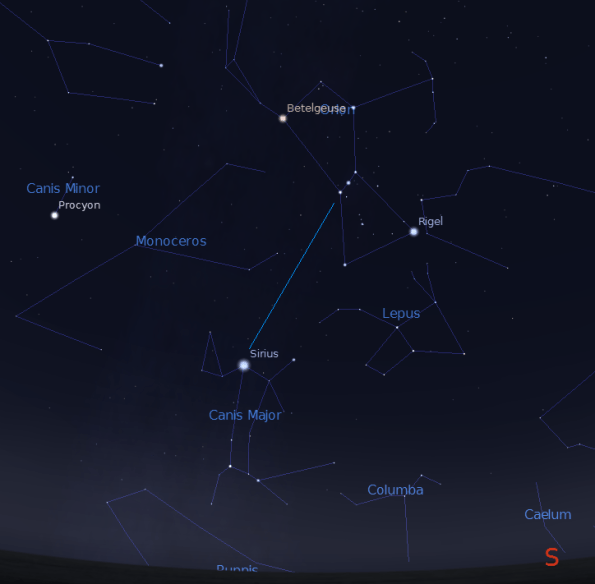
Orion’s Belt points to Sirius. Created using Stellarium.
01/07/2016 – Ephemeris – The Orion entourage
Ephemeris for Thursday, January 7th. The Sun will rise at 8:19. It’ll be up for 8 hours and 59 minutes, setting at 5:18. The Moon, 2 days before new, will rise at 6:42 tomorrow morning.
The whole Orion entourage is now visible in the southeast at 9 p.m. Orion the hunter with stars at his shoulders and knees and has a belt of three stars in a straight line. He has one arm upraised holding a club from the reddish star Betelgeuse and in the other arm he’s holding a lion skin shield fending off an attack from Taurus the bull above and right of him. Following the belt stars to the lower left we come to the brightest night-time star Sirius the Dog Star in the heart of Canis Major, his great hunting dog. Making a nearly equilateral triangle with Sirius and Betelgeuse is Procyon the little dog star in Canis Minor, Orion’s other small hunting dog. Hunched at the distracted Orion’s feet is the small constellation of Lepus the hare.
Times are for the Traverse City/Interlochen area of Michigan. They may be different for your location.
Addendum
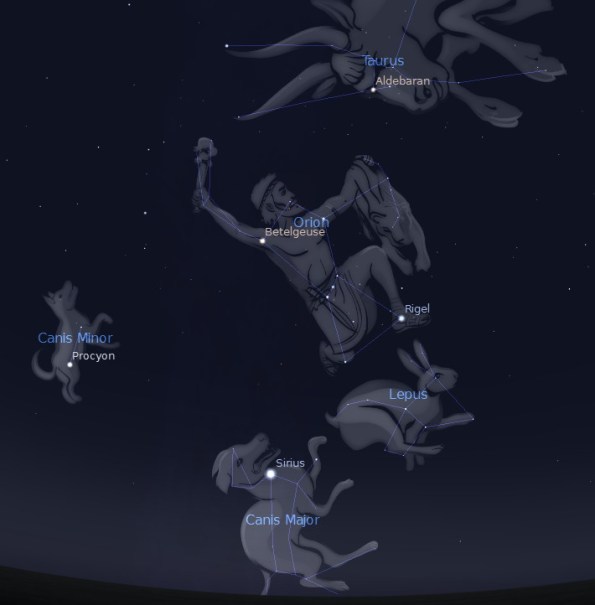
The Orion Entourage as seen at 9 p.m. January 7, 2016. Created using Stellarium
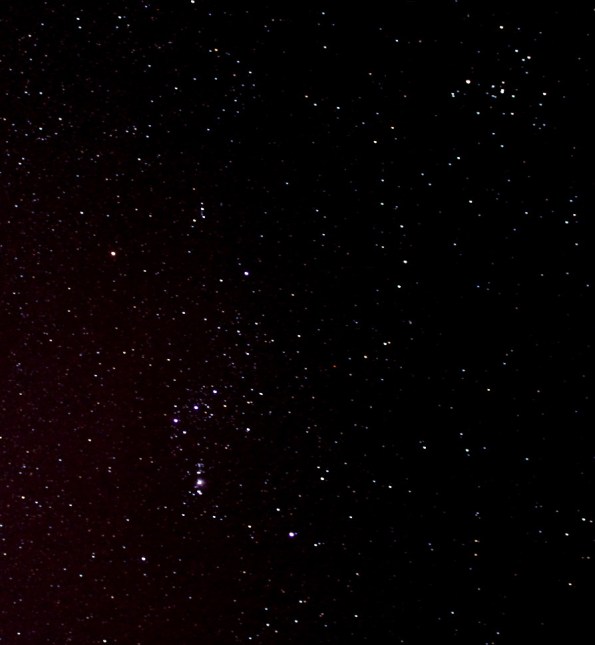
Orion and the head of Taurus photograph by myself January 4, 2016 at 11:30 p.m. It’s a stack of 5 untracked 20 second exposures.
Limiting magnitude is about 8, so you’re seeing stars you’d see with binoculars. The glow off to the left s from Traverse City, the center of which is 6 miles away to my northeast. I’m looking south here to get out of the glow, so Orion is more upright. I didn’t quite make it. My southwest through northwest is the darkest.
As you can probably guess I’ve got a new camera for my birthday/Christmas, a Canon EOS Rebel T5, and I’m investigating its astrophotographic capabilities. So expect some more “new” actual photographs on these posts.
02/16/2015 – Ephemeris – The Winter Circle
Feb 16. This is Bob Moler with Ephemeris for President’s Day, Monday, February 16th. The sun will rise at 7:42. It’ll be up for 10 hours and 30 minutes, setting at 6:12. The moon, 2 days before new, will rise at 6:25 tomorrow morning.
The winter skies are blessed with more first magnitude stars than any other season. That’s a full one-third of the total are seen is a relatively small area. Six of these stars lie in a large circle centered on the seventh. This circle is up at 9 p.m. Starting high overhead is Capella in Auriga the charioteer. Moving down clockwise is Aldebaran in the face of Taurus the Bull. Then down to Orion’s knee we find Rigel. Down and left is the brightest star of all Sirius the Dog Star in Canis Major, lowest of these stars in the south-southeast. Moving up and left is Procyon in Canis Minor, Above Procyon is Pollux in Gemini the twins. All these are centered on Betelgeuse the bright red star in Orion’s shoulder.
Times are for the Traverse City/Interlochen area of Michigan. They may be different for your location.
Addendum
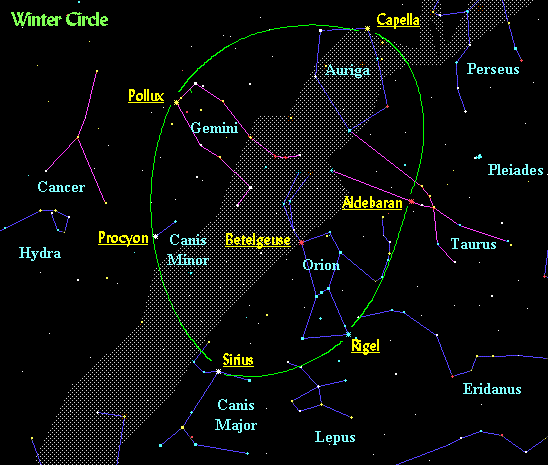
The Winter Circle of 1st magnitude stars
01/19/2015 – Ephemeris – Sirius, the brightest star in the night
Ephemeris for Martin Luther King Day, Monday, January 19th. The sun will rise at 8:14. It’ll be up for 9 hours and 19 minutes, setting at 5:33. The moon, 1 day before new, will rise at 7:53 tomorrow morning. | The star Sirius is the brightest night-time star in the heavens. It’s up on frosty winter evenings, and currently low in the southeastern sky in the early evening. It can be found in line and left of the three stars of Orion’s belt. It’s known as the Dog Star because it’s in the heart of the constellation Canis Major the greater dog. Sirius, however means dazzling one or sparkling one due to its brightness and the long time it spends low to the horizon where our turbulent atmosphere breaks up its light as a sparkler of color in telescopes and binoculars. Sirius owes its brightness mostly to its close proximity of 8.6 light years. It is 25 times brighter than the sun. It also has a white dwarf companion star nicknamed the Pup.
Times are for the Traverse City/Interlochen area of Michigan. They may be different for your location.
Addendum
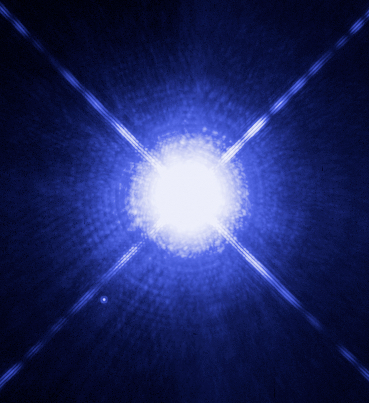
Sirius A and B (near the diffraction spike to the lower left), A Hubble Space Telescope photograph. Credit NASA, ESA.
01/16/2015 – Ephemeris – Orion’s greater hunting dog: Canis Major
Ephemeris for Friday, January 16th. The sun will rise at 8:16. It’ll be up for 9 hours and 13 minutes, setting at 5:29. The moon, 3 days past last quarter, will rise at 5:09 tomorrow morning.
The great winter constellation or star group Orion the Hunter, is located in the south-southeastern sky at 9 p.m. His elongated rectangle of a torso is almost vertical. In the center of the rectangle are three stars in a line that make his belt. As a hunter, especially one of old, he has two hunting dogs. The larger, Canis Major can be found by following the three belt stars of Orion down and to the left. There lies the brilliant star called Sirius, also known as the Dog Star. It’s in the heart of a stick figure dog low in the southeast facing Orion that appears to be begging. I’ll have more to say about Sirius on Monday, but there’s a fine star cluster, caller M41, at the 5 o’clock position from Sirius easily visible in binoculars or a small telescope.
Times are for the Traverse City/Interlochen area of Michigan. They may be different for your location.
Addendum
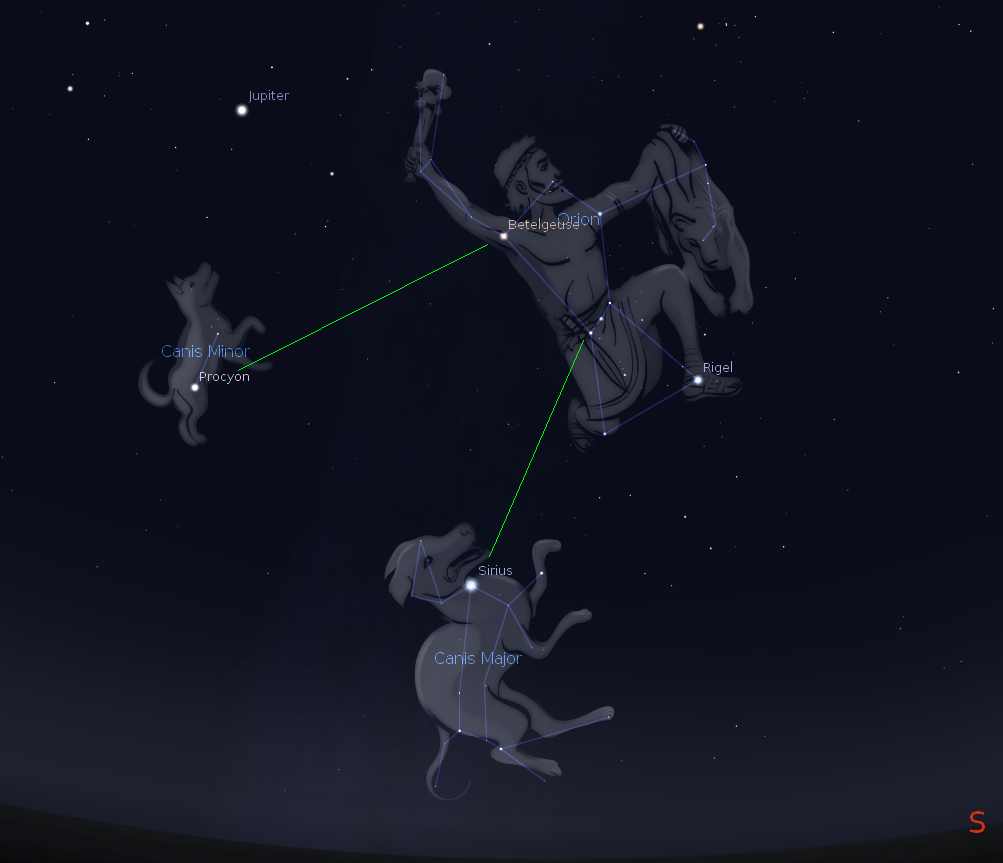
Orion and his hunting dogs with pointers as seen at 9 p.m. in the second half of January. Created using Stellarium.
01/21/2014 – Ephemeris – Orion’s hunting dogs
Ephemeris for Tuesday, January 21st. The sun will rise at 8:11. It’ll be up for 9 hours and 24 minutes, setting at 5:36. The moon, 3 days before last quarter, will rise at 11:23 this evening.
The great winter constellation or star group Orion the Hunter, is located in the south-southeastern sky at 9 p.m. His elongated rectangle of a torso is almost vertical. In the center of the rectangle are three stars in a line that make his belt. As a hunter, especially one of old, he has two hunting dogs. The larger, Canis Major can be found by following the three belt stars of Orion down and to the left. There lies the brilliant star called Sirius, also known as the Dog Star. It’s in the heart of a stick figure dog facing Orion that appears to be begging. The smaller dog can be found by extending a line through Orion’s shoulder stars to the left. We find a bright star called Procyon. It and one other star make up the hot-dog shaped constellation of Canis Minor, the little dog.
Times are for the Traverse City/Interlochen area of Michigan. They may be different for your location.
Addendum
Orion and his hunting dogs with pointers as seen at 9 p.m. on January 21, 2014. Created using Stellarium.
12/26/2013 – Ephemeris – Sirius, the brightest night-time star
Ephemeris for Thursday, December 26th. The sun will rise at 8:18. It’ll be up for 8 hours and 49 minutes, setting at 5:08. The moon, 1 day past last quarter, will rise at 2:40 tomorrow morning.
At 9 in the evening the great constellation of Orion the hunter can be seen in the southeast. Its large rectangle of bright stars is tilting to the left, while in the center is a row of three stars, his belt. These stars tilt downward and a bit to the left to a very bright star merrily twinkling above the horizon in the southeast. This star is called Sirius, also known as the Dog Star because it’s in the heart of Orion larger hunting dog, Canis Major. It is an arc light white star as seen in binoculars or telescope. It’s a neighboring star, just twice the distance of the closest star to the sun at 8.6 light years. It’s name, Sirius, has nothing to do with a dog, but is from the Greek meaning scorching for its brightness or sparkling, due to its intense twinkling.
Times are for the Traverse City/Interlochen area of Michigan. They may be different for your location.
Addendum
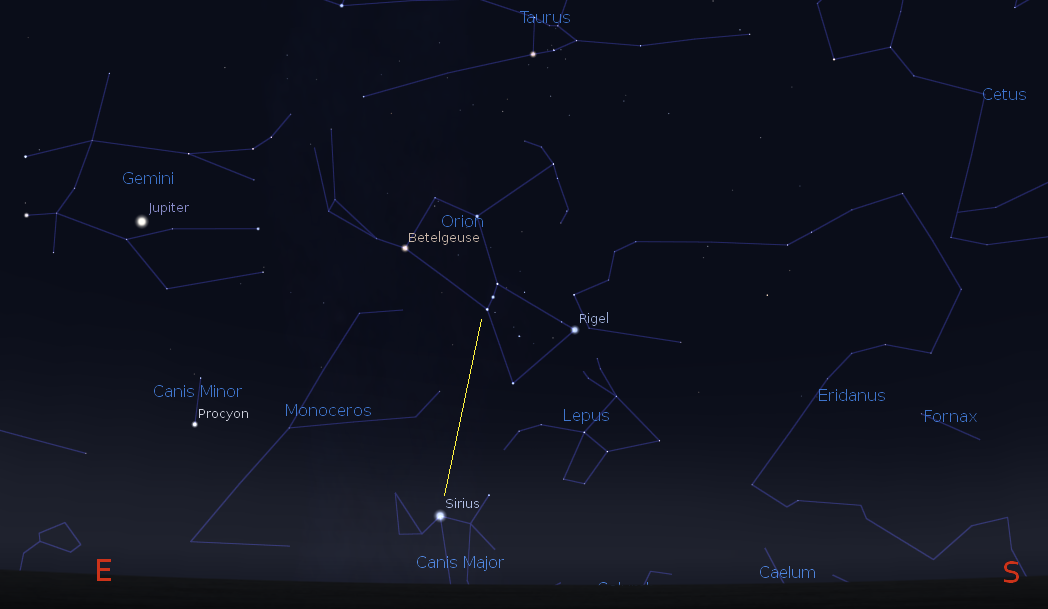
How to find Sirius from Orion. 9 p.m., December 26, 2013. Created using Stellarium.
 Bob Moler's Ephemeris Blog