Archive
02/16/2018 – Ephemeris – The Crab Nebula
Ephemeris for Friday, February 16th. The Sun will rise at 7:41. It’ll be up for 10 hours and 31 minutes, setting at 6:12. The Moon, 1 day past new, will set at 7:09 this evening.
The way the horns of Taurus the bull are shown in the sky, they are long and pointed above the head, not like a Texas Longhorn, off to the side. Near the tip of the eastern most horn is a faint and small fuzzy object. When Charles Messier saw it in 1758 he placed it as number 1 in his famous catalog of fuzzy objects that weren’t comets. It in 1913 it was realized that it was seen before. On July 5th, 1054 AD to be precise by Chinese astronomers. It, for a few weeks became the third brightest object in the sky after the Sun and Moon. It was a supernova, a massive star ending its life in a big explosion. In the 19th century Lord Rosse saw it with his huge telescope and called it the Crab Nebula. In its center is a tiny neutron star that spins 30 times a second.
The times given are for the Traverse City/Interlochen area of Michigan. They may be different for your location.
Addendum
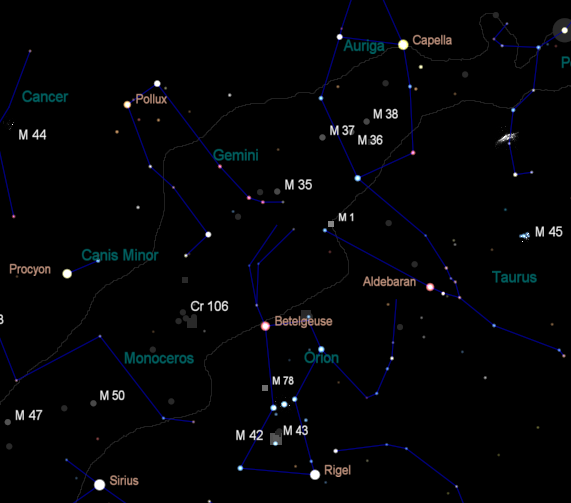
Crab Nebula (M 1) finder Chart. Orientation for 9 p.m. February 16th. It’s overall magnitude is 8.4 making it difficult to spot with binoculars or a telescope finder. I usually center the horn tip star Zeta Tauri and shift the telescope west a bit. Chart created using Cartes du Ciel (Sky Charts).
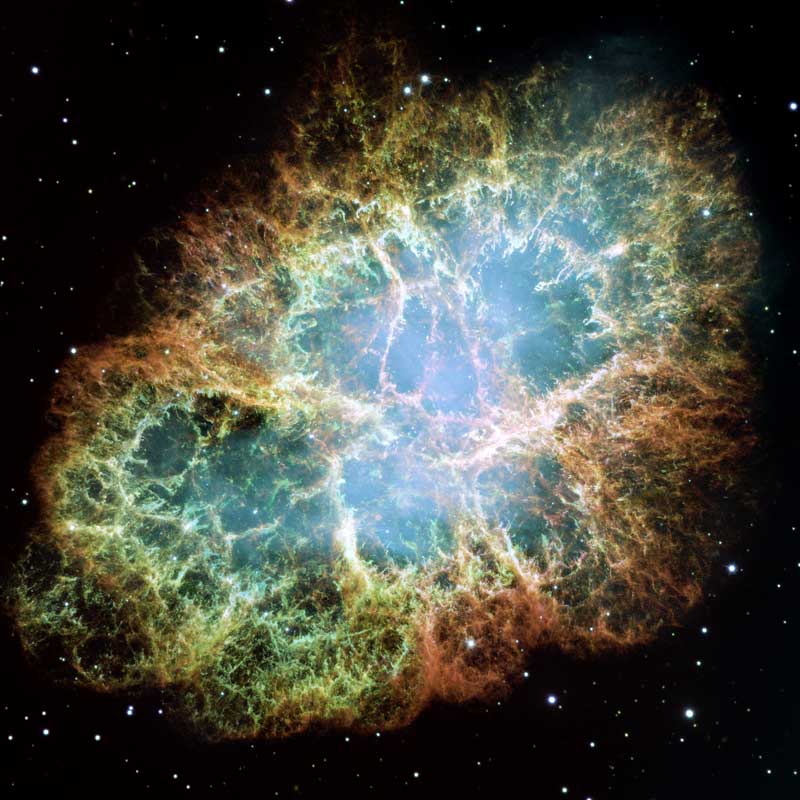
Hubble Space Telescope view of the Crab Nebula. Visually it appears a an oval blob. Credit NASA/ESA.
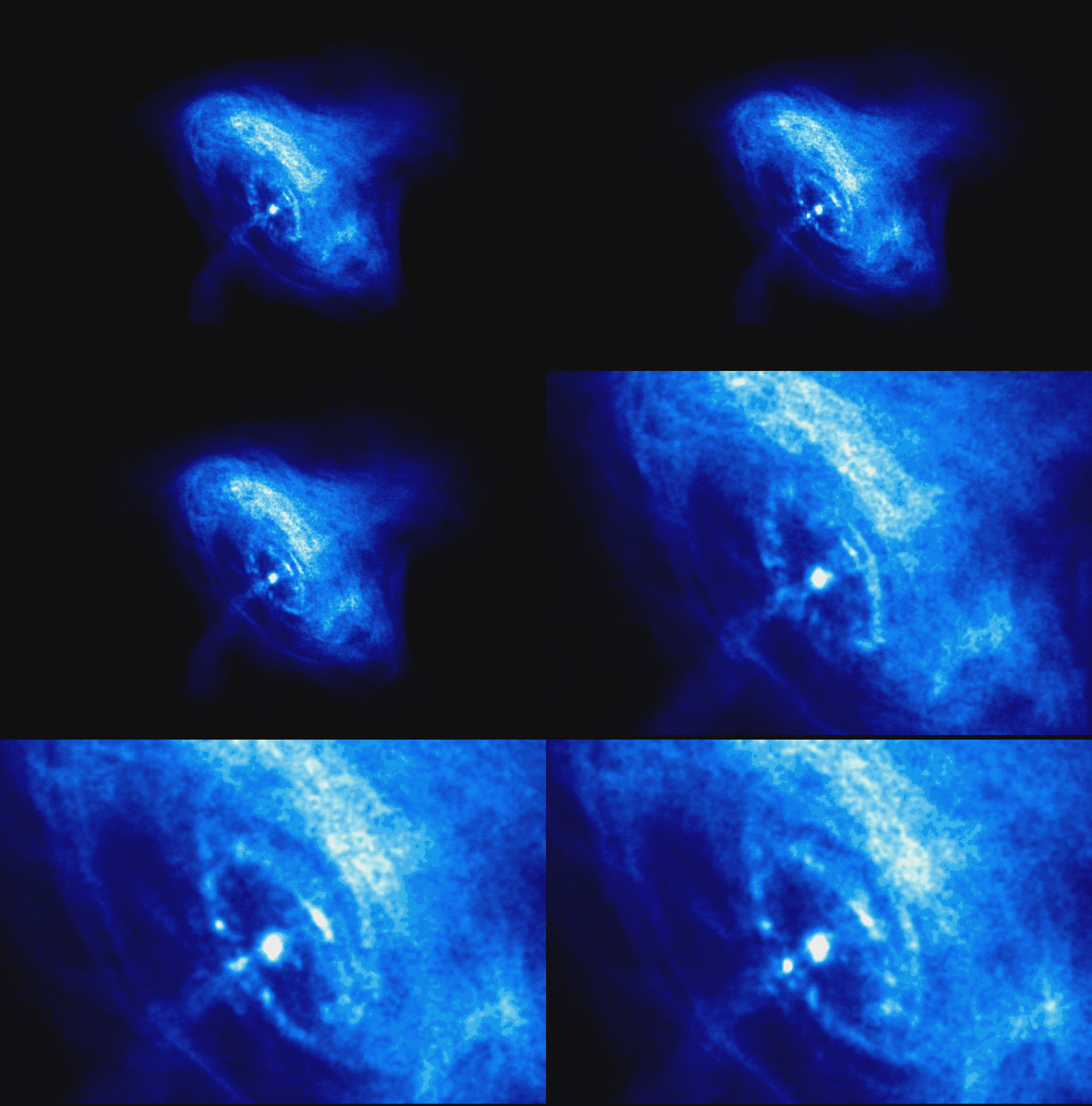
The heart of the Crab Nebula and activity around the neutron star, which also is a pulsar as seen in x-rays by the Chandra satellite. Credit: NASA/CXC/A.Jubett.
05/16/2017 – Ephemeris – The Virgo Cluster of Galaxies
Ephemeris for Tuesday, May 16th. Today the Sun will be up for 14 hours and 51 minutes, setting at 9:05, and it will rise tomorrow at 6:12. The Moon, 2 days before last quarter, will rise at 1:43 tomorrow morning.
Yesterday I talked about the constellation of Virgo the virgin. When we are looking at the constellation of Virgo, we are looking out the thin side of our galaxy, the Milky Way. The Milky Way galaxy is a flat disk. When we look into the disk we see the milky band we call the Milky Way. That band, what we can see of if is now low in the north, So the stars are much more sparse with the exception of those relatively close to us, like those of the big Dipper. Beyond the stars of Virgo is a huge cluster of over a thousand galaxies. Charles Messier, a comet hunter of the late 18th century, ran into quite a few fuzzy spots between Virgo and Leo to the upper right. Because they didn’t move in relation to the stars, they couldn’t be comets, so he added them to his list of nuisance objects, which we now enjoy looking at.
The times given are for the Traverse City/Interlochen area of Michigan. They may be different for your location.
Addendum
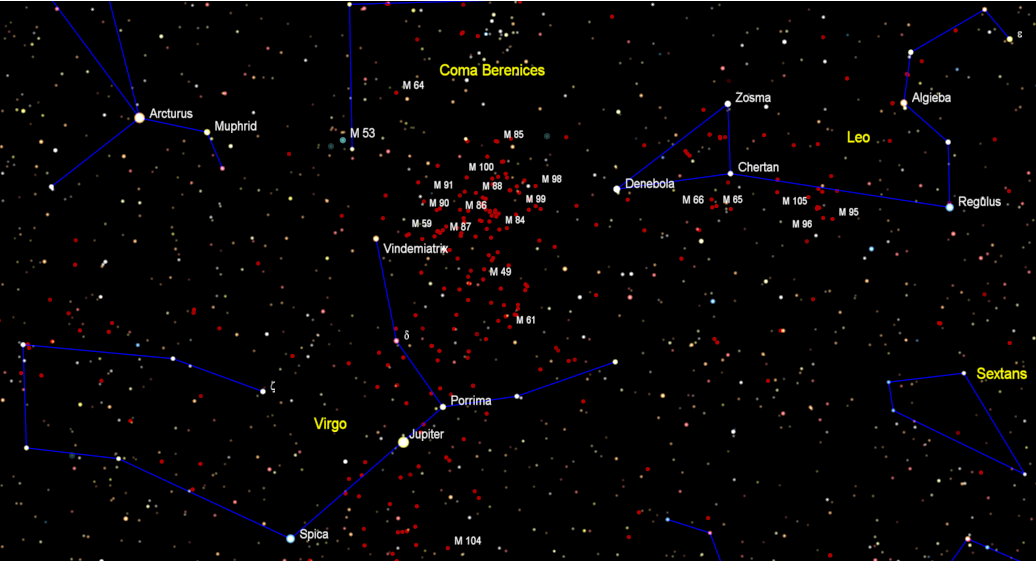
Some of the brighter members of the Virgo Cluster (of galaxies) as tiny red ovals. The galaxies marked with an ‘M’ number are part of Charles Messier’s catalog. It took a telescope of 8 inch diameter for me to spot them. Someone with better vision, like Messier himself can spot them with a smaller telescope. Created using Cartes du Ciel (Sky Charts). Click on image to enlarge.
05/08/2015 – Ephemeris – May’s missing Milky Way
Ephemeris for Friday, May 8th. Today the Sun will be up for 14 hours and 32 minutes, setting at 8:55. The Moon, 3 days before last quarter, will rise at 1:08 tomorrow morning. Tomorrow the Sun will rise at 6:22.
In May we look up to the sky and notice that the Milky Way is missing. Will not really it’s as if the sky has pattern baldness with the Milky Way as a fringe on the horizon around the north half of the sky. Overhead, where none should be is a galactic star cluster, a star cluster that should normally be in the Milky band. That cluster is the constellation of Coma Berenices. Its is a sparse star cluster of about 50 stars only 288 light years away. If we were a thousand light years from it, it would appear in the Milky band. One notes too that the stars of spring are also fewer, not the riot of stars we see in the winter or late summer. The Milky Way galaxy is a thin disk, and in spring we are looking out the thin side.
Times are for the Traverse City/Interlochen area of Michigan. They may be different for your location.
Addendum
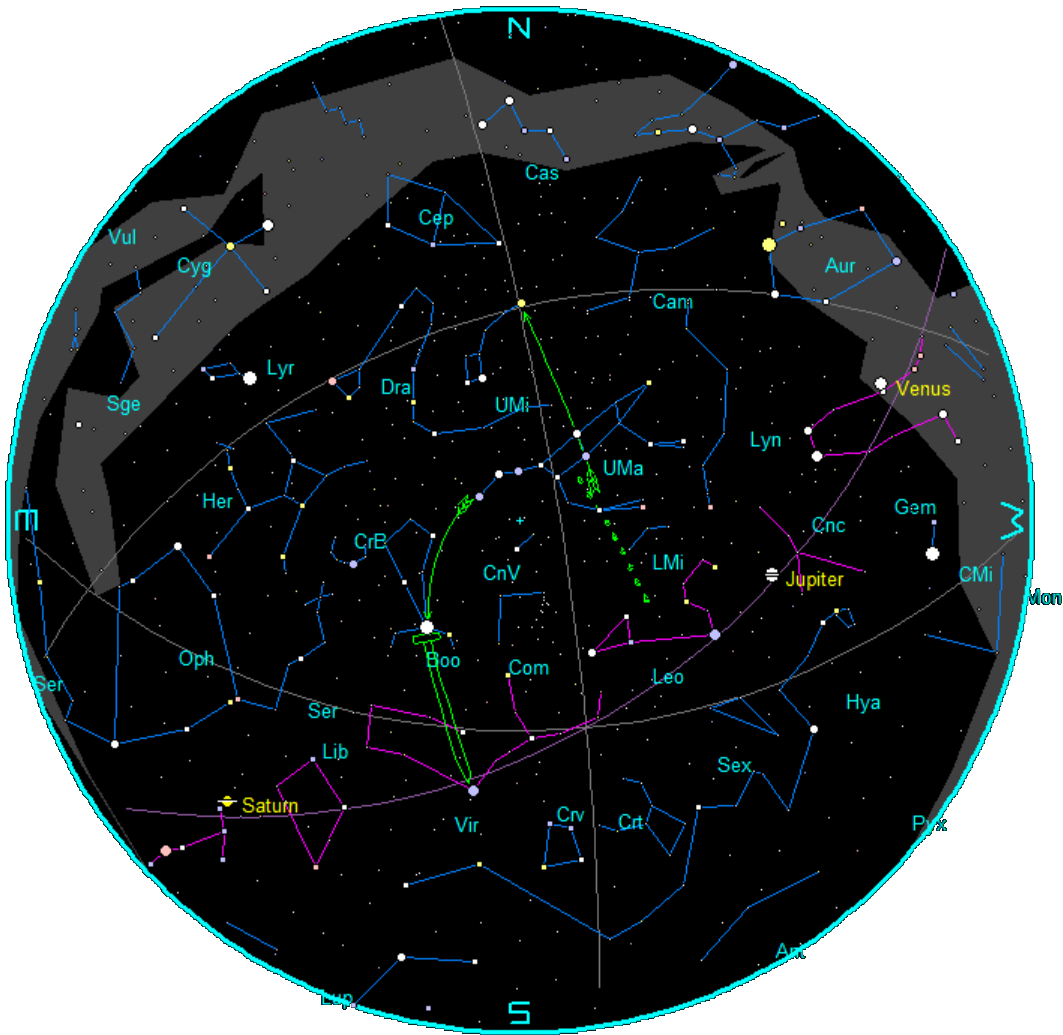
Star Chart for May 2015. Note the Milky way in the north. The Coma Berenices cluster is located between the labels CnV and Com. Created using my LookingUp program.
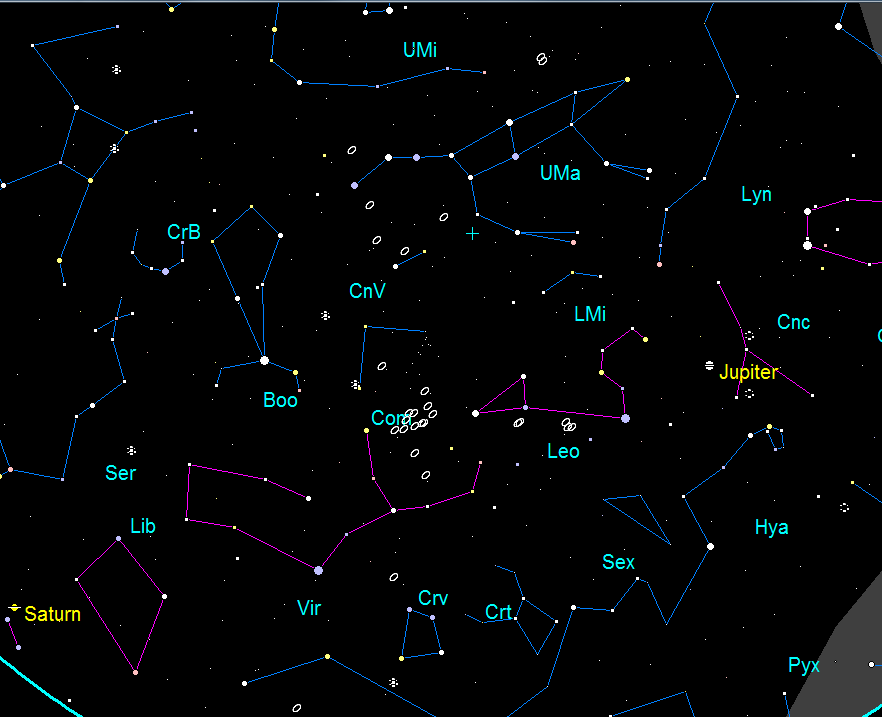
Messier objects, mostly galaxies (ovals) in the spring sky. Created using my LookingUp program.
Most of the galaxies in the above chart belong to the Virgo Cluster a cluster of several thousand galaxies about 53 million light years away. Charles Messier was a comet hunter active in the period around the time of the American Revolution at the Paris Observatory. He made a catalog of fuzzy objects he ran into that didn’t move and thus were not comets. The Messier catalog, which ran to 110 galaxies, star clusters and nebulae, some added posthumously, became a must-see list of some of the best sights for the telescope.
 Bob Moler's Ephemeris Blog