Archive
09/15/2022 – Ephemeris – Finding Cassiopeia this time of year
This is Ephemeris for Thursday, September 15th. Today the Sun will be up for 12 hours and 31 minutes, setting at 7:53, and it will rise tomorrow at 7:22. The Moon, 2 days before last quarter, will rise at 10:30 this evening.
In the northeastern sky is a letter W shaped constellation of Cassiopeia, the queen of Greek myth. I can’t say Cassiopeia is rising in the northeast, because it never sets for us in northern Michigan. This time of year it skirts above the northern horizon during the daytime. One of Cassiopeia’s claims to historical astronomical fame is that it’s the location of Tycho’s Star, a supernova discovered in 1572 by Danish astronomer Tycho Brahe, the last of the great astronomers prior to the invention of the telescope. Tycho was able to prove that the temporary phenomenon was actually a star in the heavens, disproving the Greek notion that the heavens were changeless and perfect. The Chinese had already known that, calling them Guest Stars.
The astronomical event times given are for the Traverse City/Interlochen area of Michigan (EDT, UT – 4 hours). They may be different for your location.
Addendum
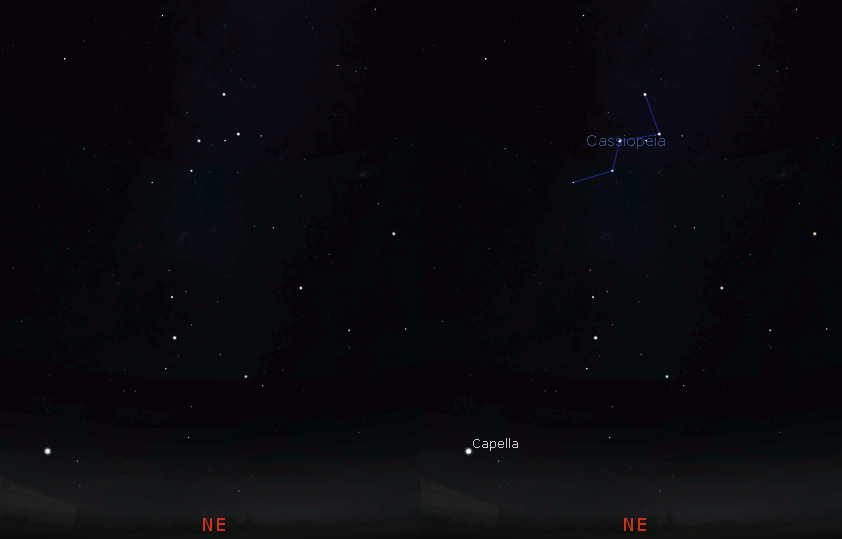
Cassiopeia finder animation for 10 pm tonight, September 15th. One cannot miss the distinctive W. Created using Stellarium.
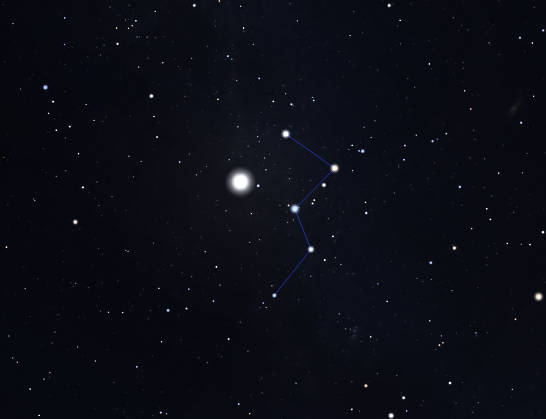
Tycho’s Supernova 1574A, as simulated in Stellarium for mid-November 1572.
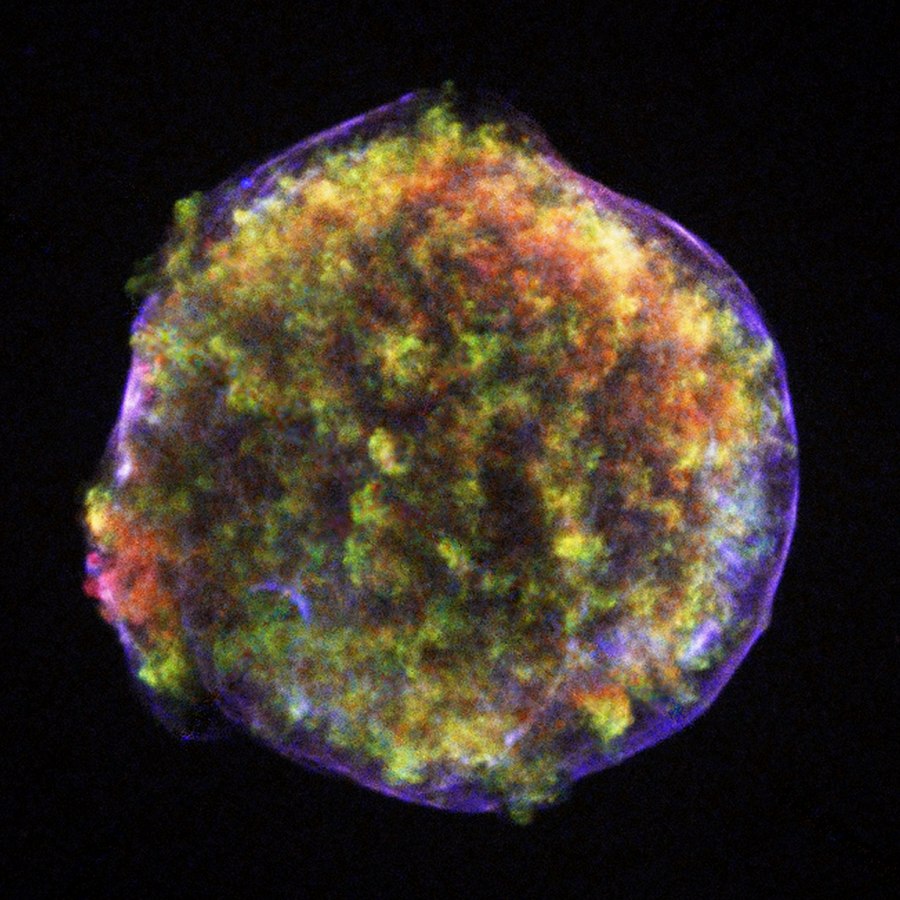
Tycho’s Supernova remnant, seen in x-rays by the orbiting Chandra X-ray Observatory. Credit: NASA / Chandra
10/18/2019 – Ephemeris – Capella rising
Ephemeris for Friday, October 18th. Today the Sun will be up for 10 hours and 51 minutes, setting at 6:53, and it will rise tomorrow at 8:03. The Moon, 3 days before last quarter, will rise at 9:59 this evening.
For those with the advantage of a low northeastern horizon, will see a bright star slowly rising, much slower than the stars in the east, or notice its change in position from night to night, moving in the northeast. The star is Capella, northernmost of the bright winter stars. It never quite sets for locations north of the latitude of Ludington (44° N), meaning it’s circumpolar like the Big Dipper. It’s slow motion, due to its position close to the north pole of the sky sometimes makes it seem odd. I’ve gotten several calls about it over the years. Capella is the brightest star in the constellation Auriga the charioteer, a constellation I see as a pentagon, with a small triangle of three stars on one side.
The times given are for the Traverse City/Interlochen area of Michigan. They may be different for your location.
Addendum
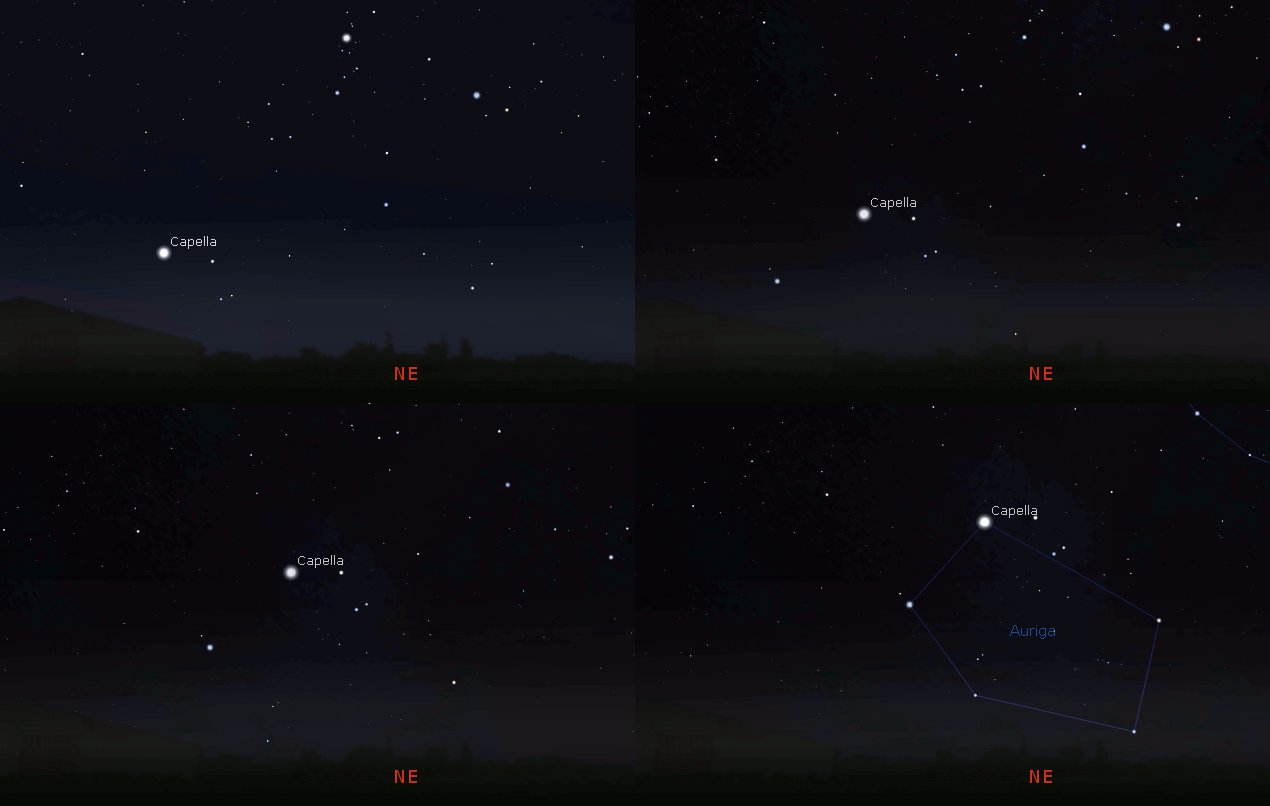
Capella rising animation at half hour intervals from 8 p.m. to 9:30 p.m. October 18th. Created using Stellarium and GIMP.
09/07/2017 – Ephemeris – Capella rising
Ephemeris for Thursday, September 7th. The Sun will rise at 7:12. It’ll be up for 12 hours and 55 minutes, setting at 8:07. The Moon, 1 day past full, will rise at 9:08 this evening.
For those with the advantage of a low northern horizon, will see a bright star moving nearly parallel above the horizon over the evening hours or notice its change in position from night to night, moving to the northeast. The star is Capella, northernmost of the bright winter stars. It never quite sets for locations north of the latitude of Ludington (44° N), meaning it’s circumpolar like the Big Dipper. It’s slow motion, due to its position close to the north pole of the sky sometimes makes it seem odd. I’ve gotten several calls about it over the years. Capella is the brightest star in the constellation Auriga the charioteer, a constellation I see as a pentagon, with a small triangle of three stars on one side. I’ll wait until the winter season to talk further about them.
The times given are for the Traverse City/Interlochen area of Michigan. They may be different for your location.
Addendum
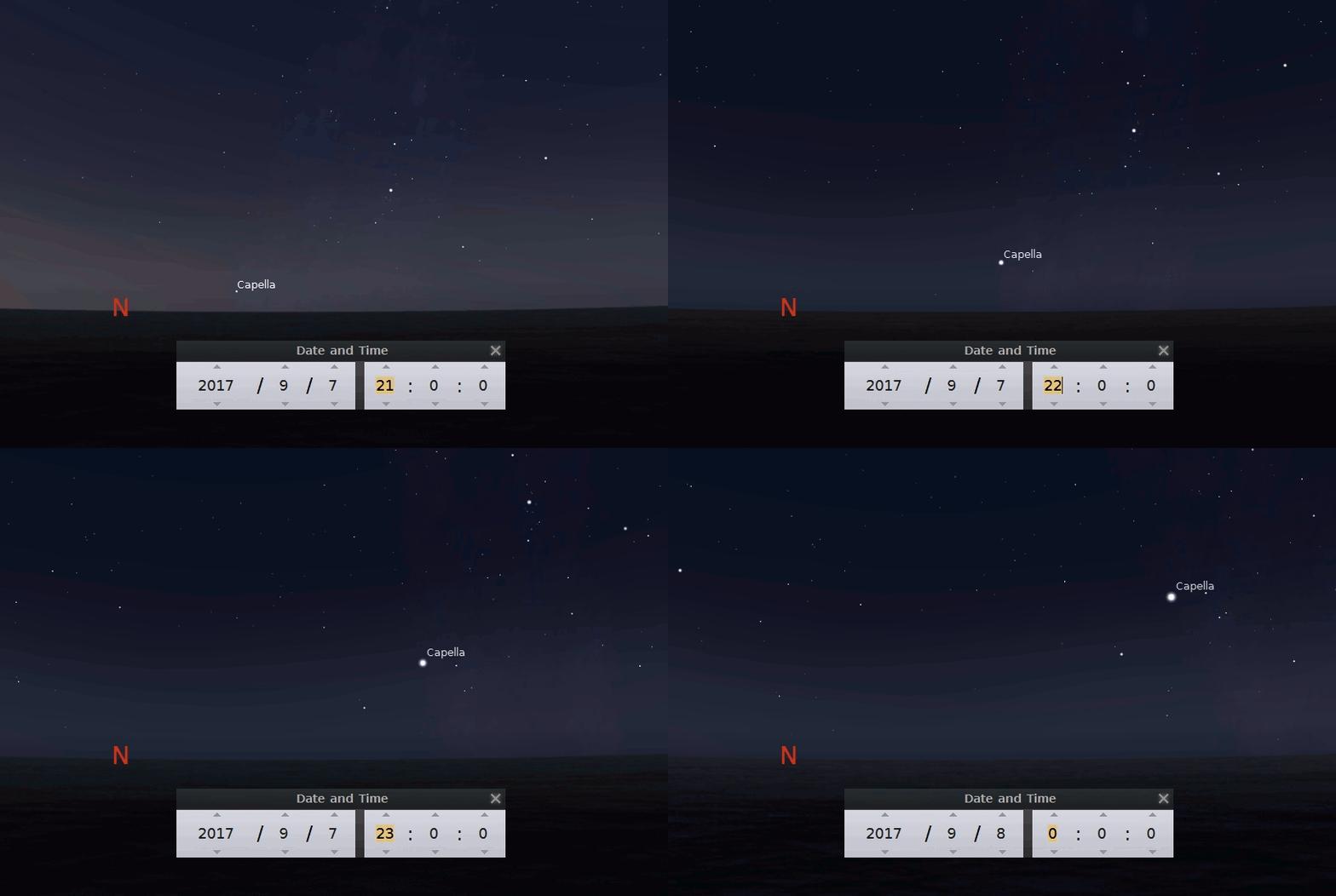
Capella appearing to rise like an aircraft taking off. Shown here at hourly intervals from 9 p.m. to midnight. Created using Stellarium and GIMP.
10/06/2015 – Ephemeris – Deneb our home-town star
Ephemeris for Tuesday, October 6th. The Sun will rise at 7:46. It’ll be up for 11 hours and 27 minutes, setting at 7:14. The Moon, 2 days past last quarter, will rise at 2:36 tomorrow morning.
We, here in Traverse City, Michigan have a pretty unique relation to the bright star Deneb, as is any location near 45 degrees north latitude. Tonight at 9:23 Deneb will be three-quarters of a degree due north of the zenith. Due north means that it’s on our meridian, a line you may remember from your school days. For astronomers it passes from the north point on the horizon, through the overhead point or zenith to the south point on the horizon. Also due to our latitude Deneb is circumpolar, meaning that it doesn’t quite set on a clean northern horizon. Deneb and 56 other stars are used for celestial navigation, which is still taught in case the GPS system goes down due to solar or enemy action.
Times are for the Traverse City/Interlochen area of Michigan. They may be different for your location.
Addendum
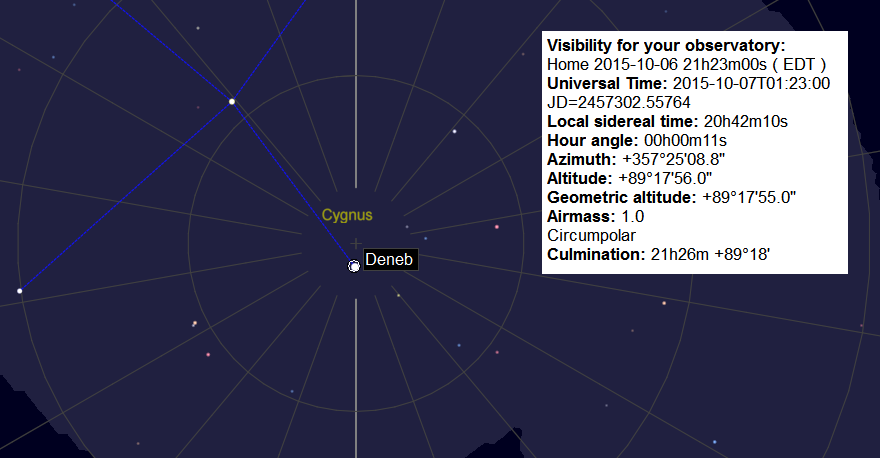
Deneb nearly at the zenith from Traverse City. Created using Cartes du Ciel.
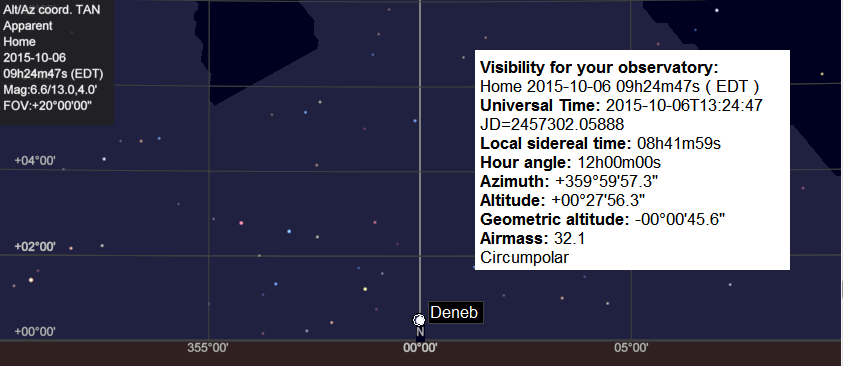
Deneb is close to the horizon due north. Created using Cartes du Ciel.
11/25/2014 – Ephemeris – Cassiopeia the constellation
Ephemeris for Tuesday, November 25th. The sun will rise at 7:52. It’ll be up for 9 hours and 14 minutes, setting at 5:06. The moon, 3 days past new, will set at 8:33 this evening.
Nearing the zenith at 8 p.m. is the W shaped constellation of Cassiopeia the queen. It’s actually just north of the zenith and since we’re half way from the equator and the north pole at near 45 degrees north, Cassiopeia will not set. Cassiopeia we say is circumpolar. Cassiopeia will rise is set if you’re in Florida. In Antarctica Cassiopeia is a just rumor, just as the Southern Cross is to us in Michigan since it never rises. Cassiopeia lies against the Milky Way, so there are a lot of star clusters in it. Unfortunately they can be seen only in telescopes. In 1572 the last of the pre-telescopic astronomers Tycho Brahe discovered a bright star that suddenly appeared. His discovery broke open the Aristotelian belief that the heavens were changeless.
Times and views are for the Traverse City/Interlochen area of Michigan. They may be different for your location.
Addendum
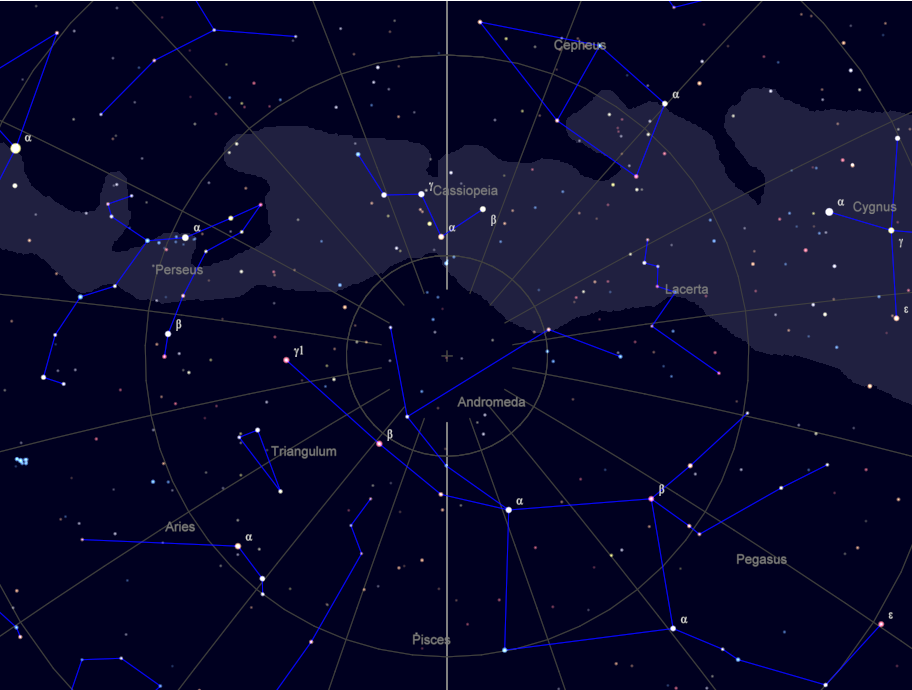
Looking straight up at the zenith, facing the south, Cassiopeia is just north of the zenith. The lines are radiating from the zenith. where the + sign is. Created using Cartes du Ciel.
My neck hurts just making this chart.
 Bob Moler's Ephemeris Blog