Archive
Ephemeris: 04/18/2025 – How the date of Easter is calculated
This is Ephemeris for Good Friday, Friday, April 18th. Today the Sun will be up for 13 hours and 39 minutes, setting at 8:32, and it will rise tomorrow at 6:51. The Moon, 2 days before last quarter, will rise at 2:40 tomorrow morning.
Easter will be celebrated by all Christian churches this Sunday. Easter is a movable feast in that it falls on a different date each year following the first full moon of spring. It’s an attempt to follow the Jewish Passover, which starts on the 15th of the month of Nisan. The Jewish calendar being a lunar calendar, the 15th is generally the night of the full moon. And since the Last Supper was a Seder, according to at least one Gospel, the Christian church wanted to link Easter with Passover as closely as possible using the Roman solar based (Julian) calendar. The months didn’t follow the cycle of the Moon anymore and where the year was 365.25 days long. Passover started at sunset last Sunday. The western churches adopted the Gregorian calendar to keep in sync with the seasons. The Orthodox churches didn’t, but Easter is so late that they match this year. They kept the old Julian Calendar and other considerations to calculate the date of Easter.
The astronomical event times given are for the Traverse City/Interlochen area of Michigan (EDT, UT – 4 hours). Times will be different for other locations.
Addendum
Ephemeris: 03/29/2024 – Calculating the date of Easter
This is Ephemeris for Good Friday, March 29th. Today the Sun will be up for 12 hours and 39 minutes, setting at 8:07, and it will rise tomorrow at 7:26. The Moon, 3 days before last quarter, will rise at 1:09 tomorrow morning.
Easter will be celebrated by Western Christian churches this Sunday. Easter is a movable feast in that it falls on a different date each year following the first full moon of spring. It was an attempt to follow the Jewish Passover, which starts on the 15th of the month of Nisan. The Jewish calendar being a lunar calendar, the 15th is generally the night of the full moon, sometimes called the Paschal Full Moon. And since the Last Supper was a Seder, according to at least one Gospel, the Christian church wanted to link Easter with Passover as closely as possible using the Roman solar based (Julian) calendar. That’s not always the case, especially with our current Gregorian Calendar. Passover this year begins at sunset April 22nd because the Jewish lunar calendar is tied to the Julian Calendar.
The astronomical event times given are for the Traverse City/Interlochen area of Michigan (EDT, UT–4 hours). They may be different for your location.
Addendum
04/15/2022 – Ephemeris – How the date of Easter is determined
This is Ephemeris for Good Friday, April 15th. Today the Sun will be up for 13 hours and 29 minutes, setting at 8:27, and it will rise tomorrow at 6:56. The Moon, 1 day before full, will set at 7:04 tomorrow morning.
Easter will be celebrated by Western Christian churches this Sunday. Easter is a movable feast in that it falls on a different date each year following the first full moon of spring. It’s an attempt to follow the Jewish Passover, which starts on the 15th of the month of Nisan. The Jewish calendar being a lunar calendar, the 15th is generally the night of the full moon. And since the Last Supper was a Seder, according to at least one Gospel, the Christian church wanted to link Easter with Passover as closely as possible using the Roman solar based (Julian) calendar. The months didn’t follow the cycle of the Moon anymore and where the year was 365.25 days long. Passover starts at sunset tonight. The western churches adopted the Gregorian calendar to keep in sync with the seasons. The Orthodox churches didn’t, so their Easter is a week later this year. They kept the old Julian Calendar and other considerations to calculate the date of Easter.
The astronomical event times given are for the Traverse City/Interlochen area of Michigan (EDT, UT – 4 hours). They may be different for your location.
Addendum
If you’re wondering about what all this has to do with astronomy? The answer is: Everything! Astronomy in ancient times wasn’t about the nature of planets, and stars, but about the cycles about the Sun and Moon. These cycles announced the seasons, and festival times. This is how the date of Passover is set. The Jews, at least in the Bible, only referenced the constellations of Orion and the Great Bear plus the star cluster Pleiades, that scholars have pinned down. There are two more possible references to constellations that don’t translate. These are all in the Book of Job. The only planet mentioned is Saturn, because it was thought to be closest to the firmament, the starry sphere.
04/07/2020 – Ephemeris – Today is the Paschal full moon
This is Ephemeris for Tuesday, April 7th. Today the Sun will be up for 13 hours and 6 minutes, setting at 8:18, and it will rise tomorrow at 7:09. The Moon, at full today, will rise at 7:55 this evening.
Tonight’s full moon is the Paschal full moon, the first full moon of spring which is tomorrow in the Holy Land, so Passover begins at sunset tomorrow. Easter for western churches falls on the first Sunday after the first full moon of spring, which is this next Sunday the 12th. Orthodox Easter rule adds that it must fall after Passover,a week long observance, which pushes their Easter celebration to a week later, April 19th. Both Christian churches attempt to mimic the Jewish Lunar Calendar by setting Easter by the first full moon of spring using solar based calendars and assuming that spring started on March 21st. This year actual spring started on the 20th in the Holy Land, and 19th here by 10 minutes, in our Gregorian Calendar and 13 days earlier by the old Julian Calendar. This is all very complicated.
The event times given are for the Traverse City/Interlochen area of Michigan. They may be different for your location.
04/19/2019 – Ephemeris – Why Sunday is Easter
Ephemeris for Good Friday, Friday, April 19th. Today the Sun will be up for 13 hours and 40 minutes, setting at 8:32, and it will rise tomorrow at 6:50. The Moon, at full today, will rise at 8:56 this evening.
Easter will be celebrated by western Christian churches this Sunday. Easter is a movable feast in that it falls on a different date each year following the first full moon of spring. It’s an attempt to follow the Jewish Passover, which starts on the 15th of the month of Nisan. Being a lunar calendar the 15th the generally the night of the full moon. And since the Last Supper was a Seder, the Christian church wanted to follow Passover as closely as possible using the Roman solar based (Julian*) calendar where the year was 365.25 days long. Passover starts at sunset tonight. The western churches eventually adopted the Gregorian calendar to keep in sync with the seasons. The Eastern churches kept the old Julian Calendar and other considerations to calculate the date of Easter, which arrives a week later.
The times given are for the Traverse City/Interlochen area of Michigan. They may be different for your location.
* The Julian calendar is named after Julius Caesar who proposed it in 46 BC. It took effect on January 1, 45 BC. By the Julian calendar today is April 6.
03/18/2019 – Ephemeris – Spring, the full moon and Easter
Ephemeris for Monday, March 18th. Today the Sun will be up for 12 hours and 2 minutes, setting at 7:52, and it will rise tomorrow at 7:48. The Moon, 2 days before full, will set at 7:21 tomorrow morning.
Spring is two days away. In checking my astronomical calendars I noticed an odd thing related to the date of Easter for western churches. If I said that the date of Easter was the first Sunday after the first full Moon after the vernal equinox. I’d be wrong. Even if I replaced vernal equinox with first day of spring, I would still be wrong by ecclesiastical standards. The ecclesiastical vernal equinox is March 21st, no matter what. Plus the full moon date is a tabulated value and not necessarily the astronomical full moon date. This year the astronomical first full moon of spring falls less than 4 hours after the astronomical vernal equinox on March 20th. Therefore Easter will be late this year on April 21st, 4 days earlier than its latest possible date.
The times given are for the Traverse City/Interlochen area of Michigan. They may be different for your location.
03/29/2018 – Ephemeris – The Easter date is set by the first full moon of spring and a developing conjunction
Ephemeris for Thursday, March 29th. The Sun will rise at 7:29. It’ll be up for 12 hours and 37 minutes, setting at 8:06. The Moon, 2 days before full, will set at 7:21 tomorrow morning.
This Sunday, April 1st will be Easter for western churches. Because it falls on the first Sunday after the first full moon since March 21st. The Full Moon is Saturday the 31st. It happens that Passover begins at sundown the 31st. Orthodox churches will celebrate Easter on April 8th, a week later. It’s going to be a somewhat busy weekend in the sky also. Sunday Mercury will pass from the evening sky to the morning sky in an event called an inferior conjunction of the Sun. It is not visible, but folks in the southern hemisphere will easily spot Mercury late in April. In the morning sky Mars will pass below Saturn between the mornings of the 2nd and 3rd. They are close to the same brightness, but Mars is distinctly redder.
The times given are for the Traverse City/Interlochen area of Michigan. They may be different for your location.
Addendum
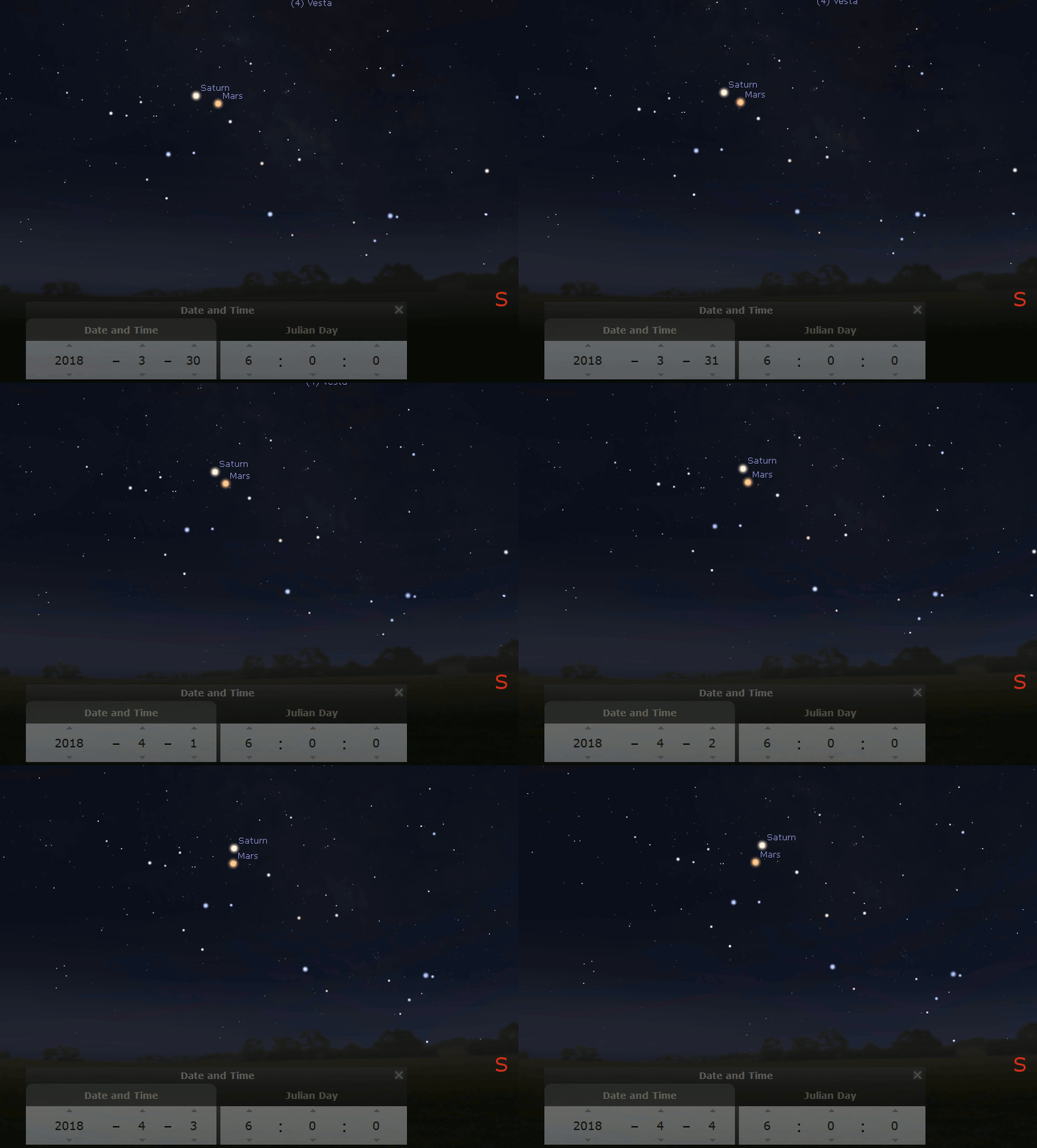
Conjunction animation of Mars passing Saturn at daily intervals at 6 a.m. for March 30 to April 4, 2018. This will occur above the Teapot asterism of the constellation of Sagittarius. Created using Stellarium ans GIMP.
04/14/2014 – Ephemeris – Why does Easter occur on a different Sunday every year?
The answer is astronomical!
Ephemeris for Good Friday, Friday, April 14th. The Sun will rise at 6:59. It’ll be up for 13 hours and 26 minutes, setting at 8:26. The Moon, 3 days past full, will rise at 11:48 this evening.
Easter will be celebrated by western and eastern christian churches this Sunday. Easter is a movable feast in that it falls on a different date each year following the first full moon of spring. It’s an attempt to follow the Jewish Passover, which starts on the 15th of the month of Nisan. Being a lunar calendar the 15th the generally the night of the full moon. And since the Last Supper was a Seder, the Christian church wanted to follow Passover as closely as possible using the Roman solar based calendar where the year was 365.25 days long. Passover started at sunset this past Monday night. The western churches eventually adopted the Gregorian calendar to keep in sync with the seasons. The Eastern churches did not, however Easter is late enough this year so they both fall on the same date.
The times given are for the Traverse City/Interlochen area of Michigan. They may be different for your location.
Addendum
The seasonal, or officially the Tropical Year, from vernal equinox to vernal equinox is approximately 365.24220 days long, about 11 1/2 minutes shorter than the Julian (after Julius Caesar) Calendar year. The Julian Calendar kept up with the year by having three 365 ordinary years and one leap year of 366 days. It over corrects. To make the calculation for Easter easier in the various dioceses of the far-flung church, the vernal equinox, the day the Sun crosses the celestial equator, heading northward was defined as March 21st. The actual vernal equinox was falling behind the Julian Calendar by 0.8 days every century.
By 1582 the Roman Catholic Church under Pope Gregory XIII decided to correct the problem. By then the real vernal equinox occurred on March 11th. Easter is supposed to be a spring feast, and using March 21st as the vernal equinox would eventually push Easter into summer. The Pope instituted a commission to look into the problem. This commission headed by Christophorus Clavius* came up with what we know as the Gregorian Calendar. First, eliminate 10 days from the calendar. This was done in October 1582 between October 4th and 15th. Then to keep the calendar in sync with the actual year it was decreed that leap years would continued for years divisible by 4; except that century years, those divisible by 100 be ordinary years, except those by also divisible by 400. Thus the year 1900 was an ordinary year, but the year 2000 was a leap year, and the year 2100 will be an ordinary year. Adoption of this as a civil calendar took 400 years to be universal.
The Greek Orthodox and other eastern churches kept the Julian Calendar, so on occasion their Easter is sometimes celebrated in May. The Jewish Calendar is, as I alluded to in the program transcript, a lunar calendar. It has a relationship to the Julian Calendar in that 19 Julian Years equals 235 lunar months almost exactly. This is called the Metonic Cycle. Those 235 months equal 12 lunar years of 12 and 13 months. So without correction Passover too will slowly head into summer in millennia to come.
* Clavius was honored by having a large, rather spectacular crater on the Moon named for him. Search these posts for Clavius to find it.
03/25/2016 – Ephemeris – Easter, the reason for our calendar
Ephemeris for Good Friday, Friday, March 25th. The Sun will rise at 7:35. It’ll be up for 12 hours and 26 minutes, setting at 8:02. The Moon, 2 days past full, will rise at 10:17 this evening.
The so-called movable feasts of the church calendar are based on the date Easter falls on. They span from Ash Wednesday to Pentecost. And Easter is determined by astronomical events. In 1582 the fact that the actual vernal equinox had fallen 10 days behind the Julian calendar then in use which was decreed by Julius Caesar in 45 BC. Pope Gregory XIII in the 1580’s resolved to fix the situation and commissioned some astronomers to work on the problem. The solution was to fix the 10 day problem by eliminating the days October 5th through 14th of the October 1582 calendar and modifying the leap year rule to keep February 29th in calendars whose years were evenly divisible by 4, except those century years not also divisible by 400. Thus the year 2000 was a leap year, but 1900 and 2100 was and will not be.
Times are for the Traverse City/Interlochen area of Michigan. They may be different for your location.
Addendum
The Gregorian Calendar in essence decoupled Easter from Passover by keeping the formula first Sunday after the first full moon after March 21st, as a marker for the vernal equinox, and keeping March 21st on or near the vernal equinox. Passover this year starts sunset on April 22nd, while Orthodox Easter will occur on May 1st. The reason is the relationship between the Jewish lunar calendar and the Julian Calendar I mentioned in yesterday’s post. The difference between the Julian and Gregorian Calendars is now 13 days.
The error in the Gregorian calendar is at most 1 day in 3,300 years, in relation to the seasonal year. But the Gregorian Calendar makes calculating the date of Easter more complicated. It introduces something called Epact to the list of chronological cycles in an almanac. The quantity called Epact is the age of the moon on January 1st, and still has a relationship with the Metonic Cycle and the Golden Number which I discussed yesterday. This year the value is 21.
As I’ve admitted before, the first paragraph of these posts are generated by a computer program. Part of that program is a list of holidays, and those designated as movable feasts use the date of Easter as a starting point. I use the 10 step method from Astronomical Algorithms by Jean Meeus. Easter for the Julian Calendar is a simpler 6 step method.
03/24/2016 – Ephemeris – Why is this Sunday Easter?
Ephemeris for Thursday, March 24th. The Sun will rise at 7:37. It’ll be up for 12 hours and 23 minutes, setting at 8:01. The Moon, 1 day past full, will rise at 9:19 this evening.
This Sunday is Easter, only 5 days later than the earliest Easter can ever be. Yesterday’s full moon or the tabular date for it is called the Paschal Full Moon, an attempt for the Christian Church to match the solar Roman calendar to the Jewish lunar calendar in regards to the date of Passover. It doesn’t always work, especially when Easter turns out to be early as it is this year. The simple formula for western churches is the first Sunday after the first full moon after the vernal equinox which is defined as March 21st, no matter the date spring actually started, which was the 20th, this year. All this started to be counted using the Julian Calendar, which is 11 minutes longer than the seasonal or tropical year. We’ll see how that was corrected for tomorrow.
Times are for the Traverse City/Interlochen area of Michigan. They may be different for your location.
Addendum
The Jewish calendar does not have a relationship with the Gregorian Calendar, so Passover will drift later and later into spring over the years. The Jewish calendar does have a relation to the Julian Calendar in that 19 years equals 235 lunar months. This was probably discovered by the Babylonians but was popularized by the Athenian Menton in the 5th century BCE. It’s a way to relate the lunar calendar to the solar or seasonal calendar. We call it the Metonic cycle.
In a lunar calendar the months alternate between 29 and 30 days because the lunar month is 29.53 days. Also a 365.25 day year is 12.37 lunar months. The solution for all this is quite complex, with 12 common or 12 month years and 7 13 month great years to fit the 19 year cycle. It also means that the phases of the moon repeat on or near the same date at 19 year intervals. If you see a quantity called the Golden Number in almanacs, which happens to be 3 this year, that’s where we are (1-19) in the Metonic cycle. The Gregorian Calendar breaks this relationship. We’ll see how tomorrow.
 Bob Moler's Ephemeris Blog