Archive
Ephemeris: 03/17/2026 – It’s also an equilux day
This is Bob Moler with Ephemeris for St. Patrick’s Day, Tuesday, March 17th. Today the Sun will be up for 12 hours and to the minute, setting at 7:51, and it will rise tomorrow at 7:49. The Moon, 1 day before new, will rise at 7:33 tomorrow morning. | This upcoming Saturday will be the vernal equinox, the first day of spring. Equinox means equal night, meaning that day and night are equal. Geometrically that’s correct, but, that’s not actually true. Today is the day when the sun is up for 12 hours and of course set for 12 hours. The name for this day has come to be called equilux day. Lux being the Latin for light. The difference is, because the Earth has an atmosphere, plus we have a different definition of sunrise and sunset that puts the sun a little bit below the horizon at the rise and set moment. So enjoy a few extra minutes of sunlight before the official equinox date. Think of it as a St Patrick’s Day bonus.
The astronomical event times given in this blog are for the Traverse City/Interlochen area of Michigan (Lat 44.7° N, Long 85.7° W; EST, UT – 5 hours) unless stated otherwise. Times will be different for other locations.
Addendum
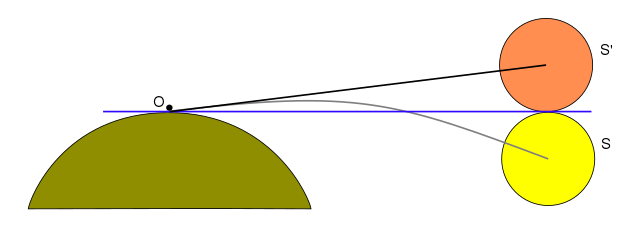
A note: This is equilux day for folks a 45 degrees north latitude. The actual date may vary by a day or so depending on one’s latitude, which affects the angle the Sun appears to cross the horizon.
Ephemeris: 02/26/2024 – The angle of the rising and setting planets from the Sun vary with the seasons
This is Bob Moler with Ephemeris for Monday, February 26th. Today the Sun will be up for 10 hours and 59 minutes, setting at 6:25, and it will rise tomorrow at 7:24. The Moon, 2 days past full, will rise at 8:44 this evening.
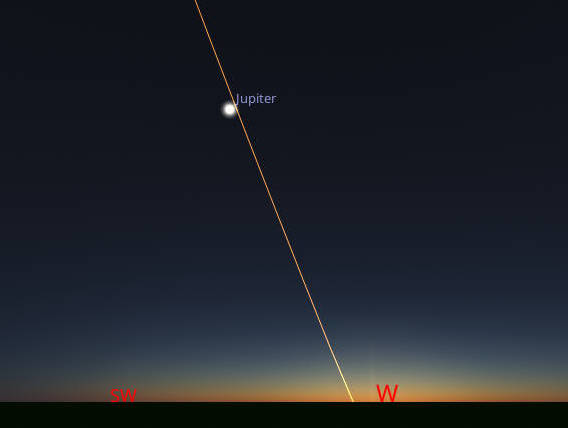
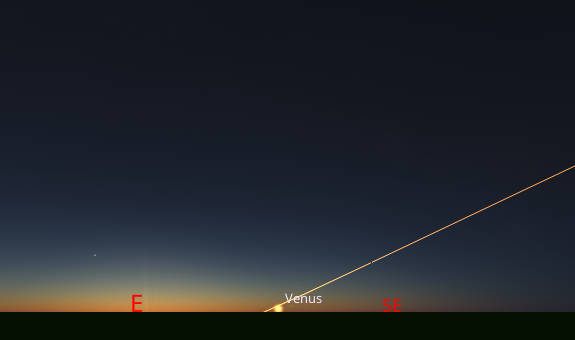
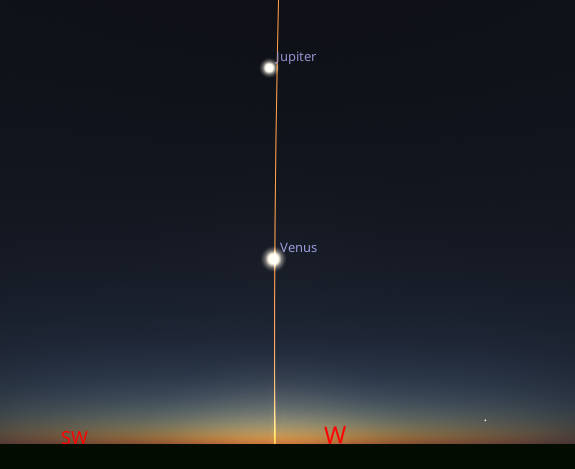
In late winter and early spring dark skies return within a few days after the full Moon. Indeed, this is the first day after the full moon, which was on Saturday morning, that we have dark skies. Well for 40 minutes before the Moon rises. This is because the ecliptic which is the Sun’s path in the sky is as close to vertical as it can get for us. It shows planets near the Sun and the area of the full moon as steeply inclined to the horizon as possible. Twelve years ago this month when my wife and I were on a Hawaiian cruise, I was aboard ship looking at the sky after sunset and was amazed to see Jupiter and Venus* vertically aligned in the west. It was because we were located around the Tropic of Cancer and near the equinox, so the ecliptic was actually vertical after sunset. It was quite a jolt to see that. So this time of year we can see planets close to the sun at sunset and the moon to go away after full rapidly.
The astronomical event times given are for the Traverse City/Interlochen area of Michigan (EST, UT –5 hours). They may be different for your location.
* On the broadcast I said Jupiter and Saturn, relying on my memory. As can be seen below, it was Jupiter and Venus.
Addendum
More questions about the length of daylight hours
This is the result of a question I got about why the daylight hours change the way they do during the year. My answer is posted here as “How come hours of daylight changes very slowly around the solstice, but very rapidly around the equinoxes?”
My correspondent has a few more questions. I’ll boil them down.
I pretty much understand why daylight changes rapidly at the equinoxes and slowly at the solstices based upon your map showing the ecliptic and how the steepest part is at the equinoxes. Also, the figure eight drawing makes sense. But why does the curve of the ecliptic seem to linger for a time at the solstices before plunging? Does it have to do with the speed of the Earth in its orbit?
The analemma, as seen below, is the result of two phenomena. First, the tilt of the Earth’s axis which would on itself make a figure 8 with equally sized lobes, with crossing point at the equinoxes. Second, the Earth’s orbit of the Sun is a slight ellipse, meaning for our purposes here that the Earth moves its fastest near perihelion when the Earth is nearest the Sun, around January 4th. and slowest at aphelion, when the Earth is farthest from the Sun, around July 4th. That makes the bottom lobe larger because the Sun is by reflection moving faster eastward in the sky. The apparent slowness that the questioner perceives is an illusion because the Sun appears to be moving in a more directly eastward, and changed the actual time of local solar noon. Wikipedia has a detailed discussion of the analemma.
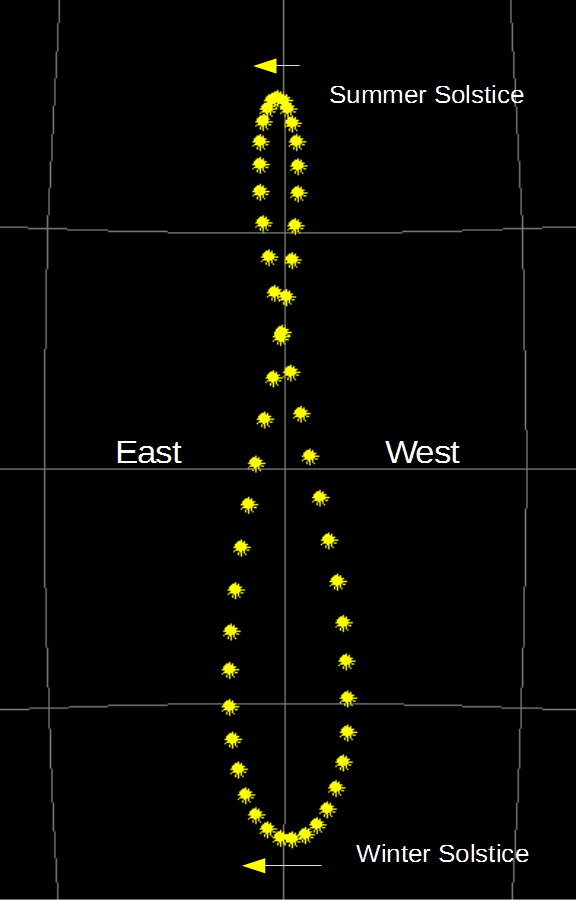
This figure 8 is called an analemma. One can find it on old globes in the Pacific Ocean. Explanation below. Created using my LookingUp program.
I had stated in the prior post that daylight hours would be 12 hours at the equinoxes and also all the time at the equator. So here’s the other question.
At the equator, day length does change over the course of the year, doesn’t it? At the equinoxes it would be 12 hours long, but at the summer solstice up north it would sink towards the south by 23 degrees and at the summer solstice in the south it would sink towards the north by the same amount.
Other than getting cooperation from someone who either lives on or has visited the equator, I generated a calendar of sunrise and sunset times for the equator, specifically for 0º longitude and 0º latitude. A link to it is here. Also read the explanation on that calendar page.
The answer is No, the daylight hours at the equator doesn’t change over the year. The one minute variance has to do with the Analemma.
How come hours of daylight changes very slowly around the solstice, but very rapidly around the equinoxes?
This question came in as a an off topic comment to my post yesterday 01/09/2015. It deserves a good answer. So here goes.
Day to day change in daylight hours occur when the Sun appears to move south or north. For us in the northern hemisphere the daylight hours get shorter when the Sun appears to move south, and longer when the Sun appears to move north. If we spread out the sky in a Mercator projection, like they do the earth or one of those satellite tracking maps, it would look like the image below.
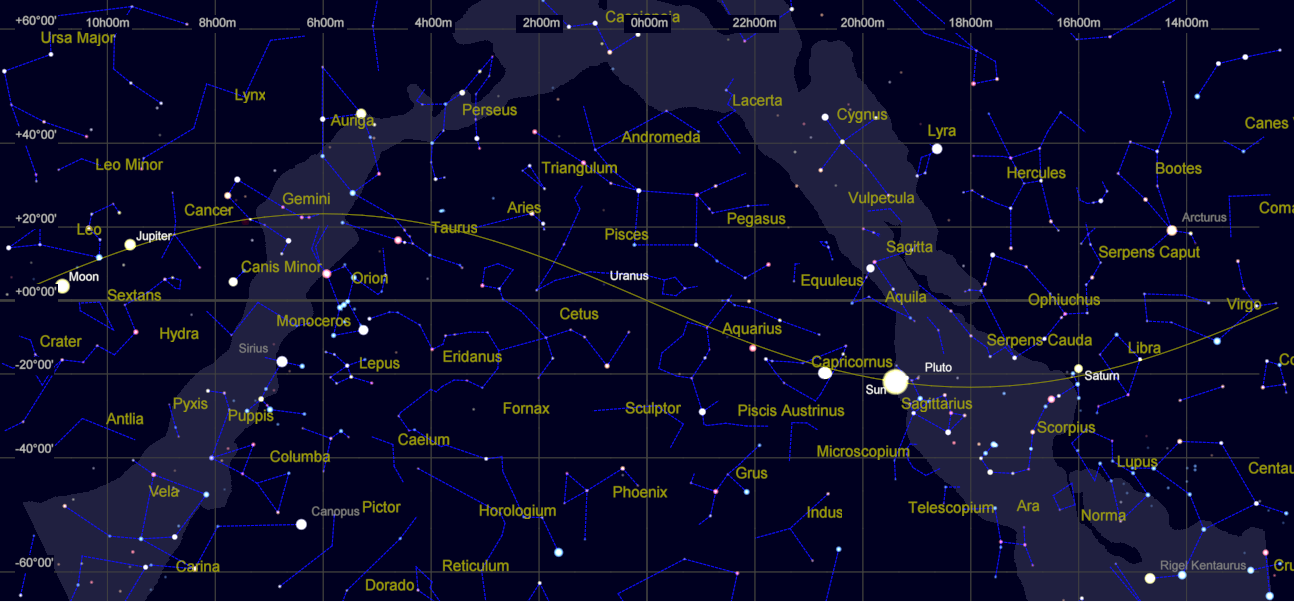
Mercator projection of the heavens from declinations +60 to -60 degrees declination, centered on the vernal equinox. The center horizontal white line is the celestial equator, and the yellow sinusoidal line is the ecliptic, the apparent path of the sun. Note the planets and Moon also stick close to that line. The date of the image is January 9, 2015. Venus and Mercury are on top of each other and unlabeled under the ‘a’ in Capricornus. Created using Cartes du Ceil (Sky Charts). Click image to enlarge.
Note that the steepest part of the ecliptic occurs at the equinoxes, the vernal or March equinox in the center and the autumnal or September equinox at the left and right edges. That’s where the sun’s motion north or south is the greatest, so the daily change in daylight hours is the greatest. Near the solstices at 6 and 18 hours* the Sun isn’t changing its north-south motion very much, so the daylight hours aren’t changing much from day to day. If you were watching the sky at local solar noon, you’d think that at the solstice the sun would stop its motion and stand still before heading back. That’s what the word solstice means: sun-standstill. The variation is daylight hours also depends on your location. At the equator, it doesn’t change at all. Of course at the other extreme, at the poles, there’s 6 months of daylight and 6 months of night.
* The east-west direction in the heavens is like longitude on the Earth but it’s called right ascension and is measured in hours where 15 degrees equals one hours. Astronomers use clocks to keep track of it. Declination is the same as latitude on the Earth. In astronomy longitude and latitude were already in use for ecliptic based coordinates.
So what causes the wavy path in the sky? Lets check out the earth from the sun’s point of view, so to speak.
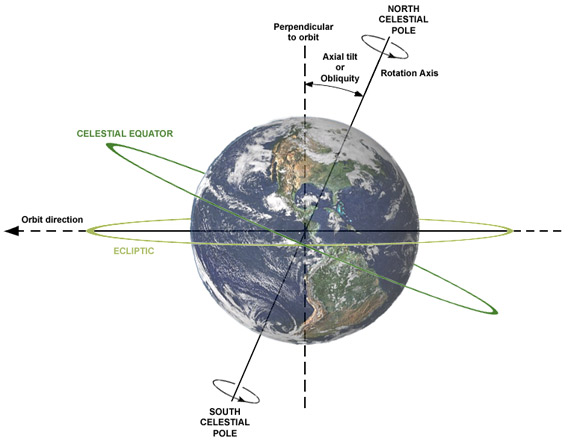
Earth’s axial tilt. The horizontal line is the plane of the Earth’s orbit and what we see projected on the sky as the ecliptic. The tilt of the Earth’s axis to the plane of its orbit by 23 1/2 degrees, gives us the seasons and why the celestial equator and ecliptic cross at a 23 1/2 degree angle. Credit Dennis Nilsson.
Both the celestial equator and the ecliptic are great circles in the sky. They intersect at an angle of 23 1/2 degrees at the equinox points.
Lets take a look at the difference in daylight hours at three times in the year, the equinox and the two solstices for Traverse City, MI whose latitude is just shy of 45° north. The following three images were generated in stereographic projection, which exaggerates the distance of things near the horizon and diminishes the distance of things in the center, the zenith. So actually the speed of the sun is unchanging across the sky.
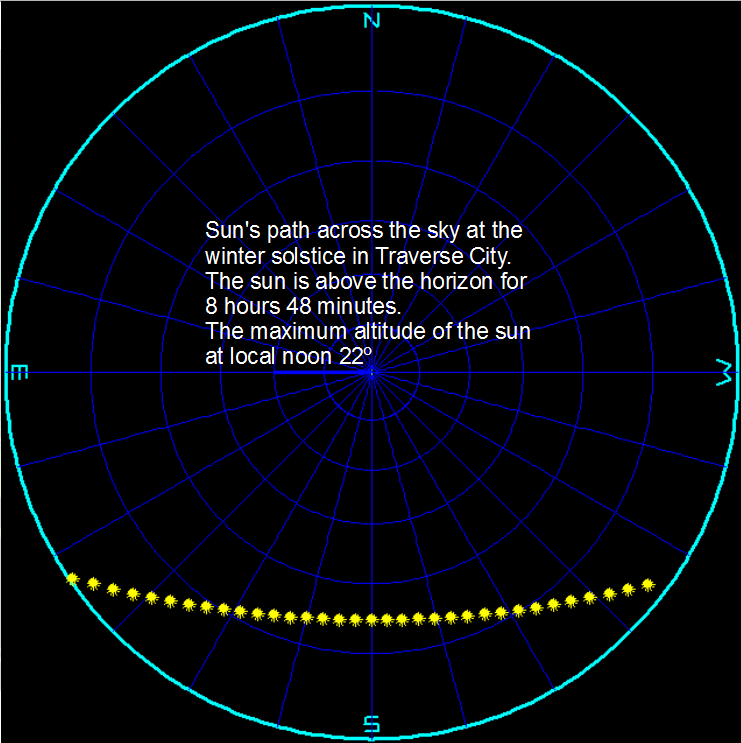
The sun’s daily path through the sky from horizon to horizon on the first day of winter, the winter solstice. Credit My LookingUp program.
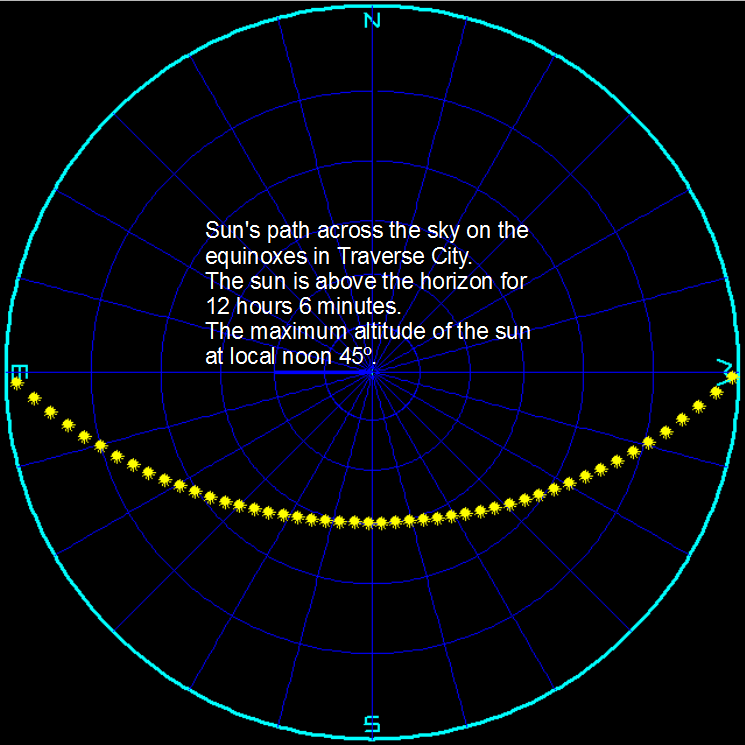
The sun’s daily path through the sky from horizon to horizon on an equinox the first day of spring or autumn. Credit My LookingUp program.
Note that at the equinox the sun rises due east and sets due west.
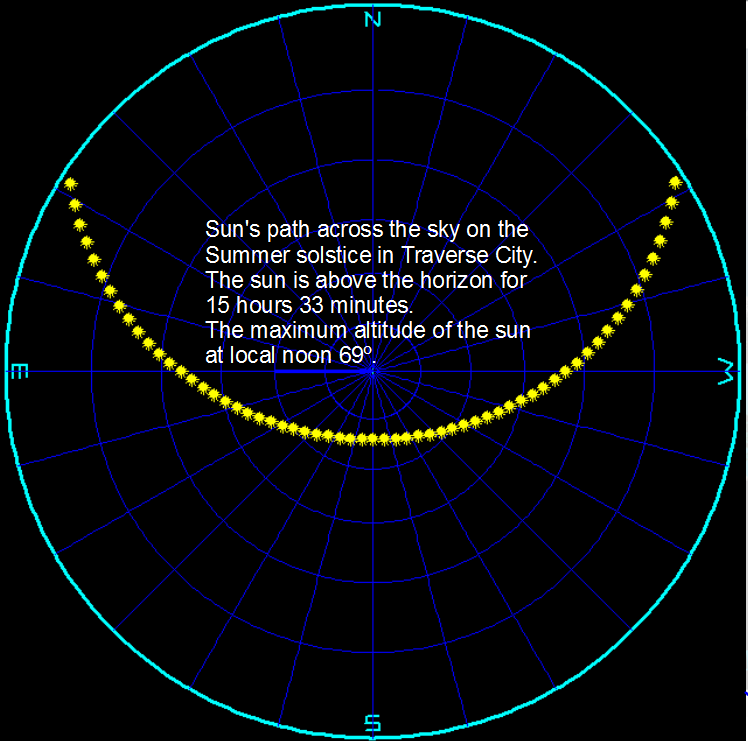
The sun’s daily path through the sky from horizon to horizon on the first day of summer, the summer solstice. Credit My LookingUp program.
One more diagram to illustrate the change in the sun’s north-south position in the sky.
This figure 8 is called an analemma. One can find it on old globes in the Pacific Ocean. Created using my LookingUp program.
This is the Sun plotted for mean solar noon over one year at 7 day intervals. One can see the rapid motion in the north-south position of the sun around the equinoxes versus the solstices. The more rapid the north-south motion of the Sun the greater the change in day-to-day daylight hours. The line with “East West” on it is the celestial equator. Check out my December 2, 2014 post on why it’s a figure 8.
 Bob Moler's Ephemeris Blog