Archive
Ephemeris: 10/17/2025 – Fomalhaut, lonely again
This is Ephemeris for Friday, October 17th. Today the Sun will be up for 10 hours and 52 minutes, setting at 6:54, and it will rise tomorrow at 8:02. The Moon, halfway from last quarter to new, will rise at 5:04 tomorrow morning.
There’s a bright star that appears for only seven and a half hours on autumn evenings. Its appearance, low in the south in the evening, is a clear indication of autumn. It is currently below and right of the much brighter Saturn. The star’s name is Fomalhaut, which means fish’s mouth. That’s fitting because it’s in the constellation of Piscis Austrinus, the southern fish. At our latitude it’s kind of the fish that got away, because Fomalhaut is low in our skies where stars lose more than half their brightness. For the last few years Jupiter, then Saturn have kept it company. However, Saturn is moving on, having shifted into Pisces, leaving Fomalhaut to its lonely vigil in the south.
The astronomical event times given in this blog are for the Traverse City/Interlochen area of Michigan (Lat 44.7° N, Long 85.7° W; EDT, UT – 4 hours) unless stated otherwise. Times will be different for other locations.
Addendum
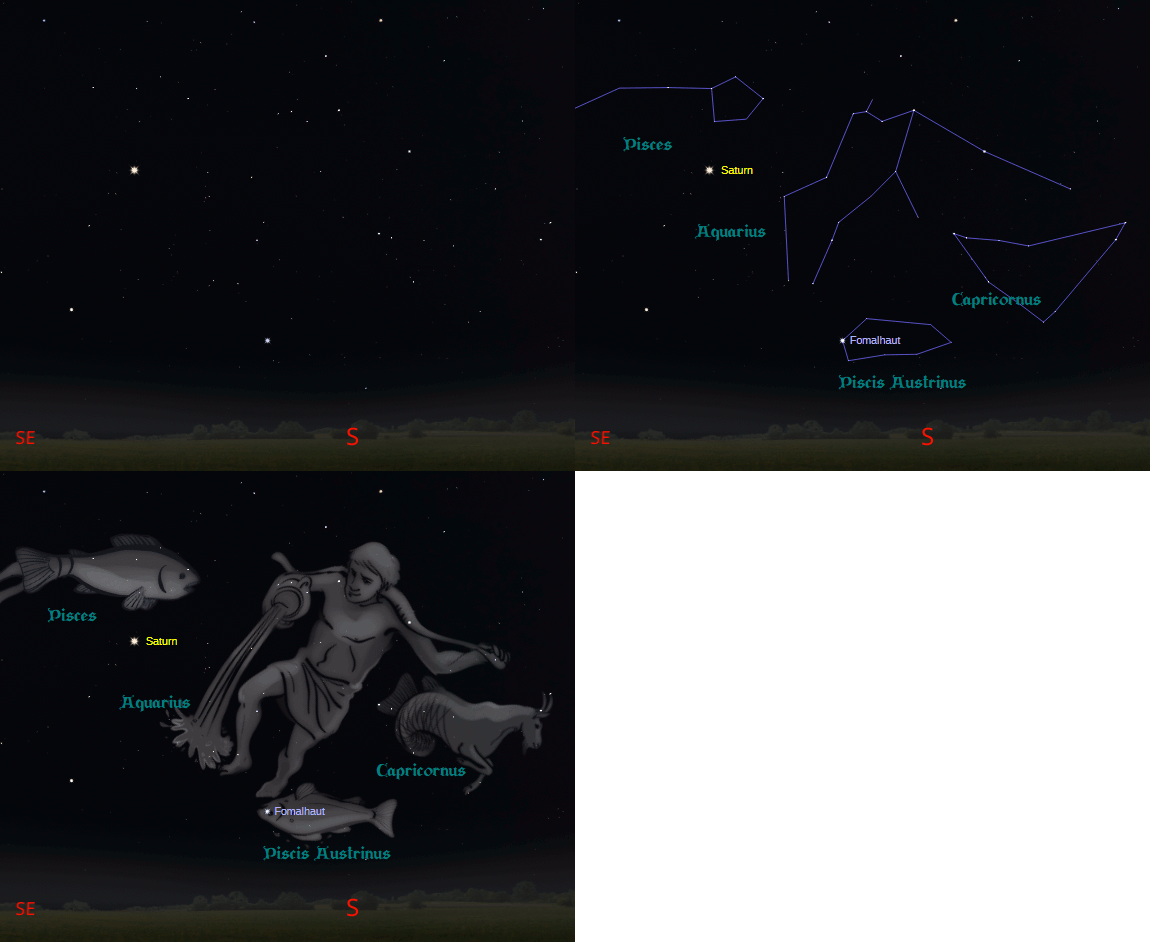
Ephemeris: 11/19/2024 – The loneliest star in the sky
This is Bob Moler with Ephemeris for Tuesday, November 19th. Today the Sun will be up for 9 hours and 24 minutes, setting at 5:10, and it will rise tomorrow at 7:47. The Moon, 3 days before last quarter, will rise at 8:32 this evening.
There’s a bright star that appears for only seven and a half hours on autumn evenings. Its appearance, low in the south-southeast at 8 p.m., is a clear sign that autumn is here. It is currently far below the much brighter Saturn. The star’s name is Fomalhaut, which means fish’s mouth. That’s fitting because it’s in the constellation of Piscis Austrinus, the southern fish. At our latitude it’s kind of the fish that got away, because usually Fomalhaut appears to be quite alone low in the sky. For the last few years Jupiter and then Saturn have kept it company. In a couple of years Saturn will have moved on leaving Fomalhaut to its lonely vigil in the south.
The astronomical event times given are for the Traverse City/Interlochen area of Michigan (EST, UT – 5 hours). Times will be different for other locations.
Addendum
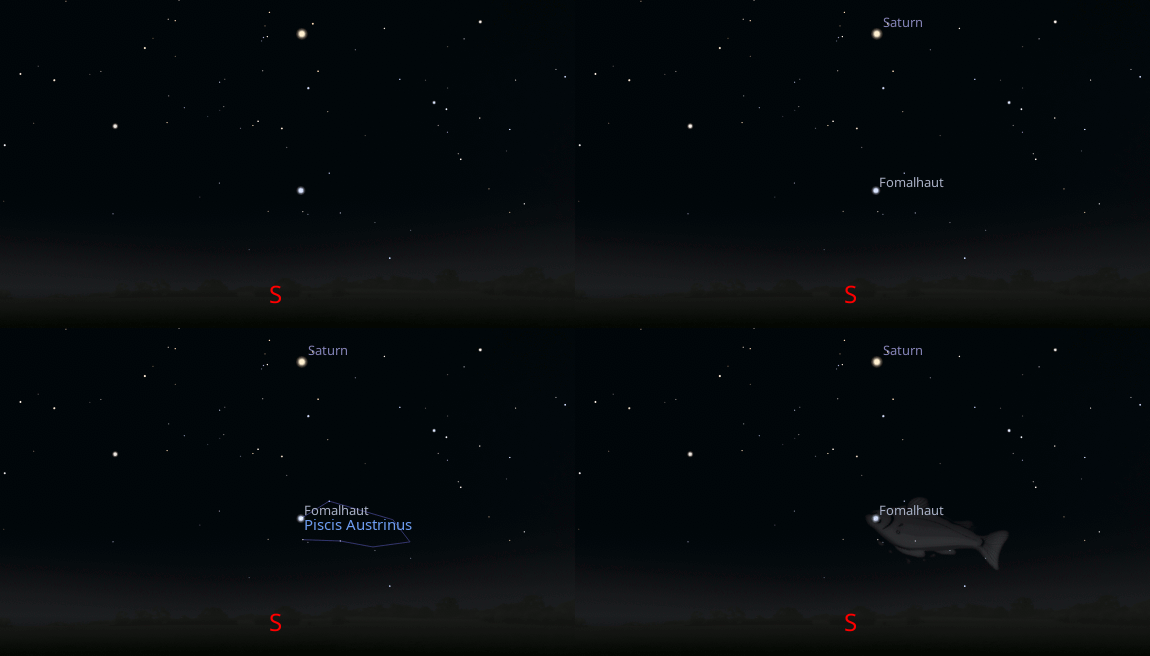
Ephemeris: 10/19/2023 – The southern star of autumn – Fomalhaut
This is Bob Moler with Ephemeris for Thursday, October 19th. Today the Sun will be up for 10 hours and 48 minutes, setting at 6:51, and it will rise tomorrow at 8:04. The Moon, 2 days before first quarter, will set at 9:39 this evening.
There’s a bright star that appears for only seven and a half hours on autumn evenings. Its appearance, low in the south-southeast at 9 p.m., is a clear indication of the autumn season. It is currently below the much brighter Saturn. The star’s name is Fomalhaut, which means fish’s mouth. That’s fitting because it’s in the constellation of Piscis Austrinus, the southern fish. At our latitude it’s kind of the fish that got away, because usually Fomalhaut appears to be quite alone low in the sky. For the last few years Jupiter and then Saturn have kept it company. In a couple of years Saturn will have moved on leaving Fomalhaut to its lonely vigil in the south.
The astronomical event times given are for the Traverse City/Interlochen area of Michigan (EDT, UT –4 hours). They may be different for your location.
Addendum
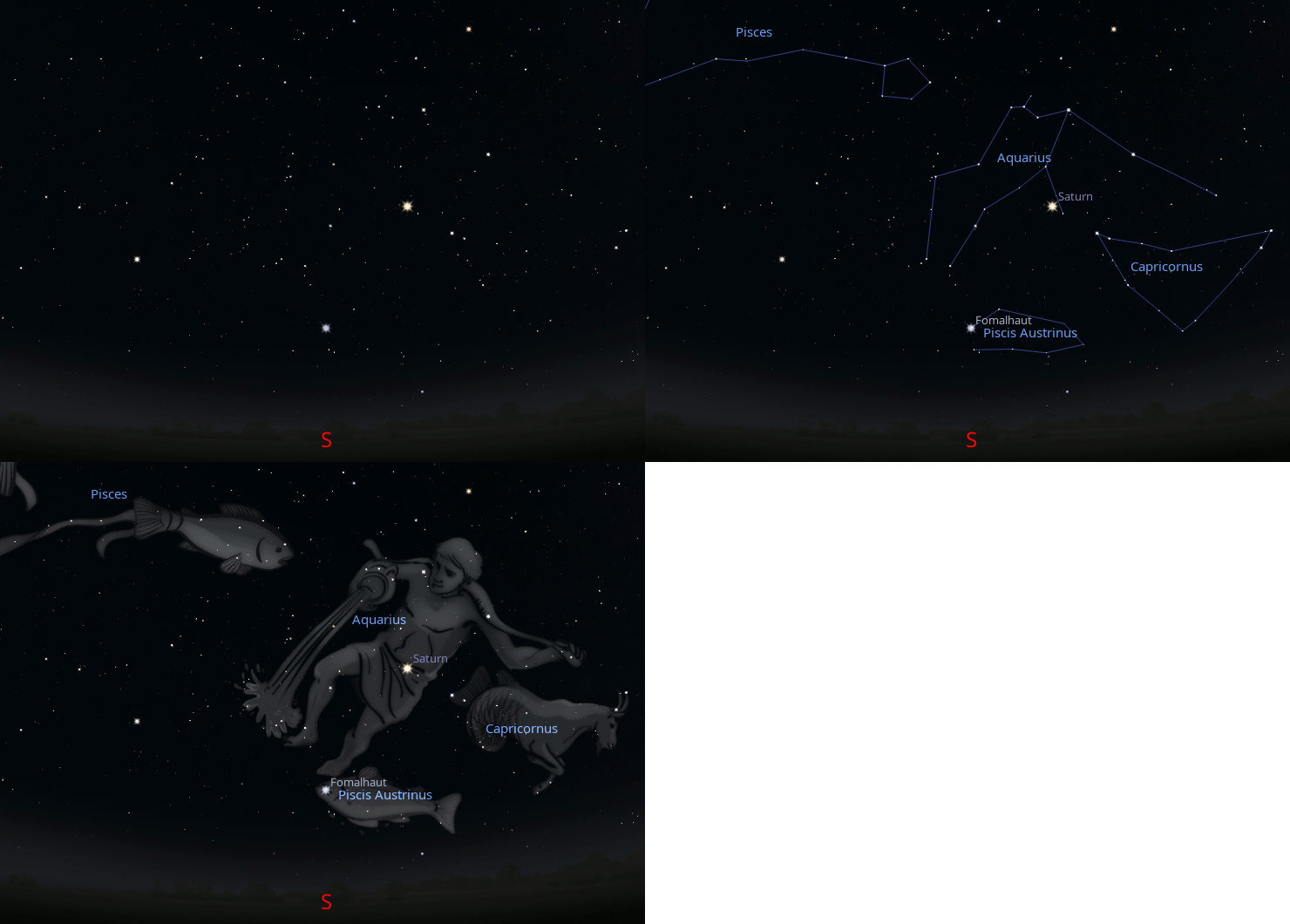
11/18/2022 – Ephemeris – Fomalhaut’s disappearing “planet”
This is Ephemeris for Friday, November 18th. Today the Sun will be up for 9 hours and 27 minutes, setting at 5:11, and it will rise tomorrow at 7:45. The Moon, 2 days past last quarter, will rise at 2:32 tomorrow morning.
The lonely bright star low in the south at 8 p.m. these evenings is Fomalhaut, the harbinger of autumn in my book, and about to leave as winter approaches. Fomalhaut is a young white star only about 400 million years old with a disk of dust surrounding it. Near an outer dust ring, in 2008 the Hubble Space Telescope discovered a spot. Four years later, astronomers discovered that the spot had moved along the dust lane and announced the first direct discovery of an exoplanet. In 2010 and 2012 the planet now dubbed Fomalhaut b or Dagon was observed again. However, it appears to be dissipating. It might be an expanding cloud of debris that’s the result of two asteroids colliding. We’ll keep watching.
The astronomical event times given are for the Traverse City/Interlochen area of Michigan (EST, UT -5 hours). They may be different for your location.
Addendum
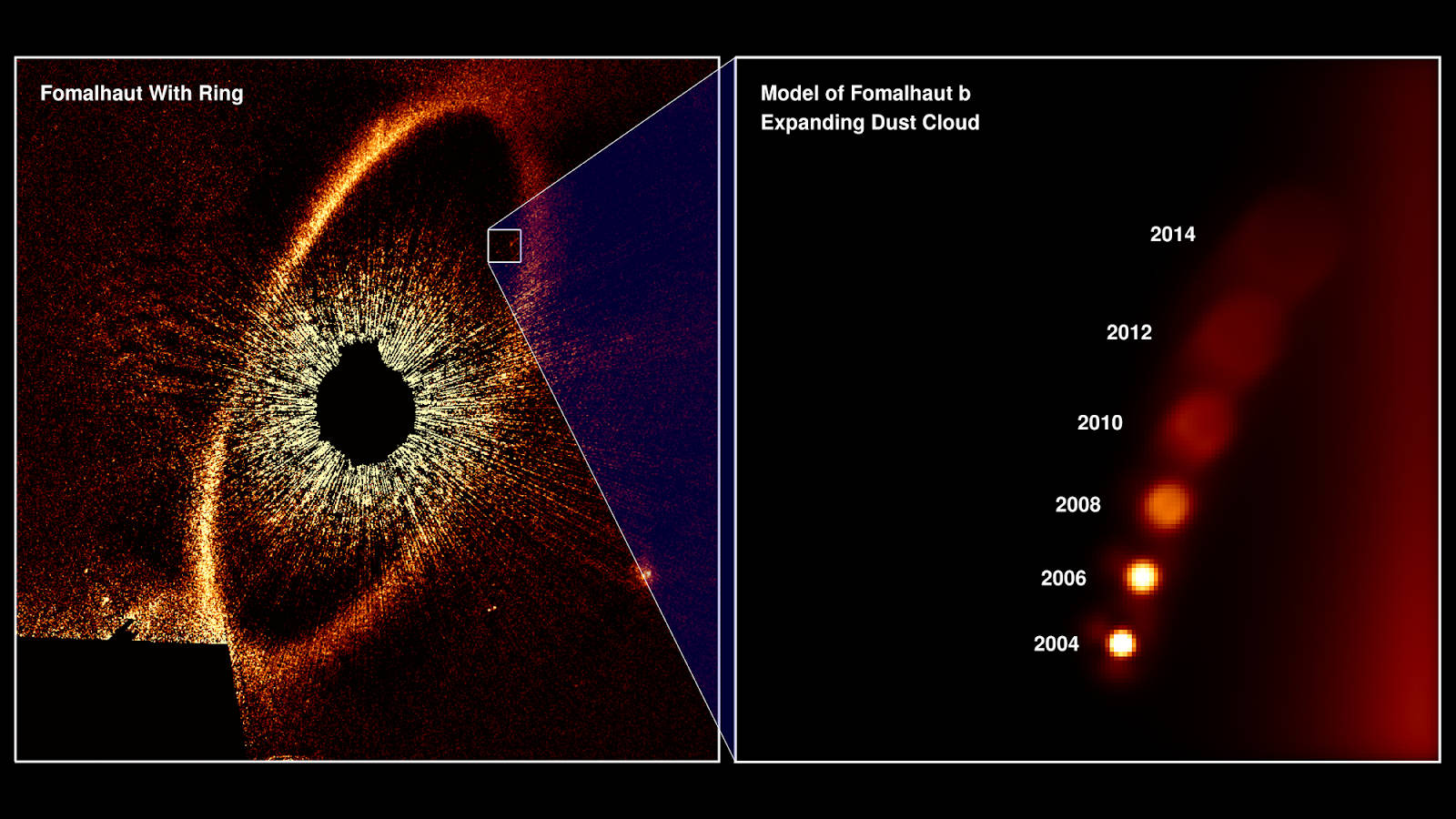
Hubble Space Telescope image of Fomalhaut’s ring and model of the disappearing dust cloud that was first thought to be a planet. Credit: Space Telescope Science Institute.
10/14/2022 – Ephemeris – The loneliest star in the sky isn’t so lonely this year, and more
This is Ephemeris for Friday, October 14th. Today the Sun will be up for 11 hours and 2 minutes, setting at 6:59, and it will rise tomorrow at 7:58. The Moon, 3 days before last quarter, will rise at 9:37 this evening.
There’s a bright star that appears for only seven and a half hours on autumn evenings. It’s appearance, low in the south-southeast at 9 p.m., is a clear indication of the autumn season. The star’s name is Fomalhaut, which means fish’s mouth. That’s fitting because it’s in the constellation of Piscis Austrinus, the southern fish. At our latitude it’s kind of the fish that got away, because Fomalhaut appears to be quite alone low in the sky. The other stars of its constellation are dim, and being low in the sky makes them even dimmer. However, this year Fomalhaut has visitors. Above and left of it is the brilliant planet Jupiter. And above and right of it is the bright planet Saturn. Both planets, while not very close to Fomalhaut, will keep it company this year.
The astronomical event times given are for the Traverse City/Interlochen area of Michigan (EDT, UT – 4 hours). They may be different for your location.
Addenda
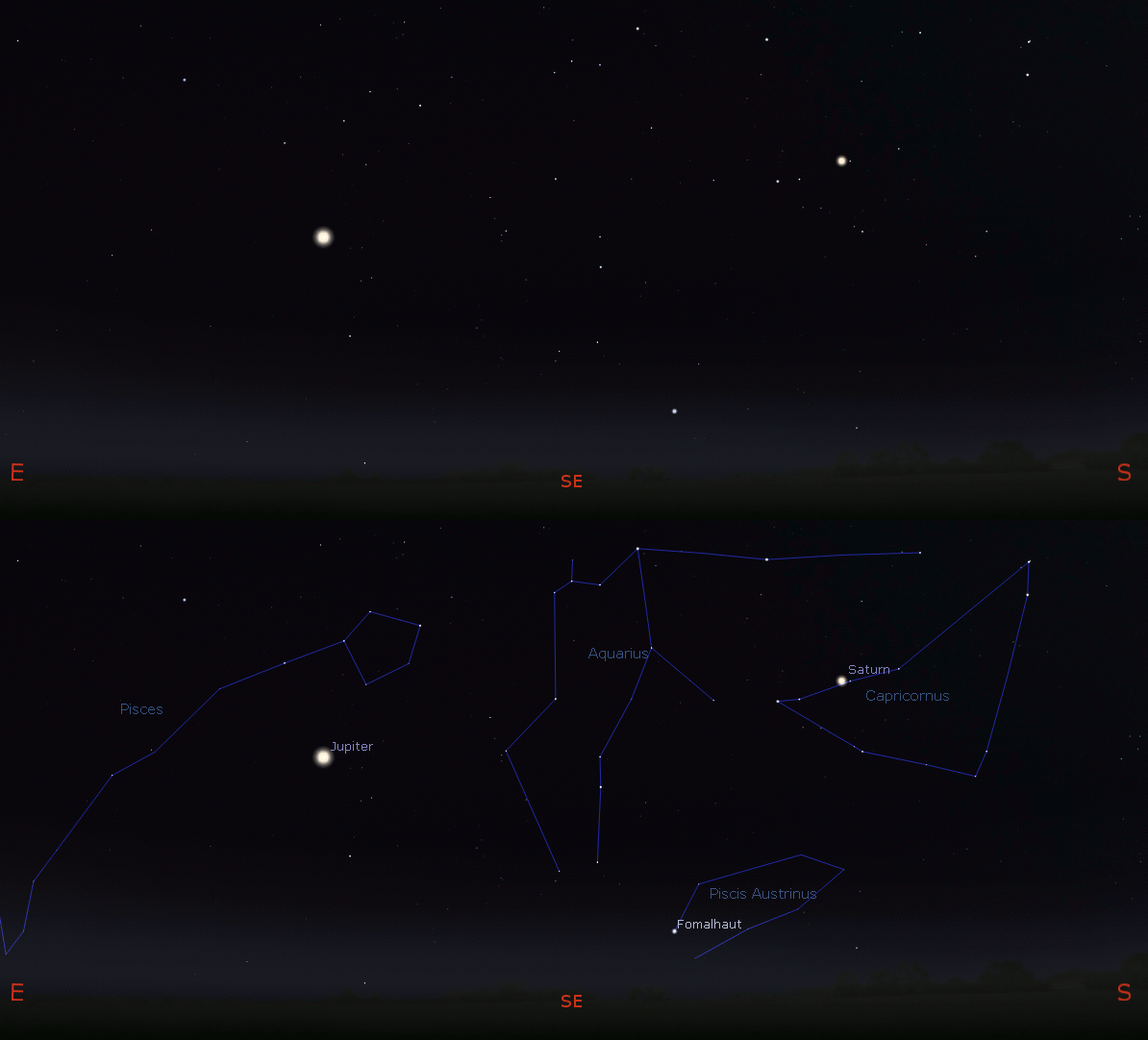
Fomalhaut and friends (Jupiter and Saturn) finder animation for 9 pm tonight, Friday, October 14, 2022. Click on the image to enlarge it. Created using Stellarium and GIMP.
Also at Corson Auditorium on the Interlochen Center for the Arts Campus…

Join Interlochen Public Radio for Kids Commute Live! This family-friendly matinee is brought to you by the Interlochen Arts Academy Wind Symphony and features Interlochen theatre and singer-songwriter students, TCAPS middle school musicians, and special guests from NASA, the Coast Guard, and the International Dark Sky Park. Conductor Matthew Schlomer and Kids Commute host Kate Botello will lead this multi-sensory experience centered on the theme “Space Flight.”
The program will include Gustav Holst’s “Jupiter,” Michael Mogenson’s “Aerial Fantasy,” John Williams’ “Fantasy of Flight,” and more!
Come early for pre-concert activities for kids of all ages, including drone demonstrations and paper airplane contests. Space-themed food will be available for purchase.
I will be there from 12 to 1 pm, having the kids help me make COMETS! I’ll also be part of the program.
For more information and tickets: https://www.interlochen.org/events/kids-commute-live-space-flight-2022-10-15
10/07/2021 – Ephemeris – The loneliest star in the sky
This is Bob Moler with Ephemeris for Thursday, October 7th. Today the Sun will be up for 11 hours and 23 minutes, setting at 7:11, and it will rise tomorrow at 7:49. The Moon, 1 day past new, will set at 8:06 this evening.
There’s a bright star that appears for only seven and a half hours on autumn nights. It’s appearance, low in the south-southeast at 9 p.m., is a clear indication of the autumn season. The star’s name is Fomalhaut, which means fish’s mouth. That’s fitting because it’s in the constellation of Piscis Austrinus, the southern fish. At our latitude it’s kind of the fish that got away, because Fomalhaut appears to be quite alone low in the sky. The dimness of the constellation’s other stars and location close to the horizon make the other stars hard to spot. The Earth’s thick atmosphere near the horizon reduces their brightness by a factor of two or more, so Fomalhaut, one of the brightest stars in the sky, keeps a lonely vigil in the south.
The astronomical event times given are for the Traverse City/Interlochen area of Michigan (EDT, UT-4 hours). They may be different for your location.
Addendum
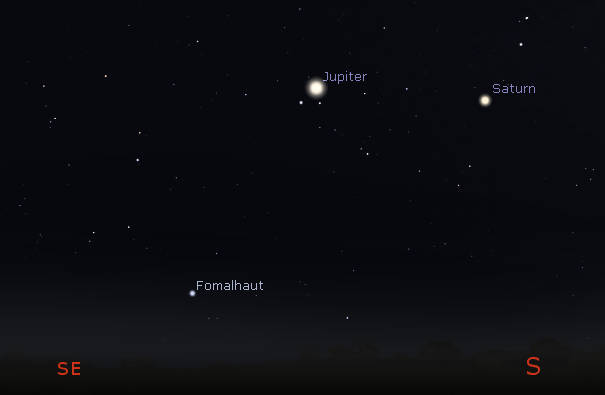
Fomalhaut at 9 pm, October 7, 2021. This year it has two bright planets relatively nearby, By they’re just passing through, albeit slowly. Normally the closest first magnitude star to Fomalhaut is Altair, the southernmost of the Summer Triangle stars. Created using Stellarium.
11/25/2019 – Ephemeris – Fomalhaut has a visible exoplanet
Ephemeris for Monday, November 25th. Today the Sun will be up for 9 hours and 14 minutes, setting at 5:06, and it will rise tomorrow at 7:53. The Moon, 1 day before new, will rise at 7:41 tomorrow morning.
The lonely bright star low in the south at 8 p.m. these evenings is Fomalhaut the harbinger of autumn in my book, and about to leave as winter approaches. Fomalhaut means fishes mouth and is located at the head of Piscis Austrinus, a very dim constellation. Fomalhaut is a young white star only about 400 million years old with a disk of dust surrounding it. Near an outer dust ring, 15 years ago the Hubble Space Telescope discovered a spot. Four years later astronomers discovered that the spot moved along the dust lane and announced the first direct discovery of an exoplanet. In 2010 and 2012 the planet now dubbed Fomalhaut b or Dagon was observed again and it really does orbit Fomalhaut in a very eccentric orbit.
The times given are for the Traverse City/Interlochen area of Michigan. They may be different for your location.
Addendum
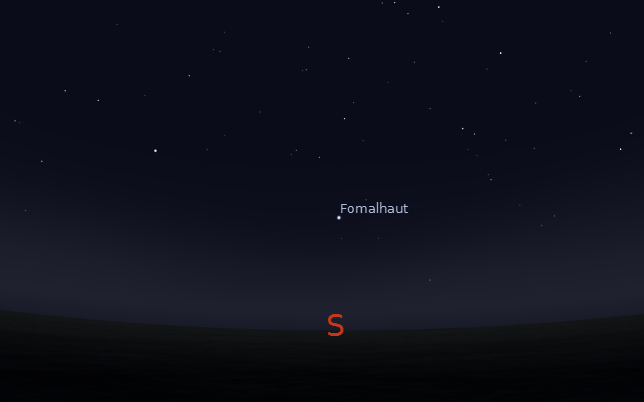
Fomalhaut in the south at 8 p.m. in November. Created using Stellarium.

The track of observations of Fomalhaut b or Dagon in 2004, 2006, 2010 and 2012. Credit: NASA and ESA – http://www.nasa.gov/images/content/717874main_p1301aw-orig_full.jpg, Public Domain, https://commons.wikimedia.org/w/index.php?curid=23735991
10/17/2019 – Ephemeris – Fomalhaut, the loneliest star in the sky
Ephemeris for Thursday, October 17th. Today the Sun will be up for 10 hours and 54 minutes, setting at 6:55, and it will rise tomorrow at 8:01. The Moon, half way from full to last quarter, will rise at 9:18 this evening.
There’s a bright star that appears for only seven and a half hours on autumn evenings. It’s appearance, low in the south-southeast at 9 p.m., is a clear indication of the autumn season. The star’s name is Fomalhaut, which means fish’s mouth. That’s fitting because it’s in the constellation of Piscis Austrinus, the southern fish. At our latitude it’s kind of the fish that got away, because Fomalhaut appears to be quite alone low in the sky. The dimness of the constellation’s other stars and location close to the horizon make the faint stars hard to spot. The Earth’s thick atmosphere near the horizon reduces their brightness by a factor of two or more, so Fomalhaut, one of the brightest stars in the sky, keeps a lonely vigil in the south.
The times given are for the Traverse City/Interlochen area of Michigan. They may be different for your location.
Addendum
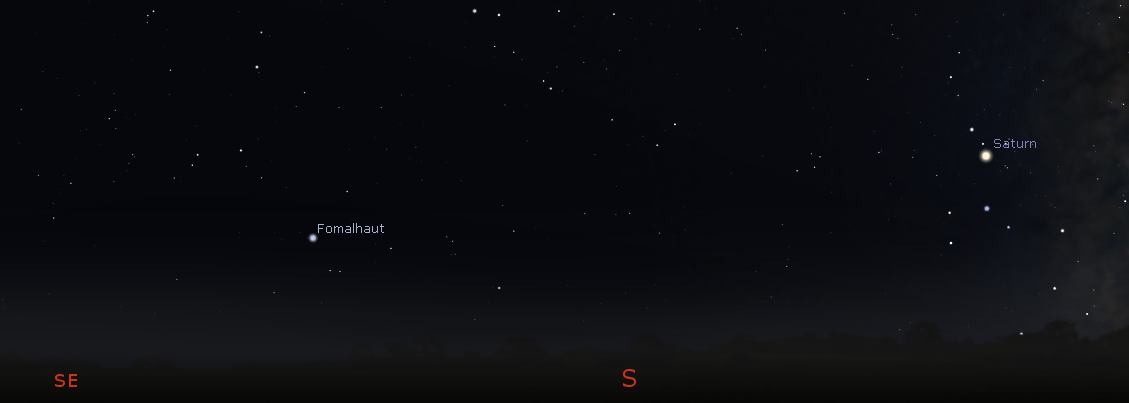
Fomalhaut, Saturn and the southern evening stars at 9 p.m. tonight, October 17, 2019. Click on image to enlarge. Created using Stellarium.
11/24/2017 – Ephemeris – Fomalhaut, the loneliest star, has a little buddy
Ephemeris for Friday, November 24th. The Sun will rise at 7:51. It’ll be up for 9 hours and 15 minutes, setting at 5:07. The Moon, 2 days before first quarter, will set at 10:30 this evening.
The lonely bright star low in the south at 8 p.m. these evenings is Fomalhaut the harbinger of autumn in my book, and about to leave as winter approaches. Fomalhaut means fishes mouth and is located at the head of Piscis Austrinus, a very dim constellation. Fomalhaut is a young white star only about 400 million years old with a disk of dust surrounding it. Near an outer dust ring, 15 years ago the Hubble Space Telescope discovered a spot. Four years later astronomers discovered that the spot moved along the dust lane and announced the first direct discovery of an exoplanet. In 2010 and 2012 the planet now dubbed Fomalhaut b or Dagon was observed again and it really does orbit Fomalhaut in a very eccentric orbit.
The times given are for the Traverse City/Interlochen area of Michigan. They may be different for your location.
Addendum
Fomalhaut in the south at 8 p.m. on November evenings. Created using Stellarium.
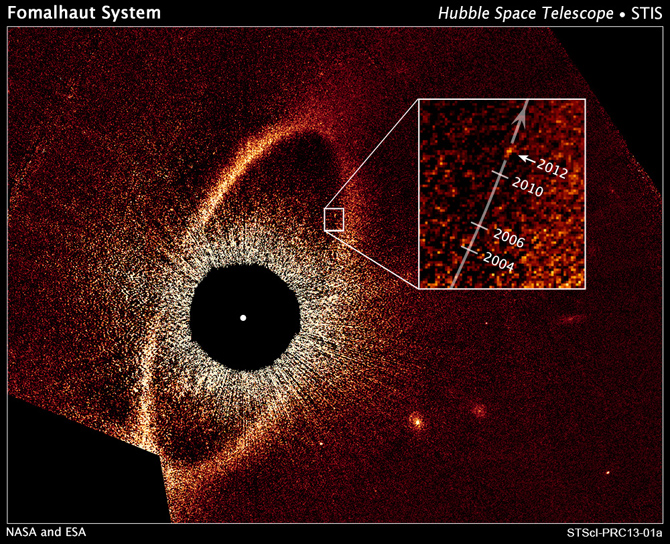
Fomalhaut b and it’s path around its star. Credit: NASA, ESA, and P. Kalas (University of California, Berkeley and SETI Institute)
10/24/2016 – Ephemeris – Fomalhaut, the loneliest star in the sky
Ephemeris for Monday, October 24th. The Sun will rise at 8:10. It’ll be up for 10 hours and 31 minutes, setting at 6:42. The Moon, 2 days past last quarter, will rise at 3:01 tomorrow morning.
There’s a bright star that appears for only seven and a half hours on autumn evenings. It’s appearance, low in the south at 10 p.m., is a clear indication of the autumn season. The star’s name is Fomalhaut, which means fish’s mouth. That’s fitting because it’s in the constellation of Piscis Austrinus, the southern fish. At our latitude it’s kind of the fish that got away, because Fomalhaut appears to be quite alone low in the sky. The dimness of the constellation’s other stars and location close to the horizon make the faint stars hard to spot. The earth’s thick atmosphere near the horizon reduces their brightness by a factor of two or more, so Fomalhaut, one of the brightest stars in the sky, keeps a lonely vigil in the south.
Times are for the Traverse City/Interlochen area of Michigan. They may be different for your location.
Addendum
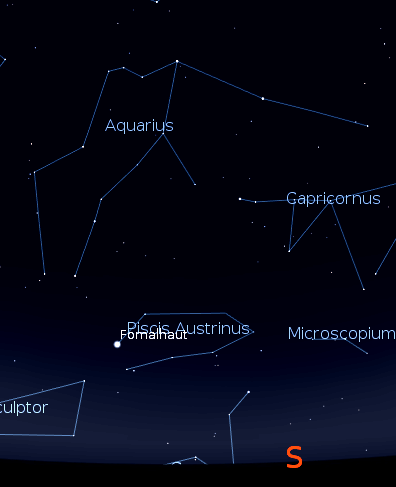
Aquarius and Fomalhaut as visualized by Stellarium.
 Bob Moler's Ephemeris Blog
