Archive
Ephemeris: 02/20/2024 – Schiller, an odd lunar crater
This is Ephemeris for Tuesday, February 20th. Today the Sun will be up for 10 hours and 41 minutes, setting at 6:17, and it will rise tomorrow at 7:34. The Moon, halfway from first quarter to full, will set at 6:39 tomorrow morning.
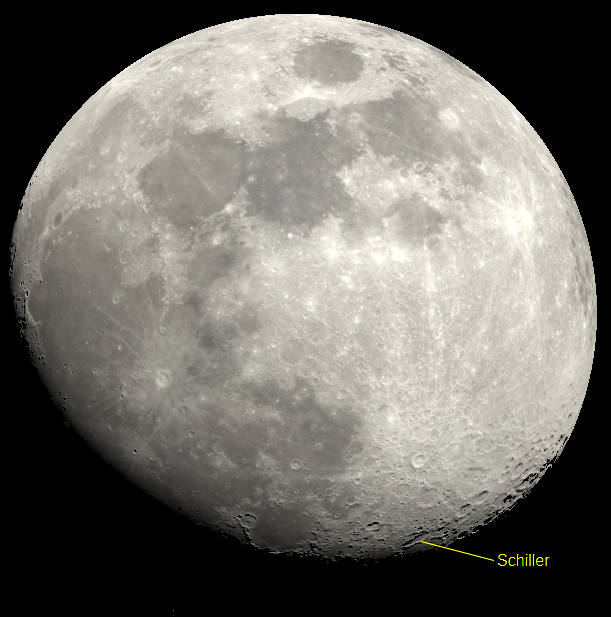
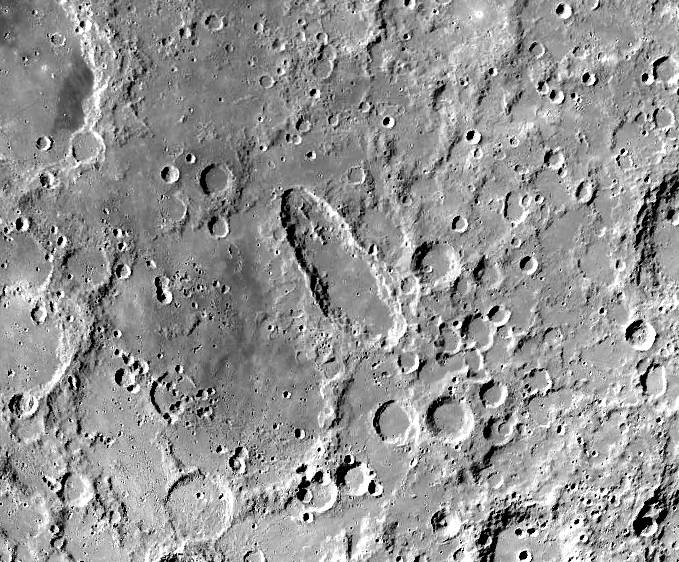
The moon tonight is in its gibbous phase, with more than half of it being illuminated by the Sun. In binoculars or a small telescope, looking at the bottom part of the moon, near the South Pole. All the craters appear to be elongated, foreshortened actually, because the moon is spherical. But one crater stands out as being more elliptical than the rest it’s called Schiller. It’s about 111 miles long, and much less in the other direction. It still appears elongated when seen from overhead by a spacecraft. It looks like the footprint of a long narrow shoe. It is either the result of a low angle hit from the asteroid or two overlapping low angle asteroid craters. I suspect the latter, though I have no expertise in the matter.
The astronomical event times given are for the Traverse City/Interlochen area of Michigan (EST, UT –5 hours). They may be different for your location.
Addendum
06/26/2023 – Ephemeris – After the latest sunset, a look at the Moon
This is Ephemeris for Monday, June 26th. Today the Sun will be up for 15 hours and 33 minutes, setting at 9:32, and it will rise tomorrow at 5:59. The Moon, at first quarter today, will set at 2:02 tomorrow morning.
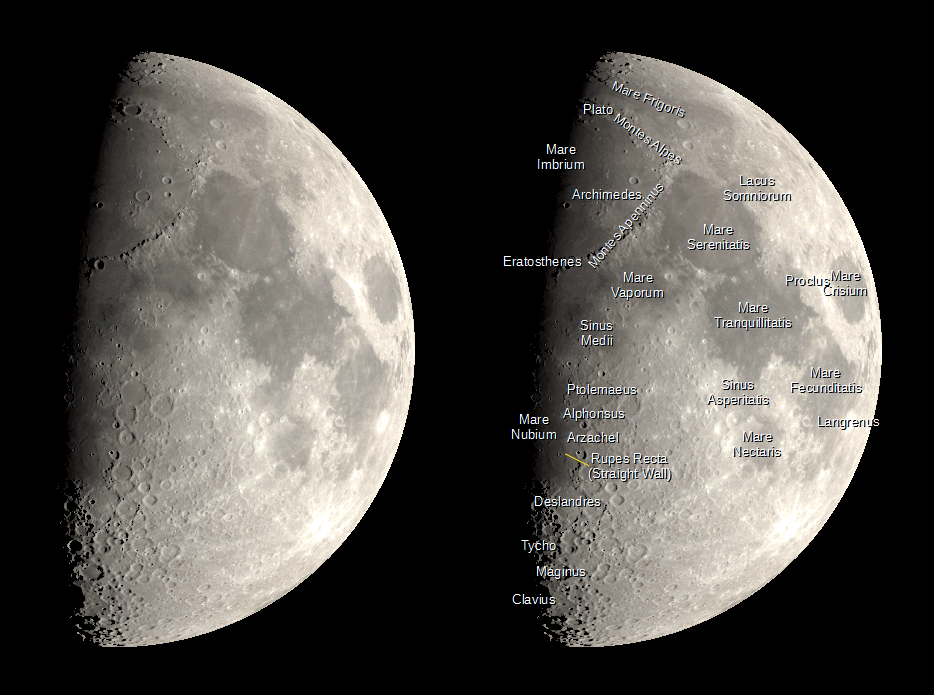
Tonight is the night of the latest sunset. From now to December 10th the Sun will be setting earlier than the night before. It won’t be noticeable at first, but the change will increase throughout the summer. The Moon actually arrived at first quarter phase early this morning, so by tonight it will appear slightly gibbous. The term gibbous actually means hump-backed, and the Moon will appear more so as it advances toward being fully illuminated a week from now. For me personally, I find that the best time to view the Moon with a telescope is within three or four days from its quarter phase, unless I’m looking at a specific feature. That’s when shadows are front and center on the moon. The Moon being gray on gray, shadows keep the Moon from appearing flat.
The astronomical event times given are for the Traverse City/Interlochen area of Michigan (EDT, UT –4 hours). They may be different for your location.
Addendum
09/11/2014 – Ephemeris – The waning gibbous moon and a strange double crater
Ephemeris for Thursday, September 11th. The sun will rise at 7:16. It’ll be up for 12 hours and 43 minutes, setting at 8:00. The moon, 3 days past full, will rise at 9:30 this evening.
It might be about 10 p.m. before the moon gets high enough to appreciate with a small telescope. The terminator running across the moon is the sunset line. It has gobbled most of the little round Sea of Crises at the upper right of the moon. The Sea of Fertility just below it has two distinctive small craters in it with two parallel streaks of ejecta emanating from the one farthest from the terminator. No one knows exactly what happened here, but it appears that a binary asteroid struck the moon at a low angle coming from the direction of the terminator and gouged out the two small craters, which are elongated in the direction of the streaks. The crater names are Messier and Messier A, named after the French astronomer who cataloged some of the brightest interstellar objects.
Times are for the Traverse City/Interlochen area of Michigan. They may be different for your location.
Addendum
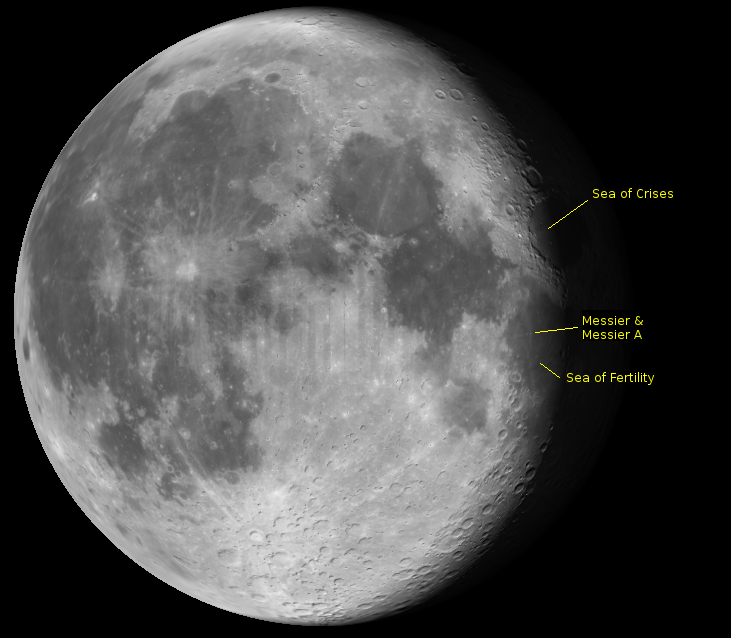
The gibbous Moon at 9 p.m. September 11, 2014. Created using Virtual Moon Atlas.
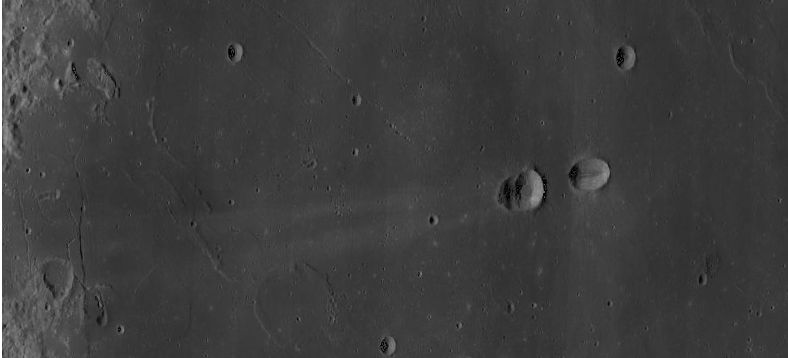
Closeup of Messier (right) and Messier A with the twin ejecta streaks. Credit: Lunar Reconnaissance Orbiter via Virtual Moon Atlas.
These craters were named for the 18th century astronomer Charles Messier whose famous catalog of deep sky objects is a who’s who of the brightest star clusters, nebulae and galaxies for the amateur astronomer. For instance M22 is not only a scenic state road in Michigan, but a beautiful bright globular star cluster in the constellation of Sagittarius. To Messier the objects on his list were a quick check of objects to ignore. He was looking for comets at the Paris Observatory. He found 12 of them.
08/05/2014 – Ephemeris – The gibbous Moon and the Perseid meteors
Ephemeris for Tuesday, August 5th. The sun rises at 6:33. It’ll be up for 14 hours and 29 minutes, setting at 9:02. The moon, 2 days past first quarter, will set at 2:07 tomorrow morning.
As the moon moves around the Earth, its illuminated fraction gets greater since it’s now moving around to be opposite the sun in the sky which it will reach in 5 days, the full moon. Tonight the face of the moon we see is 71 percent illuminated by the sun. Anytime the moon is between 50 and 100 percent illuminated by the Sun we call a gibbous moon. The word gibbous means hump-backed, and lets face it, the Moon looks cooler when it’s a crescent. If you’re interested in the growing Perseid meteor shower and want to see it in dark skies, the hours of darkness will be restricted tonight to between moon set at 2:07 a.m. and the beginning of astronomical twilight at 4:32 a.m., though you can push it to 5 a.m. before the twilight becomes objectionable.
Times are for the Traverse City/Interlochen area of Michigan. They may be different for your location.
Addendum
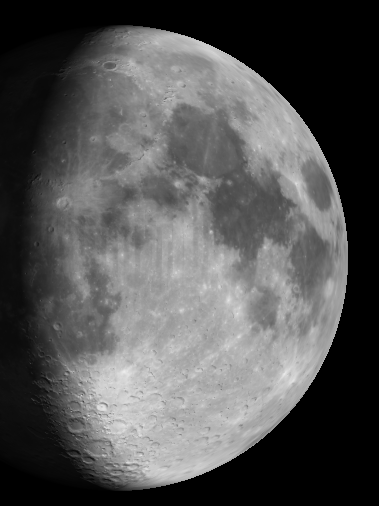
The gibbous Moon tonight (August 5, 2014). Created using Virtual Moon Atlas.
04/14/11 – Ephemeris – The gibbous moon
Thursday, April 14th. The sun will rise at 7:00. It’ll be up for 13 hours and 25 minutes, setting at 8:25. The moon, half way from first quarter to full, will set at 5:13 tomorrow morning.
The moon tonight is in its gibbous phase. The word gibbous means hump backed. At this phase the moon is severely interfering with the dimmer stars. So looking at the moon with a telescope becomes a good option. The moon will be bright and ruin any dark adaption your eye had before looking at it. Remember the sun shines on the moon with the same strength that it does on the earth, since it’s at roughly the same distance from the sun as the earth. The brightest spot on the earth facing side of the moon will be emerging into the lunar morning light this evening. It will be showing that brightness in a few days, but now it is the crater at the upper left edge of the moon, just coming into light. It is the crater Aristarchus.
* Times are for the Traverse City/Interlochen area of Michigan. They may be different for your location.
Addendum
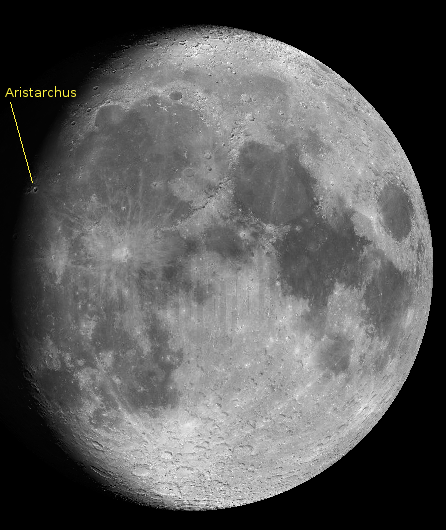
The gibbous moon for April 14, 2011. Created using Virtual Moon Atlas.
The crater Aristarchus is moving into the morning lunar daylight.
 Bob Moler's Ephemeris Blog