Archive
10/12/2012 – Ephemeris – The constellation of Andromeda and its great galaxy
Ephemeris for Friday, October 12th. The sun will rise at 7:54. It’ll be up for 11 hours and 7 minutes, setting at 7:02. The moon, 3 days before new, will rise at 5:42 tomorrow morning.
In the east at 9 this evening can be found a large square of stars, the Great Square of Pegasus the flying horse. The square is standing on one corner. What look like its hind legs stretching to the left from the left corner star is another constellation, Andromeda the chained maiden. She is seen in the sky as two diverging curved strings of stars that curve upward. She was rescued by the hero Perseus, a nearby constellation, riding his steed Pegasus. Andromeda’s claim to astronomical fame is the large galaxy seen with the unaided eye just above the upper line of stars, the Great Andromeda Galaxy, nearly 2 and a half million light years away. To the unaided eye the galaxy appears as a small smudge of light. In binoculars the galaxy is a delicate spindle of light.
Times are for the Traverse City/Interlochen area of Michigan. They may be different for your location.
Addendum
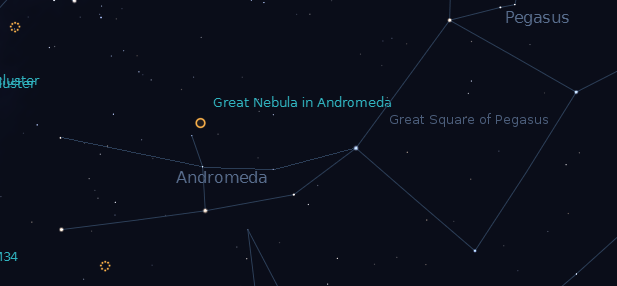
Andromeda at 9 p.m. with the Great Andromeda Galaxy. Created using Stellarium.
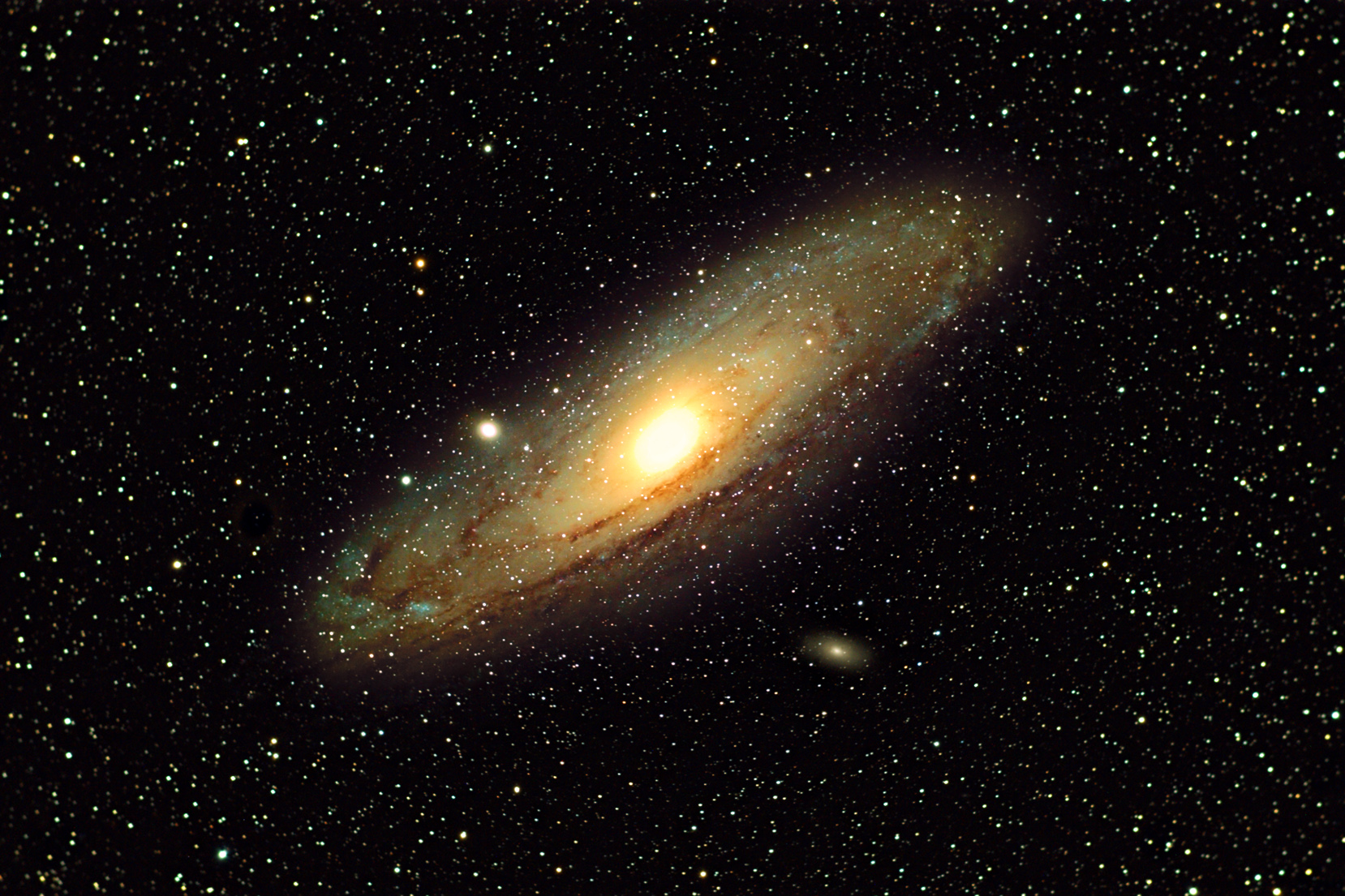
The Great Andromeda Galaxy (M31). Image taken by Scott Anttila.
10/28/11 – Ephemeris – The Great Andromeda Galaxy
Friday, October 28th. The sun will rise at 8:14. It’ll be up for 10 hours and 23 minutes, setting at 6:37. The moon, 2 days past new, will set at 7:53 this evening.
The Great Andromeda Galaxy is the closest large spiral galaxy to our own Milky Way Galaxy. It’s visible to the unaided eye in the east off the left star of the Great Square of Pegasus. Move left two stars and up two stars to the fuzzy spot. That is the heart of a galaxy that’s actually 6 moon diameters wide. It’s close too as galaxies go, only two and a half million light years away. Andromeda appears to be be somewhat larger than our galaxy, though may be less massive than the Milky Way because our galaxy seems to have more dark matter. It is approaching us at somewhat less than 100 miles per second, and will collide with the Milky Way in four or five billion years, about the time the sun will begin to bloat toward a red giant. Mark those down on your calendar.
* Times are for the Traverse City/Interlochen area of Michigan. They may be different for your location.
Addendum
The Great Andromeda Galaxy (M31). Image taken by Scott Anttila.
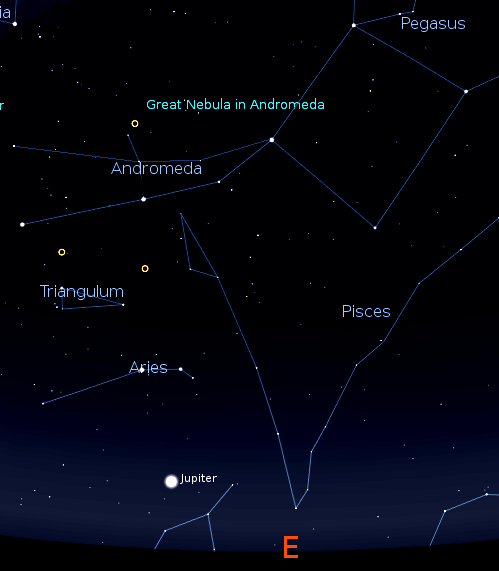
The Constellation Andromeda. Created using Stellarium.
09/20/11 – Ephemeris – The constellation Andromeda
Tuesday, September 20th. The sun will rise at 7:26. It’ll be up for 12 hours and 17 minutes, setting at 7:44. The moon, at last quarter today, will rise at 12:33 tomorrow morning.
In the east southeast at 9 this evening can be found a large square of stars, the Great Square of Pegasus the flying horse. The square is standing on one corner. What look like its hind legs stretching to the left from the left corner star is another constellation, Andromeda the chained maiden. She is seen in the sky as two diverging curved strings of stars that curve upward. She was rescued by the hero Perseus, a nearby constellation, riding his steed Pegasus. Andromeda’s claim to astronomical fame is the large galaxy seen with the unaided eye just above the upper line of stars. The Great Andromeda Galaxy is two and a half million light years away. To the unaided eye the galaxy appears a a small smudge of light. In binoculars the galaxy is a delicate spindle of light.
* Times are for the Traverse City/Interlochen area of Michigan. They may be different for your location.
Addendum
The Constellation Andromeda. Created using Stellarium.
The Great Andromeda Galaxy (M31). Image taken by Scott Anttila.
Click on image for full size version.
Stellarium has it by its old name the Great Andromeda Nebula, before it was reclassified as an island universe (obsolete) or galaxy.
 Bob Moler's Ephemeris Blog