Archive
12/11/2012 – Ephemeris – The Pleiades and Hyades star clusters
Ephemeris for Tuesday, December 11th. The sun will rise at 8:09. It’ll be up for 8 hours and 52 minutes, setting at 5:02. The moon, 2 days before new, will rise at 7:13 tomorrow morning.
At 8 to 9 p.m. The constellation of Taurus the bull rises higher in the east to southeast. Taurus contains two bright clusters of stars. The most famous of these is the Pleiades, also known as the Seven Sisters. The other is a letter V shape that is the face of Taurus, the Hyades. In the Greek mythology they are half-sisters of each other, all fathered by the Titan Atlas. They are apparently fleeing from the giant Orion rising in the east. The Pleiades are the younger of the two star clusters, and there has been some problem in estimating their distance. They could be from 390 to 460 light years away. The distance to Hyades is much better known at 153 light years. It was the star cluster upon which greater distances could be measured.
Times are for the Traverse City/Interlochen area of Michigan. They may be different for your location.
Addendum
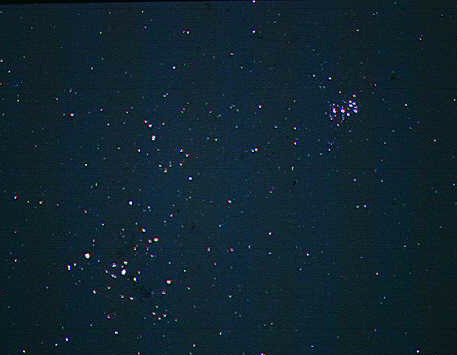
The Hyades (lower left) and the Pleiades (upper right). My photograph from many years ago.
04/17/2012 – Ephemeris – The constellation of Coma Berenices as a star cluster
Ephemeris for Tuesday, April 17th. The sun rises at 6:54. It’ll be up for 13 hours and 36 minutes, setting at 8:30. The moon, half way from last quarter to new, will rise at 5:23 tomorrow morning.
Looking to the southeast these nights can be found the dim constellation of Coma Berenices, or Berenice’s hair. It’s located about half way from the horizon to the zenith. It’s best seen on a moonless night as a sprinkling of faint stars that look like strands of hair. It is a star cluster some 270 light years away, the second closest star cluster to the earth, the closest being the Hyades the marks the face of Taurus the bull, at about 153 light years, which is below, left of Venus tonight in the west. Coma Berenices is located at an odd spot for an open or galactic star cluster. It’s at the pole of the milky way, as far from the milky band as you can get. Most galactic star clusters are close or in that band. However due to its closeness Coma Berenices is abreast of us. as we orbit the center of the Milky Way.
* Times are for the Traverse City/Interlochen area of Michigan. They may be different for your location.
Addendum

Coma Berenices via Stellarium
Only one star of the three denote the constellation is part of the Coma Berenices star cluster, which appears to trail from the top star.
01/24/2012 – Ephemeris – The face of the constellation Taurus – The Hyades
Ephemeris for Tuesday, January 24th. The sun will rise at 8:09. It’ll be up for 9 hours and 29 minutes, setting at 5:39. The moon, 1 day past new, will set at 7:36 this evening.
To the upper right of the constellation Orion in the south in the evening is a letter V of stars with a bright orange star at one tip. This is the face of Taurus the bull. In some constellation depictions the bull is charging Orion who is turned to face him. The V of stars isn’t very bright and are outshone by the Pleiades star cluster to the right in Taurus’ shoulder. In Greek mythology the V of stars are the Hyades, half sisters of the Pleiades. It is a star cluster like the Pleiades and very important, because it is the closest star cluster to us at 153 light years distant. It helped determine the scale of the universe. The bright star at the tip is Aldebaran the follower (of the Pleiades). It is not part of the Hyades and is less than half way to it at 65 light years.
* Times, as always are for the Traverse City/Interlochen area of Michigan.
Addendum
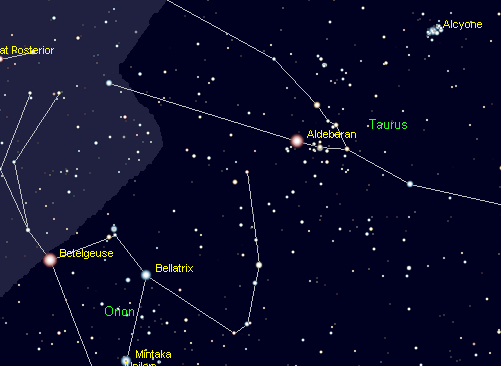
The Hyades, Orion and the Pleiades. Created using Cartes du Ciel
11/25/11 – Ephemeris – The mythology of Taurus the bull
Friday, November 25th. The sun will rise at 7:51. It’ll be up for 9 hours and 15 minutes, setting at 5:06. The moon is new today, and won’t be visible.
Low in the east at 9 p.m. is the constellation of Orion the giant hunter. Above him is Taurus the bull. His face is a letter V shape of stars lying on its side with the bright orange-red star Aldebaran at the bottom tip of the V as its angry blood-shot eye. Orion is depicted in the sky facing with club in one hand and a shield in the other the approaching and in some depictions charging Taurus. The V of stars is a star cluster called the Hyades. The Pleiades are in his shoulder above. Taurus in Greek mythology was the guise the god Zeus when he carried off the maiden Europa. Europa’s still with him, sort of, as the intriguing satellite orbiting Zeus’ Roman equivalent Jupiter. In fact the moons around the planet Jupiter are generally named for Jupiter’s lovers and friends.
* Times, as always are for the Traverse City/Interlochen area of Michigan.
Addendum
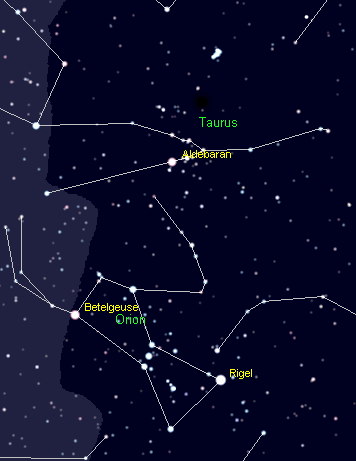
The constellations Taurus and Orion and the Pleiades. Created using Cartes du Ciel.
11/18/11 – Ephemeris – Pleiades, Hyades and Orion
Friday, November 18th. The sun will rise at 7:42. It’ll be up for 9 hours and 29 minutes, setting at 5:12. The moon, at last quarter today, will rise at 12:48 tomorrow morning.
The Pleiades or Seven Sisters star cluster is now quite high in the east at 9 p.m. To the Greeks they were the daughters of the god Atlas. Their half sisters, the Hyades is seen below them as the letter V shape of stars that form the face of Taurus the bull, with the bright orange star Aldebaran at one corner. Both are being chased by the giant hunter Orion, now mostly risen in the east. His three belt stars in a row are now oriented vertically. The reddish star Betelgeuse is to their upper left, while blue-white Rigel to the lower right. Rigel may suffer some by being very close to the horizon at the time, but it will come into its own as it rises higher. [Here is our preview of the glories of the winter sky. There is more to come as the night wears on.]
* Times, as always are for the Traverse City/Interlochen area of Michigan. Bracketed passage was omitted from the audio program due to time constraints.
Addendum
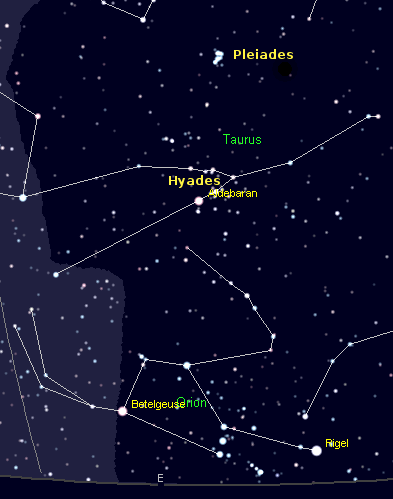
The eastern sky at 9 p.m.
 Bob Moler's Ephemeris Blog