Archive
07/04/2023 – Ephemeris – The Bicentennial space mission
This is Bob Moler with Ephemeris for Independence Day, Tuesday, July 4th. Today the Sun will be up for 15 hours and 28 minutes, setting at 9:31, and it will rise tomorrow at 6:03. The Moon, 1 day past full, will rise at 11:14 this evening.
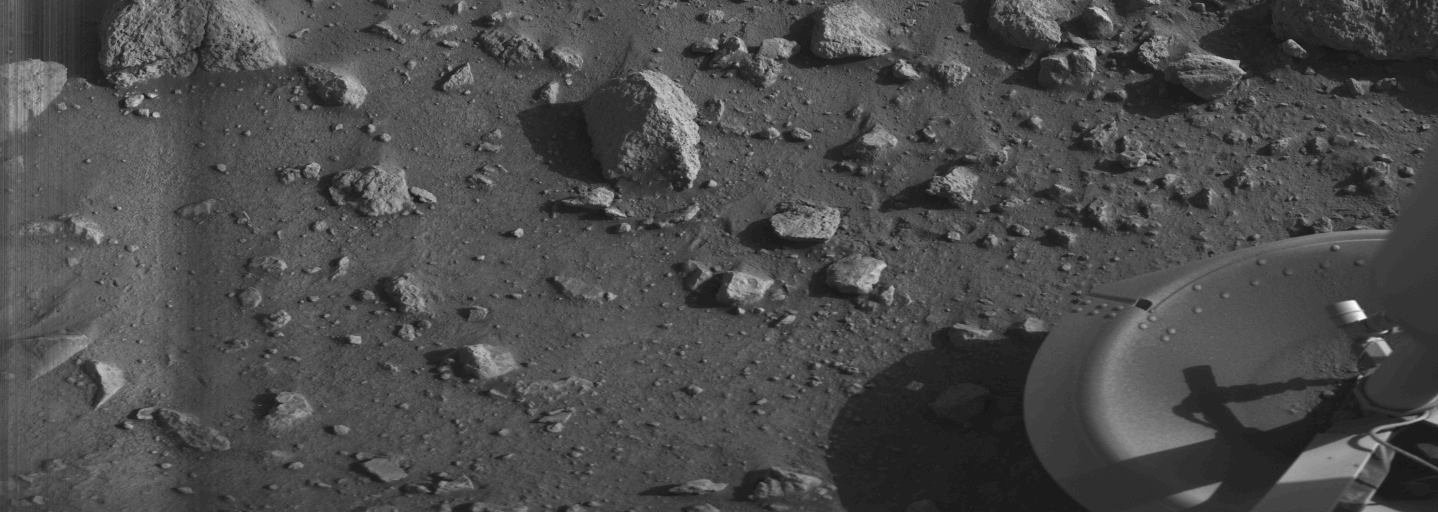
To celebrate our nation’s 200th birthday, NASA attempted to land the Viking 1 lander on the planet Mars on July 4th, 1976. The Viking was a combination orbiter and lander and had a twin spacecraft arriving almost two months later. Viking 1 entered orbit on June 19th and began to survey the prime landing area, that radar from the Earth suggested would be smooth, to land on the day of the Bicentennial. However, images from orbit showed too many obstructions, so another area was surveyed. The mission planners from JPL found a spot and sent the Viking lander down to land on Mars on another historic date, July 20, 1976, the 7th anniversary of the Apollo 11 landing on the Moon.
The astronomical event times given are for the Traverse City/Interlochen area of Michigan (EDT, UT –4 hours). They may be different for your location.
Addendum
NASA did finally make a historic landing on July 4th,
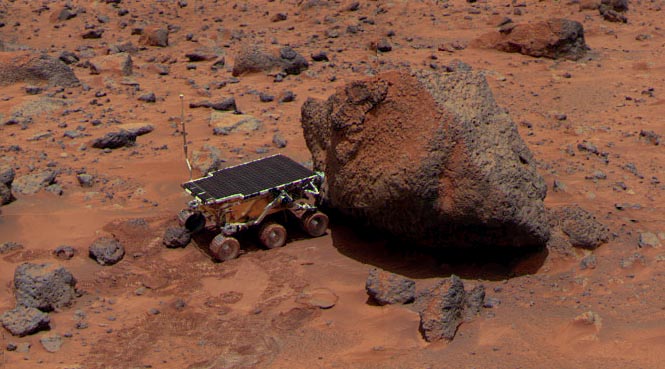
the Mars Pathfinder mission, with the first rover to operate on Mars, the Sojourner rover, landed on July 4, 1997. It was a microwave sized rover. The mission on the surface lasted 85 days.


07/04/2022 – Ephemeris – Space firsts, or attempts, on our nation’s birthday
This is Ephemeris for Independence Day, Monday, July 4th. Today the Sun will be up for 15 hours and 28 minutes, setting at 9:31, and it will rise tomorrow at 6:03. The Moon, 2 days before first quarter, will set at 12:53 tomorrow morning.
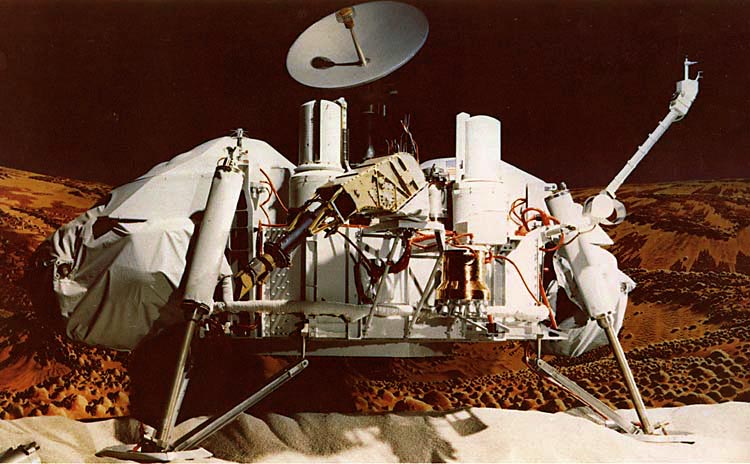
To celebrate our nation’s 200th birthday, NASA attempted to land the Viking 1 lander on the planet Mars on July 4th, 1976. The Viking was a combination orbiter and lander and had a twin spacecraft arriving almost two months later. Viking 1 entered orbit on June 19th and began to survey the prime landing area, that radar from the Earth suggested would be smooth, to land on the day of the Bicentennial. However, images from orbit showed too many obstructions, so another area was surveyed. The mission planners from JPL found a spot and sent the Viking lander down to land on Mars on another historic date, July 20, 1976, the 7th anniversary of the Apollo 11 landing on the Moon.
The astronomical event times given are for the Traverse City/Interlochen area of Michigan (EDT, UT – 4 hours). They may be different for your location.
Addendum
Model of the Viking lander. Credit NASA/JPL.
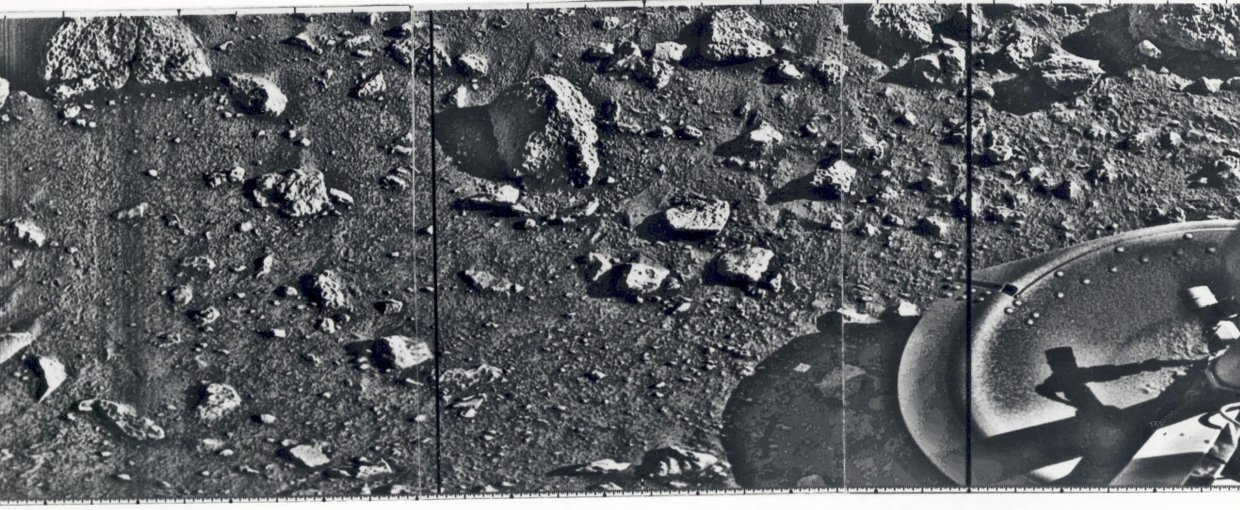
The first Mars image from the Viking 1 lander, taken moments after touchdown. The Viking landers used rockets to land, after a parachute descent, because the parachutes would not slow the lander enough in the thin Martian atmosphere. The reason to photograph the landing pad was to see how far it would sink into the surface. Credit NASA/JPL.
NASA did finally make a historic landing on July 4th,
the Mars Pathfinder mission, with the first rover to operate on Mars, the Sojourner rover, landed on July 4, 1997. It was a microwave sized rover. The mission on the surface lasted 85 days.
Pathfinder collage, Left to right, the collapsed Sojourner rover attached to one of the lander’s tetrahedron petals; 24 inflated airbags, attached 6 to a side of the Pathfinder tetrahedron; launch of the Delta II rocket carrying Pathfinder to Mars. Credit NASA/JPL.
Sojourner rover investigates a rock named Yogi with its Alpha Particle X-ray Spectrometer to determine its composition. Credit NASA/JPL.
The Pathfinder Lander/Base Station and its deflated airbags from Sojourner. All communications from Sojourner to Earth is relayed through the Base Station. Credit NASA/JPL.
07/04/2017 – Ephemeris – Happy birthday America! Tomorrow morning Venus will appear near the Pleiades
Ephemeris for Independence Day, Tuesday, July 4th. Today the Sun will be up for 15 hours and 27 minutes, setting at 9:30, and it will rise tomorrow at 6:03. The Moon, 4 days past first quarter, will set at 3:46 tomorrow morning.
This is the 241st anniversary of the signing of the Declaration of Independence. Venus is our morning star now, and back in 1776 it too was a morning planet, but a lot closer to the rising Sun, and harder to spot.
Tonight Venus will pass south of the famous Pleiades star cluster, so that tomorrow morning at about 4:30 it will be dark enough to see the Pleiades above and left of our brilliant Morning Star.
Planets to us appear as stars to the naked eye due to their distance, though they are close enough to appear as disks in small telescopes. Very few of the largest telescopes can ever see the disk of a star, other than the Sun,, and only if that star is really huge, like Betelgeuse in the winter constellation of Orion.
The times given are for the Traverse City/Interlochen area of Michigan. They may be different for your location.
Addendum
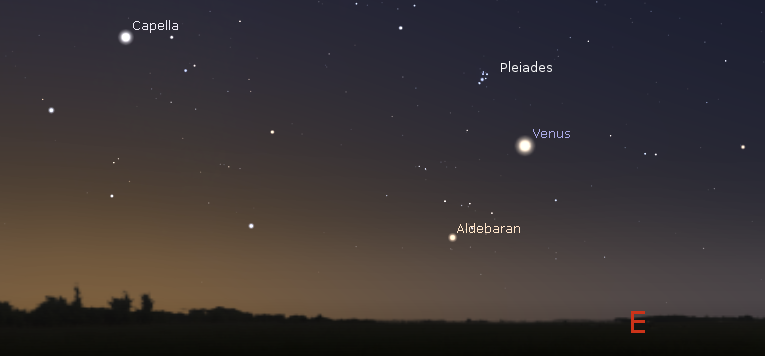
The eastern sky at 5 a.m. July 5, 2017 with the Pleiades above and left of Venus. Created using Stellarium.
We’ll be seeing the Pleiades in the evening sky in four months when summer is a memory.

The morning sky to the east and Venus about 20 minutes before sunrise that auspicious morning July 4, 1776 from Philadelphia. Created using Stellarium.
Excuse the fact that the landscape is the same in both images.

This is the disk of the star Betelgeuse in Orion. It is not an image from an optical telescope of an image created in submillimeter microwaves by the Atacama Large Millimeter/submillimeter Array (ALMA) in Chile. Credit: ALMA (ESO/NAOJ/NRAO)/E. O’Gorman/P. Kervella.
Betelgeuse, though it is 600 light years away has a radius of slightly more than the orbit of Jupiter. The bump on the left side of the image may be a plume of gas erupting from the star.
07/04/2014 – Ephemeris – Find patriotic red, white and blue stars
Ephemeris for Independence Day, Friday, July 4th. Today the sun will be up for 15 hours and 27 minutes, setting at 9:30. The moon, 1 day before first quarter, will set at 1:03 tomorrow morning. Tomorrow the sun will rise at 6:03.
On this patriotic day let’s look for some red, white, and blue stars. Red is easy, the red star Antares is seen in the south at 11 p.m. Mars, the red planet, in the southwest, can be added even though it’s not technically a star. White is easy too, the official white calibration star Vega high in the east at 11 p.m. The blue star is really blue-white. The brightest of these out at 11 p.m. is Spica, low in the southwest. The color is best seen in binoculars. Star colors are quite subtle, and are an indicator of the temperature of their outer gaseous layers. The temperature of a stars outer layers, in order of their increasing temperatures, red, white and blue, is not related to the temperature in their cores. Of these three the coolest on the outside, Antares is really the hottest inside, using helium as fuel.
Times are for the Traverse City/Interlochen area of Michigan. They may be different for your location.
Addendum
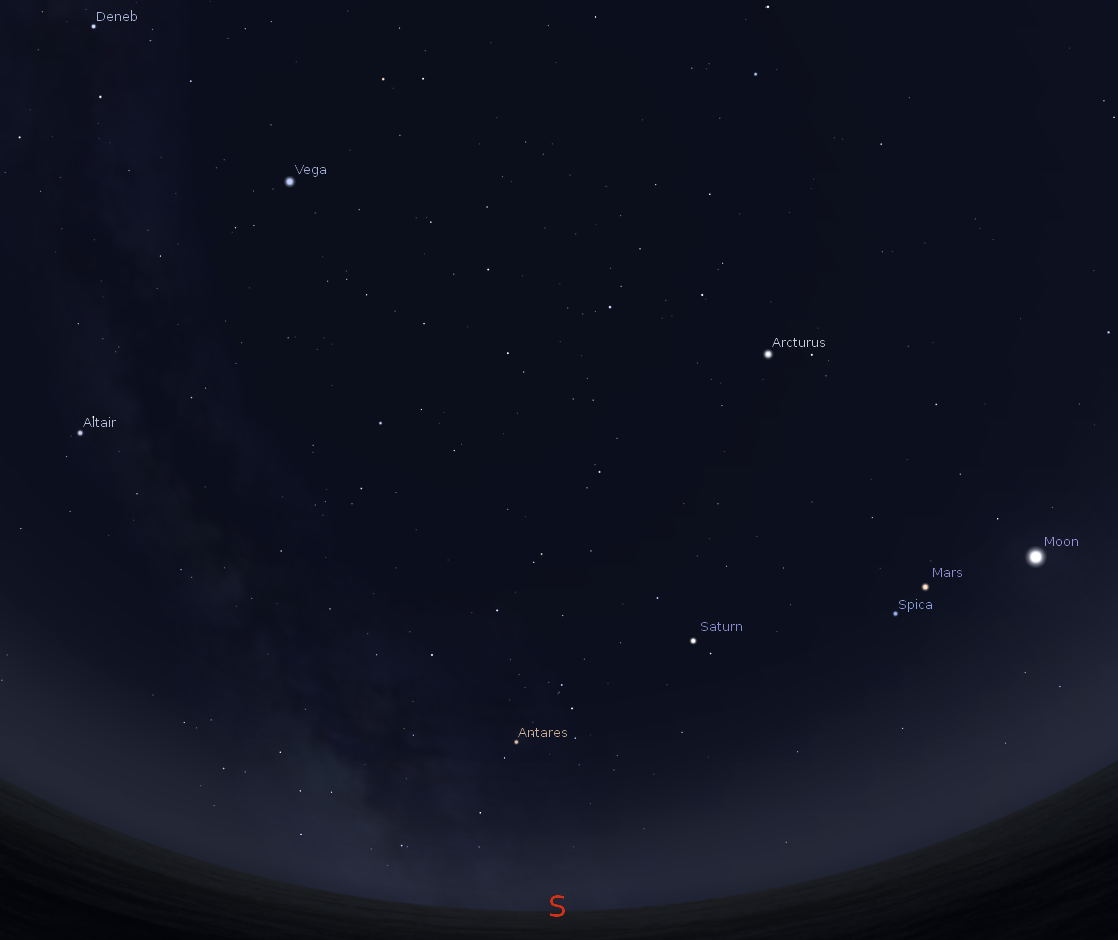
Red white and blue stars for Independence Day at 11 p.m. on July 4, 2014. Created using Stellarium.
 Bob Moler's Ephemeris Blog