Archive
Ephemeris: 03/24/2025 – Mercury crosses over to the morning side
This is Ephemeris for Monday, March 24th. Today the Sun will be up for 12 hours and 22 minutes, setting at 8:00, and it will rise tomorrow at 7:36. The Moon, 2 days past last quarter, will rise at 5:58 tomorrow morning.
Today, Mercury is at inferior conjunction with the Sun, two days after Venus. Mercury of course, this is in the middle of its retrograde motion period, moving westward against the stars, and for astrologers Mercury in retrograde is a big deal. I consider astrology is to astronomy as tea-leaf reading is to botany, so I dismiss it. Every once in a while Mercury, when it passes inferior conjunction, crosses in front of the face of the Sun for us. These are called transits, and are fairly rare. The last time was in November 2019 and the next time will be in November 2032 which is seven years from now. Mercury will move into the morning sky, where its appearance will not be favorable for us in the Northern Hemisphere.
The astronomical event times given are for the Traverse City/Interlochen area of Michigan (EDT, UT – 4 hours). Times will be different for other locations.
Addendum
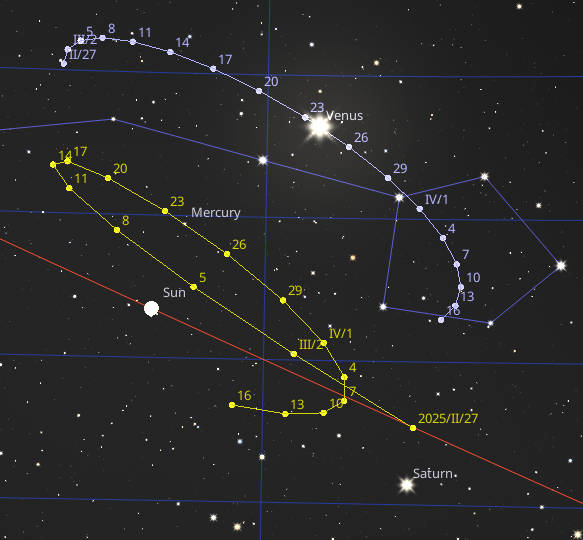
Retrograde loops are caused by looking at a moving planet from another moving planet, the Earth.
02/25/2020 – Ephemeris – Mercury at inferior conjunction with the Sun today
Ephemeris for Fat Tuesday, February 25th. Today the Sun will be up for 10 hours and 56 minutes, setting at 6:24, and it will rise tomorrow at 7:26. The Moon, 2 days past new, will set at 8:27 this evening.
A bit more than two weeks ago Mercury was visible in the evening twilight at its greatest elongation from the Sun, then at 8:37 this evening it will pass between the Earth and the Sun and enter the morning sky. The event is called an inferior conjunction. That’s not a dig on the quality of the event. Indeed an inferior conjunctions are more important and can produce a transit of the planet across the Sun. A rare and formerly important event when we were trying to determine the distance to the Sun. In astronomy an inferior planet is one that orbits the Sun inside the Earth’s orbit. A superior planet orbits the Sun farther than the Earth. It’s not a sign of quality. The best time to spot Mercury in the morning is in August to October, so we’ll miss Mercury this time.
The times given are for the Traverse City/Interlochen area of Michigan. They may be different for your location.
Addendum
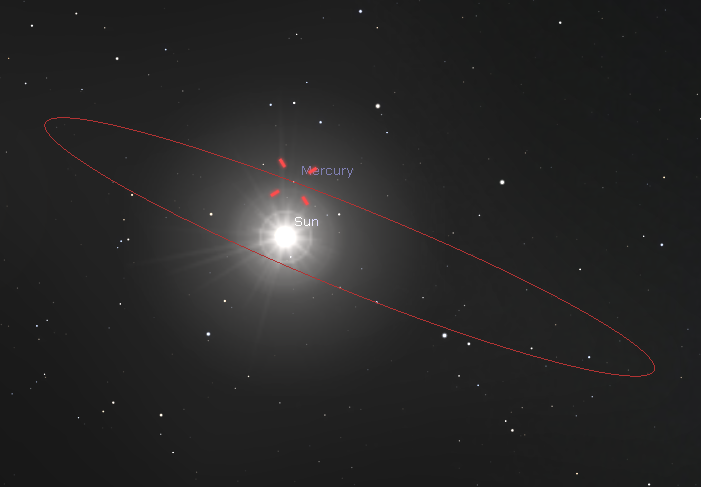
Mercury about 7 hours before inferior conjunction February 25, 2020 near local solar noon. The last inferior conjunction of Mercury on November 11, 2019 Mercury passed across the Sun’s disk in a transit. The red ellipse is Mercury’s orbit as seen From the Earth. It’s orbit is tilted about 7 degrees from the Earth’s orbit, so transits are fairly rare events. Created using Stellarium.
09/12/2016 – Ephemeris – Mercury passes inferior conjunction with the Sun today
Ephemeris for Monday, September 12th. The Sun will rise at 7:18. It’ll be up for 12 hours and 39 minutes, setting at 7:58. The Moon, 3 days past first quarter, will set at 3:34 tomorrow morning.
Today the Planet Mercury will pass inferior conjunction, that is move between the Earth and the Sun. Unlike last inferior conjunction, when it passed directly in front of the Sun on May 9th. This time it will pass below the Sun. The term inferior means it is between the Earth and the Sun. A superior conjunction is when Mercury passes the back side of the Sun. Mercury will be moving into the morning side of the sky, and toward the end of the month it will be much easier to spot than it was last month when it was low in the west. On autumn mornings the ecliptic, the path of the Sun and planets, sticks up, close to vertical, while in the evenings it lies close to the horizon, which is also why Venus sets so soon after the Sun now.
Times are for the Traverse City/Interlochen area of Michigan. They may be different for your location.
Addendum
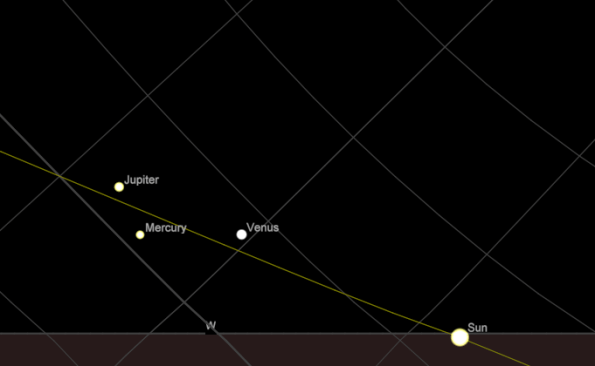
Mercury last August 16 at greatest eastern elongation. Note how low Mercury is to the horizon at sunset. Created using Cartes du Ciel (Sky Charts).
Note in the charts above and below the line passing through the Sun, and the one the planets hang around is the ecliptic, the projection of the Earth’s orbit on the celestial sphere. The grid line running through the west compass point at the horizon is the celestial equator. I’m allowing us to see below the horizon. As planets rise, move across the sky and set they will appear to move parallel to the celestial equator.
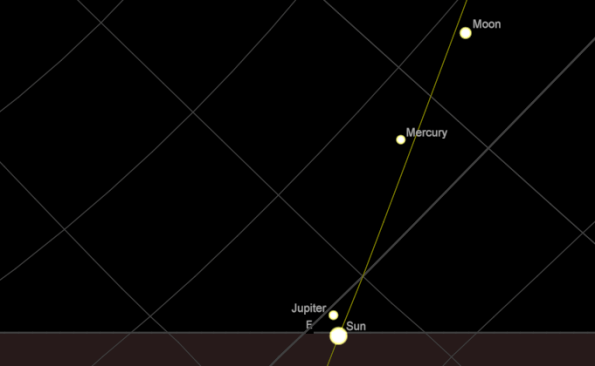
Mercury this coming September 28 at greatest western elongation. Note how high Mercury is to the horizon at sunrise. Created using Cartes du Ciel (Sky Charts).
Note too that Mercury appears farther from the Sun on August 16th than at September 28th. And it is. On August 16th Mercury appears 27.4 degrees from the Sun. On September 28th, it’s only 17.8 degrees. That’s a big advantage for observers in the southern hemisphere. The best times to see an eastern elongation of Mercury is on winter and spring evenings, and the best times to see a western elongation of Mercury is on summer and autumn mornings. Since the seasons are reversed from the northern hemisphere to the southern hemisphere. Our not so good August 16th elongation of Mercury was a really good one for folks south of the equator. We’ll return the favor September 28th. But the best southern hemisphere greatest elongations are always greater in the separation of Mercury from the Sun than northern ones because Mercury has a markedly elliptical orbit.
01/14/2016 – Ephemeris – Mercury joins the rest of the bright morning planets
Ephemeris for Thursday, January 14th. The Sun will rise at 8:17. It’ll be up for 9 hours and 9 minutes, setting at 5:26. The Moon, 2 days before first quarter, will set at 11:08 this evening.
After 9:03 this morning all the bright planets, known from antiquity, will be in the morning sky. To be a morning planet one must be in the sky at sunrise. And even though Jupiter rises before midnight, it is still in the sky at sunrise. It will leave the morning sky and enter the evening sky February 6th when it moves in opposition with the Sun and rises at sunset. Mercury is joining the morning planets by passing inferior conjunction with the Sun this morning, however this is not a good time of year to spot it in the morning. In the later part of February, we may have a shot at spotting it. However folks in the southern hemisphere will have better luck at spotting it, because it too is in the southern part of the sky.
Times are for the Traverse City/Interlochen area of Michigan. They may be different for your location.
Addendum
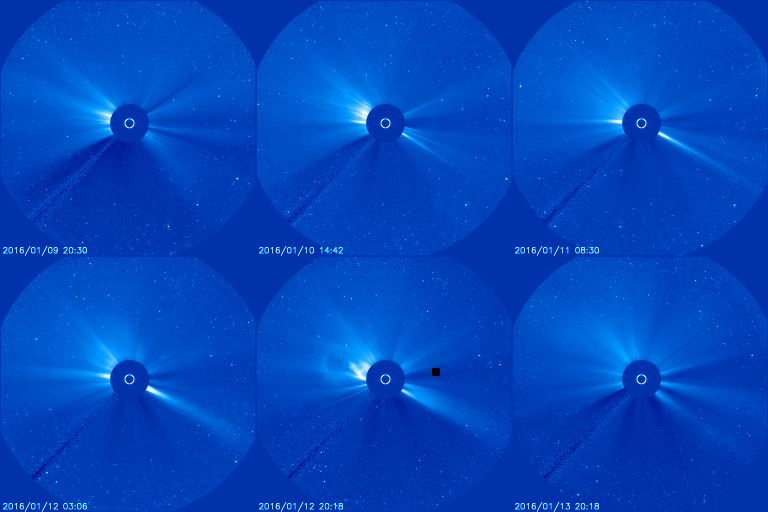
Solar and Heliospheric Observatory (SOHO) LASCO C3 coronograph animated GIF of a three day period 1/10 to 1/13/2016 image of the Sun. Mercury will enter the picture above center on the left on 1/11. Mercury is not very bright due to the fact that the Sun is illuminating it on the other side. We’re seeing mostly the unlit side. Credit ESA/NASA.
 Bob Moler's Ephemeris Blog