Archive
Ephemeris: 12/10/2024 – Jupiter’s four bright moons
This is Ephemeris for Tuesday, December 10th. Today the Sun will be up for 8 hours and 52 minutes, setting at 5:02, and it will rise tomorrow at 8:10. The Moon, 2 days past first quarter, will set at 3:39 tomorrow morning.
The bright star like object in the east in the evenings is the planet Jupiter. If one were to look at Jupiter through binoculars it would appear somewhat larger than a star would look. It has several dimmer stars from one side to the other of it, and if one looked the next night those little stars would have moved. Those are not stars at all, but the four largest moons of Jupiter. This would be easily apparent in the telescope. These are the four Galilean moons. They were observed by Galileo in either late 1609 or early 1610. Another astronomer, Simon Marius discovered these moons at about the same time, but Galileo was first to publish. So he gets the honor. However, Simon Marius is the one who gave them the names we know them by today. Their names, in order of their distance from Jupiter, are: Io, Europa, Ganymede, and Callisto. Each is a fascinating world in its own right.
The astronomical event times given are for the Traverse City/Interlochen area of Michigan (EST, UT – 5 hours). Times will be different for other locations.
Addendum
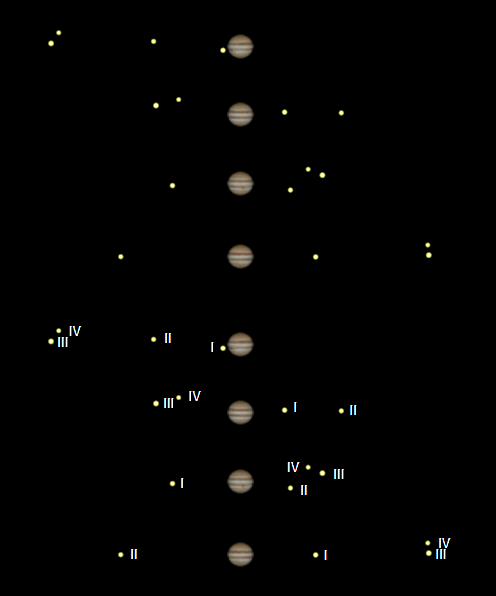
The periods of these satellites is interesting. Io orbits Jupiter in 1.8 days. Europa orbits in 3.6 days twice as long as Io. Ganymede orbits Jupiter in 7.2 days which is twice as long as Europa. Callisto takes 16.7 days to orbit Jupiter, and that is longer than twice Ganymede’s orbital period, and so is not in resonance with Ganymede. So the first three are in a 2:1orbital resonance with each other.
Ephemeris: 10/26/2023 – A closer look at Jupiter’s moon Io
This is Ephemeris for Thursday, October 26th. Today the Sun will be up for 10 hours and 28 minutes, setting at 6:40, and it will rise tomorrow at 8:13. The Moon, 2 days before full, will set at 6:36 tomorrow morning.
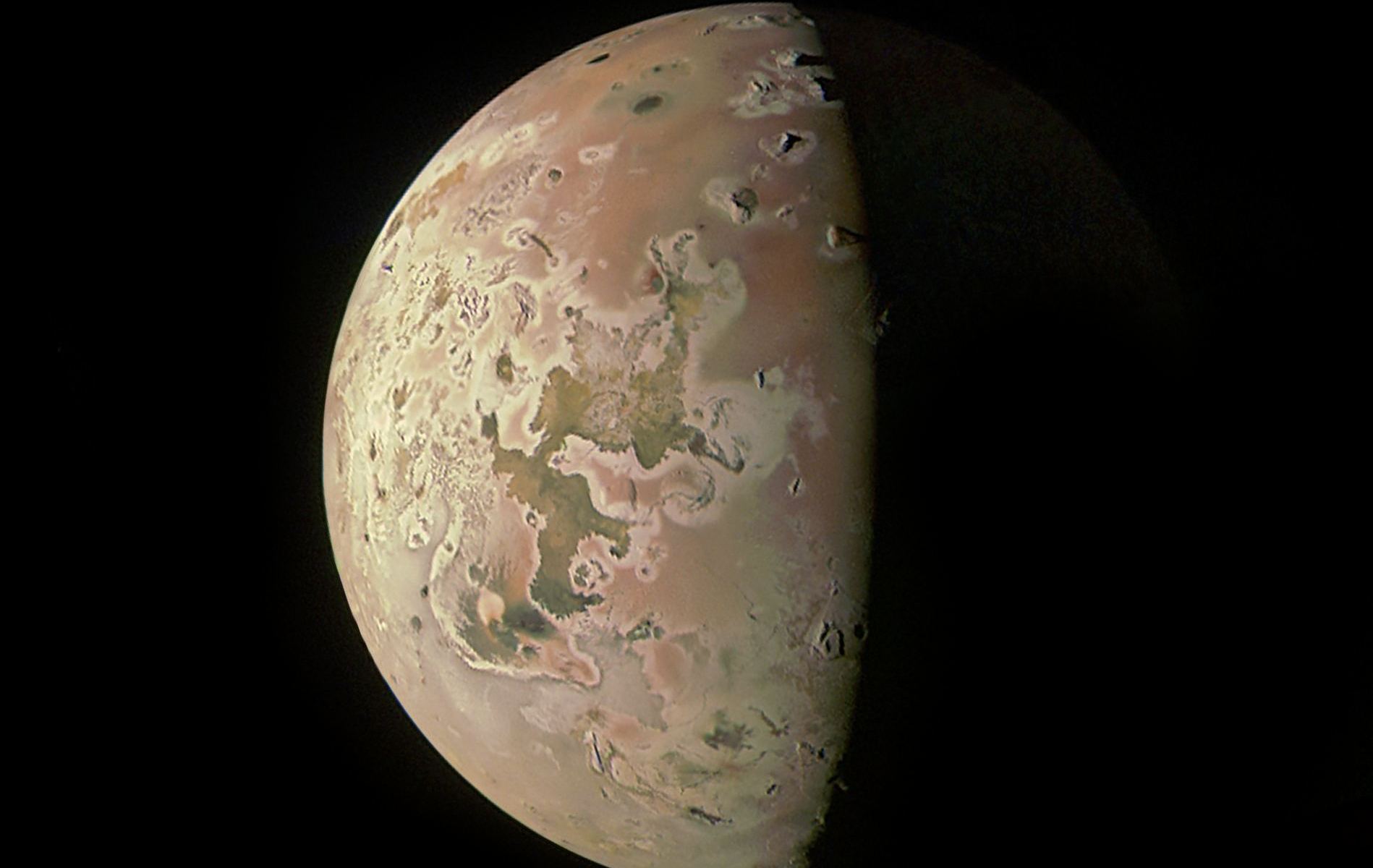
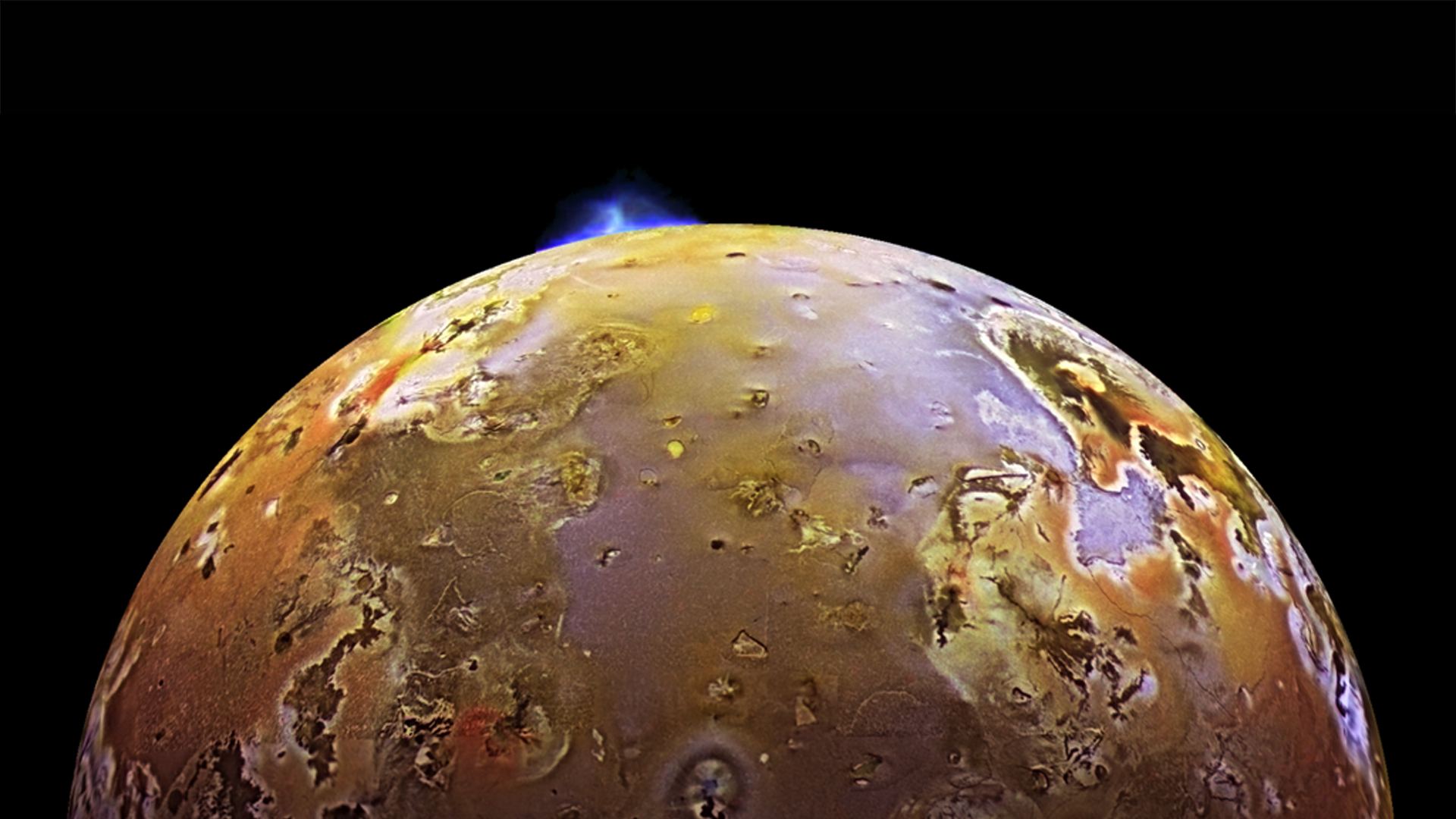
My favorite moon of Jupiter has been Io ever since the Voyager 1 spacecraft discovered volcanoes on it. It turns out that Io is the most volcanic body in the solar system and perhaps the least studied of the Galilean moons of Jupiter. Most of the probes that have swung by or orbited Jupiter never got very close to Io, so we never really got a good close look at it. Well, now we are getting that closer look. The Juno spacecraft, which was sent to Jupiter to work out the interior of Jupiter using gravitational effects on its orbit, has now completed its main mission and its orbit has precessed so that now comes close to Io. The Juno spacecraft has a camera, mainly there for the public, which is showing amazing closeups of this moon.
The astronomical event times given are for the Traverse City/Interlochen area of Michigan (EDT, UT –4 hours). They may be different for your location.
Addendum
08/19/2021 – Ephemeris – Jupiter is at opposition today!
This is Ephemeris for Thursday, August 19th. Today the Sun will be up for 13 hours and 51 minutes, setting at 8:41, and it will rise tomorrow at 6:51. The Moon, 3 days before full, will set at 4:11 tomorrow morning.
Tonight, Jupiter will be at opposition. That’s a shortcut term for Jupiter being opposite the Sun in our sky. At that time, Jupiter rises at sunset and sets at sunrise. It is also at its closest to us. It also officially becomes an evening planet, available in the evening for those of us with daytime jobs. In even small telescopes, Jupiter shows two dark bands. There’s more, but those two are the most prominent. Its four largest moons will be visible before 9:50 pm tonight, after that the innermost of the four, Io, will start to cross the face of Jupiter. It will leave Ganymede on Jupiter’s east side. On the west side will be the moon Europa, and farther out, Callisto. At 12:08 am, Io will reappear on the west side of Jupiter, joining Europa and Callisto. The moons do put on a show.
The astronomical event times given are for the Traverse City/Interlochen area of Michigan (EDT, UT – 4 hr). They may be different for your location.
Addendum
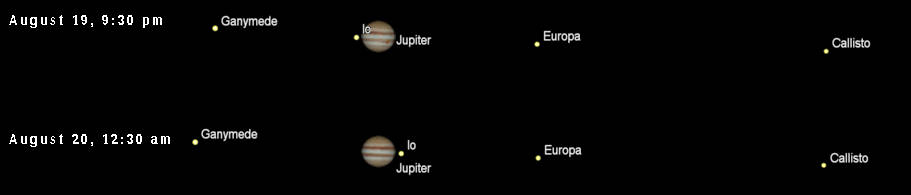
Jupiter’s Galilean moons at two times tonight, August 19th at 9:30 pm (01:30 on the 20th, UT) and 12:30 am (04:30 UT). From 9:50 pm to 12:08 am (01:50 – 04:08 UT), Io will pass in front of Jupiter and be practically invisible. Click on the image to enlarge it. Created using Cartes du Ciel (Sky Charts).
08/04/2020 – Ephemeris – Viewing Jupiter and its moons with binoculars or small telescope
This is Ephemeris for Tuesday, August 4th. Today the Sun will be up for 14 hours and 30 minutes, setting at 9:03, and it will rise tomorrow at 6:34. The Moon, 1 day past full, will rise at 10:06 this evening.
The planet Jupiter is a fine object to view with just about any optical aid be it a pair of binoculars, spotting scope or telescope. In binoculars, if held steady or mounted on a tripod Jupiter itself will no longer look star-like, but a tiny disk. Several of Jupiter’s moons can also be seen. With a telescope four of them can be seen, the same four Galileo discovered 410 years ago. At 10 pm they will be in the same order of distance from the planet that they actually are. The two nearest will be on the west side of the planet Io the closest, the Europa the next moon out. On the east side there is the third farthest Ganymede, and farthest out is Callisto. Their orbits are nearly edge on to us, so they shuttle from one side to the other of the planet.
The event times given are for the Traverse City/Interlochen area of Michigan. They may be different for your location.
Addendum
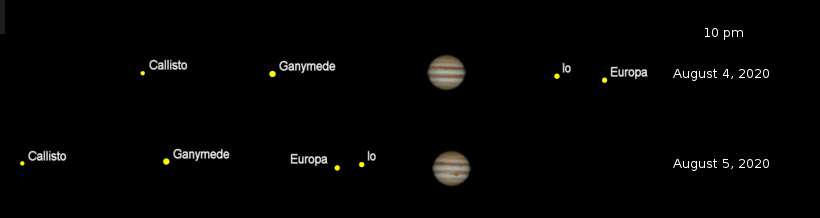
Jupiter and its Galilean moons for tonight and tomorrow night August 4 & 5, 2020. Those moons really move from night to night. This is shown north at the top, east to the left. Based on telescope design the image presented could be inverted, mirror image or both. Created using Cartes du Ciel (Sky Charts).
Due to the lack of time (59 seconds) I could only cover the moons. I’ll address Jupiter’s cloud features at another time. Can’t wait? Here’s a link: https://bobmoler.wordpress.com/2018/05/22/05-22-2018-ephemeris-seeing-detail-on-the-face-of-jupiter-with-a-small-telescope/
04/12/2016 – Ephemeris – Can you tell the Jovian moons apart without a program?
Ephemeris for Yuri’s Night, Tuesday, April 12th. The Sun will rise at 7:02. It’ll be up for 13 hours and 21 minutes, setting at 8:24. The Moon, 1 day before first quarter, will set at 2:22 tomorrow morning.
It’s the 55th anniversary of Yuri Gagarin’s flight as first human to orbit the Earth. Speaking of orbits, we can see Jupiter’s 4 largest moons orbit that planet in small telescopes. Their orbits are nearly edge on to us, so they seem to move back and forth from one side to the other of the planet in pretty much a straight line. So how can you tell them apart without a reference? The four moons from Jupiter in order are Io, Europa, Ganymede, and Callisto. They are not normally arranged like that. Ganymede is the brightest and Callisto the dimmest, and is usually the farthest away. Io is usually the closest appearing and has a slight reddish hue due to its sulfurous volcanic surface, and Europa is the dimmer moon close in to Jupiter. Io also can be seen to noticeably move in an hour.
Times are for the Traverse City/Interlochen area of Michigan. They may be different for your location.
Addendum
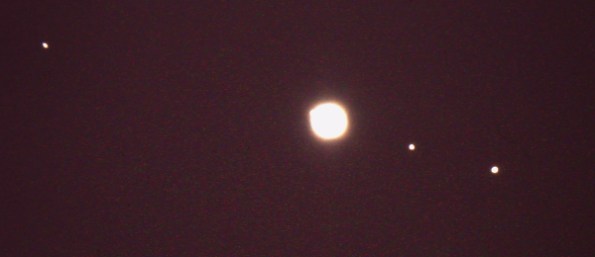
One of my old pictures of Jupiter. Callisto is obvious from its far left position and dimmer brightness. On the right, the farthest is Ganymede due to its brightness and position. Inside of it is Europa, again, dimmer than Ganymede and inside position is probably Europa. That leaves Io, which may be trying to duck behind Jupiter, as a bump in the left edge of the planet.

Jupiter and its moons as simulated by Cartes du Ciel for tonight, 10 p.m. April 12, 2016. The bodies, from let to right are Ganymede, Callisto. a background star, Jupiter, Io, and Europa.
03/07/2016 – Ephemeris – Jupiter officially becomes an evening planet tomorrow, celebrating with a double transit of its moons.
Ephemeris for Monday, March 7th. The Sun will rise at 7:08. It’ll be up for 11 hours and 30 minutes, setting at 6:39. The Moon, 1 day before new, will rise at 6:49 tomorrow morning.
Tomorrow is a busy day astronomically speaking, Tomorrow night our time there will be a solar eclipse on the other side of the Earth that will be covered by NASA-TV. I’ll talk more about it tomorrow. However in the early morning hours Jupiter will reach opposition from the Sun tomorrow at 4:58 a.m. At opposition the Earth is placed almost directly between the Sun and Jupiter. It is the time the planet is closest to the Earth in its orbit. For Jupiter that distance will be 412 million miles (664 million km) away. It’s apparent diameter will be 44.5 seconds of arc. One second of arc is one 3,600th of a degree. The Moon and Sun are about a half a degree or 1800 seconds in diameter. Even so Jupiter appears as a tiny disk in binoculars, but a very tiny disc. A few of its 4 large Galilean moons can also be spotted in binoculars. Jupiter is over 11 times the Earth’s diameter and is twice as massive as all the other planets, asteroids and satellites combined.
Times are for the Traverse City/Interlochen area of Michigan. They may be different for your location.
Addendum
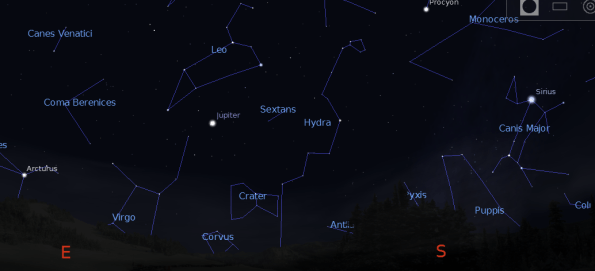
Jupiter at 10 p.m. March 8, 2016 with some of the spring constellations and Canis Major. Created using Stellarium.
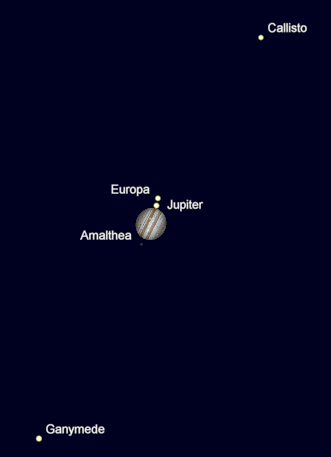
Jupiter and its moons at 10 p.m. March 7, 2016. Created using Cartes du Ciel (Sky Charts).
Io and Europa and their shadows transit the face of Jupiter
This evening there will be two satellites transiting across the face of Jupiter at the same time: Europa and Io. The start of Europa’s transit won’t be seen locally, since Jupiter will rise at 6:30 p.m. Locally, because of Jupiter being low in the sky I wouldn’t expect to spot the transiting satellites or their shadows. However observers in Europe, whose Jupiter rising has a 5 hour head start on us, will be in perfect position. In any case this takes a very good telescope to see. The appearance of Europa and Io in and out of transit can easily be seen in any telescope. In the table below I give the timing of these events for both the Eastern time zone (us) and Universal Time for others. Note the transits start on the 7th of March and end on the 8th for Universal Time.
The shadows of the moons themselves will appear very close to the moons, and may be obscured by them because we are just hours from opposition, and looking at Jupiter from nearly in line with the Sun. That should be a challenge. Watch for pictures from astrophotographer’s Twitter, Instagram and Facebook sites.
Times for this table are from Project Pluto: http://www.projectpluto.com/jevent.htm.
| Event | Eastern Time Zone | Universal Time | ||
| Date | Time | Date | Time | |
| Europa Shadow Start* | 7 | 6:08 p.m. | 7 | 23:08 |
| Europa Transit Start* | 7 | 6:11 p.m. | 7 | 23:11 |
| Io Shadow Start | 7 | 7:27 p.m. | 8 | 00:27 |
| Io Transit Start | 7 | 7:28 p.m. | 8 | 00:28 |
| Europa Transit End | 7 | 8:56 p.m. | 8 | 01:56 |
| Europa Shadow End | 7 | 8:56 p.m. | 8 | 01:56 |
| Io Transit End | 7 | 9:42 p.m. | 8 | 02:42 |
| Io Transit End | 7 | 9:42 p.m. | 8 | 02:42 |
| * The Europa Shadow and Transit Start Events cannot be seen in Michigan because they will occur before Jupiter will rise. |
||||
02/19/2015 – Ephemeris – Jupiter is beginning to take its rightful place as king of the evening sky
Ephemeris for Friday, February 19th. The Sun will rise at 7:37. It’ll be up for 10 hours and 38 minutes, setting at 6:16. The Moon, 3 days before full, will set at 6:10 tomorrow morning.
Jupiter is becoming noticeable in the evening sky in the east after 8 p.m. The heavy atmosphere near the horizon make telescopic observations difficult because the planet and its satellites will appear fuzzy and have color fringes top and bottom. Wait an hour or two for the planet to rise higher into quieter and thinner air to get the best telescopic views. Jupiter is accompanied by four moons in telescopes. Tonight they’re on one side of Jupiter, with Io closest, then Europa and Ganymede close to each other, while Callisto as usual appears to be the farthest satellite. The face of Jupiter itself is crossed by dark belts and light zones that run in the same direction as the satellites orbit. The moons change position from night to night.
Times are for the Traverse City/Interlochen area of Michigan. They may be different for your location.
Addendum
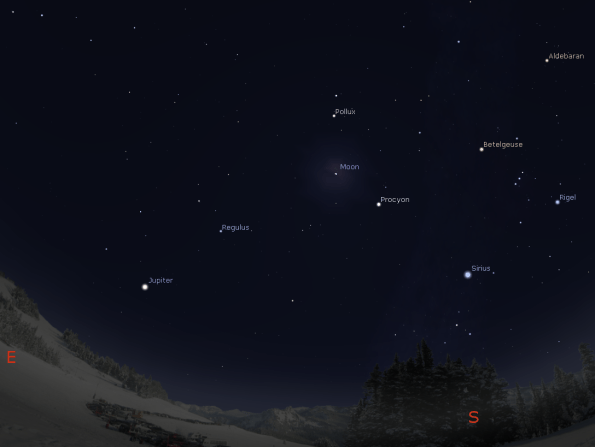
Jupiter, the Moon and stars tonight at 10 p.m., February 19, 2016. Created using Stellarium.
This image is shown smaller than actual size. Image expansion lately hasn’t worked. If you are using Firefox, right-click on the image, and then click on View Image.
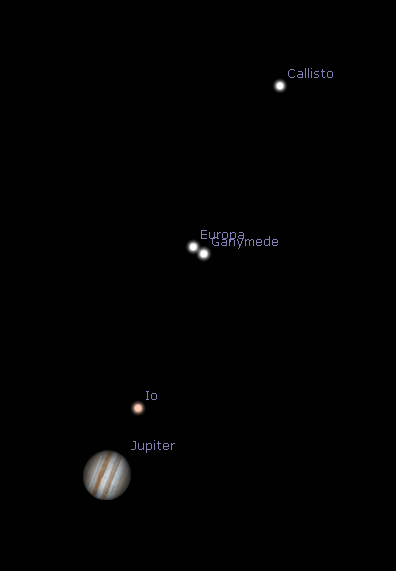
Jupiter and its moons tonight, 10 p.m. February 19, 2016. Created using Stellarium.
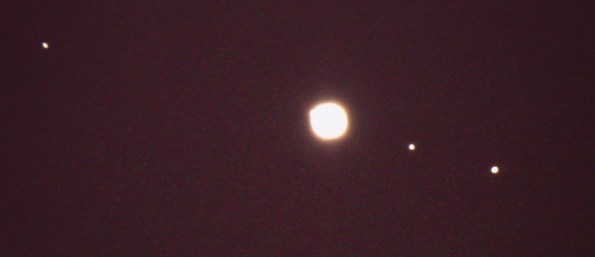
Jupiter and its four Galilean moons. The planet has to be over exposed to pick up the moons. But the eye can handle the brightness difference with no problem. This is one of my old pictures I do believe.
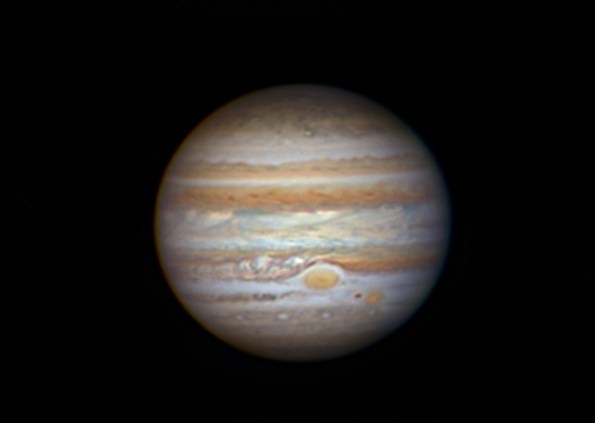
Jupiter with its Great Red Spot November 18, 2012 by Scott Anttila.
The above image by Scott Anttila is actually much better that the image seen in small telescopes. Advances in digital photography and processing allow the stacking and averaging of many images to create better pictures by amateur astronomers with modest equipment than the best telescopes of a quarter century ago.
06/03/2015 – Ephemeris – The visible bright planets are hanging on in the evening
Ephemeris for Wednesday, June 3rd. Today the Sun will be up for 15 hours and 23 minutes, setting at 9:22. The Moon, 1 day past full, will rise at 10:15 this evening and tomorrow the Sun will rise at 5:59.
Lets take a look at the bright planets for this week. Our brilliant evening star Venus is in the west by 9:45 p.m. It will set at 12:40 a.m. As Venus is reaching its greatest eastern elongation or separation from the Sun it is now setting earlier. Venus apparent orbit of the Sun is also tilting to a lower angle with the horizon, since though east, it is now south of the Sun. Jupiter will appear high in the west-southwestern sky about 10 p.m. It will set at 1:23 a.m. It’s near the sickle-shaped head of Leo the lion, and it’s the second brightest star-like object in the sky after Venus, which is approaching it. Saturn is in the southeast as evening twilight fades. It will set at 5:37 a.m. in the southwest.
Times are for the Traverse City/Interlochen area of Michigan. They may be different for your location.
Addendum
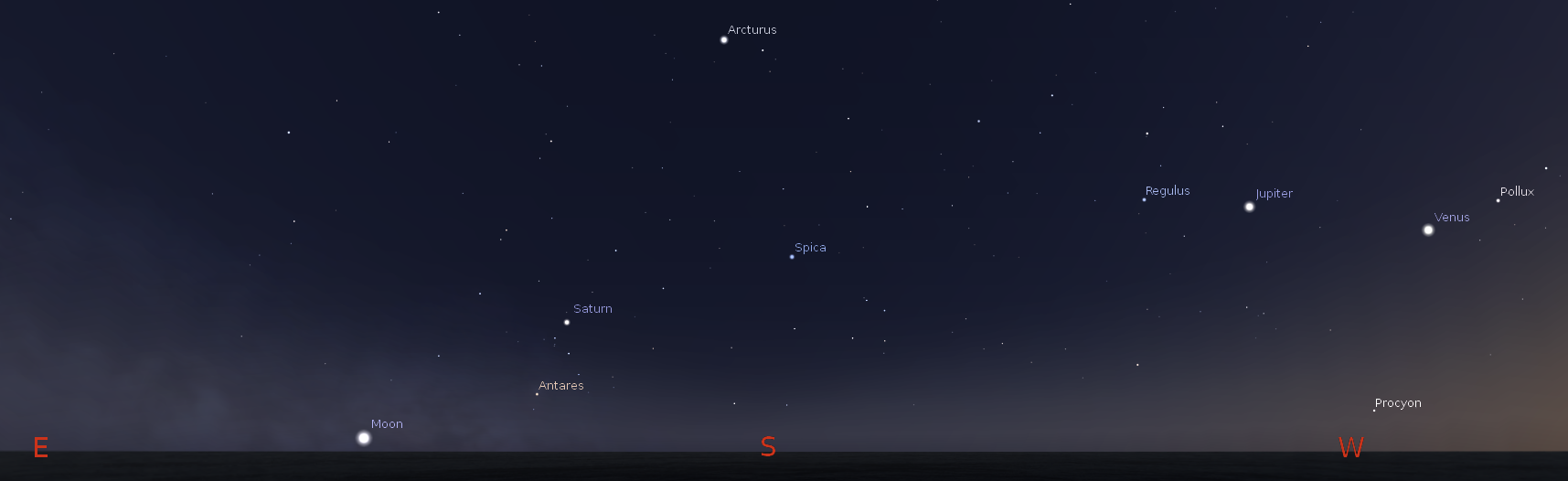
The evening planets and bright stars, including the Moon, at 10:30 p.m. June 3, 2015. Created using Stellarium. Click on Image to enlarge.
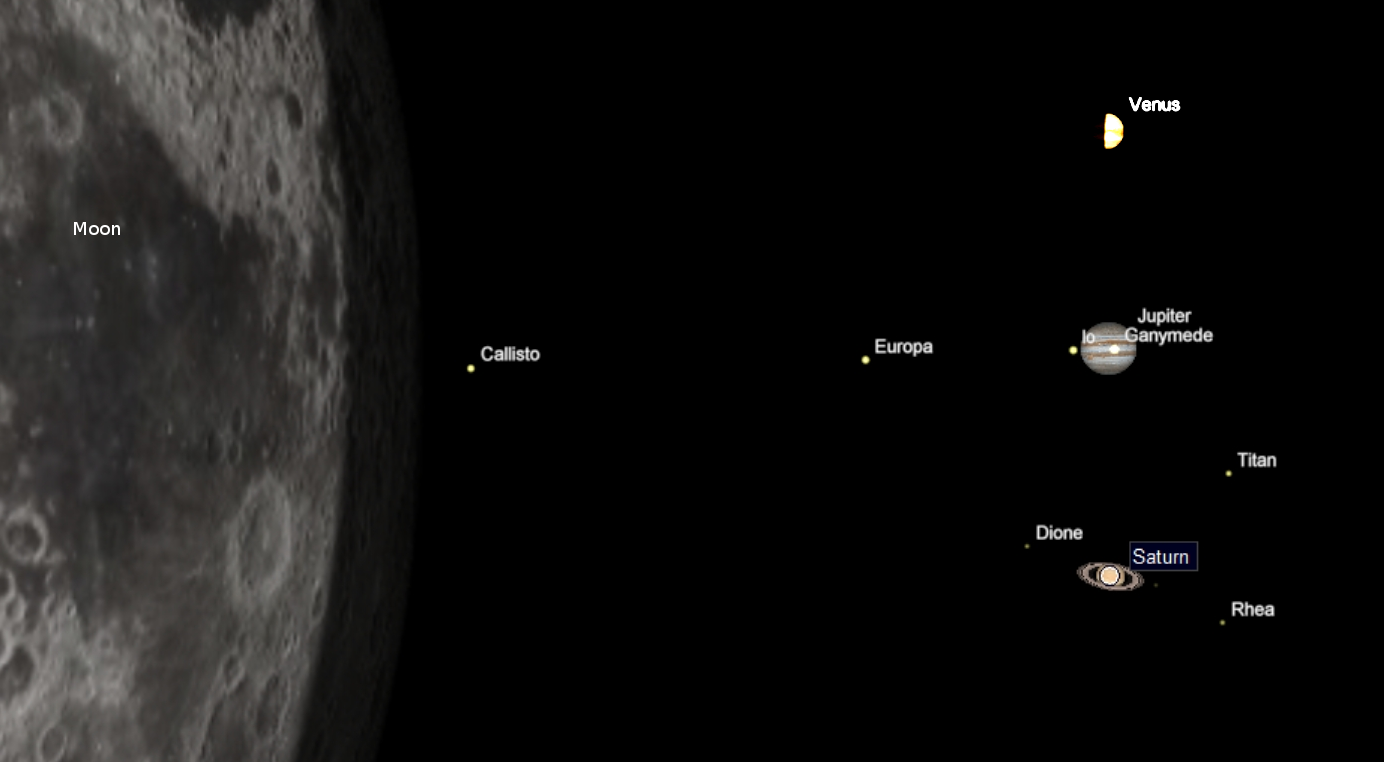
Comparison of the apparent sizes and satellite locations of the bright planets and the Moon at 10:30 p.m. June 3, 2015. Created using Cartes du Ciel (Sky Charts) and GIMP.
Jupiter’s satellites Io and Ganymede have a busy night tonight
Satellite  Event           UT            EDT
Ganymede   Transit Start   June 4  0:17  June 3  8:17 p.m.
Io         Transit Start   June 4  2:46  June 3 10:46 p.m.
Io         Shadow Start    June 4  3:56  June 3 11:56 p.m.
Ganymede   Transit End     June 4  3:56  June 3 11:56 p.m.
Ganymede   Shadow Start    June 4  4:57  June 4 12:57 a.m.
Io         Transit End     June 4  5:04  June 4  1:04 a.m.
Io         Shadow End      June 4  6:13  *
Ganymede   Shadow End      June 4  8:35  *

* Not visible from the Traverse City/Interlochen are, Jupiter has set.
Satellite data was taken from www.projectpluto.com/jevent.htm
04/01/2015 – Ephemeris – No fooling, it’s time to look at the bright planets for this week
Ephemeris for April Fools Day, Wednesday, April 1st. The Sun will rise at 7:24. It’ll be up for 12 hours and 45 minutes, setting at 8:10. The Moon, 3 days before full, will set at 6:29 tomorrow morning.
Lets take a look at the bright planets for this week. Brilliant Venus is in the west by 8:40 p.m. It will set at 11:23 p.m. Mars appears much lower and to the right of it. The Red Planet will set tonight at 9:48. Jupiter will appear In the southeastern sky in the evening. It will set at 5:20 a.m. It’s near the sickle-shaped head of Leo the lion, and it’s the second brightest star-like object in the sky after Venus. All four moons will be visible in telescopes tonight, but tomorrow morning the moon Io will duck behind Jupiter at 2:55, but will not pop into sunlight until after Jupiter sets. Early risers will be able to spot Saturn which will rise in the east-southeast at 12:30 a.m. It will be low in the south at 5 to 6 a.m.
Times are for the Traverse City/Interlochen area of Michigan. They may be different for your location.
Addendum
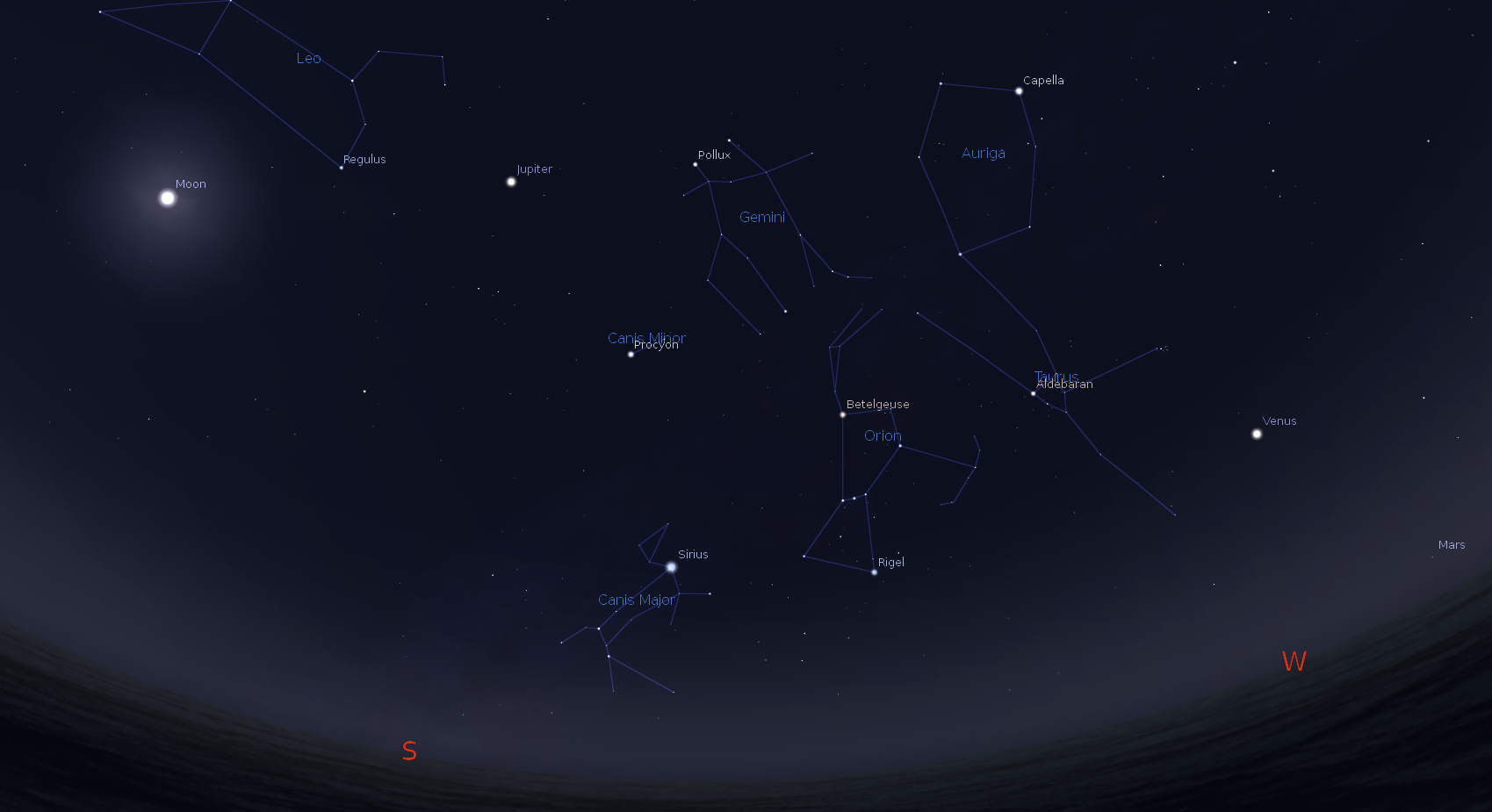
The Moon, evening planets and bright constellations at 9:30 p.m. April 1, 2015. Created using Stellarium.
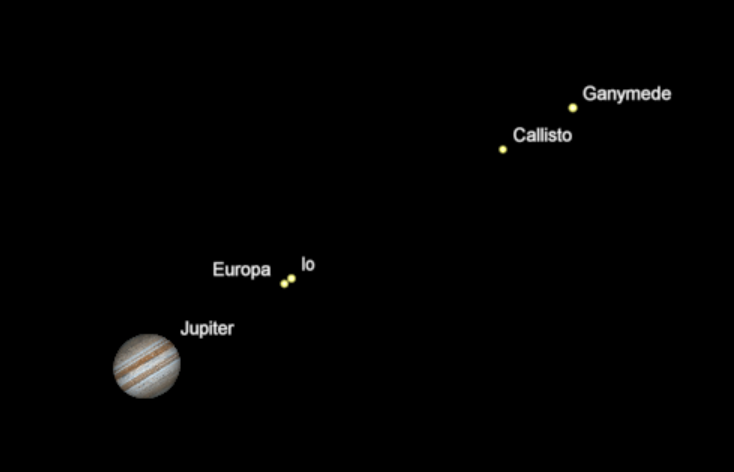
Jupiter as seen in a telescope at 9:30 p.m. April 1, 2014. Europa will partially occult Io starting at 9:41 p.m. for 4 minutes. They will appear to merge. Later at 11:21 p.m. Io will be partially eclipsed in Europa’s shadow for about 4 minutes. Europa will dim slightly. Created using Cartes du Ceil (Sky Charts).
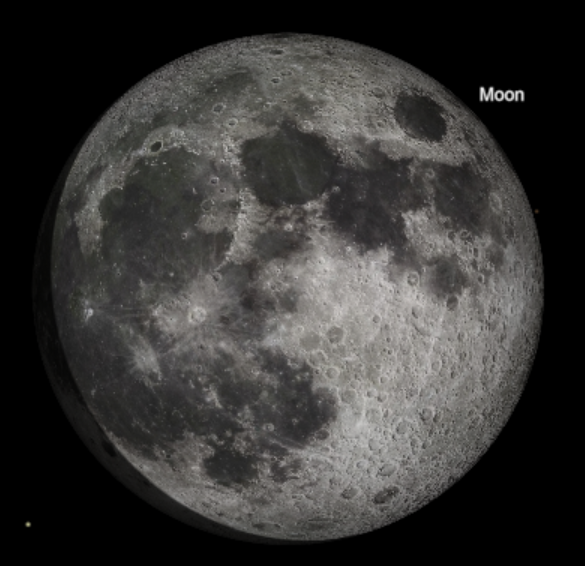
The Moon at 9:30 p.m. April 1, 2015. Created using Cartes du Ceil (Sky Charts).
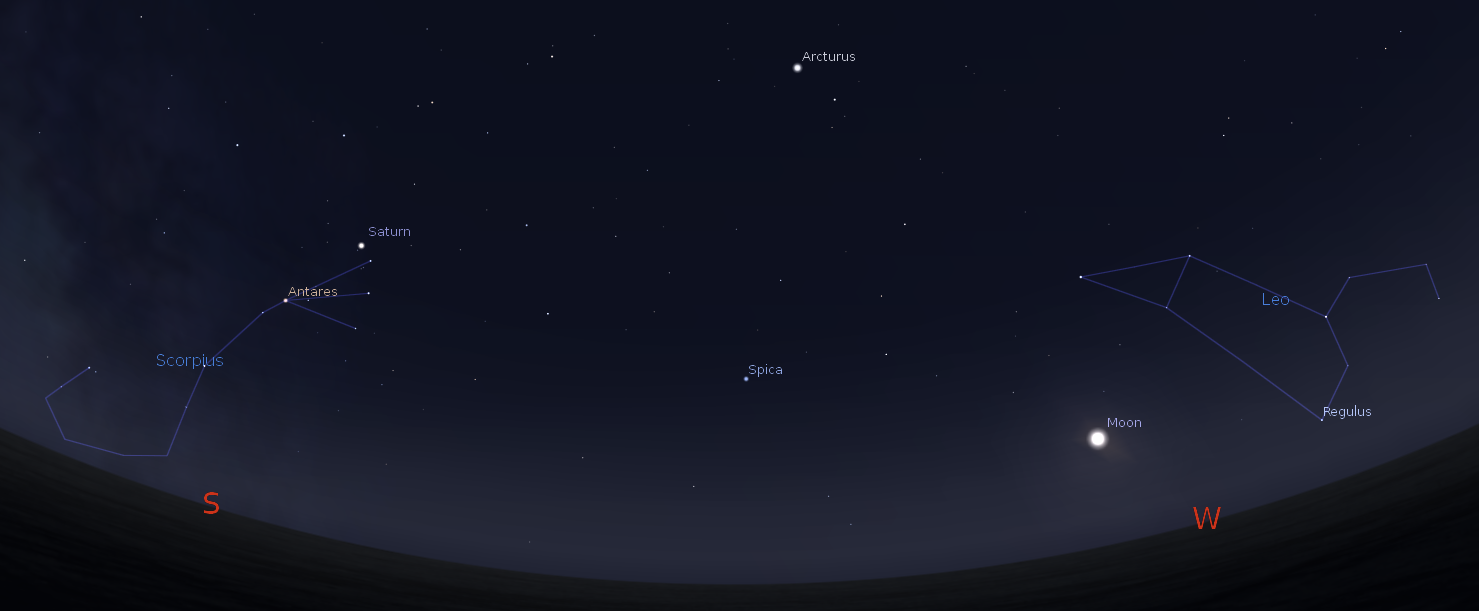
Saturn, the Moon with Scorpius and Leo at 5:30 a.m. April 2, 2015. Created using Stellarium.
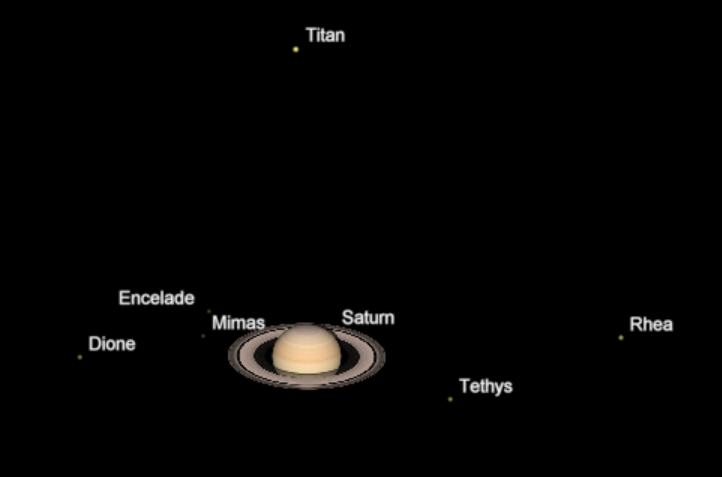
What Saturn and its moons might appear like in a telescope at 5:30 a.m., April 2, 2015. Small telescopes will show only the moon Titan. Created using Cartes du Ceil (Sky Charts).
03/12/2015 – Ephemeris – Tonight’s a big night for Jovian satellite events
Ephemeris for Thursday, March 12th. The Sun will rise at 8:01. It’ll be up for 11 hours and 43 minutes, setting at 7:44. The Moon, 1 day before last quarter, will rise at 2:40 tomorrow morning.
Tonight will be a busy one in Jupiter’s system for those watching with telescopes. As it gets dark Jupiter’s moon Io will be in front of Jupiter and very difficult to spot. It’s shadow may be seen as a tiny inky black dot on the face of the planet. Io will move off the planet at 8:55 p.m., This will be followed by the shadow at 9:42 p.m. The fun isn’t over because the moon Europa will be appearing to approach Jupiter as Io leaves it. Europa will disappear behind Jupiter at 12:06 a.m. It will stay hidden until 4:32 a.m. Europe will clear the planet earlier, but will still be in Jupiter’s shadow until 4:32. When a moon’s in shadow, it is said to be eclipsed. When behind the planet it is occulted and when in front of Jupiter it is in transit.
Times are for the Traverse City/Interlochen area of Michigan. They may be different for your location.
Addendum
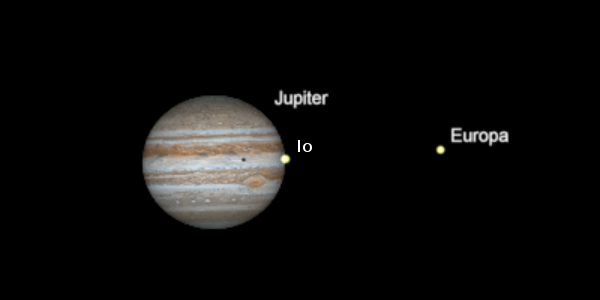
Io transit end at 8:55 p.m., March 12, 2015. Note Io’s shadow will leave the face of Jupiter at 9:32 p.m. Created using Cartes du Ciel (Sky Charts).
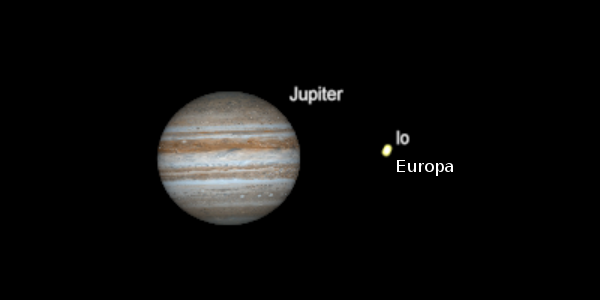
Io passes Europa about 10:20 p.m. March 12, 2015. Created using Cartes du Ciel (Sky Charts).
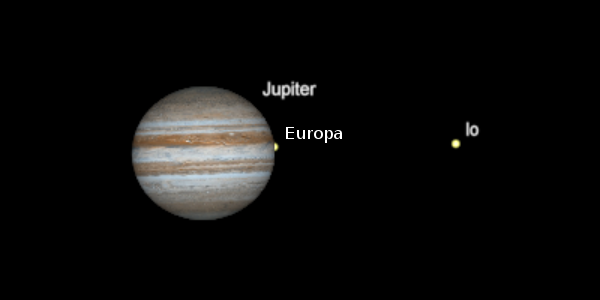
Europa’s occultation begins at 12:06 a.m., March 13, 2015. Created using Cartes du Ciel (Sky Charts).
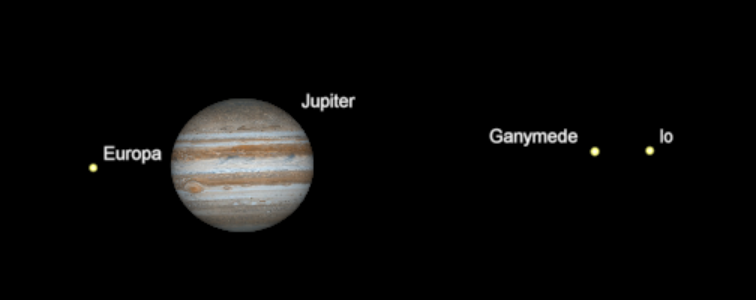
Europa emerges from eclipse by Jupiter’s shadow at 4:32 a.m., March 13, 2015. Note that Ganymede has entered the picture. It appeared to pass Io at about 3:30 a.m. Created using Cartes du Ciel (Sky Charts).
 Bob Moler's Ephemeris Blog