Archive
01/09/2014 – Ephemeris – More on Jupiter’s Galilean moons.
Ephemeris for Thursday, January 9th. The sun will rise at 8:18. It’ll be up for 9 hours and 3 minutes, setting at 5:21. The moon, 2 days past first quarter, will set at 3:20 tomorrow morning.
The planet Jupiter has, as of the latest count, 67 satellites or moons. However only four can be seen in small to medium-sized telescopes. Astronomers use the term moon and satellite interchangeably, though only moons orbit planets. A satellite is a more generic term and is a smaller body that orbits another larger body. Though we don’t usually call an artificial satellite orbiting the Earth a moon. Anyway, the four bright moons of Jupiter are called the Galilean moons, because Galileo discovered then in early 1610. Their names from Jupiter on out are Io, Europa, Ganymede and Callisto. They orbit over Jupiter’s equator. Since the planet has a very small axial tilt the moons seem to move back and forth from one side to the other of Jupiter in a nearly straight line.
Times are for the Traverse City/Interlochen area of Michigan. They may be different for your location.
Addendum
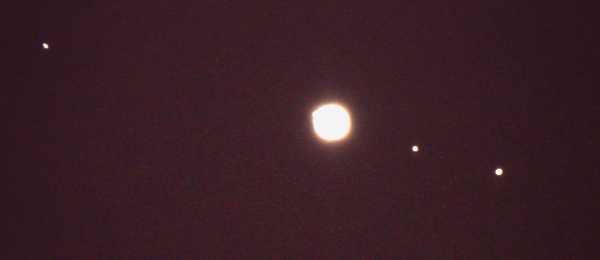
Jupiter and its four Galilean moons. The planet has to be over exposed to pick up the moons. But the eye can handle the brightness difference with no problem. This is one of my old pictures I do believe.
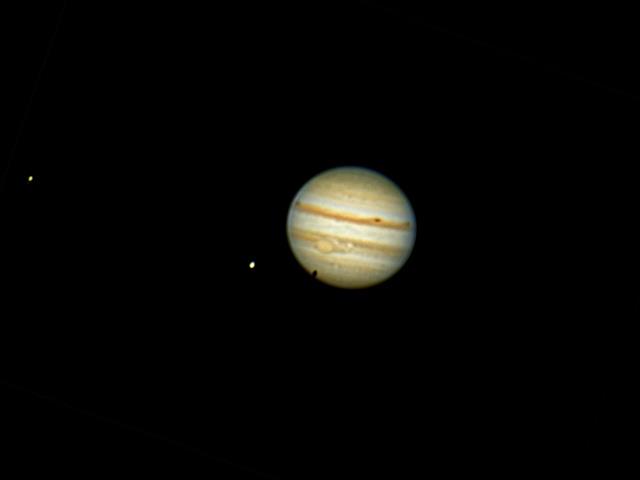
Jupiter with a solar eclipse in progress as Ganymede, lower left, casts its shadow on Jupiter on November 14, 2011 at about 10:15 p.m.. Credit: Scott Anttila.
The moon Io is off to the far left. This eclipse can be simulated with Cartes du Ciel.
01/11/2012 – Ephemeris – Where are the planets tonight?
Wednesday, January 11th. The sun will rise at 8:17. It’ll be up for 9 hours and 5 minutes, setting at 5:22. The moon, 2 days past full, will rise at 8:29 this evening.
It’s time again to take a look at the whereabouts of the bright planets. Venus is brilliant in the southwestern sky after sunset and will set at 8:25. Jupiter is the most prominent planet of the evening sky, once Venus sets. It’s located high in the south and is seen against the stars of the constellation Aries. It will pass due south at 7:15 p.m. It will set at 2:00 a.m.. Jupiter is a great sight in a small telescope with its four moons which change position from night to night. Mars will rise at 10:27 p.m in the east northeast and is below the hind end of the constellation Leo the lion. It is 88 million miles away and closing. Mars will pass due south at 4:54 a.m. Saturn will rise at 1:41 a.m. just to the left of the bright star Spica in the east southeast.
* Times, as always are for the Traverse City/Interlochen area of Michigan.
Addendum
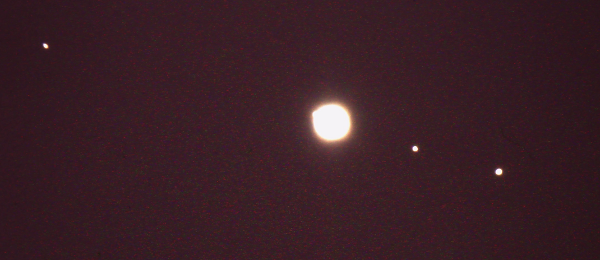
Overexposed Jupiter and its moons. My archival image.
The four Galilean satellites or moons of Jupiter are in order of distance from Jupiter Io, Europa, Ganymede and Callisto. They all orbit near Jupiter’s equator, and Jupiter itself has a very small axial tilt of about 3 degrees so the satellites seem to shuffle from one side to the other of Jupiter. The pattern is different night.
The programs Stellarium, Cartes du Ciel, and other sources including http://www.calsky.com can be used to determine the positions of the satellites. But there are clues by just looking at them.
- Io is closest to Jupiter and generally appears so. In the photograph above it appears as a bump on the left edge of Jupiter. It has a slight reddish tinge.
- Europa is dimmer than Io and also is usually close to Jupiter.
- Ganymede is easy. It’s the brightest.
- Callisto is usually found the farthest from Jupiter and is also the dimmest of the four.
Based on the photograph alone, which is undated, I’d guess that from left to right we have Callisto and Io to the left of Jupiter, Europa and Ganymede to the right.
Sometimes fewer than four satellites can be seen. They can hide in front of Jupiter, usually casting their shadow on the planet, behind Jupiter or in its shadow. Calsky will give you the times for your location.
Update
I located the date of the above image. It was taken the evening of March 17, 1989. A check with Cartes du Ciel (Sky Charts) confirm the satellite’s locations and order. Io was just ending a transit (passing in front ) of Jupiter.
 Bob Moler's Ephemeris Blog