Archive
Ephemeris: 07/25/2023 – Is the universe twice as old as we think?
This is Ephemeris for Tuesday, July 25th. Today the Sun will be up for 14 hours and 55 minutes, setting at 9:16, and it will rise tomorrow at 6:22. The Moon, at first quarter today, will set at 12:44 tomorrow morning.
Is the universe twice as old as we thought? That’s a conclusion of a study printed in the monthly notices of the Royal Astronomical Society by Rajendra Gupta from the University of Ottawa, in which he postulates that the structure and chemical composition of very early galaxies found by the James Webb Space Telescope turn out to be more developed than one would expect for objects so soon after The Big Bang. The problem with hypothesizing an older universe is to explain what we see currently that have shown that the universe is 13.8 billion years old. One of the things he hypothesized was something called tired light, where light loses energy and is red-shifted not just because of the expansion of the universe but over time and distance. Stay tuned.
The astronomical event times given are for the Traverse City/Interlochen area of Michigan (EDT, UT –4 hours). They may be different for your location.
Addendum
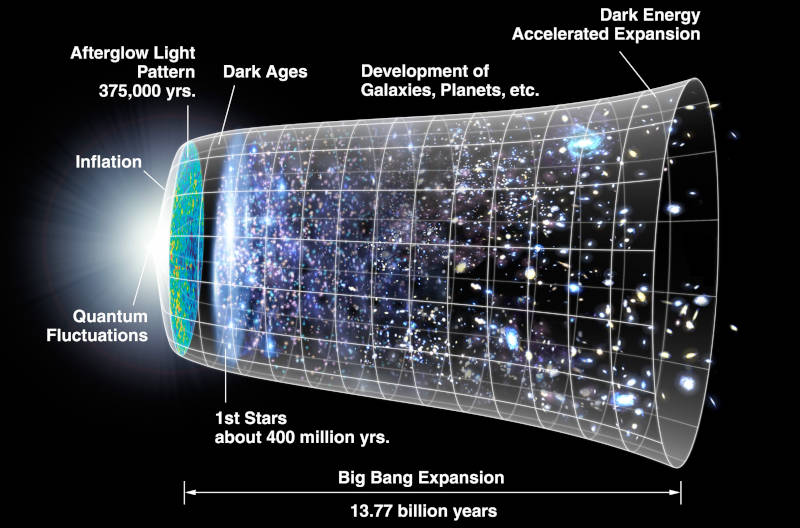
Timeline of the universe. A representation of the evolution of the universe over 13.77 billion years. The far left depicts the earliest moment we can now probe, when a period of “inflation” produced a burst of exponential growth in the universe. (Size is depicted by the vertical extent of the grid in this graphic.) For the next several billion years, the expansion of the universe gradually slowed down as the matter in the universe pulled on itself via gravity. More recently, the expansion has begun to speed up again as the repulsive effects of dark energy have come to dominate the expansion of the universe. The afterglow light seen by WMAP was emitted about 375,000 years after inflation and has traversed the universe largely unimpeded since then. The conditions of earlier times are imprinted on this light; it also forms a backlight for later developments of the universe. Public Domain.
Diagram is from Wikipedia. Above is the expansion of the universe as commonly understood. Not mentioned in the program script above, is the requirement, according to Gupta’s hypothesis, that the basic constants of the universe change over time. As Carl Sagan explained, “Extraordinary claims require extraordinary evidence.” So more evidence is needed. His hypothesis won’t be the only explanation put forth, so there will be more to test. That’s job security for astrophysicists and cosmologists.
07/10/2023 – Ephemeris – Presentation about the James Webb Space Telescope in Traverse City!
This is Bob Moler with Ephemeris for Monday, July 10th. Today the Sun will be up for 15 hours and 21 minutes, setting at 9:28, and it will rise tomorrow at 6:07. The Moon, 1 day past last quarter, will rise at 1:39 tomorrow morning.
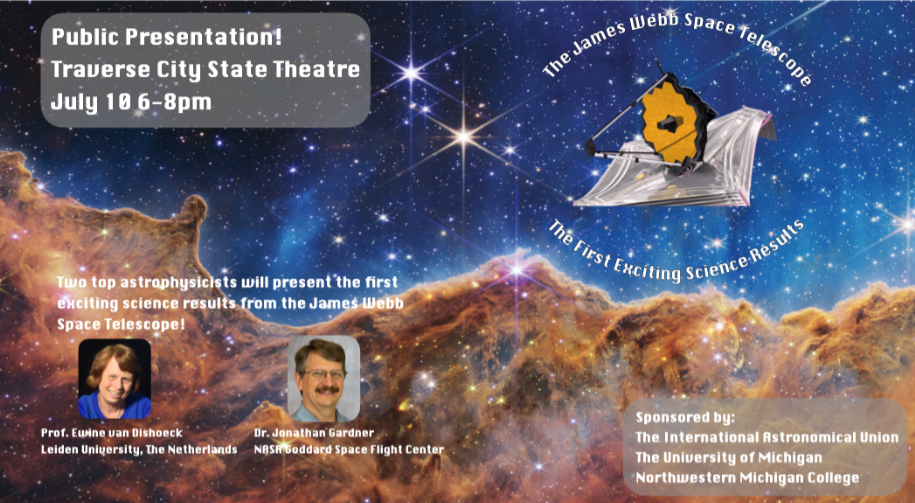
The International Astronomical Union, or IAU, is holding a symposium in Traverse City this week, a meeting of some of the world’s astronomers on the general topic of astrochemistry: From the First Galaxies to the Formation of Habitable Worlds, at the Park Place Hotel & Conference Center. As part of the meeting, there will be a presentation at the State Theater on East Front Street at 6 pm Monday, July 10, 2023 by Professor Ewine van Dishoeck and Dr. Jonathan Gardner on The James Webb Space Telescope – The First Exciting Results. There may still be some free tickets that can be obtained from the State Theater website: https://stateandbijou.org. The program is sponsored by the IAU, University of Michigan, Northwestern Michigan College and the Grand Traverse Astronomical Society.
The astronomical event times given are for the Traverse City/Interlochen area of Michigan (EDT, UT –4 hours). They may be different for your location.
Addendum
This was provided to us about the presentation and the presenters:
Title: The James Webb Space Telescope: a new exploration of the cosmos
Speakers: Jonathan Gardner and Ewine van Dishoeck
Abstract:
The James Webb Space Telescope was launched on Christmas Day 2021 after 25 years of planning, design, development, integration, and testing. Following a six-month deployment and commissioning period, the first science results from Webb have engaged the public and surprised the scientists. Webb’s science goals address our origins and the history of the universe: the first stars and galaxies that formed after the Big Bang; the morphological and dynamical buildup of galaxies; the formation of stars and planetary systems; and exoplanets, our Solar System, and the conditions for life. Webb has already found the most distant galaxies ever seen, made the first detection of carbon dioxide in the atmosphere of an exoplanet, and has examined the interactions between giant stars and the planets that are forming near them.
Jonathan Gardner will review Webb’s construction, launch, and deployments, and discuss the commissioning of the telescope and its instruments. He will describe what scientists have learned in the first year of science results from the telescope on the deep universe. Ewine van Dishoeck will focus on the new insights that Webb has provided us on the formation of new stars and planets and the habitability of other worlds. She will highlight chemical richness of the Webb data, with water and other molecules seen throughout the universe.
Bio:
Jonathan Gardner is the Deputy Senior Project Scientist for the James Webb Space Telescope, a position he has held since 2002 at NASA’s Goddard Space Flight Center. Gardner received an AB degree from Harvard and MS and PhD from the University of Hawaii. As a NATO Fellow, he did postdoctoral research at the University of Durham in the UK. He came to NASA-Goddard in 1996 to work with the Hubble Space Telescope, but soon got involved in early studies of Webb. His scientific research involves using deep infrared observations to study the statistical evolution of galaxies. On the Webb project, he works with the other scientists to ensure the scientific success of the mission, now coming to fruition with Webb’s scientific results.
Ewine van Dishoeck is professor of molecular astrophysics at Leiden University, the
Netherlands. Graduated from Leiden in 1984, she held positions at Harvard, Princeton and
Caltech before returning to Leiden in 1990. The work of her group unites the world of
chemistry with that of physics and astronomy. She has been heavily involved in planning
major new telescopes, including being co-PI on the JWST-MIRI instrument for more than 20
years. She has been fortunate to receive many awards, including the 2018 Kavli Prize for
Astrophysics, as well as membership of the Netherlands, US, German and Norwegian
academies. From 2018-2021, Ewine served as the President of the International
Astronomical Union (IAU).
05/09/2023 – Ephemeris – The planet Uranus’ rings
This is Ephemeris for Tuesday, May 9th. Today the Sun will be up for 14 hours and 35 minutes, setting at 8:57, and it will rise tomorrow at 6:20. The Moon, 3 days before last quarter, will rise at 1:56 tomorrow morning.
Today, the planet Uranus is in conjunction with the Sun. I don’t talk about Uranus that much, because it can’t be spotted in the sky with the naked eye. However, the James Webb Space Telescope observed it, and gave our clearest view of the planet since Voyager 2 flew past it in January 1986. Uranus has a system of rings, which were discovered in March 1977. Though not visible, they blocked the light of a star. Astronomers at the time were trying to get a more accurate diameter of the planet by timing the disappearance of a star behind the planet. Extra short dips in brightness before and after the main occultation revealed the existence of the rings. Uranus also has an extreme axial tilt of 98 degrees.
The astronomical event times given are for the Traverse City/Interlochen area of Michigan (EDT, UT –4 hours). They may be different for your location.
Addendum
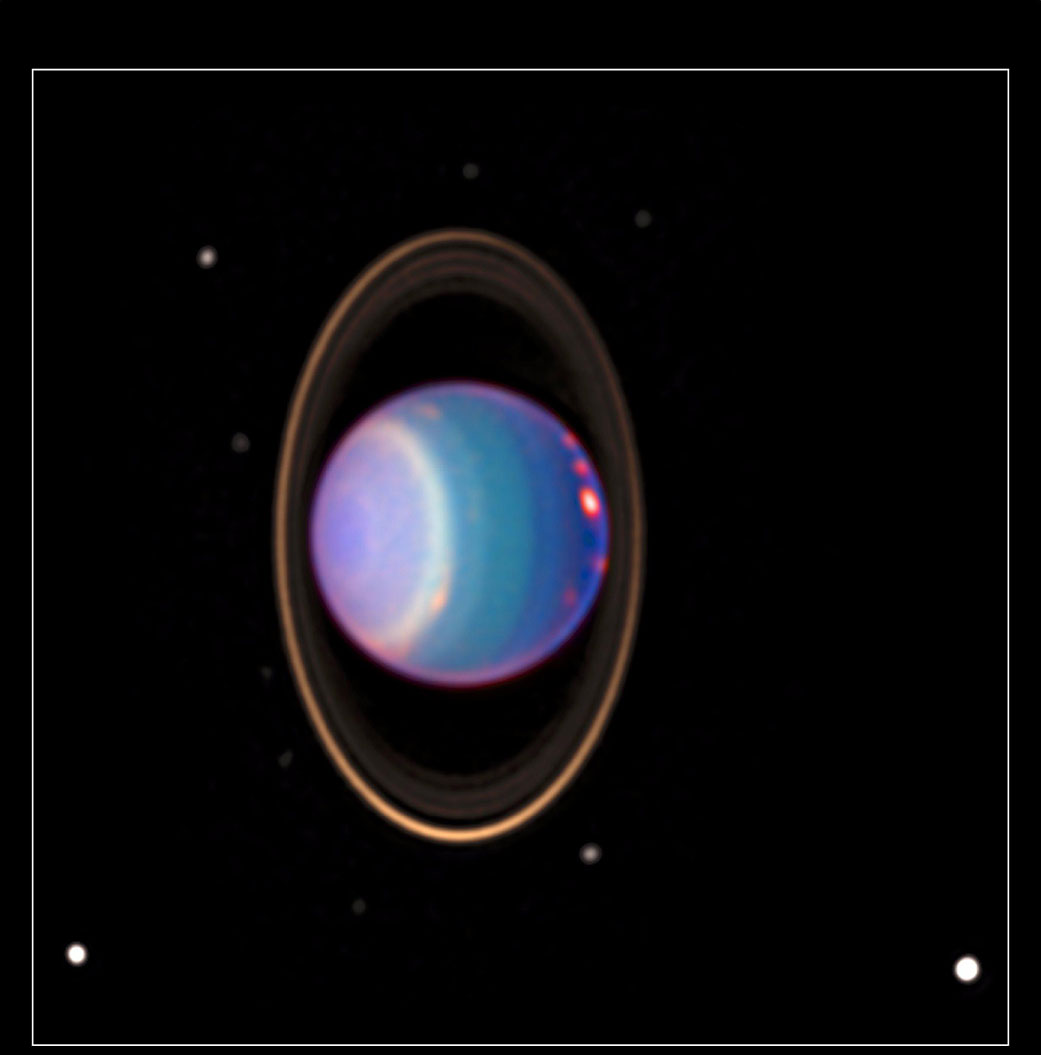
Uranus and its rings as photographed by the Hubble Space Telescope. Credit NASA/ESA.
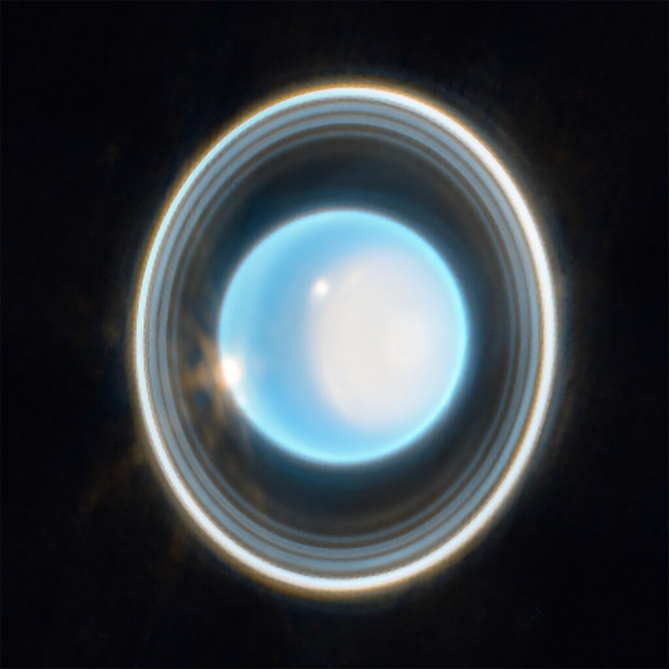
Uranus and its rings as photographed by the James Webb Space Telescope. The rings are much brighter in the infrared. Credit: NASA\CSA\ESA.
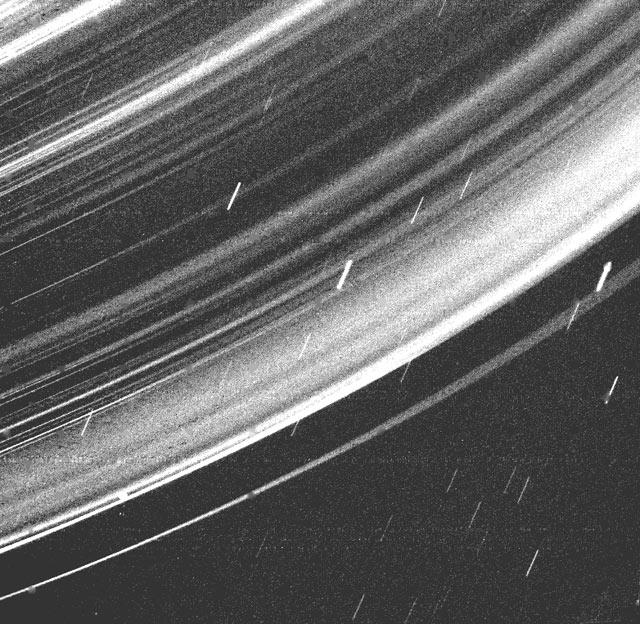
Closeup of the Uranian rings from Voyager 2. The stars are trailed due to the spacecraft turning to focus on the rings as it moves through the Uranian system in this time exposure. Credit NASA/JPL.
12/26/2022 – Ephemeris – Some space firsts this year
This is Ephemeris for Monday, December 26th. Today the Sun will be up for 8 hours and 49 minutes, setting at 5:08, and it will rise tomorrow at 8:19. The Moon, halfway from new to first quarter, will set at 9:10 this evening.
I hope we all survived the holiday season so far. We now have one more to go, New Year’s Eve. The Moon will pass the planet Saturn later this morning. By this evening, Saturn will be to the right of the Moon in the southwestern sky. Now that we’re ending the year, we can look back at some space firsts. The James Webb Space Telescope was launched last Christmas. It became operational late spring of this year and presented its first 5 spectacular images in July. The DART spacecraft, also launched last year, collided with the small asteroid Dimorphos, orbiting the larger Didymos in a 12-hour orbit produced an amazing effect on its orbit. And late this year Artemis I finally launched, making a nearly flawless orbit of the Moon with its Orion space capsule, and returned.
The astronomical event times given are for the Traverse City/Interlochen area of Michigan (EST, UT –5 hours). They may be different for your location.
Addendum
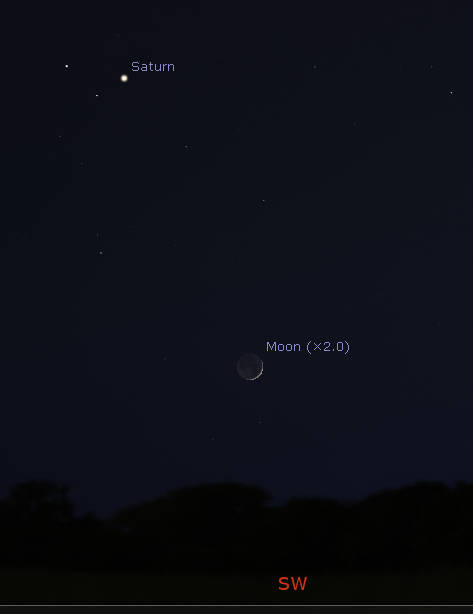
The Moon and Saturn at 6:30 pm tonight, December 26, 2022. Note that the Moon is shown at twice its apparent size to better show its phase. Created using Stellarium.
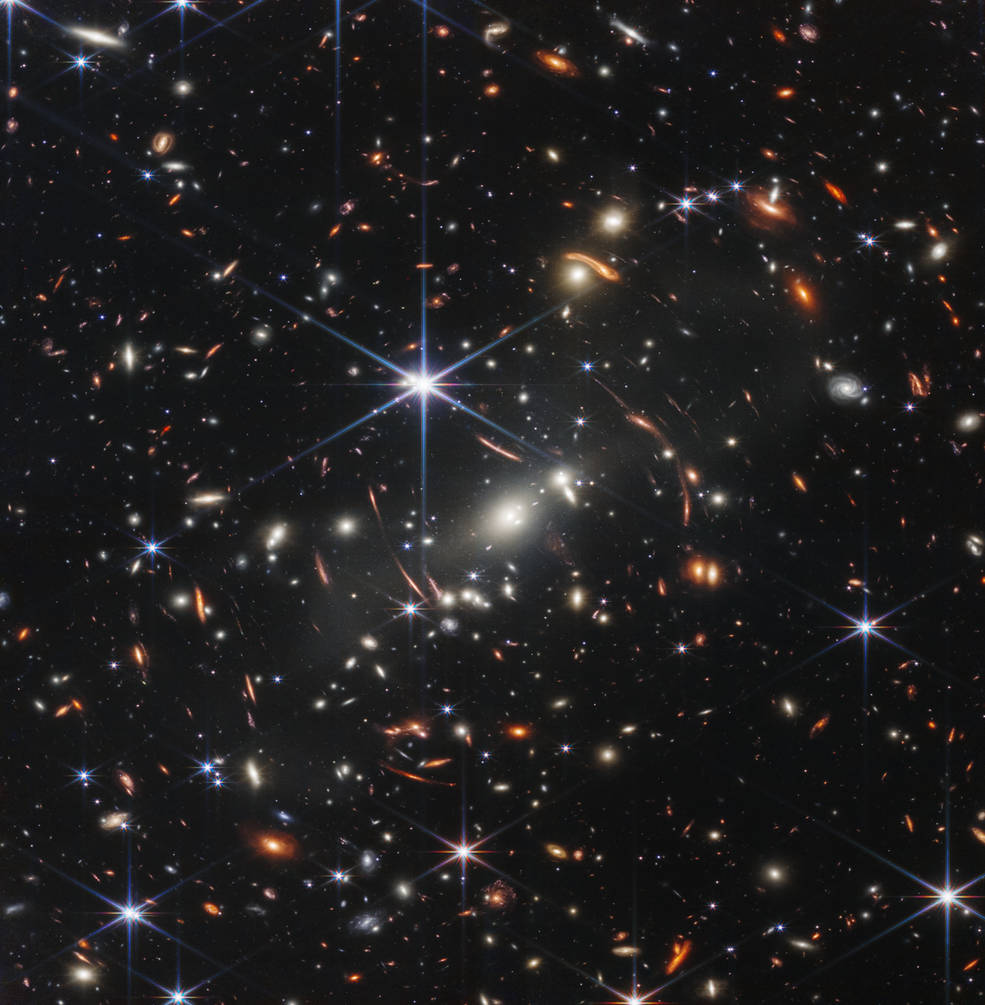
The James Webb Space Telescope teaser deep field image from President Biden’s July 11th presentation. Credit: NASA, ESA, CSA, JWST, STScI.
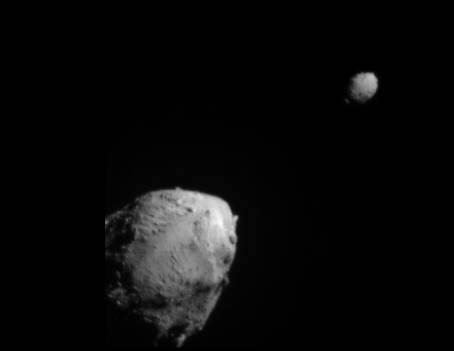
DART images of both Didymos, the big one, and Dimorphos, on approach. Dimorphos is the target. Credit NASA / JHAPL.
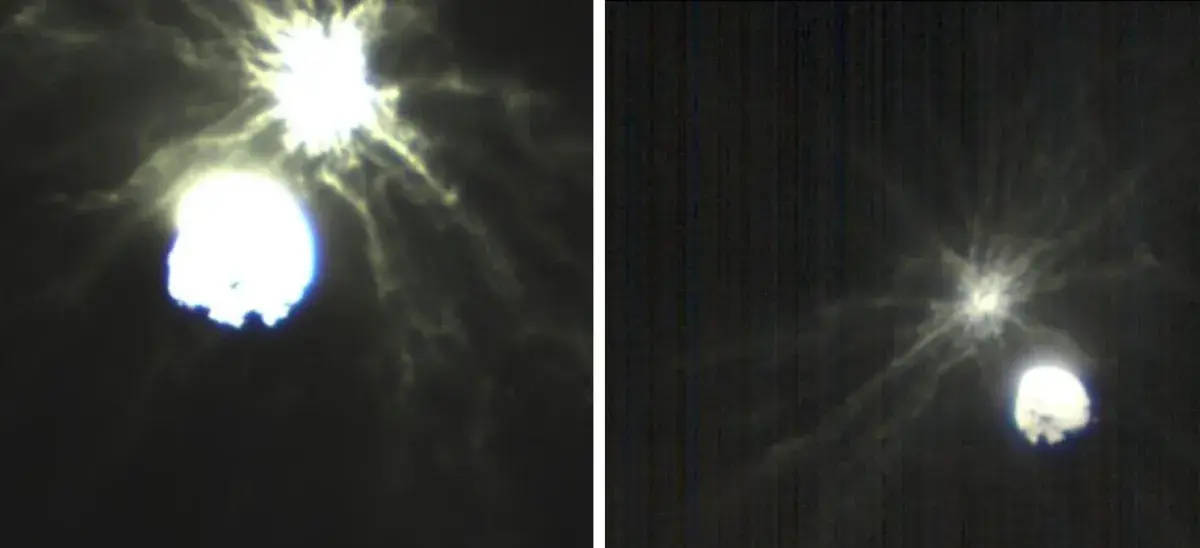
Two images from the LiciaCube satellite launched from the DART spacecraft 15 days before the impact, and trailing it to record the collision with its wide and narrow angle imagers. Dimorphos does appear to be a rubble pile asteroid from its appearance and the amount of ejecta caused by the impact. The ejecta adds to the effect of the spacecraft’s kinetic energy by pushing away from the asteroid by Newton’s third law of motion.
Credit Italian Space Agency.
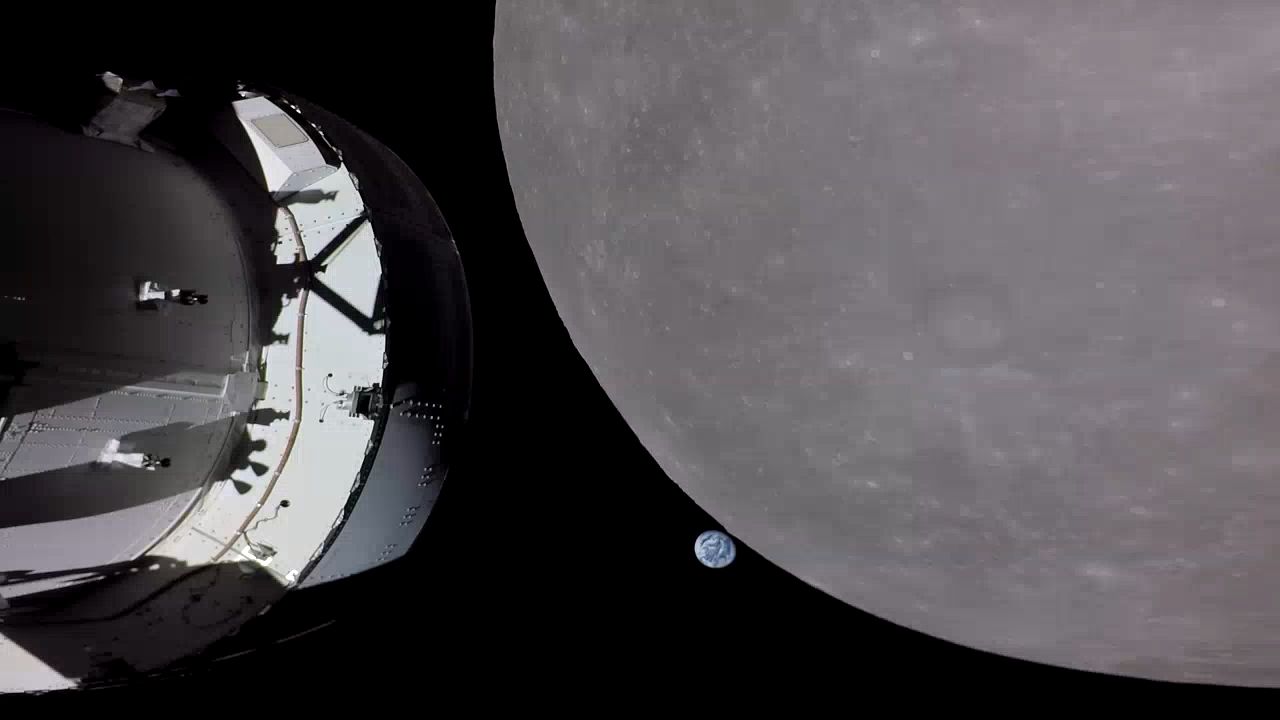
Earthset from Artemis I’s Orion spacecraft, as it moves around to the far side of the Moon. Click on the image to enlarge it. Credit: NASA.
10/04/2022 – Ephemeris – DART does its job, now we wait and watch.
This is Ephemeris for Tuesday, October 4th. Today the Sun will be up for 11 hours and 33 minutes, setting at 7:17, and it will rise tomorrow at 7:45. The Moon, 2 days past first quarter, will set at 2:14 tomorrow morning.
Last week Monday night NASA’s DART spacecraft successfully smashed into the tiny asteroid Dimorphos, which was slowly orbiting an asteroid named Didymos five times its size, and nearly a half mile in size. Dimorphos is too small and too close to Didymos to be seen in optical telescopes. Even the DART spacecraft’s telescope could only spot it in the last hour before the collision. Astronomers have found that they can see asteroid shapes and moonlets by radar. One technique was to send out radar pulses out from the Arecibo Observatory in Puerto Rico and receive them back with the Green Bank Telescope in West Virginia. Now that Arecibo has been destroyed, astronomers transmit from Goldstone, California.
The astronomical event times given are for the Traverse City/Interlochen area of Michigan (EDT, UT – 4 hours). They may be different for your location.
Addendum
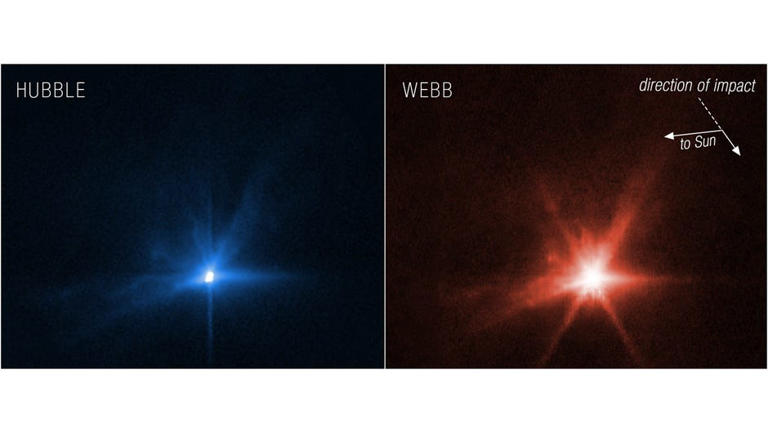
Dimorphos collision from as seen from Hubble and JWST. The colors aren’t true. Credit: NASA, ESA, CSA, Jian-Yang Li, Cristina Thomas, Ian Wong, Joseph DePasquale, Alyssa Pagan. From CNET web site.
07/12/2022 – Ephemeris – The rest of the first images and data from the James Webb Space Telescope to be released tomorrow
This is Bob Moler with Ephemeris for Tuesday, July 12th. Today the Sun will be up for 15 hours and 18 minutes, setting at 9:27, and it will rise tomorrow at 6:09. The Moon, 1 day before full, will set at 5:26 tomorrow morning.
Later today at 10:30 am, NASA and the Space Telescope Science Institute will present the first results from the James Webb Space Telescope. These will be, I believe, four multi-spectral images rendered in full color, and other data. The wavelength coverage of Webb in the infrared is greater than Hubble Space Telescope, which is mostly visible light, by several factors. The test images we’ve seen released so far are monochromatic and rendered in white, yellow, orange and red to depict a wide brightness range. There will be a Webb image release with explanations at the Milliken Auditorium of the Dennos Museum at 10:30, with doors opening at 10 am; and also at the Main Library in Traverse City. I’ll endeavor to be at the library.
The astronomical event times given are for the Traverse City/Interlochen area of Michigan (EDT, UT – 4 hours). They may be different for your location.
Addendum
Not known by me last Sunday night when I wrote and recorded today’s program was that President Biden was going to preview one of the images Monday evening. If I were the general public, I would have been underwhelmed. It wasn’t enlarged, or particularly colorful. Here it is below. Click on it for an even larger view:
The teaser deep field image from President Biden’s July 11th presentation. Click on the image to fill your screen with it. Credit: NASA, ESA, CSA, JWST, STScI.
In the image above, anything with diffraction spikes is a star in our galaxy. Everything else is a galaxy, like the Milky Way, with billions of stars. This is a tiny piece of sky. As a rule of thumb, the redder the galaxy, the farther away it is. The light emitted by these galaxies are starlight in mostly visible wavelengths, but shifted to the infrared by their great speed of recession caused by the expansion of space between us and them. Also note that many of these galaxies are distorted into short arcs. They seem curved as if being part of a circle around the large, bright galaxy in the center. This is caused by the gravitational lensing caused by the mass of that galaxy, dark matter, and other galaxies in its cluster. This is an effect predicted by Einstein’s theory of General Relativity. I have a feeling that we are going to see a lot more gravitational lensing as the JWST probes into deeper and deeper fields.
One thing to remember about deep fields, is that because of the speed of light being finite, that the farther we look out, the farther back in time we see into an evolving universe. The farthest back we can see with electromagnetic radiation (that is gamma rays, x-rays, ultraviolet, visible, and infrared light, microwaves and radio waves) is the era of the cosmic microwave background, when the universe became transparent, about 380 thousand years after the Big Bang. After that came a period called the dark ages before galaxies formed and the first stars ignited, called the dark ages. At least that’s what I hear-tell. There are lots of questions, like the chicken and egg question: Which came first, supermassive black holes or galaxies?
We will find answers to some of our questions, I’m sure. Even more intriguing, we will be able to ask even more and deeper questions to probe the mystery and beauty of the universe.
07/11/2022 – Ephemeris – First color images from the James Webb Space Telescope will be released tomorrow
This is Ephemeris for Monday, July 11th. Today the Sun will be up for 15 hours and 20 minutes, setting at 9:28, and it will rise tomorrow at 6:08. The Moon, 2 days before full, will set at 4:19 tomorrow morning.
Tomorrow at 10:30 am, NASA and the Space Telescope Science Institute will present the first results from the James Webb Space Telescope. These will be, I believe, four multi-spectral images rendered in full color, and other data. The spectral range of Webb in the infrared is greater than Hubble Space Telescope by several factors. Hubble operates mostly in visible light and plus a bit in the ultraviolet and the near infrared. The current alignment images released are monochromatic and rendered in orange for aesthetic reasons, and to hint that these are from the long wavelength part of the spectrum. I expect the new images to look as great or better than anything the Hubble has produced. There will be a Webb image release and celebration at the Milliken Auditorium of the Dennos Museum at 10:30, with doors opening at 10 am; and also at the Main Library in Traverse City.
The astronomical event times given are for the Traverse City/Interlochen area of Michigan (EDT, UT – 4 hours). They may be different for your location.
Addendum
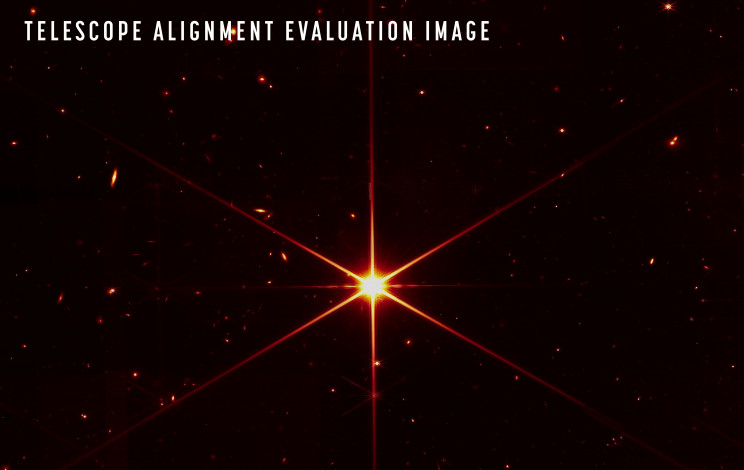
The alignment image of the James Webb Space Telescope after the 18 primary mirror segments have been aligned to act as a single mirror. Beside the alignment star showing its overexposed diffraction spikes, many faint galaxies can be seen. The alignment star, near the Big Dipper, is almost too faint to be seen in binoculars. Credit: NASA, Space Telescope Science Institute (STScI).
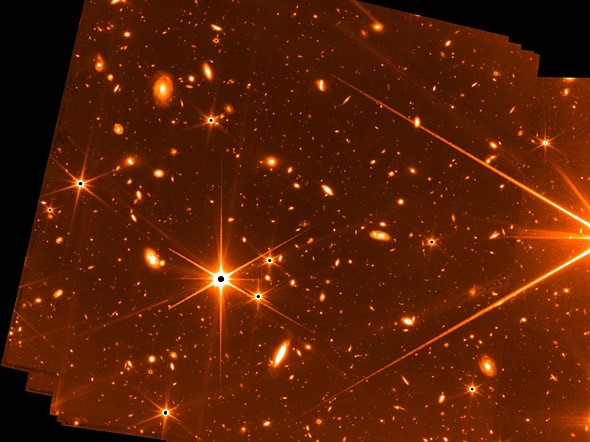
Webb Fine Guidance Sensor (FGC) test image guiding on a star for 72 exposures totaling 32 hours over 8 days. The color key to brightness is white, yellow, orange, red for bright to dim. The black cores to the stars, and at least one galaxy is due to saturating the pixels due to brightness, and are not black holes. Credits: Canadian Space Agency, NASA, FGS team. The Fine Guidance Sensor is a contribution to the James Webb Space Telescope by the Canadian Space Agency.
12/28/2021 – Ephemeris – The James Webb Telescope is on its way to L2
This is Ephemeris for Tuesday, December 28th. Today the Sun will be up for 8 hours and 50 minutes, setting at 5:09, and it will rise tomorrow at 8:19. The Moon, 2 days past last quarter, will rise at 3:18 tomorrow morning.
The James Webb Space Telescope was launched Christmas morning and is heading out past the Moon’s orbit. It was launched from the European Space Agency’s Spaceport in Kourou, French Guiana on the northeast coast of South America, as part of their contribution to the project. It will orbit a point called Lagrange Point 2, or L2 for short, over four times the Moon’s distance in a direction opposite of the Sun. It will take the telescope 29 days to unfold itself. First order of business was to unfold the solar panels to obtain power, then to deploy its high gain antenna for communications with the Earth. Next to begin to deploy a 5 layer, tennis court sized sun shield. After that, the telescope will be unfolded.
The astronomical event times given are for the Traverse City/Interlochen area of Michigan (EST, UT – 5 hours). They may be different for your location.
Addendum
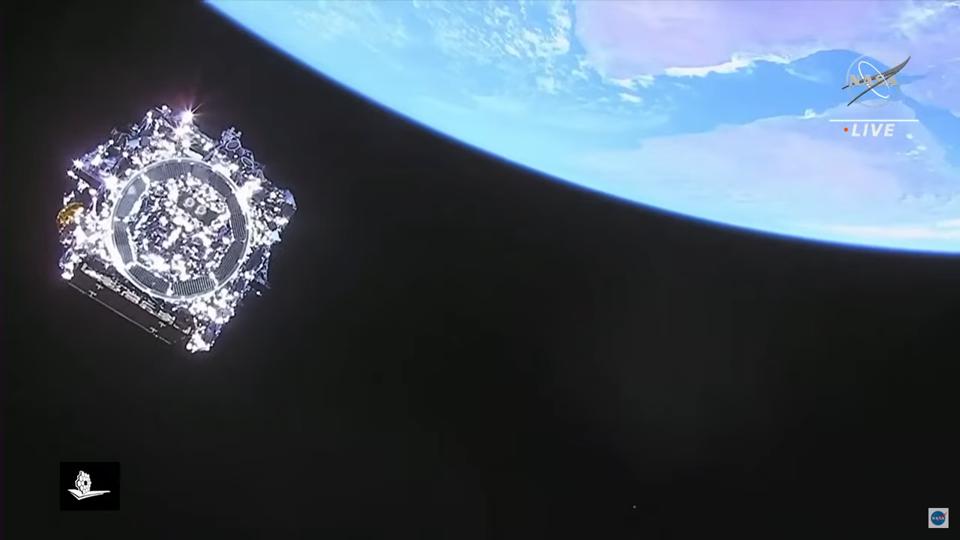
The last view of Webb as it separated from the Ariane 5 launch vehicle. Credit: NASA.
07/12/11 – Ephemeris – Dim prospects for the James Webb Space Telescope
Tuesday, July 12th. Today the sun will be up for 15 hours and 18 minutes, setting at 9:27. The moon, 3 days before full, will set at 4:24 tomorrow morning. Tomorrow the sun will rise at 6:09.
The US House Appropriation Committee is planning to cancel the Jame Webb Space Telescope. This follow on to the wildly successful Hubble Space Telescope, is, like its predecessor over budget and behind schedule. The Webb will gather over 6 times the light as the Hubble, and operate in the infrared where the action is in astronomy now a days. As it is currently funded the Webb telescope might not be launched by 2018. They are cutting NASA’s budget by 1.6 billion dollars and want to mandate instead the development of a heavy lift rocket, for which there is no immediate use. As it is the commercial SpaceX company supposedly can upgrade their current Falcon 9 rocket to a Falcon Heavy quicker and cheaper than NASA can produce their heavy rocket.
* Times are for the Traverse City/Interlochen area of Michigan. They may be different for your location.
Addendum

Artist's view of the James Webb Space Tellescope. Courtesy NASA.

Artist's conception of the Falcon Heavy rocket. Courtesy SpaceX.
 Bob Moler's Ephemeris Blog