Archive
Ephemeris: 02/10/2025 – How old are the features on the Moon?
This is Ephemeris for Monday, February 10th. Today the Sun will be up for 10 hours and 14 minutes, setting at 6:04, and it will rise tomorrow at 7:48. The Moon, 2 days before full, will set at 7:42 tomorrow morning.
In dating Moon rocks scientists get a range of dates from 4.6 to 3.3 billion years. An age of a rock is determined by the decay of a radioactive element one of which is uranium 238 decaying to lead 206. So the ratios of these two elements gives a date when a rock was last solidified. This clock is reset when a rock was last melted either by volcanism or by asteroid impact. It turns out that the rocks of the highlands, the lighter area on the Moon where most of the craters are, date to close to 4.5 billion years, and are probably the original crust of the Moon. The rocks from the lunar maria or seas are younger from about 4.1 billion years down to 3.8 billion years. So they were thought to be caused by asteroid impacts from the Late Heavy Bombardment.
The astronomical event times given are for the Traverse City/Interlochen area of Michigan (EST, UT – 5 hours). Times will be different for other locations.
Addendum
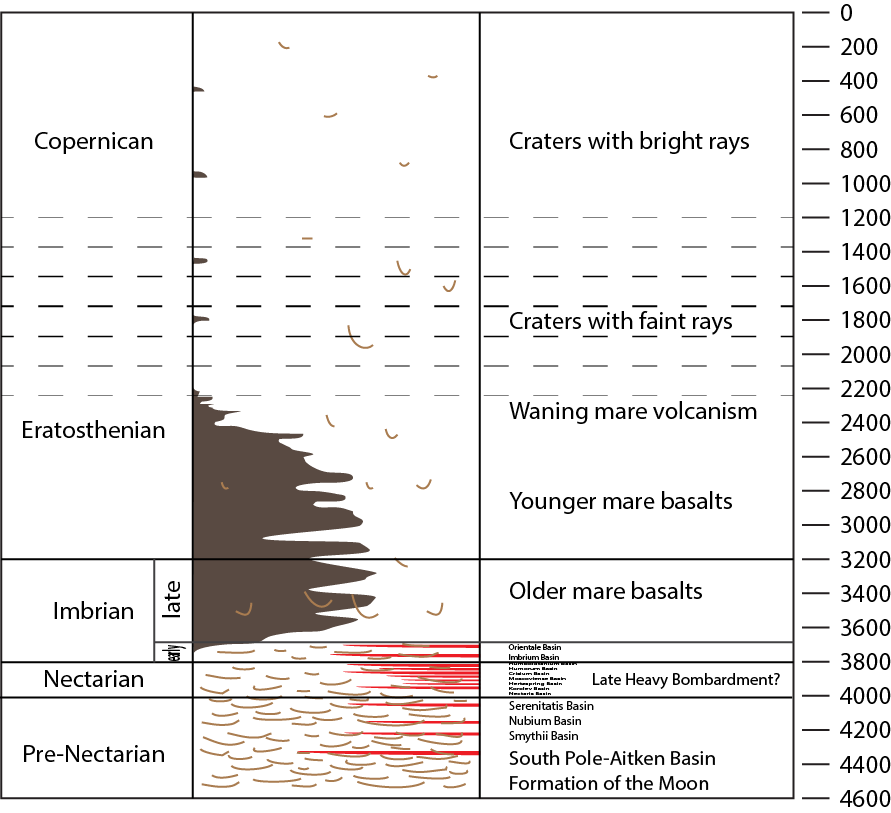
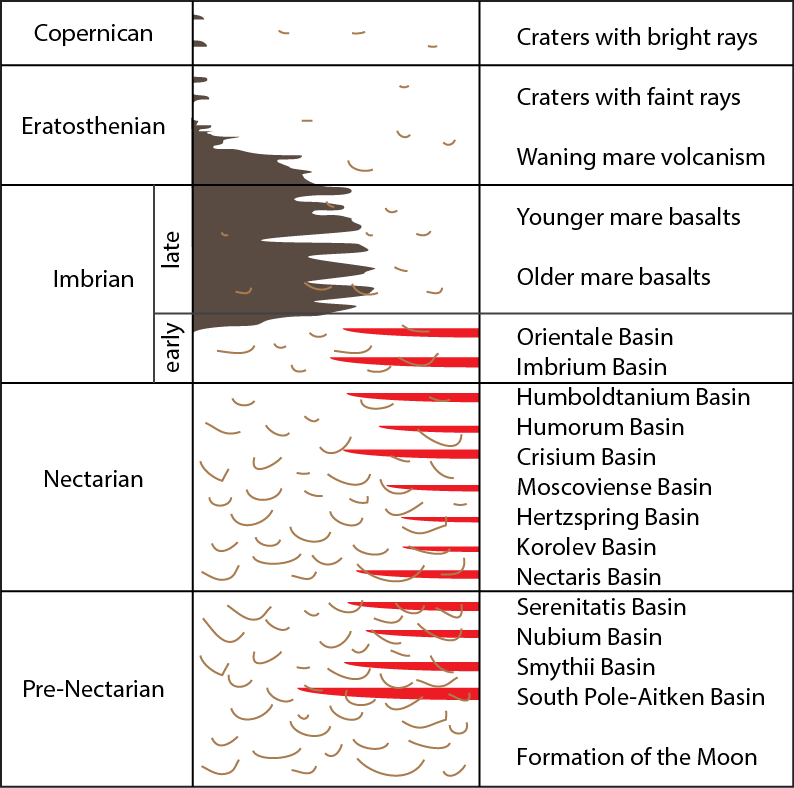
The Late Heavy Bombardment is not accepted by all planetary scientists. The main evidence is the cratering and maria on the Moon.
06/22/2023 – Ephemeris – The lunar seas on tonight’s Moon
This is Ephemeris for Thursday, June 22nd. Today the Sun will be up for 15 hours and 34 minutes, setting at 9:32, and it will rise tomorrow at 5:57. The Moon, halfway from new to first quarter, will set at 12:51 tomorrow morning.
The crescent Moon tonight reveals two large seas. Astronomers using the first telescopes thought the darker flat areas on the moon may actually be filled with water. It turns out that they are flat lava plains, and since most of them are roughly circular, may be gigantic craters from impacts of asteroids. Examination of rocks brought back by the Apollo astronauts over 50 years ago suggest the age of the seas at around 4 billion years. This suggests some kind of disruption in the solar system, called the Late Heavy Bombardment. The reason the Earth does not have these scars is due to plate tectonics and the weathering of wind and water. The Moon has none of these, so it preserves the damage done to it.
The astronomical event times given are for the Traverse City/Interlochen area of Michigan (EDT, UT –4 hours). They may be different for your location.
Addendum
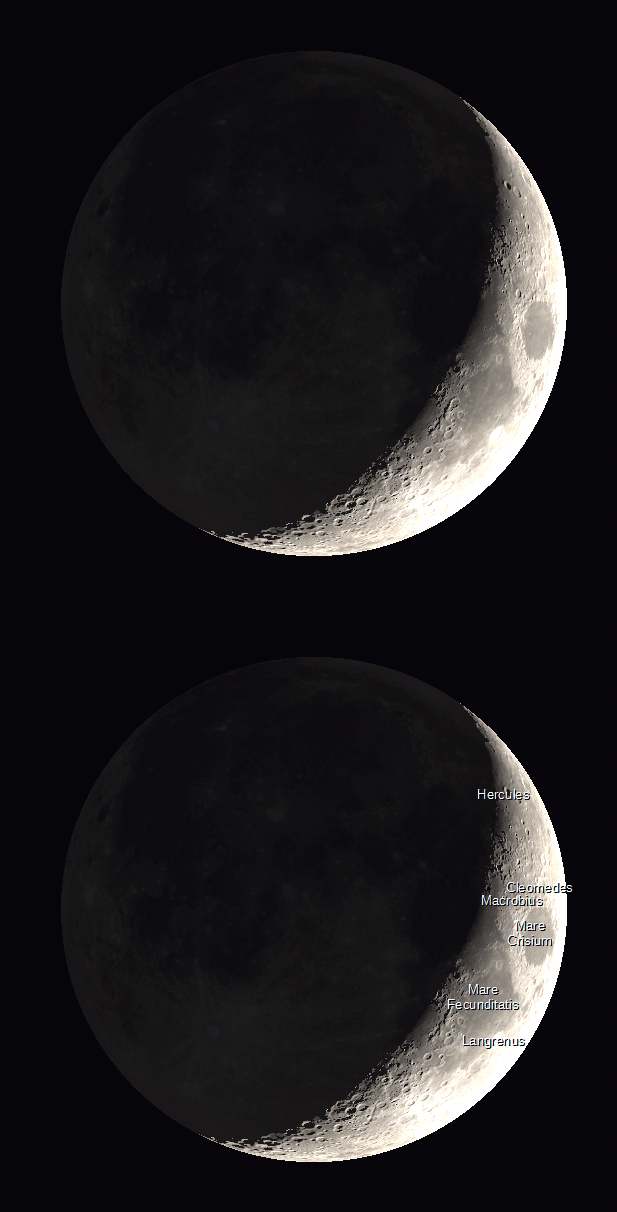
Late Heavy Bombardment (Based on my August 4, 2022 post)
There are even more and larger seas on the east half of the Moon, as we see it. Most were created about 3.9 billion years ago by asteroid strikes. The same thing happened to the Earth, but plate tectonics destroyed the evidence. Not so on the Moon. The result, many planetary scientists think, was the Late Heavy Bombardment, caused by the shifting orbits of mainly Saturn, Uranus and Neptune that disrupted the smaller asteroids, and sending them careening through the solar system.
08/04/2022 – Ephemeris – The Late Heavy Bombardment
This is Bob Moler with Ephemeris for Thursday, August 4th. Today the Sun will be up for 14 hours and 32 minutes, setting at 9:04, and it will rise tomorrow at 6:33. The Moon, 1 day before first quarter, will set at 12:19 tomorrow morning.
The face of the Moon is nearly half uncovered from our point of view, with first quarter occurring at 7:06 tomorrow morning. It shows the string of lunar seas, those gray areas on the moon which lead to the terminator, the Moon’s sunrise line. There are even more and larger seas on the east half of the Moon, as we see it. Most were created about 3.9 billion years ago by asteroid strikes. The same thing happened to the Earth, but plate tectonics destroyed the evidence. Not so on the Moon. The result, many planetary scientists think, was the Late Heavy Bombardment, caused by the changing orbits of mainly Saturn, Uranus and Neptune disrupting the smaller asteroids, and sending them careening through the solar system.
The astronomical event times given are for the Traverse City/Interlochen area of Michigan (EDT, UT – 4 hours). They may be different for your location.
Addendum
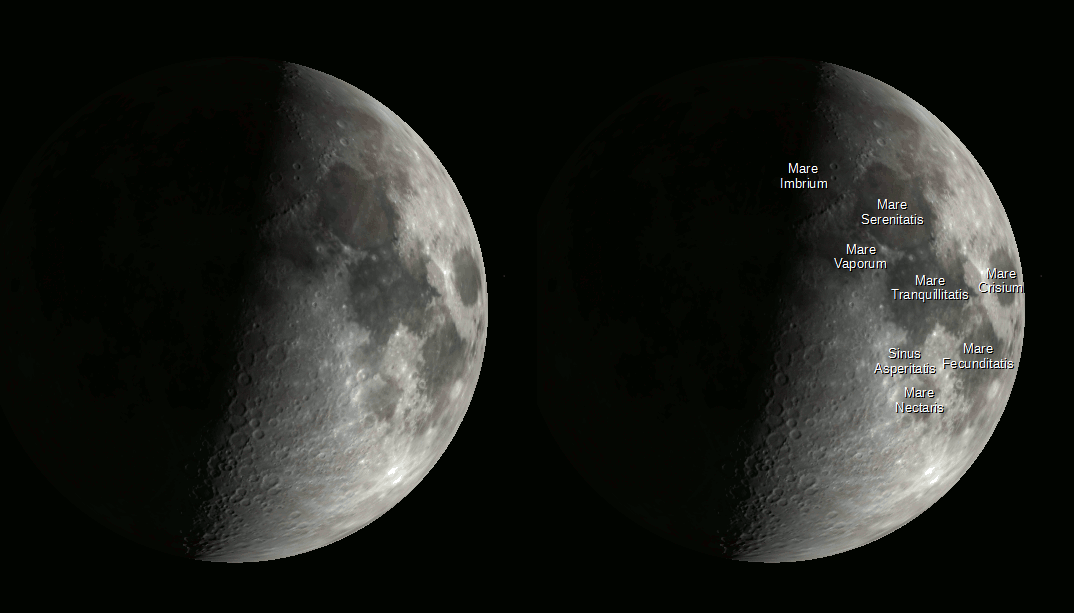
First quarter Moon with prominent seas labeled. Created using Stellarium, GIMP and LibreOffice.
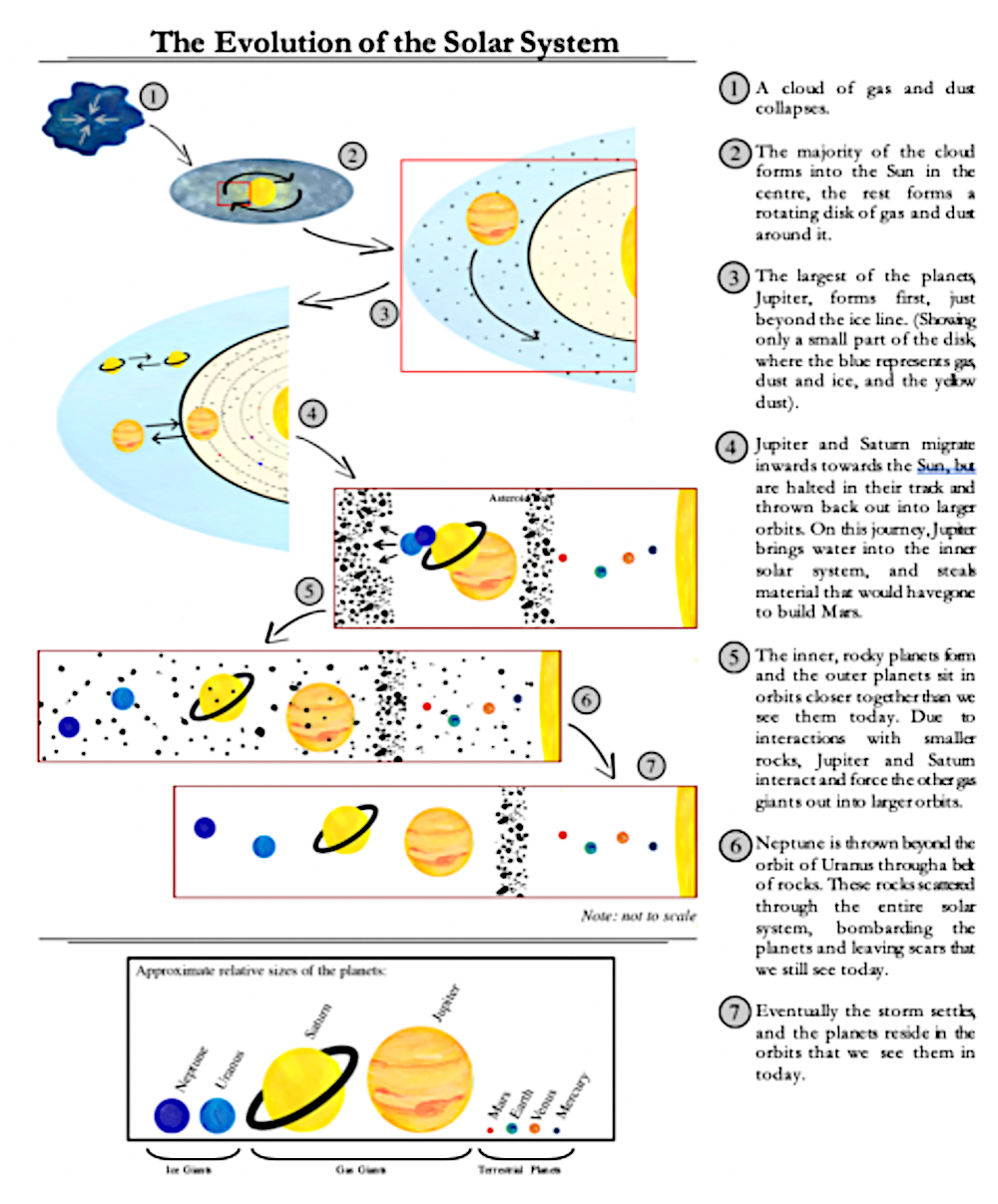
Nice model infographic: Evolution of the solar system. Step 6, with the exchange of Neptune’s and Uranus’ orbits, cause the Late Heavy Bombardment. The Nice model isn’t that nice. It’s named for Nice, France, the city where the model was first developed. The original on the web page was smaller. I enlarged it and sharpened it a bit, so it’s more readable. Credit: Nora Eisner.
The above infographic is from the blog post at https://blog.planethunters.org/2019/04/29/formation-of-our-solar-system/ by Nora Eisner.
06/08/2017 – Ephemeris – The late heavy bombardment of the inner planets
Ephemeris for Thursday, June 8th. Today the Sun will be up for 15 hours and 28 minutes, setting at 9:25, and it will rise tomorrow at 5:57. The Moon, 1 day before full, will set at 6:22 tomorrow morning.
The Moon and many bodies of the inner solar system have many craters which bear witness to many meteorite hits. In studying lunar samples brought back by the Apollo astronauts, from Russian lunar sample return missions and meteorites found on Earth that came from the Moon planetary scientists found that many of their ages correspond to a narrow range of dates of 3.8 to 4.1 billion years ago. Radioisotope dating of rocks would date them to the last time they were molten. This lead to the hypothesis that about a half billion years after the planets were formed, the inner solar system bodies were pelted with millions of asteroids in what is known as the late heavy bombardment. The reason is not completely understood, but one hypothesis is that the outer planets migrated destabilizing the asteroid belt causing the solar system to be a shooting gallery.
The times given are for the Traverse City/Interlochen area of Michigan. They may be different for your location.
Addendum
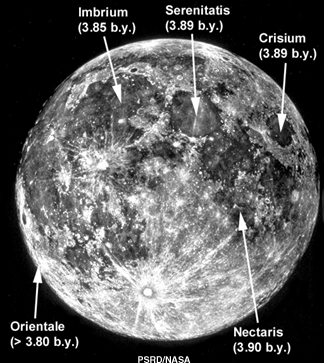
Lunar seas and their ages. Credit NASA.
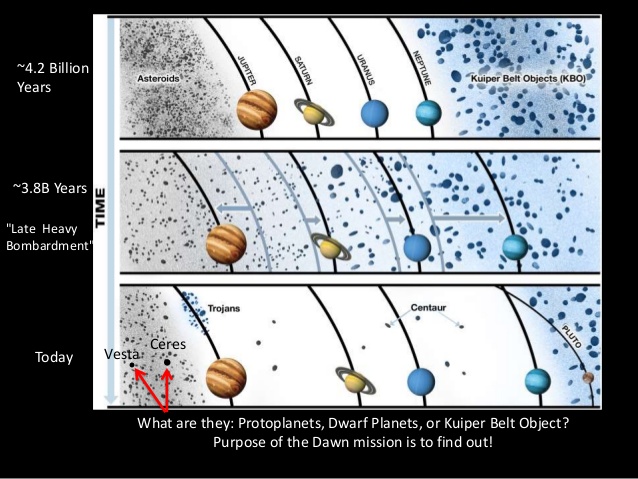
How the migration of the outer planets caused the Late Heavy Bombardment. Credit James Green, Director Planetary Science, NASA.
 Bob Moler's Ephemeris Blog