Archive
09/25/2015 – Ephemeris – There will be a great lunar eclipse Sunday night
Ephemeris for Friday, September 25th. The Sun will rise at 7:33. It’ll be up for 12 hours and 1 minute, setting at 7:35. The Moon, 2 days before full, will set at 5:34 tomorrow morning.
Lets check out Sunday’s total lunar eclipse. It will be visible from the entire contiguous 48 states, and in its entirety from Colorado, eastward. The partial phase will start at 9:07 p.m. Totality will begin at 10:11 p.m. and extend to 11:23 p.m. when the Moon should appear red in color, illuminated by the combined sunrises and sunsets occurring on the Earth at that moment. The eclipse will end at 12:27 a.m. The eclipse is perfectly viewable with the naked eye or binoculars. For those who want company and commentary as to what’s going on, the Grand Traverse Astronomical Society will provide two locations from which to view the eclipse. The NMC Observatory, south of Traverse City and Platte River Point, part of the Sleeping Bear Dunes National Lakeshore, both weather permitting.
Times are for the Traverse City/Interlochen area of Michigan. They may be different for your location.
Addendum
The next lunar eclipse visible from our area will be January 31, 2018 which will achieve totality just before the moon sets. The next lunar eclipse will be January 20-21, 2019 which will start late in the evening. The problem being that January is a pretty cloudy month around here.
We’re closer to the next solar eclipse, which will be a total eclipse visible at midday, and the center line of the path of totality which will pass from Oregon to South Carolina, passing just south of St. Louis Missouri and north of Nashville Tennessee. For more on the 2017 eclipse check out this NASA eclipse page.
09/24/2015 – Ephemeris – Looking forward to Sunday’s Lunar Eclipse
Ephemeris for Thursday, September 24th. The Sun will rise at 7:32. It’ll be up for 12 hours and 4 minutes, setting at 7:36. The Moon, half way from first quarter to full, will set at 4:20 tomorrow morning.
Lets check out Sunday’s total lunar eclipse. It will be visible from the entire contiguous United States, and in its entirety from Colorado, eastward. The partial phase will start at 9:07 p.m. The total phase will begin at 10:11 p.m. and extend to 11:23 p.m. when the ending partial phase will start. The eclipse will end at 12:27 a.m. The eclipse is perfectly viewable with the naked eye or binoculars. For those who want company and commentary as to what’s going on, the Grand Traverse Astronomical Society will provide two venues from which to view the eclipse: The Northwestern Michigan College’s Rogers Observatory, south of Traverse City on Birmley Rd. and Platte River Point at the end of Lake Michigan Road off M22, part of the Sleeping Bear Dunes National Lakeshore, weather permitting.
Times are for the Traverse City/Interlochen area of Michigan. They may be different for your location.
Addendum
The following is an excerpt from my September 1 post.
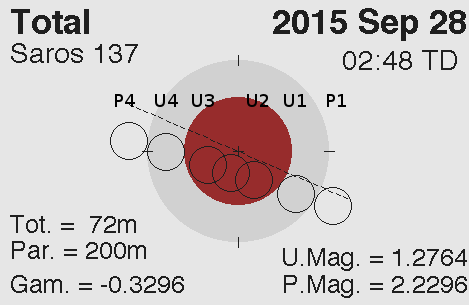
The eclipse occurs on the 28th for Universal Time. It’s the evening of the 27th for us. The Moon travels through the Earth’s shadow from right to left. What are seen are points of contact with the shadow and mid-eclipse. From Five Millennium Canon of Lunar Eclipses (Espenak & Meeus) NASA.
Contact times are labeled P1, U1, U2, U3, U4, and P4. P2 and P3 are omitted because they are synonymous with U1 and U4 respectively:
- P1 – 8:11:47 p.m. Enter the penumbra (unseen). By about 8:30 the duskiness on the left edge of the moon will start to be noticeable.
- U1 – 9:07:11 p.m. Enter the umbra (partial eclipse begins).
- U2 – 10:11:10 p.m. Totality begins.
- Mid eclipse 10:48:17 p.m.
- U3 – 11:23:05 p.m. Totality ends, egress partial phase begins.
- U4 – 12:27:03 a.m. Partial phase ends. The Moon’s upper right edge should appear dusky for the next half hour or so.
- P4 – 1:22:27 a.m. Penumbral phase ends (unseen).
Note: The duskiness of the penumbral phase of the eclipse can be enhanced by viewing through sunglasses.
During the total phase, light leaks in around the Earth due to the bending of light in the Earth’s atmosphere, so the Moon is illuminated by the collective sunrises and sunsets around the globe. This usually gives the Moon a coppery hue, that some are now calling a blood moon. Occasionally, due to volcanic eruptions the Moon can become very dark.
This full moon is also the Harvest Moon and for those who care, a supermoon, it having reached perigee earlier that day.
Weather permitting there will be two GTAS venues to view this eclipse. The first will be the NMC Rogers Observatory. The second will be at the Sleeping Bear Dunes National Lakeshore at Platte River Point at the end of Lake Michigan Road. The site will be open for the visible parts of the eclipse from 9 p.m. to 12:30 a.m.
09/21/2015 – Ephemeris – Next Sunday’s total lunar eclipse
Ephemeris for Monday, September 21st. The Sun will rise at 7:28. It’ll be up for 12 hours and 14 minutes, setting at 7:42. The Moon, at first quarter today, will set at 1:02 tomorrow morning.
It’s six days to the total lunar eclipse next Sunday night. The eclipse starts just after 9 p.m. and ends shortly before 12:30 a.m. Of the remarkable four eclipse string at every possible lunar eclipse opportunity, this last one is the best for us, in that it occurs in the evening. The others were in the morning our time or occurred around the time of moon set around here. So if clear skies prevail we will have a wonderful and beautiful total lunar eclipse. Lunar eclipses occur at full moon when the Sun, Earth and Moon line up close enough for the Moon to enter the Earth’s shadow. Generally this only occurs about 1 out of 6 full moons. Eclipses of the Sun and Moon normally appear in pairs. The solar eclipse already occurred 8 days ago.
Times are for the Traverse City/Interlochen area of Michigan. They may be different for your location.
Addendum
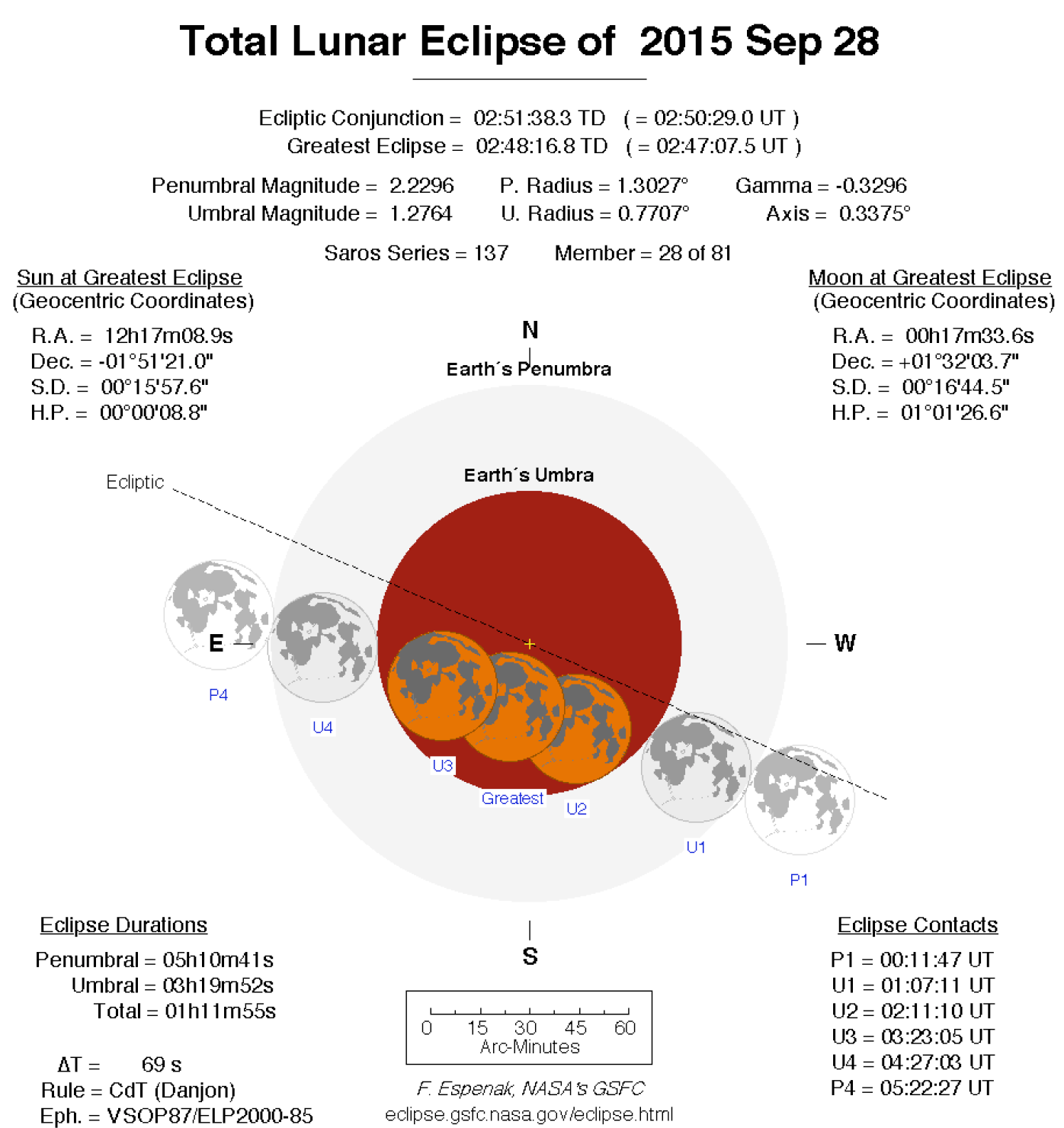
NASA eclipse chart portion. In the eastern US the Date will be September 27. Subtract 4 hours from UT to get EDT (Eastern Daylight Time) Credit: NASA/ Fred Espanek.
Here’s the link to the full chart.
04/04/2015 – Yay, it was finally clear for a lunar eclipse!
Well, of course the sky was clear for this eclipse. This is the third of a tetrad of lunar eclipses visible from the US. For this one we in Michigan are located too far east to see totality, although it was the first to be clear for. The image below shows that we just ran out of sky.
The last eclipse of the tetrad will be on the evening (for us) of September 27th 2015.
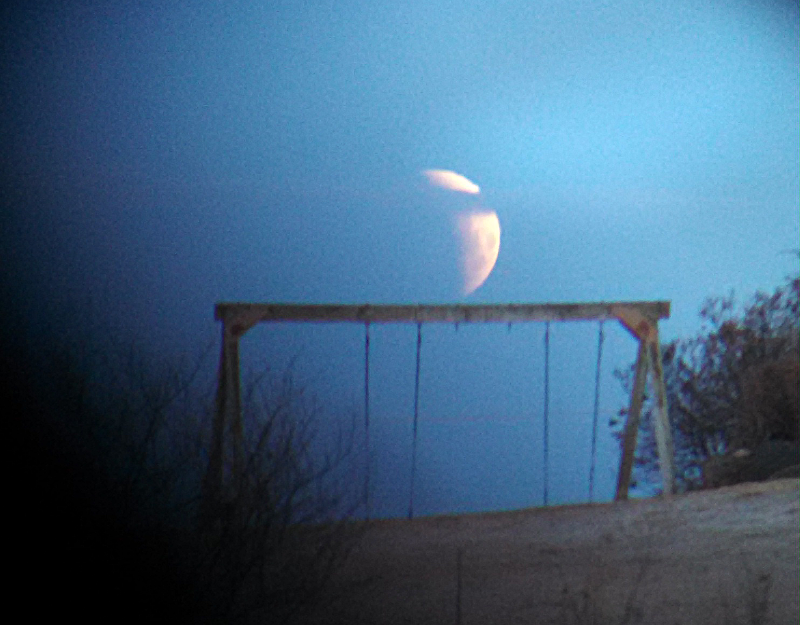
The partially eclipsed Moon setting through a thin cloud and the neighbor’s swing set at 7:09 EDT April 4, 2015. Taken with a Motorola Droid Razr phone through 10X50 binoculars. Credit: Bob Moler.
04/03/2015 – Ephemeris – Learn about meteorites tonight
Ephemeris for Good Friday, Friday, April 3rd. The Sun will rise at 7:20. It’ll be up for 12 hours and 52 minutes, setting at 8:12. The Moon, 1 day before full, will set at 7:24 tomorrow morning.
Meteorites will be the topic given by Joe Brooks local meteorite expert and collector at this evening’s meeting of the Grand Traverse Astronomical Society at 8 p.m. at Northwestern Michigan College’s Rogers Observatory. He even has a meteorite that’s pretty much been proven to be from the asteroid Vesta. Today we are all too aware that stones and even bigger asteroids can collide with the earth. Everyone is welcome. Also at 9 p.m. there will be a star party at the observatory. The observatory is located south of Traverse City on Birmley Road between Garfield and Keystone roads. Remember also the partial lunar eclipse tomorrow morning starting at 6:15 a.m. The society and the observatory will not hold an event for it.
Times are for the Traverse City/Interlochen area of Michigan. They may be different for your location.
Addendum
If you missed yesterday’s post about tomorrow morning’s lunar eclipse, click here.
04/02/2015 – Ephemeris – Information on Saturday morning’s lunar eclipse
Ephemeris for Thursday, April 2nd. The Sun will rise at 7:22. It’ll be up for 12 hours and 49 minutes, setting at 8:11. The Moon, 2 days before full, will set at 6:56 tomorrow morning.
Saturday morning we will be able to witness the start of a lunar eclipse. This is the third of four consecutive total lunar eclipses visible from parts of North America. The last and best of them will occur on the evening of September 27th. The totality of Saturday’s eclipse will only last under 5 minutes, but even that will not be visible from here. The partial phase will begin at 6:15 a.m. with the Moon low in the west-southwest. The Moon will progress about half way into the Earth’s shadow by the time it sets at 7:24 a.m. This will be shortly after the 7:17 a.m. sunrise. It is possible to see the eclipse in its entirety via the Internet. Search for Griffith Observatory. The will have a live feed of the eclipse if it’s clear in Los Angeles.
Update: The URL for the LiveStream from Griffith Observatory is http://new.livestream.com/GriffithObservatoryTV/LunarEclipseApril2015
Times are for the Traverse City/Interlochen area of Michigan. They may be different for your location.
Addendum:
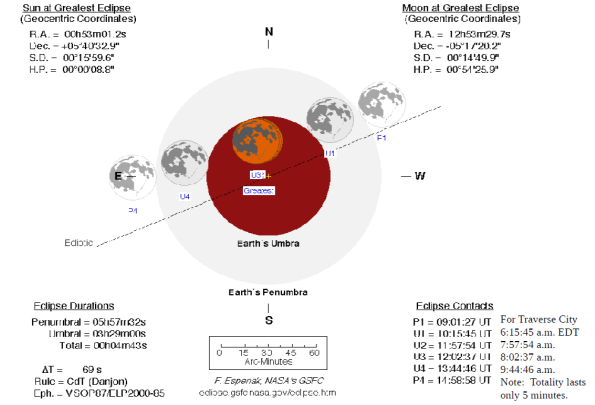
This is an annotated clip of the NASA Eclipse diagram. Click on it to show the entire pdf file.
In the interval P1 to U1 and U4 to P4 the Moon will be only in the Earth’s penumbra, where the Sun’s light is only partially blocked. However for about a half hour before U1 and after U4 the Moon’s edge closest to the umbra will appear dusky.
03/31/2015 – Ephemeris – Previewing April skies
Ephemeris for Tuesday, March 31st. The Sun will rise at 7:25. It’ll be up for 12 hours and 42 minutes, setting at 8:08. The Moon, half way from first quarter to full, will set at 6:02 tomorrow morning.
The 4th month of the year begins tomorrow. Daylight hours in the Interlochen/Traverse City area and will increase from 12 hours and 45 minutes tomorrow to 14 hours 11 minutes on the 30th. The altitude, or angle, of the sun above the southern horizon at local noon will be 50 degrees tomorrow and will ascend to 60 degrees on the 30th. The altitude of the Sun in the Straits area will be a degree lower. The actual time of local apparent noon this month for the Interlochen/Traverse City area, when the sun passes due south, will be about 1:43 p.m. For the straits area local noon occurs about 4 minutes earlier. This Saturday morning we’ll see the first part of a lunar eclipse. This month Venus and Jupiter are our evening planets.
Times are for the Traverse City/Interlochen area of Michigan. They may be different for your location.
Addendum
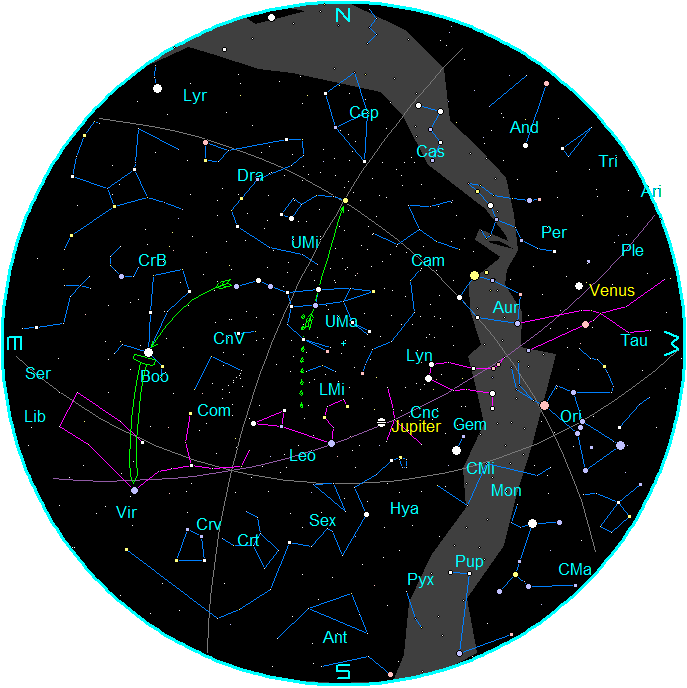
Star Chart for April 2015. Created using my LookingUp program.
The Moon is not plotted. The planets and stars are plotted for the 15th at 10 p.m. EDT. That is chart time.
Evening Astronomical twilight ends at 9:51 p.m. EDT on April 1st, increasing to 10:42 p.m. EDT on the 30th.
Morning astronomical twilight starts at 5:43 a.m. EDT on April 1st, and decreasing to 4:41 a.m. EDT on the 30th.
Add a half hour to the chart time every week before the 15th and subtract and hour for every week after the 15th.
For a list of constellation names to go with the abbreviations click here.
The green pointer from the Big Dipper is:
- Pointer stars at the front of the bowl of the Big Dipper point to Polaris the North Star.
- Drill a hole in the bowl of the Big Dipper and the water will drip on the back of Leo the Lion.
- Follow the arc of the Big Dipper’s handle to Arcturus
- Continue with a spike to Spica
Calendar of Planetary Events
Credit: Sky Events Calendar by Fred Espenak and Sumit Dutta (NASA’s GSFC)
To generate your own calendar go to http://eclipse.gsfc.nasa.gov/SKYCAL/SKYCAL.html
Times are Eastern Daylight Time on a 24 hour clock. Some additions made to aid clarity.
Conjunctions like the Moon-Saturn: 2.3° S means Saturn will appear 2.3° south of the Moon.
| Apr | 01 | We | Venus: 36.6° E | |
| 01 | We | 08:59 | Moon Apogee: 406000 km | |
| 03 | Fr | 23:17 | Moon Ascending Node | |
| 04 | Sa | 08:01 | Partial Lunar Eclipse* | |
| 04 | Sa | 08:06 | Full Moon | |
| 06 | Mo | 09:48 | Uranus Conjunction | |
| 08 | We | 09:08 | Moon-Saturn: 2.3° S | |
| 08 | We | 10:16 | Jupiter-Beehive: 5.4° S | |
| 09 | Th | 23:52 | Mercury Superior Conj. | |
| 10 | Fr | 03:46 | Moon South Dec.: 18.2° S | |
| 11 | Sa | 11:30 | Venus-Pleiades: 2.6° S | |
| 11 | Sa | 23:44 | Last Quarter | |
| 16 | Th | 23:53 | Moon Perigee: 361000 km | |
| 17 | Fr | 09:07 | Moon Descending Node | |
| 18 | Sa | 14:57 | New Moon | |
| 21 | Tu | 12:35 | Moon-Aldebaran: 0.9° S | |
| 21 | Tu | 14:09 | Moon-Venus: 6.8° N | |
| 22 | We | 19:21 | Lyrid Shower: ZHR = 20 | |
| 22 | We | 19:26 | Moon North Dec.: 18.3° N | |
| 25 | Sa | 19:55 | First Quarter | |
| 28 | Tu | 23:55 | Moon Apogee: 405100 km | |
| 30 | Th | 21:29 | Mercury-Pleiades: 1.7° S | |
* For the Grand Traverse area the partial phase of the eclipse will begin at 6:15 a.m. The eclipse will be interrupted by the moon setting at 7:24 a.m. Sunrise will occur at 7:17 a.m. More information will be provided in the Thursday, April 2nd post.
10/13/2014 – Ephemeris – Columbus uses knowledge of eclipses to get supplies from the natives
Ephemeris for Columbus Day, Monday, October 13th. The sun will rise at 7:55. It’ll be up for 11 hours and 6 minutes, setting at 7:01. The moon, 2 days before last quarter, will rise at 11:04 this evening.
On Columbus’ 4th voyage to the Caribbean he was stranded on Jamaica. For a while the natives of the island fed Columbus and his men. However due to the thievery of some of his crew, these people no longer trusted Columbus any refused them any more supplies. Columbus consulted a table of eclipses and found that a lunar eclipse was to occur on February 29th that year (1504), and that at his location the moon would rise in eclipse. He went to the leader of the people and said that they had displeased their god by refusing his crew food, and that the god would turn the Moon red in anger. The native peoples saw the red moon rising and promptly gave Columbus the supplies he wanted.
Times are for the Traverse City/Interlochen area of Michigan. They may be different for your location.
Addendum
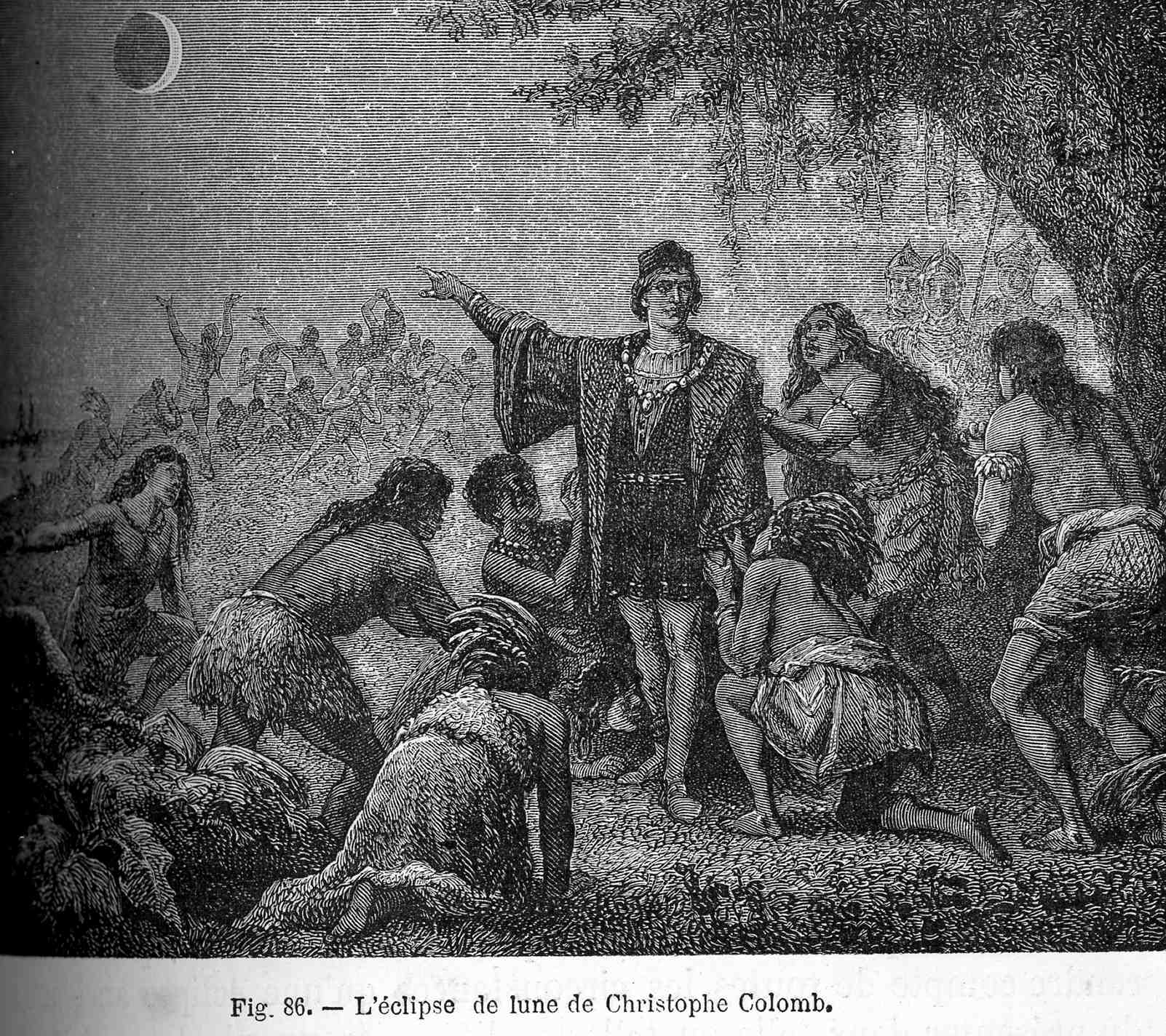
Christopher Columbus showing the lunar eclipse. From Camille Flammarion – Astronomie Populaire 1879, p231.
For more information in the Internet – search for Columbus lunar eclipse
10/09/2014 – Ephemeris – The next lunar eclipses and recollections of what happened with yesterday’s eclipse
Ephemeris for Thursday, October 9th. The sun will rise at 7:50. It’ll be up for 11 hours and 18 minutes, setting at 7:08. The moon, 1 day past full, will rise at 8:01 this evening.
With the two total lunar eclipses done for this year, we can look forward to two more next year. The April 4th, 2015 eclipse won’t appear total here because the moon will set before totality. However the September 28th, 2015 lunar eclipse will be an evening eclipse. These 4 eclipses make a rare tetrad of total lunar eclipses that won’t be repeated until 2032 and 2033. After September 28th the next total lunar eclipse visible from northern Michigan will be in 2021. On the solar eclipse side there’s one on the 23rd of this month, a partial eclipse at sunset. I’ll have more on that later. After that is the big event, the total solar eclipse on August 21, 2017. The path of totality will run from coast to coast, running just south of St. Louis Missouri, and just north of Nashville Tennessee.
Times are for the Traverse City/Interlochen area of Michigan. They may be different for your location.
Addendum
What follows is my recollection of the October 8th lunar eclipse. Originally relayed in an email to Pat Stinson, freelance writer and author of the wonderful article in the Grand Traverse Insider about the activities of Space Week and the astronomical events in October:
The skies were trending clearer at midnight and again at 2:30 a.m. when I took a shower to prepare for the eclipse. After that it got slowly worse. That afternoon Ranger Marie Scott of the Sleeping Bear Dunes National Lakeshore said she’d go to our site, Platte River Point, clouds or not, and I was willing. In setting up the eclipse observing sites,earlier in the year, this site was the one place that if it were clear, we could see either the moon or the sun set onto the Lake Michigan horizon for the three eclipses this year. I loaded my van with my two telescopes, the C8 and an 11″ Dobsonian and lots of coffee.
I got to the site at 4:30 and began to set up. Marie arrived a few minutes later and another Grand Traverse Astronomical Society member Don Flegel arrived shortly after that. They had some rain in Kingsley, where he lived that morning. We had a strong, cold northwest wind. When we’re at the Point we commandeer the small parking lot to the north of the road that’s up against a hill. That hill and my van offered some protection from the wind. I got the C8 set up just in time to spot the moon emerging from the clouds a few minutes after first contact. We were able to follow the eclipse intermittently until about 5:45 when a large cloud covered the moon big time. We could see the glint of the moon off the water until after totality.
This was our situation until about 7:30 when the clouds began to break up, By then the moon was so low that the foreshortened breaks weren’t all that open. Then about 10 minutes before moon set it did peek out at intervals. Unlike the Cheshire Cat’s smile, the moon (cat) had a frown because the upper edge of the moon was coming back into sunlight. 5 minutes later the moon finally disappeared for good in a cloud bank as the puffy clouds overhead caught the sun’s golden sunrise rays.
Marie Scott counted 18 folks that at one time or another came out to witness the event. Marie also posted some pictures she took of the eclipse on the park’s Facebook page.
09/30/2014 – Ephemeris – Previewing October skies and events
Ephemeris for Tuesday, September 30th. The sun will rise at 7:39. It’ll be up for 11 hours and 45 minutes, setting at 7:24. The moon, 1 day before first quarter, will set at 11:43 this evening.
Let’s look at the skies for the month of October. The sun will still be moving south rapidly. Daylight hours in the Interlochen/Traverse City area and will drop from 11 hours and 42 minutes tomorrow to 10 hours, 14 minutes at month’s end. The altitude of the sun above the southern horizon at local noon will be 42 degrees tomorrow in the Interlochen area, and will descend to 31 degrees on Halloween. This month will see two eclipses visible from our area plus a close encounter that a comet will have near Mars and our assets on and around Mars. We will be able to see, weather permitting a total lunar eclipse in the morning a week from today, the 8th and a partial solar eclipse on the 23rd, just before sunset.
Times are for the Traverse City/Interlochen area of Michigan. They may be different for your location.
Addendum
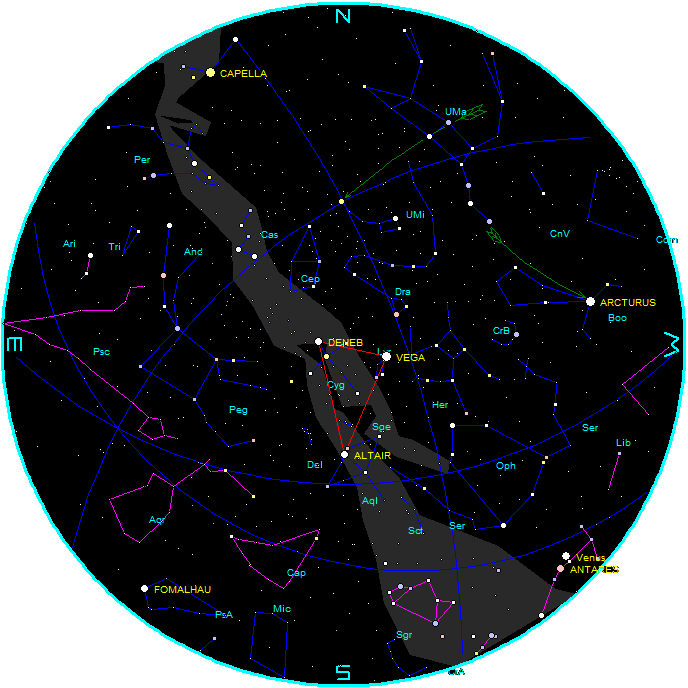
Star Chart for October 2014. Created using my LookingUp program.
The Moon is not plotted. The planets and stars are plotted for the 15th at 8 p.m. That is chart time.
Astronomical twilight ends at 9:00 p.m. on October 1st, decreasing to 8:11 on the 31st.
Add a half hour to the chart time every week before the 15th and subtract and hour for every week after the 15th.
For a list of constellation names to go with the abbreviations click here.
Also shown is the Summer Triangle in red. Clockwise from the top star is Deneb in Cygnus, Vega in Lyra and Altair in Aquila.
The green pointers from the Big Dipper are:
- Pointer stars at the front of the bowl of the Big Dipper point to Polaris the North Star.
- The arc of the dipper’s handle points to Arcturus.
Information on the total lunar eclipse on the 8th will be posted starting Monday October 6th.
 Bob Moler's Ephemeris Blog