Archive
Ephemeris: 12/18/2023 – The Moon tonight
This is Bob Moler with Ephemeris for Monday, December 18th. Today the Sun will be up for 8 hours and 48 minutes, setting at 5:03, and it will rise tomorrow at 8:15. The Moon, 1 day before first quarter, will set at 11:50 this evening.
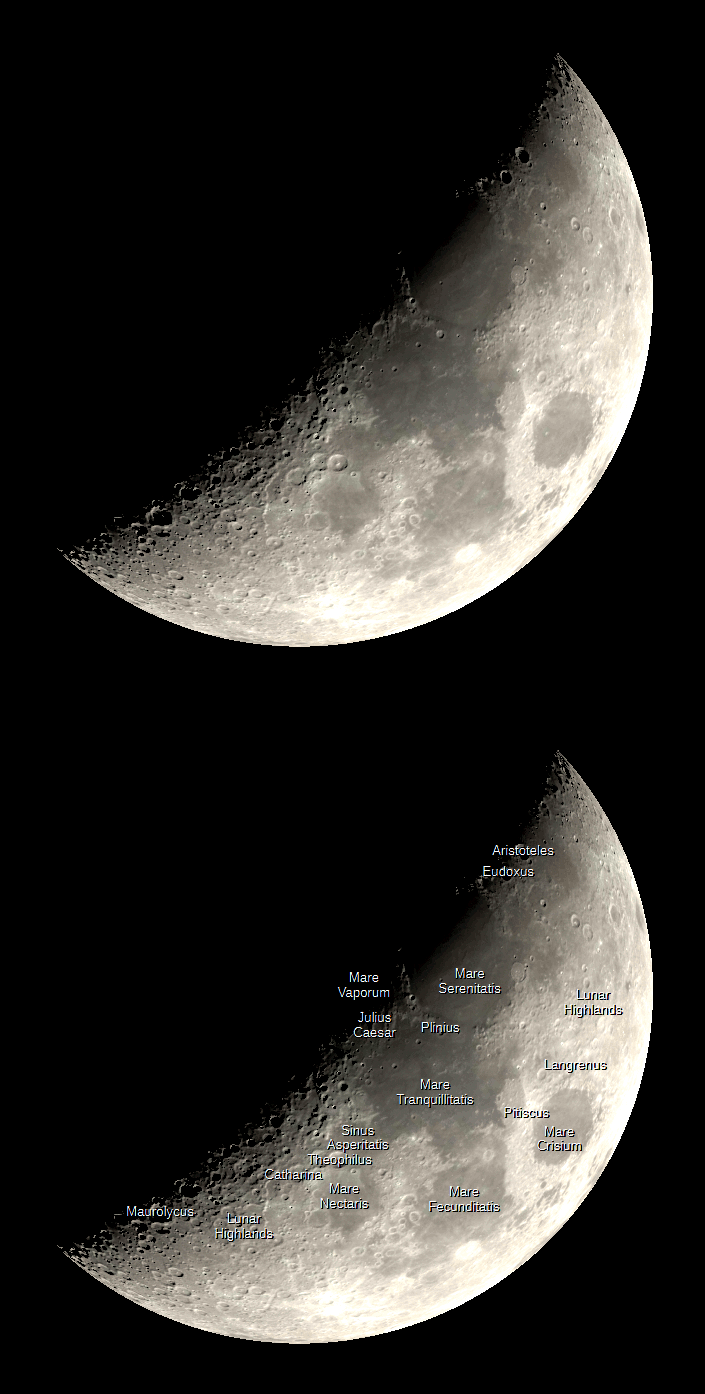
Tonight’s Moon is just about exactly one day before first quarter it’s a six-day-old Moon. Each quarter of the revolution of the moon is just about one week. A lunar month comes out to 29 1/2 days which is a little bit more than 28 days which should be four weeks. That’s pretty close. The illuminated part of the moon that we’re looking at first quarter I consider the most interesting half of the Moon with a good mixture of lowlands which are the seas which are the dark grayer parts of the Moon and the highlands which are very roughly cratered, and are actually higher than the lowlands, or the seas. So if you could put water on the Moon without evaporating it, this is where the water would be. Early telescopic astronomers did think that’s where the water was. Of course the Moon has no atmosphere and the water would just evaporate.
The astronomical event times given are for the Traverse City/Interlochen area of Michigan (EST, UT –5 hours). They may be different for your location.
Addendum
09/08/2016 – Ephemeris – The Moon tonight: Two mountain ranges
Ephemeris for Thursday, September 8th. The Sun will rise at 7:14. It’ll be up for 12 hours and 51 minutes, setting at 8:05. The Moon, 1 day before first quarter, will set at 12:07 tomorrow morning.
The planet Saturn will appear below the nearly first quarter Moon tonight. The southern part of the Moon shows lots of craters in a pair of binoculars or small telescope. The area is called the lunar highlands. Most of the northern part of the Moon contains the lunar seas or maria. There is some interesting terrain there for the small telescope, including the mountain range the Alps to the North and the Apennines south of them. Lunar mountain ranges are named after Earthly ones. The two ranges are part of the broken ramparts around Mare Imbrium, the large Sea of Showers. In it are a few large craters that were created by impacts since the sea itself was created by a huge asteroid impact over 3.8 billion years ago.
Times are for the Traverse City/Interlochen area of Michigan. They may be different for your location.
Addendum
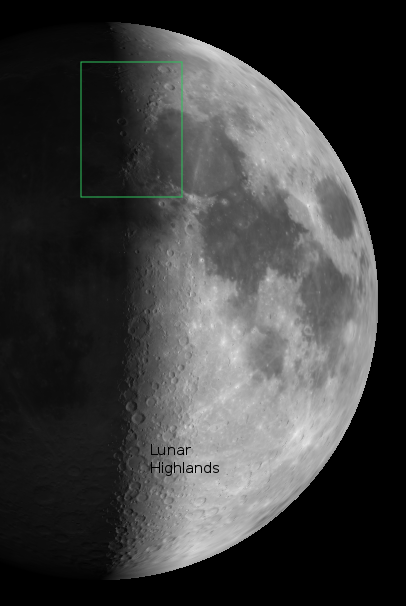
The Moon tonight at 9 p.m. September 8, 2016. Created using Stellarium.
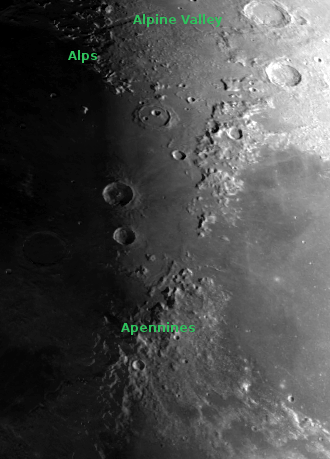
A closer look at the emerging mountains on the Moon at 9 p.m. September 8, 2016. Created using Stellarium.
More of these mountains will be revealed in coming nights.
06/25/2015 – Ephemeris – Lunar seas and highlands tell the story of the Moon’s history
Ephemeris for Thursday, June 25th. Today the Sun will be up for 15 hours and 34 minutes, setting at 9:32. The Moon, 1 day past first quarter, will set at 2:26 tomorrow morning and tomorrow the Sun will rise at 5:58.
Tuesday I talked about the brightness variation on the Moon, the bright and ancient highlands and the darker areas called seas, but a large asteroid impact areas that welled up magma from the moon’s interior erasing prior craters. The dark seas were created after most cratering had ended, or they’d be heavily cratered too. They seem to have occurred about 4 billion years ago, about 500 million years after the Moon formed. This appeared to be a period when the giant planets came closer to the Sun than they are now, before retreating again. This period is called the late heavy bombardment. Not all astronomers give it credence, but it bears out what we see in planetary systems around other stars.
Times are for the Traverse City/Interlochen area of Michigan. They may be different for your location.
Addendum
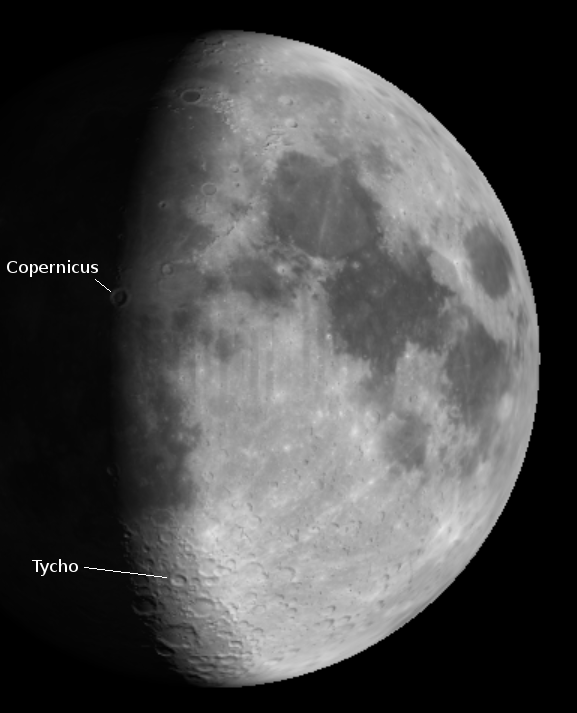
The Moon tonight with pointers to seas near the crater Copernicus and the highlands near the crater Tycho. 10:30 p.m. June 25, 2015. Created using Virtual Moon Atlas.
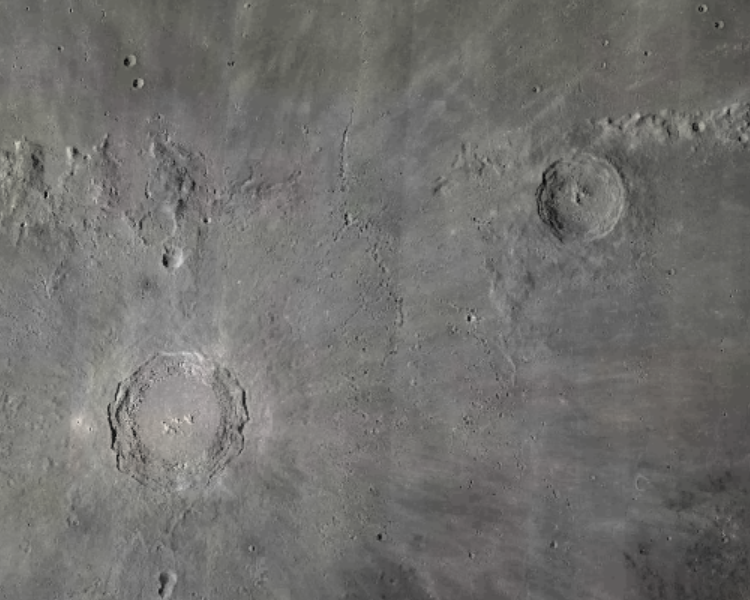
The Lunar seas near the crater Copernicus showing the smooth surface with relatively few craters. Credit: Virtual Moon Atlas with the texture from NASA’s Lunar Reconnaissance Orbiter. The lunar phase was omitted.
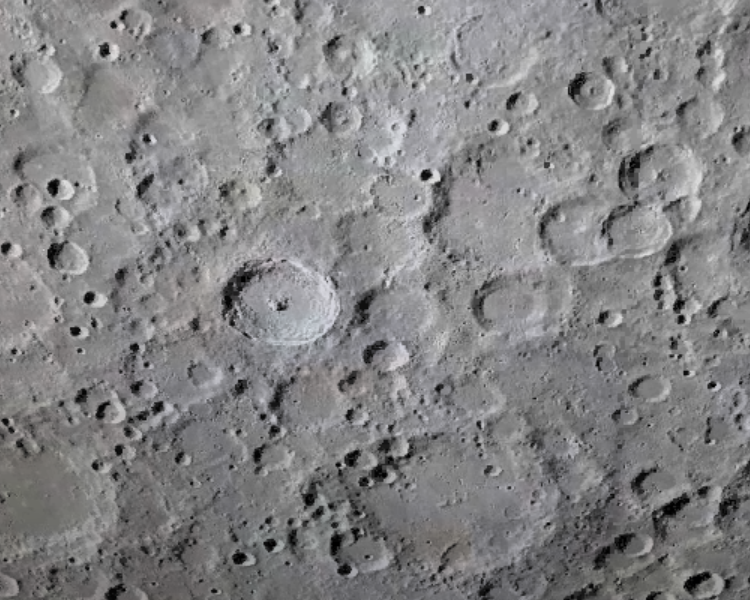
The Lunar highlands near the crater Tycho showing a surface saturated with craters. Credit: Virtual Moon Atlas with the texture from NASA’s Lunar Reconnaissance Orbiter. The lunar phase was omitted. Both images are shown to the same scale.
06/23/2015 – Ephemeris – What can you tell about the appearance of the Moon to the naked eye?
Ephemeris for Tuesday, June 23rd. Today the Sun will be up for 15 hours and 34 minutes, setting at 9:32. The Moon, 1 day before first quarter, will set at 1:31 tomorrow morning and tomorrow the Sun will rise at 5:57.
The Moon is at nearly half phase or first quarter. The unaided eye can see that the Moon has darker and lighter areas. The Greeks, who thought the objects in the heavens were perfect thought that the Moon was a silvery sphere. They never quite figured out why the moon had this mottled appearance. So why are the bright parts different from the darker parts? The bright parts are called the highlands and are the oldest part of the Moon’s surface. It’s saturated with craters from impacts since the Moon formed. The dark areas are roughly circular, and are really vast craters that penetrated through the Moon’s crust to bring up molten lava that repaved the surface of the Moon some 500 million years after it formed.
Times are for the Traverse City/Interlochen area of Michigan. They may be different for your location.
Addendum
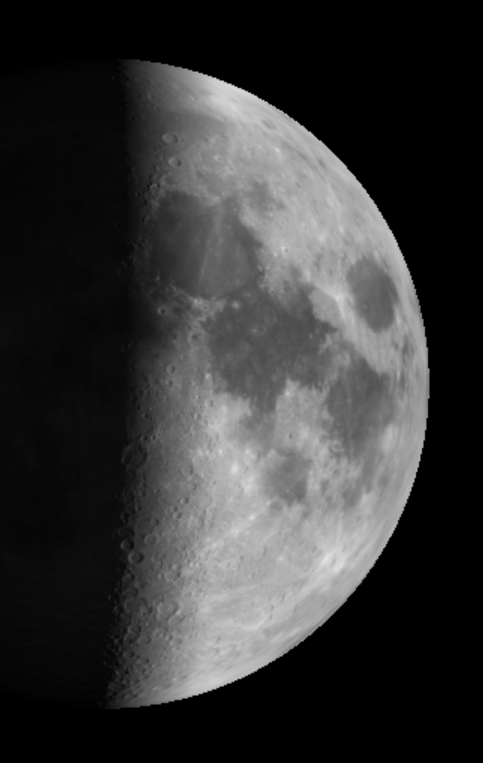
The Moon tonight (June 23, 2015). Look at the difference in the surface albedo (reflectance) between the light and dark areas and wonder about their origins. Created using Virtual Moon Atlas.
08/13/2013 – Ephemeris – Highs and lows on the moon
Ephemeris for Tuesday, August 13th. The sun rises at 6:43. It’ll be up for 14 hours and 7 minutes, setting at 8:50. The moon, 1 day before first quarter, will set at 12:04 tomorrow morning.
The moon passed Saturn a couple of hours ago while they were below the horizon. By this evening the moon will be to the left of Saturn. In each 24 hour period the moon moves about 24 times its diameter against the stars, or its own width in an hour. Looking at the moon tonight with binoculars or a telescope, the Sea of Serenity or Mare Serenitatis dominates the moon’s upper right quadrant. To me its shaped like a scallop shell. On the bottom part of the moon are the lunar highlands, bright and saturated with craters large and small. The highlands are really high, while the sea’s like Serenity are low. Should the moon have an atmosphere and water, the seas would be real, not just lava filled plains.
Times are for the Traverse City/Interlochen area of Michigan. They may be different for your location.
Addendum
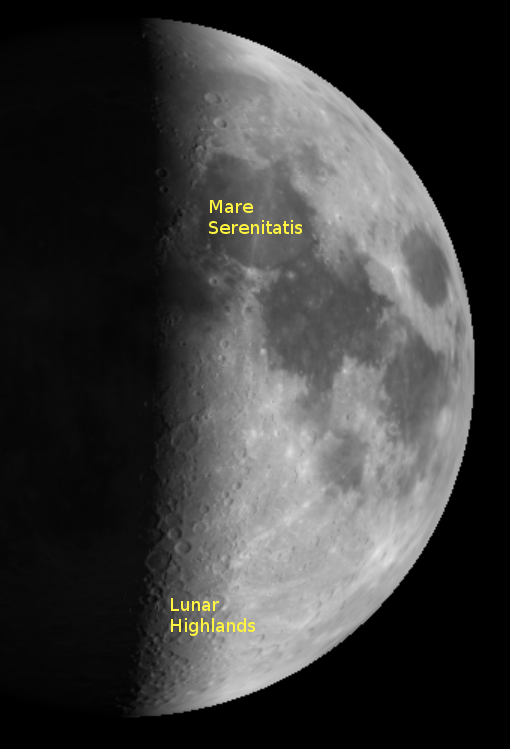
The Moon 1 day before first quarter. Created usinf Virtual Moon Atlas.
 Bob Moler's Ephemeris Blog