Archive
06/25/2015 – Ephemeris – Lunar seas and highlands tell the story of the Moon’s history
Ephemeris for Thursday, June 25th. Today the Sun will be up for 15 hours and 34 minutes, setting at 9:32. The Moon, 1 day past first quarter, will set at 2:26 tomorrow morning and tomorrow the Sun will rise at 5:58.
Tuesday I talked about the brightness variation on the Moon, the bright and ancient highlands and the darker areas called seas, but a large asteroid impact areas that welled up magma from the moon’s interior erasing prior craters. The dark seas were created after most cratering had ended, or they’d be heavily cratered too. They seem to have occurred about 4 billion years ago, about 500 million years after the Moon formed. This appeared to be a period when the giant planets came closer to the Sun than they are now, before retreating again. This period is called the late heavy bombardment. Not all astronomers give it credence, but it bears out what we see in planetary systems around other stars.
Times are for the Traverse City/Interlochen area of Michigan. They may be different for your location.
Addendum
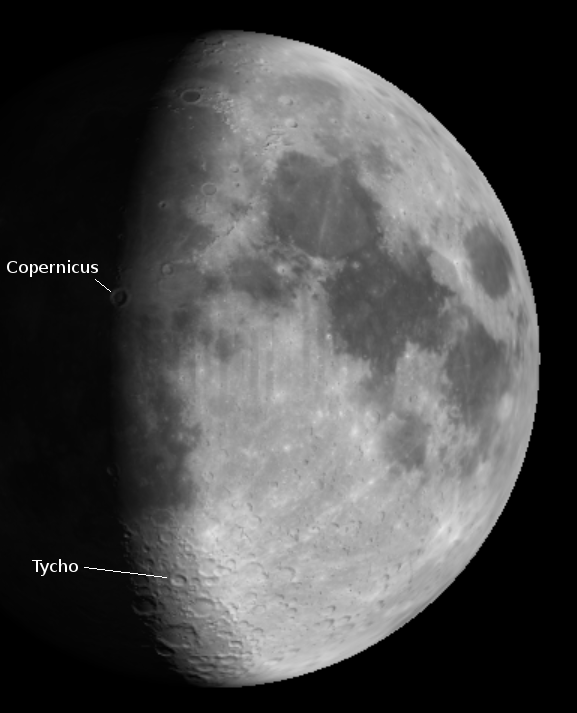
The Moon tonight with pointers to seas near the crater Copernicus and the highlands near the crater Tycho. 10:30 p.m. June 25, 2015. Created using Virtual Moon Atlas.
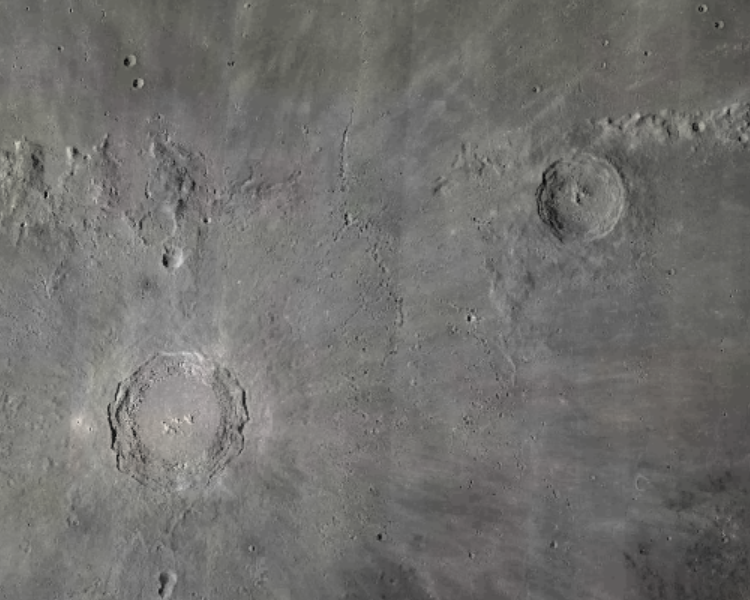
The Lunar seas near the crater Copernicus showing the smooth surface with relatively few craters. Credit: Virtual Moon Atlas with the texture from NASA’s Lunar Reconnaissance Orbiter. The lunar phase was omitted.
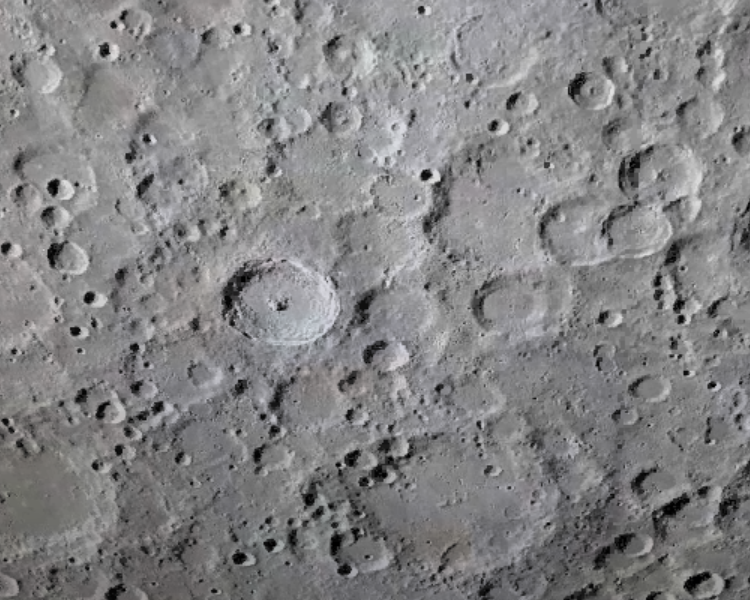
The Lunar highlands near the crater Tycho showing a surface saturated with craters. Credit: Virtual Moon Atlas with the texture from NASA’s Lunar Reconnaissance Orbiter. The lunar phase was omitted. Both images are shown to the same scale.
06/23/2015 – Ephemeris – What can you tell about the appearance of the Moon to the naked eye?
Ephemeris for Tuesday, June 23rd. Today the Sun will be up for 15 hours and 34 minutes, setting at 9:32. The Moon, 1 day before first quarter, will set at 1:31 tomorrow morning and tomorrow the Sun will rise at 5:57.
The Moon is at nearly half phase or first quarter. The unaided eye can see that the Moon has darker and lighter areas. The Greeks, who thought the objects in the heavens were perfect thought that the Moon was a silvery sphere. They never quite figured out why the moon had this mottled appearance. So why are the bright parts different from the darker parts? The bright parts are called the highlands and are the oldest part of the Moon’s surface. It’s saturated with craters from impacts since the Moon formed. The dark areas are roughly circular, and are really vast craters that penetrated through the Moon’s crust to bring up molten lava that repaved the surface of the Moon some 500 million years after it formed.
Times are for the Traverse City/Interlochen area of Michigan. They may be different for your location.
Addendum
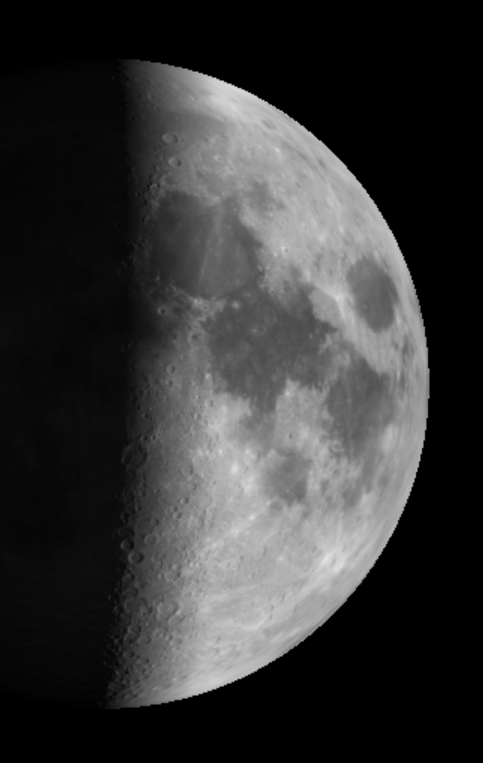
The Moon tonight (June 23, 2015). Look at the difference in the surface albedo (reflectance) between the light and dark areas and wonder about their origins. Created using Virtual Moon Atlas.
03/29/2012 – Ephemeris – The moon tonight
Ephemeris for Thursday, March 29th. The sun will rise at 7:28. It’ll be up for 12 hours and 38 minutes, setting at 8:06. The moon, 1 day before first quarter, will set at 2:55 tomorrow morning.
Tonight’s moon will be nearly half full. The gray patches on the moon are from the upper right the sea of Crises, Below it is the sea of fertility, centered on the moon’s equator is the sea of Tranquility. Above that is the scallop shaped sea of Serenity. One of the interesting craters in viwe for a telescope now is the ruined crater Julius Caesar. It’s on the edge of Tranquility near Serenity. This is an ancient crater whose crater walls were breached by the impact that created the sea of Tranquility, so it kind of looks like the letter C. So how did this crater become named for a Roman Emperor? My only guess is that it was for his calendar reform giving us the 365 day year with a leap year every 4th. This is also a good time to check out the rest of the moon.
* Times are for the Traverse City/Interlochen area of Michigan. They may be different for your location.
Addendum
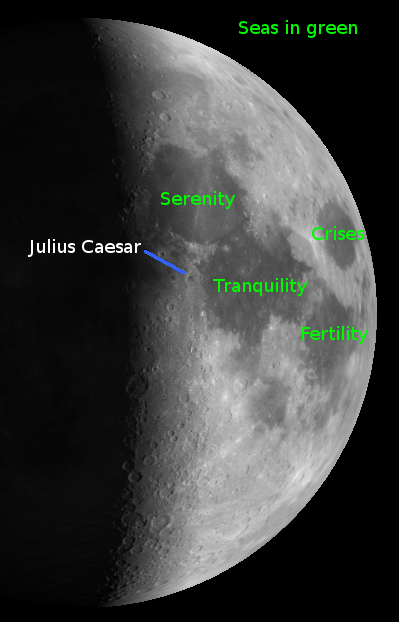
The moon at 10 p.m. 3/29/2012. Created using Virtual Moon Atlas.
03/08/2012 – Ephemeris – The full moon
Ephemeris for Thursday, March 8th. The sun will rise at 7:06. It’ll be up for 11 hours and 33 minutes, setting at 6:40. The moon, at full today, will rise at 7:30 this evening.
The full moon, contrary to what you’d think is a poor time to observe it. The moon is essentially gray on gray. And at full moon we are looking at the moon from about the same perspective as the sun, so there are no shadows to delineate its fine features. Since the actual instant of full moon occurred at 5 this morning, some shadows will be creeping in on the moon’s upper right face as it is seen in the evening. Full moon is the best time to see the maria or lunar seas, the dark areas that make up the man in the moon. In binoculars can be seen the bright rays emanating from the crater Tycho near the south end of the moon. Other craters have rays too, but none so long and distinctive. Night by night for the next two weeks the moon’s illuminated landscape will wane.
* Times are for the Traverse City/Interlochen area of Michigan. They may be different for your location.
Addendum
The image below is of the waxing gibbous moon presumably from last Sunday night. The phase fits Virtual Moon Atlas for that date. And I received the photo Monday. many of the full moon features including the maria and the crater Tycho can be seen on it. Click on it to see the larger version.
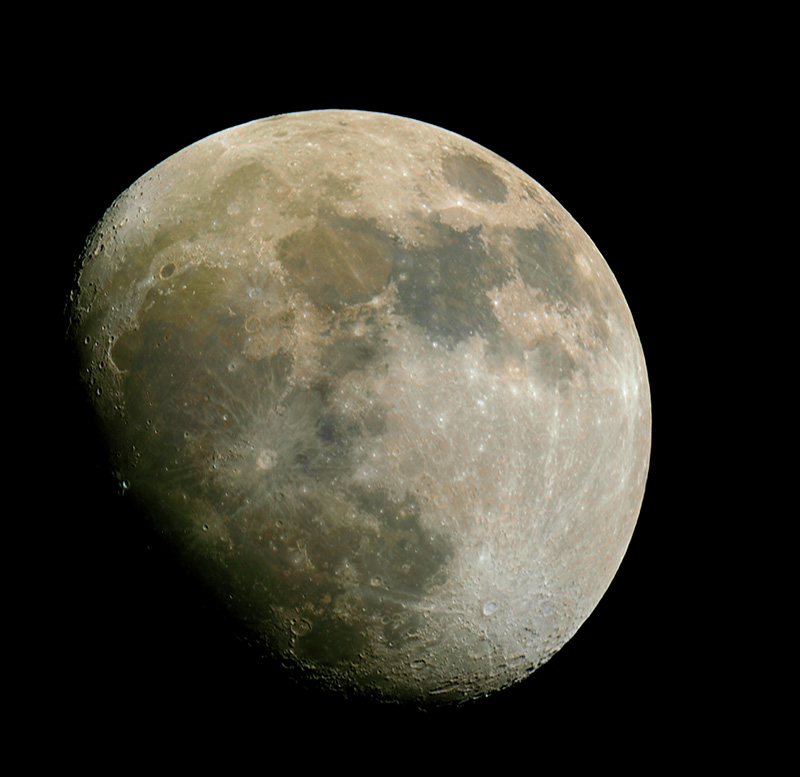
The gibbous moon 03/04/2012 by Scott Anttila
This is from Scott: “The full-size image is huge, a 6 panel mosaic by my DSLR in the (Celestron) C11. It has had the saturation boosted to show detail in the seas that otherwise is difficult if not impossible to detect. You can also see where different minerals are located in the highland areas. Not many people like this view of the moon, I’m fairly fond of it.”
08/08/11 – Ephemeris – The lunar seas and the possible second moon theory
Monday, August 8th. The sun rises at 6:36. It’ll be up for 14 hours and 22 minutes, setting at 8:58. The moon, 2 days past first quarter, will set at 2:17 tomorrow morning.
With the announcement last week that the earth may have had two moons, we’d kind of look at our surviving moon in a new light. Tonight the terminator, the line between light and dark on the moon, really the sunrise line crosses through the Sea of Clouds or Mare Imbrium. Telescope will reveal the crater Copernicus near the moon’s equator that will come into sunlight an hour from now as you listen to this. Two astronomers from the US and Switzerland propose that the collision of the earth that created the moon also created another moon. After a time this second, smaller moon crashed into our moon and created the dark seas on the side that faces the earth. The far side of the moon only has one small sea, the Sea of Moscow, discovered by the Russians in 1959 with their Lunik 3 spacecraft.
* Times are for the Traverse City/Interlochen area of Michigan. They may be different for your location.
 Bob Moler's Ephemeris Blog