Archive
06/13/2023 – Ephemeris – Messier 13, the Great star cluster in Hercules
This is Bob Moler with Ephemeris for Tuesday, June 13th. Today the Sun will be up for 15 hours and 32 minutes, setting at 9:29, and it will rise tomorrow at 5:56. The Moon, 3 days past last quarter, will rise at 3:34 tomorrow morning.
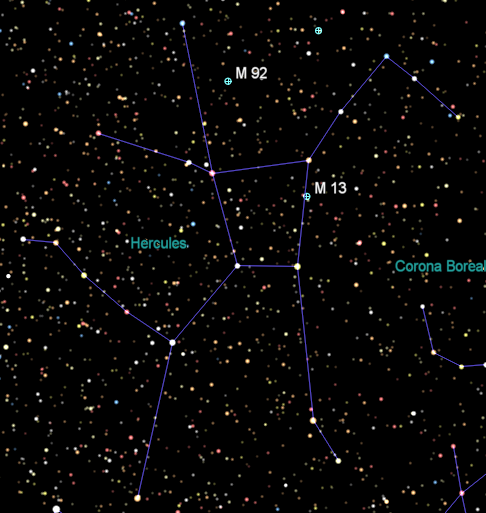
About a third of the way between the bright stars Vega which is high in the east and Arcturus, high in the south, can be found the Keystone of Hercules, a four-star box wider at the top than at the bottom. Along the right edge, a third of the way down is what looks like a faint star to someone with really good vision. In binoculars the star becomes fuzzy. One needs a larger telescope probably six or eight inches in diameter to begin to see some stars among the fuzziness. That is a globular star cluster containing hundreds of thousands of stars. This is the Great Hercules Globular Star Cluster. It’s beautiful if seen in a large telescope, such as the one brought out to the star parties at the Sleeping Bear Dunes, especially in August and September.
The astronomical event times given are for the Traverse City/Interlochen area of Michigan (EDT, UT –4 hours). They may be different for your location.
Addendum
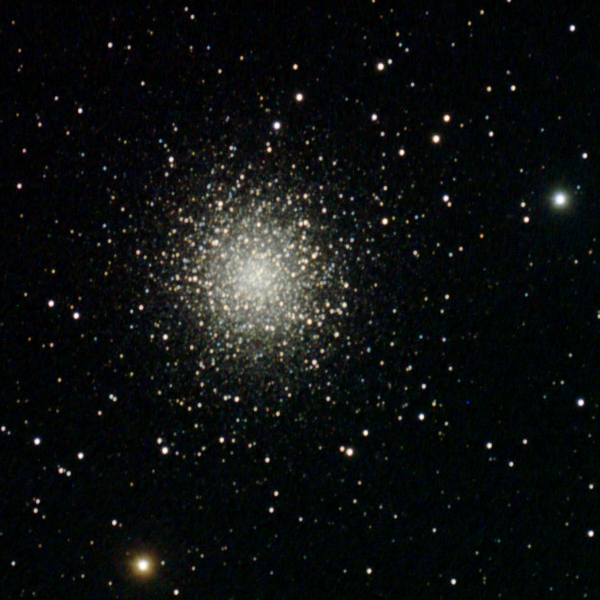
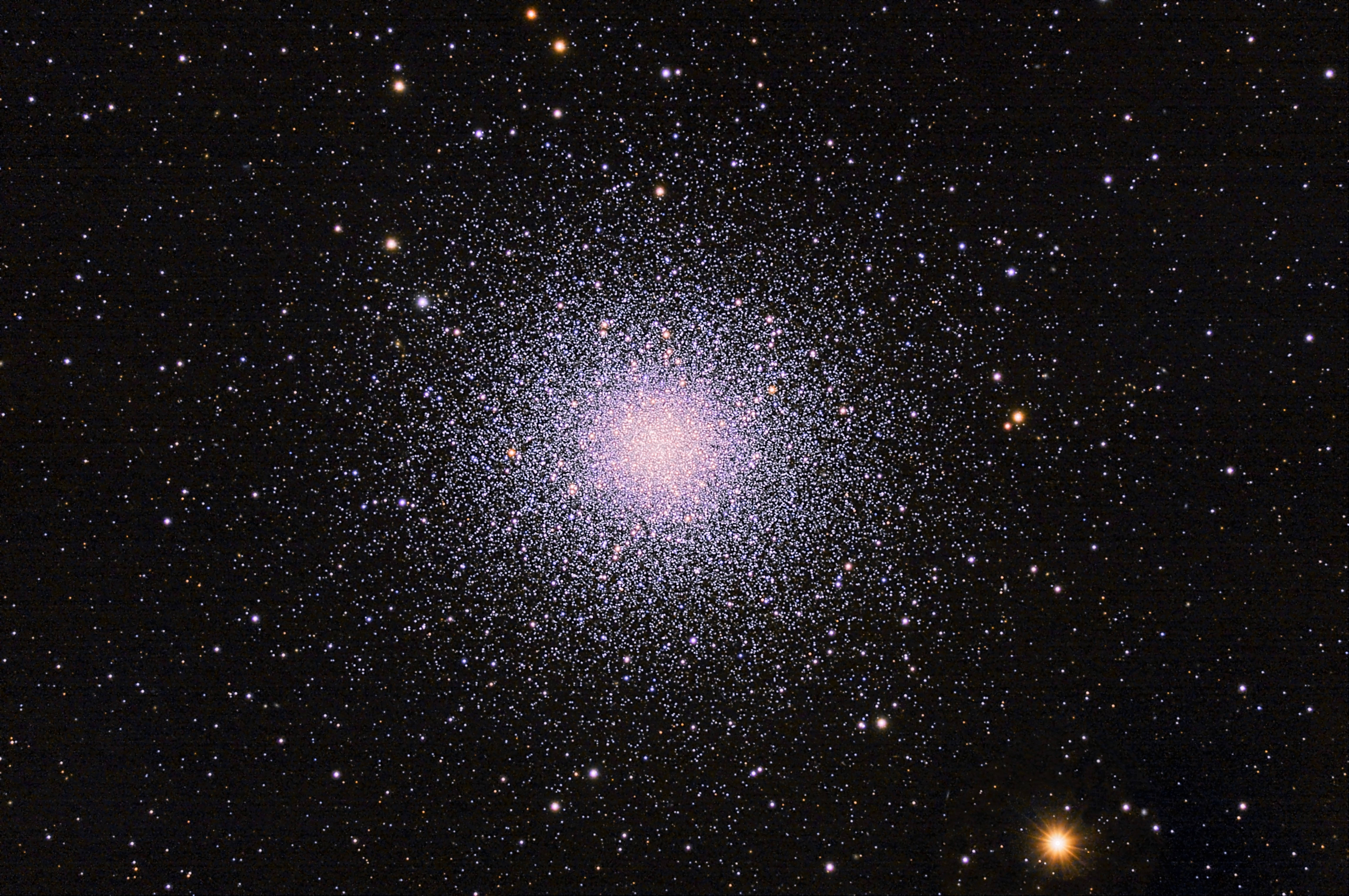
Dan’s image is rotated from Scott’s. The bright star at the lower left of Scott’s image is the same as the one at the lower left of Dan’s.
Globular star clusters are uniformly very old. M 13 is estimated to be between 11 and 12 billion years old, more than twice as old as our Sun and the solar system. As I say in my talks: “They don’t make them like that any more.” Globular clusters form a spherical distribution around the Milky Way galaxy with an increasing concentration toward the center. Do they reveal the original spherical shape of the galaxy before the gas and dust collapsed into the disk of the galaxy we see today? The star clusters that form today lie in the disk, and contain a few hundreds or a thousand stars. They are called open or galactic star clusters. The Pleiades is the most famous example of this type of star cluster.
06/12/2023 – Ephemeris -Finding Hercules among the stars
This is Ephemeris for Monday, June 12th. Today the Sun will be up for 15 hours and 31 minutes, setting at 9:28, and it will rise tomorrow at 5:56. The Moon, 2 days past last quarter, will rise at 3:13 tomorrow morning.
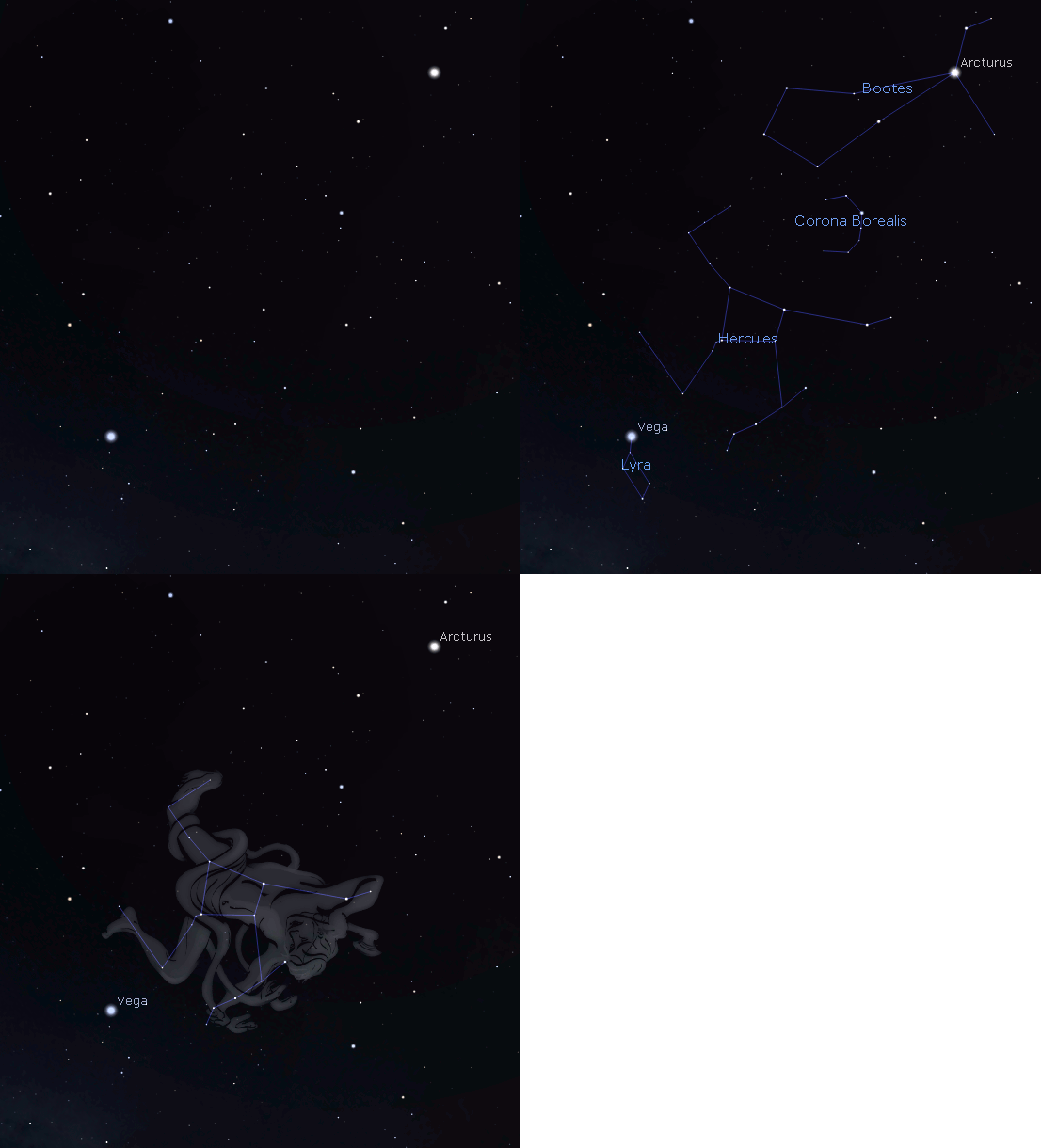
Orion, the hard luck mythical Greek hunter, gets a splashy constellation in the winter sky, but the greatest hero of all, Hercules, gets a dim group of stars on the border between the spring and summer stars. At 11 p.m. Hercules is high in the east-southeast. It is located above and right of the bright star Vega, in the east. Hercules’ central feature is a keystone shaped box of stars, called, of course, the Keystone of Hercules tilted to the left, which represents the old boy’s shorts. From the top and left corner stars extend lines of stars that are his legs, from the bottom and right stars, the rest of his torso and arms extend. So in one final indignity, he’s upside down in our sky. For those with a telescope, Hercules contains the beautiful globular star cluster Messier 13.
The astronomical event times given are for the Traverse City/Interlochen area of Michigan (EDT, UT –4 hours). They may be different for your location.
Addendum

05/31/2021 – Ephemeris – Hercules the constellation
This is Bob Moler with Ephemeris for Memorial Day, Monday, May 31st. Today the Sun will be up for 15 hours and 19 minutes, setting at 9:20, and it will rise tomorrow at 6:00. The Moon, 2 days before last quarter, will rise at 2:23 tomorrow morning.
Orion, the hard luck mythological Greek hunter gets a splashy constellation in the winter sky, but the greatest hero of all, Hercules, gets a dim group of stars on the border between the spring and summer stars. At 11 p.m. Hercules is fairly high in the east. It is located above and a bit right of the bright star, Vega east-northeast. Hercules’ central feature is a keystone shaped box of stars, called the Keystone laying on its side, which represents the old boy’s shorts. From each left corner stars extend lines of stars that are his legs, from the right stars, the rest of his torso and arms extend. So in one final indignity he’s upside down in our sky. For those with a telescope, Hercules contains the beautiful globular star cluster Messier 13.
The astronomical event times given are for the Traverse City/Interlochen area of Michigan. They may be different for your location.
Addendum
Hercules can be found in the east among the line of constellations at around 11 pm in late May or early June between the bright stars Arcturus and Vega. Created using Stellarium and GIMP.
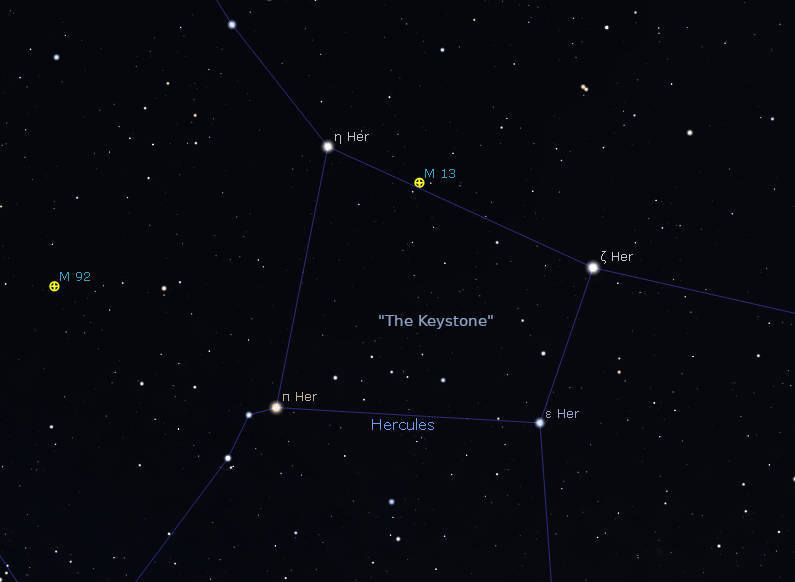
M 13 is found on the western side of the Keystone. In this orientation when Hercules is in the east, it is the top side. Created using Stellarium with an annotation.
M 13, the Great Globular Star Cluster in Hercules. Credit: Scott Anttila.
M 13 is the brightest and finest globular star cluster in the northern hemisphere of the sky. It’s at a distance of 25 thousand light years. Some amateur astronomers can spot M 13 with the naked eye. It is a fuzzy spot in binoculars. I can barely resolve some of its stars in an 8-inch (200 mm) telescope. It’s a wonderful sight in anything bigger! The slightly dimmer M 92 is also slightly farther away at nearly 27 thousand light years.
Click on any of the images above to enlarge them.
 Bob Moler's Ephemeris Blog