Archive
Ephemeris: 03/27/2025 – Cancer the celestial crab
This is Bob Moler with Ephemeris for Thursday, March 27th. Today the Sun will be up for 12 hours and 32 minutes, setting at 8:04, and it will rise tomorrow at 7:30. The Moon, 2 days before new, will rise at 7:08 tomorrow morning.
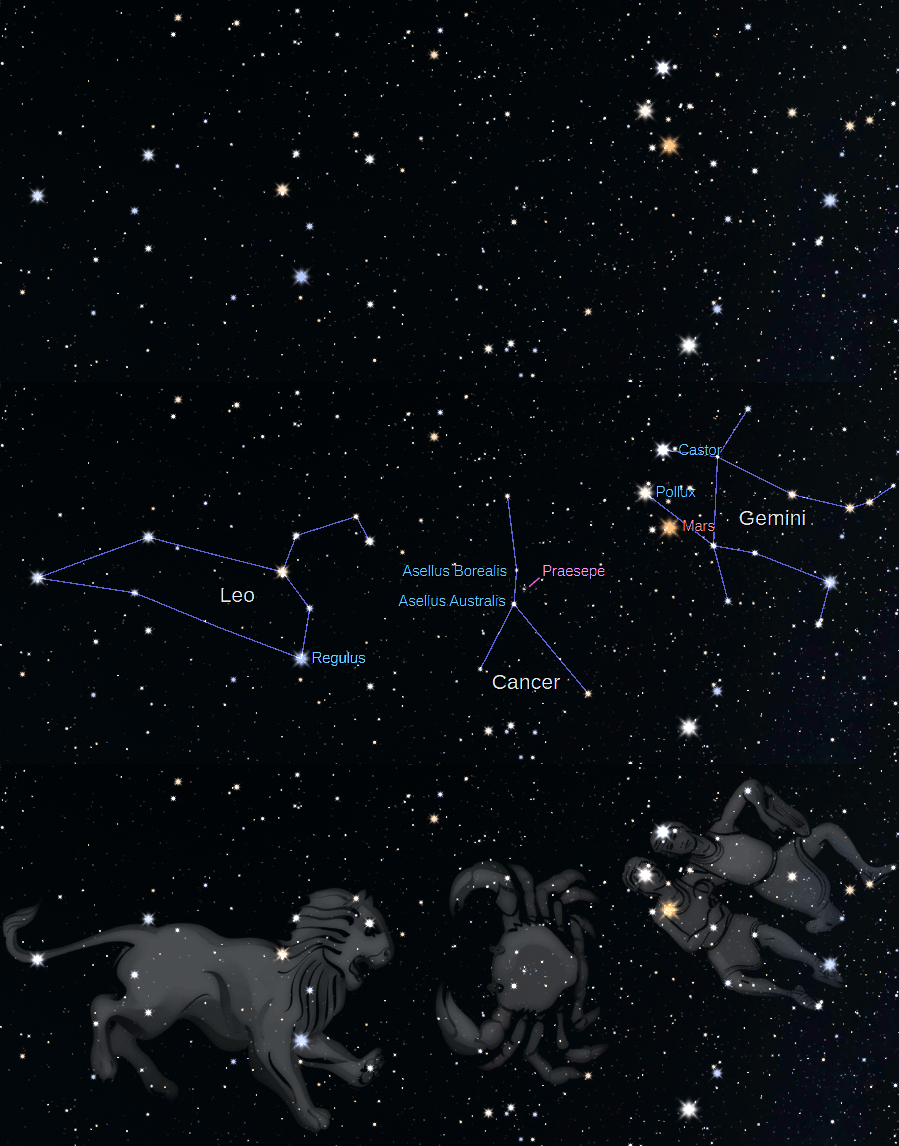
At 10 PM, between the stars Castor and Pollux in Gemini high in the southwest and the star Regulus in Leo the Lion in the southeast lies the dimmest constellation of the zodiac, Cancer the crab. To me its 5 brightest stars make an upside down Y. There are the stars in the center of the constellation Asellus Borealis and Asellus Australis, the north and south donkeys. There’s a fuzzy spot between and just west of them called Praesepe, the manger, from which they are eating hay. In binoculars, it resolves into a cluster of stars called the Beehive cluster. We amateur astronomers also know it as M44, the 44th object on 18th century comet hunter Charles Messier’s list of fuzzy objects that might be mistaken for comets.
The astronomical event times given are for the Traverse City/Interlochen area of Michigan (EDT, UT – 4 hours). Times will be different for other locations.
Addendum
06/22/2021 – Ephemeris – Mars is poised to cross in front of the Beehive Star Cluster tonight
This is Bob Moler with Ephemeris for Tuesday, June 22nd. Today the Sun will be up for 15 hours and 34 minutes, setting at 9:32, and it will rise tomorrow at 5:57. The Moon, 2 days before full, will set at 4:41 tomorrow morning.
Tonight, the planet Mars will be at the western edge of the Beehive star cluster. Tomorrow night, Mars will be seen against its stars. Normally, the Beehive star cluster is easily seen in binoculars. The problem is, that both the cluster and Mars will be low in the west-northwestern sky, only six to seven degrees above a sea or lake horizon near the optimal time to spot them of 11 pm. It has been 8 months since Mars was opposite the Sun in our skies, and relatively close to us. Back then it was as bright as Jupiter and relatively close to the Earth. Now, Mars is 221 million miles (356 million kilometers) and 5 times farther aw0ay, about half the distance to Jupiter. It’s tiny in telescopes and very hard to pick out of the dim twilight glow of 11 pm.
The astronomical event times given are for the Traverse City/Interlochen area of Michigan (EDT, UT-4). They may be different for your location.
Addendum
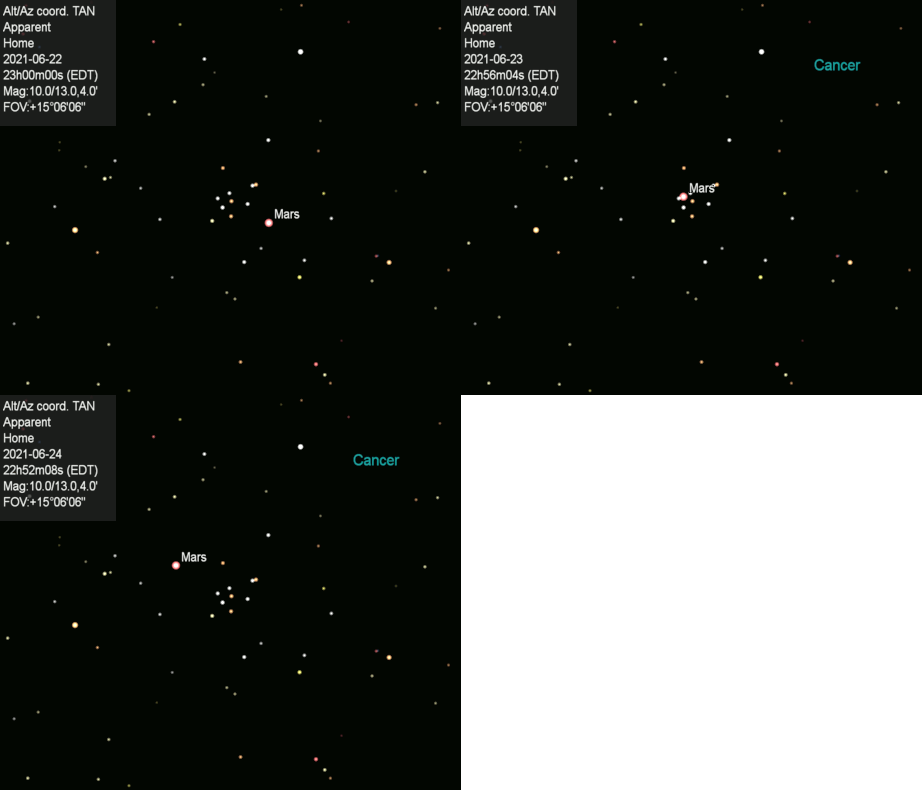
Mars passing in front of M44 as a GIF animation. This is difficult to spot with binoculars low in the west-northwest at 11 pm on the nights of June 22nd, 23rd and 24th. The Beehive star cluster is a relatively close and sparse cluster. On dark nights in early spring, the cluster looks like a fuzzy spot to the naked-eye. It reveals its true nature in binoculars. Created using Cartes du Ciel.
05/17/2021 – Ephemeris – The Moon tonight
This is Ephemeris for Monday, May 17th. Today the Sun will be up for 14 hours and 54 minutes, setting at 9:06, and it will rise tomorrow at 6:11. The Moon, 2 days before first quarter, will set at 2:25 tomorrow morning.
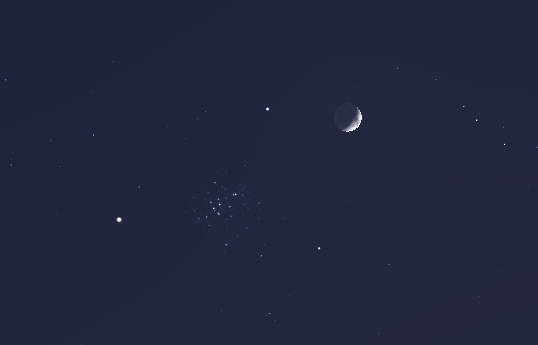
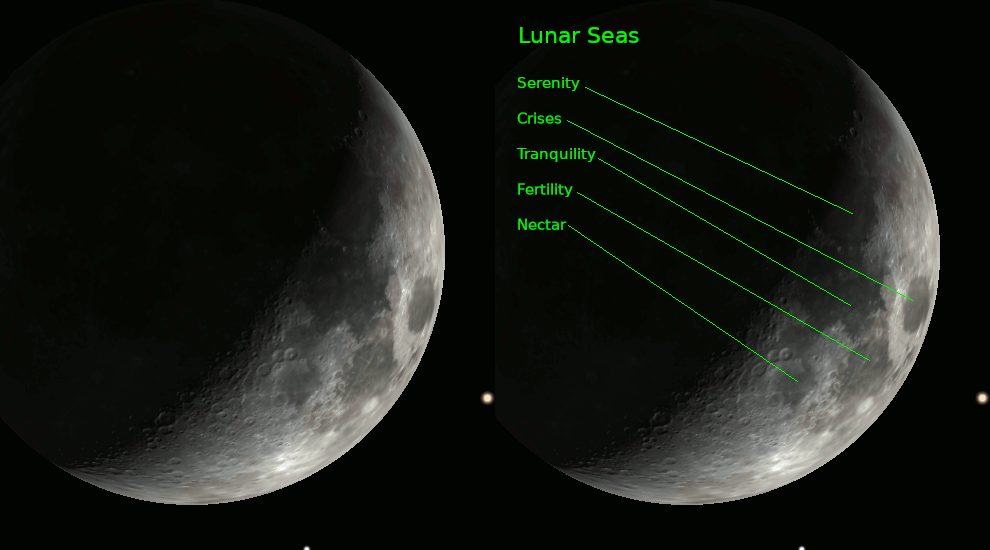
The Moon tonight reveals a bit more territory than it did last night, and will every night until full moon. The Moon’s solar day equals a lunar month of about 29 and a half of our days. As seen in binoculars, below and left of The distinctly oval Sea of Crises, or Mare Crisium, is the Sea of Fertility, or Mare Fecunditatis. To the left of the Sea of Crises, the Sea of Tranquility (Tranquilitatis) where the Apollo 11 crew landed. Above that half of Sea of Serenity has come into daylight. Tonight the Beehive star cluster will be visible below and left of the Moon. It should be easily visible in binoculars and has a vaguely triangular shape. It was known to the ancients as Praesepe, the manger, who saw it as a glowing spot on moonless nights.
The astronomical event times given are for the Traverse City/Interlochen area of Michigan. They may be different for your location.
Addendum
03/04/2021 – Ephemeris – A very crabby constellation
Mar 4. This is Ephemeris for Thursday, March 4th. Today the Sun will be up for 11 hours and 20 minutes, setting at 6:34, and it will rise tomorrow at 7:12. The Moon, 1 day before last quarter, will rise at 1:26 tomorrow morning.
Lying between the stars Castor and Pollux in Gemini high in the southeast and the star Regulus in Leo the Lion in the east-southeast is the dimmest constellation of the zodiac, Cancer the crab. To me its 5 brightest stars make an upside down Y. There are the stars in the center of the constellation Asellus Borealis and Asellus Australis, the north and south donkeys. There’s a fuzzy spot between and just west of them called Praesepe, the manger from which they are supposedly eating. In binoculars, it resolves into a cluster of stars called the Beehive star cluster. We amateur astronomers also know it as M 44, the 44th object on 18th century comet hunter Charles Messier’s list of fuzzy objects that might be mistaken for comets.
The astronomical event times given are for the Traverse City/Interlochen area of Michigan. They may be different for your location.
Addendum
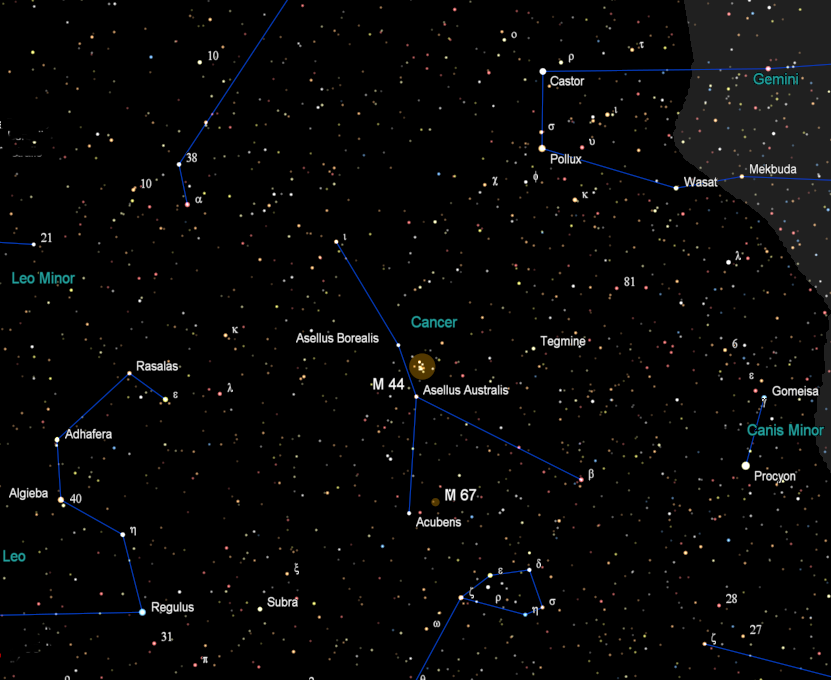
The constellation Cancer finder chart. Created using Cartes du Ciel (Sky Charts).
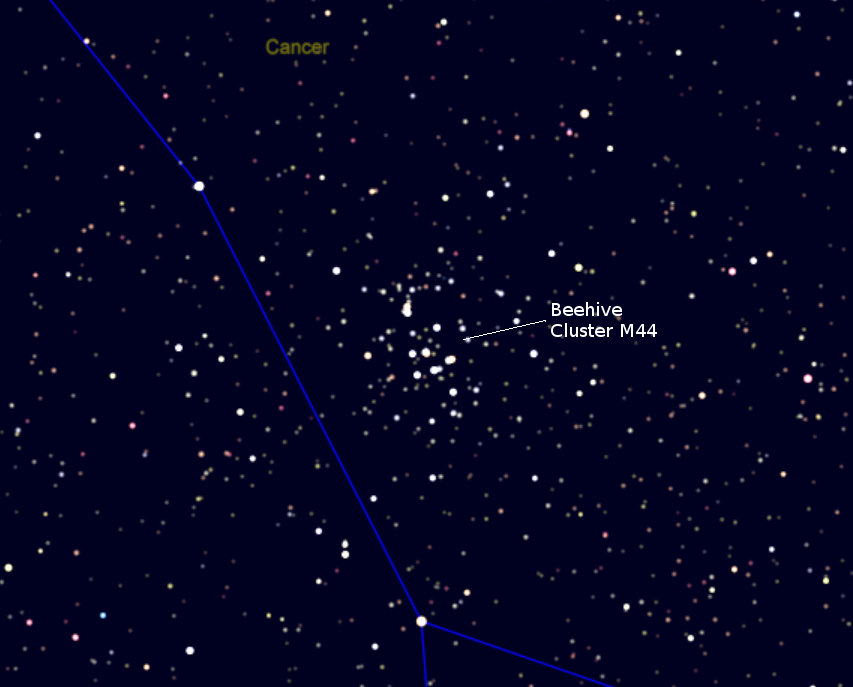
The Beehive star cluster, M44. Its ancient name was the Praesepe or manger when glimpsed by the naked eye. Created using Cartes du Ciel (Sky Charts)
Note in the top image above the star cluster M 67 at the bottom of Cancer, near the star Acubens. M 67 requires a small telescope to spot. They are both open or galactic star clusters which lie in or very near the plane of the Milky Way, denoted by the milky band. Part of the milky band can be seen at the upper right of the chart. M 44 is quite close to us, at only 610 light years away so is physically close to the plane of the Milky Way. M67, however is 2,610 to 2,930 light years away and is quite a bit farther than M 44 from the plane of the Milky Way. It is also much older (4 billion years old) than the stars of the Beehive (600 to 700 years old).
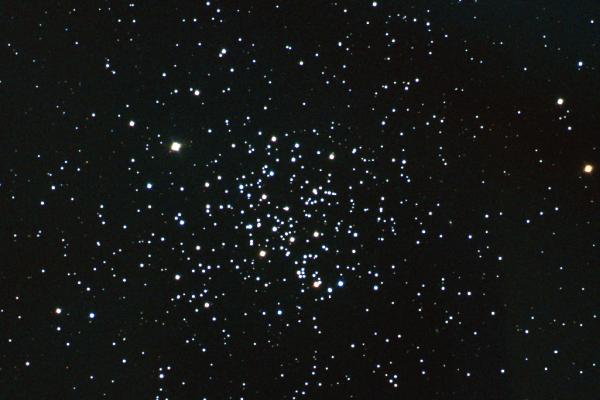
M67 is a beautiful telescopic object. Credit Nigel Sharp, Mark Hanna, AURA/NOAO/NSF.
 Bob Moler's Ephemeris Blog