Archive
05/22/2019 – Ephemeris – Where are the bright planets for this week
Ephemeris for Wednesday, May 22nd. Today the Sun will be up for 15 hours and 3 minutes, setting at 9:11, and it will rise tomorrow at 6:06. The Moon, half way from full to last quarter, will rise at 12:56 tomorrow morning.
Let’s look at the planets for this week. Mars will be low in the west-northwestern sky this evening, entering Gemini near Castor’s foot. It will set at 11:52 p.m. In the morning sky we have Jupiter, in Ophiuchus, which will actually rise at 10:38 tonight in the east-southeast. Jupiter won’t be considered an evening planet until it rises before sunset, which will occur after June 10th. Saturn will be next to rise at 12:40 a.m., also in the east-southeast. It’s in Sagittarius. Both planets are easily visible in as morning twilight grows. Venus will rise 53 minutes before the Sun in the east northeast. It will remain in our morning sky, though too close to the rising Sun to be easily glimpsed. In August it will pass behind the Sun to enter the evening sky.
The times given are for the Traverse City/Interlochen area of Michigan. They may be different for your location.
Addendum
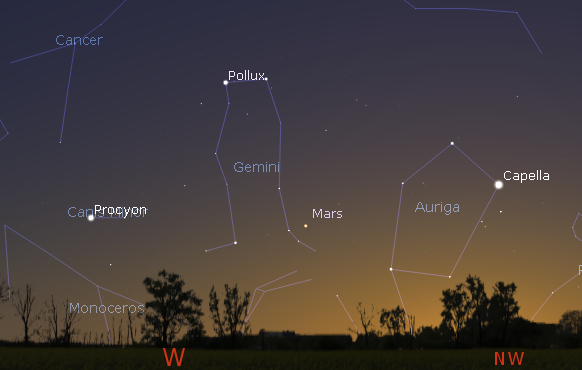
Mars and the setting winter stars tonight at 10 p.m. May 22, 2019. Click on the image to enlarge. Created using Stellarium.
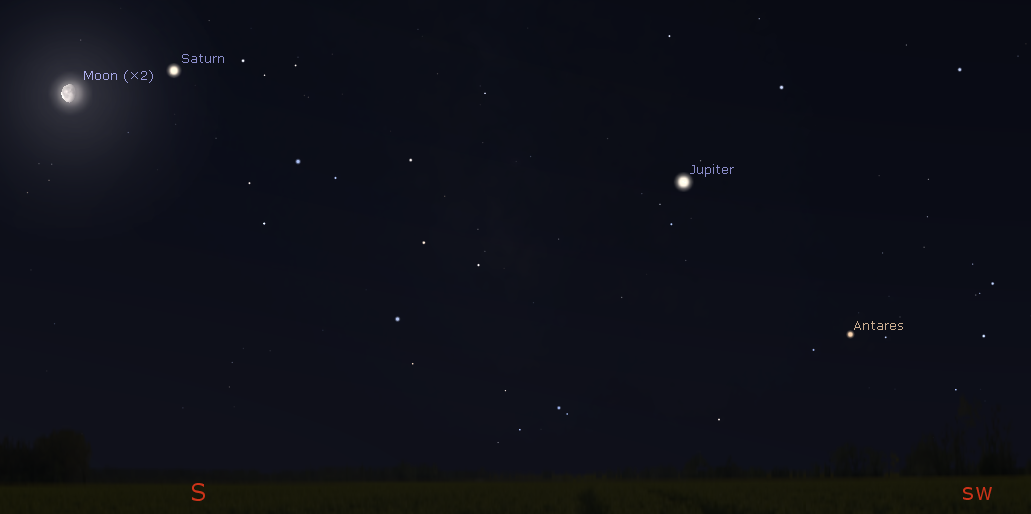
Jupiter, Saturn and the Moon at 5 a.m. May23, 2019. Click on the image to enlarge. Created using Stellarium.
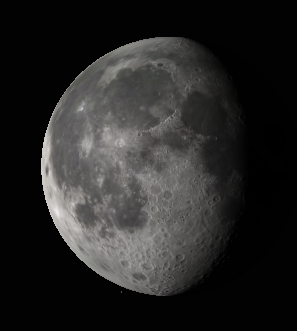
The waning gibbous Moon at 5 a.m. May 23, 2019. Created using Stellarium.
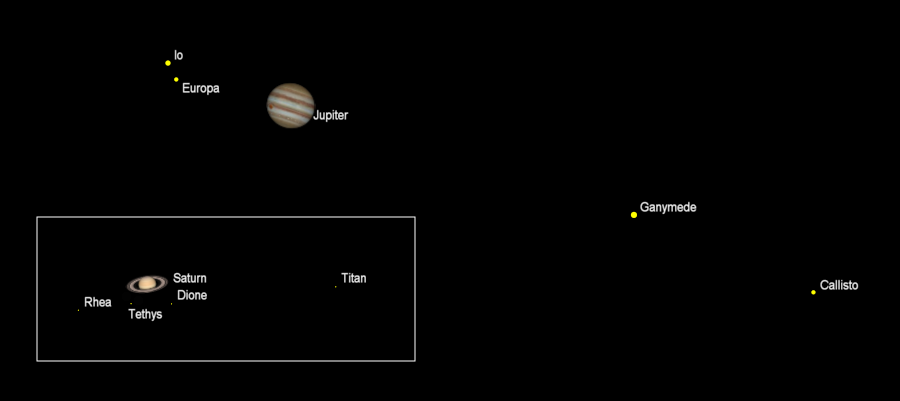
Jupiter and Saturn with the same magnification at 5 a.m. tomorrow morning May 23, 2019. Created using Cartes du Ciel (Sky Charts).
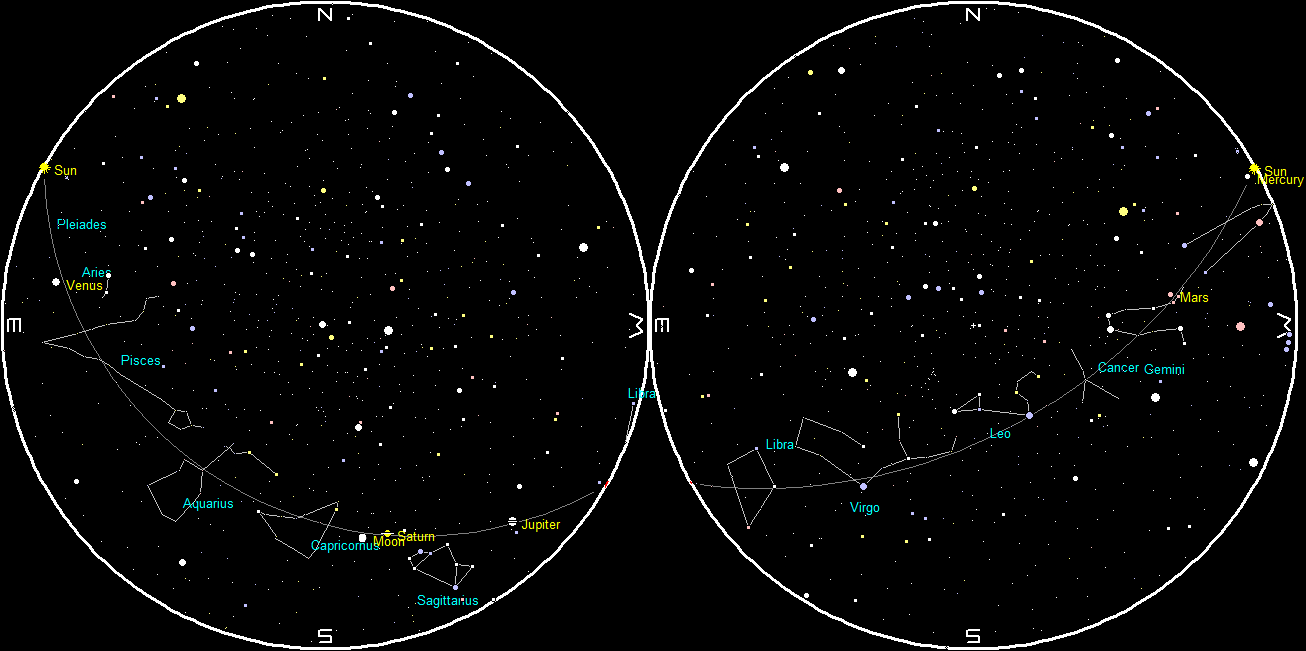
Planets and the Moon at sunset and sunrise of a single night starting with sunset on the right on May 22, 2019. The night ends on the left with sunrise on the 23rd. Click on the image to enlarge. Created using my LookingUp program.
05/15/2019 – Ephemeris – The bright planets this week
Ephemeris for Wednesday, May 15th. Today the Sun will be up for 14 hours and 49 minutes, setting at 9:04, and it will rise tomorrow at 6:13. The Moon, 3 days before full, will set at 5:22 tomorrow morning.
Let’s look at the planets for this week. Mars will be in the western sky this evening, entering Gemini near Castor’s foot. It will set at 12:04 a.m. In the morning sky we have Jupiter, in Ophiuchus, which will actually rise at 11:09 tonight in the east-southeast. Jupiter won’t be considered an evening planet until it rises before sunset, which will occur after June 10th. Saturn will be next to rise at 1:04 a.m., also in the east-southeast. It’s in Sagittarius. Both planets are easily visible in as morning twilight grows. Venus will rise 53 minutes before the Sun in the east. It will remain in our morning sky, though too close to the rising Sun to be easily glimpsed. In August it will pass behind the Sun to enter the evening sky.
The times given are for the Traverse City/Interlochen area of Michigan. They may be different for your location.
Addendum
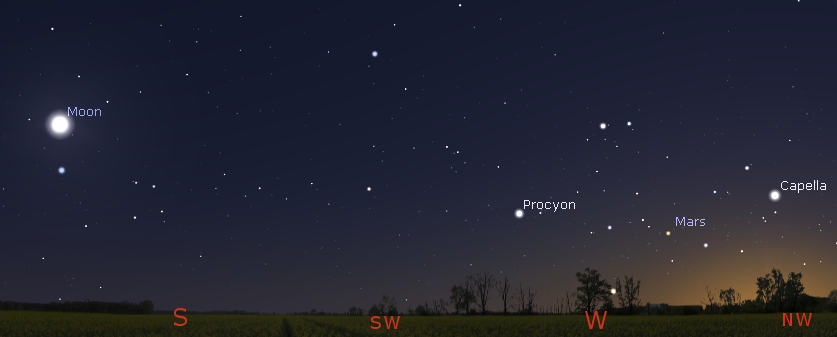
Mars and the Moon tonight at 10 p.m. May 15, 2019. Click on the image to enlarge. Created using Stellarium.
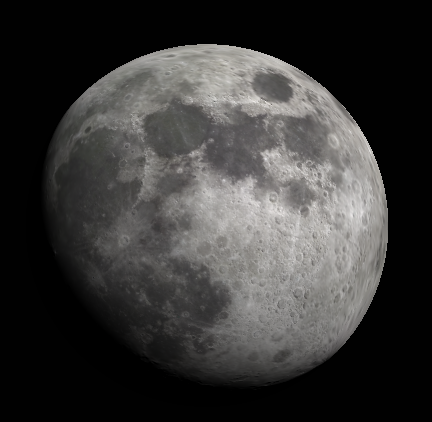
The waxing gibbous nearly full Moon at 10 p.m. May 15, 2019. Created using Stellarium.
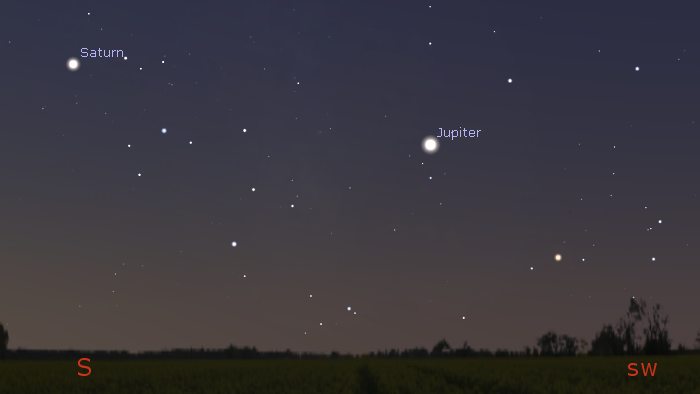
Morning planets at 5:30 a.m. May 16, 2019. Click on the image to enlarge. Created using Stellarium.
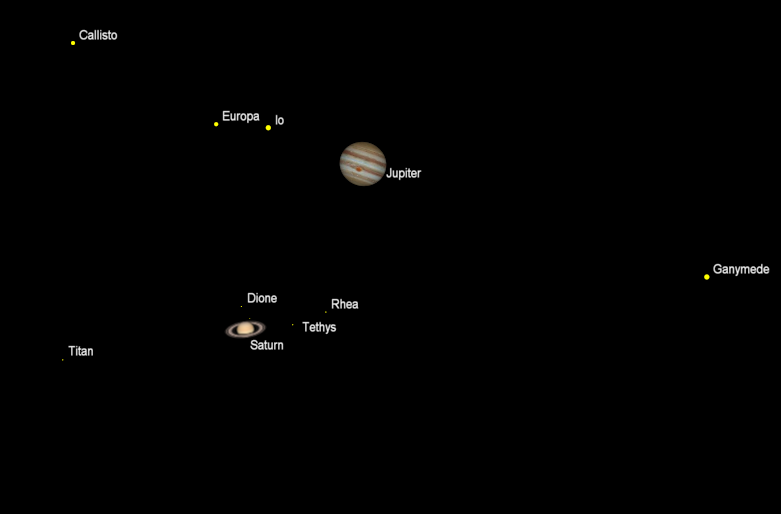
Jupiter and Saturn with the same magnification at 5:30 a.m. tomorrow morning May 16, 2019. Created using Cartes du Ciel (Sky Charts).
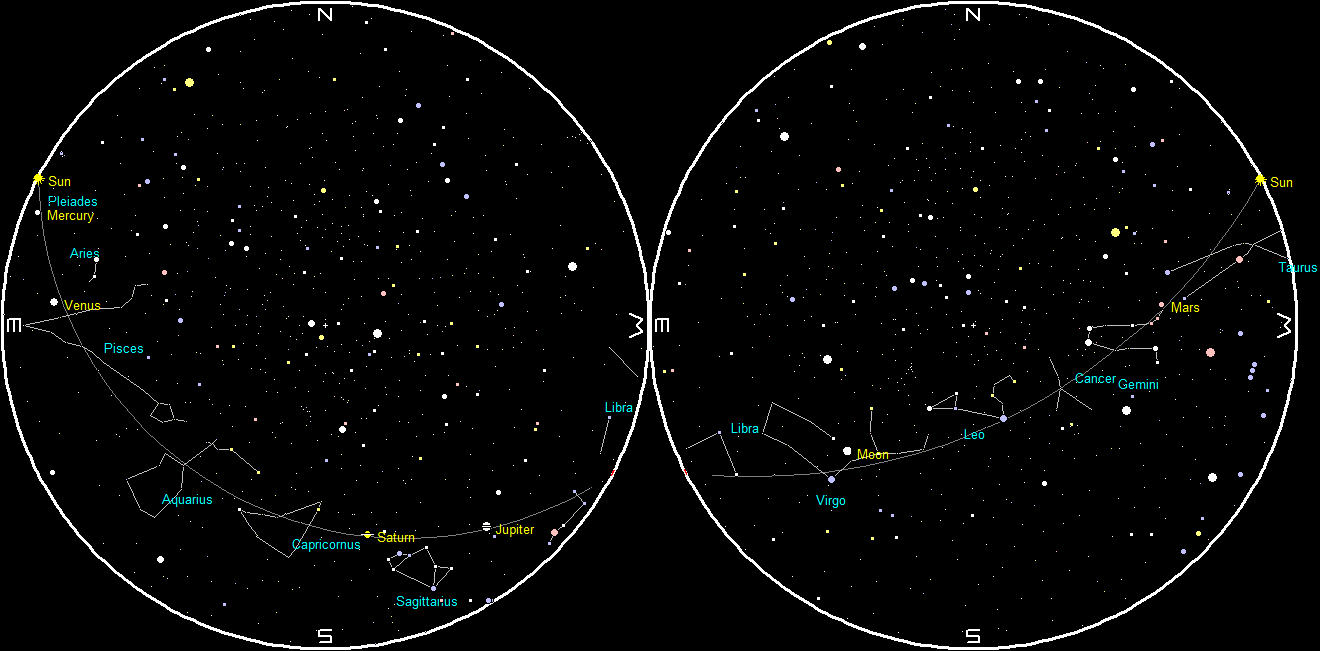
Planets and the Moon at sunset and sunrise of a single night starting with sunset on the right on May 15, 2019. The night ends on the left with sunrise on the 16th. Click on the image to enlarge. Created using my LookingUp program.
05/08/2019 – Ephemeris – Let’s look at the bright planets for this week
Ephemeris for Wednesday, May 8th. Today the Sun will be up for 14 hours and 32 minutes, setting at 8:55, and it will rise tomorrow at 6:22. The Moon, 3 days before first quarter, will set at 12:59 tomorrow morning.
Let’s look at the planets for this week. Mars will be in the western sky this evening, between Gemini and Taurus the bull. It will set at 12:07 a.m. In the morning sky we have Jupiter, in Ophiuchus, which will actually rise at 11:40 tonight in the east-southeast. Saturn will be next to rise at 1:32 a.m., also in the east-southeast. It’s in Sagittarius. Both planets are easily visible in the morning twilight. Venus will rise 53 minutes before the Sun in the east. It will remain in our morning sky, though too close to the rising Sun to be easily glimpsed. In August it will pass behind the Sun to enter the evening sky. It will be in position later this year to be our bright evening Christmas Star.
The times given are for the Traverse City/Interlochen area of Michigan. They may be different for your location.
Addendum
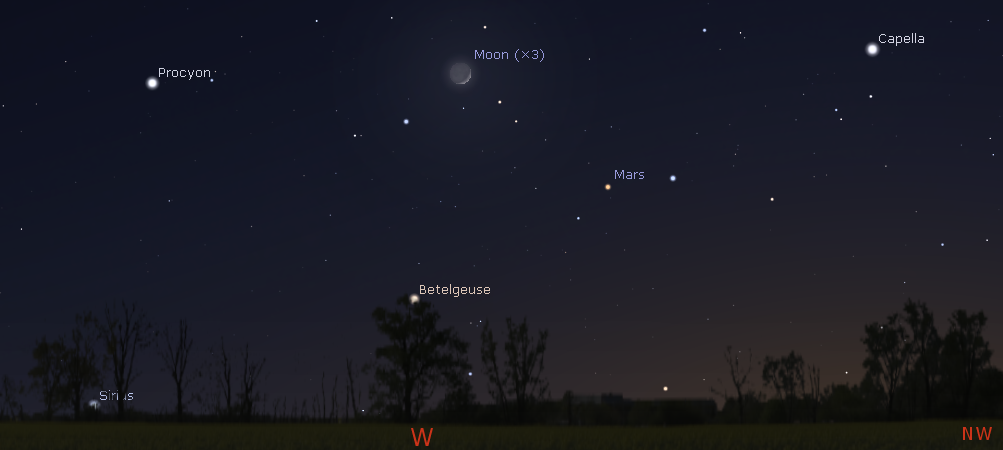
Mars and the Moon (at 3 times its actual size) tonight at 10 p.m. May 8, 2019. Click on the image to enlarge. Created using Stellarium.
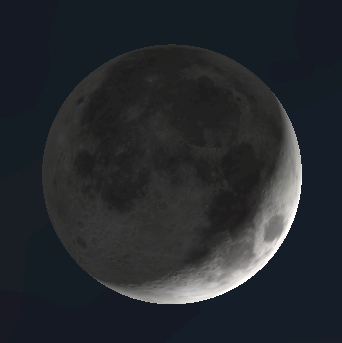
The Moon as it might appear in binoculars or a small telescope tonight at 10 p.m. May 8, 2019. Created using Stellarium.
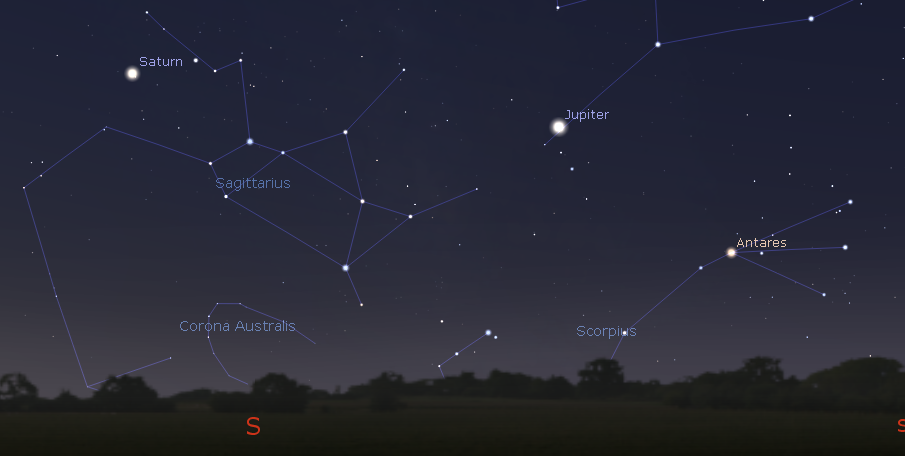
Morning planets and Moon at 5:30 a.m. May 9, 2019. Click on the image to enlarge. Created using Stellarium.
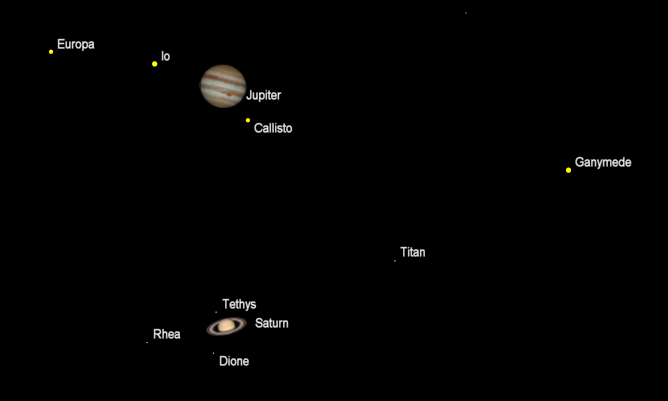
Jupiter and Saturn with the same magnification at 5:30 a.m. tomorrow morning May 9, 2019. Created using Cartes du Ciel (Sky Charts).
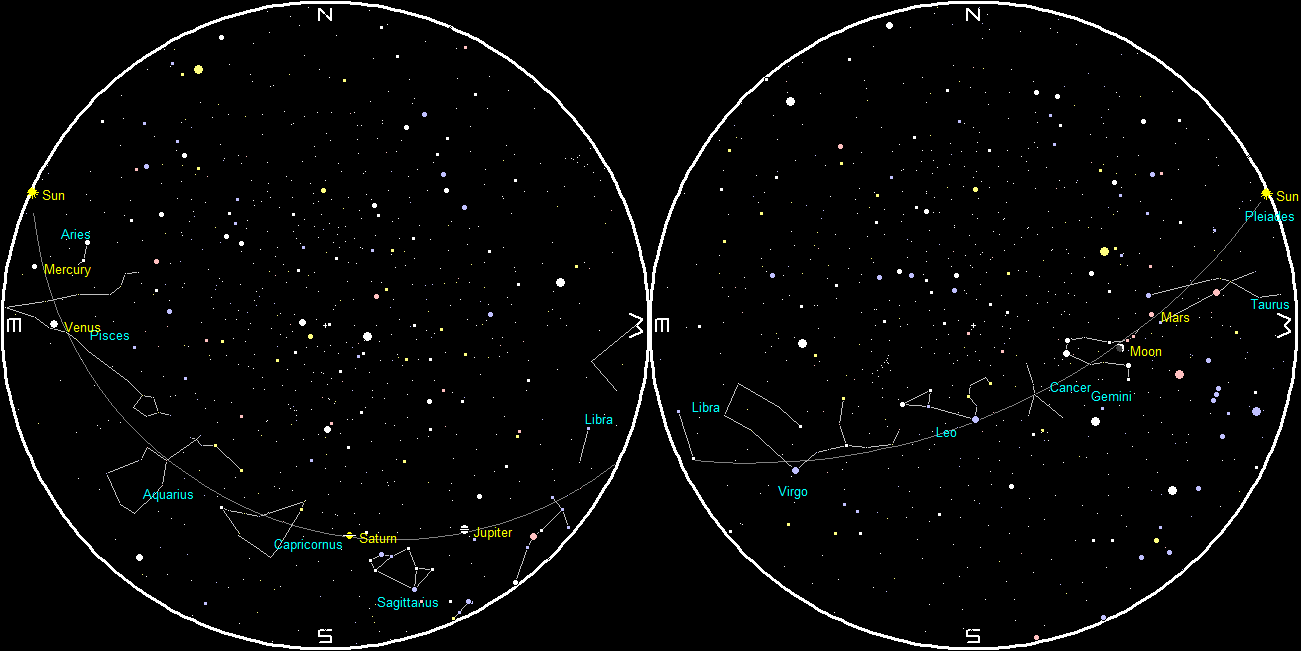
Planets and the Moon at sunset and sunrise of a single night starting with sunset on the right on May 8, 2019. The night ends on the left with sunrise on the 9th. Click on the image to enlarge. Created using my LookingUp program.
05/01/2019 – Ephemeris – Checking out the bright planets for May Day
Ephemeris for Wednesday, May 1st. Today the Sun will be up for 14 hours and 14 minutes, setting at 8:47, and it will rise tomorrow at 6:31. The Moon, 3 days before new, will rise at 5:54 tomorrow morning.
Let’s look at the planets for this first day of May. Mars will be in the western sky this evening, in the horns above the V-shaped stars of the face of Taurus the bull. It will set at 12:13 a.m. In the morning sky we have Jupiter, in Ophiuchus, which will rise tomorrow at 12:09 a.m. in the east-southeast. Saturn will be next to rise at 2 a.m., also in the east-southeast. It is in Sagittarius. Venus will rise 57 minutes before the Sun in the east. It will remain in our morning sky, though too close to the rising Sun to be easily glimpsed. In August it will pass behind the Sun to enter the evening sky. It will be in position later this year to be our bright evening Christmas Star. Mercury will rise only 32 minutes before the Sun.
The times given are for the Traverse City/Interlochen area of Michigan. They may be different for your location.
Addendum
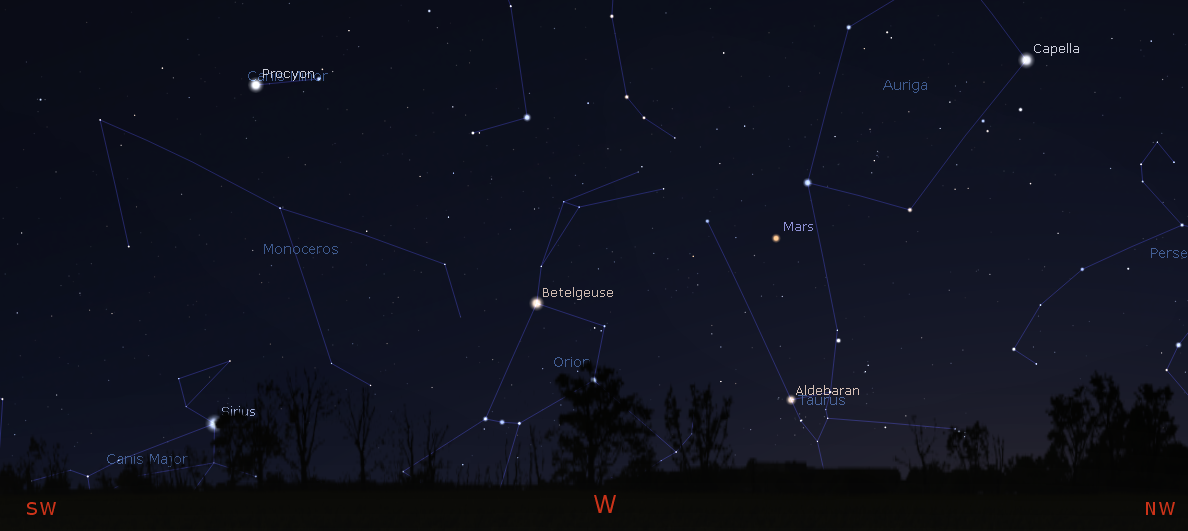
Mars and the setting winter stars tonight at 10 p.m. May 1, 2019. Click on the image to enlarge. Created using Stellarium.
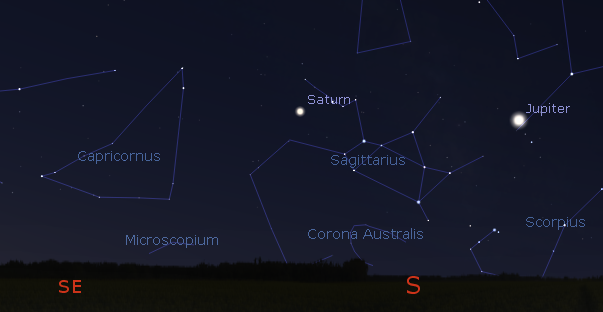
Morning planets and Moon at 5:30 a.m. May 1, 2019. Click on the image to enlarge. Note that at this time for the Grand Traverse area the International Space Station will be visible, crossing from the southwest starting at 5:25 and ending in the east-northeast at 5:31 a.m. Created using Stellarium.
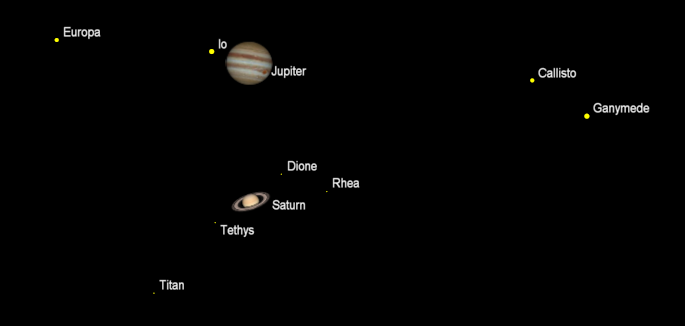
Jupiter and Saturn with the same magnification at 5:30 a.m. tomorrow morning May 2, 2019. Created using Cartes du Ciel (Sky Charts).
Io’s shadow will start to cross Jupiter’s disk at 9:27 UT or 5:27 a.m. EDT.
Io’s will start to transit the planet at 10:19 UT or 6:19 a.m. EDT.
Io events for observers west of here can be accessed from Project Pluto: https://www.projectpluto.com/jevent.htm#may.
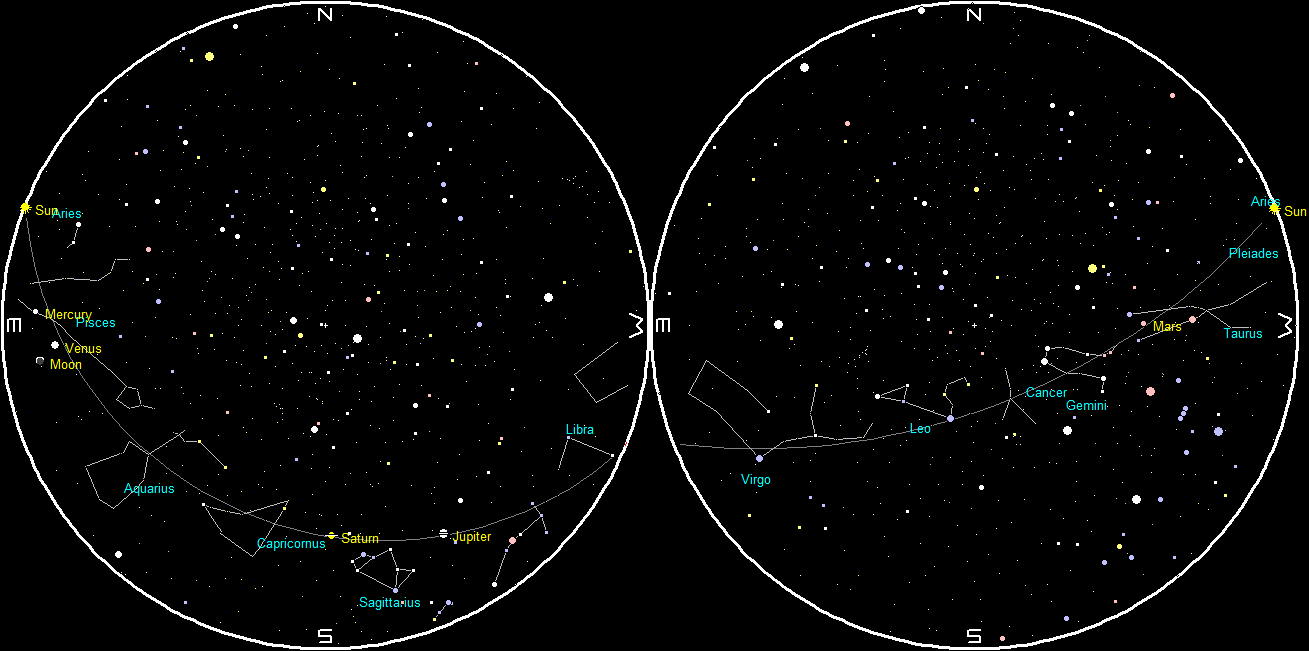
Planets and the Moon at sunset and sunrise of a single night starting with sunset on the right on May 1, 2019. The night ends on the left with sunrise on the 2nd. Click on the image to enlarge. Created using my LookingUp program.
04/24/2019 – Ephemeris – Looking at the bright planets this week
Ephemeris for Wednesday, April 24th. Today the Sun will be up for 13 hours and 54 minutes, setting at 8:38, and it will rise tomorrow at 6:42. The Moon, 2 days before last quarter, will rise at 2:16 tomorrow morning.
Let’s look at the planets for this week. Mars will be in the western sky this evening, above the V-shaped stars of the face of Taurus the bull. It will set at 12:18 a.m. In the morning sky we have Jupiter, in Ophiuchus, which will rise tomorrow at 12:39 a.m. in the east-southeast. Saturn will be next to rise at 2:27 a.m., also in the east-southeast. It is in Sagittarius. Tomorrow morning the Moon will be just right of the ringed planet. Venus will rise at 5:47 a.m. in the east. Venus will remain in our morning sky, though too close to the rising Sun to be easily glimpsed until August when it passes behind the Sun to enter the evening sky. It will be in position later this year to be our bright evening Christmas Star.
The times given are for the Traverse City/Interlochen area of Michigan. They may be different for your location.
Addendum
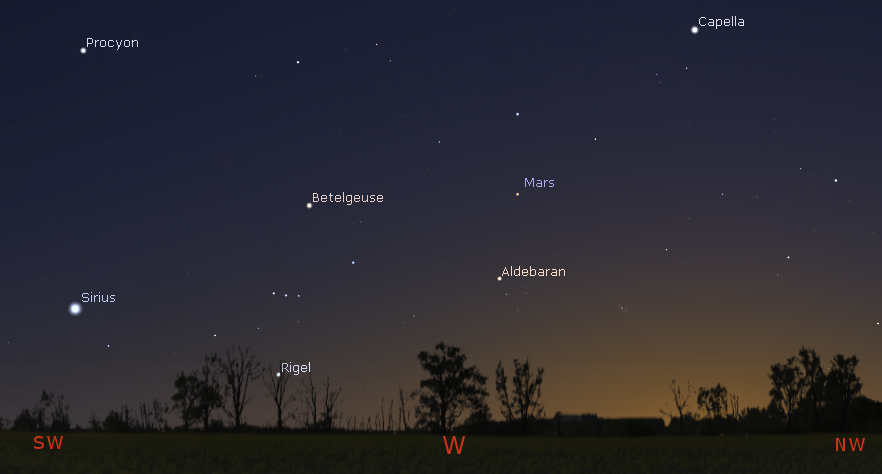
Mars and the setting winter stars tonight at 9:30 p.m. April 24, 2019. Click on the image to enlarge. Created using Stellarium.
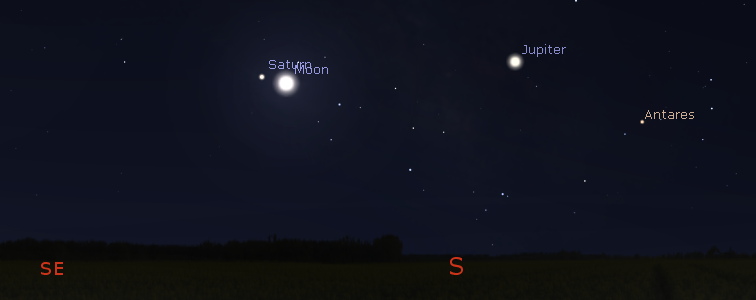
Morning planets and Moon at 5:30 a.m. April 25, 2019. Click on the image to enlarge. Created using Stellarium.
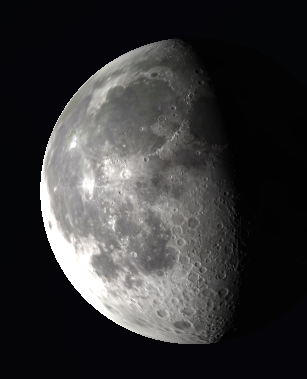
The waning gibbous Moon at 5:30 a.m. April 25, 2019. Created using Stellarium.

Jupiter and Saturn with the same magnification at 5:30 a.m. tomorrow morning April 25, 2019. Created using Cartes du Ciel (Sky Charts).
Note that the moon Io is transiting the planet at 5:30 a.m. Io will not be that visible. Here’s the timeline.
| Moon | Event | Date | UT | EDT |
| Io | Shadow start | 25 Apr 2019 | 07:33 | 3:33 AM |
| Io | Transit start | 25 Apr 2019 | 08:32 | 4:42 AM |
| Io | Shadow end | 25 Apr 2019 | 09:45 | 5:45 AM |
| Io | Transit end | 25 Apr 2019 | 10:44 | 6:44 AM |
Times supplied by the Pluto Project: https://www.projectpluto.com/jevent.htm.
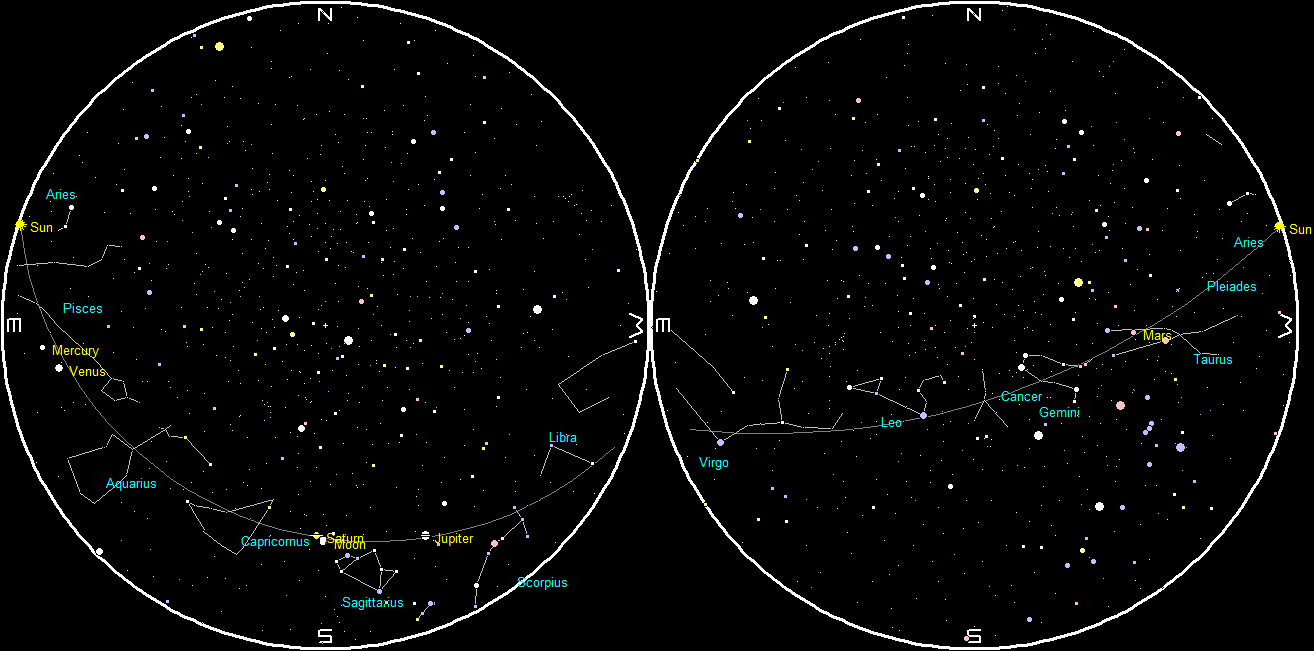
Planets and the Moon at sunset and sunrise of a single night starting with sunset on the right on April 24, 2019. The night ends on the left with sunrise on the 25th. Click on the image to enlarge. Created using my LookingUp program.
04/22/2019 – Ephemeris – Earth Day
Ephemeris for Earth Day, Monday, April 22nd. Today the Sun will be up for 13 hours and 49 minutes, setting at 8:36, and it will rise tomorrow at 6:45. The Moon, 3 days past full, will rise at 12:24 tomorrow morning.
A good slogan for this Earth Day or any day is “Support your local planet.” As an amateur astronomer I look around the solar system at all the habitable planets. The Earth is it. Mars may be terraformed at great expense, that is made more earth-like. There may be life in the oceans of Jupiter’s moon Europa, or Saturn’s Enceladus, but they are not habitable for us. Terraforming (stopping and reversing climate change) the Earth would be the easiest and much more practical. One look at our nearest neighbor Venus will show us our fate, hopefully in billions of years from now, a hell hole of heat and a crushing atmosphere. Our job is push-off that day as far as we can, and keep the Earth a blue-green oasis in the solar system.
The times given are for the Traverse City/Interlochen area of Michigan. They may be different for your location.
Addendum
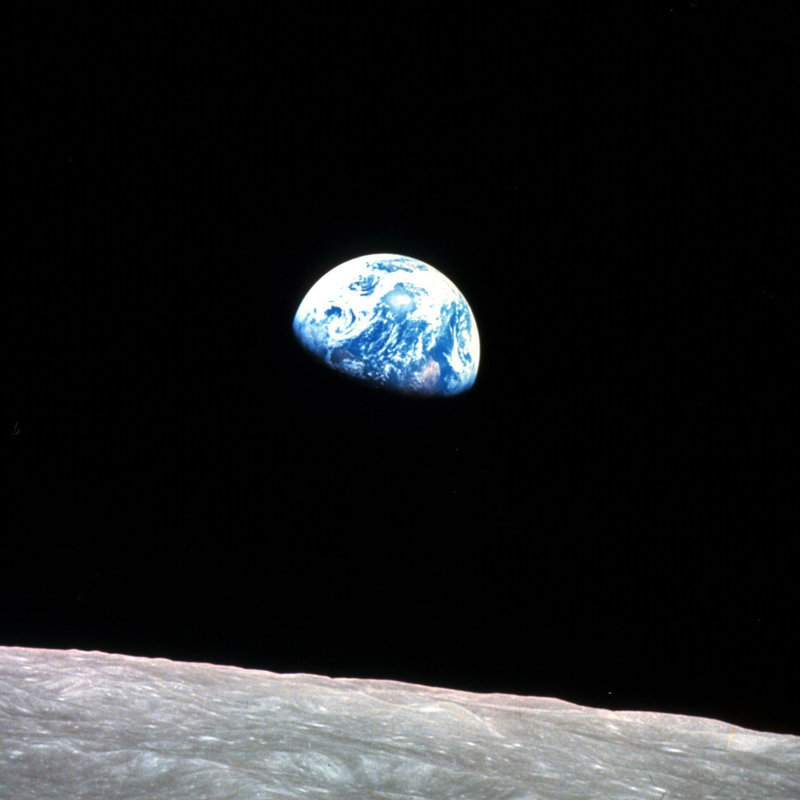
Earth rising above the Moon’s limb from Apollo 8. Credit: NASA/Apollo 8
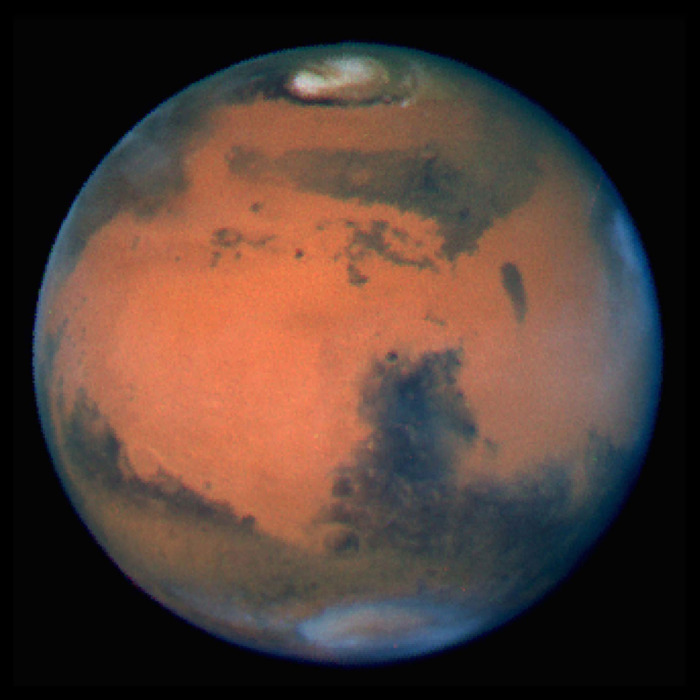
Mars had its day, but that ended about 3 billion years ago. Being half the size of the Earth, Mars cooled down, lost its magnetic field, so the solar wind stripped away most of its atmosphere and water. Credit NASA.
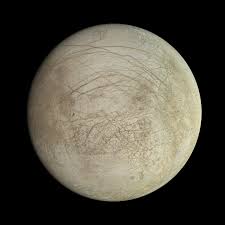
Europa, one of the four Galilean moons of Jupiter and easily seen in small telescopes, is slightly smaller than our Moon. Under that thick icy shell lurks an ocean with more water than all the Earth’s oceans. There’s probably volcanic vents like the black smokers in Earth’s oceans where a whole ecology of extremophiles could live like they do on Earth. Credit: NASA.
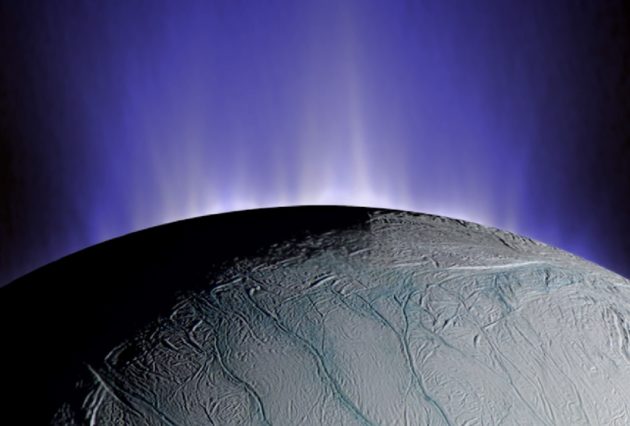
Enceladus, a small moon of Saturn spews continuous geysers of water from cracks in its south polar region indicating an ocean below its frozen icy exterior. Sampling the plumes with the right instruments may detect life on this small world without the need for drilling. Credit: NASA.
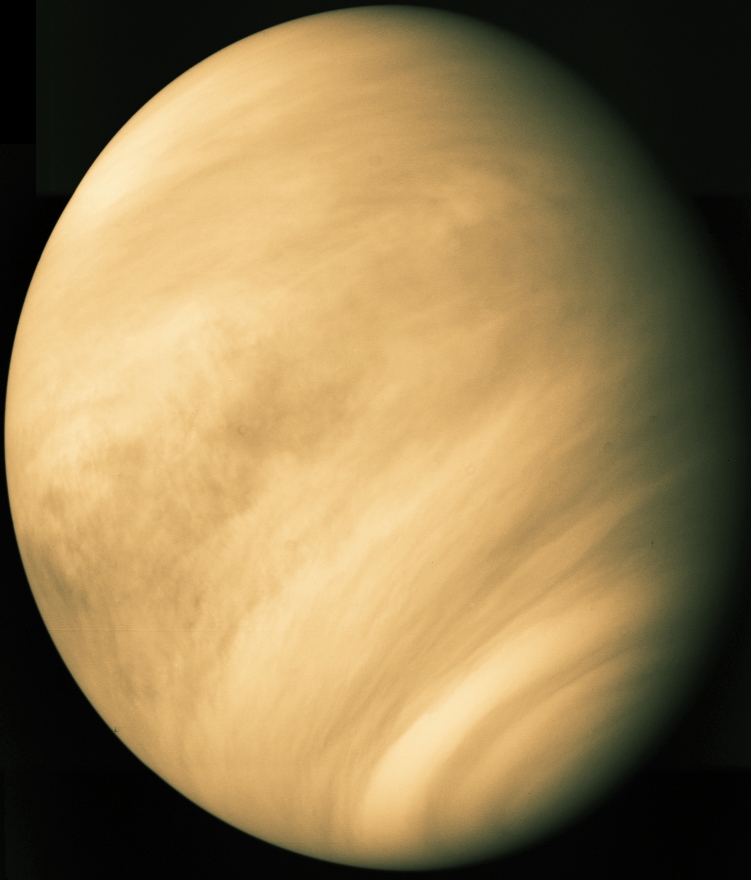
Is this our future? Venus had the misfortune of ending up too close to the Sun. It has a hellish landscape of nearly 900 degrees F, and 90 times the Earth’s atmospheric pressure. Its clouds consist of sulfuric acid. Talk about a runaway greenhouse effect and acid rain… Credit: NASA.
04/17/2019 – Ephemeris – Let’s look for the bright planets
Ephemeris for Wednesday, April 17th. Today the Sun will be up for 13 hours and 34 minutes, setting at 8:30, and it will rise tomorrow at 6:53. The Moon, 2 days before full, will set at 6:53 tomorrow morning.
Let’s look at the planets for this week. Mars will be in the western sky this evening, above the V-shaped stars of the face of Taurus the bull. It will set at 12:23 a.m. In the morning sky we have Jupiter, in Ophiuchus, which will rise tomorrow at 1:07 a.m. in the east-southeast. Saturn will be next to rise at 2:54 a.m., also in the east-southeast. It is in Sagittarius. Venus will rise at 5:56 a.m. again in the east-southeast. By 6:30 in the morning they will be strung out from the south down to the eastern horizon. Venus will remain in our morning sky, though more difficult to see until August when it passes behind the Sun to enter the evening sky. Tiny Mercury may be glimpsed a bit left and just below Venus in the bright twilight.
The times given are for the Traverse City/Interlochen area of Michigan. They may be different for your location.
Addendum
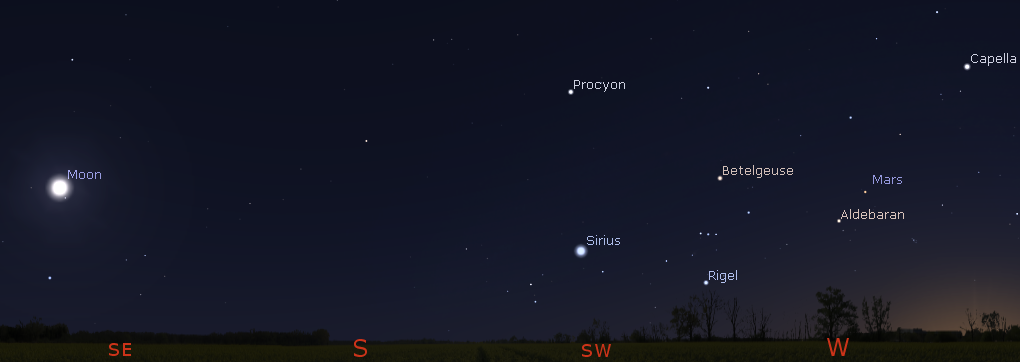
Mars and the Moon tonight at 9:30 p.m. April 17, 2019. Click on the image to enlarge. Created using Stellarium.
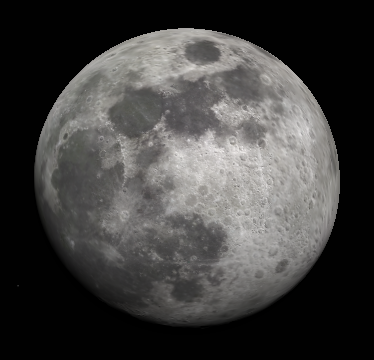
The waxing gibbous nearly full Moon at 9:30 p.m. April 17, 2019. Created using Stellarium.
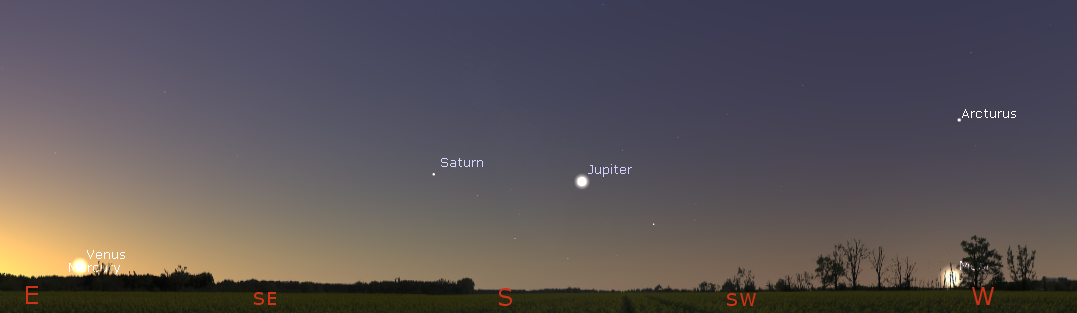
Morning planets and Moon at 6:30 a.m. April 18, 2019. Click on the image to enlarge. Created using Stellarium.
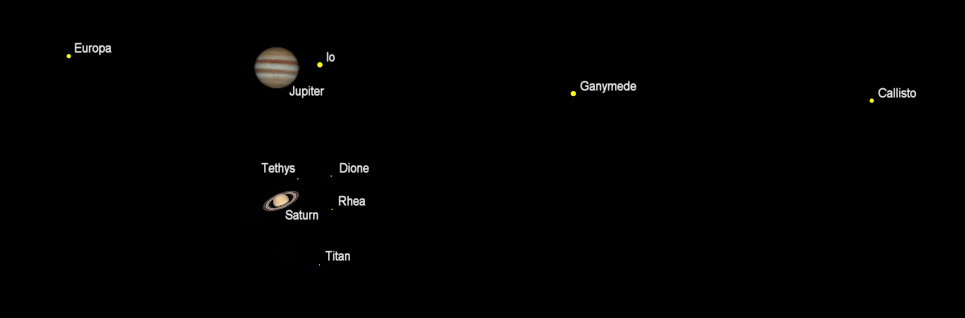
Jupiter and Saturn with the same magnification at 6:30 a.m. tomorrow morning April 18, 2019. Click on the image to enlarge. Created using Cartes du Ciel (Sky Charts).
Jupiter’s moon Io events earlier in the morning
| Moon | Event | Date | U.T. | EDT |
| Io | Shadow start | 18 Apr 2019 | 05:40 | 1:40 AM |
| Io | Transit start | 18 Apr 2019 | 06:44 | 2:44 AM |
| Io | Shadow end | 18 Apr 2019 | 07:51 | 3:51 AM |
| Io | Transit end | 18 Apr 2019 | 08:56 | 4:56 AM |
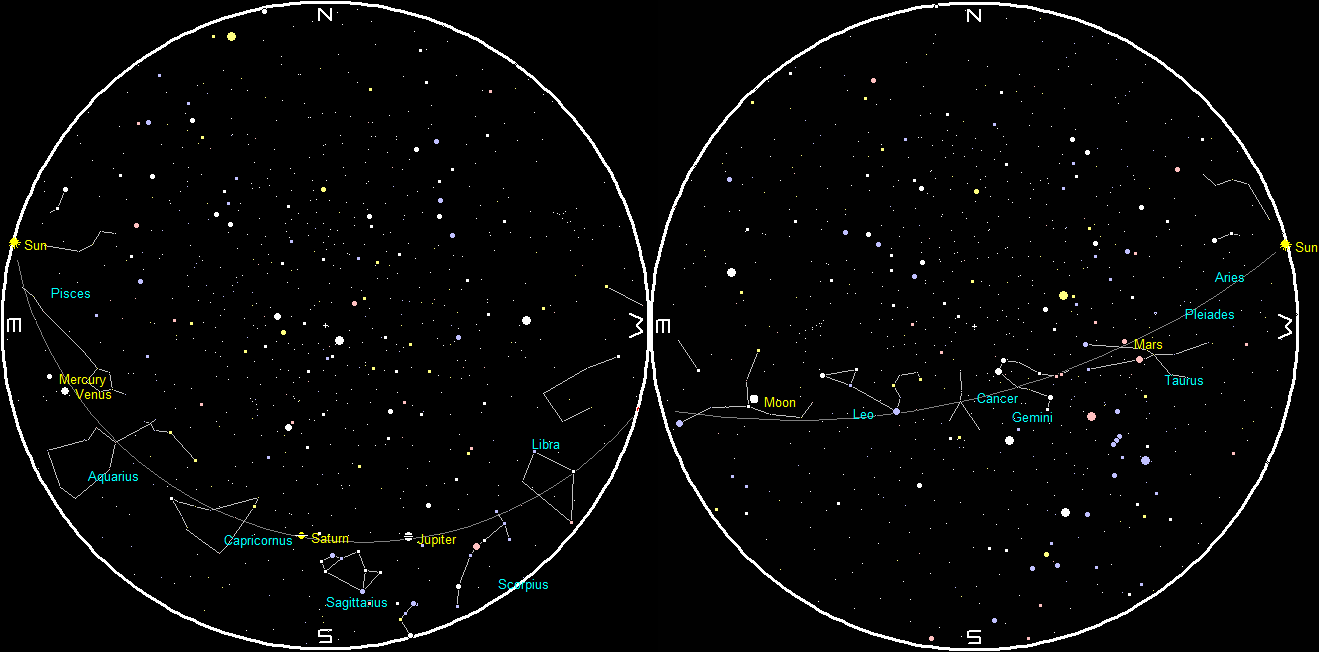
Planets and the Moon at sunset and sunrise of a single night starting with sunset on the right on April 17, 2019. The night ends on the left with sunrise on the 18th. Click on the image to enlarge. Created using my LookingUp program.
04/10/2019 – Ephemeris – Looking for the bright planets for this week
Ephemeris for Wednesday, April 10th. Today the Sun will be up for 13 hours and 13 minutes, setting at 8:21, and it will rise tomorrow at 7:05. The Moon, 2 days before first quarter, will set at 2:04 tomorrow morning.
Let’s look at the planets for this week. Mars will be in the western sky this evening, to the right of the V-shaped stars of the face of Taurus the bull. It will set at 12:27 a.m. In the morning sky we have Jupiter which will rise tomorrow at 1:35 a.m. in the east-southeast. It is second to Venus in brightness. Saturn will be next to rise at 3:21 a.m., also in the east-southeast. Venus will rise at 6:05 a.m. again in the east-southeast. By 6:30 in the morning they will be strung out from the southeast to the south. Venus will remain in our morning sky until August when it passes behind the Sun. Tiny Mercury may be glimpsed a bit left and just below Venus in the bright twilight.
The times given are for the Traverse City/Interlochen area of Michigan. They may be different for your location.
Addendum
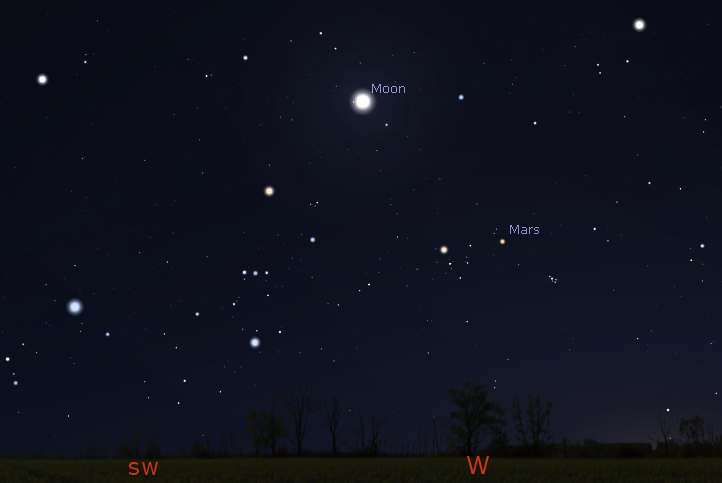
Mars and the Moon in the evening at 9:30 p.m. April 10, 2019. Click on the image to enlarge. Created using Stellarium.
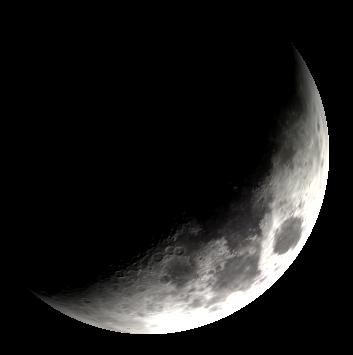
The Moon as it might appear in binoculars or a small telescope tonight at 9 p.m. April 10, 2019. Created using Stellarium.
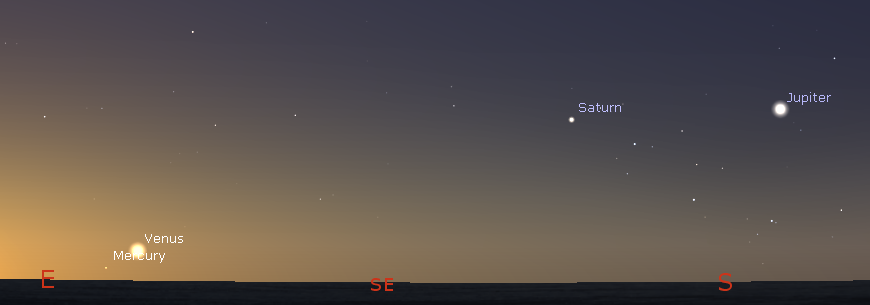
Morning planets at 6:30 a.m. April 11, 2019. Click on the image to enlarge. Created using Stellarium.
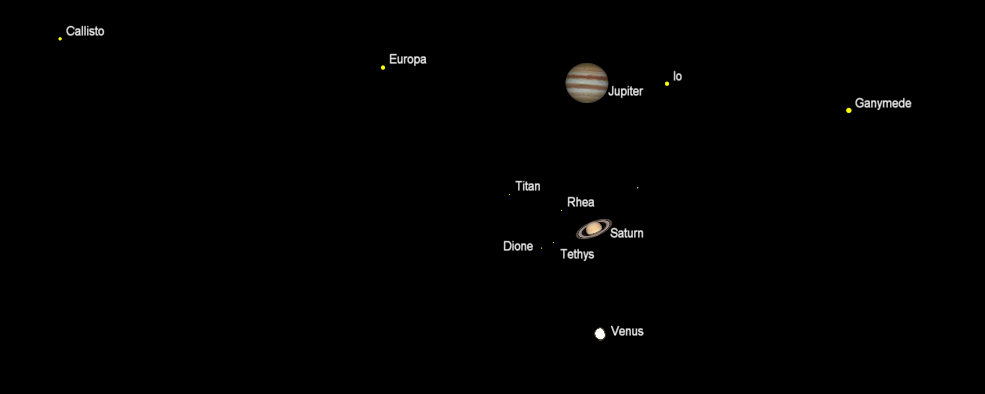
Jupiter, Saturn and Venus with the same magnification at 6:30 a.m. tomorrow morning April 11, 2019. Created using Cartes du Ciel (Sky Charts).
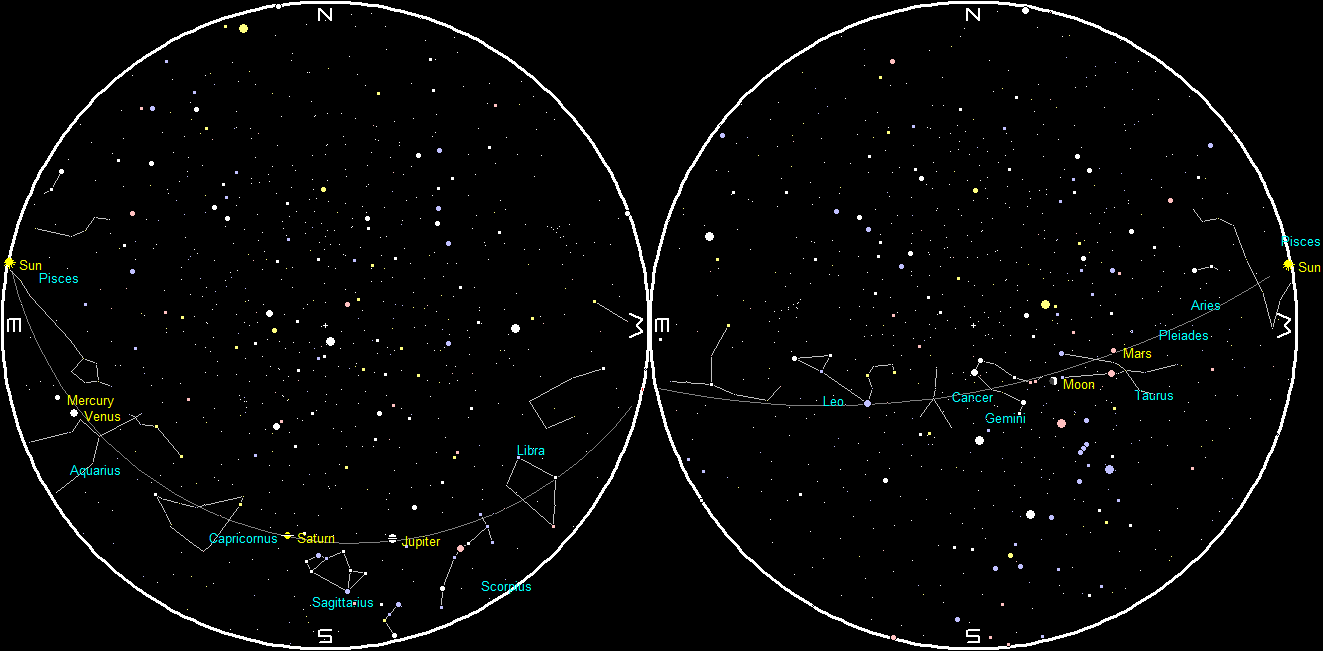
Planets and the Moon at sunset and sunrise of a single night starting with sunset on the right on April 10, 2019. The night ends on the left with sunrise on the 11th. Click on the image to enlarge. Created using my LookingUp program.
04/03/2019 – Ephemeris – Let’s check out the bright planets for this week
Ephemeris for Wednesday, April 3rd. Today the Sun will be up for 12 hours and 52 minutes, setting at 8:12, and it will rise tomorrow at 7:18. The Moon, 2 days before new, will rise at 7:27 tomorrow morning.
Let’s look at the planets for this week. Mars will be in the western sky this evening, to the right of the V shaped stars of the face of Taurus the bull. It will set at 12:31 a.m. In the morning sky we have Jupiter which will rise tomorrow at 2:02 a.m. in the east-southeast. It is second to Venus in brightness. Saturn will be next to rise at 3:48 a.m., also in the east-southeast. Venus will rise at 6:13 a.m. again in the east-southeast. By 7 in the morning they will be strung out from the southeast to the south. Venus will remain in our morning sky until August when it passes behind the Sun. It will emerge to become a bright addition to our winter and spring evening skies later this year and next. Mercury will be
The times given are for the Traverse City/Interlochen area of Michigan. They may be different for your location.
Addendum
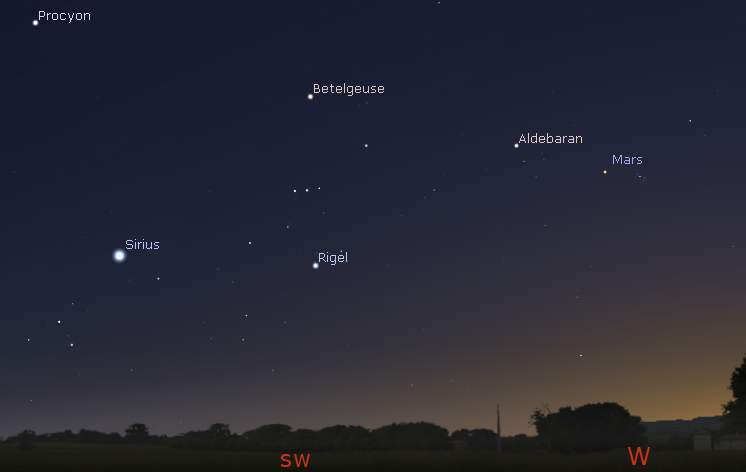
Mars in the evening at 9 p.m. April 3, 2019. Click on the image to enlarge. Created using Stellarium.
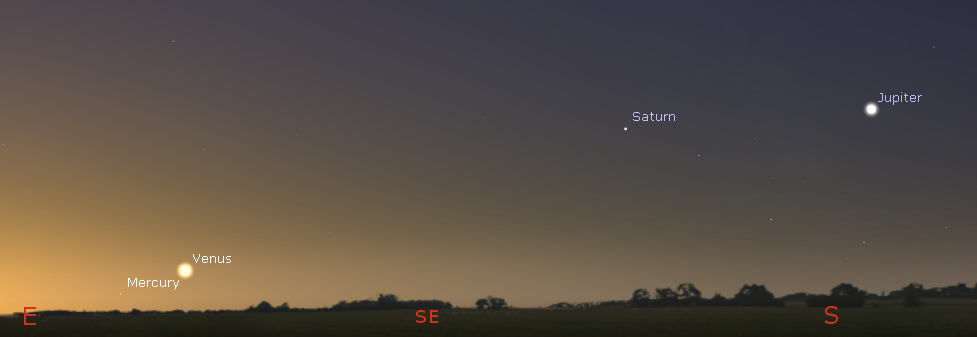
Morning planets at 6:45 a.m. April 4, 2019. Click on the image to enlarge. Created using Stellarium.
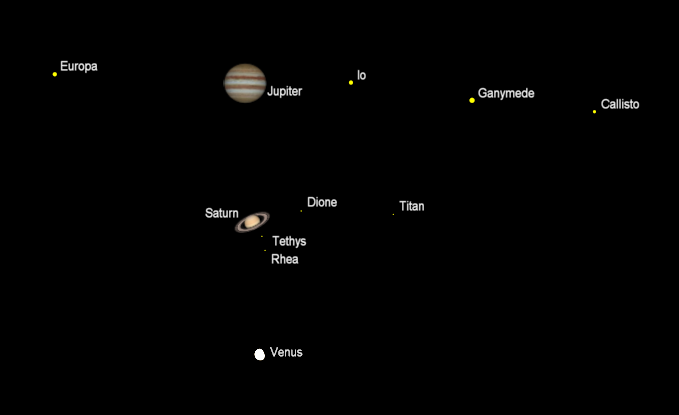
Jupiter, Saturn and Venus with the same magnification at 6:45 a.m. tomorrow morning April 4, 2019. Created using Cartes du Ciel (Sky Charts).
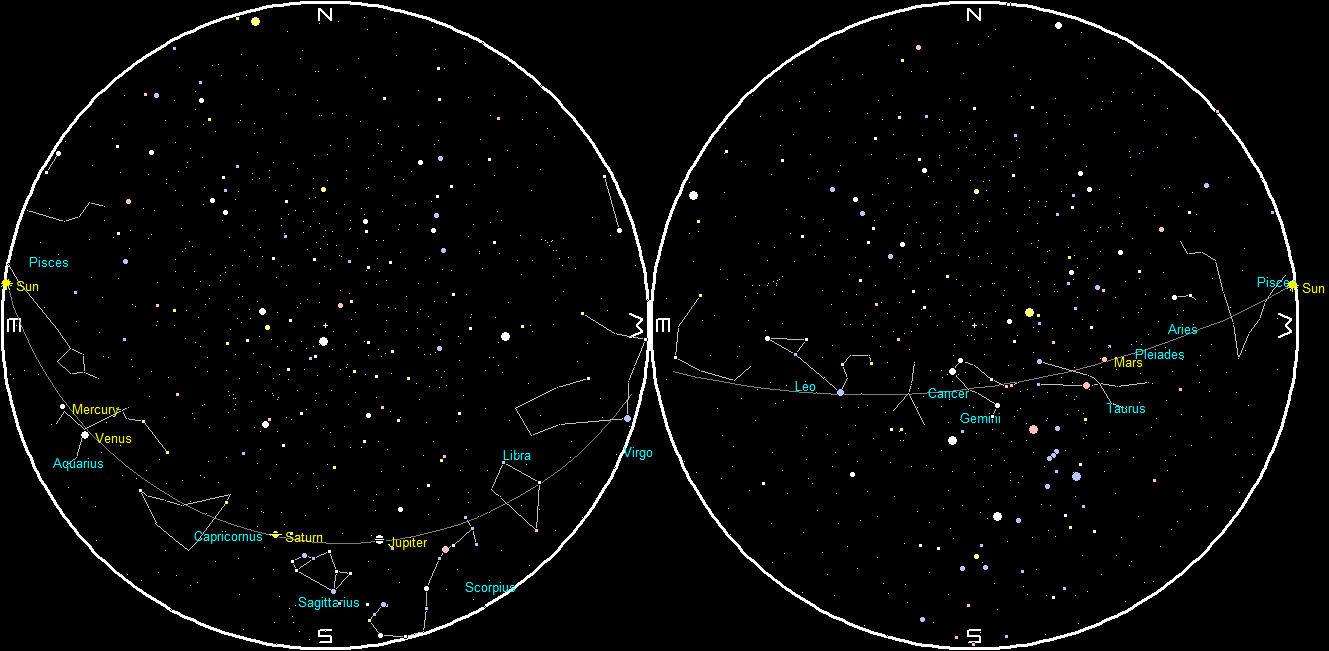
Planets and the Moon at sunset and sunrise of a single night starting with sunset on the right on April 3, 2019. The night ends on the left with sunrise on the 4th. Click on the image to enlarge. Created using my LookingUp program.
03/27/2019 – Ephemeris – Looking for and at the bright planets for this week
Ephemeris for Wednesday, March 27th. Today the Sun will be up for 12 hours and 30 minutes, setting at 8:03, and it will rise tomorrow at 7:31. The Moon, 1 day before last quarter, will rise at 3:33 tomorrow morning.
Let’s look at the planets for this week. Mars will be in the western sky this evening, below the Pleiades, or Seven Sisters, star cluster. It will pass to the left of the Pleiades Saturday night. Tonight, however, it will set at 12:34 a.m. In the morning sky we have Jupiter which will rise tomorrow at 2:29 a.m. in the east-southeast. It is second to Venus in brightness. Saturn will be next to rise at 4:14 a.m., also in the east-southeast. Venus will rise at 6:20 a.m. also in the east-southeast. By 7 in the morning they will be strung out from the southeast to the south, with the last quarter Moon between Jupiter and Saturn. The Moon will pass Saturn early Friday morning before it rises and will be seen then to the left of Saturn.
The times given are for the Traverse City/Interlochen area of Michigan. They may be different for your location.
Addendum
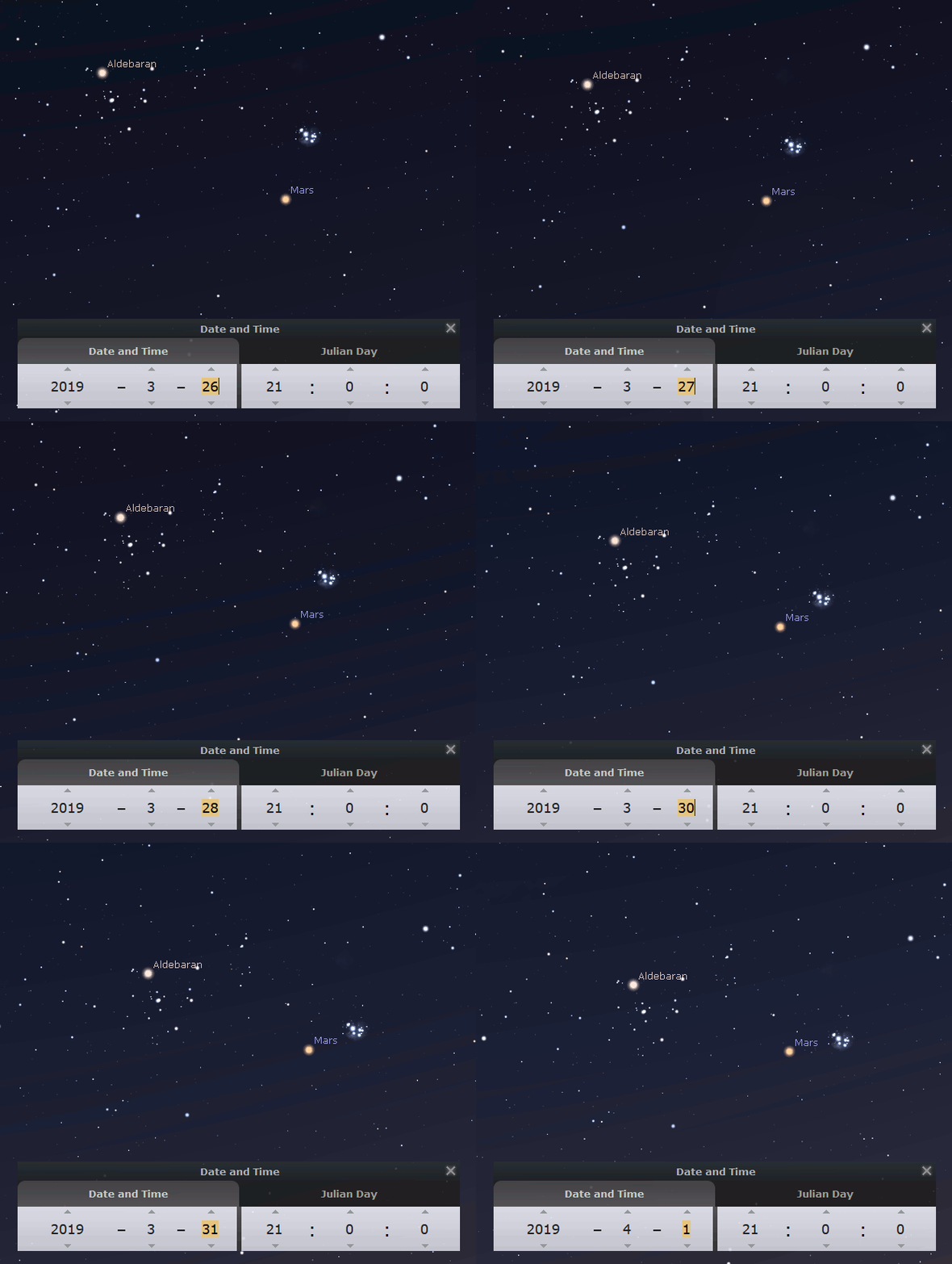
Mars tiptoeing past the Pleiades nightly from March 26th to April 1st, 2019. Looking west. Created using Stellarium and GIMP.
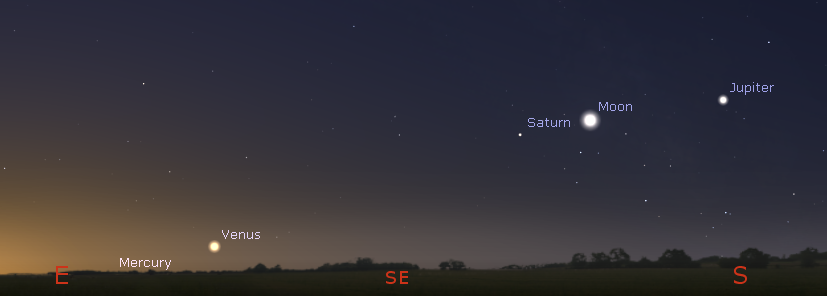
Morning planets and the Moons at 6:45 a.m. tomorrow March 28, 2019. Click on the image to enlarge. Created using Stellarium.
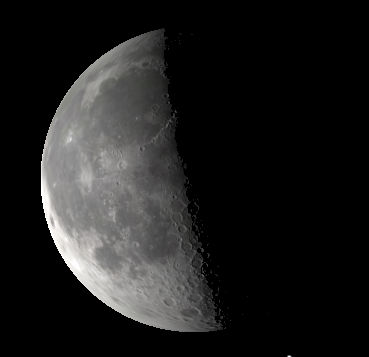
The moon as it might appear in binoculars tomorrow morning, March 28, 2019. Created using Stellarium.
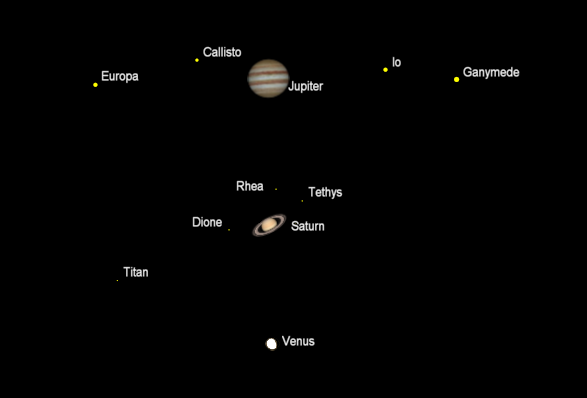
Jupiter, Saturn and Venus with the same magnification at 6:45 a.m. tomorrow morning March 28, 2019. Created using Cartes du Ciel (Sky Charts).
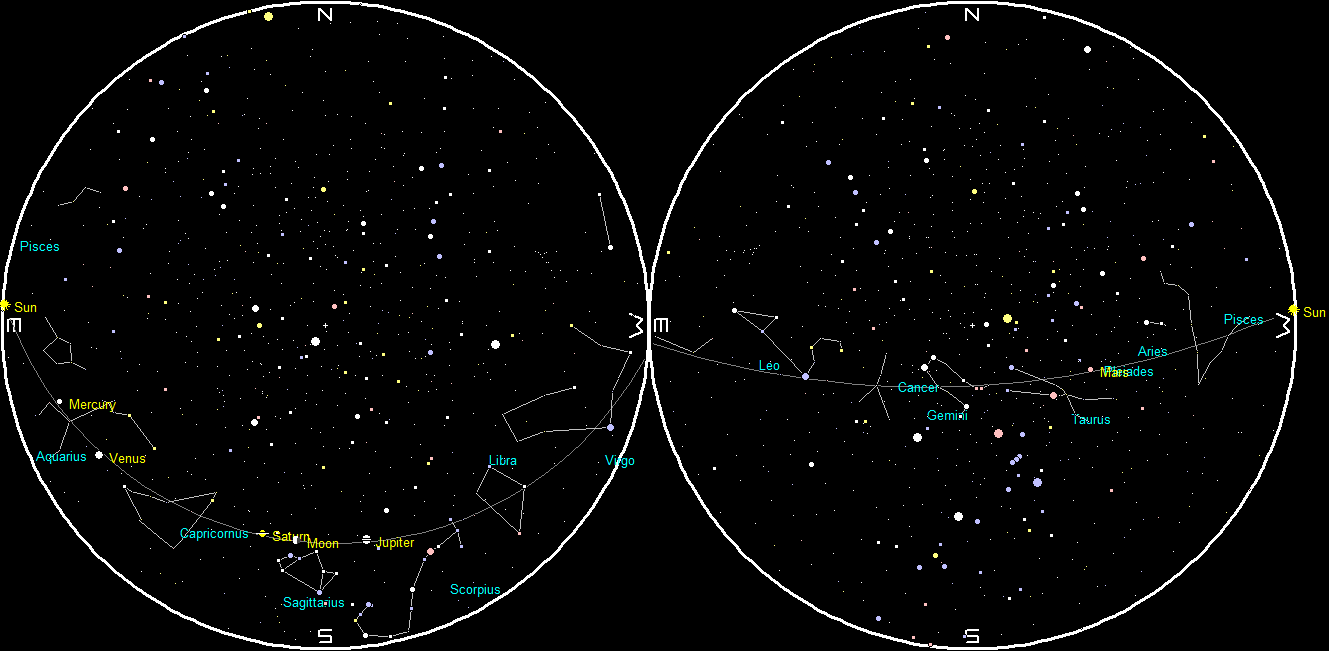
Planets and the Moon at sunset and sunrise of a single night starting with sunset on the right on March 27, 2019. The night ends on the left with sunrise on the 28th. Click on the image to enlarge. Created using my LookingUp program.
 Bob Moler's Ephemeris Blog