Archive
01/22/2021 – Ephemeris – Mercury will be at it’s greatest angular distance from the Sun in the evening tomorrow
This is Ephemeris for Friday, January 22nd. Today the Sun will be up for 9 hours and 26 minutes, setting at 5:37, and it will rise tomorrow at 8:10. The Moon, 2 days past first quarter, will set at 3:43 tomorrow morning.
The planet Mercury, tomorrow night, will reach its greatest elongation or separation east of the Sun. It will be visible low in the southwestern sky around and for a half hour or so after 6 pm. Mercury, being the closest planet to the Sun, never strays far from it. Here in the Northern Hemisphere never see it outside of twilight. It’s apparent angular separation from the Sun will be 18.6 degrees. We will have a somewhat better view of an evening appearance of Mercury in May when Venus will again be in our evening sky and near Mercury. Mercury takes 88 days on to orbit the Sun. However, we are viewing it from another moving planet. So it takes about 116 days for Mercury to appear to orbit the Sun from our vantage point.
The event times given are for the Traverse City/Interlochen area of Michigan. They may be different for your location.
Addendum
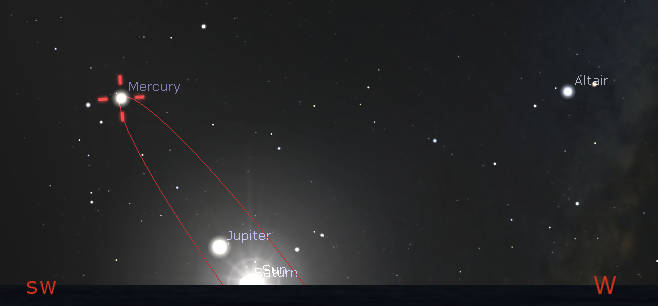
Mercury at greatest elongation at sunset January 23, 2021. It also shows Mercury’s orbit that evening plus Jupiter. Saturn is actually behind the Sun that evening as can be seen by the over display of the labels for Saturn and the Sun. Created using Stellarium by removing Earth’s atmosphere.
06/04/2020 – Ephemeris – Mercury is at it’s greatest separation from the Sun today
This is Ephemeris for Thursday, June 4th. Today the Sun will be up for 15 hours and 25 minutes, setting at 9:24, and it will rise tomorrow at 5:58. The Moon, 1 day before full, will set at 5:53 tomorrow morning.
Today at 9 am the planet Mercury will be at its greatest eastern elongation. That’s what astronomers call it. Implied is that it is at its greatest angular separation east of the Sun. Mercury, and also Venus have orbits inside Earth’s orbit of the Sun. For that reason they are called inferior planets. Therefore they never stray far from the position of the Sun in the sky. From around our latitude near 45 degrees north, we never see Mercury outside of twilight. Mercury has a remarkably elliptical orbit ranging from 29 million miles (47 million km) to 43 million miles (70 million km) from the Sun. In both spring and fall at favorable elongations, we see Mercury near perihelion, that close point. Southern hemisphere observers get a better view of it. Having a late spring greatest eastern elongation we get to see Mercury farther from the Sun than the same elongation earlier in the year.
The event times given are for the Traverse City/Interlochen area of Michigan. They may be different for your location.
Addendum
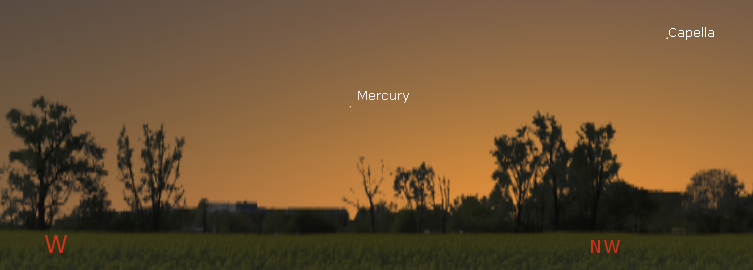
Mercury in the evening tonight at 10 pm June 3, 2020 (About 45 minutes after sunset). Click on the image to enlarge. Created using Stellarium.
03/15/2018 – Ephemeris – Mercury at greatest separation (elongation) from the Sun today
Ephemeris for the Ides of March, Thursday, March 15th. The Sun will rise at 7:55. It’ll be up for 11 hours and 53 minutes, setting at 7:48. The Moon, 2 days before new, will rise at 7:45 tomorrow morning.
Today the planet Mercury will be at its greatest separation east from the Sun. It is called its greatest eastern elongation from the Sun. It is at an angle of 18.4 degrees from the Sun. It will be seen in the west about 8:15 for about an hour before it sets. It will be above right of the much brighter Venus. Mercury is probably at its best place to be observed than any time this year, with eastern elongation happening near the vernal equinox and is placed at a high angle above the Sun. The best morning appearance of Mercury will be its greatest western elongation on August 26th, almost a month short of the autumnal equinox, where it won’t be placed at as great an angle above the rising Sun.
The times given are for the Traverse City/Interlochen area of Michigan. They may be different for your location.
Addendum
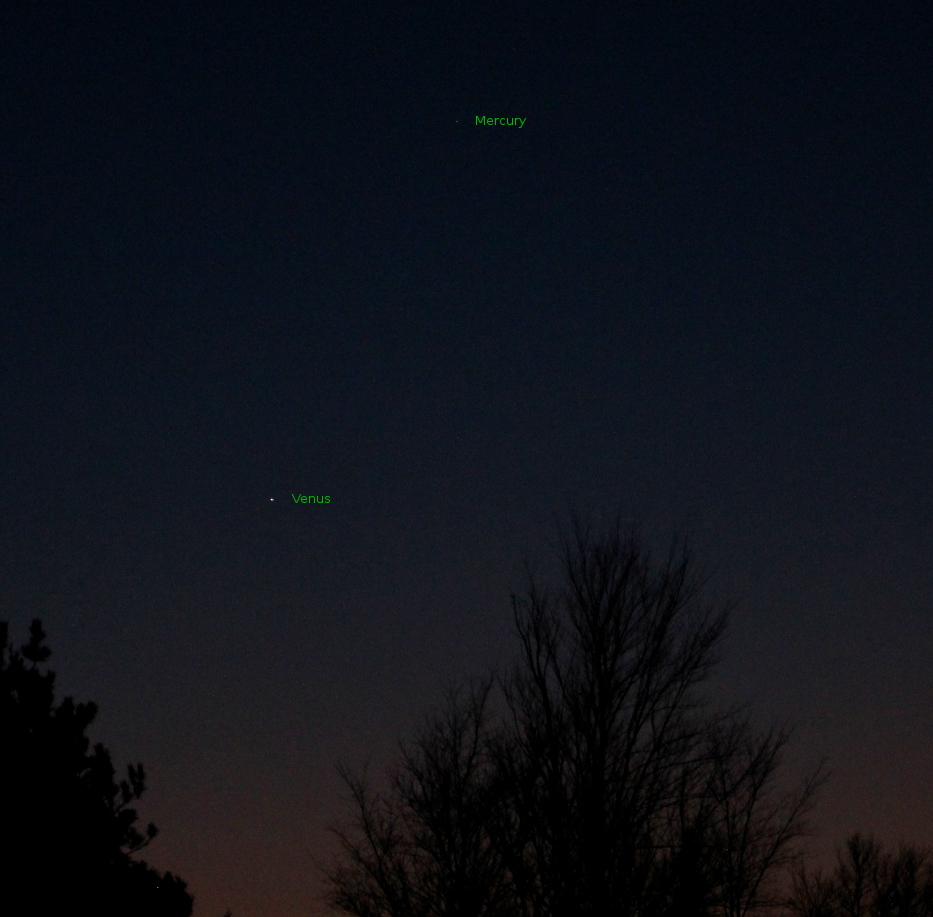
Venus and Mercury photographed last night at 8:20 EDT March 14, 2018. Did some tweaks to bring out Mercury in GIMP. Canon EOS Rebel T5, 75 mm, though reduced by 67%; f/4, 1/400 sec., ISO 1600. Click on image to enlarge. Click on image to enlarge. Credit Bob Moler.
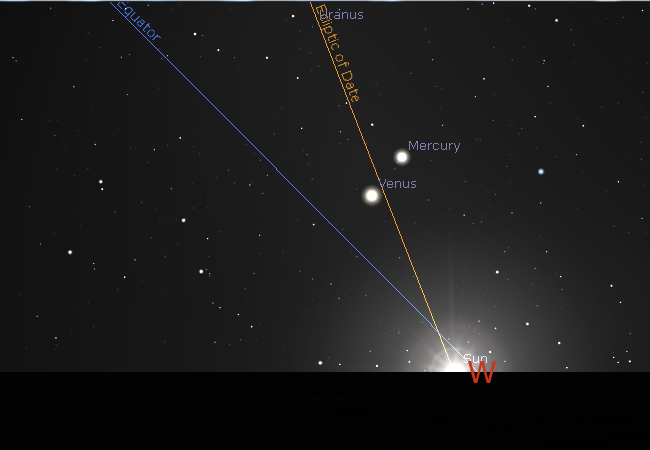
Stellarium’s showing of Venus and Mercury at 8:15 p.m. March 15. 2018.
Note in the above image, the steepness of the ecliptic (plane of the Earth’s orbit) is to the horizon in the spring. Its angle to the celestial equator is 23.5°. The angle the celestial equator makes with the horizon is your co-latitude (90° – your latitude). At my location my latitude is 44.7°, so the celestial equator meets the horizon at 45.3°. On the March equinox the ecliptic, near where the planets hang out, reaches its most vertical at nearly 70°. This makes planets, including Mercury appear higher in the sky near sunset, and as they set, moving parallel to the equator, will stay up their longest.
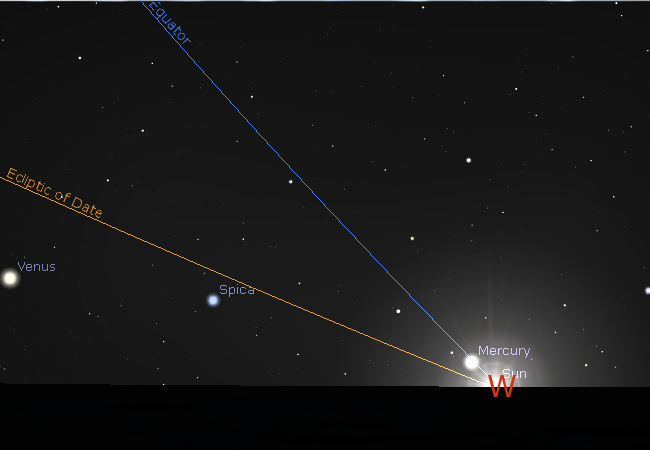
Celestial equator and ecliptic at the September equinox showing how low it appears. Created using Stellarium.
On the September equinox the ecliptic, near where the planets hang out, reaches its most horizontal at near 22°. This makes planets, including Mercury appear lower in the sky near sunset, and as they set, moving parallel to the equator, will set shortly after the Sun. This September Venus happens to be approaching its inferior conjunction and is very close to the Earth. This exaggerates its orbital inclination. in this case shows the planet a good deal south of the ecliptic.
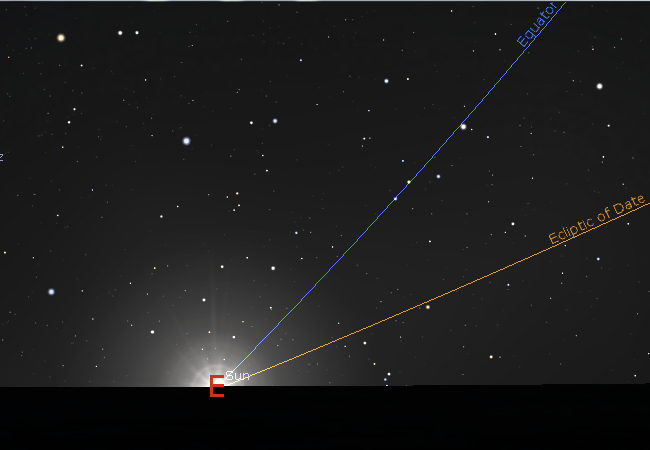
At the spring equinox close morning planets to the Sun will be hard to spot, being low to the horizon.
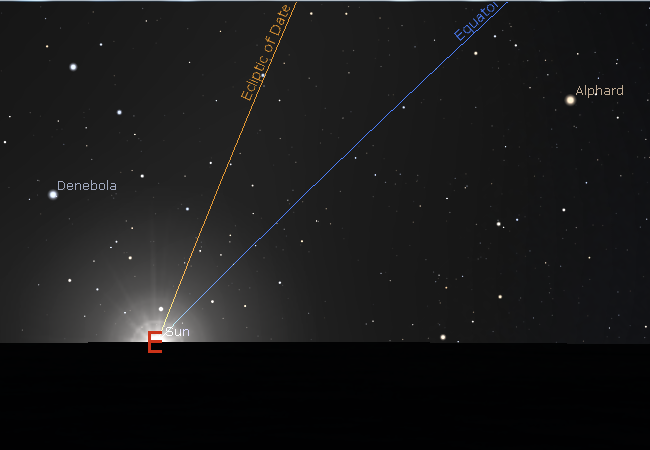
Celestial equator and ecliptic at the September equinox mornings showing how high it appears. Created using Stellarium.
Update
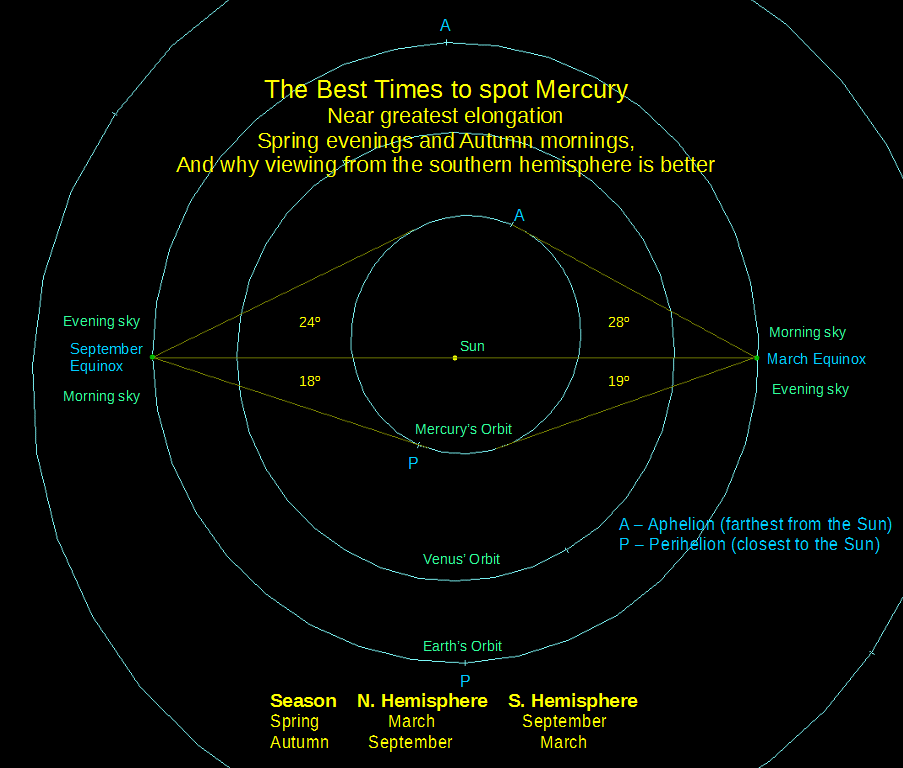
The angles of the elongation of Mercury at the equinoxes. Click on image to enlarge. Created using my LookingUp program.
Due to the eccentricity of Mercury’s orbit and its orientation with respect to the Earth’s positions at the equinoxes, observers on the southern hemisphere of the Earth get a better view of Mercury than us northerners.
(I created a similar diagram for posting yesterday, but found right before the scheduled posting time that it was incorrect in its orientation, so I redid it this morning.)
11/23/2017 – Ephemeris – Mercury is at it’s greatest eastern elongation tonight
Ephemeris for Thanksgiving Day, Thursday, November 23rd. The Sun will rise at 7:49. It’ll be up for 9 hours and 17 minutes, setting at 5:07. The Moon, 3 days before first quarter, will set at 9:33 this evening.
Mercury is going to reach its greatest elongation or apparent separation from the Sun this evening. It will be 22 degrees east of the Sun. Because Mercury is the closest planet to the Sun, it is never seen far from it. And because it has the most eccentric orbit of all the planets its greatest elongations are between 17 and 27 degrees from the Sun. Other than that the best times of the year to see Mercury are late winter and early spring evenings and late summer and early autumn mornings. Being an autumn evening means that Mercury is almost too low to spot after sunset. The southern hemisphere is in spring, so Mercury tonight will be much easier seen. Also their best view is when Mercury is farther from the Sun.
The times given are for the Traverse City/Interlochen area of Michigan. They may be different for your location.
Addendum
There are rather clinical charts. The horizontal line through the W (western compass point) is the horizon. Grid marks are 10 degrees apart.
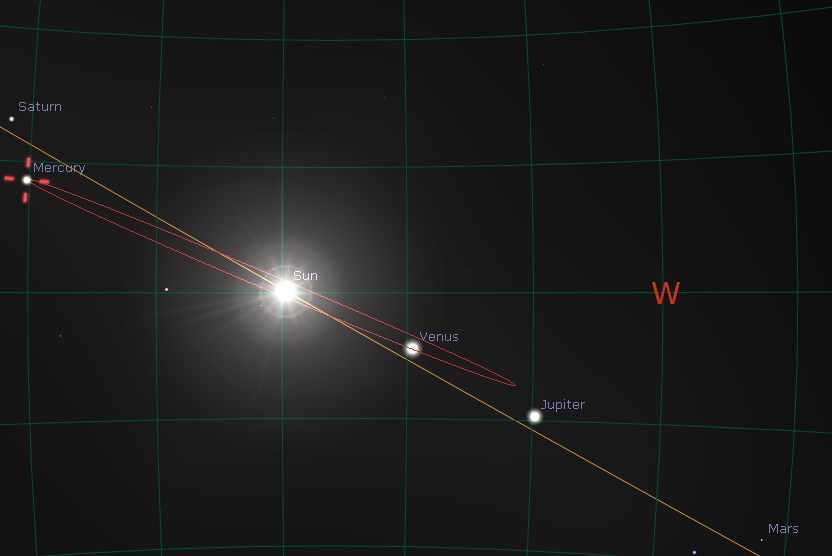
Diagram showing the poor placement of Mercury at greatest eastern elongation tonight in autumn from 45 degrees north latitude. Mercury is about 8.5 degrees altitude at sunset. The orange line is the ecliptic, the path pf the Sun on the celestial sphere. Created using Stellarium.
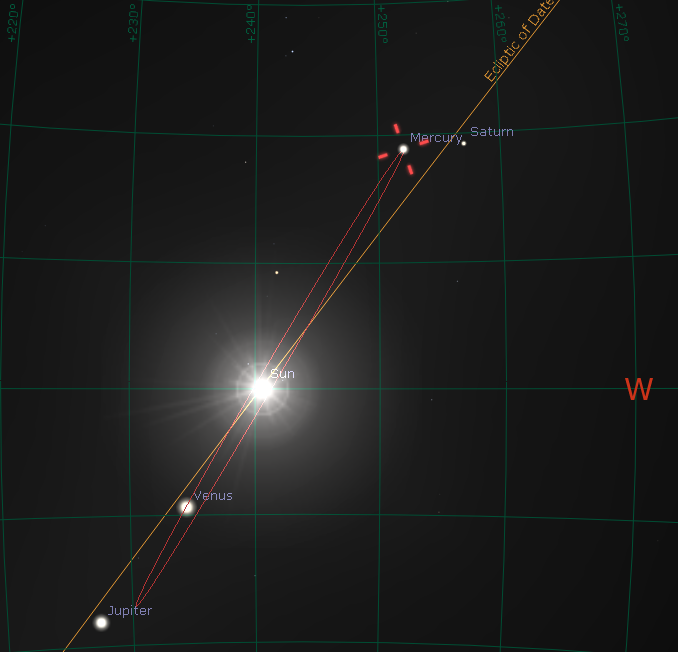
Diagram showing the great placement of Mercury at greatest eastern elongation tonight in southern hemisphere spring from 45 degrees south latitude. Mercury is nearly 19 degrees altitude at sunset. The orange line is the ecliptic, the path pf the Sun on the celestial sphere. Created using Stellarium.
09/12/2016 – Ephemeris – Mercury passes inferior conjunction with the Sun today
Ephemeris for Monday, September 12th. The Sun will rise at 7:18. It’ll be up for 12 hours and 39 minutes, setting at 7:58. The Moon, 3 days past first quarter, will set at 3:34 tomorrow morning.
Today the Planet Mercury will pass inferior conjunction, that is move between the Earth and the Sun. Unlike last inferior conjunction, when it passed directly in front of the Sun on May 9th. This time it will pass below the Sun. The term inferior means it is between the Earth and the Sun. A superior conjunction is when Mercury passes the back side of the Sun. Mercury will be moving into the morning side of the sky, and toward the end of the month it will be much easier to spot than it was last month when it was low in the west. On autumn mornings the ecliptic, the path of the Sun and planets, sticks up, close to vertical, while in the evenings it lies close to the horizon, which is also why Venus sets so soon after the Sun now.
Times are for the Traverse City/Interlochen area of Michigan. They may be different for your location.
Addendum
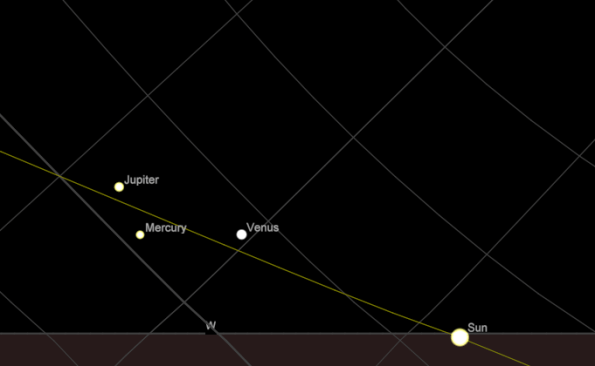
Mercury last August 16 at greatest eastern elongation. Note how low Mercury is to the horizon at sunset. Created using Cartes du Ciel (Sky Charts).
Note in the charts above and below the line passing through the Sun, and the one the planets hang around is the ecliptic, the projection of the Earth’s orbit on the celestial sphere. The grid line running through the west compass point at the horizon is the celestial equator. I’m allowing us to see below the horizon. As planets rise, move across the sky and set they will appear to move parallel to the celestial equator.
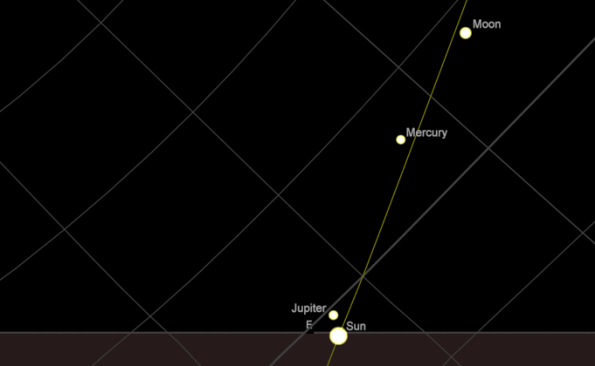
Mercury this coming September 28 at greatest western elongation. Note how high Mercury is to the horizon at sunrise. Created using Cartes du Ciel (Sky Charts).
Note too that Mercury appears farther from the Sun on August 16th than at September 28th. And it is. On August 16th Mercury appears 27.4 degrees from the Sun. On September 28th, it’s only 17.8 degrees. That’s a big advantage for observers in the southern hemisphere. The best times to see an eastern elongation of Mercury is on winter and spring evenings, and the best times to see a western elongation of Mercury is on summer and autumn mornings. Since the seasons are reversed from the northern hemisphere to the southern hemisphere. Our not so good August 16th elongation of Mercury was a really good one for folks south of the equator. We’ll return the favor September 28th. But the best southern hemisphere greatest elongations are always greater in the separation of Mercury from the Sun than northern ones because Mercury has a markedly elliptical orbit.
08/16/2016 – Ephemeris – Does Proxima Centauri have a planet? Also some information for southern observers about Mercury
Ephemeris for Tuesday, August 16th. The Sun rises at 6:46. It’ll be up for 13 hours and 59 minutes, setting at 8:46. The Moon, 2 days before full, will set at 5:53 tomorrow morning.
Proxima Centauri is the closest star to our solar system. It is a red dwarf star, and a distant third member of the Alpha Centauri star system. Recently the German weekly Der Spiegel announced that astronomers at the La Silla Observatory in Chile have detected a possible Earth-like planet at a distance that water may be liquid on its surface around this tiny star. Other than this one leak, no one is talking, and the European Southern Observatory is mum on the subject. There may be some kind of announcement at the end of the month. If true, this means that the closest earth-like planet orbits the closest star, only four and a quarter light years away. That’s nearly 25 trillion miles, and hundreds of years travel time with our current technology.
Times are for the Traverse City/Interlochen area of Michigan. They may be different for your location.
Addendum
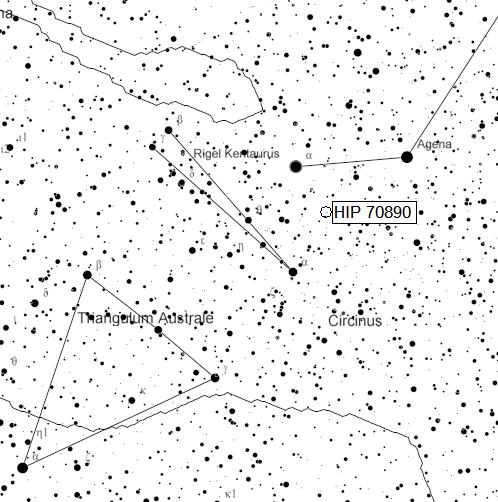
Chart showing the location of Proxima Centauri, labeled here HIP 70890. Alpha Centauri is labeled Rigel Kentaurus. Alpha Centauri is actually a catalog name in the style of Johann Bayer’s 1603 star atlas. Note also the alpha (α) Greek letter next to the star. Created using Cartes du Ciel (Sky Charts).
Note also the star labeled Agena. That is the more distant Beta (β) Centauri also known as Hadar.
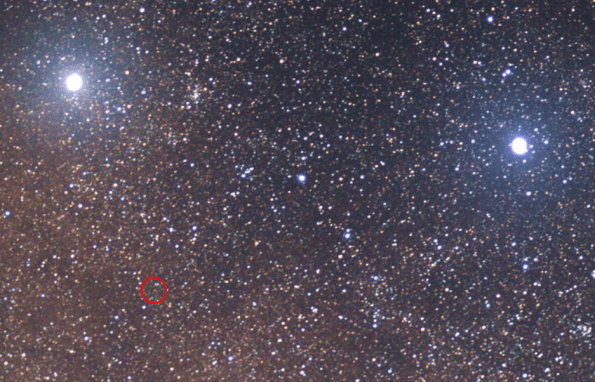
A section of a photograph of part of the field of view of the chart above. Credit: Wikipedia user Skatebiker.
Extra
For our southern observers: Today Mercury reaches its greatest eastern elongation of 27 degrees. So it’s visible in the west with Venus and Jupiter.
 Bob Moler's Ephemeris Blog