Archive
09/27/2022 – Ephemeris – Finding the constellation of Perseus the hero
This is Ephemeris for Tuesday, September 27th. Today the Sun will be up for 11 hours and 54 minutes, setting at 7:30, and it will rise tomorrow at 7:37. The Moon, 2 days past new, will set at 8:28 this evening.
Close to the horizon, but rising in the northeast in the evening, is the constellation of Perseus the Greek hero, holding as his prize the severed head of Medusa. To me, the stars don’t seem to match the figure in the stars. It’s either the Greek letter pi (π) tilted to the left or the cartoon roadrunner running up the sky. Perseus’ brightest star is Mirfak in the middle of the top of the letter π, or back of the roadrunner. Using a pair of binoculars to look towards Mirfak, one can see many more stars, just below naked eye visibility near it. It’s a very loose star cluster called the Alpha (α) Persei Association, α Persei being a catalog designation for Mirfak. And Mirfak is actually in the association. Unlike some bright stars, who are just foreground stars.
The astronomical event times given are for the Traverse City/Interlochen area of Michigan (EDT, UT – 4 hours). They may be different for your location.
Addendum
For my take on the mythology featuring Perseus, see The Great Star Story of Autumn. It’s way too long for my short radio program. For Hollywood’s treatment of the story, see Clash of the Titans.
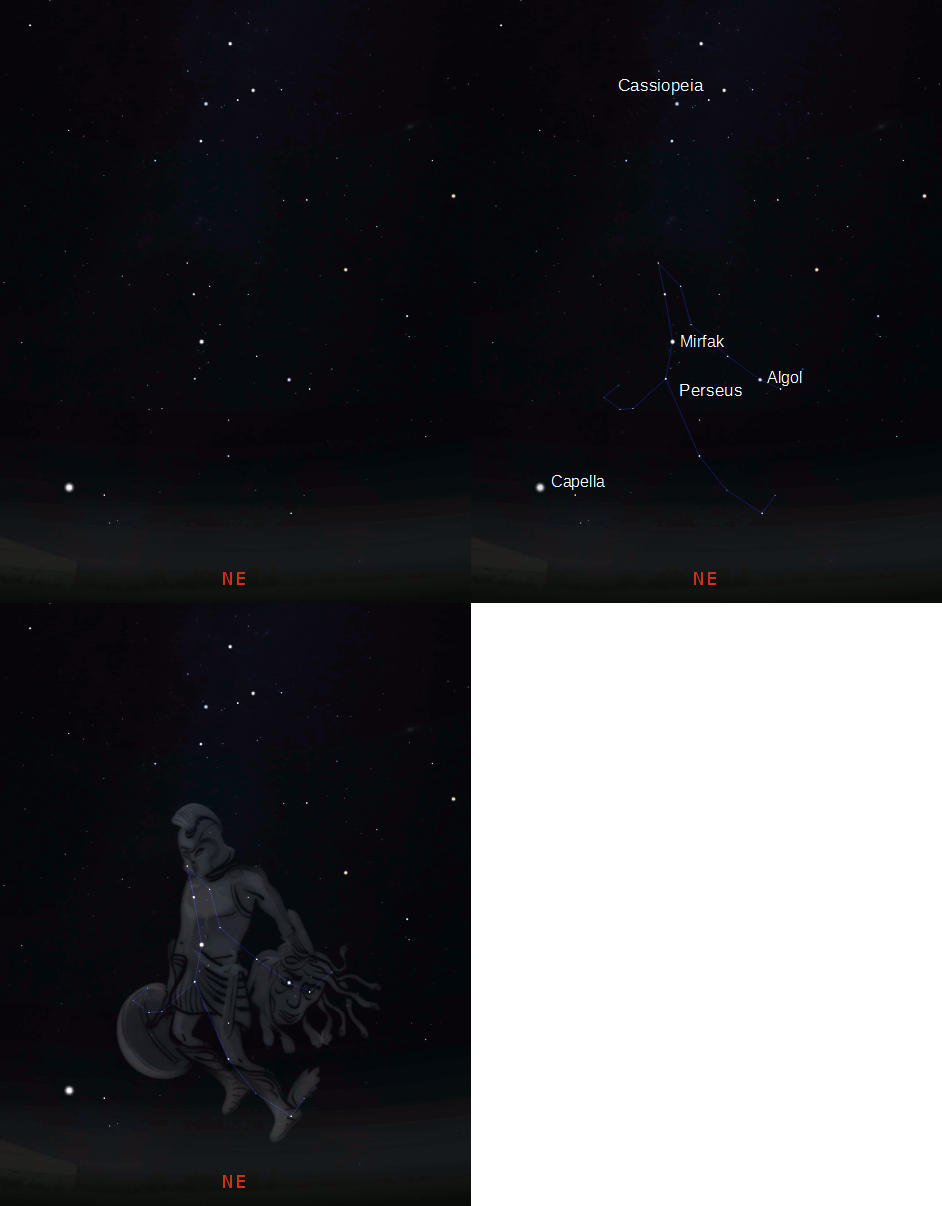
Perseus finder using the animated GIF to show the star field, constellation lines and names, and Perseus as art. Cassiopeia is included as a means to find the dimmer Perseus below it on autumn evenings. Algol, another important star and the second-brightest star of Perseus, is also labeled. I normally cover it around Halloween, but if you can’t wait, type Algol in the search box at the upper right. Created using Stellarium, LibreOffice Draw, and GIMP.
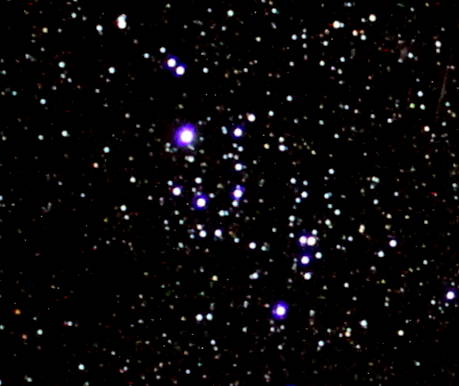
The Alpha Persei Association. The brightest star is Mirfak (Alpha Persei). This is a small section of a photograph taken February 18, 2017, Canon EOS Rebel T5, 121 seconds, f/3.5, 18 mm fl., ISO 3200. Credit Bob Moler.
10/29/2018 – Ephemeris – Perseus the hero
Ephemeris for Monday, October 29th. The Sun will rise at 8:16. It’ll be up for 10 hours and 18 minutes, setting at 6:35. The Moon, 2 days before last quarter, will rise at 10:48 this evening.
bout a third the way from the east northeastern horizon to the zenith at 9 p.m. and below the letter W shaped constellation of Cassiopeia the queen is Perseus the hero. It’s kind of a odd shape for a hero, To me it looks like the cartoon roadrunner. To those who’s imagination doesn’t run to cartoons, its shape is also like the Greek letter pi. It’s two brightest stars are Mirfak and Algol the demon star. Look at the area around Mirfak with binoculars and you will see a large group of stars just below naked eye visibility. It’s called the Alpha Persei association. That because Mirfak is Alpha Persei. The group is about 560 light years away, which means, though close, are farther away than the Pleiades, below and right of them.
The times given are for the Traverse City/Interlochen area of Michigan. They may be different for your location.
Addendum
11/28/2014 – Ephemeris – Not quite a star cluster, but pretty cool nonetheless
Ephemeris for Friday, November 28th. The sun will rise at 7:55. It’ll be up for 9 hours and 9 minutes, setting at 5:04. The moon, 1 day before first quarter, will set at 12:01 tomorrow morning.
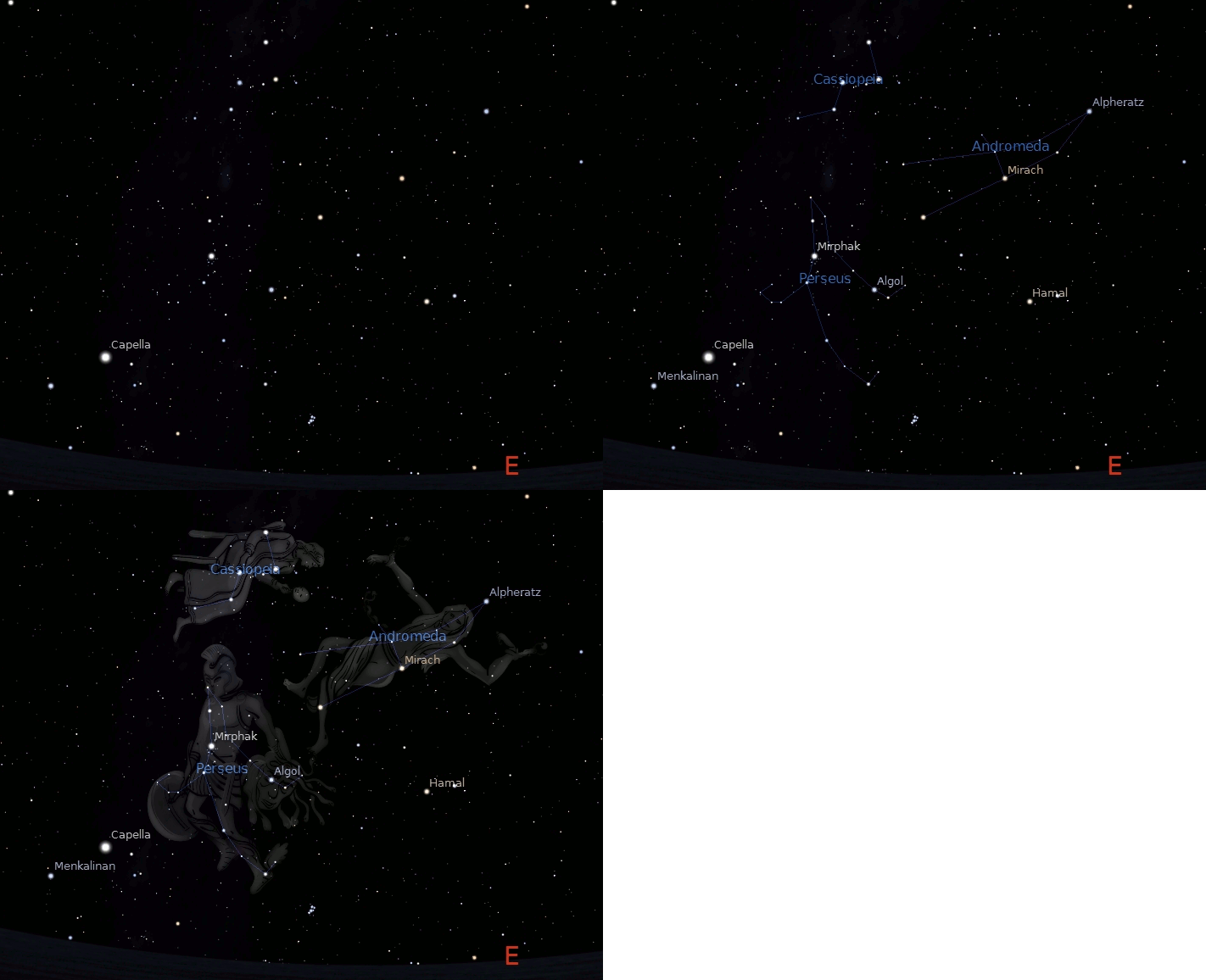
When is a star cluster not a star cluster? When it’s an association. That is when it has begun to dissipate because the gravitational force of the group cannot hold it together. The central stars of the Big Dipper belong to The Ursa Major Association. Below the W shaped constellation of Cassiopeia in the northeast at 9 or 10 p.m. Is the constellation of Perseus (Per-seus or Pers-e-us) as it is usually pronounced. Its brightest star is Mirfak with a designation of Alpha Persei. There are some stars there to the naked eye, but with binoculars there are a great many stars just below naked eye visibility. This is called the Alpha Persei association. It is perfect to spot with binoculars, but way too wide-spread for a telescope.
Times are for the Traverse City/Interlochen area of Michigan. They may be different for your location.
Addendum
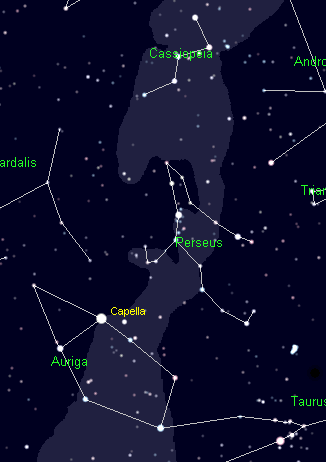
The Constellations Cassiopeia, Perseus and Auriga. Cartes du Ciel
Alpha Persei Association. Created using Stellarium.
10/18/2012 – Ephemeris – Autumn wonders for binoculars or small telescope: The Alpha Persei Association
Ephemeris for Thursday, October 18th. The sun will rise at 8:02. It’ll be up for 10 hours and 49 minutes, setting at 6:52. The moon, half way from new to first quarter, will set at 9:17 this evening.
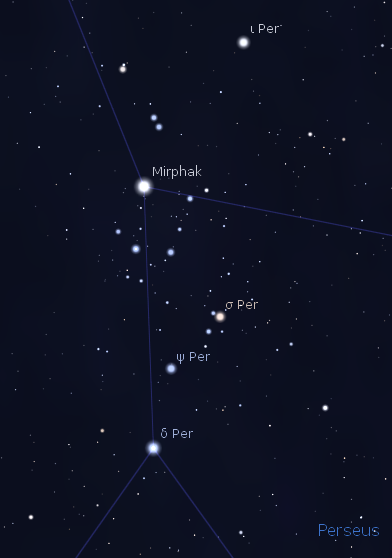
When is a star cluster not a star cluster? When it’s an association. That is when it has begun to dissipate because the gravitational force of the group cannot hold it together. The central stars of the Big Dipper belong to The Ursa Major Association. Below the W shaped constellation of Cassiopeia in the northeast at 9 or 10 p.m. Is the constellation of Per-seus or Pers-e-us as it is usually pronounced. Its brightest star is Mirfak with a designation of Alpha Persei. There are some stars there to the naked eye, but with binoculars there are a great many stars just below naked eye visibility. This is called the Alpha Persei association. The star groups I’ve talked about this week are just some of the wonders visible in a simple pair of binoculars.
Times are for the Traverse City/Interlochen area of Michigan. They may be different for your location.
Addendum
The constellation Perseus. (Stellarium spells Alpha Persei Mirphak, not Mirfak. Star name spelling can be something variable.)
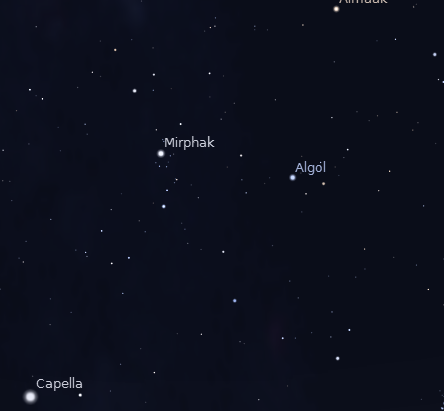
The constellation Perseus in the northeast at 10 p.m. on October 18, 2012. Created using Stellarium.
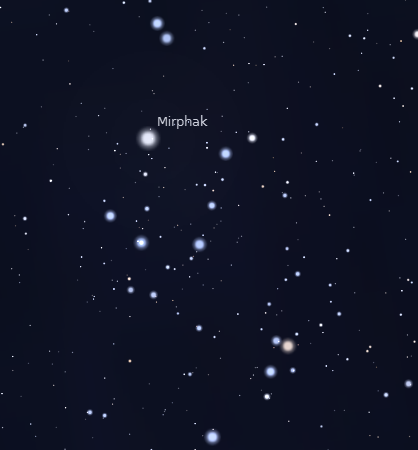
The Alpha Persei Association in a binocular view. Created using Stellarium.
 Bob Moler's Ephemeris Blog